Reviewed by our editorial team Published
In September 2026, rail commentator Jon Worth boarded a train in Kemijärvi, a small town deep inside the Arctic Circle in Finnish Lapland. Five days later he stepped off a train in Lagos, on the sun-soaked southern coast of Portugal’s Algarve, having completed the longest journey currently possible on scheduled trains within the European Union.
The route covers more than 6,000km of railway, crossing eight countries and requiring dozens of individual connections along the way. It only became possible in 2026, after the long-closed Tornio to Haparanda line reopened and finally linked Finland’s isolated rail network to the rest of the EU.
This page is not a guide to breaking that record, and nobody needs to replicate the exact 23-train schedule Worth used. Instead, it is the first practical route guide for turning that same Kemijärvi to Lagos corridor into a genuinely brilliant, achievable trip for ordinary travellers.
Below you will find the story behind the record, a realistic day-by-day itinerary that breaks the journey into worthwhile overnight stops, and guidance on sleeper trains. There is also help using an Interrail pass to cover the whole route, plus the everyday logistics of a long cross-continent rail trip.
Along the way, the route runs through some of Europe’s most rewarding cities, with Stockholm, Copenhagen, Hamburg, Geneva, Barcelona and Madrid all sitting naturally on the path south. Treated properly, this is less an endurance test than a grand tour with a very long spine.
Few journeys let you wake up in Arctic snow country and, days later, watch the sun set over an Atlantic beach, all without boarding a single flight. That is the achievable trip this page exists to help you plan, not a record to repeat.
Where This Record-Breaking Route Came From
Jon Worth is a Berlin-based rail commentator and campaigner behind #CrossBorderRail, a long-running project mapping and testing every cross-border passenger line in Europe. Run through Trains for Europe together with MitOst e.V., the project has spent years documenting where Europe’s rail network genuinely joins up, and where it still does not.
The Kemijärvi to Lagos route only became the EU’s longest possible journey in 2026, when the Tornio-Haparanda line between Finland and Sweden reopened to passengers. That single reconnection finally linked Finland’s rail network to the rest of the EU for the first time in decades, extending a previous record route that had started further south at Riksgränsen.
Worth’s actual attempt ran from Monday 7 September to Saturday 12 September 2026, a total of 125 hours and 31 minutes on the move. He covered roughly 6,203km of track across 23 individual trains, run by around ten different operators spanning Finland, Sweden, Denmark, Germany, Switzerland, France, Spain and Portugal.
Ticketing tells its own story: an Interrail pass covering the whole trip cost around €387 (£337/$418), against roughly €563 (£490/$608) for 11 separate point-to-point tickets covering the same ground. That gap alone explains why a rail pass is worth serious consideration later on this page.
The original plan was a tighter 100 hours across 18 trains, but reality intervened twice. A wartime bomb uncovered at a building site in Hamburg and a small earthquake in Rhineland-Palatinate both forced last-minute rerouting, adding five extra trains and over a day to the total.
The Route at a Glance
Breaking the Kemijärvi to Lagos corridor into eleven manageable legs across ten overnight stops turns an endurance feat into a properly enjoyable trip, with each stop chosen because it rewards a night’s stay, not just because it happens to be reachable. The table below shows which day of the trip each leg falls on and the approximate distance covered, with full timing and detail covered further down this page.
| Day | Leg | Country | Approx. Distance |
|---|---|---|---|
| Day 1 | Kemijärvi to Rovaniemi | Finland | approx. 80km |
| Day 1-2 | Rovaniemi to Stockholm | Finland, Sweden | approx. 1,270km |
| Day 2 | Stockholm to Copenhagen | Sweden, Denmark | approx. 600-650km |
| Day 3 | Copenhagen to Hamburg | Denmark, Germany | approx. 330-370km |
| Day 4 | Hamburg to Basel | Germany, Switzerland | approx. 750-800km |
| Day 5 | Basel to Geneva | Switzerland | approx. 250-270km |
| Day 6 | Geneva to Lyon | Switzerland, France | approx. 150-170km |
| Day 7 | Lyon to Barcelona | France, Spain | approx. 630-650km |
| Day 8 | Barcelona to Madrid | Spain | approx. 620-630km |
| Day 9 | Madrid to Lisbon | Spain, Portugal | approx. 650-700km |
| Day 10 | Lisbon to Lagos | Portugal | approx. 280-300km |
Best for two or three nights. The widest choice of rooms, with filters for free cancellation and included breakfast.
View staysBest for longer stays. Whole apartments and houses, so you are not eating out three times a day.
View rentalsBest as a last check before booking. Compares hotel rates across several sites in one search.
Compare ratesGetting to the Start: Reaching Kemijärvi
Kemijärvi has no airport of its own, so reaching Finland’s northernmost EU rail gateway starts with getting somewhere else first. The nearest option by a wide margin is Rovaniemi Airport, roughly 82km to the south and around an hour away by road.
The simplest way to cover that final stretch is often the most obvious one: stay on the train. Rovaniemi is itself a scheduled stop on the same VR line running north to Kemijärvi, covered as its own leg right after this section, so travellers can continue straight through.
For late landings, a Matkahuolto coach also runs between the airport and Kemijärvi. These long-distance buses are a well-used, reliable part of Lapland’s transport network and a straightforward way to cover the 82km.
A taxi is the fastest door-to-door option, useful for early arrivals or heavy luggage. It costs more than the bus, but the drive itself still takes only around an hour on quiet Lapland roads.
Travellers who want the full picture of the airport-to-city leg, transfer options and typical costs included, should read our dedicated guide to Rovaniemi Airport Transfers.
A further alternative exists in Kuusamo Airport, roughly 140km away and about 1 hour 45 minutes by road. It serves fewer routes and sits considerably further from Kemijärvi, making it a distant second choice.
Travellers flying into Helsinki instead have a genuinely different option: VR’s overnight sleeper network, popularly branded the Santa Claus Express, runs direct from Helsinki all the way to Kemijärvi in around 14 to 15 hours. It’s a separate, Finland-only service that terminates here rather than continuing into Sweden, and our Finland Sleeper Trains guide covers it in full, including how it compares with flying to Rovaniemi instead.
For nearly everyone starting this journey, Rovaniemi Airport is simply the sensible choice, closer, better connected and the easiest to reach Kemijärvi from without extra planning.
Kemijärvi itself is worth a proper look rather than a quick pass-through, and it is entirely possible to base a night or two here before setting off. As Finland’s northernmost town, its small centre holds a rebuilt lakeside church, a local history museum covering everyday Lapland life in the early 1900s, and the wood-sculpture park at Art Centre Puustelli on the water’s edge.
The Kotavaara lookout tower gives sweeping views over the surrounding forest and lakes a short walk from the centre, and Kemijärvi also makes a genuine gateway to Pyhä-Luosto National Park, home to the 200-metre-deep Isokuru Gorge and the Lampivaara Amethyst Mine further north.
Hotels are easy to find for a night before departure, from the central Hotel Kemijärvi and Hotel Mestarin Kievari to lakeside options like Hotel Suvanto. None of it needs advance planning beyond picking one that suits the budget.
Kemijärvi to Rovaniemi: Into Lapland’s Capital
The first leg south is a short hop rather than an expedition, covering the roughly 80km between Kemijärvi and Rovaniemi in just over an hour. It’s a gentle, easy introduction to Lapland rail travel before the longer stretches into Sweden begin.
| From | To | Distance | Duration | Operator | Service | Optional Stop |
|---|---|---|---|---|---|---|
| Kemijärvi | Rovaniemi | ~80km | ~1h 10m | VR | Daytime | None |
A VR regional train covers this short hop, the same operator running services further south through Finland. It’s a modest, local working train rather than a flagship route, and a gentle, easy way to begin the journey.
The ride takes around 1 hour and 10 minutes to cover the roughly 80km between the two towns, with a handful of services running each day. It’s short enough that there’s little need to plan around it beyond checking the timetable.
Outside the window, the line runs through classic Lapland scenery, dense pine and birch forest broken by the Kemijoki river, which the train shadows for much of the way south. It’s a quiet, understated stretch rather than a dramatic one.
Onboard, expect a modern regional set with comfortable seating and power sockets, broadly similar to the Norrtåg services covered further into Sweden later on this page. Don’t expect a café car on a trip this short, just a trolley or vending machine.
Interrail and Eurail pass holders do not need a paid reservation for this leg. Simply board with a valid pass and travel, a welcome contrast with the compulsory reservation required later on the SJ X2000 into Stockholm.
It’s tempting to treat Rovaniemi as a pass-through on the way to Sweden, but that undersells it. As the capital of Finnish Lapland, home to Santa Claus Village and the official Arctic Circle line, it’s one of the most visited towns in the entire region.
Travellers with any flexibility should consider breaking the journey here for a day or two rather than pushing straight on. Our guide to Things to Do in Rovaniemi covers the best of the town beyond Santa Claus Village.
There is no overnight sleeper option on this short hop, only the regular daytime service. At just over an hour, an overnight train would make little sense anyway, and the daytime timetable runs frequently enough that missing one service is rarely a problem.
Rovaniemi to Stockholm: Crossing the New Finland-Sweden Link
From Rovaniemi, the route continues south and west, crossing into Sweden for the first time and covering the bulk of this Nordic corridor before Stockholm. Total journey time runs to roughly 15 to 18 hours, the honest range for a multi-operator leg with several changes along the way.
| From | To | Distance | Duration | Operator | Service | Optional Stop |
|---|---|---|---|---|---|---|
| Rovaniemi | Stockholm | ~1,270km | ~15-18h | VR / Norrtåg / SJ | Daytime or Sleeper | Luleå or Umeå |
This leg is not one train but five, and it helps to think of it that way rather than as a single fifteen-to-eighteen-hour slog. A VR regional train first carries travellers from Rovaniemi through Kemi to Tornio, a run of around 100km taking roughly two hours, with a handful of departures most days.
| Leg | From | To | Distance | Duration | Operator | Service |
|---|---|---|---|---|---|---|
| 1 | Rovaniemi | Tornio | ~100km | ~2h | VR | Daytime |
| 2 | Haparanda | Luleå | ~120km | ~2h | Norrtåg | Daytime |
| 3 | Luleå | Umeå | ~215km | ~4h | Norrtåg/SJ | Daytime |
| 4 | Umeå | Sundsvall | ~218km | ~3h | Norrtåg/SJ | Daytime |
| 5 | Sundsvall | Stockholm | ~390km | ~3-3.5h | SJ | Daytime or Sleeper |
At Tornio, travellers cross into Haparanda, its Swedish twin town just over the border, where the onward Norrtåg service begins. This crossing only reopened in August 2026, when the long-closed Tornio-Haparanda line was restored after nearly four decades, finally linking Finland’s railway to the rest of the EU’s network. The two towns share a single urban centre straddling the border, an odd, walkable novelty worth a look if there’s time between connections.
From Haparanda, a Norrtåg regional train covers the roughly 120km down to Boden and on to Luleå in around two hours, with several services a day. A further Norrtåg or SJ regional service then continues the approximately 215km from Luleå to Umeå, typically around four hours, with five or six departures daily.
South of Umeå, trains run noticeably more often: the roughly 218km on to Sundsvall takes around three hours, with departures roughly every hour or two through the day. From Sundsvall, a fast SJ service covers the final stretch into Stockholm in around three to three and a half hours, with several departures daily.
Travellers who would rather break up this fifteen-to-eighteen-hour monster with a stop of their own could get off at Luleå, home to the UNESCO-listed Gammelstad Church Town, or a little further south at Umeå, a youthful university city built around Vasaparken and known for its Bildmuseet contemporary art gallery and quirky Guitar Museum. Both sit directly on this same route, a genuine option worth building into the trip rather than a forced detour.
A genuine overnight sleeper covers much of the Swedish side of this corridor instead, boarded at Boden or Luleå rather than at the border itself. SJ’s nightly service typically leaves Luleå in the early evening, around 9pm, and arrives into Stockholm the following morning around 10am, so travellers who reach the border by mid-afternoon can comfortably make the connection and wake up in the capital rather than pushing on by daytime train. Interrail pass holders pay a small reservation fee on top of the pass, from around €3 (£3/$3) for a seat up to roughly €40 (£35/$43) for a bed in a 2nd class sleeper compartment.
The scenery for most of the day is classic Norrland, pine forest broken by wide, slow rivers and glimpses of the Gulf of Bothnia as the line nears the coast.
Onboard, the VR and Norrtåg trains are modern regional sets with comfortable seating and free WiFi, though catering is limited to a trolley or vending machine on each of the four northern segments. The SJ service into Stockholm is a different class of train, considerably faster with a self-service bistro serving coffee, beer and light meals.
Interrail and Eurail pass holders must book a paid reservation for the final SJ leg into Stockholm, since it’s compulsory on that train regardless of ticket type. None of the four earlier segments, VR or Norrtåg, require one.
Stockholm rewards the effort with one of Europe’s most handsome capitals, its old town of Gamla Stan spread across islands linked by bridges and water. Spend the stop wandering its cobbled lanes or exploring the city’s museums, both covered in full in our guide to things to do in Stockholm.

Stockholm to Copenhagen: Over the Öresund Bridge into Denmark
From Stockholm, the route turns toward one of Europe’s most photogenic rail crossings, the span that turned Malmö and Copenhagen into virtual neighbours. It’s a leg that trades Arctic scenery for sleek Scandinavian design and one genuinely famous stretch of water.
| From | To | Distance | Duration | Operator | Service | Optional Stop |
|---|---|---|---|---|---|---|
| Stockholm | Copenhagen | ~615km | ~5h | SJ / Öresundståg | Daytime or Sleeper | Malmö |
An SJ X2000 tilting train covers the roughly four to four and a half hour run from Stockholm down to Malmö, cutting through the Swedish countryside at up to 200km/h. It’s a single comfortable ride with no changes required until Malmö itself, and the train carries a self-service bistro car for coffee, snacks and light meals along the way.
From Malmö, an Öresundståg regional train continues over the Öresund Bridge, the striking crossing that carries both road and rail traffic between the two countries. The train covers roughly eight kilometres on the bridge itself before dropping into a short tunnel near Copenhagen Airport, and the famous midpoint where the two spans meet, best known internationally from the television series The Bridge, marks the maritime border between Sweden and Denmark.
Onboard the Öresundståg, seating is open plan with no reserved places, so travellers can sit wherever there is space and enjoy power outlets at every bay along with free WiFi. There is no catering on these trains, so it’s worth picking up food or coffee at Malmö Central before boarding for the final stretch into Denmark.
Interrail and Eurail pass holders need to book a paid seat reservation for the X2000 leg to Malmö, since reservation is compulsory on that train. No reservation is required for the Öresundståg continuation into Copenhagen, and pass holders can simply board and show their pass when asked.
Copenhagen more than earns its place as an overnight stop, with colourful Nyhavn, world-class design shops and some of Europe’s best New Nordic cooking all within easy reach of the station. Our guide to things to do in Copenhagen covers the highlights, from Tivoli Gardens to the city’s canals.
Whether it’s the bridge crossing or the city waiting on the other side, this is one of the journey’s easiest and most rewarding legs to slot into a shorter Scandinavian trip of your own.
Rather than riding straight through, it’s easy to break the journey in Malmö itself, since the Öresundståg continuation to Copenhagen departs from the very same station the SJ service already arrives at. Sweden’s third city has its own skyline in the Turning Torso tower, a walkable old town and beaches along the Öresund, and our guide to things to do in Malmö covers the best of it for anyone who wants to stop over.
A genuine overnight sleeper also covers this stretch, part of a wider service linking Stockholm with Copenhagen and on to Hamburg and Berlin. It runs only a few times a week rather than nightly, so it suits travellers who can build a flexible date around it rather than those working to a fixed schedule. Interrail pass holders pay a reservation fee on top, from around €19 (£16/$20) for a seat to roughly €37 (£32/$40) per person for a 6-berth couchette or €85 (£74/$92) per person for a double sleeper.
Copenhagen to Hamburg: Leaving Scandinavia for Germany
Crossing from Copenhagen into Germany marks the journey’s shift from Scandinavia into continental Europe proper, and it happens without a single change of train. It’s a fitting introduction to Hamburg, a city built on trade and water that feels like a natural gateway south.
| From | To | Distance | Duration | Operator | Service | Optional Stop |
|---|---|---|---|---|---|---|
| Copenhagen | Hamburg | ~470km | ~4h 40m | DSB / Deutsche Bahn | Daytime or Sleeper | Odense |
A joint DSB and Deutsche Bahn EuroCity service covers the whole route direct, mostly using DSB’s new Talgo trains alongside a couple of Czech Railways ComfortJet services continuing on to Berlin and Prague. The journey takes around four hours and forty minutes, with no need to change trains at the border.
The route currently runs the long way round, crossing the Great Belt fixed link near Odense and continuing south through Kolding and Flensburg, rather than the far more direct path the old Puttgarden to Rødby ferry used to offer. That detour exists because the Fehmarn Belt tunnel, the fixed link eventually meant to cut this journey dramatically, is still under construction and not expected to open until around 2030.
Out of the window there is genuine variety, with flat Danish farmland and island crossings giving way to the low hills and wind turbines of Schleswig-Holstein as the train nears the German border. The Great Belt crossing itself is a highlight in its own right, with the train running for several minutes on a bridge high above open water before the scenery softens back into fields.
Onboard the DSB Talgo sets, seating runs 2+2 in second class and 2+1 in first, with power sockets at every seat and free WiFi throughout, though the trains carry only vending machines rather than a proper restaurant car. The Czech ComfortJet departures are a step up, with a full restaurant car and seat-side steward service in first class for travellers who catch one of those particular workings.
Reservations on this route are usually optional but become compulsory during the height of summer, and Interrail and Eurail pass holders should book ahead regardless since seats do sell out. Outside that peak window a reservation is not required, though booking one for a small fee is sensible on a train this popular.
Hamburg rewards the detour with a proper big city after days of smaller stops, from the Elbphilharmonie‘s striking waterfront silhouette to the warehouses of the Speicherstadt. Our guide to the best things to do in Hamburg covers where to spend the overnight stop before continuing south.
It’s a short, simple leg by the standards of the rest of this journey, but a genuinely useful hinge point between Scandinavia and the network of European rail that lies ahead.
Travellers keen to break up this leg could hop off at Odense, roughly the route’s midpoint, where the scheduled stop alone often runs to around 40 minutes, long enough to reconsider riding straight through. It’s the birthplace of Hans Christian Andersen, with a compact, walkable historic centre close to the station, and our Copenhagen day trips guide already covers it as a worthwhile option for a longer stop.
The same overnight sleeper that covers the Stockholm to Copenhagen leg continues on to Hamburg, offering sleeping cars, couchettes and reclining seats on the same limited weekly schedule. It is worth checking exactly which days it runs before planning around it, since this leg’s daytime EuroCity service is far more frequent. The same Interrail reservation fees apply as on the Stockholm-Copenhagen stretch: roughly €19 (£16/$20) for a seat, €37 (£32/$40) per person for a couchette, or €85 (£74/$92) per person sharing a sleeper.
Hamburg to Basel: The Long Run South Through Germany
Leaving Hamburg behind, this leg of the #CrossBorderRail route is a transcontinental sprint: a single high-speed train carrying travellers the length of Germany in one sitting. By the time Basel comes into view, the flat northern landscape has given way to gentler hills at the edge of the Rhine valley, a genuine shift in scenery for one day’s travel.
| From | To | Distance | Duration | Operator | Service | Optional Stop |
|---|---|---|---|---|---|---|
| Hamburg | Basel | approx. 750km | ~7-7.5h | Deutsche Bahn (ICE) | Daytime or Sleeper | Frankfurt |
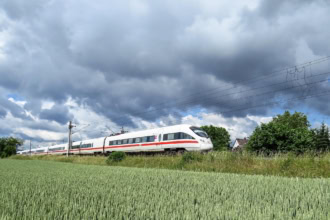
The leg runs on Deutsche Bahn’s ICE network, Germany’s flagship high-speed InterCity-Express service, calling at Mannheim and Karlsruhe on its way south. Most days a single through train covers the whole route, though a change at Mannheim is sometimes needed depending on the departure chosen.
Expect the journey to take roughly seven to seven and a half hours, covering close to 750 kilometres at speeds up to 300 km/h. It is a long day in the seat, but the onboard bistro car and steadily changing scenery help the hours pass faster than the timetable suggests.
Most services on this route run modern ICE 3 or ICE 4 rolling stock, with bright open-plan carriages, at-seat power sockets throughout second class, and free WiFi that generally holds up well outside the more rural stretches. The bordbistro car serves hot food, coffee and beer for the whole journey, and standard second-class seating stays comfortable across the full seven hours.
For the first few hours out of Hamburg, expect flat-to-rolling farmland, scattered wind turbines and small German towns sliding past the window rather than anything dramatic. The terrain only really changes shape from around Karlsruhe onward, where the line runs closer to the Rhine and the wooded hills of the Black Forest begin to rise ahead of Basel.
Basel is a reward worth the wait, a compact and quietly wealthy city sitting exactly where Germany, France and Switzerland meet on the Rhine. Its old town is a tangle of red sandstone and cobbled lanes climbing up from the river, with the Munster’s twin spires visible from almost every angle.
The city also punches above its weight on art, home to the Kunstmuseum Basel, one of the oldest public art collections in the world. A gentle Rhine-side walk in the evening, watching the current and the little passenger ferries cross the river, is the simplest way to unwind after a full day on the train.
For a fuller rundown of the city, our guide to things to do in Basel covers the old town, museums and riverside spots worth building into a longer stopover.
A seat reservation is optional rather than compulsory on this ICE service, so an Interrail pass holder can board without paying any reservation supplement. Booking a seat in advance is still sensible on a journey this long, since it guarantees somewhere to sit rather than just the right to travel.
Seven hours is a genuinely long day in a seat, and Frankfurt sits almost exactly at the midpoint, roughly three hours out of Hamburg and under three from Basel. Breaking the journey there, whether for a few hours or a full overnight, turns one long slog into two comfortable half-days, and our guide to things to do in Frankfurt covers what’s worth seeing around the station.
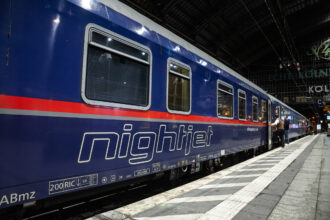
A genuine overnight sleeper now covers this leg too, since Nightjet launched a new service linking Hamburg directly with Zurich and Basel. It is a welcome recent addition to the network and a good way to save a hotel night while still covering serious distance. Nightjet’s Interrail reservation fees are dynamic, but budget roughly €5 to €25 (£4-22/$5-27) for a seat, €20 to €95 (£17-83/$22-103) per person for a couchette, and upward of €60 (£52/$65) per person for a private sleeper compartment, with earlier bookings landing at the cheaper end.
Best for long or awkward journeys. Builds one itinerary out of separate flights.
View flightsBest for anyone whose home plan charges by the megabyte abroad. Pay a fixed price up front.
Check eSIMsBest if you would rather not work out the transport on arrival. Book it now and forget it.
View transfersBasel to Geneva: A Scenic Detour Through Switzerland
The Basel to Geneva leg is where the #CrossBorderRail route makes a deliberate choice worth explaining: rather than cutting through eastern France, it swings south through the heart of Switzerland instead. It is not a shortcut so much as a genuine detour, trading a few extra kilometres for some of the most scenic, reliably punctual railway in Europe.
| From | To | Distance | Duration | Operator | Service | Optional Stop |
|---|---|---|---|---|---|---|
| Basel | Geneva | approx. 260km | ~2h 45m-3h | SBB-CFF-FFS | Daytime | Lausanne |
The service is run by SBB-CFF-FFS, Swiss Federal Railways, threading its way from Basel down through Renens VD before arriving into Geneva. Swiss trains are famous for running exactly to the minute, so this is one of the more relaxing legs of the journey, changes included.
Journey time comes in at roughly two and three-quarter to three hours, a single comfortable ride rather than a multi-train slog. It is a leg that rewards a window seat more than most, especially on the final approach into Geneva.
Trains on this route typically run modern SBB InterCity double-deck stock, with roomy open carriages, free WiFi and at-seat power sockets available in both classes. An onboard minibar trolley covers coffee, snacks and light meals, and the ride itself stays notably smooth even at speed.
The first stretch out of Basel runs through the rolling farmland and forest of the Jura foothills, with small Swiss towns and church spires marking the route south. Lake Neuchatel comes into view further along, its still water and vineyard-lined shore offering the first real taste of the scenery still to come.
The final approach into Geneva brings the Alps properly into frame, with the Mont Blanc massif occasionally visible away to the southeast on a clear day. Lake Geneva itself appears in the last few minutes before arrival, with the Jet d’Eau fountain often spotted from the window before the platform.
Geneva itself is a small city with an outsized presence, wrapped around the western tip of Lake Geneva and instantly recognisable by that same fountain throwing water high into the air. Its compact old town climbs a hill above the lake, all narrow streets, the Cathedrale Saint-Pierre, and views back down over the harbour.
What sets Geneva apart is its genuinely international character, home to the United Nations’ European headquarters and a long list of humanitarian and diplomatic organisations. Evenings by the lakefront, with the mountains visible on a clear day, are reason enough to build in an overnight stop here.
For a longer stopover, our guide to things to do in Geneva covers the old town, the lakefront and the city’s international quarter in full.
Seat reservations are optional rather than compulsory on this route, and most Interrail pass holders travel without booking one at all. That keeps this leg refreshingly simple to plan, with no reservation supplement to budget for beyond the pass itself.
Travellers who would rather split this leg into two shorter hops could stop off at Lausanne, which sits directly on this same line just past Renens VD and around two hours out of Basel. It’s the seat of the International Olympic Committee, and the lakefront Olympic Museum, the steep cobbled old town and the views over Lake Geneva are easily worth an hour or two before catching a later train on for the last short run into Geneva.
There is no overnight sleeper on this leg, only the daytime SBB service. Given the journey takes well under three hours, a sleeper would not make much sense here regardless, and the daytime timetable runs frequently throughout the day.
Geneva to Lyon: Arriving in France’s Food Capital
After two Swiss legs, the route crosses back into France for a short, sharp hop that delivers travellers straight into one of the country’s great culinary capitals. Geneva to Lyon is one of the shortest legs of the whole itinerary, a welcome breather before the longer overnight cities still to come.
| From | To | Distance | Duration | Operator | Service | Optional Stop |
|---|---|---|---|---|---|---|
| Geneva | Lyon | approx. 160km | ~1h 50m-2h | SNCF (TGV) | Daytime | Annecy (detour) |
This leg runs on SNCF’s TGV network, France’s high-speed rail operator, with a direct service linking the two cities without any changes required. It is a smooth, fast introduction to French rail after the Swiss and German legs that came before it.
Expect the journey to take somewhere around one hour fifty minutes to two hours, cutting south-west through the Jura foothills before the train slides into Lyon’s Part-Dieu station. It is short enough that travellers barely have time to settle in before arrival.
These TGV Duplex double-deck trainsets offer wide reclining seats, free WiFi and at-seat power sockets in both standard and first class, along with a bar car serving hot drinks, sandwiches and snacks. Upper-deck seats are worth requesting for the best view of the passing countryside on such a short ride.
For the first half hour, expect the wooded slopes of the Jura still visible off to one side before the line drops down toward the Rhone valley. Vineyards and scattered farmland then take over as the train nears Lyon, with the city’s rooftops and the Rhone itself appearing shortly before arrival at Part-Dieu.
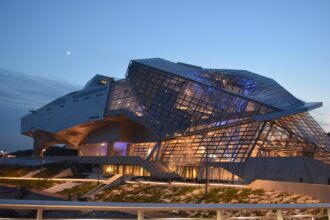
Lyon itself is the reason to linger, widely regarded as France’s food capital and the birthplace of the bouchon, its own style of unpretentious, hearty bistro. Between the Renaissance streets of Vieux Lyon and the grand squares of the Presqu’ile, it is a city built for walking off a very good meal.
The historic traboules, hidden passageways once used by silk workers, cut through Vieux Lyon’s buildings and are one of the city’s more unusual sights, alongside the Basilica of Notre-Dame de Fourviere on its hilltop above the city. For a full rundown of what to see and where to eat, our guide to things to do in Lyon is the place to start.
A seat reservation is compulsory on French TGV services, including for Interrail pass holders, so a small reservation supplement needs to be budgeted alongside the pass itself. Booking it as early as possible is worth doing, since TGV reservation allocations for pass holders are limited and can sell out on popular departures.
The direct service itself doesn’t call anywhere of particular note along the way, so there is no obvious on-route stop to recommend here. Travellers who fancy a detour instead can leave the mainline at Annecy, reachable by direct regional trains from both Geneva and toward Lyon, and our guide to things to do in Annecy covers its lake and old town in full; those who would rather not detour at all could simply spend an extra day in Geneva or Lyon instead.
This short hop has no overnight sleeper option, running as a daytime TGV service only. At under two hours end to end, the absence is no great loss, and multiple daytime departures make timing easy to fit around other plans.
Lyon to Barcelona by TGV Along the Mediterranean Coast
This leg trades the Alpine backdrop of the previous days for open coastline, and there are few better rewards on the whole route than watching the Mediterranean appear outside the window. It is widely considered one of the most visually rewarding days of the entire crossing.
| From | To | Distance | Duration | Operator | Service | Optional Stop |
|---|---|---|---|---|---|---|
| Lyon | Barcelona | approx. 640km | ~5-5.5h | SNCF TGV | Daytime | Girona |
The journey runs on a double-deck TGV Duplex train, SNCF’s flagship high-speed set, capable of 320km/h before speeds ease closer to the Spanish border. Onboard there is a café-bar car serving hot drinks and snacks, free onboard WiFi, and a power socket built into every seat, in both first and second class.
SNCF runs the service direct from Lyon through Valence and on to Perpignan before crossing into Spanish Catalonia, with no need to change trains along the way. That single-train simplicity is a welcome change after several days of connections further north.
Budget roughly five to five and a half hours for the full journey, with the train tracing the Rhône valley south before swinging to hug the Mediterranean coastline for the final stretch past Perpignan and Girona. A window seat on the left-hand side heading south earns real sea views, not just glimpses, right up to the approach into Barcelona Sants.
TGV services are all-reserved, so every Interrail pass holder must pay a seat reservation supplement on this leg, typically somewhere around €10 to €20 (£9-17/$11-22). Booking it early matters more here than on some other legs, since pass-holder seat allocations are limited and can sell out well ahead of departure.
Once in the city, Las Ramblas remains the obvious first wander, even if seasoned travellers now treat it as a corridor rather than a destination in itself. Head instead toward the beachfront at Barceloneta for a proper sea breeze and a plate of fresh seafood after a long day on the train.
History runs deep here too, and the Gothic Quarter‘s narrow medieval streets open unexpectedly onto Roman ruins and grand cathedral squares. El Born, just beside it, adds a livelier mix of bars and boutique shops for anyone with energy left after the journey.
Gaudí’s unfinished Sagrada Família is worth building an extra hour into the evening for, even viewed from outside after dark when its towers are quietly floodlit. It is as good a first taste of the city as any, and a fitting reward after a long day spent watching the coast slide past the window.
For a fuller rundown of the city, our guide to things to do in Barcelona covers the Gothic Quarter, the beaches and Gaudí’s other landmarks in more depth.
Travellers with time to spare could break this leg at Girona, right on the route and roughly 40 minutes short of Barcelona by regional train from the mainline. Its walled old town, medieval Jewish quarter and cathedral steps are well worth a few hours, an easy, low-effort stop worth building into the day.
There is no overnight sleeper on this route today, and no operator currently plans to reintroduce one. Travellers wanting to save a hotel night here need to look elsewhere on the route, since this leg only runs as a daytime TGV service.
Barcelona to Madrid on Spain’s High-Speed AVE Line
Spain’s capital greets you with an entirely different energy to Barcelona’s beachfront sprawl, all grand boulevards, royal architecture and some of Europe’s finest art. It’s a fast, flat run across the middle of the country, more about comfort than scenery, but the comfort on board is genuinely excellent.
| From | To | Distance | Duration | Operator | Service | Optional Stop |
|---|---|---|---|---|---|---|
| Barcelona | Madrid | approx. 620km | ~2.5-3h | Renfe / Iryo | Daytime | Zaragoza |
The corridor is served by Spanish high-speed operators, principally the state-run Renfe and the newer open-access operator Iryo, both running modern high-speed sets with 2+2 seating in standard class and a roomier 2+1 layout up front. Every train on this line carries a café-bar car, free onboard WiFi and a power socket at every seat, so the journey stays comfortable even in a full carriage.
Either way, it’s a single train with no change required between Barcelona Sants and Madrid, one of the simplest legs of the whole crossing to book. The journey takes roughly two and a half to three hours, making it one of the shortest legs of the entire crossing and a welcome breather before the next border.
There’s little drama out of the window on this stretch, and that’s rather the point after several days of mountains and coastline. The train crosses the flat plains and high plateau of central Spain, wheat fields and scrubland stretching to the horizon on both sides, country closer in character to La Mancha than to the coast just left behind.
Reservation is compulsory on every AVE service, so Interrail pass holders must pay a seat reservation supplement here too, typically around €10 (£9/$11). It’s worth booking this one early, since pass-holder seat allocations on the busy Madrid corridor are some of the most contested anywhere on this route.
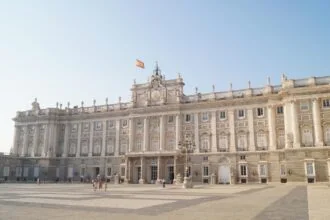
The high-speed line passes right by Zaragoza, roughly the midpoint of this leg and a genuinely worthwhile stop rather than just a convenient one. Its Basilica del Pilar dominates the skyline over the Ebro river, and the Aljafería, a Moorish palace later absorbed into Spain’s Catholic monarchy, is one of the more unusual sights on the whole route, and well worth making time for.
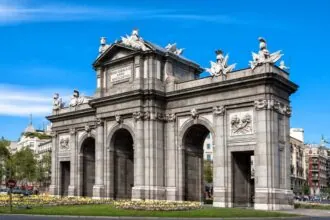
Once in the city, Retiro Park offers the perfect antidote to a day of train travel, its shaded avenues and boating lake a short walk from the centre. Plaza Mayor, all arcaded stone and café tables, is the natural spot for an evening drink once the sightseeing is done.
Madrid’s museum quarter rewards a longer stay too, with the Prado, Reina Sofía and Thyssen-Bornemisza all within walking distance of one another. Even a single evening is enough to appreciate why the city holds its place as one of Europe’s great capitals.
Our guide to things to do in Madrid covers the museum quarter, Retiro Park and the rest of the city in far more depth for anyone building in a longer stop.
No overnight sleeper runs on this corridor either, since Spain’s high-speed AVE network has made a night train largely redundant here. With the daytime journey taking under three hours, there is little demand for a slower overnight alternative in any case.
Madrid to Lisbon via Badajoz and the Portuguese Border
This leg marks a genuine milestone: the crossing into the eighth and final country of the whole journey, and the reward at the end is one of Europe’s most charming capitals. Lisbon‘s pastel façades, steep hills and riverside trams make it a fitting place to pause before the final push south.
| From | To | Distance | Duration | Operator | Service | Optional Stop |
|---|---|---|---|---|---|---|
| Madrid | Badajoz | ~328km | ~4h 20m | Renfe (Alvia) | Daytime | Badajoz (overnight-worthy) |
| Badajoz | Entroncamento | ~145km | ~2h 45m | Comboios de Portugal | Daytime | Entroncamento (overnight-worthy) |
| Entroncamento | Lisboa Oriente | ~101km | ~1h 15m | Comboios de Portugal | Daytime | None |
A Spanish Alvia service, run by Renfe, carries travellers from Madrid to the border town of Badajoz in around four hours twenty minutes, covering roughly 328km. From there, Comboios de Portugal (CP) takes over for a slower two hours forty-five minutes across the border to Entroncamento, before a final one hour fifteen minutes on to Lisboa Oriente. Because it involves a change of railway at the border, this leg takes longer than the distance suggests: budget roughly eight to ten hours all told, including connection time between the three trains.
The rolling stock changes character along the way: the Alvia out of Madrid is a modern, air-conditioned train with a café-bar and power sockets at every seat, while the short hop across the border to Entroncamento still runs on a vintage single-coach railcar from the 1950s, second class only with no catering on board. The final stretch into Lisbon switches again to a proper Intercidades or Alfa Pendular service, complete with its own café-bar car.
Reservations are compulsory on the Alvia out of Madrid and on the Intercidades or Alfa Pendular into Lisbon, so Interrail pass holders need to pay a seat reservation supplement on both of those. The short cross-border hop on the older Portuguese stock is open-seating and needs no reservation at all, one of the few genuinely reservation-free stretches on this whole route.
Out of Madrid the train crosses the wide plains and dehesa of Extremadura, oak grassland grazed by cattle and black Iberian pigs, before the border gives way to Portuguese countryside and dense cork oak forest. The approach into Lisbon runs alongside the Tagus estuary, the river widening dramatically in the last stretch before the city’s rooftops appear.
Lisbon itself repays the effort generously, from the historic trams that climb the Alfama district to the monasteries and towers of Belém on the riverfront. A detailed rundown of the best of the city, including where locals actually eat, is covered in our guide to things to do in Lisbon.
Evenings here are made for the miradouros, the city’s scattered viewpoints that catch the sunset over the Tagus and the rooftops below. A fado performance in one of the older neighbourhoods rounds out the night with something distinctly Portuguese.
Badajoz itself deserves more than a change of platform, and the border-crossing gap between trains is a genuine opportunity to see it rather than just a wait. Spain’s largest fortress, the 9th-century Alcazaba, still has its walls largely intact, and the cathedral’s three-story clock tower gives sweeping views over the old town for anyone with an hour to spare.
The Puente de Palmas, a 15th and 16th-century bridge over the Guadiana river, and the arcaded, red-and-white Plaza Alta are both an easy walk from the station. With three trains and two changes on this leg already, breaking the journey overnight in Badajoz rather than rushing straight through is a genuinely sensible way to split the day.
The other natural place to break the journey is Entroncamento itself, on the Portuguese side of the border, and it has a genuinely good reason to justify a stop beyond the change of train. It is home to Portugal’s National Railway Museum, a collection of around 36,000 objects including the ornate Royal Train and the Presidential Train, housed in a former locomotive roundhouse a few minutes’ walk from the station.
Entrance runs to around €6 (£5/$6) for an adult, and given the town exists almost entirely because of the railway, wandering the surrounding streets of what is still called Portugal’s railway town rounds out an easy half-day stop. Either Badajoz or Entroncamento works well as a place to break this leg overnight; which one suits best comes down to which side of the border a traveller would rather wake up on.
The Trenhotel Lusitania once made this an overnight sleeper journey, but Renfe discontinued the service in 2020 and it has not returned. A direct high-speed replacement is planned for later this decade, though for now this remains a daytime-only crossing.
Lisbon to Lagos: The Final Run to the Atlantic
After eight countries and ten overnight stops, the final leg is almost startlingly ordinary: a Portuguese train winding south along the Algarve line toward the sea. It closes the loop between Arctic Finland and Portugal’s warm Atlantic coast.
| From | To | Distance | Duration | Operator | Service | Optional Stop |
|---|---|---|---|---|---|---|
| Lisbon | Lagos | approx. 290km | ~3.5-4.5h | Comboios de Portugal (CP) | Daytime | None |
The route runs on Comboios de Portugal (CP), starting from Lisbon Oriente and heading south before branching onto the Algarve line. Almost no services run direct, so travellers change trains at Tunes, the junction where the line splits toward Faro and Lagos.
The Lisbon to Tunes stretch runs on an Intercidades or Alfa Pendular service, Portugal’s mainline express and tilting high-speed trains respectively. Both offer air-conditioned open carriages, a buffet trolley and reclining seats, a proper step up from the regional train that follows.
At Tunes, the onward connection to Lagos switches to a regional CP service, and since July 2026 that means new electric multiple units, three-carriage sets that replaced the older diesel railcars long used on this branch. Reservations work differently either side of that change too: compulsory and paid on the Intercidades or Alfa Pendular leg into Tunes, booked in person at a CP ticket counter rather than online, but not needed at all on the regional hop onward to Lagos.
Beyond Tunes the line runs through rolling stretches of cork oak and pine forest, with the flat orange groves of the western Algarve giving way to low hills as the train pushes west. The final approach brings the first real glimpses of the coast, with the Atlantic flashing between the trees before the train curves down into Lagos station.
Budget roughly three and a half to four and a half hours door to door for the whole Lisbon to Lagos run, depending on the connection at Tunes and which onward service is used. It is an unhurried finish after five days of trains, a last chance to watch scenery rather than the clock.
Lagos itself rewards the effort generously. The old town is a tangle of whitewashed, cobbled streets built inside surviving city walls, anchored by the Forte da Ponta da Bandeira guarding the harbour mouth and the Igreja de Santo António’s richly gilded Baroque interior.
A short walk south leads to Ponta da Piedade, a headland of golden cliffs, sea arches and hidden grottoes best explored by boat tour or along the wooden boardwalk that now threads between the viewpoints. Praia Dona Ana and Praia do Camilo, both reached by a flight of steps down the cliffside, are two of the best beaches on this entire stretch of coast.
The marina is the town’s social hub come evening, ringed with restaurants and the departure point for most boat trips, while the Mercado Municipal beside it is worth a browse for fresh seafood. Meia Praia, the long sandy beach stretching east of town, gives a quieter alternative when the older streets get busy in summer.
Our guide to things to do in Lagos covers all of this, plus the boat tours out to the grottoes, in far more detail.
For planning the wider region, lean on our coverage of nearby Faro, the Algarve’s other main hub. Our guide to things to do in Faro covers plenty that applies just as well from a Lagos base.
This last leg has no overnight sleeper option, running purely as a daytime regional and Intercidades connection, though given the modest distance involved a night train was never really needed here.
Step off the train in Lagos to close a genuinely remarkable loop: eight countries, twenty-three trains, and a continent’s worth of climate and language in one journey.
Best for short city stops where being central matters more than the room. Dorms and private rooms both listed.
See hostelsBest if you have ever given up on a claim. AirHelp checks whether the flight qualifies and pursues it for you.
See the benefitsBest if your room is not ready yet. Left luggage booked in advance, so you are not hunting for a locker.
Check storageGetting Home: Leaving from Lagos
Getting home from Lagos is a much shorter trip than the one that brought you here. Faro Airport is the nearest airport, roughly 90km away, and the same gateway most visitors use to reach the Algarve.
A direct train runs from Faro to Lagos roughly eight times a day, taking about 1 hour 45 minutes. It costs around €8 (£7 / $9) one way, making it the cheapest option by far.
One catch worth knowing: Faro Airport has no train station of its own, so this route means a short local bus or taxi transfer into Faro town first. Allow an extra 20 to 30 minutes for that connection.
Vamus also runs the Aerobus, route 56, direct from the airport to Lagos in a little under two hours. It operates several times daily from May to October, though services thin out considerably over the winter months.
A taxi covers the same 90km in about an hour for around €100 (£87 / $108); a rideshare like Uber or Bolt is usually somewhat cheaper. Renting a car at the airport suits travellers who want flexibility before flying home.
Our Faro Airport Transfers guide covers the full breakdown of routes, prices and booking tips for that airport. It is worth a quick read before you travel, since fares and timetables shift with the seasons.
However you choose to leave, it closes a remarkable loop. From the Arctic Circle at Kemijärvi to the Atlantic coast at Lagos, the journey finally comes home.
Sleeper Trains Worth Building a Night Around
Not every leg of this route has a genuine overnight option, but several exist for travellers who would rather sleep through a stretch than sit through it. Used well, they turn a couple of the longer daytime hauls into a comfortable night’s journey instead.
The clearest example sits at the northern end: Sweden’s long-distance sleeper network runs north from Stockholm, the genuine way to break up that leg overnight rather than by day. An Interrail pass covers this corridor too, since the northbound sleeper sits on the same Global Pass used for the rest of the trip.
Further south, Snälltåget runs a genuine overnight service linking Berlin, Hamburg, Copenhagen and Stockholm, a real substitute for the daytime Hamburg-to-Scandinavia stretch for anyone happy to sleep through the scenery. Night Trains from Copenhagen covers exactly what is currently running on this corridor, since sleeper timetables here shift more often than most.
Further south again, in the DACH region of Germany, Switzerland and Austria, Nightjet-style overnight services offer a similar trick for the Hamburg-to-Basel or Basel-to-Geneva stretches. The European Sleeper Trains Guide is the place to check what is actually running before building a leg around one.
Not every leg has this option, and it is worth saying so plainly rather than overselling it: the Spanish and Portuguese stretches near the end of this journey are daytime-only in practice. Treat sleeper trains as a genuine bonus on some nights, not a guarantee across the whole route.
Using an Interrail Pass for a Trip Like This
The real number from the record attempt makes the best case for a pass: an Interrail Global Pass covering all twenty-three trains cost around €387 (£337/$418), against about €563 (£490/$608) for eleven separate tickets on the same route. That is a genuinely compelling saving, even before counting the flexibility it buys.
A Global Pass is the version that matters here, not a single-country pass, since this itinerary crosses eight countries in just over five days. Single-country and two-country passes are cheaper but only work for trips that stay within their own borders, which this one plainly does not.
Owning the pass does not mean skipping reservations: most high-speed trains here, TGV, AVE and ICE included, still need a paid seat reservation on top of the pass. The pass covers the base fare, but the reservation fee is a separate, non-negotiable extra on these services.
Booking those reservations early matters most on the busiest high-speed legs, where seat allocations for pass holders are limited and can sell out well before departure. Leaving reservations until the week of travel is the single most common way this kind of itinerary falls apart.
Plans change, and it is worth knowing before departure that there is no single Interrail-wide policy on changing or cancelling a reservation. Each operator sets its own terms: some, including certain Renfe and SNCF services, allow one free date or time change before departure, while others, such as Deutsche Bahn’s domestic trains, are entirely non-exchangeable once booked.
The small booking fee itself, typically around €2 (£2/$2) per passenger per reservation, is generally not refunded either way. Whenever a change looks likely, checking the specific terms for that train through the Interrail account or the operator directly, before relying on being able to shift it later, saves a lot of frustration.
The Interrail Pass Guide explains how the Global Pass actually works, from validity windows to which trains it covers outright. For the booking mechanics, especially how reservations interact with the pass, Eurostar and Interrail covers the practical side in more depth.

What This Journey Is Likely to Cost
Budgeting for a route like this comes down to four main costs: the rail pass itself, ten nights of accommodation, food along the way, and a handful of paid attractions in the bigger cities. None of it needs to be extravagant, and the figures below assume a comfortable but not luxurious trip throughout.
A Global Interrail Pass covering ten travel days within a two-month window costs €447 (£389/$483) in second class for an adult in 2026, comfortably matching the shape of this itinerary. Our Interrail Pass Guide covers the full range of pass options if a longer or shorter trip is planned instead.
On top of the pass, budget roughly €80 to €120 (£70-105/$86-130) for the compulsory seat reservations on the TGV and X2000 services covered earlier in this guide. Reservations on the ICE, SBB and Iberian legs are optional for pass holders, so that figure covers only the trains where a supplement genuinely cannot be avoided.
Hotel costs vary sharply along the route, with Scandinavia and Switzerland running noticeably higher than Germany, France, Spain or Portugal. A comfortable mid-range double room averages somewhere between €70 and €140 (£61-122/$76-151) a night depending on the city, which works out to roughly €700 to €1,400 (£610-1,219/$756-1,512) across the ten overnight stops.
Food follows a similar north-to-south pattern, with a casual dinner in Stockholm or Basel costing noticeably more than the same meal in Lisbon or Lagos. Allowing €30 to €55 (£26-48/$32-59) a day for breakfast, lunch and dinner combined covers roughly €350 to €600 (£305-522/$378-648) across the whole eleven-day trip.
A handful of paid attractions add up quickly too: the Vasa Museum in Stockholm and Tivoli Gardens in Copenhagen each cost around €17 to €23 (£15-20/$18-25), while the Sagrada Família in Barcelona runs to about €26 (£23/$28) and the Prado in Madrid closer to €15 (£13/$16). Picking two or three such stops along the way adds roughly €150 to €250 (£131-218/$162-270) to the total.
Add it all together and a realistic total for the rail pass, hotels, food and a few paid attractions lands somewhere between €1,700 and €2,800 (£1,480-2,440/$1,840-3,020) per person, before flights to Kemijärvi or home from Lagos. The table below breaks down where that range comes from.
| Item | Estimated Cost (per person) |
|---|---|
| Interrail Global Pass (10 days in 2 months, 2nd class) | €447 (£389/$483) |
| Compulsory seat reservations | €80-120 (£70-105/$86-130) |
| Hotels, 10 nights | €700-1,400 (£610-1,219/$756-1,512) |
| Food and drink, 11 days | €350-600 (£305-522/$378-648) |
| Museums and attractions | €150-250 (£131-218/$162-270) |
| Total (excluding flights) | €1,700-2,800 (£1,480-2,440/$1,840-3,020) |
Apps for Planning This Route
The essential app for anyone using an Interrail or Eurail pass on a trip like this is the official Rail Planner App. It holds offline timetables across the whole of Europe, so a train time is still visible on a remote Nordic branch line with no signal.
It is also where the pass itself lives day to day, since travellers activate each travel day digitally rather than filling in a paper calendar. A recent update added live real-time timetable data, making it the single most useful tool for a trip crossing this many national rail networks.
That said, this route crosses eight national rail systems, and no single app covers every operator equally well. For some legs it is worth double-checking booking or platform details through the relevant national operator’s own app instead.
Germany’s DB Navigator is particularly good for real-time platform changes and delay alerts on the Deutsche Bahn network. France’s SNCF Connect plays a similar role on the French leg, especially around TGV reservations.
At each overnight stop, a general tool like Google Maps earns its place for local city transit, from tram routes to the walk from station to hotel. None of these replace the Rail Planner App as the backbone of the trip, they just fill in local detail.
For a fuller rundown of booking apps by country, Train Booking Apps: The Complete Global Rail Guide covers the wider landscape beyond this one route.
Packing for a Journey From the Arctic to the Atlantic Coast
Kemijärvi sits in Finnish Lapland, where early autumn mornings already bring frost and shortening daylight. Lagos, on Portugal’s Algarve coast, will likely still be warm days later, so packing for two seasons at once is the real challenge on this trip.
The simplest fix is a layering strategy rather than separate wardrobes for each climate. A base layer, a mid layer and a packable shell cover the Lapland mornings, then compress down once they’re not needed further south.
A compact, packable coat earns its place on the northern legs through Finland and Sweden, where a proper insulated layer matters more than style. Choose one that stuffs into its own pocket, since it spends most of the journey crushed at the bottom of a bag.
South of Hamburg, breathable cotton and technical fabrics do far more work than anything heavy, especially once the train reaches France and Spain. A couple of quick-drying t-shirts matter more here than extra jumpers.
Footwear should prioritise comfort, since this trip is spent mostly seated or walking station platforms rather than hiking. One well broken-in pair of comfortable shoes outperforms packing two pairs for two climates.
A portable charger and a universal adapter earn their keep given how many plug types and operators this route crosses in five days. Keep the power bank somewhere reachable, since seat-side sockets aren’t guaranteed on every train.
Above all, travel light. With no porters, tight connections and limited overhead racks on many of these trains, a single cabin-sized bag that lifts overhead in seconds beats a second suitcase every time.

Staying Clean and Managing Luggage Along the Way
Five days on trains with only cabin luggage means rethinking how you stay clean, since there’s no daily access to a proper laundry service. The good news is that a quick sink wash covers most of what you need between overnight stops.
A few travel detergent sheets take up almost no space and turn any hotel bathroom into a laundry station. Rinse worn t-shirts and underwear in the sink, wring them out well, and hang them to dry overnight so they’re ready by morning.
On longer overnight stops, such as a night in Hamburg or Geneva, a proper laundromat or hotel laundry service is worth seeking out. It’s the difference between managing with a handful of quick-dry basics and needing to overpack for five days.
Not every station on this route offers left-luggage lockers, and where they exist, opening hours and availability can be unpredictable, especially at smaller stops. It’s worth checking ahead rather than assuming a locker will be free and open when your train pulls in.
For cities where you’d rather explore without dragging a bag around, a shop-based storage network fills the gap that station lockers leave. Our Stasher Review covers how that network works, while the Radical Storage guide is a solid alternative in cities where Stasher has fewer partners.
Booking storage in advance for a few hours in Stockholm, Copenhagen or Lyon means one less thing to think about after stepping off an overnight train. It also frees you to spend a layover exploring a city centre instead of sitting in a station waiting room.
Can You Actually Book This as a Single Journey?
Despite reading like a single continuous line on a map, this Kemijärvi to Lagos corridor is not sold anywhere as one through-ticket. It is a chain of separate national bookings, each made directly with that country’s own operator, or through a recognised retailer, and stitched together by the traveller rather than issued as one itinerary.
Every operator opens its own booking window, and those windows genuinely differ by country and by train type. Northern and central European operators including VR, SJ and Deutsche Bahn tend to release seats and reservations months ahead of travel, while some southern high-speed services open closer to departure, so the earliest legs on this route often need locking in well before the later ones.
Because the route crosses eight countries, expect several separate booking systems rather than one central portal covering the whole trip. A journey planning app is useful for confirming realistic connections and platform changes, but each ticket still generally has to be bought through, or reserved via, the relevant national operator or a trusted third-party rail retailer.
As covered elsewhere on this page, an Interrail Global Pass sidesteps most of that fragmentation by covering the base fare on nearly every leg, leaving only seat reservations to arrange country by country. Travellers without a pass instead need to work backwards from each operator’s booking window, treating the earliest-opening legs as the ones to secure first.
In practice, the sensible order is booking the longest-distance or least flexible legs first, typically the overnight sleeper and high-speed segments covered earlier in this guide, then filling in shorter regional connections closer to departure. That sequencing spreads the admin out and avoids a scramble where several countries’ booking windows all open in the same week.
Mixing operators also means mixing payment systems, confirmation formats and, occasionally, languages, so keeping every booking reference and QR code organised in one place, whether a folder or a dedicated app, matters more on a trip like this than on a single-country holiday. A short checklist built around each country’s opening date turns an intimidating booking process into a manageable, staged one.
What Can Go Wrong and Where to Build in Buffer Time
A trip built from more than twenty separate connections across eight countries has far more failure points than a normal holiday itinerary. The biggest risk is not any single delay but a missed connection early in the route causing every booking that follows it to unravel, since later legs are fixed to specific departure times rather than flexible.
Delays have a habit of cascading across borders on a route this long, where a late-running Nordic or German service can push arrival past the departure of a tightly booked onward train. Compensation schemes and rebooking rights also differ by country, so a delay that is easily fixed in one nation can become a genuine problem the moment it crosses into the next.
Some legs on this itinerary carry noticeably more risk than others. Connections through major interchange hubs during peak commuter hours, and any change built around a single daily long-distance or overnight service, leave far less room for error than a leg served by frequent regional trains running every thirty minutes.
The most reliable fix is building in buffer time rather than assuming every connection will run exactly to schedule. A spare hour at a tight interchange, or better still, an extra unplanned night in a city the itinerary was already going to pass through, absorbs a delay that would otherwise wreck the following days.
Overnight sleeper services deserve particular caution, since a late-running sleeper can arrive after the next booked connection has already departed, with no realistic way to catch up that same day. Treating the morning after any sleeper leg as a buffer window, rather than scheduling a tight onward connection straight off the platform, removes one of the route’s most common failure points.
It is also worth deciding in advance which stops can absorb a lost day without wrecking the wider trip. A flexible overnight kept loosely booked gives the itinerary somewhere to fall back to if an early leg runs into trouble. A longer stay at the finish, using our Things to Do in Lagos guide to fill the extra time, is one of the easiest places to build that slack in.

Seasonality: What the Northern Leg Looks Like in Winter
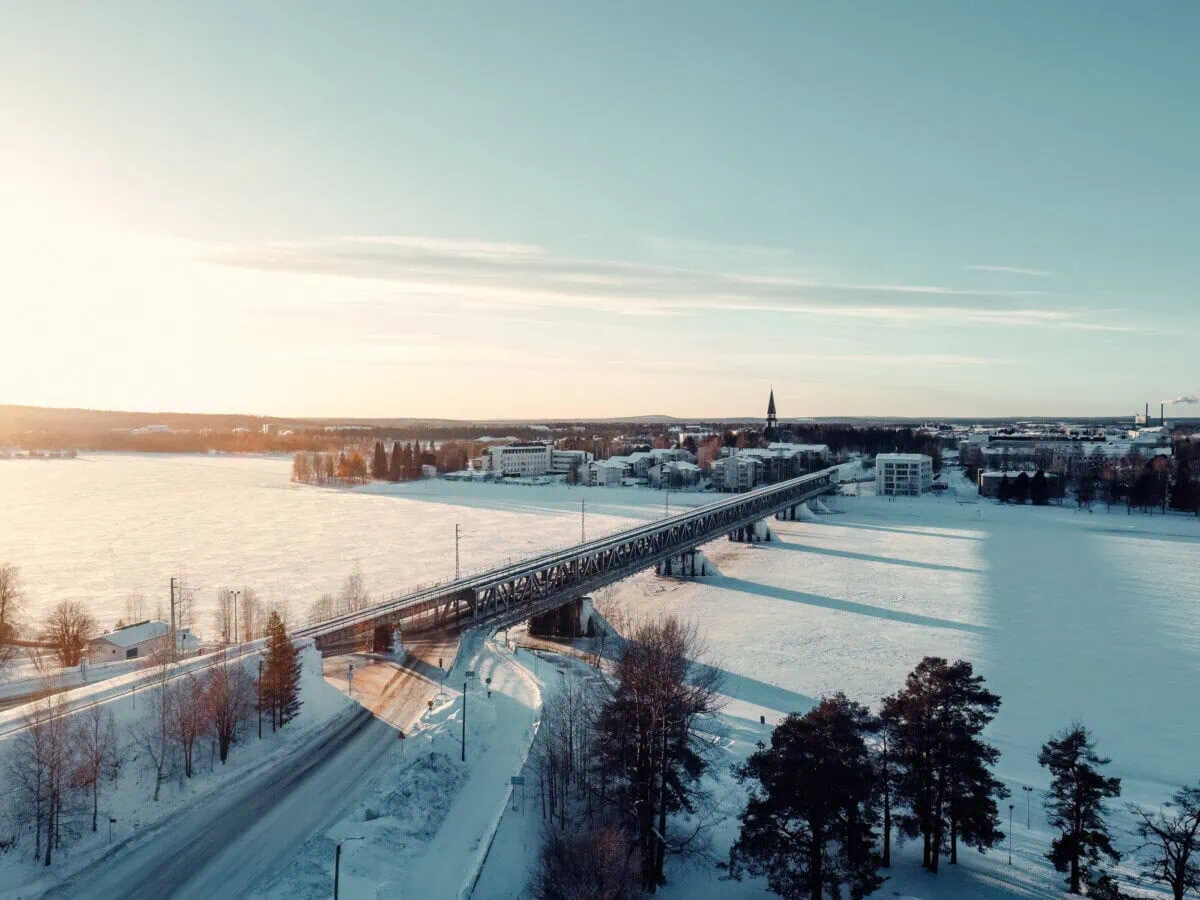
Kemijärvi sits well inside the Arctic Circle, and snow here is the default rather than the exception. Ground cover typically holds from mid-October through mid-May, close to seven months of the year, so most travellers who are not passing through in high summer should expect a genuinely white start to the journey.
Northern Sweden shares the same Arctic character, with similarly long, snow-bound winters across the stretch this route crosses before reaching central Europe. Anyone picturing green fields at the northern end of the trip for most of the year is imagining the wrong season entirely.
The good news is that Finnish and Swedish railways are built for exactly this climate. Their networks run heated switches, dedicated snow ploughs and cold-trained crews as standard, and Nordic winter punctuality figures regularly beat what some southern European networks manage in mild weather.
That resilience is not absolute, though, and honesty matters here. Severe cold snaps or heavy snowfall can still cause occasional weather-related delays, daylight in December and January shrinks to only a few hours around midday, and a handful of seasonal or scenic services thin out or pause entirely outside the main tourist window.
For planning purposes, the practical split is simple. Summer brings near-endless daylight and easy travel conditions, while winter delivers dramatic Arctic scenery at the cost of shorter days and a colder, slower start to what is otherwise the same reliable route.
Travellers who prefer to sidestep the harshest conditions can aim for late spring or early autumn on the northern leg, when snow is easing but the Arctic light is still dramatic. Those chasing a genuine Lapland winter, complete with northern lights and reindeer, should simply plan for the cold and lean on the buffer time already recommended above.

Rupert’s Handy Travel Tips
I’ve hoofed it across enough borders to know a trip this ambitious rewards planning more than almost any other journey I’ve seen.
- Book seat reservations early: Reservations on the busiest high-speed legs, like Lyon to Barcelona or Barcelona to Madrid, sell out fast, so lock yours in as soon as you know your dates.
- Activate your Interrail pass correctly: Activate a pass in the Rail Planner app before your very first travel day, not at the platform in Kemijärvi with patchy signal and a train about to leave.
- Pack for two climates in one bag: You’ll go from Arctic frost to Atlantic sunshine in under a week, so a packable coat and a light t-shirt both need to live in the same small bag.
- Use a rail-planner app for live updates: With this many operators and border crossings, an app showing live platform and delay information saves you from guessing which platform a late connection actually left from.
- Build in one spare day: The real 2026 record attempt was disrupted by a bomb find in Hamburg and an earthquake, so leave one slack day in your own plan in case a multi-country trip like this throws you a curveball.
Want to meet the reindeer behind our travel tips? Find out more in our page Who is Rupert?.




Frequently Asked Questions
Do I need to book the whole route as one ticket, or leg by leg?
Leg by leg is more realistic than a single through-ticket, since the record attempt itself was stitched together from 23 separate train segments across eight countries. Booking each leg separately, or covering them with an Interrail pass, also gives you flexibility to swap a train if one leg runs late.
How much does this trip cost with an Interrail pass versus booking each ticket separately?
On the real 2026 record attempt, the full route came to roughly €387 (£337/$418) with an Interrail pass, compared with around €563 (£490/$608) buying every ticket individually, so the pass works out cheaper across this many legs. Exact savings depend on how far ahead you book seat reservations, which are extra on top of the pass.
Is this realistic for an ordinary two-week holiday, or only for rail enthusiasts?
It’s genuinely realistic for an ordinary holiday, since the itinerary on this page spreads the journey across sensible overnight stops rather than racing the 125-hour record. Treat Stockholm, Copenhagen, Hamburg, Geneva and Lyon as destinations in their own right and the whole trip becomes a relaxed multi-country holiday instead of an endurance test.
What happens if I miss a connection partway through?
A missed connection is manageable if you’ve left a little slack in your schedule, since most legs have a later train the same day or the next morning. This is exactly why a spare day is worth building into your itinerary, rather than booking every transfer back-to-back.
Can the route be done in reverse, starting in Lagos and finishing in Kemijärvi?
Yes, every leg of this journey runs in both directions, so starting on Portugal’s Algarve coast and finishing in Arctic Finland works just as well. Some travellers prefer that order specifically to save the coldest, darkest leg for the very end rather than the start.
Further Reading
Before you book anything, it helps to understand the two building blocks of a trip like this. Our European Sleeper Trains Guide covers how to choose a couchette or private cabin for the longer overnight legs, while the Interrail Pass Guide walks through whether a pass like the one used on the record attempt actually saves you money on your own itinerary.
The Nordic leg of this journey deserves more than a change of platform. If you’re breaking the trip with a night or two in Sweden’s capital, our guide to things to do in Stockholm covers the old town and waterfront, and our Things to Do in Copenhagen guide is worth a look before you sit down at Copenhagen Central for the legs further south.
Further along the route, Hamburg and Lyon both reward a longer stop than most travellers give them. Our guide to the Best Things to Do in Hamburg is worth reading before that leg of the trip, and our Things to Do in Lyon guide covers one of the country’s most underrated food cities, well worth the overnight stop this route builds in.
By the time the route nears its Portuguese finish, Lisbon makes a natural final stopover before continuing on to the Algarve. Our Things to Do in Lisbon guide covers the essentials for a city that easily earns a day or two of its own before you finish the journey in Lagos.