Reviewed by our editorial team Published
Lagos is a historic harbour town on Portugal’s western Algarve coast, built around a natural inlet that made it one of the country’s most important ports for centuries. Its walled old town still traces the streets from which caravels once sailed during the Age of Discovery, while the surrounding coastline is famous for some of the Algarve’s most dramatic cliff scenery.
Few Algarve towns pack in quite as much variety. Within a short walk of the same historic centre, visitors can move between a fifteenth-century fort, a museum that confronts one of the darkest chapters of European history, a bustling fishing marina and beaches that range from wide sandy bays to hidden coves tucked beneath golden cliffs.
The old town itself is compact and largely pedestrianised, centred on Praça Gil Eanes and the pedestrian shopping street of Rua 25 de Abril. From there it’s a short stroll to the marina in one direction and to the clifftop path leading toward Ponta da Piedade in the other, so most of what makes Lagos worth visiting sits within easy walking distance of a place to stay.
This guide works through the town’s essential sights and activities, from the old fortifications and the Mercado de Escravos museum to the grottoes at Ponta da Piedade, the beaches at Dona Ana, Camilo and Meia Praia, and family-friendly options like Zoo Lagos. Each section covers what the attraction actually involves, roughly how much time to set aside and current entry prices where relevant.
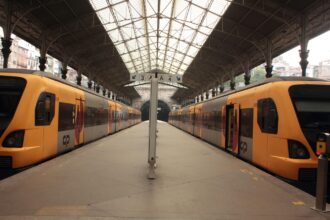
Lagos sits on the Algarve rail line and is well connected to Faro by train, making it an easy add-on to a trip that starts at Faro Airport. The town works equally well as a standalone beach base for a week or as a day trip from further east along the coast.
| Attraction | What It Is | Best For |
|---|---|---|
| Old Town & City Walls | Historic pedestrianised centre | First-time visitors |
| Forte da Ponta da Bandeira | 17th-century harbour fort | History and views |
| Mercado de Escravos | Slave Market Museum | Serious history |
| Ponta da Piedade | Cliffs, grottoes & lighthouse | Photography & boat tours |
| Praia Dona Ana | Sheltered cliff-framed cove | Swimming & sunbathing |
| Meia Praia | Long sandy town beach | Families & watersports |
| Lagos Marina | Waterfront & boat departures | Boat and dolphin tours |
| Zoo Lagos | Wildlife park near town | Families with children |
Wander the Old Town and City Walls
Lagos’s old town is a tight grid of cobbled lanes, whitewashed houses and small squares enclosed by stretches of medieval defensive wall. Parts of the fortifications date back to the Moorish period, with later rebuilding after the town became a key naval and trading base during the Age of Discovery.
At its heart is Praça Gil Eanes, an open square named after the navigator credited with being the first European to round Cape Bojador. The square’s modern statue of King Sebastian, cast in a deliberately stylised bronze, tends to divide opinion but has become one of the town’s most photographed landmarks.
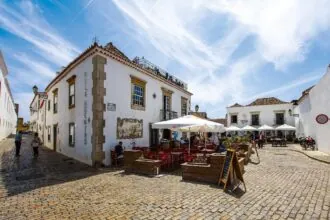
Running from the square toward the marina, Rua 25 de Abril is the town’s main pedestrian artery, lined with cafés, souvenir shops and restaurants spilling onto the street. It gets busy in high season, but side streets just a block away are noticeably quieter and reveal more of the town’s everyday character.
Sections of the old walls are still walkable, particularly around the waterfront near the fort, giving a sense of how compact and defensible the original town once was. Much of it collapsed or was damaged during the 1755 earthquake that devastated large parts of southern Portugal, so what remains is a patchwork of original and rebuilt stonework.
Getting around the old town costs nothing beyond your own time, and most visitors need no more than two to three hours to cover the main streets and squares at an easy pace. It’s the natural starting point for exploring everything else Lagos has to offer, since almost every other sight on this list is reachable on foot from here.
Explore Forte da Ponta da Bandeira
Guarding the entrance to the harbour, Forte da Ponta da Bandeira is a squat, whitewashed fortress built between 1680 and 1690 to defend Lagos against pirate raids and seaborne attack. It survived the 1755 earthquake that destroyed an earlier fortification nearby, and its thick stone walls still meet the water almost exactly as they did three centuries ago.
Inside, a small chapel dedicated to St Barbara retains its original seventeenth-century tilework, while the rest of the fort houses rotating exhibitions covering the building’s history and that of the wider town. It’s a modest collection rather than a major museum, but the setting does most of the work.
A ramp leads up to an open terrace where you can look back across the harbour, the marina and the stretch of coastline running toward Meia Praia. It’s one of the better vantage points in town for photographs, particularly in the late afternoon when the light turns the stone a warm gold.
The fort sits at Cais da Solaria, right on the waterfront just a few minutes’ walk from Praça Gil Eanes, making it an easy stop on the way to or from the marina. General admission is around €2 (£2/$2), though combined tickets covering the fort, the Mercado de Escravos and the Municipal Museum bring worthwhile savings if you plan to see all three.
Allow around 30 to 45 minutes for a visit, and check opening hours before you go since the fort closes on Mondays along with the town’s other municipal sites. It’s a small but worthwhile stop, especially combined with the two museums nearby.
Best for two or three nights. The widest choice of rooms, with filters for free cancellation and included breakfast.
View staysBest for longer stays. Whole apartments and houses, so you are not eating out three times a day.
View rentalsBest if you have already picked a hotel. Checks the big booking sites for the same room and shows who is cheapest.
Check dealsVisit the Mercado de Escravos
The Mercado de Escravos, or Slave Market Museum, occupies a modest building on Praça do Infante that holds a genuinely difficult place in European history. Lagos is widely recognised as the site of Europe’s first regular market in enslaved Africans, with recorded sales beginning here in 1444, and the building itself started life as the town’s customs house before its conversion into a museum in 2016.
Inside, bilingual Portuguese and English displays trace the origins and scale of the transatlantic slave trade, including maps of Portuguese trade routes, records of the goods exchanged and the conditions endured during Atlantic crossings. The exhibits also cover resistance, including the 1595 uprising led by an enslaved man named Amador Vieira.
This is not a large museum, and the displays are direct rather than dramatised, which feels appropriate given the subject. Most visitors move through it thoughtfully rather than quickly, and it’s worth setting aside time to actually read the panels rather than treating it as a brief detour between beaches.
Admission is €3 (£3/$3), with reduced tickets for visitors aged 12 to 18 and over 65, and combined tickets covering the fort and Municipal Museum are available at the door. The museum keeps the same hours as the town’s other historic sites, roughly 10am to 6pm with a midday closure, and is shut on Mondays.
Plan on around 45 minutes to an hour here. Of everything covered in this guide, this is arguably the site that visitors should treat with the most seriousness, since Lagos’s role in this history is significant and not always well known outside Portugal.
See Igreja de Santo António and the Municipal Museum
Tucked away on Rua General Alberto da Silveira, Igreja de Santo António hides one of the finest baroque interiors in the Algarve behind a fairly plain exterior. Gilded woodwork, known locally as talha dourada, covers much of the chapel in swirling carved detail, framing a painted ceiling designed to create an illusion of depth above the nave.
Blue-and-white azulejo tile panels line the lower walls, and paintings depicting scenes from the life of St Anthony fill the spaces between. The retable dates to 1718 and survived the 1755 earthquake largely intact, which is part of why the interior feels so complete compared with many other Algarve churches.
Next door, the former sacristy now houses the Museu Municipal Dr. José Formosinho, a small archaeology and folk museum founded in 1932. Its collection ranges from prehistoric standing stones and Roman mosaics to coins and everyday objects spanning the Celtic, Phoenician and early twentieth-century Algarve.
A single ticket at €3 (£3/$3) covers both the church and the museum, with the same combined-ticket discounts available if you’re also visiting the fort or the Slave Market. Hours mirror the town’s other historic sites, open 10am to 6pm with a midday break, and closed Mondays.
Set aside around an hour for both together. It’s a quieter, less-visited stop than the beaches or the fort, which makes it a good option if you’re looking for somewhere calm in the middle of a busy sightseeing day.
Walk Out to the Ponta da Piedade Viewpoint
South of town, the coastline rises into Ponta da Piedade, a headland of ochre-orange limestone cliffs carved by the Atlantic into arches, sea stacks and narrow grottoes. It’s the single image most associated with Lagos, and seeing it from the clifftop path alone is enough to understand why the town built its reputation on this stretch of coast.
A wooden boardwalk with several lookout platforms runs along the top of the headland, giving free views down into the coves and arches without needing to book anything. A working lighthouse marks the point itself, and a set of steep steps drops down from the car park toward sea level, where several boat tours depart directly from the rocks.
It’s around a 30 to 40 minute walk from the old town along a marked coastal path, or a five to ten minute drive if you’d rather save your energy for the steps down. Parking near the lighthouse is free but fills up quickly in the middle of the day during summer.
There’s no entry fee for the viewpoint or boardwalk, and most visitors spend somewhere between 45 minutes and an hour here just walking between the lookout points. Early morning or the last couple of hours before sunset give the cliffs their best colour and the smallest crowds.
This is also the natural jumping-off point for the boat and kayak tours covered in the next two sections, so it’s worth timing your visit to combine the walk with a trip out onto the water rather than treating them as separate outings.

Take a Grotto Boat Tour
The clifftop boardwalk shows you Ponta da Piedade from above, but the caves, arches and hidden coves that make it famous are only fully visible from sea level. Small open boats run continuously from the rocks below the headland and from Lagos Marina, weaving between the sea stacks and into grottoes too narrow to spot from land.
Standard grotto tours run for around an hour and typically cost somewhere between €15 (£13/$16) and €25 (£22/$27) per person, depending on the operator and how far along the coast the route extends. Longer trips that add a swim stop or continue further along the coastline usually sit toward the top of that range.
Operators run boats departing directly from beneath the cliffs at Ponta da Piedade as well as from the marina in town, and most trips run throughout the day with no need to book far in advance outside of peak summer weeks. Morning departures tend to give calmer water and better light for photographs.
Sunset departures are also popular and generally cost a little more than the standard daytime routes. Life jackets are provided on every boat, though the open craft used for grotto tours aren’t a good fit for anyone with limited mobility, since boarding involves stepping down onto rocks or a small jetty.
Booking a spot the day before, either online or directly with an operator at the marina, is usually enough outside July and August. During peak season it’s worth reserving a couple of days ahead to guarantee your preferred time slot.
Kayak or Paddleboard Through the Grottoes
For a slower, more physical way to see the same coastline, several outfitters run kayak tours that paddle right into the caves and narrow passages a larger boat can’t reach. Guided trips typically last around an hour to ninety minutes and cost roughly €35 (£31/$39) to €50 (£44/$56) per person, usually including all equipment.
Groups paddle out from a small beach near Ponta da Piedade in double or single kayaks, following a guide who points out the arches, sea caves and rock formations while explaining a bit of the geology behind them. Morning sessions are recommended, both for calmer conditions and for the light hitting the orange cliffs at its best.
Stand-up paddleboard tours cover similar ground at a similar price and are a reasonable alternative if you’d rather stand than sit, though they demand slightly more balance and are better suited to calmer days. Both activities are offered by multiple operators based around the marina and the headland itself.
No previous kayaking experience is required for the standard tours, and guides typically run a short briefing on the beach before setting off. Reasonable fitness helps, since the return paddle against any wind or current can be more tiring than the outward leg.
Booking in advance is worth doing in high season, since group sizes are kept deliberately small and popular morning slots sell out first. Most operators offer free cancellation up to 24 hours ahead, which makes it easy to plan around the weather.
Relax at Praia Dona Ana
Long considered one of the Algarve’s most photographed beaches, Praia Dona Ana is a small cove wedged between golden limestone cliffs a short walk from the old town. Calm, sheltered water and soft sand make it one of the most reliably swimmable beaches in Lagos, without the exposure to swell that affects some of the more open bays nearby.
The cliffs themselves are part of the appeal, riddled with small arches and outcrops that hint at the more dramatic formations further along the coast at Ponta da Piedade. A handful of sea caves are visible from the sand, and the whole cove feels more intimate than the town’s bigger beaches.
It’s roughly a 30-minute walk from central Lagos, mostly along a clifftop path with good views back toward the town, or a short ride on the local Linha 2 bus route if you’d rather not walk in the heat. A seasonal mini road train also connects the old town to the beach in summer.
There’s no entry charge, and the beach has sun loungers, umbrellas and a couple of beachfront cafés for hire in season, along with lifeguard cover during the busiest months. Space is limited compared with Meia Praia, so it fills up quickly on hot days.
Given its size, most visitors treat Dona Ana as a half-day stop rather than an all-day base, and it pairs naturally with a walk on to Praia do Camilo or the Ponta da Piedade boardwalk afterward.
Best if you can move a day either way. Shows how the fare to Portugal changes across the month.
Compare flightsBest if you want maps and messaging working the moment you switch your phone on.
See eSIM plansBest when public transport has stopped, or when you are travelling with children and bags.
Book a transferDiscover Praia do Camilo
A little further along the cliffs from Dona Ana, Praia do Camilo is smaller again and, for many visitors, even more striking. A narrow wooden staircase zigzags down through a cleft in the cliff to reach the sand, and the descent itself is part of the appeal, framed by rock walls on either side.
At low tide the beach connects to a neighbouring cove and a scattering of small offshore rocks, which is part of why it’s a popular spot for snorkelling as well as swimming. The water here is generally calm, though the beach itself is genuinely tiny and disappears almost entirely at high tide.
There’s no bus route directly to Camilo, and it’s roughly a 40-minute walk from the old town, mostly following the same clifftop path used to reach Dona Ana and Ponta da Piedade. A car park sits at the top of the staircase for anyone driving or cycling out.
Facilities are minimal at beach level, but the seafood restaurant O Camilo sits right at the top of the cliff with views over the cove, making it a good spot for lunch either before or after your swim.
Because of its size, Camilo suits a shorter visit of an hour or two rather than a full day on the beach. It’s best combined with Dona Ana and the walk out to Ponta da Piedade as one longer coastal outing.
Spend a Day on Meia Praia
On the other side of the harbour from the cliffs sits Meia Praia, the town’s main beach and one of the longest stretches of sand anywhere in the Algarve, running for nearly five kilometres toward Alvor. It’s a completely different kind of beach from Dona Ana or Camilo, open, flat and backed by low dunes rather than cliffs.
The western section, closest to town, is the busiest and best served by facilities, with a boardwalk running behind the beach lined with bars and restaurants including the well-known Bahia Beach Bar. Walking east along the sand quickly thins the crowds, and the far end sees relatively few visitors even in peak summer.
The open aspect and steady onshore breeze make the eastern stretch popular with windsurfers and kitesurfers, particularly in the afternoons when the wind tends to pick up. Families tend to gravitate toward the western end, where the shallow water and wide sand give plenty of room to spread out.
Meia Praia is a short walk from the old town across a footbridge near the marina, or a quick drive if you’re heading further along the beach. There’s no charge to use the beach itself, and paid parking is available near the main access points.
Given its length, Meia Praia works as an easy full-day base, particularly for anyone travelling with children or looking to combine sunbathing with watersports rather than sightseeing.
Try Surfing Around Lagos
Lagos sits close enough to the open Atlantic beaches west of town to make it a practical base for surfing, even though the town’s own sheltered coves aren’t where the waves break. Several surf schools operate out of Lagos and run lessons and transport out to nearby beaches such as Praia do Zavial, Praia da Cordoama and Praia do Amado.
Beginner group lessons typically run for around two to three hours and cost somewhere in the region of €40 (£35/$44) to €55 (£48/$61), usually including board and wetsuit hire along with transport from a meeting point in town. Multi-day packages bring the per-session cost down noticeably.
Wave conditions along this stretch of coast vary a lot depending on swell direction and season, which is exactly why local schools tend to choose the beach on the day rather than fixing a location in advance. This flexibility is one of the genuine advantages of booking through a Lagos-based operator rather than a fixed-location school further west.
Board and wetsuit rental without a lesson is also widely available for more experienced surfers who’d rather find their own spot. Autumn and winter generally bring the biggest, most consistent swell, while summer tends to be gentler and better suited to complete beginners.
Most schools operate year-round, though it’s worth booking a day or two ahead in summer when demand is highest. It’s a worthwhile addition to a Lagos trip even for travellers who’ve never surfed before.
Explore Lagos Marina and Watch for Dolphins
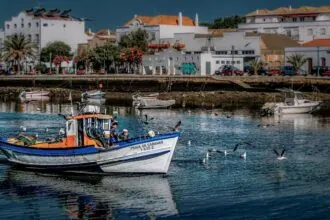
Sitting between the old town and Meia Praia, Marina de Lagos is a modern marina lined with cafés, restaurants and the departure points for most of the town’s boat trips. It’s a pleasant place to walk regardless of whether you’re booking anything, with a steady stream of yachts, fishing boats and excursion vessels coming and going through the day.
Beyond the grotto and kayak tours already covered, several operators run dedicated dolphin-watching trips from the marina out into the Atlantic, where bottlenose and common dolphins are regularly spotted year-round off this stretch of coast. Trips typically last two to three hours and cost roughly €35 (£31/$39) to €50 (£44/$56) per person.
Most operators use faster rigid-hulled boats for dolphin trips rather than the small open boats used for grotto tours, which makes them a bit more comfortable over longer distances and generally suitable for a wider range of ages and mobility levels. Sightings aren’t guaranteed, though local operators report reasonably high success rates.
Longer half-day and full-day charter trips, including sailing and fishing excursions, also depart from the marina and can be arranged directly with operators at the waterfront or booked online in advance. Prices climb quickly for private charters, so it’s worth comparing group tours first if budget matters.
Even without booking a tour, the marina is a good spot for an evening meal, with restaurant terraces overlooking the boats and, further along, views back toward the fort and the harbour entrance.
Browse the Mercado Municipal
Facing the marina on Avenida dos Descobrimentos, the Mercado Municipal is Lagos’s working municipal market and one of the best places in town to see everyday local life rather than tourist-facing shopfronts. The ground floor is dominated by a busy fish market, with the morning catch laid out on ice not long after the boats come in.
Upstairs, stalls sell fresh fruit, vegetables, cheese and bread, and it’s a good place to put together picnic supplies if you’re heading to one of the beaches for the day. A handful of small cafés inside the building serve coffee and simple snacks.
The market is busiest in the early morning, when fishermen, restaurant buyers and locals doing their weekly shop fill the aisles, and noticeably quieter by midday. Weekday mornings tend to be the most authentic time to visit, while weekends can feel a little more subdued outside the fish hall.
There’s no entry charge, and it’s only a couple of minutes’ walk from Praça Gil Eanes and the marina, making it easy to fold into a morning walk around town. Most visitors need no more than 20 to 30 minutes to have a look around.
It’s not a major attraction in its own right, but for anyone interested in how Lagos actually functions as a working fishing town, it’s a worthwhile short detour between the marina and the old town.
Take the Family to Zoo Lagos
Despite its name, Zoo Lagos isn’t actually in Lagos itself but in the nearby village of Barão de São João, around eight kilometres from the town centre and about a fifteen to twenty minute drive. It’s a family-oriented wildlife park with more than 150 animal species, alongside a large collection of plants and gardens spread across its grounds.
The zoo puts a fair amount of emphasis on conservation and education alongside the usual mix of exhibits, with information panels and keeper talks covering breeding programmes and habitat protection for several of its more endangered residents. It tends to work well as a half-day outing for families with younger children in particular.
Adult admission runs at around €19 (£17/$21) on the day, dropping to roughly €17 (£15/$19) if booked online in advance, with reduced pricing for children. It’s worth checking the zoo’s own site for current family ticket bundles before you go, since these change from season to season.
There’s no public transport link directly from Lagos, so a hire car, taxi or organised transfer is the most practical way to get there. Some tour operators in town also sell combined transport-and-entry tickets, which can work out more convenient than arranging your own car for a single trip.
Plan on spending three to four hours on site to see the collection properly, and pair the visit with lunch in Barão de São João itself rather than rushing straight back to the beach.
Best if you would rather spend the money on Portugal than on the room. Compare hostels by location and rating.
Search hostelsBest for anyone flying more than once or twice a year. Handles the compensation claim so you are not chasing the airline.
See AirHelp+Best if your room is not ready yet. Left luggage booked in advance, so you are not hunting for a locker.
Check storageTaste the Local Food Scene
Lagos’s dining scene runs well beyond the marina’s tourist terraces, and the old town’s back streets hold some of the best value cooking in the western Algarve. Small Portuguese tascas serve daily specials and grilled fish at prices closer to what locals pay than what the waterfront charges.
The definitive regional dish is cataplana de marisco, a seafood stew of clams, prawns and fish sealed and steamed in a hinged copper pot that’s cracked open at the table. A cataplana large enough for two typically costs around €25 (£22/$27) to €35 (£30/$38), so it’s a dish worth ordering to share.
Simpler grilled fish, usually whole sea bass or sea bream with boiled potatoes and salad, is a reliable order at almost any restaurant and generally runs €15 (£13/$16) to €25 (£22/$27) per portion. For something lighter, petiscos, small Portuguese sharing plates such as grilled chouriço, fried cuttlefish and garlic prawns, let you try several dishes for roughly €10 (£9/$11) to €15 (£13/$16) a plate.
The Mercado Municipal’s fish hall, covered separately below, is the best place to see the raw ingredients behind these dishes, and several old-town kitchens buy straight from its stalls each morning. Reservations aren’t usually necessary outside peak summer weeks, though the most popular tascas do fill up by around 8pm in July and August.
Most of the better restaurants cluster in the quieter side streets away from Rua 25 de Abril’s busiest cafés, generally offering more authentic cooking and better value than the marina-front options. Budget travellers can eat well for under €15 (£13/$16) at lunch, while a full evening meal with wine typically runs €25 (£22/$27) to €40 (£35/$44) per person.
Shop the Old Town’s Independent Boutiques
Beyond its historic sights, the old town doubles as a genuine shopping destination, with small independent boutiques tucked along the lanes off Rua 25 de Abril and Praça Gil Eanes. Expect owner-run shops rather than chain stores, many selling goods actually made in Portugal.
Cork products are one of the region’s real specialties, since Portugal produces most of the world’s cork, and local shops stock everything from wallets and bags to coasters and shoes made from the material. Hand-painted ceramics and azulejo-style tiles are another common find, ranging from small fridge magnets to full decorative plates.
A handful of shops sell local food and drink to take home, including tinned fish in decorative cans, Algarve honey and bottles of medronho, a strong local spirit distilled from the arbutus berry. These pack more easily than ceramics and make practical souvenirs.
Rua 25 de Abril itself mixes genuine independent shops with more generic souvenir stalls, so it’s worth continuing into the quieter side streets for better quality and prices. The lanes around Praça Gil Eanes tend to hold the more considered, locally-run boutiques.
Most shops open around 10am and close for a couple of hours at lunch before reopening into the evening, a pattern common across the Algarve. Sunday trading is patchy outside the busiest summer weeks, so it’s worth shopping earlier if you’re after something specific.
Experience Lagos’s Nightlife
Lagos has a genuinely lively nightlife scene for a town its size, concentrated almost entirely inside the old town and led by Rua 25 de Abril and the lanes around it. Everything sits within a five-minute walk, so it’s easy to move between several bars over the course of one evening.
The scene leans toward bars rather than clubs, ranging from relaxed early-evening spots to louder, later-opening venues aimed at a younger backpacker crowd. Stevie Ray’s, tucked just back from the marina, has built a reputation for live jazz, blues and acoustic sets running most nights of the week.
Open-air venues such as The Garden suit an early drink, with outdoor seating and a relaxed crowd before the louder bars fill up later on. Livelier spots including Three Monkeys and InsideOut draw a younger, more boisterous crowd, with the latter running as one of the town’s few proper late-night dance venues.
Most bars open from around 6pm, with the busiest stretch running from 10pm until 2am or later from Thursday to Saturday in high season. Things quieten considerably outside June to September, when several venues cut their hours or close for the winter.
For something calmer, the marina’s restaurant terraces and Meia Praia’s beach bars, covered in the beach section above, offer an evening drink with water views rather than a crowded bar street. It’s an easy scene to dip in and out of, whether you’re after a quiet nightcap or a proper night out.

A Day in Lagos
A single day in Lagos works best with an early start, since the town’s compact layout means most of its highlights sit within easy walking distance of each other. Begin in the old town before the heat builds, leaving the coastal walk and beach time for later in the day when the light is better anyway.
Spend the morning around Praça Gil Eanes and Rua 25 de Abril, then drop down to the marina to watch the boats before the first tours depart. A coffee at one of the marina-front cafés is a good way to plan the rest of the day while the town is still quiet.
By late morning, walk or take a short taxi ride out to Ponta da Piedade, allowing time on the boardwalk before joining a grotto boat tour departing from the rocks below. Booking the tour for late morning keeps the light strong for photographs and avoids the busiest afternoon slots in summer.
After the boat trip, walk on to Praia Dona Ana or Praia do Camilo for an hour or two on the sand, both within easy reach of the headland along the same clifftop path. Either cove offers calm, sheltered water that suits an afternoon swim better than the more exposed beaches further along the coast.
Head back into the old town in time for sunset, either from the marina or one of the streets near the fort, before finding dinner in the quieter lanes off Rua 25 de Abril. A cataplana or plate of grilled fish rounds off the day well, and the walk back to a hotel is short from almost anywhere in the centre.
Travellers based further from the centre, such as near Meia Praia, can adapt this route by swapping the afternoon beach for whichever stretch of sand sits closest to their accommodation. The overall order, old town first and coastline last, still works well regardless of where the day begins.
Getting Around Lagos Without a Car
Lagos is an easy town to manage without a car, since the old town, marina and train station all sit within about ten minutes’ walk of each other. Most visitors staying centrally never need transport at all for sightseeing, museums and restaurants, only for reaching beaches further along the coast.
Walking to Ponta da Piedade takes around thirty to forty minutes each way along a marked coastal path, which is manageable for most people but adds up with the steps down to the boat departure points. A short taxi or the summer road train is worth considering if you’re combining the walk with a boat tour and want to save energy.
Local buses run limited routes out to some of the beaches, including a service to Praia Dona Ana, which helps if you’d rather not walk in the midday heat. Timetables are infrequent outside peak season, so checking current times before setting out saves standing around at a stop with no shade.
Taxis wait around Praça Gil Eanes and the marina, and ride-hailing apps generally work well in Lagos for short hops to beaches or out to attractions like Zoo Lagos that sit beyond walking distance. Fares within town are modest, making a taxi a sensible option whenever the heat or the distance makes walking impractical.
The marina itself is entirely walkable from the old town, reached in a few minutes along Avenida dos Descobrimentos, and is the departure point for most boat trips, so there’s rarely any need to arrange transport just to board a tour. Evening access is just as easy, with restaurant terraces lining the waterfront a short stroll from Praça Gil Eanes.
Of the main beaches, Praia Dona Ana and Praia do Camilo are realistically walkable from the centre for reasonably fit visitors, while Meia Praia is close enough on foot via the footbridge near the marina but long enough that many people prefer a short taxi ride, especially with children or beach gear in tow.
Best Sunset Spots in Lagos
The boardwalk at Ponta da Piedade is the best-known sunset spot in Lagos, with the lighthouse and orange cliffs catching the last light before the sun drops into the Atlantic. Arriving thirty minutes early secures a good spot on one of the lookout platforms before the small evening crowd builds.
Further along the western coastline toward Luz and Burgau, quieter clifftop stretches give an uninterrupted view out over open water, away from the small crowds that gather at Ponta da Piedade itself. These spots suit anyone happy to drive or take a short taxi ride for a calmer, less crowded sunset.
Closer to the centre, the marina and the terrace at Forte da Ponta da Bandeira both catch decent evening light without needing to leave town at all. Pairing a marina-front dinner with the sunset is an easy way to end a day of sightseeing without any extra planning.
Sunset times shift noticeably between summer and winter, so it’s worth checking the exact time before setting out rather than guessing, particularly if you’re timing a boat tour or dinner reservation around it. Photographers generally rate the half hour after the sun dips as good as the sunset itself, when the sky over the cliffs turns deep orange.

Rupert’s Handy Travel Tips
Planning a trip to Lagos? Here are a few tips to help you make the most of your visit.
- Wear proper shoes for the cliff paths: the walk to Ponta da Piedade, Dona Ana and Camilo is scenic but uneven in places, so sandals aren’t ideal.
- Book grotto tours early in the day: mornings bring calmer water and better light for photos, and operators fill up fast in summer.
- Buy the combined museum ticket: the fort, Slave Market and Municipal Museum all sell a joint ticket that’s cheaper than paying for each separately.
- Head to Meia Praia’s eastern end for space: the western section by town gets crowded, but the crowds thin out fast the further east you walk.
- Visit the Mercado de Escravos with time to spare: it’s a small museum, but the subject deserves more than a rushed five-minute walk-through.
- Check Monday closures before you plan your day: the fort and both museums close on Mondays, so build your sightseeing around that.
Want to meet the reindeer behind our travel tips? Find out more in our page Who is Rupert?.




Frequently Asked Questions
Is Lagos, Portugal worth visiting?
Yes. It combines a genuinely historic old town, one of the Algarve’s most photographed stretches of cliff coastline at Ponta da Piedade, and beaches ranging from sheltered coves to a five-kilometre sandy bay, all within walking distance of each other.
How many days do you need in Lagos?
A full day covers the old town, the fort and museums, plus a walk out to Ponta da Piedade. Two to three days allow time for a boat or kayak tour, a proper beach day at Meia Praia, and a trip out to Zoo Lagos.
What is Lagos, Portugal known for?
Lagos is best known for the dramatic orange cliffs and grottoes of Ponta da Piedade, its role in the Portuguese Age of Discovery, and its historical, difficult connection to Europe’s earliest slave market.
Is Ponta da Piedade free to visit?
The clifftop boardwalk and viewpoint are free, with no charge to walk out and view the cliffs and lighthouse. Boat, kayak and paddleboard tours out to the grottoes themselves are paid activities booked separately.
Which beach is best in Lagos?
It depends what you want. Meia Praia suits families and watersports with its long sandy stretch, while Praia Dona Ana and Praia do Camilo offer smaller, more sheltered coves better suited to swimming and photography.
Is Zoo Lagos actually in Lagos?
No. Despite the name, Zoo Lagos is located in the nearby village of Barão de São João, around eight kilometres and a fifteen to twenty minute drive from Lagos town centre.
Do you need a car to get around Lagos?
Not for the town itself. Most of the old town, beaches, marina and cliff walks are reachable on foot, though a car or taxi is useful for Zoo Lagos and for reaching surf beaches further west.
How do you get to Lagos from Faro?
Lagos sits on the Algarve rail line, with regular direct trains from Faro taking around an hour to ninety minutes depending on the service, alongside bus and car options for a similar journey time.

Further Reading and Related Guides
If you’re arriving by air, our Faro Airport Transfers Guide covers the train, bus, taxi and car hire options for reaching Lagos and other Algarve towns after landing. It’s worth reading before you book onward transport, especially if you’re travelling with luggage or arriving late in the evening.
For a longer stay along the coast, our Things to Do in Faro Guide and Day Trips from Faro Guide round out the wider Algarve, covering the regional capital’s old town and the excursions that connect it to towns like Lagos, Tavira and Albufeira.
If you’re planning to explore more of Portugal by rail, our Portugal Rail Pass Guide explains the national and regional tourist passes, including the Algarve Line that runs through Lagos, while our Interrail Portugal Guide covers longer journeys linking the Algarve to Lisbon and Porto.