Reviewed by our editorial team Published
Vatican City is the smallest sovereign state in the world, a walled 44-hectare enclave inside Rome that packs in one of the largest churches on Earth, one of the world’s greatest art collections, and its own tiny, ceremonial army. Most visitors see it as a single half-day stop on a Rome trip, but between St Peter’s Basilica, the Vatican Museums and the Sistine Chapel, it easily fills a full day if the timing and tickets are right.
The two big sights, St Peter’s Basilica and the Vatican Museums, sit right next to each other but are entered from opposite sides of the Vatican walls, run on completely different ticketing systems, and have their own separate queues. Getting the order and the timing wrong is the single most common way a Vatican visit turns into hours of standing in line rather than actually looking at anything.
This guide covers both sights properly, along with the dress code and security screening that catches out a surprising number of first-time visitors, the Pontifical Swiss Guard, how to see or hear the Pope in person or attend Mass, the small parish church and the postal and pharmacy services most visitors never notice are there, and the simplest ways to get there from central Rome by metro, bus or train.
St Peter’s Basilica: Free Entry and the Dome Climb
St Peter’s Basilica is free to enter, with no ticket required for the church itself, though the queue to pass through security can still run long, especially in summer and around Christmas and Easter. It is open daily, typically from 7am to 7pm between April and September and 7am to 6pm from October to March.
The one part of the Basilica that does charge is the dome, or cupola. Visitors can pay around €8 (£6.88/$9.36) to take a lift partway up and then climb the remaining 320 steps, or pay around €6 (£5.16/$7.02) to climb all 551 steps on foot from ground level. Either way, there is no way to reach the dome’s outdoor terrace, with its panoramic view over St Peter’s Square and Rome, without a genuine flight of stairs at the end.
Inside, the Basilica houses Michelangelo’s Pietà, protected behind glass since a 1972 attack, and the ornate bronze Baldachin over the papal altar, designed by Bernini and standing nearly 30 metres tall. The crypt below holds the tombs of numerous popes, including that of Pope John Paul II, and is generally included in the same free visit.
St Peter’s Basilica is also physically enormous: the Vatican’s own figures put the building at around 187 metres from the entrance to the apse, with the dome climbing to roughly 136 metres, making it, in the Vatican’s own words, one of the largest churches anywhere in the world. For comparison, the nave alone could swallow a football pitch several times over, and the whole building can hold tens of thousands of worshippers at once for a major Mass.
The Vatican Necropolis: Touring the Scavi
Beneath St Peter’s Basilica lies a site most visitors never even learn exists. The Vatican Necropolis, known as the Scavi, is an excavated ancient Roman cemetery uncovered during digs ordered by Pope Pius XII in the 1940s, and it is generally accepted by the Vatican as the site of St Peter’s own tomb.
Access is deliberately limited to protect the site, with only around 250 visitors admitted each day in small guided groups of roughly a dozen people at a time. Tours run for about an hour, take in Roman-era mausoleums and the traditional location of the apostle’s grave beneath the high altar, and photography is not allowed underground.
Tickets cost around €20 (£17.20/$23.40) for adults and €14 (£12.04/$16.38) for those aged 10 to 17, and the site is not suitable for young children, with a minimum age of 10 enforced because of the confined spaces and uneven ground underfoot. The tour is booked separately from a standard Vatican Museums ticket, through the Basilica’s own Excavations Office.
Because daily numbers are so small, booking well in advance is essential rather than optional, ideally several weeks ahead and months ahead for a summer visit, and the Office is closed on Sundays and Vatican public holidays along with the tour itself. Anyone drawn to the idea should treat it as a booking to make before flights and hotels, not an add-on decided on the day.
Best for two or three nights. The widest choice of rooms, with filters for free cancellation and included breakfast.
View staysBest for longer stays. Whole apartments and houses, so you are not eating out three times a day.
View rentalsBest as a last check before booking. Compares Vatican City hotel rates across several sites in one search.
Compare ratesThe Vatican Museums and the Sistine Chapel
The Vatican Museums, a sprawling complex of galleries built up over centuries of papal collecting, run on a completely separate ticket from the Basilica and are entered from a different side of the Vatican walls entirely, a short walk around the city walls from St Peter’s Square. Visitors queuing at the Basilica’s security line in St Peter’s Square will not find the Museums entrance anywhere near it, and mixing the two up is the single most common way a Vatican visit ends up wasting an hour standing in the wrong queue. A single ticket covers the Museums and the Sistine Chapel together, and is valid only for the day it is issued.
Full-price entry costs around €20 (£17.20/$23.40) bought at the door, rising to around €25 (£21.50/$29.25) for a “skip the line” slot booked online in advance, which is worth paying for given how long the walk-up queue regularly runs. Reduced tickets, for students and under-25s, cost roughly half that, and children under 7 enter free. Entry is free for everyone on the last Sunday of each month, though that day draws by far the largest crowds of the month as a result.
Vatican Museums tickets are nominative, meaning the booking is tied to a named individual, and staff can ask to see a passport or other photo ID to confirm it, particularly for reduced-price and children’s tickets. Enforcement is inconsistent in practice and plenty of visitors are never asked, but the rule genuinely exists, so it is worth carrying ID to the Museums even though the free Basilica next door checks nothing more than what passes through the bag scanner.
Standard opening hours run Monday to Saturday, roughly 8am to 8pm with last entry at 6pm; the Museums are closed to general visitors on most Sundays, opening instead only on that free last Sunday each month, from around 9am to 2pm with last entry at 12:30pm.
The Sistine Chapel sits at the end of the Museums’ one-way route and is the reason most visitors book at all, home to Michelangelo’s ceiling frescoes, painted between 1508 and 1512, and his Last Judgment on the altar wall, completed roughly two decades later. Photography and filming are banned inside the Chapel, and attendants actively enforce a rule of near-silence, since it remains a working chapel used for the conclave that elects each new pope.
Half a Day or a Full Day: Getting the Order Right
A half day at the Vatican, realistically four to five hours including the security queue, is enough to do one of the two big sights properly rather than both at a comfortable pace. Visitors with only a morning or afternoon free are generally better off choosing either St Peter’s Basilica and the dome climb, which together take around two hours, or the Vatican Museums and Sistine Chapel alone, which need at least three hours to walk the one-way route without feeling rushed.
A full day comfortably covers both, and the order matters more than most first-time visitors expect. The most efficient sequence for an independent ticket holder is the Basilica first thing in the morning, ideally at opening or by 8:30am before the security queue builds, followed by a pre-booked Vatican Museums slot later that morning or in early afternoon, finishing at the Sistine Chapel at the end of its one-way route rather than trying to fit it in first.
The Sistine Chapel does have a direct passage through to St Peter’s Basilica, and using it genuinely saves the fifteen-to-twenty-minute walk around the Vatican walls between the two entrances. In practice, though, this shortcut is reserved for specific guided tours booked with an operator whose itinerary already includes the Basilica, and standard Vatican Museums tickets, whether booked online in advance or bought at the door, have no access to it. Anyone visiting independently should plan to exit through the Museums’ own exit and walk the perimeter if the Basilica is still on the list, or simply see it first as above and skip the return trip altogether.
Sant’Anna dei Palafrenieri: The Vatican’s Own Parish Church
Most visitors leave Vatican City assuming St Peter’s Basilica is its only church, but Vatican City has its own working parish church too, tucked away from the crowds near the Porta Sant’Anna entrance. Sant’Anna dei Palafrenieri is small, elliptical in plan, and was built in the 16th century for the Confraternity of the Palafrenieri, the papal grooms and equerries who once attended to horses and carriages within the Vatican household.
The church briefly held one of Caravaggio’s most controversial paintings, the Madonna dei Palafrenieri, commissioned for its altar in 1605 and removed within a month after church officials objected to its unidealised depiction of the Virgin and Christ child. That painting now hangs in Rome’s Galleria Borghese, and the altarpiece seen today is a 1926 replacement by the Italian painter Arturo Viligiardi rather than the original.
Sant’Anna functions as an active parish church for Vatican City’s own residents and staff, rather than a tourist sight with fixed advertised hours, so it is not somewhere to build a visit around the way St Peter’s Basilica is. It is, however, a genuinely interesting few-minute detour for anyone walking between the Basilica and the Vatican Museums who wants a quieter glimpse of Vatican religious life away from the main queues.
Vatican City at a Glance
| Sight | Price | Typical Hours | Booking Needed |
|---|---|---|---|
| St Peter’s Basilica | Free | 7am-7pm (Apr-Sep); 7am-6pm (Oct-Mar) | No |
| Dome climb (lift + stairs) | Around €8 (£6.88/$9.36) | Same days as the Basilica, slightly shorter hours | No |
| Dome climb (stairs only) | Around €6 (£5.16/$7.02) | Same days as the Basilica, slightly shorter hours | No |
| Vatican Museums & Sistine Chapel | Around €20-25 (£17.20-£21.50/$23.40-$29.25) | Mon-Sat, roughly 8am-8pm, last entry 6pm | Recommended |
| Museums on the last Sunday of the month | Free | Roughly 9am-2pm, last entry 12:30pm | No |
| Vatican Necropolis (Scavi) | Around €20 (£17.20/$23.40) adults; €14 (£12.04/$16.38) ages 10-17 | Small guided tours daily, about an hour each | Yes, essential |
| Vatican Gardens | Around €45 (£38.70/$52.65) full; €33 (£28.38/$38.61) reduced | Mon-Sat, mostly morning departures | Yes, essential |
Prices and hours are set by the Vatican Museums administration and can change with little notice, particularly around religious holidays, so it is worth checking the official Vatican Museums website close to the date of travel.
Dress Code and Security Screening
Vatican City enforces a genuine dress code at both St Peter’s Basilica and the Vatican Museums, and it is applied to men and women alike rather than being a rumour aimed at one gender. Shoulders and knees need to be covered, which rules out sleeveless tops, shorts and short skirts, and hats should come off before entering the Basilica itself.
Staff and volunteers at the Basilica’s entrance do turn people away for breaking the dress code, so it is worth carrying a scarf or light jacket even on a hot day, rather than relying on being let through anyway. Every visitor also passes through an airport-style security check, with bag scanners and metal detectors at both the Basilica and the Museums, so arriving a little early for the screening queue is sensible on busy days.
Bag rules are enforced just as strictly as the dress code. Wheeled suitcases and cabin bags are not allowed through security at either site, and backpacks much larger than a slim daypack will be turned away too, along with tripods, selfie sticks, pointed umbrellas and anything bladed. The Vatican Museums run a free cloakroom just past the security check for coats, umbrellas and medium-sized bags, but St Peter’s Basilica has no such facility, so anything too large for the Basilica’s own security line needs to be left at the hotel rather than carried along.
The Pontifical Swiss Guard
The colourfully uniformed soldiers standing watch around Vatican City are the Pontifical Swiss Guard, founded in 1506 and often described as the world’s smallest standing army. Their role today is personal protection for the Pope and security for Vatican City itself, a continuation of a role Swiss mercenaries have held at the Vatican for more than five centuries.
Joining is genuinely demanding: recruits must be Swiss, Catholic, single, male, aged between 19 and 30, at least 1.74 metres tall, and must already have completed Swiss secondary school and basic training with the Swiss army before signing on for a minimum 26-month contract. Marriage is only permitted after five years of service, at a minimum age of 25, alongside a commitment to a further three years.
Their striped ceremonial uniform is often, and wrongly, credited to Michelangelo. It was in fact designed in 1914 by Commander Jules Repond, drawing on a 1577 Renaissance painting, with its distinctive red and yellow colours borrowed from the coats of arms of the Della Rovere and Medici families rather than from anything Michelangelo himself ever sketched.
The Guard’s reputation for loyalty rests on a single brutal afternoon: on 6 May 1527, during the Sack of Rome, 147 Swiss Guards died defending Pope Clement VII, buying him enough time to escape along the raised Passetto di Borgo corridor to Castel Sant’Angelo. Only a handful of the Guard survived, and new recruits are still sworn in every 6 May in their memory, a ceremony held in the Cortile di San Damaso inside the Apostolic Palace.
Best for long or awkward journeys. Builds one itinerary out of separate flights.
View flightsBest for anyone whose home plan charges by the megabyte abroad. Pay a fixed price up front.
Check eSIMsBest when public transport has stopped, or when you are travelling with children and bags.
Book a transferPapal Audiences and Seeing the Pope
The Pope, currently Pope Leo XIV, elected in 2026, generally holds a Wednesday general audience at around 10:30am, held in St Peter’s Square during the warmer months and moved indoors to the Paul VI Audience Hall over winter. Attendance is free, but tickets still need to be requested in advance, either by post, by fax through the Prefecture of the Papal Household, or in person at the Bronze Door beside St Peter’s Basilica the day before, and security lines for a Wednesday audience can mean queuing from as early as 8am.
A simpler, ticket-free option is the Sunday Angelus, when the Pope typically appears at the window of the papal apartment overlooking St Peter’s Square around midday to deliver a short blessing, usually lasting 20 to 30 minutes in total. Since audience schedules and formats can change without much notice, especially around major religious holidays or a change in papacy, it is worth checking the Vatican’s own press office listings close to the date of travel rather than assuming either event is running as usual.
Booking has also moved online: tickets for the Wednesday general audience can now be requested through the Prefecture of the Papal Household’s own booking portal rather than only by post, fax or an in-person visit to the Bronze Door, and they remain free regardless of how they are requested. Anyone unable to attend in person can still watch the whole audience live and free through Vatican Media’s own streaming channel, which also carries the Sunday Angelus in real time.
Attending Mass and Other Services at St Peter’s
Beyond the Wednesday general audience and the Sunday Angelus, St Peter’s Basilica holds its own regular daily Mass schedule that any member of the public can simply walk in and attend, with no ticket or booking required. Weekday Masses run at several altars through the morning and into the evening, roughly from 7am through to 6pm, with the exact altar and time depending on that day’s liturgical calendar.
The Basilica also runs genuine confession facilities close to the main altar, staffed by priests hearing confession in multiple languages including English, open on a walk-in basis in both the morning and afternoon. It is a detail few first-time visitors expect inside a building most think of purely as a sightseeing stop, and a reminder that St Peter’s remains a fully working church rather than a museum piece.
The hardest services to get into are the major set-piece dates: Christmas Eve Midnight Mass and the Pope’s Easter Sunday blessing both require a free ticket requested well in advance through the Prefecture of the Papal Household, with confirmation usually needed in person a few days beforehand. Anyone who misses out can still watch from the giant screens in St Peter’s Square itself, which carries the Mass live without a ticket of any kind.
What Else Is in Vatican City: Post Office, Pharmacy and Shops
Vatican City runs its own postal service, and the Vatican Post Office, just off the Courtyard of the Cuirasses within the Museums complex, is a genuine novelty worth using rather than skipping. Postcards sent from here carry a Vatican postmark and Vatican stamps rather than Italian ones, and the office also handles registered and express mail for anyone who wants a properly official souvenir.
Less expected still is the Vatican Pharmacy, reportedly the busiest single pharmacy in the world, serving around 2,000 customers a day from a building behind the main post office. Non-residents can use it too, with a short-stay pass, a valid prescription and ID, and it is genuinely popular with Roman locals as well as tourists, since its tax-free status makes many products noticeably cheaper than an ordinary Italian pharmacy.
The Museums complex also runs its own official bookshop along the visitor route, selling art books, prints and museum-branded gifts to anyone holding a ticket. One thing not open to visitors is the Vatican’s own supermarket, reserved strictly for residents and staff carrying a Vatican identity card, so that particular door is not one a tourist can walk through no matter how curious.
The Vatican Gardens: Guided Tours Only
Most of Vatican City’s 44 hectares are actually greenery rather than buildings, and the Vatican Gardens that make up roughly half the territory are open to visitors, but only as part of a guided tour rather than somewhere to wander independently. Manicured lawns, formal Italian and French-style parterres, fountains, grottoes and a scattering of smaller papal buildings fill the grounds behind St Peter’s Basilica.
Tours run either by open-top minibus with a multilingual audio guide or on foot with a live guide, both lasting around 45 minutes before continuing on into the Vatican Museums on the same combined ticket. Full tickets cost roughly €45 (£38.70/$52.65) and reduced tickets around €33 (£28.38/$38.61) for children aged 6 to 17 and students up to 25 with valid ID.
Tours run Monday to Saturday only, generally with morning departures, and availability is genuinely limited, so booking online well ahead of the visit, ideally weeks rather than days, is the safer approach. As with the Sistine Chapel, this is not somewhere to arrive without a plan and hope for a same-day slot.
For anyone who enjoys the Vatican Museums’ collections but finds the indoor galleries crowded, the gardens offer a genuinely different, quieter side of the same visit, and a rare chance to see some of Vatican City’s working buildings from the outside rather than just its museums and churches.
Getting to Vatican City from Rome
Vatican City sits within easy reach of central Rome, and the simplest approach is usually the metro. Line A stops at both Ottaviano-San Pietro, a roughly ten-minute walk from St Peter’s Square, and Cipro, which sits closer to the Vatican Museums entrance on the opposite side of the walls.
Several bus routes, including numbers 64, 40 and 49, run to stops close to St Peter’s Square from various points across central Rome, and the regional train stops at Stazione Roma San Pietro, around a 15-minute walk from the Basilica. Given how compact Vatican City is once inside, no onward transport is needed to move between the Basilica and the Museums themselves, just the walk around the perimeter wall between the two entrances.
Anyone flying into Rome should check our Terravision Review for coach transfers from Fiumicino Airport into the city centre, and our Italia in Tour Pass guide and Interrail Italy Pass guide are both worth reading if Rome is one stop on a wider Italian rail trip.
Staying Overnight: Why You Can’t Sleep in Vatican City
Vatican City does technically have a guesthouse within its walls, but it is not an option for ordinary visitors. The Domus Sanctae Marthae, a modern residence completed in 1996 close to St Peter’s Basilica, houses cardinals, senior clergy and Vatican staff on official business, and it is best known as the building where cardinals stay during a papal conclave while electing a new pope.
Its roughly 130 rooms are reserved for clergy and Vatican personnel rather than paying guests, and there is no public booking system, walk-up reception or tourist rate of any kind. Even Pope Francis chose to live there permanently rather than in the traditional Apostolic Palace, but that was a residency decision, not evidence the building takes outside bookings.
In practice, this means every ordinary visitor to Vatican City, whatever the budget, ends up sleeping in Rome rather than inside the walls themselves. The area around the Vatican, particularly the Prati and Borgo districts just outside the walls, is a genuinely convenient and popular base, within easy walking distance of St Peter’s Square and well served by both the metro and the regional train.
There is nothing to book on the Vatican side of the wall itself, so travellers researching accommodation for a Vatican visit should search for Rome hotels near St Peter’s or the Ottaviano and Cipro metro stations rather than looking for anything inside Vatican City proper.
Best for a short stop where being central matters more than the room. Dorms and private rooms both listed.
See hostelsBest for anyone flying more than once or twice a year. Handles the compensation claim so you are not chasing the airline.
See AirHelp+Best for the gap between checking out and your train. Drop bags at a shop or hotel nearby and carry on.
Store your bagsBest Time to Visit and Avoiding the Queues
The single busiest day of the month at the Vatican Museums is, unsurprisingly, the free last Sunday, and anyone who can visit on a different day and simply pay the entry fee will generally have a far calmer visit. On any other day, booking a timed morning slot online, ideally for opening time, or a late-afternoon slot in the last couple of hours before closing, both tend to run quieter than the middle of the day.
Wednesday mornings bring an additional wave of visitors into the area around St Peter’s Square for the general audience, so anyone not specifically attending it may prefer to visit the Basilica itself on a different day, or wait until the audience has finished before heading over. Booking Vatican Museums tickets online in advance, even at the higher price, is close to essential in peak season, since walk-up queues in summer can run to two hours or more.
Season matters as much as time of day: the summer months from June to August bring Rome’s biggest crowds and its most uncomfortable heat for standing in an outdoor security queue, while the shoulder months of March, April, October and especially February tend to combine noticeably shorter queues with genuinely pleasant weather for the walk between the Basilica and the Museums. Christmas and the weeks around Easter bring their own separate surge, driven by pilgrims rather than sightseers, so travellers with flexible dates are generally better off avoiding both the height of summer and the major religious calendar peaks.
St Peter’s Square and Bernini’s Colonnade
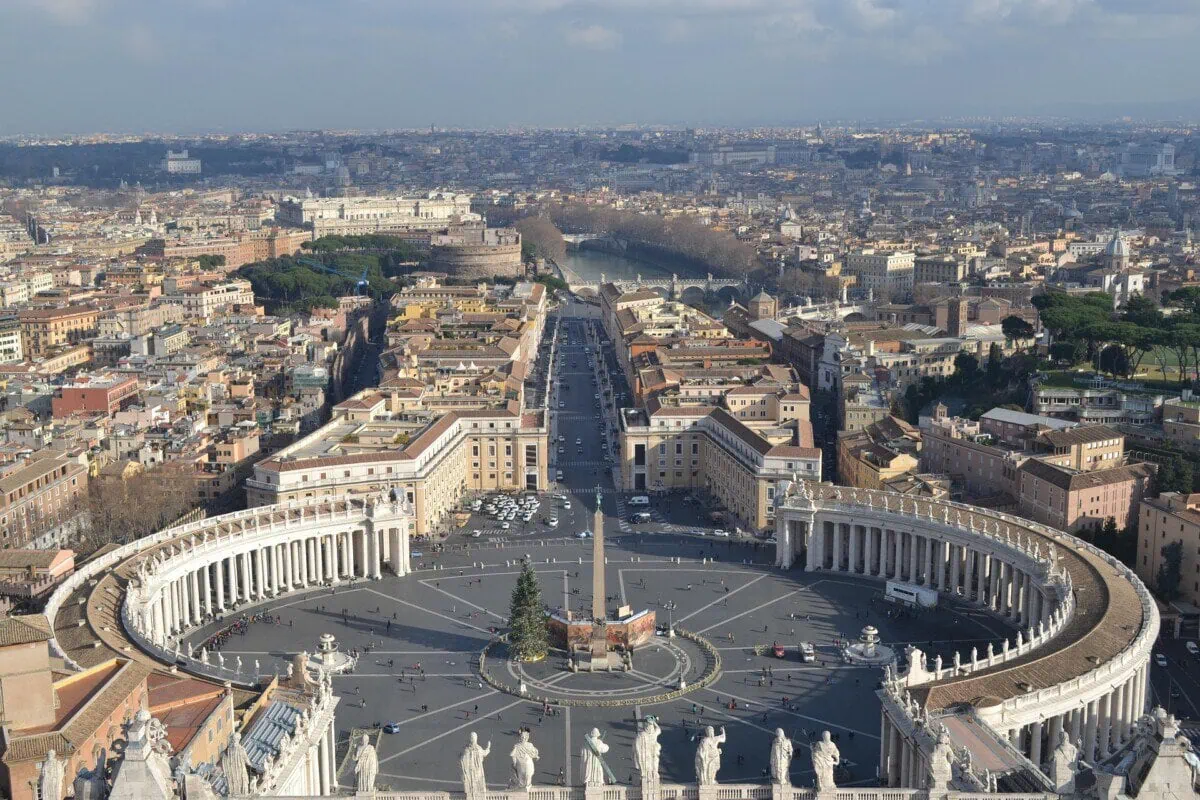
The vast oval piazza in front of St Peter’s Basilica is as much a designed monument as the church itself. Commissioned by Pope Alexander VII and completed in 1667 after eleven years of work, St Peter’s Square was designed by the Baroque sculptor and architect Gian Lorenzo Bernini, who had already created the bronze Baldachin inside the Basilica decades earlier.
Bernini’s design wraps the square in two curving colonnades, 284 travertine columns arranged four rows deep and standing 16 metres tall, topped by 140 statues of saints each over three metres high. He described the effect as the Church’s arms reaching out to embrace visitors arriving from every direction, a piece of architectural theatre as much as a practical gathering space for tens of thousands of pilgrims at once.
The colonnade hides a genuine optical trick most visitors walk straight past. Two round stone markers set into the paving, roughly level with the fountains flanking the obelisk, show where Bernini placed the two focal points of his elliptical design. Standing on either one and looking towards the nearer colonnade makes all four rows of columns appear to line up as a single row, an effect anyone can test in under a minute on the way to security.
The Pinecone Courtyard and Its Ancient Fountain
The Cortile della Pigna, the large courtyard visitors cross partway through the Vatican Museums’ one-way route, takes its name from the enormous bronze pinecone standing at one end. The Fontana della Pigna dates back to the 1st century AD, when it worked as a genuine fountain, water spouting from its tip, and originally stood near the Pantheon close to Rome’s ancient Temple of Isis.
The pinecone moved twice over the centuries: first into the atrium of the original Old St Peter’s Basilica sometime in the medieval period, then into its current spot once the courtyard itself took shape in 1608. Standing almost four metres tall, it is flanked by two bronze peacocks, both modern replicas of originals that once decorated the mausoleum of the Emperor Hadrian, now known as Castel Sant’Angelo, with the genuine ancient birds kept inside the Museums’ own Braccio Nuovo gallery.
A very different, much newer sculpture shares the same courtyard: Sphere Within Sphere, a cracked bronze globe by the Italian sculptor Arnaldo Pomodoro that reveals a second, mechanical-looking sphere fractured open inside it. It belongs to a series of similar spheres the artist placed in public spaces around the world, and its presence next to a nearly two-thousand-year-old Roman fountain sums up the Vatican Museums rather neatly: a collection that keeps adding to itself across millennia.

The Vatican Observatory: Astronomy on Papal Ground
Vatican City runs one of the world’s oldest astronomical institutions, and its origins go back further than most visitors would guess. Vatican-employed astronomers, led by the Jesuit mathematician Christoph Clavius, provided the calculations behind the 1582 Gregorian calendar reform, the same calendar most of the world still uses today, making the Church an unlikely but genuine pioneer of practical astronomy.
The Vatican Observatory in its current form, known in Italian as the Specola Vaticana, was formally re-founded by Pope Leo XIII in 1891, partly as a deliberate answer to critics who claimed the Church stood opposed to science. Growing light pollution in Rome forced the telescopes out of the city in 1935, to the papal summer residence at Castel Gandolfo in the Alban Hills, where the Observatory is still based and still run by Jesuit priest-astronomers today.
Rome’s skies eventually grew too bright even for Castel Gandolfo, so in 1993 the Observatory dedicated a second research telescope, the Vatican Advanced Technology Telescope, on Mount Graham in Arizona, run jointly with the University of Arizona. Guided tours of the historic Castel Gandolfo site run periodically for the public, a genuinely under-visited add-on for anyone with extra time in the wider Rome area beyond the Vatican’s museums and churches.

Rupert’s Handy Travel Tips
Planning a visit to Vatican City? Here are a few useful tips to make the day run smoothly.
- Book Vatican Museums tickets online, always: the small extra cost over a walk-up ticket is easily worth avoiding queues that can run past two hours in peak season.
- Cover shoulders and knees before you arrive: staff do turn people away at the door, so pack a scarf or light layer even in summer.
- Don’t confuse the two entrances: St Peter’s Basilica and the Vatican Museums are entered from opposite sides of the Vatican walls, with separate queues and separate tickets.
- Carry ID for the Museums: tickets are nominative, so bring a passport or photo ID, especially if you’re travelling with a reduced-price or children’s ticket.
- Aim for opening time or the last two hours: both the Basilica and the Museums run noticeably calmer at the edges of the day than around midday.
- Skip the free last Sunday if you want it quiet: it is genuinely the busiest day of the month at the Museums, so paying to visit on any other day is usually the better trade.
- Book the dome climb early in the day: queues build steadily through the morning, and there is no lift all the way to the top regardless of which ticket is bought.
Want to meet the reindeer behind our travel tips? Find out more in our page Who is Rupert?.




Frequently Asked Questions About Visiting Vatican City
Is St Peter’s Basilica free to visit?
Yes, entry to the Basilica itself is free, though queues for the security check can still run long at busy times. Only the dome climb charges a separate fee.
Do I need to book Vatican Museums tickets in advance?
It is not strictly required but is strongly recommended, since walk-up queues can run to two hours or more in peak season, and online booking guarantees a timed entry slot.
What is the dress code for the Vatican?
Shoulders and knees must be covered at both St Peter’s Basilica and the Vatican Museums, ruling out sleeveless tops, shorts and short skirts for men and women alike, and hats should be removed before entering the Basilica.
Can I take photos in the Sistine Chapel?
No. Photography and filming are banned inside the Sistine Chapel, and attendants also enforce a rule of near-silence throughout the visit.
How do I see the Pope in person?
The Wednesday general audience requires a free ticket booked in advance, while the Sunday Angelus, when the Pope typically appears briefly at a window overlooking St Peter’s Square, needs no ticket at all.
Is Vatican City free to enter on the last Sunday of the month?
The Vatican Museums and Sistine Chapel are free on the last Sunday of each month, though this is also by far the busiest day of the month there. St Peter’s Basilica is free to enter every day regardless.
How do I get to Vatican City from central Rome?
The metro is usually simplest, with Line A stopping at Ottaviano-San Pietro and Cipro, both within easy walking distance of the Basilica or Museums. Several bus routes and a regional train to Roma San Pietro station also serve the area.
Do I need ID to enter the Vatican Museums?
Tickets are nominative, so officially a passport or photo ID should be carried to match the booking, particularly for reduced-price and children’s tickets, though enforcement at the door is inconsistent.
Can I attend Mass at St Peter’s Basilica?
Yes. Daily Mass runs at several altars through the day with no ticket or booking needed, and confession is available in multiple languages including English on a walk-in basis.
Is there anywhere to send a postcard from the Vatican?
Yes, the Vatican Post Office inside the Museums complex sells Vatican stamps and franks post with a genuine Vatican postmark, and a Vatican Pharmacy nearby can also be used by non-residents with a short-stay pass and valid prescription.
Further Reading & Related Guides
Travellers flying into Rome should check our Terravision Review for coach transfers from Fiumicino Airport into the city centre, and once you’re booking onward trains beyond the Vatican, our Train Booking Apps guide rounds up the platforms worth having installed.
Anyone treating Rome as one stop on a longer Italian rail trip should compare our Interrail Italy Pass guide, built around the high-speed network linking Rome to Florence, Milan and Venice, against our Italia in Tour Pass guide, which focuses on slower regional trains for a more relaxed style of travel.
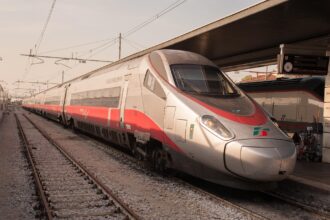
Travellers who want the speed of Italy’s fastest trains without committing to a full multi-country pass should instead look at our Trenitalia Pass Italy guide, which covers Frecciarossa and Frecciargento services between Rome and cities such as Florence, Milan and Naples.
Anyone timing a trip around a specific date should also read our Travelling at Easter guide, since the Vatican’s Easter Sunday blessing draws some of the largest crowds of the year to St Peter’s Square.