Reviewed by our editorial team Published
Innsbruck is the only Alpine capital in Europe where the ski slopes are genuinely visible from the Christmas market stalls, and that single fact shapes almost everything about a festive visit here. The Nordkette range rises almost vertically above the old town’s rooftops, close enough that the illuminated Golden Roof and the snow-capped peaks behind it appear in the same photograph without a zoom lens.
Rather than one central square, Tyrol’s capital spreads its festive season across seven separate markets, from the cobbled lanes of the medieval old town to a mountainside terrace reached by funicular. Some are compact and traditional, built around Glühwein and handmade decorations, while others lean into Innsbruck’s identity as a genuine winter sports city rather than just another pretty backdrop.
What genuinely sets Innsbruck apart from Vienna, Salzburg or the flatter German market towns is that a visitor can browse stalls beneath the Golden Roof in the afternoon, then ride a cable car up to a market with panoramic Alpine views before dinner. Few other European cities let a Christmas market trip double as a proper mountain excursion within the same few hours.
The season runs across a layered calendar rather than one fixed window. Most of Innsbruck’s markets open between 13 and 25 November 2026, with several running through to 23 December and the longer-running markets continuing to 6 January 2027, so the exact dates worth planning around depend on which markets a visit is built around.
This guide covers each of Innsbruck’s seven markets and what makes them different, the food and drink worth seeking out, how to combine a market visit with a day on the slopes, whether Innsbruck works as a day trip from Munich or Salzburg, and the practical detail of getting there, getting around and staying warm.
Innsbruck’s Christmas Markets at a Glance
| Market | Location | Typical Dates (2026/27) | Best For |
|---|---|---|---|
| Old Town | Herzog-Friedrich-Straße, beneath the Golden Roof | 13 Nov to 23 Dec | The classic, most traditional market |
| Maria-Theresien-Straße | Innsbruck’s main shopping boulevard | 25 Nov to 6 Jan | Mountain views and international stalls |
| Marktplatz | Riverside, beside the Inn | 13 to 23 Dec | Families with young children |
| Hungerburg | Mountainside, via the Hungerburgbahn funicular | 20 Nov to 6 Jan | Panoramic Alpine views |
| Wiltener Platzl | Wilten district, south of the centre | 20 Nov to 23 Dec | A small, local, artisan atmosphere |
| St Nikolaus | Hans-Brenner-Platz, across the Inn | 20 Nov to 23 Dec | A quieter neighbourhood market |
| Bergisel | At the base of the Bergisel ski jump | 13 to 20 Dec | Combining with a ski jump visit |
The Old Town, Maria-Theresien-Straße and Marktplatz markets sit close enough together to walk between in an afternoon, while Hungerburg, Wiltener Platzl, St Nikolaus and Bergisel each require a short tram, bus or funicular ride. A guided walking route linking all seven covers roughly seven kilometres and takes around four hours at an easy pace, though most visitors pick three or four rather than attempting the full circuit in one go.
Old Town Christmas Market Beneath the Golden Roof
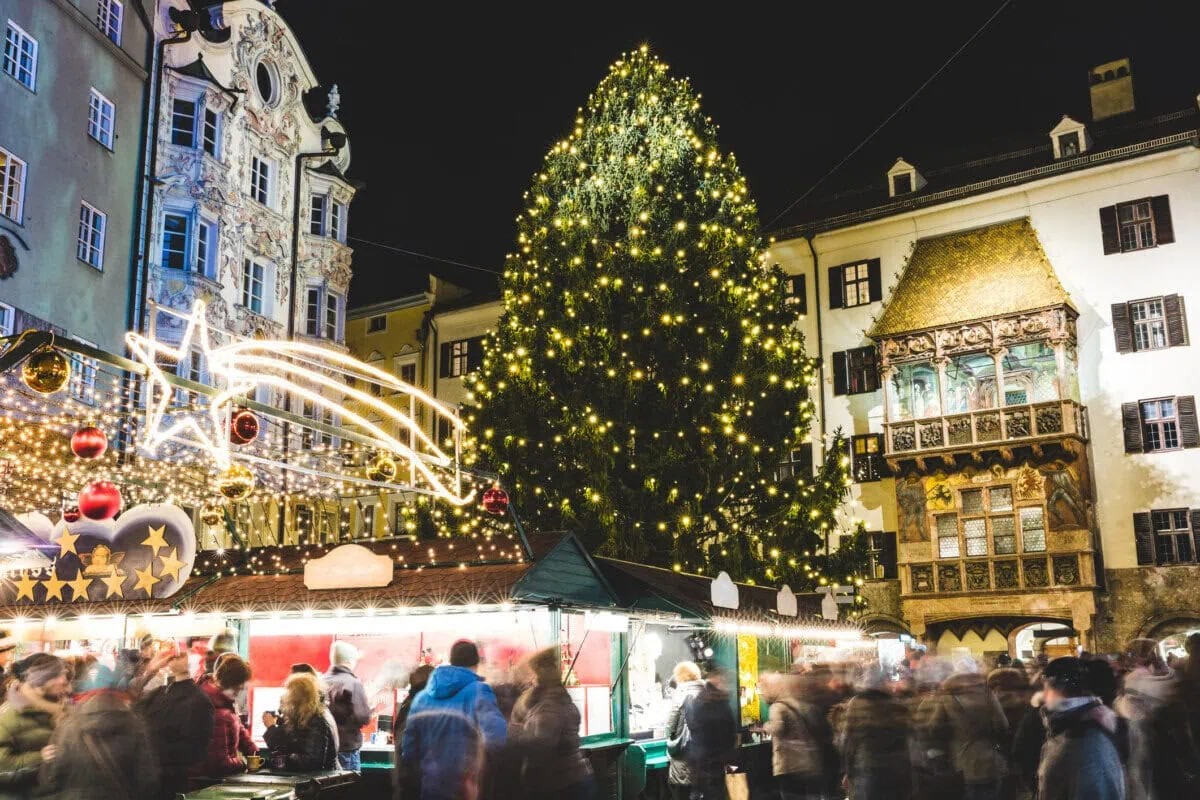
Innsbruck’s oldest and largest Christmas market fills Herzog-Friedrich-Straße, the narrow, arcaded street that leads directly to the city’s most famous landmark. The Golden Roof, a late-Gothic balcony covered in more than 2,600 gilded copper tiles, sits at the end of the market and forms the backdrop for almost every photograph taken here after dark.
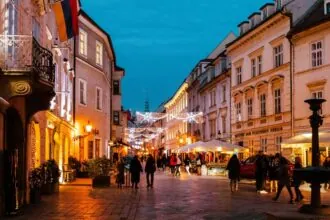
Around a hundred wooden stalls line the medieval street, selling hand-carved ornaments, wool goods, candles and Tyrolean crafts beneath the pastel-coloured facades of the old town’s merchant houses. A towering, illuminated Christmas tree usually stands at the market’s centre, and the street’s arcades mean much of it stays sheltered from light snow.
This is the market most first-time visitors head for, and it earns the reputation: the combination of a genuinely historic setting, a compact walkable layout and the Golden Roof itself makes it Innsbruck’s equivalent of Salzburg’s Domplatz or Vienna’s Rathausplatz. It typically opens from 13 November and runs daily until 23 December, from 11am to 9pm.
Because it sits inside the pedestrianised old town, there is no need for transport once arriving in central Innsbruck. Most visitors combine it with the neighbouring Marktplatz market and a short walk to Maria-Theresien-Straße, treating the three central markets as one continuous evening’s browsing before deciding whether to venture further out to Hungerburg or Wiltener Platzl.
Best for two or three nights. The widest choice of rooms, with filters for free cancellation and included breakfast.
View staysBest for longer stays. Whole apartments and houses, so you are not eating out three times a day.
View rentalsBest if you have already picked a hotel. Checks the big booking sites for the same room and shows who is cheapest.
Check dealsMaria-Theresien-Straße Christmas Market
A short walk south of the old town, Innsbruck’s grand baroque boulevard hosts a market with a noticeably different character from the medieval lanes nearby. Wide and open rather than narrow and arcaded, Maria-Theresien-Straße gives stallholders and visitors far more room to spread out, and its straight sightline delivers one of the city’s best views of the Nordkette mountains rising directly behind it.
The stalls here lean more international than the Old Town market, with vendors selling gifts and specialities described locally as coming from five continents alongside the usual Tyrolean crafts and mulled wine. It tends to draw a slightly different crowd too, mixing shoppers heading between the boulevard’s department stores with visitors there purely for the market.
It is also the longest-running of Innsbruck’s central markets, typically opening from around 25 November and continuing through to 6 January, well past the point most of the smaller markets have closed for the season. Daily hours generally run from 11am to 9pm, making it a reliable option for visitors arriving in the quieter week between Christmas and New Year.
The Annasäule column, a baroque monument standing at the street’s midpoint, gives the market a natural landmark to meet at, and the view up the boulevard toward the mountains is worth pausing for even without buying anything. Combined with the Old Town market a few minutes’ walk away, it forms the practical backbone of a first evening in Innsbruck.
Marktplatz Family Christmas Market
Down by the River Inn, Innsbruck’s riverside square hosts a market built specifically with children in mind, and it reads very differently from the crafts-focused stalls in the old town. A carousel, a petting area and a puppet theatre sit alongside the usual food and drink stands, and a large decorated tree, sometimes dressed with Swarovski crystal, anchors the square’s centre.
It runs a shorter season than most of Innsbruck’s other markets, typically opening on 13 November and closing on 23 December, so it is worth checking dates specifically if a visit falls in the week before Christmas. Daily hours generally match the Old Town market, from 11am to 9pm, making the two easy to combine on the same walk.
The riverside setting gives Marktplatz a more open, less crowded feel than the narrow lanes further into the old town, with views across the Inn towards the pastel-fronted houses of St Nikolaus on the opposite bank. Families staying in Innsbruck over several days often treat this as the market to return to more than once, since the children’s activities genuinely hold attention beyond a single browse.
Hungerburg Christmas Market High Above the City
Reached by the striking Hungerburgbahn funicular, whose curved glass stations were designed by Zaha Hadid, Innsbruck’s highest Christmas market sits on a mountainside terrace roughly 860 metres above sea level. The eight-minute ride up from the Congress station beside the old town is an attraction in its own right, gliding above the rooftops before delivering visitors to a market genuinely unlike anything at street level.
The draw here is the view rather than the size of the market itself: a handful of stalls sell Glühwein, regional specialities and handicrafts against a backdrop of Innsbruck’s illuminated rooftops far below and the Nordkette’s darker peaks rising immediately behind. On a clear evening, the whole Inn Valley spreads out beneath the terrace, and few Christmas markets anywhere in Europe offer a comparable panorama.
Hungerburg is one of the season’s longer-running markets, typically open from 20 November through to 6 January, with shorter hours than the central squares: roughly 1pm to 7pm on weekdays and from midday on weekends. A return funicular ticket to Hungerburg station alone, without continuing onto the higher cable cars, is considerably cheaper than the full round trip to the summit.
Because the terrace is exposed and considerably colder than the sheltered old town streets, it is worth timing a visit for a clear evening rather than a foggy or heavily overcast one, since the view is genuinely the point. Most visitors treat it as a deliberate excursion within a longer evening rather than a quick stop, allowing an hour or two to enjoy the setting properly.
Wiltener Platzl Christmas Market
South of the main old town, in the district of Wilten, a small square hosts one of Innsbruck’s more understated markets, and it rewards visitors willing to venture slightly beyond the obvious central stops. Wiltener Platzl is noticeably quieter than the Old Town or Maria-Theresien-Straße markets, with a genuinely local feel rather than a coach-tour atmosphere.
The stalls here focus heavily on handcrafted items, from woodwork to knitted goods, and several regular visitors rate the craft quality above the busier central markets even if the setting is far less dramatic. It sits close to the baroque Wilten Basilica, one of Tyrol’s most significant churches, giving the market an attractive backdrop of its own.
Opening hours run shorter than the central markets, typically from 4pm to 8pm daily between 20 November and 23 December, reflecting its smaller, more evening-focused character. It is reachable by tram from the old town in around ten minutes, making it an easy addition to an evening that starts at the more central markets rather than a destination in itself.
St Nikolaus Christmas Market
Across the River Inn from the old town, the St Nikolaus district hosts a small neighbourhood market at Hans-Brenner-Platz, named after the same saint whose feast day on 6 December is still celebrated across Austria with costumed processions. It is among the least visited of Innsbruck’s seven markets, which is precisely its appeal for anyone who has already seen the busier central squares.
The pastel-fronted houses along this stretch of the riverbank, sometimes called the “Inn Bank” district, form a genuinely photogenic setting once the market’s lights come on after dark. Stalls here are modest in number but locally run, and the atmosphere is closer to a village gathering than a tourist attraction.
It runs from 20 November to 23 December, with notably short daily hours of around 4pm to 9pm, reflecting a market built for locals finishing work rather than daytime visitors. Combined with a walk along the riverbank back toward Marktplatz, it makes a quiet, uncrowded final stop for an evening that began among the crowds beneath the Golden Roof.
Bergisel Christmas Market at the Ski Jump
Innsbruck’s most unusual market sits at the base of the Bergisel ski jump, the dramatic curved structure designed by Zaha Hadid that has hosted Olympic and World Cup ski jumping events since the city’s two Winter Olympics. It is a short tram ride south of the centre, and the setting alone makes it worth the trip even before browsing a single stall.
The market itself is compact, with a handful of stalls selling drinks and Tyrolean food beneath the enormous white tower rising above them, but the real draw is combining it with a ride up to the ski jump’s viewing platform, which offers its own panorama across Innsbruck and the surrounding peaks. Few Christmas markets anywhere pair so directly with a genuine winter sports venue.
It runs the shortest season of Innsbruck’s seven markets, typically only from 13 to 20 December, with limited weekend-focused hours: Friday afternoons and fuller Saturday and Sunday opening. Anyone visiting outside that narrow window will find the ski jump itself still open as a standalone attraction, just without the market stalls around its base.
Best for long or awkward journeys. Builds one itinerary out of separate flights.
View flightsBest for anyone whose home plan charges by the megabyte abroad. Pay a fixed price up front.
Check eSIMsBest when public transport has stopped, or when you are travelling with children and bags.
Book a transferThe Nordkette Cable Car and Innsbruck’s Mountain Backdrop
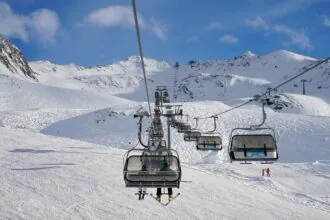
What separates an Innsbruck Christmas trip from almost anywhere else in Europe is how directly the mountains intrude on the city itself. The Nordkette range rises more than 2,300 metres above the old town in barely four kilometres, and the three-stage cable car system, the Hungerburgbahn, Seegrubenbahn and Hafelekarbahn, climbs from the market stalls to genuine high-alpine terrain in around twenty minutes.
A round-trip ticket all the way to Hafelekar, the top station at over 2,300 metres, costs around €40 (£34/$43) for an adult, while a shorter round trip to Seegrube, the middle station, costs closer to €31 (£27/$33). Both are considerably more than a Hungerburg-only ticket to the Christmas market terrace, but the additional stages reach genuine ski terrain rather than just a viewpoint.
Allowing two to three hours for the full round trip, rather than treating it as a quick add-on to an evening at the markets, is worth building into any itinerary. Even in December, when the lifts run primarily for skiers rather than sightseers, the platform at Seegrube gives an unobstructed view back down over the illuminated old town and the Inn Valley beyond it.
Food and Drink at Innsbruck’s Christmas Markets
Glühwein, Austria’s spiced mulled wine, is the drink every Innsbruck market is built around, typically costing around €4 to €5 (£3 to £4/$4 to $5) per cup and served in a souvenir mug that can usually be kept for a small deposit. Some stalls also serve Jagertee, a stronger spiced tea laced with rum, particularly welcome on the exposed Hungerburg terrace.
Food leans firmly Tyrolean rather than generically Austrian. Kiachln, a fried dough pastry usually topped with sauerkraut or cranberry, is the closest thing Innsbruck has to a signature market snack, alongside Spätzle and hearty sausages, typically priced from €6 to €10 (£5 to £9/$6 to $11) per portion.
Sweet stalls sell roasted chestnuts, gingerbread and Zelten, a dense Tyrolean fruit loaf traditionally baked for Christmas, alongside the more familiar candied almonds found across Austrian markets. Handicraft stalls, particularly at the Old Town and Wiltener Platzl markets, sell wood carvings, candles and wool goods that tend to be more distinctly local than souvenir shop equivalents elsewhere in the city.
Card payment is increasingly common at the central markets, though cash remains useful at smaller stalls, particularly at Wiltener Platzl and St Nikolaus. Budgeting around €25 to €35 (£22 to £30/$27 to $38) per person for food and drink across an evening spent at two or three markets is a realistic estimate.
Carol Concerts and Other Christmas Events in Innsbruck
Beyond the market stalls, Innsbruck runs a genuine cultural programme through Advent, and its most distinctive trademark is the Turmbläser, tower brass players who perform seasonal carols and fanfares from the balcony of the Golden Roof several evenings a week. Their music drifts down over Herzog-Friedrich-Straße’s stalls, becoming a familiar signal each evening that the Old Town market has properly come alive.
The Wiltener Sängerknaben, a renowned boys’ choir based in the Wilten district and one of Austria’s most respected ensembles, perform a run of Advent and Christmas concerts each December, usually inside a church setting rather than on an open-air stage. Tickets for these concerts tend to sell well ahead of December, so checking the choir’s own listings before travelling is worth the effort for anyone building a trip around a specific date.
A costumed Christkindl procession also runs through the Old Town during Advent, with children dressed as angels and shepherds accompanying the Christ Child figure past the market stalls, a tradition that draws as many local families as visitors. The nostalgic Christkindlbahn, a decorated tram that has run through Innsbruck’s festively lit streets for more than a century, adds a further, lower-key spectacle for anyone happy to watch it pass rather than seek out a ticketed event.
Innsbruck’s parish and cathedral churches, including the baroque Dom zu St. Jakob beneath the Nordkette, typically host their own carol services and organ recitals through December, usually free to attend and open to anyone wanting a quieter counterpart to the markets outside. None of this needs advance planning beyond checking dates closer to a visit, since most of it runs as a normal part of the city’s own festive routine rather than a ticketed tourist programme.

Combining Christmas Markets With Skiing
Innsbruck is one of the very few European cities where a genuine ski day and a Christmas market evening fit into the same trip without any real travel between them. The Nordkette’s ski slopes are reachable directly from the city centre by the same cable car system that carries visitors up to the Hungerburg market, with skiing typically possible from early December depending on snowfall.
Beyond Nordkette itself, Innsbruck sits within easy reach of several larger ski areas across the wider Tyrol region, including Axamer Lizum, roughly half an hour away by bus, and the resorts around Stubai Glacier, which often has snow reliable enough for skiing even before the lower slopes open properly for the season.
A realistic day for anyone combining both looks like a morning on the slopes, a return to the city by early afternoon, and an evening spent moving between two or three of the central markets once the lifts close and the light fades. Equipment rental is widely available in the city centre, so skiing does not require arriving with a full kit.
This dual identity, genuine ski resort by day and Christmas market city by night, is what most consistently surprises first-time visitors, since few other market destinations in Europe offer anything close to lift-served skiing within the city limits rather than a coach transfer away.
Innsbruck as a Day Trip from Munich or Salzburg
Innsbruck sits close enough to both Munich and Salzburg that visitors based in either city can genuinely consider it a day trip, though doing all seven markets justice in a single visit is unrealistic. Direct trains from Munich take around two hours, run roughly every couple of hours through the day, and are operated jointly by ÖBB’s Railjet and Deutsche Bahn’s ICE services.
From Salzburg, the direct train journey runs at a similar length, making it entirely feasible to base a wider Austrian Christmas market trip in one city and add the other as a single-day excursion rather than a full relocation. Both routes arrive at Innsbruck Hauptbahnhof, a short walk from the Old Town and Maria-Theresien-Straße markets.
A realistic day trip covers the three central markets, Old Town, Maria-Theresien-Straße and Marktplatz, plus a return trip up to Hungerburg if the weather cooperates, leaving Wiltener Platzl, St Nikolaus and Bergisel for a longer stay. Anyone tempted to see all seven properly should plan on staying at least one night rather than attempting the full circuit on a day return.
Best Time to Visit Innsbruck’s Christmas Markets
Weekday afternoons and early evenings, roughly 4pm to 6pm, tend to offer the quietest window at Innsbruck’s central markets, after the daytime shopping crowd has thinned but before the busier post-dinner rush. Weekends, particularly the two before Christmas, draw noticeably larger crowds to the Old Town and Maria-Theresien-Straße markets than the smaller outlying ones.
The stretch from late November until the second week of December generally offers the best balance of a fully open season against manageable crowds, since several markets have not yet reached their busiest pre-Christmas weekends. The days immediately before 24 December are consistently the most crowded, as many of the shorter-running markets close for the season that week.
For visitors who specifically want the quietest possible experience, the outlying markets, Wiltener Platzl and St Nikolaus in particular, rarely feel crowded even on a Saturday evening, and Hungerburg’s exposed terrace naturally thins out on colder nights. Anyone prioritising the Nordkette views should also watch the weather forecast rather than the calendar, since a clear evening matters more than the day of the week.
Best for a short stop where being central matters more than the room. Dorms and private rooms both listed.
See hostelsBest arranged before you fly rather than after. Covers claim handling, plus lounge access on eligible delays.
Explore AirHelp+Best for the gap between checking out and your train. Drop bags at a shop or hotel nearby and carry on.
Store your bagsNew Year’s Eve in Innsbruck
Innsbruck’s New Year’s Eve, known locally as Bergsilvester, runs as a genuine two-day celebration rather than a single midnight event, beginning on 30 December with activities built for families and children. The following evening builds toward the main event, with much of the Old Town given over to open-air music, food stalls and a festive crowd well before midnight.
From early evening on 31 December, open-air parties take over the Hofburg forecourt and the adjoining market square, with live bands and DJs playing through to midnight for anyone after a proper street party rather than a quiet countdown. Anyone wanting a calmer evening can still enjoy the atmosphere from the edges, since the Old Town stays busy and lit rather than emptying out early.
The city also runs a Silvesterlauf, a New Year’s Eve run through the streets in the late afternoon, a popular local tradition before the evening properly begins. Striking 3D light projections illuminate several of Innsbruck’s landmark buildings through the turn of the year, adding a visual spectacle alongside the music.
At midnight, fireworks launch from high on the Nordkette, visible across much of the city and the surrounding valley rather than confined to a single vantage point, a dramatic alternative to the fireworks-over-a-square format found in most other European market cities. Anyone keen to keep going once the open-air parties wind down can find a ticketed after-party at the Congress Innsbruck venue nearby.
The markets running this late in the season, chiefly Maria-Theresien-Straße and Hungerburg, tend to stay open into the evening on New Year’s Eve itself, though exact hours shift year to year and are worth confirming close to a visit. Between the markets, the party mile and the mountain fireworks, Innsbruck’s New Year’s Eve offers a genuinely different way to close a festive trip than watching a countdown on a town-square screen.
Getting Around Innsbruck’s Christmas Markets
The Old Town, Maria-Theresien-Straße and Marktplatz markets sit within a genuinely walkable core, all reachable on foot from Innsbruck Hauptbahnhof in ten to fifteen minutes. Innsbruck’s compact centre means a car is rarely useful for the central markets and can be more hassle than it is worth given limited old town parking.
The outlying markets each need their own specific transport. Hungerburg requires the Hungerburgbahn funicular from the Congress station beside the old town, Wiltener Platzl and Bergisel are reachable by tram in around ten minutes from the centre, and St Nikolaus is a straightforward riverside walk of roughly fifteen minutes from Marktplatz.
Innsbruck’s tram and bus network, run by IVB, covers the whole city reliably, and single tickets or day passes are available from machines at most stops. Visitors staying several nights and planning to see all seven markets, or to combine them with the Nordkette cable car, may find a multi-day transport pass better value than buying single tickets repeatedly.
Shop Opening Hours and Christmas Closures in Innsbruck
Austrian shops generally follow a fairly standard working week, with most city-centre stores open from around 9am to 6.30pm or 7pm on weekdays and slightly shorter hours on Saturdays, typically closing by 5pm or 6pm. Sundays are closed by law for almost all retailers, a genuine contrast to countries with more relaxed Sunday trading, though the Christmas market stalls themselves keep trading as normal.
On 24 December, shops close considerably earlier than usual, generally by early-to-mid afternoon, to give staff and shoppers time to get home before the evening’s celebrations begin. Supermarkets often stay open a little later than smaller boutiques on this specific date, and shops inside Innsbruck Hauptbahnhof and the airport tend to keep longer hours than anywhere else in the city.
Both 25 and 26 December are public holidays in Austria, Christmas Day and Stefanitag, St Stephen’s Day, and the vast majority of shops, banks and non-market attractions close on both dates rather than just the first. 1 January is also a public holiday, so anyone expecting a normal shopping day on any of these three dates should plan around it rather than assume standard Austrian retail hours apply.
Public transport across the city, run by IVB, typically shifts to a reduced, Sunday-style timetable on 25 and 26 December and on New Year’s Day, so checking tram and bus times in advance is worth doing if travel plans fall on any of these dates. The Christmas markets remain the notable exception to all of this, generally staying open with only minor adjustments through the holiday period, since the festive programme is exactly why many visitors are in the city at that point.

Getting to Innsbruck and Where to Stay
Innsbruck Airport sits around 4km west of the city centre, with buses and taxis reaching the old town in well under 20 minutes, making it one of the more convenient airport-to-centre connections of any Alpine Christmas market city. The city’s main train station, Innsbruck Hauptbahnhof, connects directly to Munich, Salzburg, Vienna and Verona, sitting a short walk from the central markets.
Our Innsbruck Airport to the City guide breaks down the train, bus and taxi options from arrivals in full, including costs and journey times for each, worth checking before landing rather than working it out on arrival.
Accommodation in and around the old town books up quickly for the festive season, with a well-located central double room typically costing from around €130 to €185 (£112 to £159/$140 to $200) a night in December. Staying slightly further out, near the train station or across the river, is usually noticeably cheaper without adding much to the walk into the old town.
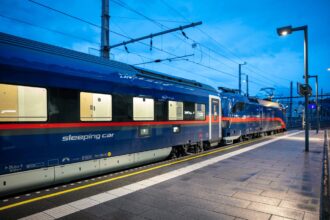
For travellers threading Innsbruck into a longer European rail trip, night trains from Innsbruck run to destinations including Amsterdam, Hamburg and Vienna, making it a practical overnight stop rather than an isolated stay. Anyone arriving specifically for skiing should also check ahead whether their chosen resort’s own transfer network connects directly with the city rather than requiring a separate booking.
Innsbruck’s December Weather
Innsbruck’s position deep in the Inn Valley, surrounded by mountains on both sides, makes its December climate colder and more genuinely alpine than lowland European market cities. Average daytime highs run from around 4°C (39°F) at the start of the month down to roughly 2°C (35°F) by New Year, with overnight lows dropping to around -3°C (27°F) early in December and closer to -5°C (23°F) by month’s end.
Snow is a realistic possibility on the ground throughout the season, particularly by mid-December, and considerably more likely here than in Vienna or the flatter German market towns given Innsbruck’s altitude and mountain setting. The Hungerburg and Bergisel markets, both more exposed than the sheltered old town streets, feel noticeably colder than the central squares even on the same evening.
Proper winter layers matter more in Innsbruck than in many other Christmas market cities, particularly for anyone planning an evening on the Hungerburg terrace or combining a market visit with time on the Nordkette. A warm coat, waterproof boots with real grip, and a hat and gloves are genuinely necessary rather than optional extras for a December evening spent moving between markets.
Typical Costs at a Glance
Pulling the numbers together from across this guide, Innsbruck’s Christmas markets themselves are free to enter, so the real budget question is food, drink, transport and accommodation rather than admission fees. The table below gathers the typical costs mentioned throughout this guide into one quick reference for anyone roughing out a budget before booking.
| Item | Typical Cost |
|---|---|
| Glühwein (mulled wine) | €4–5 (£3–4/$4–5) per cup |
| Kiachln or a market sausage | €6–10 (£5–9/$6–11) per portion |
| An evening of food and drink at two or three markets | €25–35 (£22–30/$27–38) per person |
| Nordkette cable car to Seegrube, return | €31 (£27/$33) |
| Nordkette cable car to Hafelekar, return | €40 (£34/$43) |
| Central double room per night in December | €130–185 (£112–159/$140–200) |
These figures are approximate 2026 season estimates rather than fixed prices, and actual costs can vary a little between individual stalls, operators and hotels. Even at the higher end, a couple of evenings spent browsing the markets plus one Nordkette cable car trip remains genuinely affordable set against several of Innsbruck’s pricier Alpine neighbours.

Rupert’s Handy Travel Tips
Rupert reckons Innsbruck is the one Christmas market trip where it genuinely pays to look up as often as you look at the stalls.
- Save Hungerburg for a clear evening: the view is the whole point of the trip up, and it is wasted on a foggy or heavily overcast night.
- Start central, then branch out: the Old Town, Maria-Theresien-Straße and Marktplatz markets are close enough to cover first before tackling the outlying ones.
- Keep the souvenir mug: Glühwein comes with a small deposit, and it is usually worth paying to take the mug home.
- Pack for genuine alpine cold: the Hungerburg and Bergisel markets sit fully exposed, and it is noticeably colder up there than in the sheltered old town.
- Check the ski slopes before booking: Nordkette sometimes opens for skiing before the lower resorts, so it is worth checking snow conditions ahead of a December trip.
- Don’t try to see all seven markets in one evening: three or four done properly beats a rushed circuit of every single one.
Want to meet the reindeer behind our travel tips? Find out more in our page Who is Rupert?.



Frequently Asked Questions
When do the Innsbruck Christmas markets run for 2026?
Most markets open between 13 and 25 November 2026. The shorter-running markets close on 23 December, while the Maria-Theresien-Straße and Hungerburg markets continue through to 6 January 2027.
How many Christmas markets does Innsbruck have?
Seven: Old Town, Maria-Theresien-Straße, Marktplatz, Hungerburg, Wiltener Platzl, St Nikolaus and Bergisel, each with a distinct character and its own opening dates.
Which is the best Innsbruck Christmas market for views?
Hungerburg, reached by the Hungerburgbahn funicular, sits on a mountainside terrace with panoramic views over the illuminated old town and the Inn Valley, and is Innsbruck’s highest market.
Can I ski and visit the Christmas markets in the same trip?
Yes. The Nordkette’s slopes are reachable by the same cable car system used for the Hungerburg market, so a morning on the mountain and an evening at the markets fit comfortably into one day.
Are Innsbruck’s Christmas markets free to enter?
Yes, all seven markets are free to browse. Visitors only pay for food, drink, and transport such as the funicular or tram fares to reach the outlying markets.
Is Innsbruck a good day trip from Munich or Salzburg?
Yes, both cities have direct trains taking around two hours, making the three central Innsbruck markets realistic to cover in a single day, though seeing all seven properly needs an overnight stay.
How cold does it get at Innsbruck’s Christmas markets?
Daytime highs typically run from around 4°C (39°F) in early December to 2°C (35°F) by New Year, with overnight lows regularly dropping to -3°C to -5°C (27°F to 23°F).
What food should I try at Innsbruck’s Christmas markets?
Kiachln, a fried dough pastry served with sauerkraut or cranberry, is Innsbruck’s signature market snack, alongside Glühwein, Spätzle, and the dense Tyrolean fruit loaf known as Zelten.
Further Reading
Anyone planning a wider stay should read our guide to the best things to do in Innsbruck, covering the Golden Roof, the old town’s museums and the city’s mountain railways beyond the festive season.
Combining a Christmas market trip with a few days on the slopes? Our Innsbruck Airport to Ski Resorts Transfers guide explains how to reach Tyrol’s major resorts quickly after landing.
For travellers continuing their trip overnight, our Night Trains from Innsbruck guide covers sleeper routes to Amsterdam, Hamburg and Vienna, a practical way to combine Innsbruck with other European Christmas market cities.
Innsbruck pairs naturally with a second Austrian Alpine city on the same trip. Our Salzburg Christmas Markets guide covers Mozart’s home city’s own Advent season, reachable from Innsbruck by direct train.
Comparing Innsbruck against other festive destinations before booking? Our European Christmas Markets Guide rounds up major markets across the continent by city, typical dates, and what makes each one distinctive.