Reviewed by our editorial team Updated
Hamburg is a maritime city built on water, but its real surprise is how much genuinely different scenery sits within a couple of hours of the Hauptbahnhof. Brick Hanseatic old towns, a salt-mining town that visibly leans on its own foundations, and a fashionable North Sea island are all within reach without ever needing a hire car.
Deutsche Bahn and its regional partners run almost every route in this guide on regular RE trains rather than pricier long-distance services, and several of the shorter trips are fully covered by the flat-rate Deutschland-Ticket, currently priced at €63 (£54/$74) a month. That single ticket makes an impulsive Tuesday-afternoon trip to a town most visitors have never heard of a genuinely low-risk decision. It is also the same ticket that covers Hamburg’s own U-Bahn, S-Bahn, buses and harbour ferries, detailed fully in our Hamburg Public Transport guide.
The single most popular day trip from the city is Lübeck, a UNESCO-listed brick Gothic old town less than an hour away and the historic home of German marzipan, while Lüneburg and Stade offer quieter, closer alternatives built on salt and Swedish colonial trade respectively. Bremen brings fairy-tale statues and its own UNESCO town hall a little further south, and Sylt trades old towns entirely for dunes, red cliffs and a genuinely long but rewarding day at the North Sea.
Further afield, Kiel and Travemünde add proper North Sea and Baltic waterfronts within around an hour and a half, Schwerin contributes a genuinely fairy-tale castle on its own lake, Hannover brings some of Europe’s finest baroque gardens, and Bremerhaven rounds things out with two of northern Germany’s best museums for anyone willing to give it a full day.
Below, an at-a-glance table compares journey times and transport for every destination, followed by a dedicated section on each place and a final, honest verdict on which trip suits which kind of traveller and which one genuinely does not fit into a single day.
| Destination | How to Get There | Journey Time | Suggested Time Needed |
|---|---|---|---|
| Lübeck | Direct RE1 regional express or IC from Hamburg Hbf | Around 45 to 52 minutes | Half day to full day |
| Lüneburg | Direct regional (metronom) or ICE train from Hamburg Hbf | Around 22 to 38 minutes | Half day |
| Stade | Direct erixx regional train from Hamburg Hbf | Around 33 to 41 minutes | Half day |
| Bremen | Direct ICE from Hamburg Hbf (or slower RE) | About 56 minutes by ICE, up to 1 hour 9 minutes by RE | Full day |
| Kiel | Direct RE regional or IC from Hamburg Hbf | Around 1 hour 7 minutes to 1 hour 12 minutes | Half day to full day |
| Travemünde | Direct regional train from Hamburg Hbf to Lübeck-Travemünde Strand | Around 1 hour 20 to 1 hour 28 minutes | Half day |
| Schwerin | Direct ICE or slower RE from Hamburg Hbf | About 54 minutes by ICE, up to 1 hour 26 minutes by RE | Half day to full day |
| Hannover | Direct ICE from Hamburg Hbf | Around 1 hour 10 minutes to 1 hour 27 minutes | Full day |
| Bremerhaven | Regional train from Hamburg Hbf, one change (usually at Bremen) | About 1 hour 40 minutes to 2 hours 19 minutes | Full day |
| Sylt (Westerland) | Direct Marschbahn RE6/RE6X regional train from Hamburg Hbf or Altona | About 3 hours each way | Full day, early start |
Lübeck: A UNESCO Old Town and the Home of German Marzipan
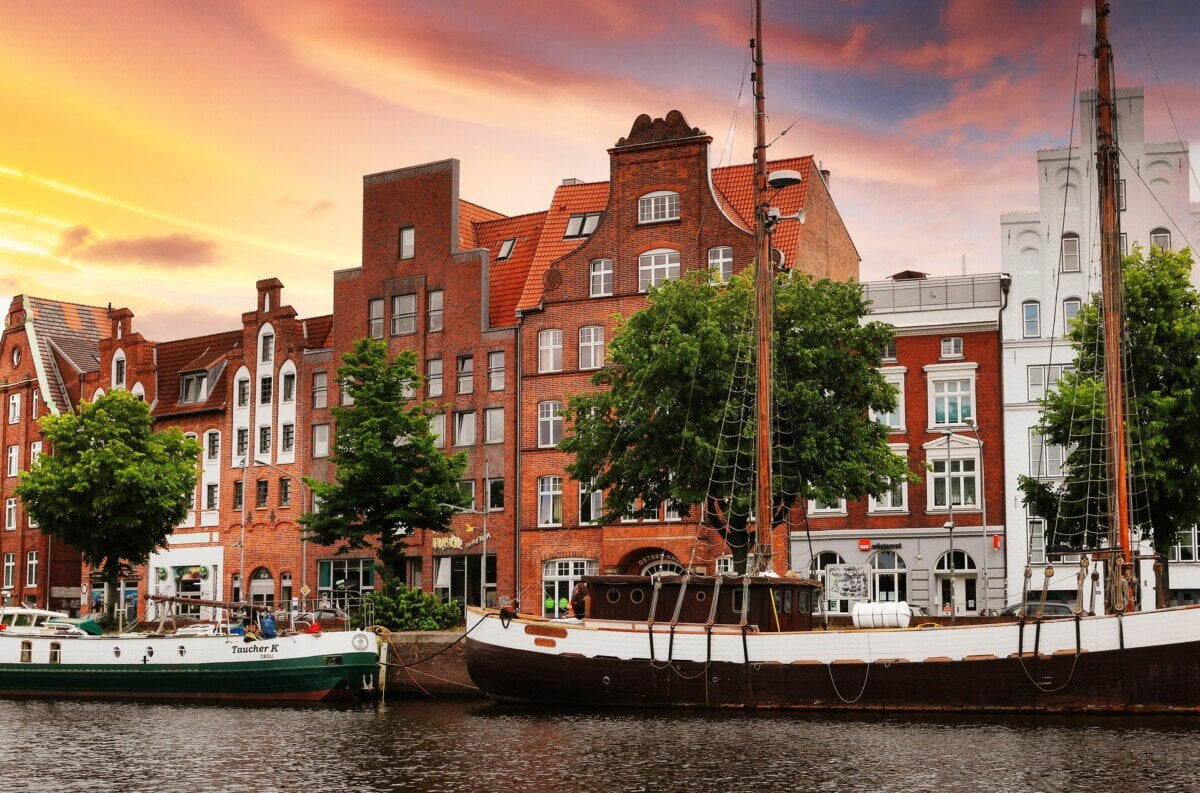
Lübeck is the closest thing on this list to stepping straight into another century. The old town sits on its own small island in the River Trave, and its skyline of brick Gothic church spires and gabled merchant houses earned the whole centre UNESCO World Heritage status in 1987.
The obvious starting point is the Holstentor, a squat, twin-towered red-brick gate that has become the unofficial symbol of the city and now houses a small museum on medieval trade, priced at €9 (£8/$11) for an adult. From there, the Marienkirche (St. Mary’s Church) holds the tallest brick vault of any church in the world, and the nearby Buddenbrookhaus celebrates Thomas Mann and his Lübeck-set novel of the same name.
No visit is complete without stopping for marzipan, and Lübeck has produced it since at least 1806, when the Niederegger family opened their café and shop opposite the town hall. It still sells dozens of shapes and flavours today, and the café upstairs is a genuinely pleasant place to sit with a coffee after a morning of walking.
Getting there is simple. The RE1 regional express runs from Hamburg Hauptbahnhof roughly every 30 minutes throughout the day, taking around 45 to 52 minutes, and the whole journey is covered by the flat-rate Deutschland-Ticket since it runs entirely on regional trains rather than ICE.
Anyone planning to visit more than one museum should pick up the Lübeck museum day ticket, priced at €14 (£12/$16), which covers every municipal museum in the city on a single day. Lübeck has its own dedicated Things to Do in Lübeck guide covering the city in full, so treat this section as a solid introduction rather than the complete picture.
A brisk half day covers the Holstentor, the old town’s main churches and a marzipan stop comfortably, while a full day allows time for the Buddenbrookhaus, a proper lunch by the harbour, and a slower wander through the quieter side streets away from the main tourist route.
Lüneburg: The Tilted, Salt-Built Hanseatic Town
Lüneburg grew wealthy almost entirely on one commodity: salt. For centuries the town held a European monopoly on the mineral, and the fortune it generated built the elaborate brick gabled merchant houses that still line its cobbled streets today.
The salt trade also left the town with a genuinely odd quirk. Centuries of underground brine extraction caused parts of the historic centre to subside, and a number of buildings, most famously the tower of St. John’s Church, now visibly lean, a small but strange detail that photographs unlike anything else on this list.
The story of that industry is told properly at the Deutsches Salzmuseum, housed in a former saltworks and covering more than a thousand years of production, priced at €10 (£9/$12) for an adult. It sits a short walk from the equally impressive Rathaus, one of the largest and most ornately decorated town halls anywhere in northern Germany.
Down by the water, the Wasserviertel is Lüneburg’s most photographed corner, centred on a distinctive old timber crane, the Alter Kran, that once loaded salt barrels onto barges bound for the Baltic. Cafés and small boat rental stands now line the same stretch of the Ilmenau river.
Reaching Lüneburg from Hamburg could hardly be simpler. Regional trains, largely run by metronom, and faster ICE services both call roughly every 20 to 30 minutes, with journey times ranging from around 22 minutes on the fastest ICE to closer to 38 minutes on a stopping regional service, the latter fully covered by the Deutschland-Ticket.
A relaxed half day is genuinely enough here, covering the salt museum, the Rathaus and a coffee in the Wasserviertel without ever feeling rushed, which makes Lüneburg an easy, low-effort choice for a first day trip out of the city.
Best for two or three nights. The widest choice of rooms, with filters for free cancellation and included breakfast.
View staysBest for longer stays. Whole apartments and houses, so you are not eating out three times a day.
View rentalsBest for double-checking. Runs the same search across several booking sites so you are not leaving money behind.
Compare pricesStade: The Quiet Hanseatic Harbour Hamburg Keeps to Itself
Where Lübeck draws coach parties and Bremen pulls in weekend city-breakers, Stade stays largely under the radar, despite having a Hanseatic pedigree every bit as genuine. It sits on the River Schwinge just west of Hamburg, and its compact old town feels closer to a well-kept secret than a headline attraction.
The centrepiece is the Alter Hafen, an old harbour basin lined with tilting half-timbered warehouses that lean gently over the water, arguably one of the most photogenic single scenes anywhere in this guide. Small cafés and a couple of galleries now occupy the ground floors of buildings that once stored grain and timber.
Stade’s other unusual chapter is Swedish rule. Sweden controlled the town for several decades in the 17th and early 18th centuries, and that occupation is the subject of the Museum Schwedenspeicher, housed in a former grain warehouse of the same name. A combined day ticket covering all three of Stade’s municipal museums costs €9 (£8/$11) for an adult.
Beyond the harbour, the old town’s narrow lanes hold a handsome brick Rathaus and a scattering of small independent shops, with none of the queues or souvenir-shop crowding found in Lübeck. It rewards unhurried wandering rather than a checklist of sights.
Getting there is easy and genuinely cheap. Regional trains run by erixx leave Hamburg Hauptbahnhof several times an hour, covering the roughly 40km route in 33 to 41 minutes, and the entire journey is covered by the Deutschland-Ticket.
A relaxed half day is plenty for the harbour, the Schwedenspeicher and a wander through the old town, making Stade an easy, low-key pairing with a slower afternoon back in Hamburg rather than a full day given over to travel.
Bremen: Fairy-Tale Statues and a UNESCO Town Hall
Unlike everywhere else in this guide, Bremen is not a small town but a proper city, and one of Germany’s own federal states in its own right. It sits a little further from Hamburg than Lübeck or Lüneburg, but a fast direct train keeps it comfortably within day-trip range.
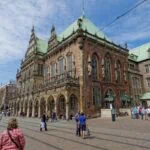
The historic heart is the Marktplatz, home to the ornately gabled Rathaus and the centuries-old Roland statue standing guard beside it, both jointly inscribed as a UNESCO World Heritage Site. Viewing the square and its facades is free, though a guided English tour of the town hall’s interior costs €9.50 (£8/$11).
Just beside the Rathaus stands the bronze Bremer Stadtmusikanten, the Town Musicians of Bremen, depicting the donkey, dog, cat and rooster from the Brothers Grimm fairy tale of the same name. It costs nothing to see and is one of the most photographed spots in the city.
A short walk away, Böttcherstraße is a narrow, unusual street of brick Expressionist architecture, commissioned in the 1920s by a wealthy coffee merchant and now home to small galleries, a glockenspiel and a scattering of independent shops. The equally distinctive Schnoorviertel, Bremen’s oldest surviving quarter, packs former fishermen’s cottages, now craft shops and cafés, into a genuinely tiny footprint.
Direct ICE trains leave Hamburg Hauptbahnhof roughly every 30 minutes, reaching Bremen in around 56 minutes, while a slower RE regional service takes closer to 1 hour 9 minutes but is fully covered by the Deutschland-Ticket, unlike the faster ICE.
Bremen’s size means it genuinely rewards a full day rather than a rushed half one, and it has its own dedicated Things to Do in Bremen guide for a fuller look at the city beyond this day-trip summary.

Compare Trains and Buses with Omio
Choosing between trains and buses is not always obvious. Some routes are faster by train, while others are cheaper or easier by bus. Omio helps you compare routes, journey times, prices, and tickets in one place.
It is useful for city-to-city travel, cross-border journeys, and trips where flexibility matters. You can quickly see which option works best for your route, budget, and schedule before booking.
Kiel: Germany’s Sailing Capital, Reached in a Morning
Sitting at the head of a long, ship-filled fjord, Kiel trades old-town charm for open water and working harbours, and it hosts Kieler Woche every June, the largest sailing event in the world, when hundreds of yachts fill the fjord and the waterfront turns into a week-long festival.
The best free activity is simply walking the Kiellinie, a long promenade tracing the fjord’s edge past ferry terminals, naval memorials and a steady procession of Scandinavian ferries heading out to sea, while the Kiel Canal locks at Holtenau reward a short detour for anyone curious how the world’s busiest artificial waterway actually works.
Kiel has its own dedicated Things to Do in Kiel guide covering the city’s museums, beaches and ferry terminals in full, so treat this as the day-trip shorthand rather than the complete picture.
Direct RE regional trains and faster IC services run from Hamburg Hauptbahnhof roughly every hour, covering the route in around 1 hour 7 minutes on the fastest IC and closer to 1 hour 12 minutes on the RE, with the regional option fully covered by the Deutschland-Ticket unlike the IC. A half day covers the Kiellinie and the fjord comfortably, while a full day allows time for a canal-side lunch and one of the city’s maritime museums.
Travemünde: Lübeck’s Own Seaside Resort, One Stop Further
Technically a district of Lübeck rather than a separate town, Travemünde sits where the River Trave meets the Baltic, and it feels like a different destination entirely: a proper seaside resort with a wide sandy beach, a promenade lined with wicker beach chairs, and one of Germany’s busiest ferry ports sending ships to Scandinavia and the Baltic states.
The Alter Leuchtturm, first documented around 1330 and rebuilt in its current form in 1539, is genuinely Germany’s oldest surviving lighthouse, and climbing it costs a modest €3 (£3/$4) for an adult ticket, with harbour and beach views that are worth the narrow stairs.
Travemünde’s ferry port is covered in full in our dedicated Travemünde ferry and cruise port guide, worth a look for anyone connecting onward to Scandinavia rather than simply visiting for the beach.
Regional trains run directly from Hamburg Hauptbahnhof to Lübeck-Travemünde Strand station, taking around 1 hour 20 minutes on the fastest services and up to 1 hour 28 minutes typically, all fully covered by the Deutschland-Ticket. Being part of Lübeck’s own district, it is the one exception on this list worth combining with another stop: pair a Lübeck old-town morning with a Travemünde beach afternoon, or treat it as its own relaxed half day.
Schwerin: The Castle That Looks Like It Escaped a Fairy Tale
Cross into Mecklenburg-Vorpommern and the reward is Schwerin, a small state capital built almost entirely around its own lake, with a castle so ornate that postcards of it are routinely mistaken for Bavaria’s Neuschwanstein by people who have never actually been to either.
The Schweriner Schloss sits on its own small island in Lake Schwerin, linked to the old town by a short causeway, and it currently houses the regional state parliament alongside a museum of period rooms, porcelain and armour. Entry to the Schlossmuseum costs €13 (£11/$15) for an adult, while the palace gardens beside it are free to wander.
The old town itself centres on the Markt and the twin-spired Schweriner Dom, a red-brick Gothic cathedral whose tower can be climbed for a rooftop view back across the castle and the lake, a genuinely different skyline from the flatter brick towns further south on this list.
Direct trains leave Hamburg Hauptbahnhof for Schwerin roughly every hour, with the fastest ICE services covering the route in around 54 minutes and slower RE regional trains taking closer to 1 hour 26 minutes, the latter fully covered by the Deutschland-Ticket. A relaxed half day covers the castle and old town comfortably, stretching to a full day for anyone who fancies a boat trip on the lake itself.
Hannover: Baroque Gardens Without the Versailles Queues
Lower Saxony’s capital rarely tops anyone’s Germany itinerary, which is precisely why Hannover is worth the detour: its Herrenhausen Gardens rank among the best-preserved baroque gardens in Europe, and they draw a fraction of the crowds of better-known equivalents further south.
The centrepiece Grosser Garten, with its geometric hedges, fountains and reconstructed palace, is combined with the neighbouring Berggarten and Schloss Herrenhausen museum on a single ticket priced at €8 (£7/$9) for an adult in the summer season. Back in the centre, the Maschsee lake and the half-timbered Altstadt around the Marktkirche round out a genuinely varied city day.
Hannover has its own dedicated Things to Do in Hannover guide for anyone planning more than a single day, with fuller coverage of the city’s museums and the wider region.
Direct ICE trains leave Hamburg Hauptbahnhof roughly every 30 minutes, reaching Hannover in around 1 hour 10 minutes on the fastest services and up to 1 hour 27 minutes on average. This is a long-distance route not covered by the Deutschland-Ticket, so budget for a standard fare, and treat Hannover as a full day given the travel time involved each way.
Best for finding routes the airlines do not sell as a single ticket. Combines carriers to bring the fare down.
Search flightsBest if you want maps and messaging working the moment you switch your phone on.
See eSIM plansBest when public transport has stopped, or when you are travelling with children and bags.
Book a transferBremerhaven: Worth the Longer Trip for Emigration History and Big Ships
The most demanding trip on this list after Sylt, Bremerhaven sits roughly an hour further north than Bremen itself, right where the River Weser meets the North Sea, and it makes its case entirely through two very different museums rather than an old town.
The Deutsches Auswandererhaus (German Emigration Center) traces the more than seven million people who emigrated to the Americas through this port between 1830 and 1974, told through genuinely moving personal stories rather than static displays, and costs €22 (£19/$26) for an adult ticket. Nearby, the futuristic Klimahaus takes visitors on a simulated journey along a single line of longitude through eight different climate zones.
Bremerhaven’s own cruise port guide covers the Havenwelten waterfront and terminal logistics in full, useful for anyone arriving by ship rather than by train.
Unlike everywhere else on this list, there is no direct train from Hamburg: regional services require a change, usually at Bremen, and the journey takes around 1 hour 40 minutes on the fastest combinations and up to 2 hours 19 minutes on slower ones. Given the travel time each way, this is honestly a full day commitment best reserved for a specific interest in emigration history or big ships, rather than a casual add-on.
Sylt: A Genuinely Long but Rewarding Day at the North Sea
Be honest with yourself before booking Sylt as a casual add-on: this fashionable North Sea island is a genuinely long way from Hamburg, and it is the one destination on this list where the travel time deserves as much thought as the destination itself.
The way there is part of the appeal. The Marschbahn, running as regional service RE6/RE6X, heads directly from Hamburg Hauptbahnhof or Altona to Westerland, crossing the Hindenburgdamm, a causeway built directly across open water and mudflats, with no bridge to the mainland for cars at all.
The journey takes around 3 hours each way, with a standard walk-up single fare costing around €33.50 (£29/$39). Because the Marschbahn is classified as a regional rather than long-distance service, both the train itself and the local buses on Sylt are covered by the Deutschland-Ticket, though car trains and ferries to the island are not.
Once there, Westerland offers the island’s main promenade and widest beach, while the village of Kampen a little further north is home to the Rotes Kliff, a striking red sandstone cliff rising above the dunes and one of the most photographed views on the whole North Sea coast.
Given a 6-hour round trip on the train alone, a single day genuinely leaves only around 4 to 5 hours on the island itself, so this is a trip for an early start on the first train of the morning rather than a leisurely late departure. Anyone wanting more than a taste of the dunes and beaches should honestly consider an overnight stay instead.
Even with the honest caveat on timing, Sylt remains worth the effort for anyone craving genuine North Sea scenery unlike anywhere else within reach of Hamburg, and the causeway crossing itself is a memorable experience before you have even reached the beach.
Which Day Trip Should You Choose?
If you only have one day to spare from Hamburg and want the classic postcard picture of northern Germany, make it Lübeck. Its UNESCO old town, Holstentor gate and marzipan tradition pack a genuine sense of history into a journey of under an hour.
Travellers who are short on time or simply want an easy, low-effort first excursion should look to Lüneburg or Stade instead. Both sit well under 45 minutes away, both work comfortably as a half day, and neither demands an early start or much advance planning.
Anyone wanting a fuller city experience, with fairy-tale statues, a UNESCO town hall and genuinely varied architecture, should give Bremen a full day rather than squeezing it in alongside something else. It is the only destination here that rewards treating the day trip almost like a mini city break.
For nature lovers and anyone chasing a genuine change of scenery, Sylt is worth the long train ride, but only with realistic expectations. Take the first train of the day, accept that the island itself gets four or five hours rather than a full one, and consider an overnight stay if the beaches and cliffs turn out to be your favourite part of the whole trip.
As a general rule, pair a relaxed, nearby half-day trip such as Lüneburg or Stade with one longer, more demanding day such as Bremen or Sylt rather than trying to fit everything into a single week, and always check the next Deutschland-Ticket-covered departure before defaulting to a pricier fast train out of habit.

Rupert’s Handy Travel Tips
Day trips from Hamburg are refreshingly easy on the whole, but a few destinations have quirks worth knowing before you set off.
- Check whether the Deutschland-Ticket covers your route: it covers the regional trains to Lübeck, Lüneburg, Stade, Kiel, Travemünde, Schwerin and the Marschbahn to Sylt, but not the faster ICE or IC alternatives on those same routes, nor the direct ICE to Bremen or Hannover.
- Buy Lübeck’s museum day ticket if visiting more than one site: at €14 (£12/$16), it covers every municipal museum in the city and works out cheaper than paying separately.
- Take the first train if heading to Sylt: the journey takes around three hours each way, so an early start protects most of your time on the island itself.
- Remember car trains and ferries to Sylt are not Deutschland-Ticket routes: only the Marschbahn train and the island’s local buses are covered.
- Book Bremen’s Rathaus tour in advance in summer: the interior is only accessible on a guided tour, and English-language slots can fill up on busy weekends.
- Wear comfortable shoes everywhere on this list: Lübeck, Lüneburg, Stade and Bremen all have genuinely cobbled old towns that are far kinder to trainers than heels.
Want to meet the reindeer behind our travel tips? Find out more in our page Who is Rupert?.





Frequently Asked Questions About Day Trips from Hamburg
What is the best day trip from Hamburg?
Lübeck is generally considered the best single day trip from Hamburg, combining a UNESCO-listed old town with a journey of under an hour on the RE1 regional express.
Is Sylt worth visiting as a day trip from Hamburg?
It can be, but be realistic about the timing: the Marschbahn takes around three hours each way, so a round trip eats up roughly six hours of a single day.
Do I need a car for any of these day trips?
No, every destination in this guide, including Sylt, is reachable by direct or near-direct regional train from Hamburg Hauptbahnhof.
Does the Deutschland-Ticket cover these day trips?
Yes for the regional trains to Lübeck, Lüneburg, Stade, Kiel, Travemünde, Schwerin and the Marschbahn to Sylt, since all run on regional RE services. The fastest ICE or IC alternatives on those same routes are not covered, and neither is the direct ICE to Bremen or Hannover, nor the regional connection to Bremerhaven that requires a change.
Is Bremen too far for a day trip from Hamburg?
No, direct ICE trains cover the route in around 56 minutes, making it one of the easier longer trips on this list despite being a full city rather than a small town.
What is Lüneburg famous for?
Lüneburg grew wealthy on salt production, and centuries of underground mining left several historic buildings, including a church tower, visibly leaning today.
Can I combine two of these destinations in a single day?
Generally not. Most of these towns sit in different directions from Hamburg, and each genuinely rewards its own dedicated visit rather than a rushed double stop. The one real exception is Travemünde, which is technically part of Lübeck’s own district and combines naturally with a Lübeck old-town visit.
Is Stade worth visiting if I have already seen Lübeck?
Yes, Stade’s old harbour and Swedish colonial history feel genuinely different from Lübeck’s Gothic grandeur, and it sees far fewer visitors as a result.
Further Reading
Landing at the airport before any of these trips? Our Hamburg Airport Transfers guide covers every realistic way of reaching the city centre from HAM, while our Best Things to Do in Hamburg guide rounds up the sights worth prioritising in the city itself before you head out on any of the trips above.
Back in the city, our Hamburg Sightseeing Cruises guide compares the harbour boat tours, our Hamburg Hop-On Hop-Off Bus Tours guide compares the sightseeing bus lines, and if you’re visiting in December, our Hamburg Christmas Markets guide covers the city’s festive markets.
For the wider picture on getting around by rail, our German Rail Tickets Explained guide breaks down the Deutschland-Ticket, regional day tickets and how they compare with buying single fares for trips like these, while our Interrail Germany Pass guide explains when a country-specific pass beats individual tickets for a longer stay.
Continuing your trip through the country’s new Germany cluster on AST? Our Best Day Trips from Nuremberg guide covers Bamberg, Würzburg and Bavaria’s own excellent day-trip country, a useful comparison if your itinerary covers both ends of Germany.