Reviewed by our editorial team Published
Why Trieste Makes a Great Base for Day Trips
Few Italian cities sit as close to another country as Trieste does. Tucked into the far northeastern corner of Italy, the city puts the Slovenian border within a short drive, opening up a range of cross-border day trips that simply are not possible from anywhere else in Italy.
Ljubljana, Lake Bled and Piran are all realistic day trips from Trieste, each under two and a half hours away, while closer to home, the limestone Karst plateau and the Roman ruins of Aquileia offer excursions that need only half a day.
Within Italy itself, Udine and the small border town of Muggia both make easy additions for anyone with a few days in the region, while Venice remains within reach for a longer, more ambitious day out.
Most of these destinations are reachable by car, bus or train, and several are commonly combined into a single day, such as Ljubljana with Lake Bled, or Grado with the ruins at Aquileia.
This guide runs through Trieste’s best day trips one destination at a time, with practical notes on getting to each one, including which trips an Italia in Tour regional rail pass can actually help with and which it cannot.
| Destination | Country | Journey Time | Best For |
|---|---|---|---|
| Ljubljana | Slovenia | ~1-1.5 hours | Slovenia’s compact, walkable capital |
| Lake Bled | Slovenia | ~2-2.5 hours | Alpine lake, island church and castle |
| Postojna Cave & Predjama Castle | Slovenia | ~1-1.25 hours | Karst cave system and cliffside castle |
| Piran | Slovenia | ~1-1.5 hours | Venetian-Gothic coastal town |
| Umag & Rovinj | Croatia | ~2-2.5 hours | Istrian coast towns, best by tour |
| Udine | Italy | ~1 hour | Friulian piazza and castle hill |
| Grado & Aquileia | Italy | ~45 min-1 hour | Lagoon beach town and Roman ruins |
| Muggia | Italy | ~20-30 minutes | Easy half-day, last town before Slovenia |
| Karst Plateau | Italy | ~15-30 minutes | Wine, caves and WWI trail sites |
| Duino Castle | Italy | ~20-25 minutes | Clifftop castle and the Rilke Trail |
| Venice | Italy | ~2 hours | A longer, more ambitious day out |
Ljubljana: Slovenia’s Compact Capital
Ljubljana is around an hour to an hour and a half from Trieste by car or direct bus, making Slovenia’s capital one of the most popular cross-border day trips from the city and a genuinely common pairing with Trieste on a wider Italian itinerary.
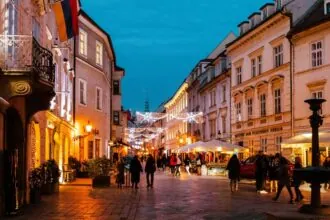
The city is small enough to see comfortably on foot in a day, centred on the dragon-flanked Dragon Bridge and a hilltop Ljubljana Castle reached by funicular, with a relaxed riverside café culture along the Ljubljanica.
Direct buses and organised day tours both run regularly from Trieste, and the border crossing itself is a formality within the EU’s Schengen area, adding no real friction to the journey.
Ljubljana is often combined with Lake Bled as a single, longer day trip, since the lake sits a further hour or so beyond the capital, making an early start worthwhile for anyone planning to see both.
An Italia in Tour rail pass will not help on this particular trip: it covers only Italy’s own regional trains, and there is no direct rail link from Trieste into Slovenia along this route, so the bus or a self-driven car remains the only practical option.
For a first taste of Central Europe beyond Italy, Ljubljana’s pastel façades, open-air markets and laid-back café terraces make it feel like a smaller, quieter cousin of Prague or Vienna, without the crowds.
Best for two or three nights. The widest choice of rooms, with filters for free cancellation and included breakfast.
View staysBest for families, or any stay past about four nights. A kitchen and a washing machine start paying for themselves.
Browse rentalsBest as a last check before booking. Compares hotel rates across several sites in one search.
Compare ratesLake Bled: An Alpine Postcard
Around two to two and a half hours from Trieste, Lake Bled is Slovenia’s best-known natural sight, a glacial lake with a tiny island church and a clifftop castle looking down over the water.
Given the distance, Lake Bled works best either as an organised day tour from Trieste, often paired with Ljubljana, or as a longer self-driven day for anyone comfortable with a full day on the road.
The island church is reached by traditional wooden pletna boats, and the short but steep climb up to Bled Castle gives one of the best views over the lake and its surrounding mountains.
Because the round trip eats up a significant part of the day, an early departure from Trieste makes a real difference to how much time is actually spent at the lake itself.
As with Ljubljana, an Italia in Tour pass offers nothing here, since Slovenian trains fall outside its network entirely and Bled itself is not directly served by rail in any case, even from Ljubljana.
Few views in Europe match the island church bell ringing out across still water with the Julian Alps behind it, a genuine bucket-list image that photographs rarely oversell.
Postojna Cave and Predjama Castle
Around an hour to an hour and a quarter from Trieste, Postojna Cave is one of Europe’s largest and most visited show caves, a vast karst system where an underground train carries visitors several kilometres into the mountain before a guided walk continues on foot.
The cave’s passages, chambers and eerie olm salamanders, blind cave-dwelling amphibians found almost nowhere else on earth, make it a strikingly different day out from anything on offer back in Trieste itself.
Around nine kilometres away, Predjama Castle is built directly into the mouth of a cliff cave, widely described as the largest cave castle in the world, with a history tangled up in the legend of a rebellious medieval robber baron.
A seasonal shuttle links the two sites for visitors holding a combined ticket, and pairing them into one day makes efficient use of the drive out from Trieste rather than returning twice.
There is no direct train to Postojna from Trieste, so an Italia in Tour rail pass will not help on this particular trip, making a self-driven car or an organised coach tour the two realistic ways to get there and back in a day.
For travellers drawn to genuinely dramatic landscapes rather than another historic piazza, the combination of an underground river system and a castle wedged into a rock face is hard to match anywhere else within reach of the city.
Piran: Slovenia’s Adriatic Coast
Piran sits on Slovenia’s short stretch of Adriatic coastline, around an hour to an hour and a half from Trieste, and offers a Venetian-Gothic old town built around Tartini Square that feels immediately familiar to anyone who has spent time in Italy.
Narrow lanes climb steeply from the harbour to the town walls, giving views back over the rooftops and out across the Gulf of Trieste towards Italy itself, a striking reminder of just how close the two countries sit.
Beyond the road connection, Piran is also reachable by seasonal hydrofoil directly from Trieste’s port, a distinctive option covered in more detail in our separate Trieste Ferry Routes Guide.
Piran makes a relaxed, easily managed day trip, particularly for anyone who prefers a coastal town to a longer inland drive towards Ljubljana or Bled.
An Italia in Tour pass will not stretch to Piran either, since the trip runs entirely by road or by sea rather than rail, though the hydrofoil crossing itself makes a memorable substitute for the drive.
Sitting in Tartini Square with the sea on three sides, it is easy to forget Piran is in Slovenia at all rather than Italy, a genuinely disorientating and rather wonderful sense of a border that barely exists.
Umag and Rovinj: A Taste of Croatian Istria
For travellers who would rather see a full slice of the Istrian coast in a single day than commit to a longer hydrofoil crossing, an organised coach day trip from Trieste covers both Umag and Rovinj in Croatia in one outing.
Umag is a smaller, more low-key resort town close to the Slovenian border, known for its marina, old town walls and a reputation as a base for tennis and cycling holidays along this stretch of coast.
Rovinj, covered in more depth in our separate Trieste Ferry Routes Guide for anyone travelling there by hydrofoil instead, adds more dramatic old town scenery, with pastel houses climbing to the Baroque bell tower of St Euphemia’s church.
Combining both towns by road rather than sea means crossing two borders in a single day, Slovenia and then Croatia, each a formality within the Schengen and EU customs arrangements that cover this corner of Europe.
There is no rail line covering this route at all, so an Italia in Tour pass is irrelevant here regardless of season, leaving an organised tour or a self-driven car as the only realistic ways to fit both towns into one day.
For a single day that genuinely spans two countries beyond Italy, this pairing packs in more variety than almost any other option on this list, at the cost of a long day mostly spent on a coach.
Udine and the Friulian Plain
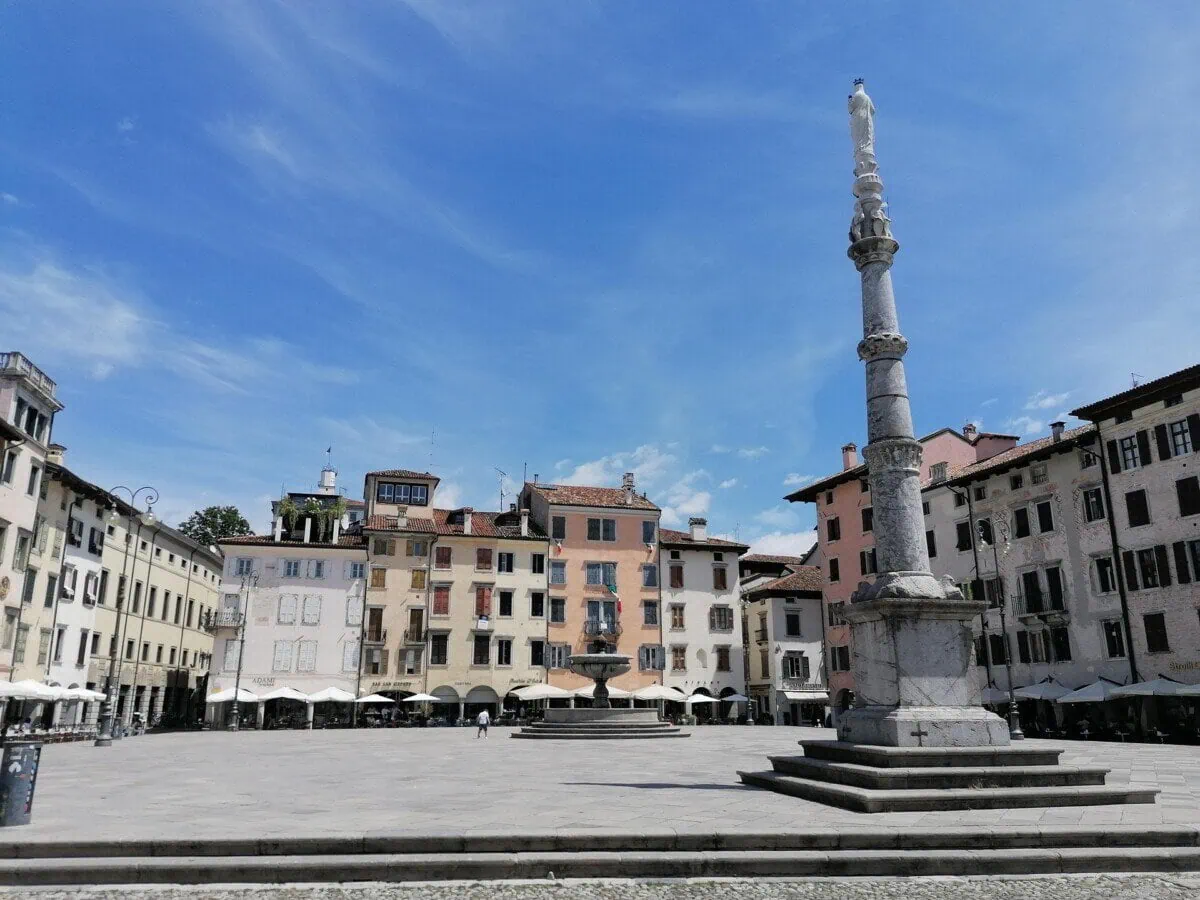
Around an hour from Trieste by car or train, Udine is the largest city in Friuli, built around an elegant Venetian-style piazza and a castle hill offering views over the surrounding plain towards the Alps.
The city’s compact centre is easily covered on foot in a day, with a noticeably different, quieter pace than Trieste itself, and it makes a good gateway for exploring the wider Friuli wine country beyond.
Direct trains run regularly between Trieste and Udine, making this one of the simplest day trips on this list logistically, with no need for a car or an organised tour.
Udine suits travellers who want a genuine taste of the Friuli-Venezia Giulia region beyond Trieste’s own Habsburg character, an easy contrast within the same short train journey.
This is one trip where an Italia in Tour pass genuinely pays off: Udine sits on Italy’s regional rail network with no exclusions affecting this corner of Friuli-Venezia Giulia, so a three-day pass at €35 (£30/$40) comfortably covers the return fare and leaves room for further regional trips besides.
Udine’s own castle hill and grand Piazza della Libertà, often called one of Italy’s finest Renaissance squares outside Venice, reward the short journey with a noticeably different pace and skyline from Trieste’s own seafront.
Getting to Postojna Cave Without a Car
Because Postojna sits roughly an hour and a quarter from Trieste with no direct train connection, the practical question for most visitors is less about the cave itself and more about how to actually get there without driving.
An organised day tour from Trieste is the simplest solution, typically combining Postojna Cave with Predjama Castle in one coach itinerary, with entry tickets, the underground train ride and a guide included in the price.
A single ticket to just the cave, bought independently once there, runs to around €35 (£30/$40) for an adult, though a combined ticket with Predjama Castle costs more and is worth it given the short distance between the two.
Public transport is possible but slow and indirect, generally involving a bus into Slovenia with at least one change, making it a realistic option only for travellers with a full day to spare and no fixed return time.
Since neither an Italia in Tour pass nor a standard Slovenian rail ticket covers this journey directly, most visitors from Trieste end up choosing between a tour and a hire car rather than public transport.
For a first visit especially, the organised tour route removes most of the friction, letting the day focus on the cave and castle rather than on cross-border timetables.
Best for finding routes the airlines do not sell as a single ticket. Combines carriers to bring the fare down.
Search flightsBest if you want maps and messaging working the moment you switch your phone on.
See eSIM plansBest after a long flight or a late landing. Price agreed before you travel, and no taxi queue.
Check transfersGrado and Aquileia
Grado, a lagoon beach town around 45 minutes to an hour from Trieste, and nearby Aquileia, a UNESCO World Heritage Roman and early-Christian archaeological site, are commonly combined into a single day trip.
Aquileia’s basilica holds one of the finest surviving Roman-era mosaic floors anywhere in Italy, spread across the length of the nave, alongside extensive archaeological ruins from its time as a major Roman city.
Grado itself offers a gentler, more relaxed contrast, with a small historic centre, a sandy beach and a lagoon setting quite different from Trieste’s rocky Adriatic coastline.
The pairing works well as a half-day of history followed by a half-day at the beach, an easy, low-effort day trip that needs no advance planning beyond a car or local bus.
An Italia in Tour pass does help here: regional trains run from Trieste to Cervignano-Aquileia-Grado station, squarely within its regional network, with a short local bus covering the final stretch into Aquileia or Grado itself.
Standing in Aquileia’s basilica with sunlight falling across mosaics laid nearly two thousand years ago, then finishing the afternoon barefoot on Grado’s sand, is about as complete a contrast as a single day trip from Trieste offers.
Muggia: The Last Italian Town Before Slovenia
Just 20 to 30 minutes south along the coast by local bus (Line 20), Muggia is the last Italian town before the Slovenian border, a small Venetian-style harbour town with a historic centre that makes an easy, low-key half-day trip.
The town’s Venetian-Gothic architecture and small fishing harbour give it a noticeably different, quieter character from Trieste itself, despite sitting only a short bus ride away around the bay.
In season, a small passenger boat also crosses the bay directly from Trieste’s port, a pleasant alternative to the bus for anyone who would rather arrive by water, though the bus runs far more reliably year-round.
There is no rail line to Muggia at all, so an Italia in Tour pass offers nothing here, and the bus fare itself is inexpensive enough that this barely matters for a single half-day trip.
Muggia’s central piazza and waterfront make a pleasant spot for a slow lunch, and the town’s proximity to the border means a short onward walk or drive into Slovenia is entirely possible for anyone wanting to extend the day.
For travellers without a full day to give over to Ljubljana or Piran, Muggia offers a genuine taste of the border region in a fraction of the time and effort.
The Karst Plateau: Wine, Caves and a WWI Landscape
Inland from Trieste, the Karst plateau (Carso) is a limestone landscape of vineyards and cave systems, reached in as little as 15 to 30 minutes by local bus or car, and a striking contrast to the city’s seafront just below it.
The plateau is home to Grotta Gigante, one of the largest tourist show caves in the world, covered in full in our separate Trieste things to do guide, alongside a scattering of seasonal osmize, small farmhouse taverns selling local Vitovska and Terrano wines directly from the producer.
The historic Tranvia di Opicina, a hybrid tram and funicular that has climbed from central Trieste up onto the plateau since 1902, is itself a scenic way to reach the area, terminating near a belvedere with sweeping views back over the gulf.
The plateau is also scattered with First World War trail sites and memorials, a legacy of the brutal Isonzo Front fighting that took place across this landscape, of real interest to anyone drawn to the region’s twentieth-century history.
Public transport covers the plateau reasonably well by local bus, but there is no rail line up here, so an Italia in Tour pass adds nothing to a Karst plateau day out.
Both Muggia and the Karst plateau suit travellers without a full day to spare, easily combined with a morning or afternoon back in Trieste itself.
Duino Castle and the Rilke Trail
Around 20 kilometres north along the coast towards Slovenia, Duino Castle sits dramatically on a clifftop, associated with the poet Rainer Maria Rilke, who wrote his Duino Elegies here during a stay at the castle.
A coastal walking path, the Rilke Trail, follows the cliffs nearby, offering some of the most striking sea views anywhere near Trieste without needing to venture far from the city.
There is no direct train to Duino itself; the nearest station, Aurisina, sits a short bus or taxi ride away, making a direct local bus from central Trieste the simpler option for most visitors.
Because the final stretch relies on a bus rather than rail, an Italia in Tour pass only partly helps here, covering the regional train as far as Aurisina but not the onward connection, so it is rarely worth buying for this trip alone.
Either way, Duino makes a far easier half-day add-on than the full trip to Venice, and pairs naturally with a coastal walk or a stop at Barcola on the way back into the city.
For travellers drawn to literary history and dramatic coastal scenery in equal measure, few half-day trips from Trieste pack in as much atmosphere for so little effort.
Venice: The Ambitious Day Trip
For a longer, more ambitious day out, Venice is reachable from Trieste in around two hours by car or by train, doable as a single day trip though it makes for a genuinely long one given the city’s own scale.
Surprisingly, the regional train to Venice Santa Lucia takes roughly the same time as the faster Frecciabianca service, since the high-speed option arrives at Venice Mestre first and requires a further connection into the historic centre.
Because of this, an Italia in Tour pass is particularly good value on this specific route: it covers the regional train in full, at a fraction of the cost of a high-speed ticket, without actually costing much time on the day.
Travellers who would rather see Venice properly, rather than rushed, may prefer to treat it as a separate overnight stop, with Trieste’s other, closer day trips filling out the rest of a regional itinerary instead.
Venice rewards even a rushed day with sights unmatched anywhere else in Italy, though the crowds around St Mark’s Square are worth bearing in mind when planning how early to leave Trieste.
Either approach works, but going in with realistic expectations about how much of Venice a single day can actually cover makes for a far less frustrating visit. For a fuller rundown of what to prioritise once there, our separate Venice Things to Do guide covers the canals, islands and landmarks in more depth.
Passport and Border Practicalities for UK and Non-Schengen Travellers
For UK travellers since Brexit, the border crossings covered above are more of a formality than genuine friction, though it helps to know exactly why. Both Slovenia and Croatia sit fully inside the Schengen area, Slovenia since 2007 and Croatia since January 2023, so there are no routine passport checks at the land border on the way to Ljubljana, Piran or the Istrian coast.
That does not mean a passport can be left behind. Border posts can still run spot checks, and a valid passport, not just a UK driving licence, remains the required document for any traveller who is no longer an EU citizen, carried at all times rather than produced only if asked.
The bigger practical point for UK passport holders is the 90 days in any 180-day period allowance that applies across the whole Schengen area as a single block, not per country. A day trip from Trieste into Slovenia or Croatia counts against the same running total as time already spent in Italy, so frequent border-hopping does not somehow reset the clock.
An additional layer, ETIAS travel authorisation, has been repeatedly delayed and was still not in force as of late 2026, with no confirmed start date. When it eventually launches, UK travellers will need to apply online before entering Schengen countries including Italy, Slovenia and Croatia, adding a small extra step ahead of any of these day trips.
Best if you would rather spend the money on the trip than on the room. Compare hostels by location and rating.
Search hostelsBest arranged before you fly rather than after. Covers claim handling, plus lounge access on eligible delays.
Explore AirHelp+Best for a day with a suitcase and nowhere to put it. Find a storage point near where you already are.
View storageBest Day Trips From Trieste Without a Car
Looking back across the destinations above, they split fairly clearly into ones that work well without a car and ones that genuinely need one. Udine and the Grado and Aquileia pairing are the simplest of all, both served by direct or near-direct regional trains from Trieste with no organised tour required.
Muggia, the Karst plateau and Duino Castle are almost as easy, each reachable by a short local bus ride, or for the Karst, the historic Tranvia di Opicina, rather than a long-distance service, making them ideal half-day options for travellers without their own transport.
Ljubljana sits in a middle category: direct buses run regularly enough to make it realistic without a car, though an organised day tour removes any timetable planning entirely, and the same applies to the seasonal hydrofoil crossing to Piran covered in our separate ferry guide, a genuinely car-free alternative to the road route.
Lake Bled, Postojna Cave with Predjama Castle, and the Umag and Rovinj pairing in Croatia are hardest to manage independently, since none has a direct rail link and public transport, where it exists at all, usually needs at least one change. An organised coach tour is the realistic default for all three rather than a genuine alternative.
Venice, reachable by regional train in around two hours, rounds out the car-free list, leaving the harder-to-reach Slovenian and Croatian interior stops as the destinations where hiring a car remains the most efficient plan.

Rupert’s Handy Travel Tips
Planning a day trip from Trieste? Rupert has a few tips that can save both time and money:
- Start early for Lake Bled: the round trip eats up a large part of the day, so extra morning time means more time at the lake itself.
- Combine Ljubljana and Bled if you’re driving: the two pair naturally into one longer day.
- Take the train to Udine: it’s one of the simplest day trips on this list, with no car or tour needed.
- Pair Grado with Aquileia: a half-day of Roman mosaics followed by a half-day at the beach works well together.
- Remember the border is a formality: Slovenia is in the Schengen area, so crossing adds no real friction to the journey.
- Check the seasonal ferry to Piran: our Trieste ferry guide covers the hydrofoil option as an alternative to driving.
- Save the Italia in Tour pass for Italian trips: it only covers regional trains within Italy, so it helps for Udine, Grado or Venice but not for Slovenia or Croatia.
- Book Postojna Cave as a tour rather than public transport: there’s no direct train, and the bus involves at least one change.
Want to meet the reindeer behind our travel tips? Find out more in our page Who is Rupert?.



Frequently Asked Questions About Day Trips from Trieste
How far is Ljubljana from Trieste?
Around one to one and a half hours by car or direct bus, making it one of the most popular day trips from the city.
Can you visit Lake Bled from Trieste in a day?
Yes, though the round trip of around two to two and a half hours each way makes for a long day, best started early.
Do you need a visa to cross into Slovenia from Trieste?
No. Both Italy and Slovenia are in the Schengen area, so the border crossing is a formality for most travellers.
What is the closest day trip to Trieste?
Muggia, the last Italian town before the Slovenian border, is around 20 to 30 minutes away and suits a half-day visit.
Is Venice a realistic day trip from Trieste?
Yes, at around two hours each way by car or train, though it makes for a long day given Venice’s own scale.
What is Aquileia known for?
A UNESCO World Heritage Roman and early-Christian site with one of Italy’s finest surviving Roman-era mosaic floors, in its basilica.
Does the Italia in Tour rail pass help with day trips from Trieste?
Only for trips within Italy on regional trains, such as Udine, Grado and Aquileia, or Venice; it does not cover Slovenia or Croatia.
How do you get to Postojna Cave from Trieste without a car?
There is no direct train, so an organised coach day trip is the simplest option, typically combined with Predjama Castle.
Further Reading & Related Guides
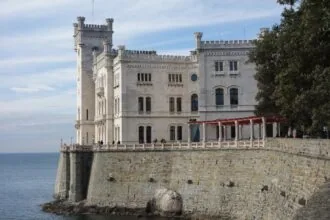
Starting your visit in the city rather than heading straight out to the border? Our Trieste Things to Do guide covers Piazza Unità, Miramare Castle and Grotta Gigante in full, useful groundwork before any of the cross-border excursions above.
Travelling into Slovenia? Our Interrail Slovenia Pass guide covers Ljubljana, Lake Bled and the Adriatic coast in more depth, and our Interrail Italy Pass guide explains the wider rail-pass options for the Italian side of a longer trip.
Arriving by sea or air? Our Trieste Ferry Port & Routes Guide and Trieste Airport Transfers guide cover getting into the city before any of these day trips begin.
Treating Venice as the ambitious day trip rather than the final stop? Our Day Trips from Venice guide flips the itinerary the other way round, setting out the mainland towns worth adding on if a longer Veneto stay follows a Trieste base.