Reviewed by our editorial team Published
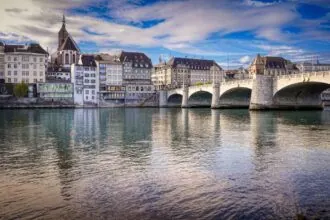
Basel occupies a genuinely rare spot on the European map, sitting almost exactly where Switzerland, France and Germany meet along the Rhine. A traveller based here can cross an international border on a regional train before finishing a morning coffee, then be spending a fourth currency by lunchtime without ever touching a motorway.
That tripoint location is what separates day trips from Basel from almost anywhere else in Europe. Most cities send visitors deeper into their own country, but Basel’s three separate rail networks mean a single day out can just as easily land in Alsace or the Black Forest as in the Swiss interior.
This guide covers ten destinations reachable by train, deliberately spread across all three neighbouring countries rather than clustering inside Switzerland. Freiburg, Titisee and Baden-Baden sit across the German border, Colmar, Strasbourg, Mulhouse and Belfort lie in French Alsace and Franche-Comté, and Lucerne, Zurich and Bern stay within Switzerland for anyone who prefers a purely domestic day out.
Basel’s own SBB, French SNCF and German DB stations sit within walking distance of each other in the city centre, an arrangement almost unheard of elsewhere on the continent. That layout, combined with EuroAirport Basel-Mulhouse-Freiburg serving all three countries from a single runway, sums up the city’s split identity rather neatly.
Every destination below is reachable without a car, and most take well under ninety minutes each way. The table underneath gives a quick comparison of journey times before the fuller detail on each destination further down the page.
Best Day Trips from Basel at a Glance
Every option below gets its own section further down the page, but this table is a quick way to compare journey times across three countries before reading on in detail.
| Destination | Journey Time | How to Get There | Best For |
|---|---|---|---|
| Freiburg im Breisgau, Germany | Around 40 minutes | Direct DB/SBB regional train | Black Forest gateway, minster and old town |
| Colmar, France | Around 55 minutes (40 minutes fastest) | Direct or one-change SNCF TER | Half-timbered old town and canals |
| Mulhouse, France | Around 26 minutes | Direct SNCF TER | Car and train museums |
| Strasbourg, France | Around 1 hour 15 to 1 hour 33 minutes | Direct TGV or TER | Cathedral and European Quarter |
| Lucerne, Switzerland | Around 1 hour to 1 hour 13 minutes | Direct SBB InterCity | Chapel Bridge and Mount Pilatus |
| Zurich, Switzerland | Around 53 minutes | Direct SBB InterCity | Old town and lakeside city break |
| Titisee and the Black Forest, Germany | Around 1 hour 25 to 1 hour 40 minutes | One change, at Freiburg | Lake, pine forest and cuckoo clocks |
| Baden-Baden, Germany | Around 1 hour 20 minutes | Direct or one-change DB ICE/IC | Roman-Irish spa and casino |
| Bern, Switzerland | Around 56 minutes to 1 hour 13 minutes | Direct SBB InterCity | UNESCO old town and Zytglogge clock tower |
| Belfort, France | Around 1 hour 5 minutes to 1 hour 19 minutes | One change, at Mulhouse | Vauban citadel and the Lion of Belfort |
Freiburg im Breisgau: Gateway to the Black Forest
Freiburg is the obvious first stop across the German border, a compact university city built around the Freiburg Minster and its famously openwork Gothic spire. Little canals called Bächle run along many streets, and the pedestrianised old town stays lively well into the evening.
Beyond the old town, Freiburg is the recognised gateway to the Black Forest, with buses and regional trains fanning out into the hills within minutes of the main station. Even a short visit gets a genuine taste of that wider region without needing to travel any further.
Trains run direct from Basel SBB or Basel Bad Bahnhof to Freiburg Hauptbahnhof on the DB and SBB regional network, with around 40 services covering the route each day. Typical journeys take about 40 minutes, with the fastest services closer to 36 minutes, and departures run at least twice an hour from early morning until late evening.
Climbing the minster tower costs around €5 (£4/$6) for adults, with the main body of the church free to enter. A half-day is enough to see the minster and wander the old town, though anyone tempted further into the Black Forest hills should plan for a full day instead.
There is a particular pleasure in wandering Freiburg once the day-trippers have thinned out, when the low sun catches the minster’s sandstone tower and turns the whole old town gold. Locals still dip their feet in the Bächle on a warm afternoon, an old superstition holding that doing so means you will one day marry a Freiburger, and the smell of fresh pretzels drifts from bakery doors along the lanes leading up to the cathedral square.
Best for a short trip. Compare rooms by neighbourhood, price and guest rating before you book.
Compare hotelsBest for longer stays. Whole apartments and houses, so you are not eating out three times a day.
View rentalsBest as a last check before booking. Compares hotel rates across several sites in one search.
Compare ratesColmar: Canals and Half-Timbered Alsace
Colmar is routinely called the prettiest town in Alsace, and the Little Venice quarter of colourful half-timbered houses along a slow canal explains why. The wider old town spreads out from there in cobbled lanes lined with flower boxes and timber-framed shopfronts.
The Unterlinden Museum, built around a former Dominican convent, is the town’s cultural centrepiece, holding the Issenheim Altarpiece alongside a wide-ranging fine art collection. Bartholdi, sculptor of the Statue of Liberty, was born in Colmar, and a small museum dedicated to him sits in the old town too.
SNCF TER trains connect Basel SBB to Colmar in around 55 minutes on average, with the fastest direct services covering it in about 40 minutes. Some off-peak journeys involve one change at Mulhouse, but there are roughly 24 direct trains among the 32 or so running each day.
Adult admission to the Unterlinden Museum costs around €14 (£12/$16), and a half-day covers the old town comfortably, with a full day better suited to anyone adding the museum and a longer lunch. Our full guide to visiting Colmar goes into far more depth on what to see.
Colmar rewards an unhurried evening walk, when lanterns reflect off the canal in Little Venice and the timber-framed houses seem to lean companionably over the water. The scent of tarte flambée and mulled wine drifts from tucked-away bistros come autumn, and even a short stroll through the flower-strewn lanes feels like stepping into a fairytale illustration rather than a working French town.
Mulhouse: Car and Train Museums Close at Hand
Mulhouse rarely tops a first-time visitor’s list, but it sits closer to Basel than almost anywhere else on this page and holds two genuinely world-class museums. The Cité de l’Automobile houses the Schlumpf collection, one of the largest car collections anywhere, including a striking run of Bugattis.
A short walk or tram ride away, the Cité du Train covers French railway history through original locomotives and carriages, a fitting stop for anyone already spending the day on the rails. Neither museum needs a full day, which makes Mulhouse easy to pair with Colmar on the same trip.
Direct SNCF TER trains link Basel SBB and Mulhouse in around 26 minutes, with services running roughly hourly throughout the day. It is the shortest cross-border hop covered anywhere on this page, barely longer than a Swiss domestic city connection.
Adult admission to the Cité de l’Automobile costs around €13 (£11/$15). Allow a half-day for one museum, or a full day if both the car and train museums are on the itinerary together.
Stepping into the Cité de l’Automobile’s cavernous main hall is a genuinely theatrical moment, rows of gleaming Bugattis lit like sculptures beneath a soaring glass roof more reminiscent of a palace than a garage. The Cité du Train has its own quieter thrill too, the hush of a vast shed broken only by the occasional creak of a century-old locomotive settling on its rails.
Strasbourg: Cathedral and the European Quarter
Strasbourg is the biggest prize on this list, and its Cathedral of Notre-Dame with its single soaring spire still dominates the skyline of the old town. The medieval Petite France quarter, laced with canals and half-timbered houses, sits within easy walking distance of the cathedral square.
Beyond the old town, the European Quarter hosts the European Parliament and Council of Europe buildings, a striking contrast of modern glass architecture against the medieval centre. It is a longer walk or a short tram ride from the cathedral, worth it only if the day allows extra time.
Trains from Basel SBB take around 1 hour 33 minutes on typical services, with the fastest direct TGV or TER trains covering it in about 1 hour 15 minutes. Roughly 24 of the 33 daily services run direct, and given the longer journey time, an early departure is worth planning for.
Climbing the cathedral’s viewing platform costs around €8 (£7/$9), while the astronomical clock’s animated show is a separate €3 (£3/$3) ticket. Strasbourg genuinely rewards a full day rather than a rushed half-day, and our Day Trips from Strasbourg guide is worth a look for anyone tempted to base a longer stay there instead.
Strasbourg is at its most atmospheric at dusk, when the cathedral’s rose-coloured sandstone glows under floodlight and the canals of Petite France turn the colour of the sky above them. In December the air fills with the smell of cinnamon and roasted chestnuts from the Christmas market stalls, a tradition the city has kept running since 1570 and still wears proudly as Europe’s oldest.
Lucerne: Chapel Bridge and Mount Pilatus
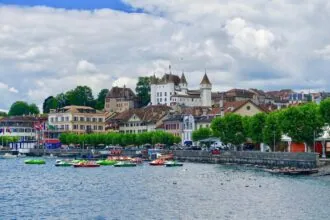
Lucerne sits on its own lake ringed by mountains, and the covered wooden Kapellbrücke (Chapel Bridge), dating back to the 14th century, is the picture most visitors already have in mind before arriving. The old town’s painted facades and small squares reward slow wandering rather than a checklist.
Above the city, Mount Pilatus is reachable by a cogwheel railway and cable car combination often marketed as the Golden Round Trip, taking in a lake steamer, the world’s steepest cogwheel railway, and a cable car down the far side of the mountain.
SBB InterCity trains run direct from Basel SBB to Lucerne, taking between 1 hour and 1 hour 13 minutes depending on the service, with departures roughly twice an hour throughout the day. No change is needed, and the whole journey stays inside Switzerland’s own rail network.
The Golden Round Trip to Mount Pilatus costs around CHF 120 (£110/€127/$145) in second class. Lucerne’s old town alone fills a half-day comfortably, but adding Pilatus turns it into a genuine full day out.
Few European views rival the one from the Kapellbrücke at first light, when mist still sits on Lake Lucerne and the snow-capped peaks beyond seem to float above the water. Church bells carry easily across the old town’s narrow lanes, and a lakeside bench with a coffee in hand is often more memorable than anything on a ticketed itinerary.
Zurich: A Swiss City Break Within Reach
Zurich is Switzerland’s largest city, and its riverside Altstadt of narrow lanes and guild houses sits directly across the Limmat from the polished shopping street of Bahnhofstrasse. Lake Zurich’s promenade adds an easy, flat walk for anyone who wants scenery without a hillside climb.
The city rewards a slower pace rather than a single headline sight, with the Fraumünster’s Chagall-designed stained glass, the Kunsthaus art museum, and a genuinely good café culture all within easy walking distance of the main station.
Zurich is the fastest genuine city-break option on this list, with direct SBB InterCity trains from Basel SBB taking around 53 minutes. Express services run once or twice an hour, and counting slower InterRegio trains too, there are typically four or five departures every hour.
Most of Zurich’s appeal costs nothing beyond wandering, though the Fraumünster’s windows carry a small entry fee of a few francs. A half-day covers the old town and lakefront easily, with a full day better suited to museum visits as well.
Zurich rewards slowing right down, whether that means watching locals swim straight off the promenade into Lake Zurich on a warm afternoon or lingering over coffee as the Altstadt’s guild houses catch the evening light. The Fraumünster’s Chagall windows cast pools of blue and gold across the stone floor inside, a small, quiet moment worth the short detour from the shopping streets outside.
Titisee and the Black Forest: Lakes, Pines and Cuckoo Clocks
Lake Titisee is the postcard image of the Black Forest, a glacial lake ringed by dense pine forest with a lakeside promenade lined with cuckoo clock shops and Black Forest gateau stalls. It leans into the tourist cliché deliberately, and most visitors enjoy it precisely because it does.
The journey itself is part of the appeal, since the final leg runs on the Höllentalbahn (Hell Valley Railway), a dramatic scenic line climbing steeply through forested gorges between Freiburg and Titisee-Neustadt.
There is no direct service from Basel, so the journey involves one change at Freiburg onto the Höllentalbahn, with a total journey time of around 1 hour 25 minutes to 1 hour 40 minutes across roughly 27 daily services. It is the longest single hop on this list, so an early start pays off.
Beyond the train ticket itself, costs stay low, with pedal boats on the lake and a cuckoo clock as the main temptations rather than any ticketed attraction. Given the change and distance, this destination works best as a full day rather than a quick half-day detour.
The Höllentalbahn climb alone is worth the trip, the train clattering through pine-dark gorges and past waterfalls before the valley suddenly opens onto the lake itself. Titisee smells of fresh pine and woodsmoke rather than a big city, and the chorus of cuckoo clocks chiming together inside the lakeside shops is the kind of small, strange delight that stays with visitors long after they leave.
Best for finding routes the airlines do not sell as a single ticket. Combines carriers to bring the fare down.
Search flightsBest for short trips. Install the eSIM at home and arrive with working data, no shop queue.
Browse eSIMsBest when public transport has stopped, or when you are travelling with children and bags.
Book a transferBaden-Baden: A Roman Spa Town
Baden-Baden has been a spa destination since Roman times, and the belle-époque Friedrichsbad bathhouse, all marble, mosaics and domed ceilings, still runs a full 17-stage Roman-Irish bathing ritual today. The elegant Casino Baden-Baden, housed in a former ducal palace, sits just across the gardens.
Outside the bathhouse, the tree-lined Lichtentaler Allee follows a small river through parkland for nearly three kilometres, and the compact old town around it is dotted with grand 19th-century hotels built for the town’s original wealthy spa visitors.
Deutsche Bahn ICE, EC and IC services connect Basel SBB or Basel Bad Bahnhof to Baden-Baden in around 1 hour 20 minutes, with about 6 of the roughly 13 daily services running direct and the rest involving one change. It sits at the far edge of a realistic day trip, so timing the return matters.
A full Roman-Irish bathing session at Friedrichsbad costs around €39 (£34/$45) and is not time-limited, though it typically takes about three hours. Between the bath and a walk along the allée, this is a destination that fills a full day easily.
There is a genuine hush inside the Friedrichsbad, all marble and steam under a domed ceiling, that makes the Roman-Irish ritual feel closer to a ceremony than a spa treatment. Outside, the Lichtentaler Allee is especially lovely in autumn, when the plane trees along the river turn gold and the grand old hotels lining it glow with the same belle-époque elegance the town has traded on for two centuries.
Bern: Switzerland’s Sandstone Capital
Bern’s Altstadt old town is a UNESCO World Heritage Site, a set of honey-coloured sandstone facades and covered arcades stretching for several kilometres through the city centre. The Aare river loops around the peninsula on three sides, keeping much of the old town free of traffic and easy to explore on foot.
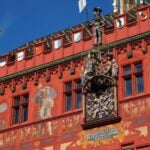
The Zytglogge clock tower marks the old town’s western gate, its 15th-century astronomical clock and mechanical figures still performing on the hour much as they always have. A short walk away, the domed Bundeshaus, Switzerland’s federal parliament building, offers free public galleries and, when parliament is not in session, free guided tours inside.
Direct SBB InterCity trains connect Basel SBB to Bern in as little as 56 minutes, with the average journey closer to 1 hour 13 minutes depending on the service. Around 35 of the roughly 71 daily trains run direct, with departures at least twice an hour throughout the day.
Entry to the Einstein House, the flat where Albert Einstein lived while developing his theory of relativity, costs around CHF 6 (£5/€6/$7) for adults. Much of Bern’s appeal beyond that, from the arcades to the hourly Zytglogge chime, costs nothing more than the train fare.
A half-day covers the old town, the Zytglogge and a walk down to the Bärengraben bear park comfortably. A full day allows time for the Bundeshaus tour and the Einstein House as well.
Bern’s sandstone Altstadt takes on a warm, honeyed glow at sunset, and standing beneath the Zytglogge just before the hour to watch its mechanical figures turn is a small ritual most first-time visitors end up repeating. On a warm day locals float lazily down the Aare in the current itself, towels and dry bags in tow, a very Bernese way of cooling off between sightseeing stops.
Belfort: A French Citadel and the Lion of Belfort
Belfort sits in the historic gap between the Vosges and Jura mountains, a strategic crossing point that made it one of France’s most heavily fortified towns. The star-shaped Citadel, designed by the military engineer Vauban, still towers over the old town from its rocky outcrop above the Savoureuse river.
Carved into the cliff below the Citadel is the Lion of Belfort, a monumental red sandstone sculpture by Bartholdi, the same sculptor behind both the Statue of Liberty and the Colmar museum mentioned above. It commemorates the town’s resistance during the 1870 to 1871 Siege of Belfort and remains the largest animal sculpture in France.
There is no direct service from Basel, so the journey involves one change at Mulhouse, with a total journey time of around 1 hour 5 minutes at the fastest and closer to 1 hour 19 minutes on typical services. Around 22 trains run the route each day, mostly SNCF TER regional trains with occasional TGV Lyria departures.
The Citadel’s grounds and ramparts are free to explore, while the History Museum ticket, which also covers access to the Lion terrace, costs around €8 (£7/$9) for adults.
A half-day is enough to see the Lion, climb through the Citadel and take in the views over the old town. Anyone adding the Cathedral of Saint-Christophe and the central squares below should allow a full day instead.
Climbing to the Citadel’s ramparts rewards the effort with sweeping views over Belfort’s rooftops toward the Vosges foothills, especially striking in the soft light of early evening. The Lion itself is more imposing in person than any photograph suggests, its huge red sandstone flanks catching the light differently through the day, and the surrounding streets have a quiet, unhurried charm rare for a town so close to a major rail junction.
Getting Around: Trains, Tickets and Cross-Border Travel
Basel’s position brings one practical requirement that most day-trip guides never need to mention. A passport or valid national ID card is needed for every destination in France and Germany covered above, even though border checks on these regional trains are usually light or non-existent.
Currency changes with the border too. Switzerland uses the Swiss franc rather than the euro used across the border in both France and Germany, so it is worth carrying or being able to withdraw both currencies before setting off, especially for cash-only stalls in smaller towns like Titisee.
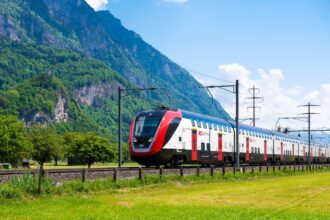
Three separate national operators run these routes: SBB within Switzerland, SNCF into France, and DB into Germany, though many cross-border services are jointly operated and ticketed as a single journey regardless of which country’s app is used to book it.
For a single day trip, a normal point-to-point ticket almost always beats any pass. Anyone planning to explore more of Switzerland itself beyond these day trips should look at the Interrail Switzerland Pass, which covers unlimited domestic travel on SBB’s network on each activated travel day.
There is something quietly thrilling about watching the language on station signage change from German to French within a single short journey, or hearing onboard announcements switch languages without anyone else on the train reacting at all. It is one of the few places in Europe where crossing a border feels genuinely unremarkable, and that everyday ease is part of what makes exploring three countries from one base so appealing.
How to Book Your Train Tickets
The SBB Mobile app is the most reliable way to check and book most of the journeys above, since it covers Swiss domestic routes and increasingly sells cross-border tickets into neighbouring France and Germany too. The German DB Navigator app and French SNCF Connect app are worth having installed as backups for their own national networks.
Comparison platforms such as Omio or Trainline are useful for checking a route across all three operators at once, particularly for the Strasbourg and Baden-Baden connections where a change of operator partway through the journey is common. Tickets are issued as mobile e-tickets on every network covered here.
Regional and TER tickets rarely need a reservation, but longer-distance TGV services to Strasbourg and ICE services to Baden-Baden can carry cheaper advance fares that sell out closer to the day. Booking a few days ahead on those two routes in particular is worth the small extra planning.
Part of the appeal of booking these trips is watching a single journey planner casually mix currencies and operators on the same results page, euros for one leg and Swiss francs for the next. It turns something as mundane as buying a ticket into a small reminder of exactly how unusual Basel’s location is, and a well-timed connection booked a few days ahead can make the whole day feel effortless rather than rushed.
Which Day Trip Should You Choose?
With ten destinations spread across three countries, the best choice from Basel depends on what the day is actually for rather than pure distance. A trip chasing alpine scenery calls for a different train than one built around a Christmas market or a family afternoon, so weighing priorities first is worth the extra five minutes.
For the shortest trip of all, Mulhouse is unbeatable at just 26 minutes on a direct SNCF TER, barely longer than crossing Basel itself. It also doubles as the best choice with children, since the Cité de l’Automobile’s sprawling car collection needs no language and holds younger visitors’ attention easily.
Lucerne takes best scenery among the Swiss options, with Lake Lucerne and Mount Pilatus delivering genuine alpine drama within an hour of Basel. Titisee and the Black Forest match it for a different mood, trading peaks for dense pine forest and a lake reached via the dramatic Höllentalbahn line.
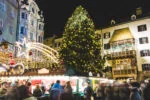
For a Christmas market visit, nothing on this list rivals Strasbourg’s, one of Europe’s oldest and largest, running through December around the cathedral and Petite France. The longer journey time is worth planning an early train for, since the market atmosphere alone can fill most of a short winter day.
The best museum trip belongs to Colmar, where the Unterlinden Museum’s Issenheim Altarpiece justifies the visit on its own, set inside a former Dominican convent. Mulhouse runs a close second with its car and train collections, so pairing the two on the same SNCF line suits a museum-focused day.
For a first visit to Alsace, Strasbourg earns the top spot over Colmar, since the cathedral, Petite France and European Quarter together give a fuller sense of the region in one trip. First-timers with less time should default to Colmar instead, whose old town needs no more than a half-day.
For a first visit within Switzerland, Lucerne wins for the Chapel Bridge alone, though Bern’s sandstone old town suits anyone short on time. Across the German border, Freiburg remains the easiest introduction to the Black Forest, reachable in around 40 minutes with no change and a properly walkable old town.
That leaves Zurich, Baden-Baden and Belfort as the trips worth returning for on a longer stay rather than a rushed first outing. Zurich suits a polished city break, Baden-Baden rewards a full day at the Friedrichsbad spa, and Belfort’s citadel appeals most to anyone drawn to Vauban’s military architecture.
The real luxury of being based in Basel is that none of these choices are final, since a different season or a spare afternoon can send a traveller down an entirely different line next time. Whether that means chasing snow above Lucerne in winter, wandering a Christmas market lit up against the cold, or simply watching the Rhine drift past on a lazy summer evening, there is always another train worth catching.

Rupert’s Handy Travel Tips
Basel’s tripoint location makes these day trips genuinely easy, but crossing three currencies and two borders rewards a little extra planning.
- Always carry a passport or ID card: every French and German destination above involves an international border, even on a short regional train.
- Carry both euros and Swiss francs: smaller towns like Titisee and Mulhouse can be light on card machines away from the main streets.
- Combine Mulhouse and Colmar: both sit on the same line out of Basel, so the car museum and the old town fit comfortably into one longer day.
- Book Strasbourg tickets ahead: the longer TGV journey carries advance fares that are noticeably cheaper than tickets bought on the day.
- Start early for Titisee and Baden-Baden: both involve the longest journey times on this list, so an early train protects the rest of the day.
- Skip the pass for a single trip: a normal point-to-point ticket is usually cheaper unless several Swiss destinations are being combined across a longer stay.
Want to meet the reindeer behind our travel tips? Find out more in our page Who is Rupert?.



Best for short city stops where being central matters more than the room. Dorms and private rooms both listed.
See hostelsBest arranged before you fly rather than after. Covers claim handling, plus lounge access on eligible delays.
Explore AirHelp+Best for the gap between checking out and your train. Drop bags at a shop or hotel nearby and carry on.
Store your bagsFrequently Asked Questions About Day Trips from Basel
What is the best day trip from Basel for a first visit?
Freiburg im Breisgau is hard to beat for a first-timer. It is only around 40 minutes away with frequent direct trains, and its minster and old town need no advance planning beyond hopping on a train.
Do I need my passport for these day trips?
Yes, for every destination in France and Germany. Switzerland sits outside the EU, so a valid passport or national ID card should be carried on every cross-border journey, even though checks on the trains themselves are usually light.
Can I visit more than one country in a single day from Basel?
Yes, and it is one of the few European cities where that is genuinely realistic. Mulhouse and Colmar sit on the same French line, so a single day can cover both without extra planning.
Is Strasbourg realistic as a day trip from Basel?
It is, though it asks for an earlier start than the closer destinations on this list. With a journey of around 1 hour 15 to 1 hour 33 minutes each way, an early outbound train protects enough time in the city.
Do I need a rail pass for these day trips?
Not usually. A single point-to-point ticket is normally cheaper for one destination, and a pass like the Interrail Switzerland Pass only pays off once several Swiss trips are combined across a longer stay.
Which currency should I carry for these trips?
Switzerland uses the Swiss franc, while both France and Germany use the euro. Carrying a small amount of both, or a card that handles conversion automatically, avoids awkward moments at cash-only stalls.
Which of these day trips is best for families?
Mulhouse works well for families thanks to the Cité de l’Automobile’s huge, easy-to-browse car collection, and the journey there is barely 26 minutes on a direct train from Basel SBB.
Can I combine Mulhouse and Colmar in one day?
Yes, easily. Both sit on the same SNCF line out of Basel, with Mulhouse only around 26 minutes away and Colmar a further short hop beyond it, making a two-town day genuinely practical.
Further Reading
Anyone flying into the region should also see our Basel Airport Transfers guide for getting from EuroAirport into the city, and pairing these train trips with a closer look at Things to Do in Basel covers the old town and museums between excursions. Visitors travelling in winter may also want our Basel Christmas Markets guide to Barfüsserplatz and Münsterplatz before heading out on the rails.
Anyone tempted to spend longer in Alsace than a single afternoon should read our full guide to visiting Colmar, which covers the old town, Little Venice and the Unterlinden Museum in far more depth than a single section here allows. Strasbourg rewards the same treatment, and our Day Trips from Strasbourg guide is a useful next step for anyone who ends up basing a longer trip there instead of treating it as a one-off day from Basel.
For the Swiss side of this trip, our Interrail Switzerland Pass guide breaks down when a multi-day pass beats buying single tickets for routes like Basel to Lucerne or Zurich. And for a wider European trip that treats Basel as just one stop among several, our Interrail Pass Guide explains how a single-country pass fits alongside the full Interrail Global Pass.