Reviewed by our editorial team Published
Geneva sits at the southwestern tip of Lake Geneva, exactly where Switzerland’s high speed rail network meets the French border, and that position is what makes day trips from the city so rewarding. Within one to three hours of leaving Geneva-Cornavin, travellers can reach Alpine villages, French lakeside towns and some of Switzerland’s most photographed castles.
This guide covers nine of the best day trips from Geneva, chosen because each one is reachable without a car and without an overnight stay. Several, including Nyon and Lausanne, barely count as a detour, while others, like Chamonix, ask for an early start but reward it with genuinely different scenery.
Geneva itself has plenty to fill a day or two before heading further afield, and our dedicated guide to things to do in Geneva covers the city’s own museums, lakefront and old town in more depth. This page picks up from there, answering the question that comes once Geneva’s own sights start to feel familiar: where the trains from Geneva-Cornavin can actually take you next.
Two-thirds of the destinations below sit inside Switzerland on the same SBB network that runs Geneva’s own buses and trams, while the remaining three cross into France on the Léman Express, a cross-border regional network that has quietly made day trips to Annecy and Chamonix far easier than they used to be. One destination, Yvoire, is reached by lake steamer rather than rail, which is worth knowing before building it into a plan.
Every section below includes a real journey time, how frequently trains or boats run, and roughly how much to budget in Swiss francs, since that is the currency most tickets and admission fees are actually charged in, even for a couple of these trips across the French border.
Best Day Trips from Geneva at a Glance
Every option below is covered in its own section further down the page, but this table is a quick way to compare journey times and decide what fits into a single day before reading on.
| Destination | Journey Time | How to Get There | Best For |
|---|---|---|---|
| Nyon | Around 15 minutes | Direct SBB regional train | Roman museum, castle & a compact lakefront |
| Lausanne | Around 40-45 minutes | Direct SBB InterCity train | Olympic Museum & a lakeside old town |
| Vevey | Around 1 hour | Direct SBB InterCity train | Chaplin’s World & the Alimentarium |
| Montreux | Around 1 hour to 1 hour 15 minutes | Direct SBB InterCity train | Chillon Castle & the lakefront promenade |
| Col du Pillon & Glacier 3000 | Around 2 hours 30 minutes to 3 hours | SBB train to Les Diablerets via Aigle, then postbus, or GoldenPass Express to Gstaad | High-altitude glacier views & the Peak Walk suspension bridge |
| Gruyères | Around 2 hours | SBB train with two changes, at Palézieux then Bulle | Medieval castle & the cheese factory |
| Yvoire, France | Around 1.5-2 hours by boat (seasonal) | Direct CGN lake steamer from Genève-Mt-Blanc | Medieval lakeside village |
| Annecy, France | Around 1 hour 30-40 minutes | Direct Léman Express L2 train, or change at Annemasse | Lake, canals & an Alpine old town |
| Chamonix, France | Around 2 hours 45 minutes to 3 hours | Léman Express to Saint-Gervais-Le Fayet, then Mont Blanc Express | Mont Blanc views & the Aiguille du Midi |
Nyon: Roman Ruins and a Castle on the Lake
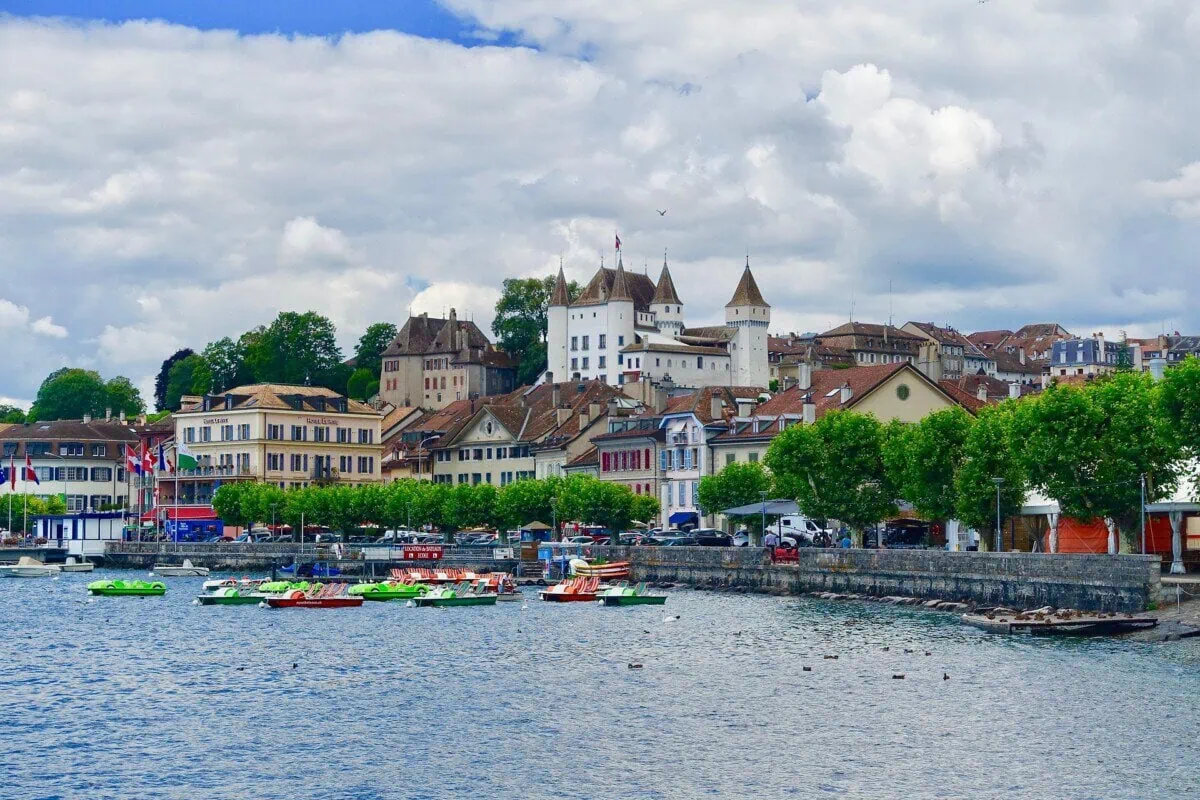
Nyon is the shortest possible escape from Geneva, and it more than earns the trip despite sitting barely fifteen minutes up the lake. The Romans founded it as Colonia Iulia Equestris, and the excavated remains beneath the main square still show the scale of the original settlement.
The Roman Museum, built directly over part of the old basilica, displays mosaics, coins and everyday objects recovered from digs across the town. Adult admission costs around CHF 12 (£11/€13/$15), and the compact size means it rarely takes more than an hour to see properly.
Above the harbour, the medieval Château de Nyon now houses a porcelain and ceramics collection, though many visitors come mainly for the view from its terrace across the lake to Mont Blanc on a clear day. The lakefront promenade below is lined with cafés and a small Saturday market that runs most of the year.
There is a genuinely unhurried feel to Nyon that is easy to underestimate on a fifteen-minute train ride. Sailing boats drift past the harbour wall below the castle, and the terraced cafés along the lakefront fill slowly through the morning with locals rather than tour groups.
That gives the town a lived-in charm some larger neighbours have traded away, and on a clear afternoon the view from the château terrace across the water to the snow-capped outline of Mont Blanc is worth the trip on its own, regardless of whether the museums are open.
Direct SBB trains leave Geneva roughly four times an hour, and the journey itself takes as little as thirteen minutes on the fastest services. There is no need to book ahead or reserve a seat for a trip this short.
A half day is genuinely enough for Nyon, which makes it an easy add-on to a longer stay in Geneva rather than a trip that needs its own dedicated day.
Best for two or three nights. The widest choice of rooms, with filters for free cancellation and included breakfast.
View staysBest for longer stays. Whole apartments and houses, so you are not eating out three times a day.
View rentalsBest as a last check before booking. Compares Geneva hotel rates across several sites in one search.
Compare ratesLausanne: Olympic Heritage and a Lakeside Old Town
Lausanne is home to the International Olympic Committee, and the hillside Olympic Museum overlooking the lake is the obvious first stop for most visitors. Interactive exhibits trace the Games from Athens 1896 through to the present, alongside genuine torches, medals and competition kit donated by athletes themselves.
Adult admission costs around CHF 20 (£18/€21/$24), and the surrounding Olympic Park, with its sculptures and lakefront lawns, is free to walk through even without a museum ticket. Allow at least two hours for the museum alone if the temporary exhibitions are of interest.
The city’s old town, built on steep terraces above the lake, centres on a Gothic cathedral often ranked among Switzerland’s finest, reached by a covered wooden staircase that has linked the upper and lower town for centuries. Place de la Palud, just below, hosts a lively market on Wednesday and Saturday mornings.
Wander beyond the cathedral steps and Lausanne rewards a slower pace, since the old town’s steep, cobbled lanes are dotted with independent bookshops, chocolatiers and small bistros that rarely make it into a guidebook. Down at Ouchy, the lakefront promenade opens out into parkland and a small harbour where the water turns a startling turquoise on a bright day, a world away from the museum crowds up the hill.
Direct SBB InterCity trains run from Geneva roughly every ten to fifteen minutes throughout the day, with a journey time of around forty to forty-five minutes. It is one of the busiest and most reliable routes in the entire Swiss network.
A full day allows time for both the museum and the old town without rushing, though a determined visitor could see the highlights of each in a longer half day.
Vevey: Chaplin’s World and the Alimentarium
Vevey is a smaller, quieter lakeside town best known today as the final home of Charlie Chaplin, who lived at the Manoir de Ban estate above the town for the last twenty-five years of his life. Chaplin’s World now occupies that estate, combining period rooms with a purpose-built studio recreating scenes from his films.
Standard adult tickets start from around CHF 30 (£27/€32/$36), though pricing varies by date, and the museum is popular enough that booking online in advance is genuinely worth doing. From Vevey station, bus 212 covers the short hop to the entrance in about fifteen minutes.
Down on the waterfront, the Alimentarium is a food museum housed in the former Nestlé headquarters, using the company’s own history as a springboard for exhibits on nutrition, agriculture and eating around the world. Adult admission costs around CHF 15 (£14/€16/$18), and it sits directly on the lakeside promenade a short walk from the station.
Vevey’s lakeside promenade has a quieter, more residential feel than its livelier neighbours, backed by vineyard-covered slopes that climb straight up from the water toward the Alps. The town’s long association with the food and chocolate industry still shows in its patisserie windows and the giant fork sculpture that rises out of the lake just offshore, a favourite spot for an evening stroll after the museums close.
Direct SBB trains run from Geneva several times an hour, with the fastest InterCity services covering the route in around one hour. Regional trains take slightly longer but run just as frequently.
Combining both museums with a stroll along the promenade fills a comfortable full day, and Vevey’s regular Saturday market, one of the largest in the region, is worth timing a visit around if the dates line up.
Montreux: Chillon Castle and the Lakefront Promenade
Montreux sits where the lake curves south toward the mountains, and its mild microclimate has made the town’s palm-lined lakefront promenade a draw since the nineteenth century. A statue of Freddie Mercury, who recorded some of Queen’s final albums at a studio here, now anchors one end of the walk.
Montreux’s stretch of shoreline is often called the Swiss Riviera for good reason, its microclimate coaxing palm trees, magnolias and even the odd fig tree into growing this far from the Mediterranean. Each July the town’s jazz festival fills the promenade and surrounding venues with music long into the evening, and even outside festival season the lakefront gardens make an easy, scenic place to linger before or after the castle.
A short walk or lake-boat ride south of the town centre, Chillon Castle is Switzerland’s most visited historic monument, its turrets rising directly out of the water on a small rocky island. Its dungeons inspired Lord Byron’s poem The Prisoner of Chillon, and his signature, carved into a pillar, is still visible today.
Adult admission to the castle costs around CHF 15 (£14/€16/$18), and the self-guided route through the great halls, chapel and battlements takes roughly ninety minutes to cover properly. The castle stays open later in summer, which makes an afternoon train from Geneva a genuinely workable option.
Direct SBB InterCity and regional trains run from Geneva throughout the day, with a typical journey time of around one hour to one hour fifteen minutes. Some services continue onward toward Gruyères, which makes an early-morning combined trip possible for energetic travellers.
A full day allows time for both the promenade and the castle without feeling rushed, though the castle alone is a satisfying half-day trip on its own.
Col du Pillon and Glacier 3000: High-Altitude Views Above the Riviera
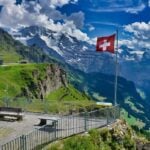
Glacier 3000 is the high-altitude cable car complex rising above Col du Pillon, a mountain pass at 1,865 metres near Les Diablerets in the Vaud Alps. From the valley station, the cable car climbs in stages to Scex Rouge, a genuine 3,000-metre summit where snow lingers even in midsummer and the view stretches across a wall of Alpine peaks.
Reaching it from Geneva takes real commitment. The most direct route is the train via Lausanne, Montreux and Aigle to Les Diablerets, followed by a connecting postbus up to Col du Pillon itself, though an alternative is the scenic GoldenPass Express to Gstaad, then the dedicated Glacier 3000 Express bus.
Either way, this is the longest day trip on this page, realistically two and a half to three hours each way, so it works best as a dedicated full day rather than a stop combined with anything else on this list. Cable cars leave Col du Pillon roughly every twenty minutes, reaching Scex Rouge in around a quarter of an hour once the connecting bus has arrived.
At the summit, the Peak Walk by Tissot is the highlight, Europe’s first suspension bridge built specifically to link two mountain peaks, with sheer drops on either side and Mont Blanc visible on a clear day. Beyond the bridge, a short glacier walk and far-reaching mountain views make the climb feel earned, even after the long journey up from the lake.
Gruyères: A Medieval Castle and the Cheese That Made It Famous
Gruyères is the destination on this list that asks for the most patience to reach, and the reward is a genuinely well-preserved medieval hilltop village that has barely changed in centuries. Its cobbled main street, closed to cars, climbs gently up to the Château de Gruyères, a fortified residence with panoramic views across the valley.
Adult admission to the castle costs around CHF 13 (£12/€14/$16), and the rooms inside mix medieval furnishings with a surprising collection of Symbolist art. Allow around ninety minutes to see the castle and its gardens properly.
At the foot of the hill, La Maison du Gruyère cheese factory lets visitors watch the region’s famous cheese being made through glass viewing windows, with wheels ageing in cellars stacked floor to ceiling. Adult admission costs around CHF 8 (£7/€8/$10), and the attached shop and restaurant make it easy to combine a visit with lunch.
Gruyères rewards the extra travel time the moment the cobbles start underfoot, with timber chalets leaning over the narrow main street, geraniums spilling from window boxes, and on a misty morning the castle’s turrets seem to float above the valley below. The wider region is properly alpine too, with green pastures dotted with grazing cows whose bells carry across the hillside, a landscape that feels far removed from Geneva’s lakeside bustle despite being reachable in a single day.
There is no direct train from Geneva, and the journey involves two changes, typically at Palézieux onto a regional S-Bahn service, then at Bulle for the final short hop. The whole trip takes around two hours each way, with connections running roughly hourly.
Given the travel time, Gruyères works best as a dedicated full day rather than a stop tacked onto another trip, ideally with an early train out and a late one back.
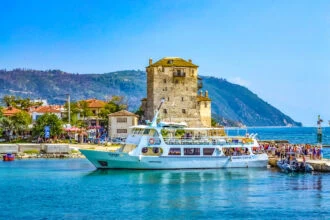
Yvoire, France: A Medieval Village on the Water
Yvoire sits directly across the lake in France, and its stone gateways, flower-covered facades and thirteenth-century castle walls have earned it a spot among France’s officially designated plus beaux villages. There is no rail line into the village, so the classic approach is by water rather than by train.
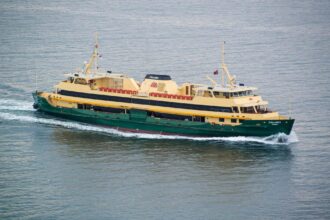
CGN, the same company that runs Geneva’s lake cruises, operates a seasonal steamer service direct from the Genève-Mt-Blanc pier, with the crossing taking somewhere between ninety minutes and two hours depending on the specific sailing and how many stops it makes along the way. Services run mainly between spring and autumn, and are far less frequent, or absent entirely, outside that window.
Inside the walls, the Jardin des Cinq Sens (Garden of Five Senses) is the main paid attraction, a series of themed gardens built within the grounds of the old castle. Adult admission costs around €12 (CHF 11/£10/$14), depending on the exact ticket chosen.
Yvoire earns its reputation as one of France’s prettiest villages the moment the ramparts come into view, its stone walls smothered in geraniums that cascade from every ledge and window frame through the summer months. Wandering the tiny lanes inside the walls, with glimpses of the lake between the buildings, feels a world away from Geneva’s business district, and the short crossing back across the water at sunset is often the best part of the day.
Outside the sailing season, the practical alternative is a train to Thonon-les-Bains or Nyon followed by a local bus, though connections are less direct and worth checking carefully before setting off. A rental car remains the simplest fallback for a winter visit.
Given the boat’s limited winter schedule, this is one destination worth checking against the season before building a whole day trip around it.
Best if you can move a day either way. Shows how the fare to Geneva changes across the month.
Compare flightsBest for anyone whose home plan charges by the megabyte abroad. Pay a fixed price up front.
Check eSIMsBest if you would rather not work out the transport on arrival. Book it now and forget it.
View transfersAnnecy, France: Lake, Canals and an Alpine Old Town
Annecy is often nicknamed the Venice of the Alps, thanks to the canals threading through its old town and the turquoise lake it sits beside. The Palais de l’Isle, a twelfth-century building perched on a small island in the middle of the Thiou canal, is the single most photographed building in town.
Adult admission to the Palais de l’Isle costs around €4 (CHF 4/£3/$5), and the interior, once a prison and courthouse, now houses exhibits on the town’s own history. The surrounding lanes of arcaded shops and flower-lined bridges reward simply wandering without a fixed itinerary.
Annecy’s old town is at its best in the early evening, when the crowds thin and the turquoise Thiou canal reflects the pastel façades and flower-strung bridges overhead. The lake itself, ringed by mountains and famously clear enough to see fish swimming several metres down, is the real draw for many visitors, and a walk or swim along its eastern shore rounds out a day that already has canals, castles and Alpine views built in.
The Léman Express L2 line runs a direct cross-border service from Geneva-Cornavin straight through to Annecy, without a change, taking around one hour thirty to one hour forty minutes, though these through-services run less frequently than the core network. Most travellers instead change at Annemasse, where regional trains to Annecy leave roughly every fifteen to thirty minutes, adding a little extra time but far more flexibility.
Our dedicated guide to things to do in Annecy covers the lake, the old town and the surrounding countryside in much more depth for anyone planning a fuller day here.
A full day is comfortable for Annecy given the journey time, and a lake cruise or a stroll along the promenade fills any time left over after the old town.
Chamonix, France: Mont Blanc and the Aiguille du Midi
Chamonix sits directly beneath Mont Blanc, western Europe’s highest peak, and it remains one of the most dramatic day trips reachable from Geneva by train despite the distance involved. The town itself is a genuine mountaineering hub rather than a manufactured resort, with a lively centre backed by glaciers visible from the main street.
The main draw is the Aiguille du Midi cable car, which climbs to an observation platform at 3,842 metres in two stages, offering views across the Mont Blanc massif and, on a clear day, as far as the Matterhorn. Adult return tickets are dynamically priced, typically running from around €65 (CHF 61/£56/$74) and higher in peak season, so booking a timed slot online in advance is strongly worth doing.
Standing in Chamonix’s centre with the Bossons Glacier visible at the end of the street is a genuinely different experience from anywhere else on this list, a reminder that this is a working mountain town rather than a lakeside resort. From the Aiguille du Midi’s summit platform, the exposed steel walkway juts out over a sheer drop, and on a clear day the panorama takes in Mont Blanc, the Grandes Jorasses and, across the valley, the distant outline of the Matterhorn.
Getting there involves two trains rather than one direct service. The Léman Express runs from Geneva-Cornavin to Saint-Gervais-les-Bains-Le Fayet in around one hour forty minutes, and the narrow-gauge Mont Blanc Express continues from there into Chamonix, adding roughly another forty-five minutes through increasingly dramatic scenery.
Altogether the trip takes around two hours forty-five minutes to three hours each way, so this is the most time-intensive destination on this list. Trains run roughly every one to two hours throughout the day, with the first departures from Geneva starting before five in the morning.
Given the travel time, Chamonix genuinely needs a full day and an early start to feel worthwhile rather than rushed, and it is not easily combined with any other destination on this list in the same trip.
Getting Around: Trains, Tickets and Rail Passes
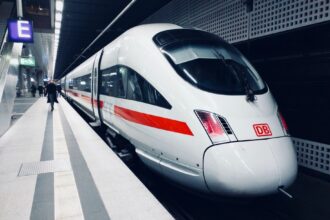
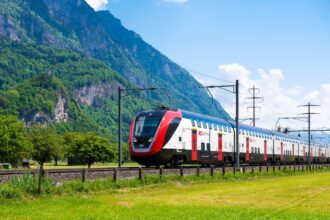
Every Swiss destination above sits on the same SBB network that runs Geneva’s own trams and buses, which is part of why these day trips feel so painless. The French destinations are covered by Léman Express, a joint SBB and SNCF cross-border network that has dramatically simplified travel to Annemasse, Annecy and the Saint-Gervais direction since it opened in 2019.
The SBB Mobile app is the most reliable way to check live departures, platforms and delays across both the Swiss and cross-border network, and it is worth installing before setting off. Most Swiss trains do not require seat reservations, though the narrow-gauge Mont Blanc Express to Chamonix can get busy in peak season.
Many of these routes are as enjoyable as the destinations themselves, since the lakeside line toward Lausanne and Montreux runs within sight of the water almost the whole way, with vineyard terraces climbing the slopes above Lavaux on a clear day, while the GoldenPass line toward Gstaad and the Bernese Oberland is one of Switzerland’s most scenic corridors. Onboard, SBB’s InterCity and regional trains typically offer power sockets, free WiFi and a bistro or trolley service on longer routes, making the journey itself part of the day out rather than simply a means of getting there.
For a single day trip, a normal point-to-point ticket is almost always cheaper than any pass. Anyone planning to combine several of these destinations, or continue on to explore Switzerland’s scenic rail lines more widely, should look at the Interrail Switzerland Pass, which covers unlimited travel on SBB’s network on each activated travel day.
Crossing into France for Annecy, Chamonix or Yvoire is straightforward and rarely involves a formal passport check on the Léman Express itself, though carrying photo ID is sensible for any cross-border trip. Swiss francs are widely accepted in the closest French border towns, but euros are still the more practical currency once further into France.
How to Book Your Train Tickets
The simplest way to book most Swiss journeys on this page is directly through SBB, Switzerland’s national operator, on its website or app. For the French destinations, SNCF Connect or the Léman Express’s own journey planner cover Annemasse, Annecy and Saint-Gervais tickets, and both can usually be paid for in Swiss francs when travelling from the Geneva side.
For comparing options across both networks, many travellers use Omio or Trainline, booking platforms that let you compare Swiss and French routes together in one search rather than checking each operator separately. Tickets are generally issued as mobile e-tickets, so there is little need to print anything before travelling.
Booking a seat reservation is rarely essential for the shorter hops on this page, but it is worth doing for the busier scenic services, particularly the panoramic carriages on the GoldenPass and Mont Blanc Express lines, where a window seat facing the right direction makes a real difference to the views. Prices are generally the same whether booked through the operator directly or a comparison platform, so the choice usually comes down to convenience rather than cost.
Our Train Booking Apps guide rounds up the platforms travellers actually use to book tickets, seat reservations and connections across the rest of Europe, which is worth a look before combining any of these day trips with a longer onward journey.
Which Geneva Day Trip Should You Choose?
With nine day trips to choose from, picking one often comes down to how much time is available and what kind of scenery appeals most. For the quickest possible outing, Nyon is unbeatable, sitting barely thirteen minutes from Geneva by direct train and needing no more than a half day to see properly, with Lausanne only a little further away as a close second.
Anyone chasing genuine Alpine scenery should look toward Chamonix, where glaciers hang directly above the town and the Aiguille du Midi cable car climbs to nearly 3,842 metres. Gruyères offers a gentler version of the same drama, its hilltop castle looking out over green pastures rather than snow and ice.
Travellers who want to stand on genuine glacier ice without the crowds or cost of Chamonix’s cable car should look at Col du Pillon and Glacier 3000 instead, accepting a longer journey in exchange for the Peak Walk suspension bridge and a summit that feels properly high-altitude. It asks for the same early start and full-day commitment as Chamonix, so most travellers pick one glacier trip rather than attempting both inside a single visit to the region.
For travellers more drawn to lakeside towns than mountains, Montreux and Vevey sit right on the water and pair neatly together on the same rail line. Yvoire adds a different flavour again, its medieval stone walls rising straight out of Lake Geneva and reachable only by boat for most of the year.
Families travelling with children tend to do best in Vevey, where Chaplin’s World combines film sets with interactive exhibits that hold younger visitors’ attention far longer than a traditional museum. Gruyères also works well for families, since the cheese factory’s glass viewing windows turn a short visit into something genuinely hands on.
Winter narrows the options slightly, since Yvoire’s lake steamer runs a reduced or non-existent schedule outside the spring to autumn season. Lausanne, Montreux and Chamonix all stay fully open through the colder months, and Chamonix in particular rewards a winter visit with genuinely different, snow covered views from the Aiguille du Midi.
Roughly two-thirds of these destinations, Nyon, Lausanne, Vevey, Montreux, Gruyères and Col du Pillon, stay entirely within Switzerland on the SBB and postbus network, while Yvoire, Annecy and Chamonix cross into France instead. The French trio generally asks for a longer journey and, in Yvoire’s case, a seasonal boat rather than a train, so travellers with only a single day to spare often lean toward the Swiss options first, saving the French trio for a day with a slightly earlier start.
Crossing into France from Geneva
Three of the nine destinations in this guide, Yvoire, Annecy and Chamonix, sit across the border in France, though the crossing itself barely registers for most travellers. Switzerland and France both belong to the Schengen area, so trains and buses cross the frontier without a formal customs stop for the vast majority of journeys.
The change is more a shift in atmosphere than any real formality, since station announcements switch to French-only, menus swap Swiss classics for French ones, and even the light seems to soften once the train is running through Haute-Savoie’s orchards and vineyards. For anyone sticking to the Swiss side instead, Col du Pillon and the other five Swiss destinations on this page need none of this planning, since they never leave SBB’s own network.
That said, carrying valid photo identification, a passport or an EU ID card, is still sensible for any of these three trips, since spot checks do occasionally happen even within Schengen. The Léman Express handles the Annecy and Chamonix crossings entirely by rail, while Yvoire is reached by lake steamer rather than train.
Mobile coverage switches to a French network somewhere over the water or along the rail line, and travellers without an EU roaming plan should check their data allowance before relying on maps or tickets stored online. Swiss francs are often still accepted in the closest French border towns, though euros become the more practical currency further in.
None of the three French destinations require any advance paperwork beyond a valid ticket, and the border crossing itself is rarely more noticeable than a change of language on station signage. Building in a little extra time is sensible only for Yvoire’s seasonal boat schedule, not because of any border formality.

Rupert’s Handy Travel Tips
Geneva’s trains make these day trips genuinely easy, but a little planning turns a good day out into a great one.
- Pair Vevey and Montreux: they sit minutes apart on the same line, so Chaplin’s World and Chillon Castle fit comfortably into one longer day.
- Check the CGN boat calendar first: Yvoire’s lake steamer runs a reduced or non-existent schedule outside the spring to autumn season.
- Book the Aiguille du Midi online: tickets are timed and dynamically priced, and popular slots sell out well before the cable car opens.
- Carry ID for the French trips: a passport or EU ID card is sensible for Annecy, Chamonix and Yvoire even without a formal check.
- Skip the pass for a single trip: a normal point-to-point ticket is usually cheaper unless several of these destinations are combined across a longer stay.
- Allow extra time for Gruyères: the two changes at Palézieux and Bulle leave little room for a missed connection, so build in slack either way.
Want to meet the reindeer behind our travel tips? Find out more in our page Who is Rupert?.




Best for a short stop where being central matters more than the room. Dorms and private rooms both listed.
See hostelsBest arranged before you fly rather than after. Covers claim handling, plus lounge access on eligible delays.
Explore AirHelp+Best for the gap between checking out and your train. Drop bags at a shop or hotel nearby and carry on.
Store your bagsFrequently Asked Questions About Day Trips from Geneva
What is the best day trip from Geneva for a first visit?
Nyon or Lausanne are hard to beat for a first-timer. Both sit under forty-five minutes away on direct SBB trains and need no planning beyond hopping on board.
Do I need a car for any of these day trips?
No. Every destination in this guide is reachable by direct train, connecting train, or seasonal boat from central Geneva, though Yvoire is easier with a car outside the summer sailing season.
Is it easy to cross into France for the day?
Yes. The Léman Express runs direct or near-direct services to Annemasse, Annecy and Saint-Gervais, and there is rarely a formal border check for day trippers travelling with photo ID.
Can I combine more than one destination in a single day?
Sometimes. Vevey and Montreux sit on the same line minutes apart, so many visitors see Chaplin’s World in the morning and Chillon Castle in the afternoon, while longer trips like Chamonix and Gruyères are best kept to their own day.
Do I need a rail pass for these day trips?
Not usually. A single point-to-point ticket is normally cheaper for one destination, and a pass like the Interrail Switzerland Pass only pays off once several trips or longer-distance Swiss travel are combined.
How do I get to Yvoire without a car?
The CGN lake steamer runs direct from Geneva’s Mt-Blanc pier between spring and autumn. Outside that season, a train to Thonon-les-Bains or Nyon followed by a local bus is the more realistic option.
Which currency should I bring for the French destinations?
Euros are the practical choice once inside France, though Swiss francs are often accepted in the closest border towns like Annemasse. Card payments are widely accepted everywhere on this list.
Is Gruyères worth the longer journey?
Yes, for most travellers. The combination of a genuine medieval hilltop village, a well-preserved castle and a working cheese factory is hard to match elsewhere on this list, even with two changes each way.
Further Reading
Anyone planning to see more of Switzerland than a single day trip should look at our Interrail Switzerland Pass guide, which breaks down pricing and shows when a multi-day pass genuinely beats buying single tickets for routes like Geneva to Zermatt or Lucerne. For a wider European trip that treats Switzerland as just one stop among several, our Interrail Pass Guide explains how a single-country pass fits alongside the full Interrail Global Pass.
Anyone extending a trip further into the French Alps beyond Annecy and Chamonix should also look at our Things to Do in Lyon guide, which covers the region’s food capital and its own rail-connected day trips in more depth. And before setting off on any of the routes above, our Train Booking Apps guide compares the platforms travellers actually use to book SBB and SNCF tickets, seat reservations and connections across the rest of Europe.
Visiting in December opens up a different set of options closer to home, and our guide to Geneva’s Christmas markets covers L’Escalade, the lakeside chalets and the free ice rink in Parc des Bastions for anyone extending a Geneva stay into the festive season.