Reviewed by our editorial team Published
Geneva does not run one single Christmas market in one square. Instead the festive season spreads across several sites at once, from the lakeside chalets of Noël au Quai on the Quai du Mont-Blanc to the free ice rink at Noël aux Bastions in the park below the Old Town, plus smaller pockets around Place de la Fusterie and the Plainpalais Christmas tree market. Across the Arve in neighbouring Carouge, a separate craft-focused market adds a fifth option within easy tram reach.
What genuinely sets Geneva apart from other Swiss and French markets nearby is not the chalets themselves, which sell a broadly familiar mix of mulled wine and wooden ornaments, but L’Escalade. This home-grown December festival commemorates a failed 1602 night attack on the city and involves a costumed procession, a bonfire, and the tradition of smashing a chocolate cauldron filled with marzipan vegetables, a genuine point of difference from every other market covered on this site.
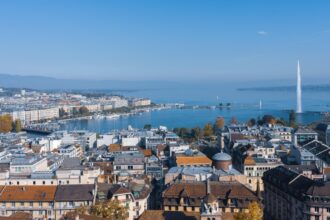
The lakeside setting adds its own character. Noël au Quai sits close enough to the water that the Jet d’Eau fountain and, on a clear day, Mont Blanc itself are visible from between the chalets, a backdrop few European Christmas markets can match. Combine that with skating at the Bastions rink and a stroll through the Old Town’s steep, cobbled lanes and Geneva earns a full day out well beyond the stalls.
This guide covers each market site by name and location, the ice rink and other seasonal attractions, what is actually for sale on the stalls, and the food and drink worth trying with real prices in Swiss francs. There is also a full section on opening hours and holiday closures, what New Year’s Eve looks like on the lakefront, and a proper explanation of L’Escalade itself, plus advice on timing your visit around Geneva’s short, dark December days.
| Market / Location | Approx. Dates (2026) | Typical Hours | Nearest Transport |
|---|---|---|---|
| Noël au Quai, Quai du Mont-Blanc | Late Nov to 24 Dec 2026 | Mon-Wed 12:00-21:00, Thu 12:00-22:00, Fri 12:00-23:00, Sat 11:00-23:00, Sun 11:00-21:00 (shorter on 24 Dec) | Short walk from Gare Cornavin or the lakefront bus stops |
| Noël aux Bastions, Parc des Bastions | Mid-Nov to 24 Dec 2026 (ice rink runs into early March 2027) | Mon-Fri 11:00-21:00, Sat 11:00-22:00, Sun 11:00-20:00 | Tram to Plainpalais, a short walk from the Old Town’s southern edge |
| Marché de Noël à la Fusterie, Place de la Fusterie | Confirm exact 2026 dates nearer the time; typically early-to-mid December | Daytime into early evening | Old Town, walkable from Bel-Air or Molard tram stops |
| Plainpalais Christmas Tree Market, Plaine de Plainpalais | Late Nov to 24 Dec 2026 | Daily, roughly 8:00-20:00 | Tram to Plainpalais |
| Marché de Noël de Carouge, Place du Marché, Carouge | A weekend in early-to-mid December 2026 (confirm exact dates) | Friday afternoon into evening, Saturday-Sunday daytime | Tram to Carouge-Marché |
Noël au Quai: Geneva’s Main Lakeside Market
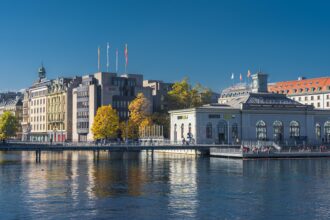
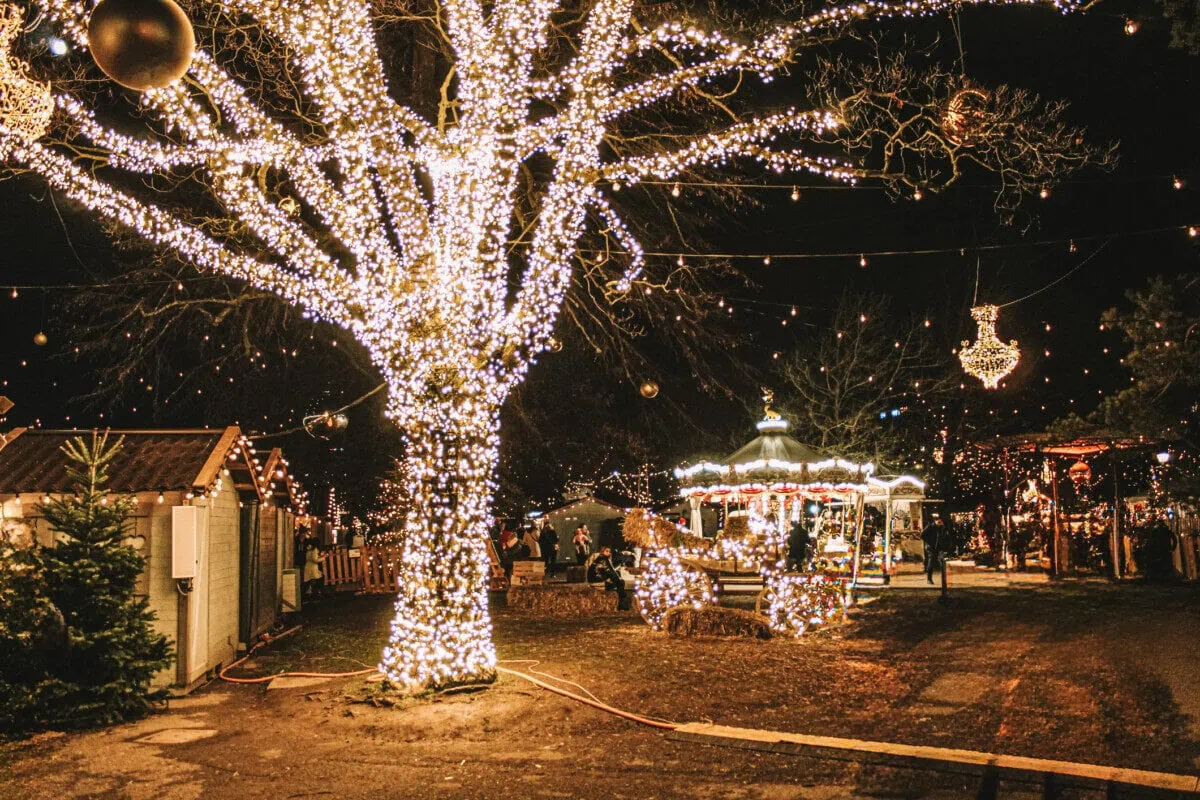
Noël au Quai on the Quai du Mont-Blanc is the market most visitors picture, a long run of wooden chalets strung with lights right along the lakefront promenade. It typically runs from late November to Christmas Eve, with dozens of stalls selling gifts, decorations and food side by side.
The setting is the real draw here. Between the chalets you get open views across Lake Geneva to the Jet d’Eau fountain, and on a clear winter day the snow-capped outline of Mont Blanc appears on the horizon, a backdrop that sets this market apart from most inland European equivalents.
A dedicated Fondue Chalet serves proper sit-down fondue in a heated setting, and reservations are generally recommended if you want a table on a busy evening. Alongside it, a small Ferris wheel and carousel add a fairground element for anyone travelling with children, and a covered kids’ yurt gives families somewhere warm to pause.
The market has grown from an earlier home at the Jardin Anglais into its current lakefront footprint, and organisers now bill it as the most elaborate of Geneva’s Christmas markets. A dedicated Christmas Pub serves warm drinks alongside the usual vin chaud stalls, and festive lighting runs the full length of the quay after dark.
Anyone arriving by air can reach the lakefront easily. Our guide to Geneva Airport to the City Centre covers the train, bus and taxi options, and the journey into town is one of the shortest airport transfers of any European capital, so a market visit is realistic even on an arrival day.
Noël aux Bastions and the Free Ice Rink
In Parc des Bastions, just below the Old Town and the Reformation Wall, a smaller village of wooden chalets sits alongside Geneva’s main outdoor ice rink. It generally runs from mid-November to Christmas Eve, with the rink itself staying open considerably longer, typically into early March.
Entry to the rink is free, and skate rental costs around CHF 2 (£2/€2/$2) on-site, making it one of the cheapest organised activities in the whole city over the festive period. Bring your own gloves and thick socks, since rental skates are functional rather than plush.
The chalets here lean more towards local vendors and Swiss artisanal products than the lakeside market’s broader mix, and the atmosphere is noticeably more relaxed and family-focused. Parents skating with young children while grandparents watch from the surrounding benches is a genuinely common sight through December.
Because the park sits directly beneath the Old Town’s ramparts, it is an easy add-on to a walk up towards the Cathedral of Saint-Pierre or the Reformation Wall itself. Combining a skate here with a browse through the smaller Fusterie market nearby makes a natural half-day loop without needing any transport at all.
The main entrance sits at Place Neuve, beside the Grand Théâtre and directly opposite the Old Town’s southern gate. A dedicated children’s chalet runs story readings, craft sessions and face painting throughout the season, alongside its own small carousel separate from the ice rink itself.
Best for two or three nights. The widest choice of rooms, with filters for free cancellation and included breakfast.
View staysBest for longer stays. Whole apartments and houses, so you are not eating out three times a day.
View rentalsBest if you have already picked a hotel. Checks the big booking sites for the same room and shows who is cheapest.
Check dealsThe Old Town, Fusterie and Plainpalais Markets
Away from the two main sites, Geneva’s Old Town hosts its own smaller festive pocket around Place de la Fusterie, a historic square just off the Rue du Rhône shopping street. The stalls here are fewer and more traditional, with handmade ornaments and decorations rather than fairground rides.
Down at the Plaine de Plainpalais, one of the city’s largest open squares, a dedicated Christmas tree market runs daily from late November through Christmas Eve. Alongside rows of trees for sale, a scattering of artisan and gourmet food stalls gives the site a genuine local, practical feel rather than a tourist-focused one.
Just across the Arve river in Carouge, technically a separate commune but reachable by tram in minutes, a craft-heavy market takes over the Place du Marché for a single weekend. Expect over a hundred stalls of ceramics, jewellery, candles and textiles, a noticeably more artisan-led lineup than the mainstream chalets in central Geneva.
Carouge also runs its own illuminated decorations through the season and a second ice rink separate from the Bastions one, so a Carouge visit works well as a quieter alternative if the central markets feel crowded on a weekend afternoon. Exact 2026 dates for the Carouge weekend vary year to year, so confirm nearer your trip.
What You Can Buy at the Chalets
Across all the sites, the most distinctively Genevan purchase is Swiss chocolate, sold loose or in gift boxes by small chocolatiers rather than the supermarket brands most visitors already know. Look out too for local honey and jam stalls, since the canton’s own producers turn up regularly at the smaller markets.
Wood carving and traditional ornaments remain a Christmas market staple here as elsewhere, alongside hand-blown glass baubles and painted nativity figures. Textile stalls sell knitted hats, scarves and mittens, a genuinely practical purchase given how cold the lakefront gets after dark.
The Fusterie and Carouge markets are the better bet for genuine craft over mass-market stock, with ceramics, jewellery and candle-makers selling their own work rather than imported decorations. Carouge in particular has a reputation among locals as an artisan neighbourhood, so its Christmas market reflects that year-round character.
For something specifically Swiss rather than generic European market stock, watch for stalls selling cowbells, embroidered linen and small Swiss Army knives, alongside the odd stand of regional wines and spirits. These make more distinctive souvenirs than another mulled-wine mug, though those are collectable in their own right too.
Regional wine stalls are worth a second look too, since the canton of Geneva has its own recognised wine region, best known for Gamay and Chasselas grapes, sold by the bottle at several of the smaller markets. A bottle bought at the stall makes a more distinctive gift than most, since Swiss wine is rarely exported and hard to find once you are back home.
Christmas Market Food and Drink, and What It Costs
Swiss cheese dishes dominate the food stalls. Raclette, melted cheese scraped over boiled potatoes with pickles, typically costs around CHF 12 (£11/€13/$15) a portion, while a proper sit-down fondue at the dedicated chalet on Quai du Mont-Blanc runs closer to CHF 22 (£20/€23/$27) per person.
For something lighter, marrons chauds, roasted chestnuts sold in a paper cone, cost around CHF 6 (£5/€6/$7) and are genuinely worth eating warm on a cold lakefront walk rather than saving for later. Crepes and Belgian-style waffles turn up at most sites too, priced similarly to the chestnuts.
To drink, vin chaud (mulled wine) costs roughly CHF 7 (£6/€7/$9), usually served in a souvenir mug with a CHF 5 (£5/€5/$6) deposit, refundable if you hand it back or worth keeping as a cheap memento. Non-alcoholic mulled apple juice is widely available for anyone driving or travelling with children.
Switzerland is not a cheap country, and the markets reflect that. As a rough budget, two people eating and drinking well across an evening, a raclette each plus a couple of vin chauds, should expect to spend somewhere around CHF 40 to 60 (£36-55/€42-64/$49-73), depending on how many stalls you sample.
Away from the stalls, no Genevan Christmas table is complete without cardon épineux de Plainpalais, a spiny cardoon vegetable brought to the canton by Huguenot refugees in the late 1600s and now protected as Switzerland’s first vegetable to hold AOP status. It is traditionally baked as a gratin, and most of the modest annual harvest is eaten during the festive weeks alone.
Opening Hours and Christmas Closures
Entry to every market site in Geneva is completely free, in line with the standard practice across almost all European Christmas markets. You only pay for food, drink, rides and any skating you do, and both cash and cards are widely accepted, though small vendors often prefer Swiss franc coins.
Christmas Eve sees shortened hours across the board, with Noël au Quai typically closing around 16:00 rather than running into the evening, and other sites winding down earlier than their usual schedule. Plan an afternoon visit on 24 December rather than an evening one.
25 December and 1 January are near-total closures for ordinary shops and services across Switzerland, though the market chalets themselves are generally not running by then anyway, since most sites finish on Christmas Eve. Museums and some cafes stay closed on these two dates too.
Sunday trading is restricted across Switzerland by law, with most ordinary shops closed, though the markets themselves, being outdoor food and craft stalls rather than retail shops, generally trade as normal on Sundays throughout the season. Confirm any specific shopping plans beyond the markets if a Sunday visit is part of your trip.
New Year’s Eve in Geneva
New Year’s Eve in Geneva centres on the lakefront, where crowds gather along the quais near the Jet d’Eau to watch midnight fireworks reflected across the water. It is one of the more atmospheric settings for a New Year’s celebration anywhere in Switzerland, largely thanks to that open lake backdrop.
Restaurants and bars around the Old Town and the lakefront get busy well before midnight, and many offer set New Year’s Eve menus that need booking in advance. If you would rather avoid the crowds, the streets around Carouge tend to stay noticeably quieter.
Geneva also marks Restauration de la République on 31 December itself, a genuinely local civic holiday commemorating the canton’s return to independence in 1813, distinct from the New Year’s celebrations that follow that evening. Expect small processions and ceremonial gatherings around the Promenade de la Treille earlier in the day.
Public transport typically runs later than usual on the night itself, so check the local operator’s schedule if you plan to travel back across the city after midnight rather than assuming normal timetables apply. A short walk back to a central hotel is generally the simplest option.
L’Escalade: Geneva’s Own December Festival
L’Escalade is the one Geneva tradition that has nothing to do with generic Christmas markets, and it is the genuine point of difference covered in this guide. It commemorates the night of 11 to 12 December 1602, when Savoyard troops under the Duke of Savoy tried to scale the city’s walls in a surprise attack and were repelled by its Protestant defenders.
According to local legend, a resident named Mère Royaume helped foil the attack by tipping a pot of boiling vegetable soup onto the invaders below her window and raising the alarm. That story is precisely why the festival’s central prop is a soup pot rather than anything more obviously military.
The modern festival runs on the weekend closest to 11-12 December, which for the 2026 season is expected to fall around 11-13 December, though the exact dates are confirmed annually and worth checking on the city’s official Escalade pages nearer the time. Celebrations include a large historical procession in period costume, torch-lit gatherings, and a running race called the Course de l’Escalade held the preceding weekend.
The defining tradition is the marmite, a chocolate cauldron filled with marzipan vegetables in Geneva’s red and gold colours. The youngest and oldest person present traditionally smash it together while reciting a phrase wishing ruin on the republic’s enemies, a genuinely striking custom sold in miniature form as souvenirs across the city through December.
The costumed procession is staged by the Compagnie de 1602, a historical society founded in 1926 that now numbers more than 2,200 members and describes itself as the largest such group in Switzerland. Its members march as musketeers, arquebusiers and cavalry to the sound of fife and drum, with cannon and musket demonstrations along the route.
Geneva’s own civic hymn, Cé qu’è lainô, retells the story of the attack and is sung throughout the festival, including by children who dress in costume and go door to door reciting verses in exchange for coins and sweets. The tradition is recognised on Switzerland’s official list of living traditions as a piece of intangible cultural heritage.
Best for long or awkward journeys. Builds one itinerary out of separate flights.
View flightsBest for anyone whose home plan charges by the megabyte abroad. Pay a fixed price up front.
Check eSIMsBest if you would rather not work out the transport on arrival. Book it now and forget it.
View transfersPlanning Ahead: Weather and Timing
Geneva’s winter climate sits firmly in the cold, often damp category, with daytime temperatures typically hovering just above or below freezing through late November and December, and evenings noticeably colder beside the open lake. Fog is common along the waterfront on still days, sometimes lingering for much of the morning.
Layers, a proper winter coat, gloves and waterproof footwear are sensible rather than optional, particularly if you plan to spend an evening at the Bastions ice rink or walking the lakefront chalets. The Old Town’s cobbled slopes also get slippery in damp weather, so grippy soles matter more than a stylish coat.
The market season runs for roughly five weeks, from mid-to-late November through Christmas Eve, so there is no need to compress a visit into one crowded weekend. Weekday afternoons are noticeably calmer than Friday and Saturday evenings, when both the lakeside market and the Bastions rink fill up quickly.
If your visit can stretch into mid-December, timing a trip around the L’Escalade weekend is worth genuine consideration, since it adds a proper local festival on top of the standard market browsing. Just be aware that hotel prices and crowds both rise noticeably around that specific weekend.
Christmas Shopping Beyond the Markets
Geneva’s Christmas shopping does not stop at the chalets. Rue du Rhône, the city’s flagship shopping street on the left bank near Place du Molard, is lined with stores for houses such as Louis Vuitton, Hermès, Dior and Bvlgari, alongside the watch and jewellery boutiques Geneva is internationally known for. Window displays are dressed for the season, and a walk down the street costs nothing even if the price tags inside do not.
For a more affordable alternative, the Confédération Centre on Rue de la Confédération, a short walk from the Bel-Air tram stop, holds more than thirty mainstream shops across several floors, from Decathlon and Arket to a small food hall. It is a practical stop for family gifts rather than luxury souvenirs, and it stays open on Sundays when most ordinary Geneva shops do not.
The Old Town itself rewards a slower browse. Streets around Place du Bourg-de-Four and the Grand-Rue mix independent bookshops, antique dealers and small design boutiques among the cafes, a change of pace from both the chalets and the flagship stores lower down towards the lake.
Combining festive shopping with the markets is easy given how close everything sits. A morning at Noël aux Bastions or the Fusterie stalls flows naturally into an afternoon on Rue du Rhône or around the Confédération Centre, before heading back to the lakefront chalets for dinner once the shops close for the evening.
Geneva’s Chocolatiers and Festive Treats
The market stalls sell plenty of Swiss chocolate, but Geneva’s dedicated chocolate shops are worth a detour of their own through December. Auer, trading on the Rues Basses since 1939, is best known for its amandes princesses and pavés glacés genevois, two specialities that rarely turn up outside the city, alongside a wider counter of fifty or so chocolate varieties including classic truffles.
In the Old Town, Arn on Place du Bourg-de-Four has been selling pralines and truffles for close to a century and stocks its own version of the Escalade marmite alongside its everyday chocolate counter. It is an easy stop to combine with a walk up to the Cathedral of Saint-Pierre.
Favarger, one of Geneva’s oldest chocolate houses, is known for its Avelines and Nougalines bars and keeps branches at Rive, Versoix and the Balexert shopping centre, making it one of the easier names to find without straying far from the centre.
Smaller houses such as Martel, trading for close to two centuries, and Micheli, known for hazelnut slabs roasted on site, round out the picture, both selling truffles and small-batch bars rather than mass-produced stock. A box from any of these makes a more distinctive gift than the supermarket brands most visitors already know from home.

Christmas Markets With Children
Geneva’s markets are genuinely built with families in mind rather than treating children as an afterthought. At Noël au Quai, a small Ferris wheel and carousel sit alongside a covered children’s yurt running crafts and seasonal activities throughout the day, giving parents somewhere sheltered to pause between chalets.
At Noël aux Bastions, entered from Place Neuve, a dedicated children’s chalet runs story readings, craft sessions and face painting throughout the season, on top of its own small carousel and the free ice rink next door. Skate hire costs around CHF 2, so an afternoon of skating for a family of four rarely runs past CHF 10.
Families visiting in early December can also catch the Course de l’Escalade, a mass-participation road race through the Old Town held the weekend before the main Escalade weekend, with dedicated youth and children’s categories run alongside the adult races. The event draws tens of thousands of runners each year and finishes in Parc des Bastions, right by the ice rink.
The marmite itself is as much a children’s tradition as an adult one. Miniature chocolate cauldrons are sold everywhere through December, and the custom of having the youngest and oldest person present smash the marmite together is one children take part in at home as readily as at any public event.
A Day Out Combining Markets, Skating and Shopping
With five market sites, two ice rinks and L’Escalade all within a compact city centre, a single well-planned day covers a surprising amount of ground. Start at Noël aux Bastions in the late morning, when the rink is quietest, and combine an early skate with a browse through the chalets before the lunchtime crowds arrive.
From Place Neuve it is a short uphill walk into the Old Town, past the Cathedral of Saint-Pierre and down to the smaller stalls around Place de la Fusterie, a natural spot for lunch. Chocolate lovers can detour to Arn on Place du Bourg-de-Four before continuing down towards the lake.
Spend the afternoon on Rue du Rhône or around the Confédération Centre for festive shopping beyond the market stalls, before the light starts to fade in the late afternoon, as it does early throughout a Genevan December.
Finish at Noël au Quai on the lakefront for dinner, where the Fondue Chalet and the wider run of food stalls are busiest and most atmospheric once the chalets are lit up against the dark water. If your visit lands on the L’Escalade weekend itself, build the evening around the torchlit procession instead and treat the markets as a daytime addition rather than the main event.
Getting Between Geneva’s Christmas Markets
Geneva’s five festive sites sit close enough together that most visitors get by entirely on foot, without ever needing to plan a transport leg in advance. The core stretch between the lakefront and the Old Town forms a compact walking triangle with the Fusterie stalls, covering well under two kilometres end to end.
From the lakeside chalets, the walk up to Parc des Bastions takes roughly fifteen minutes, tracing the quay before climbing gently towards Place Neuve and the rink’s main entrance. It is an easy stroll rather than a hike, though the final stretch through cobbled lanes rewards sturdy shoes on a damp evening.
Continuing from Bastions into the Old Town adds only a short further climb past the Cathedral of Saint-Pierre before dropping down towards Place de la Fusterie. This central stretch links three of the five market sites without a single tram ride, making it the natural spine of any single day visit.
Plainpalais and Carouge sit further out and are best reached by tram rather than on foot, particularly once the December cold sets in after dark. Geneva’s TPG tram network runs frequent services from Bel-Air or Cornavin to Plainpalais, then onward across the Arve to Carouge-Marché in a few more minutes.
A single Unireso ticket covers the whole city zone, so one fare carries you between Plainpalais, Carouge and back towards the lakefront without paying separately for each leg of the trip. A day pass is worth considering if the plan covers more than two or three tram journeys across an afternoon and evening out.
Trams stop running earlier than the markets themselves on quieter weeknights, so check the last departure before committing to Carouge’s stalls late in the evening. Taxis and ride-hailing apps cover the gap easily, and the compact city centre means no journey back to a central hotel ever runs particularly long.

Rupert’s Handy Travel Tips
I’ve trotted between all five Geneva market sites on my own hooves, so here’s what actually makes the difference on the ground.
- Time your visit around L’Escalade if you can: it’s the one thing in Geneva you genuinely cannot see anywhere else in December.
- Book the Fondue Chalet ahead: the sit-down tables at Noël au Quai fill up fast on Friday and Saturday evenings.
- Skate early rather than at night: the free Bastions rink is far less crowded before mid-afternoon than after dark.
- Keep coins handy: smaller stalls, especially in Carouge and at Fusterie, sometimes prefer cash to card.
- Save Carouge for a quieter afternoon: its craft market has a completely different, calmer feel from the central chalets.
- Pack for cobbles and fog, not just cold: the Old Town’s slopes get slick, and lakefront fog can linger into early afternoon.
Want to meet the reindeer behind our travel tips? Find out more in our page Who is Rupert?.




Frequently Asked Questions
Is it free to visit Geneva’s Christmas markets?
Yes, entry to every market site is completely free, and you only pay for food, drink, rides and ice skating.
Where is the main Christmas market in Geneva?
Noël au Quai on the Quai du Mont-Blanc is the largest and most visited site, with further markets at Parc des Bastions, Place de la Fusterie, Plainpalais and Carouge.
Is there ice skating at the Geneva Christmas market?
Yes, a free outdoor rink operates at Noël aux Bastions in Parc des Bastions, with skate rental costing around CHF 2, and it runs well into the new year.
What is L’Escalade?
L’Escalade is Geneva’s own December festival commemorating a failed 1602 attack on the city, marked with a costumed procession and the tradition of smashing a chocolate cauldron filled with marzipan vegetables.
When is L’Escalade in 2026?
The festival falls on the weekend closest to 11-12 December, expected to be around 11-13 December 2026, though exact dates are confirmed annually so it is worth checking closer to your trip.
What food should I try at the Geneva Christmas markets?
Raclette and fondue are the local specialities worth prioritising, alongside roasted chestnuts and mulled wine, all genuinely Swiss rather than generic market fare.
Are shops open on Christmas Day in Geneva?
No, 25 December and 1 January see near-total closures for ordinary shops and services across Switzerland, and most market chalets have already finished for the season by then.
Is Carouge worth visiting alongside central Geneva’s markets?
Yes, Carouge’s craft-focused market sits just across the Arve river, a short tram ride away, and offers a noticeably quieter, more artisan-led alternative to the central chalets.
Further Reading
For getting into the city from the airport, our guide to Geneva Airport to the City Centre covers the train, bus and taxi options, useful whether you are flying in for a single market evening or a longer festive break.
Geneva’s Christmas season also overlaps with its wider role as a gateway to the French Alps, so anyone continuing on to the mountains may find our other Geneva Airport guides useful for planning the next leg of a winter trip. For more on the city itself, our guides to things to do in Geneva and day trips from Geneva cover the city’s sights and its wider Alpine surroundings in full.