Reviewed by our editorial team Published
Why Leave Barcelona for the Day
Barcelona has enough sights of its own to fill a week, but the countryside and coastline around it are just as rewarding. Within an hour or two of Barcelona Sants, day-trippers can reach a mountain monastery, a medieval old town, a beach resort, and a museum built around one of the twentieth century’s strangest imaginations.
Most of these trips run on regular train services rather than tours or transfers, which keeps costs down and lets visitors set their own pace. A handful, including the Costa Brava’s smaller towns, are reachable only by coach, and this guide is honest about where that trade-off shows up.
Catalonia’s landscape shifts quickly outside the city, from Mediterranean coast to inland vineyards to the foothills of the Pyrenees. That variety is part of the appeal: a single week based in Barcelona can comfortably include a monastery, a beach, a Roman ruin, and a surrealist museum without ever needing to hire a car or book an organised tour.
This guide covers seven of the most practical day trips from Barcelona, plus a section on how to buy tickets and when the wider region, including the mountains, is worth the extra travel time. Departure stations, journey times, and realistic feasibility are covered honestly throughout, not just the best-case scenario.
Every route below starts from central Barcelona, so no early alarms or overnight relocations are required. Pack a printed or downloaded ticket, check the day’s timetable in advance, and treat this list as a realistic starting point rather than an exhaustive one.
Day Trips from Barcelona at a Glance
The table below summarises journey times and transport for each destination covered in this guide, drawn from the details in each section further down the page. Use it as a quick reference before reading the full write-up for each place.
| Destination | Journey Time | Transport | Best For |
|---|---|---|---|
| Montserrat | Around 75 to 90 minutes door to door | FGC R5 from Plaça d’Espanya, plus cable car or rack railway | Half day, mountain monastery |
| Girona | Around 40 minutes (AVE/Avant) or up to 1 hour 35 minutes (regional) | Train from Barcelona Sants | Half or full day, medieval old town |
| Sitges | Around 35 to 40 minutes | R2 Sud Rodalies from Barcelona Sants | Half day, beach town |
| Figueres | Around 42 minutes (fastest) to just over an hour | AVE/Avant from Barcelona Sants | Half day, Dalí Museum |
| Tarragona | Around an hour (regional, recommended) | R16 regional from Barcelona Sants, direct to the old town | Full day, Roman city |
| Vic | Around 80 to 85 minutes | R3 Rodalies from Barcelona Sants | Full day, medieval market town |
| Tossa de Mar & Costa Brava | Around 1 hour 20 minutes to 2 hours | Moventis Sarfa coach from Estació del Nord (no rail link) | Full day, coastal old town |
Best for a short trip. Compare rooms by neighbourhood, price and guest rating before you book.
Compare hotelsBest for families, or any stay past about four nights. A kitchen and a washing machine start paying for themselves.
Browse rentalsBest as a last check before booking. Compares hotel rates across several sites in one search.
Compare ratesMontserrat: Cable Car or Rack Railway
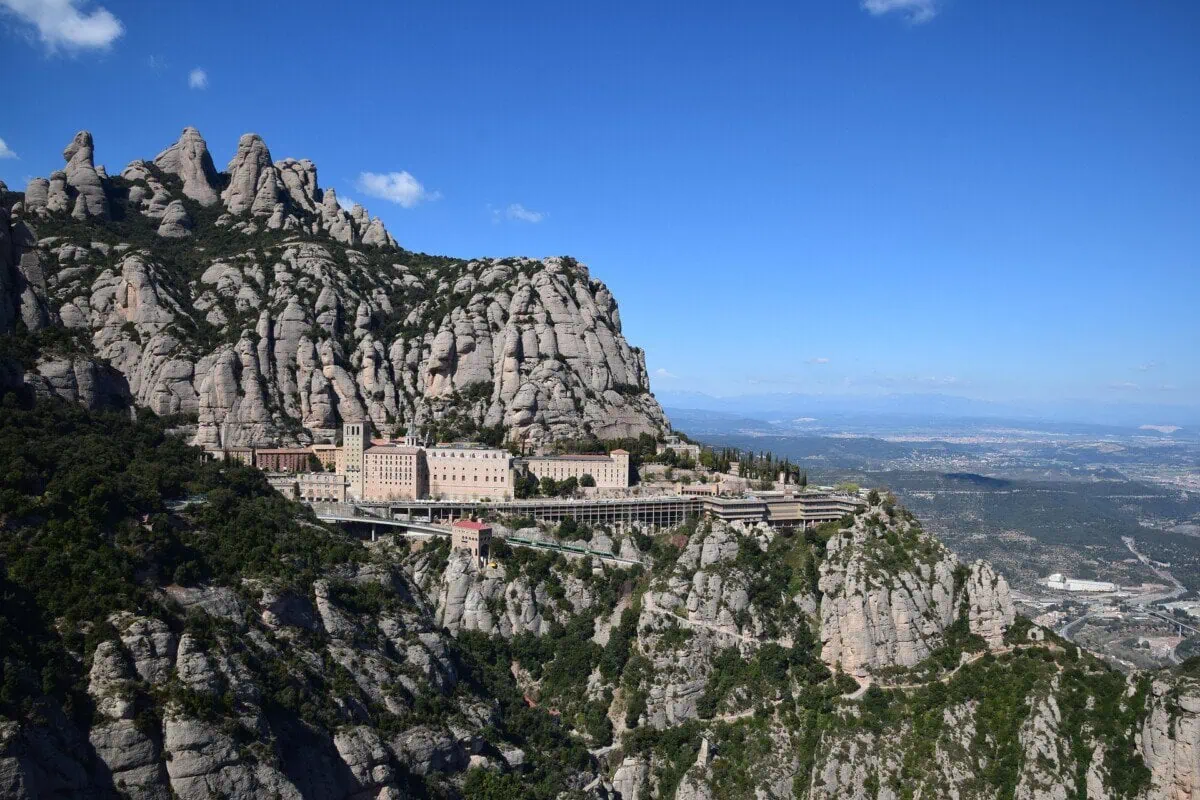
Montserrat is the most popular day trip from Barcelona, and for good reason: this jagged mountain range hosts a working Benedictine monastery and views across most of Catalonia. Trains leave from Plaça d’Espanya via FGC’s R5 line, with the journey to the mountain base taking around an hour.
From there, travellers choose between the cable car (Aeri de Montserrat) at Montserrat-Aeri station or the Cremallera rack railway from Monistrol de Montserrat. The cable car is faster and more dramatic but occasionally suspends service in high wind; the rack railway is the steadier, all-weather fallback and worth knowing about.
A combined “Tot Montserrat” ticket bundles the metro connection, FGC train, mountain transport, and monastery entry into one purchase, which simplifies a trip that otherwise involves several separate tickets. Including the ascent, Barcelona to the monastery generally takes around 75 to 90 minutes door to door.
This is one of the most comfortable, fully public-transport day trips on this list, and one of the few that never really quiets down. Bring layers even in summer, since Montserrat sits at over 700 metres and can feel noticeably cooler than the city, and allow at least three hours on the mountain to see the basilica and surrounding trails properly.
The mountain’s name gives it away: Montserrat means “serrated mountain” in Catalan, and its rows of rounded stone teeth rise straight out of the plain like nothing else on the Catalan skyline. Late afternoon light turns the rock a deep pink-gold, and the basilica’s forecourt is often the first place visitors simply stop and look.
Inside the basilica, pilgrims queue quietly to pass behind the altar and touch the orb held by La Moreneta, Montserrat’s centuries-old Black Madonna. If the timing lines up, the boys of the Escolania, one of Europe’s oldest choir schools, sing at 1pm on weekdays, their voices filling the nave with the Virolai, Montserrat’s own anthem.
Beyond the monastery buildings, marked trails climb toward Sant Jeroni and other viewpoints, where the ridge falls away and Catalonia unrolls beneath in a green and hazy sprawl. Even a short walk along the cliff path delivers a sense of scale that the cable car ride alone doesn’t quite capture.
Girona: A Walkable Medieval City
Girona’s old town is compact enough to explore entirely on foot, with colourful houses stacked along the Onyar River and a cathedral reached by a dramatic flight of stone steps. Its Jewish Quarter is one of the best-preserved in Europe, and its city walls offer a genuinely scenic walk above the rooftops.
Trains leave from Barcelona Sants, with connections also possible at Passeig de Gràcia. The AVE and Avant high-speed services cover the route in around 40 minutes, making Girona one of the fastest day trips on this list; slower regional trains take closer to 1 hour 35 minutes.
With frequent departures throughout the day, Girona works well as either a half-day add-on or a full day out, especially if a film-location walk through its old streets (several well-known scenes were shot here) is on the agenda. Return trains run late enough for a relaxed dinner before heading back.
Because the old town sits close to the station, there is no need for a taxi or bus connection on arrival, unlike some of the other trips on this list. That simplicity, combined with the fast train option, makes Girona one of the easiest wins for a first day trip from Barcelona.
Arrive in late afternoon and the houses stacked along the Onyar River turn from ochre to deep rust as the sun drops behind the old town, their reflections rippling in the water below. It’s one of the most photographed views in Catalonia, and standing on the Peixateries Velles bridge at that hour makes it obvious why.
The cathedral’s Baroque staircase climbs to a nave that is the widest Gothic nave in the world, wider even than Notre-Dame’s, and it doubled as a set for Game of Thrones, including Margaery Tyrell’s walk of atonement. Climbing those steps in person, with the old town’s rooftops spread out below, needs no fictional backdrop to feel dramatic.
El Call, Girona’s medieval Jewish Quarter, is a warren of stone stairways and covered passages barely wide enough for two people to pass, and it’s easy to lose all sense of direction inside it. Come at dusk, when the lanes empty out and lamplight catches the worn stone, and the centuries feel genuinely close.
Sitges: Beach Town by the Rails
Sitges combines sandy beaches, a whitewashed old town, and a lively seafront promenade, making it one of the most relaxed day trips from Barcelona. It is especially popular with beachgoers and sunbathers in summer, though its mild coastal climate makes it a pleasant walk even outside beach season, when the crowds thin out considerably and hotel rates drop.
The R2 Sud Rodalies line runs from Barcelona Sants roughly every 15 to 30 minutes, and the journey takes approximately 35 to 40 minutes each way, one of the shortest on this list. Trains are frequent enough that there is little need to plan tightly around a fixed schedule.
Because the station sits a short, flat walk from the seafront, Sitges needs no onward bus or taxi once travellers step off the train. This makes it an easy half-day option that pairs well with a slower morning in Barcelona before heading out in the early afternoon.
Sitges gets busy on summer weekends and during its Carnival celebrations in February, so an early departure helps secure a spot on the beach or a table at a seafront restaurant. Out of season, it is a quieter, still-worthwhile stroll through empty promenades and closed-for-winter beach bars.
Walk the Passeig Marítim in late afternoon and the whole town leans toward the water, palm trees rattling in the sea breeze as terraces fill for sunset. At the old town’s edge, the whitewashed church of Sant Bartomeu i Santa Tecla sits right on the point above the sea, one of the most photographed views on the Catalan coast.
Sitges has its own regional dish worth seeking out: xató, a winter salad of salt cod, tuna, and anchovy under a nutty romesco-style dressing, born on this stretch of the Garraf coast. Pair it with a glass of local malvasia and a table looking out at the water, and the appeal of a slower half-day here becomes obvious.
Wander a block or two back from the seafront and the streets narrow into a quieter grid of art galleries, ice-cream shops, and pastel façades that owe much to the town’s history as an artists’ colony. It’s a gentler, more colourful version of Barcelona’s old town, small enough to cover on foot in an unhurried afternoon.
Figueres and the Dalí Museum
Figueres is best known for one building: the Teatre-Museu Dalí, designed by Salvador Dalí himself and packed with his most surreal and playful work. The building itself, topped with giant eggs and a geodesic dome, is as much a spectacle as anything inside it.
High-speed AVE and Avant trains leave from Barcelona Sants roughly 14 times a day, with the fastest journeys taking around 42 minutes and the average closer to just over an hour. A slower regional service also runs the route but takes considerably longer, so the fast train is worth booking ahead for.
The museum sits a short walk from Figueres’ train station, with no onward bus or taxi needed on arrival, which is not the case for every stop on this list. Tickets are sold with timed entry slots in peak season, so booking online in advance is worth doing rather than risking a long queue at the door.
Because the fast trains run frequently throughout the day, Figueres works well as either a dedicated day trip or a stop combined with Girona, given both sit on the same rail corridor. Most visitors find two to three hours enough to see the museum properly before heading back to Barcelona.
Inside, the museum resists any normal sense of order: skylights bathe a central courtyard dominated by a vintage Rainy Taxi, where dropping a coin sends water falling inside the car onto mannequins draped in ivy. It sets the tone for a building that never once explains itself in a straight line.
Upstairs, climb a short staircase and look through a specific lens, and an entire lounge, complete with a lip-shaped sofa and a nose for a fireplace, resolves into a giant portrait of Mae West. Step even slightly out of position and the illusion collapses back into furniture, which is exactly the trick Dalí wanted.
The building itself, crowned with giant eggs and a geodesic dome visible from streets away, was once Figueres’ municipal theatre, gutted by fire during the Spanish Civil War and rebuilt by Dalí as its replacement. Few museums anywhere let the artist design the container as deliberately as the art inside it.
Tarragona: The Train Tradeoff
Tarragona is a genuine Roman-era city, with an amphitheatre overlooking the sea and a well-preserved old town built into the hillside above it. It rewards a slower visit than some of the other trips on this list, since its Roman remains are spread across several separate sites.
There is a real choice to make here. The regional R16 service runs directly into Tarragona Estació, inside the old town, taking around an hour; the AVE/Avant service is faster at 30 to 40 minutes but arrives at Camp de Tarragona, a station roughly 11km outside the city.
That “faster” high-speed option is not actually faster once the onward bus or taxi from Camp de Tarragona is added, and it can end up taking longer door to door than the regional train. For that reason, the slower regional train into the old town is the more practical choice for most day-trippers.
This is one of the clearest examples on this route network of speed on paper not matching speed in practice. Booking the regional service also tends to be cheaper, so there is little reason to pay more for the faster train unless the schedule genuinely does not align.
Stand at the Balcó del Mediterrani, the railing at the end of Rambla Nova, and the amphitheatre appears below almost by surprise, its stone tiers set directly against the Mediterranean with waves breaking close behind the arena where gladiators once trained and fought. Few Roman ruins anywhere sit this close to open water.
Tarragona was once Tarraco, capital of Roman Hispania and one of the empire’s most important cities outside Italy, and its layered remains, walls, forum, circus, amphitheatre, earned the old town UNESCO World Heritage status. Walking between them means crossing two thousand years in a few hundred metres.
Beyond the ruins, the old town’s narrow medieval streets climb the same hillside the Romans built on, opening onto small squares where cafés spill out under plane trees and washing lines cross between balconies overhead. It rewards the slower, wandering pace this guide already recommends over a rushed, list-ticking visit.
Tossa de Mar and the Costa Brava
The Costa Brava’s most photogenic small towns, including Tossa de Mar, are not served by rail at all. This is the one entry on this list where a coach is genuinely the only practical public-transport option, and it is worth being upfront about that trade-off before planning around it.
Coaches run from Estació del Nord with the Moventis Sarfa network, and some additional departures run from the airport during summer. Journey times vary by service, running from around 1 hour 20 minutes on the fastest direct coaches up to nearer two hours on slower ones, with one-way fares from approximately €14 (£12/$15).
Once there, Tossa de Mar’s medieval walled old town, sandy cove, and hilltop castle ruins make the longer journey worthwhile for most visitors, and it works comfortably as a full rather than half day out. Begur, further up the coast, is reachable the same way but with an even longer, less direct journey, and suits an overnight stay better than a single day.
Because this route depends on coach timetables rather than frequent trains, it is worth checking return times carefully before setting out, particularly outside peak summer season when services thin out. This is honestly the least convenient of the destinations covered here, though also one of the most rewarding once you arrive.
Tossa de Mar’s walled old town, the Vila Vella, is the only fortified medieval settlement still standing on the entire Catalan coast, its stone ramparts curving around the headland above a small sandy cove. Walking the walls at sunset, with the sea turning gold below the watchtowers, is worth the longer coach journey on its own.
Down on the seafront, a bronze statue of Ava Gardner gazes out to sea, a tribute to the year the town spent as a film set for Pandora and the Flying Dutchman in 1950. It’s a small, slightly unexpected detail that captures how long this stretch of coast has drawn people in.
The cove beneath the walls is small enough to feel intimate even in high summer, with fishing boats still pulled up on the sand beside the sunbathers, and the water a clear, deep turquoise that explains the Costa Brava’s reputation long before the crowds arrived. Further along the coast, smaller coves reachable only on foot or by boat stay quieter still.
Best for finding routes the airlines do not sell as a single ticket. Combines carriers to bring the fare down.
Search flightsBest if you want maps and messaging working the moment you switch your phone on.
See eSIM plansBest if you would rather not work out the transport on arrival. Book it now and forget it.
View transfersVic: A Medieval Market Town
Vic is an inland market town built around Plaça Major, one of the largest medieval arcaded squares in Europe, and it sees far fewer day-trippers than the coastal or monastery routes above. Its Saturday market has traded on the same square for centuries, and the surrounding old town rewards an unhurried wander rather than a checklist visit.
Trains run from Barcelona Sants on the R3 Rodalies line, with the journey taking around 80 to 85 minutes each way. Part of the route is single-track, so services can run a little behind schedule, and it is worth building in some slack rather than booking a tight connection.
Highlights include Vic Cathedral, the Episcopal Museum’s collection of medieval religious art, and a reconstructed Roman temple, all within walking distance of the main square. That mix of Romanesque, Gothic, and Roman sites packs more historical variety into one town than most single-monument stops on this list.
Vic suits a full day rather than a rushed half-day, since the museums alone can take a couple of hours and the train journey runs longer than the coastal routes. It works best for travellers who have already covered Girona and Sitges and want a quieter, less touristy alternative inland.
Plaça Major fills with striped awnings and stalls every Saturday morning, much as it has for centuries, its arcaded buildings painted in ochre and faded red giving the square a warmth Barcelona’s grander plazas don’t quite have. Despite being one of the largest medieval squares in Europe, it never feels like a monument, more like a town simply going about its week.
Vic has its own culinary claim to fame in llonganissa de Vic, a cured pork sausage with protected status that locals have made here for generations, best tried thinly sliced at a market stall or a family-run deli just off the square. The dry mountain air the town sits in is part of what makes the curing method work.
Away from the square, the streets of Vic stay quiet even at midday, and it’s easy to hear church bells and market chatter rather than traffic, a contrast with the coastal towns further down this list. Vic rewards visitors who are happy to slow down completely rather than tick off a single headline sight.
Three Countries in One Day: Andorra, France and Spain
This is a different kind of day trip: a long, guided coach excursion that crosses three borders in a single outing rather than a self-guided train ride to one town. Tours typically run around twelve hours door to door, leaving Barcelona early and returning after dark, so it suits travellers who want the novelty of three countries in a day over a slower, cheaper trip.
The route runs south to north through the Spanish Pyrenees first, typically stopping in Bagà, a small medieval village inside Cadí-Moixeró Natural Park, before continuing through the Cadí tunnel into the Cerdanya valley and crossing into France near Puigcerdà. A short stop across the border often includes a curious mountain supermarket stacked with French cheese, wine, and pâté, complete with a stuffed bear at the entrance.
From there the coach climbs toward Port d’Envalira, the highest paved pass in the Pyrenees at over two thousand metres, a stretch of road familiar to Tour de France cyclists and one of the most dramatic drives in the region. Passports get an Andorran stamp at the border, a small souvenir of a country most visitors never officially enter otherwise.
The day usually ends with a couple of hours of free time in Andorra la Vella, the tax-free capital where mountain scenery meets shopping streets lined with electronics, perfume, and outdoor gear at prices well below Barcelona’s. It’s a long day by road rather than rail, but for a genuine three-country stamp collection, there’s no faster way to do it from the city.
Getting Around and Booking Your Tickets
Most of the day trips above run on Rodalies de Catalunya regional trains or the faster AVE/Avant network, both bookable through Renfe’s official website or app, and neither requires the Barcelona city T-Casual travel card, since these routes fall outside Zone 1 (see our Barcelona public transport guide for how that card works). Montserrat is the exception, running on the separate FGC network from Plaça d’Espanya rather than Sants.
Booking ahead is worth it for the AVE and Avant services to Girona, Figueres, and Camp de Tarragona, since seats are assigned and popular departures can sell out on weekends and holidays. The slower regional trains, including those to Sitges, Tarragona’s old town station, and Montserrat’s FGC line, generally do not need advance booking.
For Tossa de Mar and the wider Costa Brava, coach tickets can be booked directly with Moventis Sarfa or through third-party ticketing sites, and booking a day or two ahead is sensible in peak summer. The public coach and rail network covers every destination in this guide reliably, without needing a private transfer.
A paper or downloaded ticket works for every route here, and station departure boards are generally reliable, though it is worth arriving 10 to 15 minutes early for any high-speed service, since these require going through a specific platform gate. None of these day trips need a car, and most do not benefit from one either.

Seasonality: The Pyrenees and When to Go
Barcelona itself has a mild Mediterranean coastal climate, with no meaningful city-level snow in a normal winter and comfortable temperatures for sightseeing across most of the year. None of the day trips above, including Montserrat, are meaningfully snow-affected, since all sit on lowland or coastal routes.
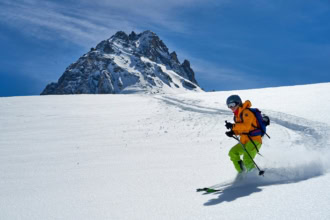
The genuine ski season lies further away, in the Pyrenees proper, roughly late November through April depending on the year and specific resort. That puts it well beyond the radius of the day trips covered in this guide, and reaching it generally means a longer journey or an overnight stay rather than a same-day return.
One partial exception is Vall de Núria, reached via the Cremallera rack railway from Ribes de Freser, which does have real winter snow and a small ski area. The regional train from Barcelona Sants to Ribes de Freser alone takes around 2 to 2.5 hours, followed by a 45-minute rack railway ascent.
With a total one-way journey of roughly three hours, and trains running only every couple of hours, Vall de Núria sits at the outer edge of day-trip feasibility rather than comfortably within it. A long, tightly-scheduled day is possible, but an overnight in Ribes de Freser is the more relaxed and honestly recommended way to see it.
Best Barcelona Day Trip Without a Car
Not every destination on this list is equally easy to reach without a car. Girona and Sitges are the simplest: both sit on a direct Rodalies or high-speed rail line from Barcelona Sants, and both old towns are a short, flat walk from the station platform.
Montserrat, Figueres, and Vic are almost as straightforward, since a single train covers most of the journey. Montserrat adds a cable car or rack railway leg at the mountain end, while Vic and Tarragona involve a noticeably longer ride than the short coastal hops.
Tossa de Mar is a different case entirely. It has no railway station, so the only genuine public-transport option is a Moventis Sarfa coach from Estació del Nord, and it should not be treated as logistically equivalent to a quick train hop like Girona or Sitges.
For a first, low-effort day trip, Girona or Sitges remain the safest choice. Tossa de Mar and the wider Costa Brava are still worth the longer coach journey, but they reward travellers who plan around a fixed timetable rather than expecting train-level flexibility.

Rupert’s Handy Travel Tips
Planning a day trip from Barcelona? Here are a few tips to help you make the most of it.
- Book high-speed seats early: AVE and Avant tickets to Girona and Figueres can sell out on weekend mornings, so book a few days ahead for the cheaper fares.
- Check the Montserrat weather: the cable car occasionally suspends in high wind, so on a blustery day the Cremallera rack railway is the more reliable option.
- Skip the “faster” train to Tarragona: Camp de Tarragona station sits well outside the old town, so the regional train straight into Tarragona Estació is usually the smarter choice.
- Pack for altitude: Montserrat and Vall de Núria both sit high enough that temperatures can feel noticeably cooler than Barcelona, even in summer.
- Book Costa Brava coaches ahead in peak season: Moventis Sarfa services to Tossa de Mar get busy in July and August, so reserve a seat a day or two early.
- Validate before you board: some regional and FGC tickets need validating at a platform machine before the train arrives, not once you’re on board.
Want to meet the reindeer behind our travel tips? Find out more in our page Who is Rupert?.




Frequently Asked Questions
Which day trip from Barcelona is easiest without a car?
Sitges and Girona are the two most straightforward, since both are reached by direct train with no onward bus or taxi needed once you arrive.
Do I need to book train tickets in advance?
For the high-speed AVE and Avant services to Girona, Figueres, and Camp de Tarragona, yes, especially on weekends; the slower regional trains generally allow walk-up tickets.
Is the cable car or the rack railway better for Montserrat?
The cable car is faster and more scenic, but it can suspend in high wind; the Cremallera rack railway runs in almost all weather and is the steadier backup.
Why does this guide recommend the slower train to Tarragona?
The faster AVE/Avant train arrives at Camp de Tarragona, roughly 11km outside the city, so the regional train into the old town’s own station is often quicker door to door.
Can Tossa de Mar be reached by train?
No, Tossa de Mar and the wider Costa Brava are bus-only from Barcelona, reached by Moventis Sarfa coaches from Estació del Nord.
Is Vall de Núria a realistic day trip?
It is possible but tight, with a one-way journey of around three hours each way; an overnight in Ribes de Freser is the more comfortable option.
What is the best day trip for a first visit to Barcelona’s surroundings?
Montserrat is the classic choice, combining a dramatic mountain setting, a working monastery, and a fully public-transport journey from central Barcelona.
Do I need a Barcelona travel card for these day trips?
No, the Hola Barcelona card and T-Casual only cover Zone 1 within the city, so day trips need separate Rodalies, AVE/Avant, FGC, or coach tickets (our guide to Barcelona’s city passes explains what each one includes).
Further Reading
For readers drawn to the mountains beyond Barcelona’s day-trip radius, Andorra Travel Guide covers the neighbouring Pyrenean country’s own ski resorts, hiking trails, and duty-free shopping in more depth than a single day trip could manage. It sits just beyond the reach of the routes above, making it a natural next stop for a longer Catalan-Pyrenees itinerary.
Anyone weighing up whether Vall de Núria or the wider Pyrenees are worth the extra travel time might also find Ski and Snowboard in Europe useful, since it places the region’s season and resorts alongside the rest of the continent’s options. Together, these two guides fill in the picture this page leaves at the mountain’s edge.
Flying into Barcelona before any of these trips? Our Barcelona Airport Transfers guide covers the Aerobus, train and taxi options from El Prat, worth reading before working out how much of a day trip’s timing is eaten up by the airport run itself.