Reviewed by our editorial team Published
Discover Trieste
Trieste sits tucked into Italy’s northeastern corner, closer to Ljubljana than to Venice, where centuries as the Austro-Hungarian Empire’s principal port left the city with a character unlike anywhere else in Italy. Grand imperial architecture, coffee culture and a genuinely Central European feel set it apart.
The city’s seafront Piazza Unità d’Italia is one of Europe’s largest squares facing directly onto open water, and its grand cafés, once favoured by writers like James Joyce and Italo Svevo, still serve the same rich blends that made Trieste synonymous with Italian coffee.
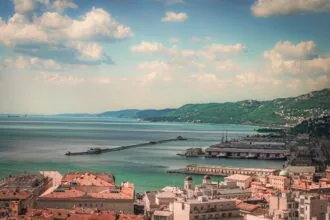
Beyond the seafront, a hilltop cathedral and castle look out over the Gulf of Trieste, while just outside the city, one of the world’s great show caves and the dramatic Miramare Castle extend a visit well beyond the historic centre.
Trieste’s position on the Slovenian border also makes it a natural base for exploring beyond Italy entirely, a theme covered in more depth in our separate day trips guide to the city.
This guide rounds up Trieste’s essential sights, from its seafront squares to its underground Roman ruins and nearby giant cave, along with practical notes on tickets and the best time to visit.
| Attraction | Type | Cost | Best For |
|---|---|---|---|
| Piazza Unità d’Italia | Seafront square | Free | Sunset views and grand historic cafés |
| Miramare Castle | Castle & gardens | €17 (£15/$20) museum, gardens free | Habsburg history and coastal views |
| San Giusto Hill | Cathedral & castle | Cathedral free | Panoramic views over the city and gulf |
| Grotta Gigante | Show cave | €15 (£13/$18) | One of the world’s largest tourist caves |
| Museo Revoltella | Art museum | €8 (£7/$9) | Period rooms and modern art |
| Risiera di San Sabba | WWII memorial | Free | Holocaust history and Resistance memory |
| Hop-On Hop-Off Bus | City tour | From €18 (£16/$20) | A quick first orientation lap |
| Tranvia di Opicina | Tram-funicular | Standard transport ticket | Belvedere viewpoint over the gulf |
| Pedocin Beach | Historic beach | Free | A genuinely unusual local tradition |
Piazza Unità d’Italia and Molo Audace
Piazza Unità d’Italia is Trieste’s grand seafront square, often cited as the largest in Europe to open directly onto the sea. Lined with Habsburg-era palazzi and the city’s town hall, it forms the ceremonial heart of the city.
The square covers around 12,280 square metres, ringed by seven grand palazzi built between the 1780s and 1905, including the domed Palazzo del Municipio, the town hall completed in 1875 by Giuseppe Bruni, and the former Lloyd Triestino headquarters designed by the Viennese architect Heinrich von Ferstel. At its centre, the Fountain of the Four Continents, carved by Giovanni Battista Mazzoleni between 1751 and 1754, predates almost every building now surrounding it.
The square opens straight onto the Gulf of Trieste, and its scale is genuinely striking, especially at sunset when the palazzi catch the last light and the piazza’s grand cafés fill with evening crowds.
Extending from the square into the Adriatic, Molo Audace is a stone pier built over the sunken hull of the San Carlo, a ship that went down in the harbour and was left in place as the foundation for a new 246-metre pier rather than being salvaged. Originally named Molo San Carlo, it was renamed in March 1922 to commemorate the Italian destroyer Audace, the first Allied ship to enter Trieste’s harbour on 3 November 1918, and a bronze compass rose placed at the pier’s end in 1925 still marks the spot.
Together, the square and the pier make the natural starting point for any visit to Trieste, close to the passenger port and a short walk from most of the city’s other sights.
Best if you want daily housekeeping and a front desk. Filter by area first, then by price.
Check availabilityBest for longer stays. Whole apartments and houses, so you are not eating out three times a day.
View rentalsBest as a last check before booking. Compares hotel rates across several sites in one search.
Compare ratesMiramare Castle and Gardens
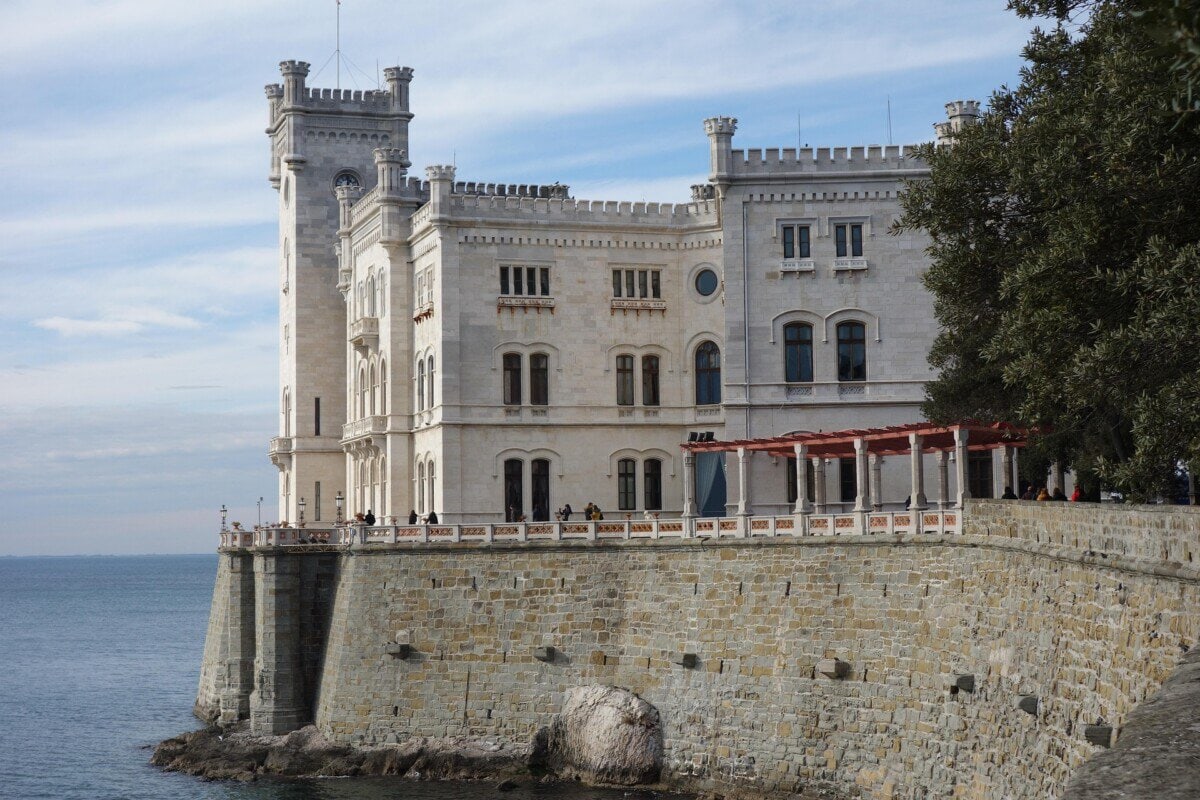
Around eight kilometres from the centre, Miramare Castle is a nineteenth-century white castle built on a rocky headland for Archduke Maximilian of Habsburg, its silhouette one of the most recognisable images of Trieste.
Built between 1856 and 1860 to a design by the Viennese architect Carl Junker, the castle mixes Austrian, German and English influences rather than following a single historical style, reflecting Maximilian’s own eclectic tastes as a well-travelled naval officer. He commissioned it after purchasing the headland in 1856, yet left for Mexico in 1864 before it was finished, having spent most of the construction years living in the smaller Castelletto nearby rather than the main building itself.
Museum tickets cost €17 (£15/$20) full price, including any current temporary exhibition, with a reduced rate of €7 (£6/$8) for visitors aged 18 to 25. The surrounding park is free to enter year-round, a rare perk for a sight this grand.
The extensive gardens, laid out across the headland, are worth a slow wander even without visiting the castle interior, with paths winding through woodland and formal planting down to the water’s edge.
Inside, the ground-floor bedroom and study were fitted out to resemble cabins aboard the frigate Novara, which had carried Maximilian on his own scientific expeditions, while upstairs a Throne Room and a pair of Chinese and Japanese drawing rooms show the more formal side of the residence. A cycle of paintings by Cesare Dell’Acqua traces Maximilian’s own life across one room, made poignant by his execution in Mexico in 1867, only three years after he first sailed away from Miramare.
Regular buses connect Miramare to central Trieste, and the castle also sits on the coastal route towards Barcola and Duino, making it easy to combine with a longer walk or cycle along the seafront.
San Giusto Hill: Cathedral and Castle
Rising above the old town, San Giusto hill holds two of Trieste’s most important historic sights. The Gothic-Romanesque Trieste Cathedral (Cattedrale di San Giusto) fuses two earlier basilicas into one building, with notable Byzantine-style mosaics inside.
The cathedral’s slightly lopsided appearance has a real explanation: two separate basilicas, one dedicated to the Assumption and the other to Saint Justus, stood side by side for centuries before being physically merged in the fourteenth century, with a nave demolished from each to create the single unified interior visitors walk through today. That history explains the off-centre Gothic rose window on the facade, while inside, apse mosaics from the twelfth and thirteenth centuries, made by craftsmen from the Veneto, depict the Virgin Mary flanked by Saints Justus and Servolus.
Entry to the cathedral itself is free, making it an easy stop on the way up to the hilltop. Beside it stands the Castello di San Giusto, a Venetian-era fortress with an armoury museum, ramparts and sweeping views over the city and gulf.
Castle admission prices are worth confirming directly with the site before visiting, since current tiers were not consistently published at the time of writing; the walkways and bastions alone are worth the climb for the view.
The hill is a genuine climb from the old town, so comfortable shoes help, and the reward is one of the best vantage points in the city for orienting the rest of a visit.
The Roman Theatre and Canal Grande
At the base of San Giusto hill, Trieste’s Roman Theatre (Teatro Romano) is a first-century open-air ruin sitting right in the city centre, free to view from outside and a reminder of the city’s long history before the Habsburgs arrived.
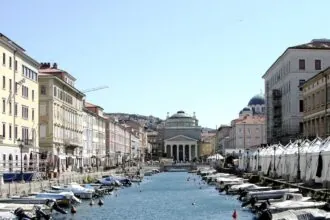
A short walk away, the Canal Grande di Trieste is a ship canal cut into the Borgo Teresiano district, lined with cafés and neoclassical buildings and terminating at the domed church of Sant’Antonio Nuovo.
The canal marks the edge of Trieste’s most elegant grid-planned district, Borgo Teresiano, and walking its length from the church back towards the sea gives a good sense of the city’s eighteenth-century commercial ambitions.
Both sights sit close enough to Piazza Unità and the old town to fold easily into a single morning of walking, without needing any transport beyond comfortable shoes.
Ponte Rosso and the James Joyce Trail
Crossing the Canal Grande at its midpoint, Ponte Rosso is where a life-size bronze statue of James Joyce stands mid-stride on the bridge, cast to look like just another passer-by rather than a formal monument.
Joyce lived in Trieste for over a decade in the early twentieth century, teaching English and drafting much of what became Dubliners and early sections of Ulysses while based in the city.
A self-guided James Joyce Trail links several addresses connected to the writer around the Borgo Teresiano and old town, including former apartments and the café where he is said to have written.
The statue itself is a popular, low-key photo stop, easy to combine with a wander along the canal or a coffee at one of the cafés lining its banks.
Trieste’s literary connections extend beyond Joyce, having also been home for years to the Triestine novelist Italo Svevo, whose own statue and memory are woven into the same streets.
For anyone with an interest in twentieth-century literature, tracing these addresses adds a different layer to Trieste beyond its architecture and coffee houses.
The Serbian Orthodox Church of San Spiridione
Rising above the Borgo Teresiano’s grid of streets, the Serbian Orthodox Church of San Spiridione is one of Trieste’s most visually striking buildings, its Byzantine-Revival domes and red-brick façade unmistakable against the surrounding neoclassical district.
Built in the late nineteenth century for Trieste’s Serbian Orthodox community, the church reflects the city’s long history as a genuine meeting point of Central European, Balkan and Mediterranean communities under Habsburg rule.
Inside, gold mosaics and an ornate iconostasis create a noticeably different atmosphere from the Catholic churches elsewhere in the city, worth the short detour even for visitors without a particular interest in church architecture.
The church sits only a few minutes from Ponte Rosso and the James Joyce statue, making it easy to fold into the same walk through the Borgo Teresiano district.
Opening hours for visitors are limited around services, so checking ahead or simply admiring the exterior on a walk through the neighbourhood is the more reliable plan for a passing visit.
Alongside the nearby synagogue, the church is a reminder that Trieste’s Habsburg-era identity was never solely Catholic or solely Italian.
Piazza Cavana and the Old Ghetto
Tucked behind the passenger port, Piazza Cavana and the surrounding Cavana quarter form one of Trieste’s oldest and least polished corners, a genuine contrast to the grandeur of Piazza Unità only a few minutes away.
The area was once home to Trieste’s Jewish ghetto, and though little of the original structure survives, the narrow lanes and close-set buildings still carry a distinctly different atmosphere from the wide Habsburg boulevards nearby.
On the first Sunday of every month, Via Cavana hosts an antiques and collectibles market running from around 8am until sunset, drawing dealers from across Italy with furniture, vintage accessories and paintings.
Outside market days, the quarter is best known for its concentration of bars and cafés, spilling tables onto Via San Sebastiano, Via Torino and Via di Cavana itself come evening.
It is a useful counterpoint to the seafront sights, a reminder that Trieste’s history includes plenty of unglamorous, lived-in streets alongside its grand imperial set pieces.
Anyone visiting on a first Sunday should build in extra time here, since the market alone can easily fill an hour of browsing.
Best for long or awkward journeys. Builds one itinerary out of separate flights.
View flightsBest for short trips. Install the eSIM at home and arrive with working data, no shop queue.
Browse eSIMsBest when public transport has stopped, or when you are travelling with children and bags.
Book a transferTrieste’s Historic Cafés
Trieste’s Habsburg-era cafés are as much a part of the city’s identity as its architecture, a legacy of the port’s coffee trade that continues today through the city’s most famous roaster, illycaffè.
Caffè San Marco, with its wood panelling and literary history, and Caffè degli Specchi on Piazza Unità itself, are the two best-known survivors of the era, both associated with writers including James Joyce and Italo Svevo, who lived in the city for years.
Caffè Tommaseo, one of the city’s oldest cafés, adds a third stop for anyone tracing Trieste’s coffeehouse history, its mirrored interior largely unchanged since the nineteenth century.
Spending an hour in any of these cafés, rather than rushing past, is arguably one of the most Trieste things a visitor can do, and a good way to pace a day of sightseeing.
Revoltella Museum and Barcola
The Museo Revoltella occupies a nineteenth-century palazzo left to the city by Baron Pasquale Revoltella, combining preserved period rooms with a modern art wing. Full-price entry costs €8 (£7/$9), with a reduced rate of €6 (£5/$7) for various concessions.
Along the coast northwest of the centre, Barcola is Trieste’s favourite seaside strip, a promenade backed by concrete platforms known locally as topolini, where locals swim, jog and gather in numbers on warm evenings.
Barcola is also known for the Bora, the powerful local wind that periodically sweeps the coast, and watching it whip up the sea from the promenade is a distinctly local Trieste experience.
The promenade runs most of the way towards Miramare Castle, making it easy to combine a swim or a walk at Barcola with a visit to the castle further along the coast.
Grotta Gigante and Risiera di San Sabba
A short drive or bus ride from the centre, in the village of Sgonico on the Karst plateau, Grotta Gigante is one of the largest tourist show caves in the world, its single cavern vast enough to hold a cathedral. Full-price entry costs €15 (£13/$18), with reduced rates from €8 (£7/$9) and advance reservation required.
Back in the city, the Risiera di San Sabba is a former rice-husking factory used by Nazi occupiers as the only concentration camp with a crematorium on Italian soil. It is now a solemn national monument and museum to the Holocaust and Resistance, with free entry.
The two sites offer very different but equally essential parts of the region’s story, one a natural wonder beneath the Karst plateau, the other a sobering reminder of the city’s wartime history.
Both are straightforward to reach by local bus, and combining Grotta Gigante with a wider trip out onto the Karst plateau, covered in our separate day trips guide, makes good use of the journey out of the city.
Seeing Trieste by Hop-On Hop-Off Bus
For a quick overview before deciding where to spend more time, a hop-on hop-off bus tour with audio guide loops around more than 22 stops across the city, covering Molo Audace, Miramare Castle, San Giusto and the Pinewood of Barcola in one circuit.
A full loop takes around 90 minutes, and tickets stay valid for 24 hours, so it works equally well as a first orientation lap or a relaxed way to reach outlying sights like Miramare without waiting for a local bus.
Commentary runs in four languages (English, German, Italian and Spanish) through synchronised headphones, useful for anyone travelling with family or a group with mixed language needs.
Tickets start from around €18 (£16/$20) per adult, with the seat only guaranteed on the specific departure booked, though hopping off and rejoining a later bus is included in the price.
This suits travellers short on time or unsure where to prioritise first, though anyone planning to walk the old town and San Giusto hill anyway may find the bus adds little beyond convenience.
Booking ahead is worth it in peak season, since free cancellation up to 24 hours before departure removes most of the downside of locking in a time slot early.
Faro della Vittoria: The Victory Lighthouse
Standing 70 metres tall on Gretta hill above the city, the Faro della Vittoria (Victory Lighthouse) was completed in 1927 on the site of a former Austrian fort, its lantern visible up to 30 miles out to sea.
A copper Winged Victory statue by Giovanni Mayer crowns the dome, and the lighthouse serves as a memorial to Italian sailors lost during the First World War, with an inscription honouring the dead of 1915 to 1918.
Two shells from the Austrian battleship Viribus Unitis flank the entrance, and the anchor of the destroyer Audace, the first Italian ship to enter Trieste’s port in 1918, sits at the base.
Interior access to the first terrace is possible on weekends, free of charge, for anyone willing to climb for a closer look at the structure and its wartime relics.
The site offers genuinely wide views over the Gulf of Trieste at any time of year, and comes into its own during the Barcolana regatta each October, when hundreds of sailing boats fill the water below.
Reaching the lighthouse involves a short uphill walk or a local bus from the Barcola seafront, a reasonable trade-off for one of the city’s best panoramic viewpoints.
The Tranvia di Opicina: Tram, Funicular and Viewpoint
Running since 1902, the Tranvia di Opicina is a genuine hybrid: a conventional tram for most of its route, switched to funicular operation on the steepest section, where cable tractors push the tram uphill and brake it on the way down.
Over just 5.2 kilometres, the line climbs from sea level in central Trieste to 329 metres above the city at Villa Opicina, one of the steepest urban transport routes anywhere in Europe.
Trams run roughly every 20 minutes between 7am and 8pm, using a small fleet of vintage steel tramcars dating from the 1930s and 1940s that are themselves part of the appeal.
At the top, a short walk leads to the Obelisco viewpoint, a belvedere with sweeping views back down over Trieste, the gulf and, on a clear day, the Istrian coast beyond.
The tram uses standard local transport tickets, making it one of the cheapest ways in the city to combine a genuine piece of engineering history with one of Trieste’s best views.
Because it also serves the edge of the Karst plateau, the tram doubles as a scenic, low-effort way up to the area covered in more depth in our separate day trips guide.
Best for short city stops where being central matters more than the room. Dorms and private rooms both listed.
See hostelsBest if you have ever given up on a claim. AirHelp checks whether the flight qualifies and pursues it for you.
See the benefitsBest if your room is not ready yet. Left luggage booked in advance, so you are not hunting for a locker.
Check storageThe Synagogue of Trieste
Built between 1908 and 1912 under Austrian rule, the Synagogue of Trieste is one of the largest and most significant Jewish places of worship in Europe, designed to serve a community that had grown to nearly 6,000 members by the late 1930s.
The Romanesque Revival design, by architects Ruggero and Arduino Berlam, draws on late Roman architectural traditions from the eastern Mediterranean rather than the Moorish Revival style common to many European synagogues of the period.
Inside, three naves lead to a monumental ark with copper doors beneath a central dome, with bronze candelabra and a pipe organ in the women’s gallery decorated with Stars of David.
The synagogue was closed and damaged under Fascist race laws from 1942, later used as a storage facility during the Nazi occupation, though the community’s ritual silver survived thanks to a hiding place built into the building itself.
Services and community life resumed after the war, and the building remains an active synagogue today, with visits generally possible through guided tours arranged in advance rather than casual drop-in hours.
For visitors interested in the fuller, more complicated story behind Trieste’s Habsburg-era cosmopolitanism, the synagogue is as essential as any of the city’s grand cafés or piazzas.
Pedocin: Europe’s Last Gender-Segregated Beach
A short walk from the centre, Pedocin (officially the Bagno della Lanterna) has operated as a public beach since 1903, when Trieste still belonged to the Austro-Hungarian Empire, and remains divided by a wall separating men’s and women’s bathing areas.
The separation is voluntary rather than enforced on individuals: families and couples move freely between sides, and the divide is maintained more as local tradition than as a strict rule imposed on visitors.
It is widely considered the last beach in Europe with a permanent gender division of this kind, similar arrangements elsewhere on the continent having disappeared over the twentieth century.
Regulars describe valuing the sense of privacy and familiarity the arrangement gives them, and most locals treat it as a quirk of Trieste’s heritage rather than anything more loaded.
Entry is free, and the beach itself is modest rather than glamorous, more a slice of local life than a postcard stretch of sand, which is arguably exactly the point of visiting.
For travellers curious about Trieste beyond its architecture and coffee houses, Pedocin offers a genuinely unusual, low-key look at a tradition that has quietly outlasted the rest of the continent.
Shopping in Trieste
Trieste’s shopping runs across a handful of distinct districts rather than one obvious high street, starting with tree-lined Viale XX Settembre, home to clothing, accessories and jewellery shops alongside gelato parlours for a summer browse.
Around Corso Italia, near Piazza Unità, sit recognisable Italian names such as Max Mara and Max&Co alongside department stores like Coin, a reliable stretch for fashion without straying from the seafront.
The Borgo Teresiano and Via San Nicolò add bookshops, including the historic Libreria Saba, plus chain and franchise stores, with a wooden-hut Christmas market appearing here each December.
For something less predictable, the Cavana quarter around Via Cavana specialises in second-hand dealers and antiques, its monthly Sunday market drawing collectors from across Italy for furniture and vintage finds.
Food-focused visitors should not skip illycaffè-branded shops and the city’s historic cafés, several of which sell their own roasted beans and blends to take home.
Between fashion streets, antiques and coffee, Trieste’s shopping rewards a slow wander over a single dedicated shopping trip, spread as it is across several distinct neighbourhoods.

Trieste’s Nightlife and Aperitivo Scene
Trieste’s evening scene centres less on nightclubs than on a long, easy aperitivo culture, with the bar-dense stretch of Via San Sebastiano, Via Torino and Via di Cavana forming the closest thing to a single nightlife district.
Tables spill out onto the street from early evening, and the pace favours wine and conversation over loud music, a noticeably more relaxed atmosphere than the nightlife of larger Italian cities.
Wine bars specialising in local Friuli-Venezia Giulia producers sit comfortably alongside craft beer spots and more cocktail-focused venues, giving the area a fairly wide spread for one compact neighbourhood.
Piazza Unità and the seafront also draw an evening crowd for a drink with a view, particularly around sunset, when the piazza’s grand historic cafés double as aperitivo spots.
For a proper late night, a handful of venues stay open into the small hours, though Trieste overall leans towards a civilised, unhurried evening rather than an all-night club scene.
Anyone used to bigger Italian cities may find Trieste’s nightlife modest by comparison, but that same lower-key character is arguably part of what makes an evening here so easy to enjoy.
Trieste’s Food Scene: Where Italy Meets the Balkans
Trieste’s kitchen draws on Mediterranean, Austrian, Slavic and Central European traditions in equal measure, a genuinely distinct food identity within Italy shaped by its centuries as the Habsburg Empire’s main port.
Jota, a hearty soup of beans, potatoes and sauerkraut served with bacon and smoked sausage, and a local version of goulash made with white onions and pork lard, both point more towards Vienna and the Balkans than Rome.
On the coast, brodetto, a seafood soup with garlic and white wine, and scampi alla busara, langoustines cooked with tomato and chilli, keep a firmer footing in Adriatic and Italian tradition.
Sweet gnocchi de susini, plum dumplings dusted with cinnamon, and strucolo in straza, a boiled strudel filled with walnuts and raisins, round out a dessert repertoire that again leans towards Central Europe rather than classic Italian pastry.
None of this displaces Trieste’s coffee culture, still centred on illycaffè and the city’s historic cafés, where a proper sit-down blend remains as much a local ritual as any meal.
For visitors expecting standard Italian trattoria fare, Trieste’s genuinely hybrid cuisine is one of the more pleasant surprises the city has to offer.
When to Visit Trieste
Spring and early autumn generally offer the most comfortable weather for exploring Trieste on foot, avoiding both the height of summer heat and the strongest winter bouts of the Bora wind along the seafront.
Trieste sees noticeably fewer international visitors than Venice or Verona, which keeps its main sights comfortably uncrowded even in the height of summer, a genuine point of difference for travellers tired of queues elsewhere in Italy.
Its historic centre is compact and flat along the seafront, with the main climb reserved for San Giusto hill, making the city an easy one to explore on foot over a couple of days.
For anyone with extra time, Trieste’s position right on the Slovenian border opens up day trips that are genuinely unusual for an Italian city, covered in full in our separate guide.

One Day in Trieste: A Practical Itinerary
Anyone with only a single day in Trieste can still cover its essential landmarks without rushing, provided the day starts early and stays within the compact seafront and old town rather than venturing out to the Karst plateau. The sequence below groups the sights covered above into a realistic order, minimising backtracking across the city.
- Start at Piazza Unità d’Italia and walk out along Molo Audace before the square fills up.
- Head inland a few minutes to the Roman Theatre and along the Canal Grande towards Sant’Antonio Nuovo.
- Cross at Ponte Rosso to see the James Joyce statue, then follow the trail through Borgo Teresiano.
- Stop for coffee at Caffè San Marco or Caffè degli Specchi before the climb ahead.
- Climb San Giusto hill for the cathedral, castle ramparts and the best views over the gulf.
- Take a bus out to Miramare Castle for the gardens, and the museum if time allows, in the afternoon.
- Return via Barcola for an early-evening walk, finishing with an aperitivo back around Piazza Cavana.
This whole loop stays walkable except for the bus out to Miramare, and can be trimmed by skipping the castle interior or Barcola if the day is running short. Anyone arriving that same morning from the airport or ferry port should build in extra time before the first stop.
Trieste in Two Days: Splitting the City and the Coast
With a second day available, the sensible split is to keep day one inside the compact old town and seafront covered above, then use day two for Miramare, the Karst plateau and the sights along the coast towards Barcola, rather than trying to cram everything into a single rushed loop.
Day one follows the same core route as the one-day itinerary above: Piazza Unità and Molo Audace, the Roman Theatre and Canal Grande, Ponte Rosso and the Joyce trail, San Giusto hill, and a historic café stop, with the Synagogue of Trieste or the Serbian Orthodox Church of San Spiridione added in for anyone interested in the city’s multi-faith Habsburg-era history, before an evening in the Cavana quarter’s bars.
- Start day two with Miramare Castle and its gardens, reached by an early bus before the crowds build.
- Walk or bus back along Barcola‘s seafront promenade towards the city.
- Ride the Tranvia di Opicina up to the Obelisco viewpoint for a different angle over the gulf.
- Visit Grotta Gigante and the Risiera di San Sabba memorial on or near the Karst plateau, booking cave tickets ahead.
- Finish at the Faro della Vittoria lighthouse if time and daylight allow, or head back for a final Trieste dinner instead.
This second day leans more on local buses than the first, so building in a little slack between stops, particularly around Grotta Gigante’s timed entry, keeps the day from feeling rushed rather than relaxed.

Rupert’s Handy Travel Tips
Exploring Trieste? Rupert has a few tips that can save both time and money:
- Visit Miramare’s park even on a tight budget: the gardens are free year-round, even if you skip the paid museum.
- Book Grotta Gigante in advance: reservations are required, and it’s a short trip out onto the Karst plateau.
- Wear comfortable shoes for San Giusto hill: it’s a genuine climb from the old town, though the view is worth it.
- Sit down in a historic café rather than grabbing coffee to go: Caffè San Marco and Caffè degli Specchi are part of the sightseeing, not just a stop.
- Check the Bora forecast before a Barcola swim: the local wind can whip up the sea with little warning.
- Consider a day trip across the border: Trieste’s position makes Slovenia genuinely easy to reach, unlike most Italian cities.
- Ride the Tranvia di Opicina for the view: the tram-funicular hybrid climbs to a belvedere over the whole gulf for the price of a bus ticket.
- Don’t skip Cavana on a first Sunday: the monthly antiques market is one of the city’s better-kept secrets.
Want to meet the reindeer behind our travel tips? Find out more in our page Who is Rupert?.


Frequently Asked Questions About Trieste
Is Trieste worth visiting?
Yes. Its Habsburg-era architecture, coffee culture and seafront setting give it a character unlike anywhere else in Italy, with far fewer crowds than Venice.
How much does Miramare Castle cost?
Museum entry costs €17 (£15/$20) full price, with a reduced rate of €7 (£6/$8) for visitors aged 18 to 25; the surrounding park is free.
How many days do you need in Trieste?
Two days covers the historic centre and Miramare comfortably, with extra time useful for a day trip into Slovenia or the Karst plateau.
What is Grotta Gigante?
One of the largest tourist show caves in the world, on the Karst plateau just outside Trieste, with a single cavern large enough to hold a cathedral.
Why is Trieste known for coffee?
The city was a major Habsburg-era coffee port and remains home to illycaffè, with historic cafés like Caffè San Marco still serving the same tradition.
Is Trieste close to Slovenia?
Yes, the border is only a short drive from the city, making Ljubljana and Lake Bled realistic day trips.
Is Pedocin beach really gender-segregated?
Yes, by a wall dividing men’s and women’s sides, though the divide is voluntary and families move between them freely.
How do you get up to Villa Opicina from Trieste?
The historic Tranvia di Opicina, a tram-funicular hybrid running since 1902, climbs from the city centre in around 20 to 25 minutes.

Further Reading & Related Guides
Planning a longer stay? Our Day Trips from Trieste guide covers Slovenia, Udine and the Karst plateau, and our Trieste Airport Transfers guide covers getting into the city on arrival.
Arriving by sea? Our Trieste Ferry Port & Routes Guide covers the city’s cruise terminal and the seasonal Adriatic crossings to Croatia and Slovenia.
Continuing into Slovenia? Our Interrail Slovenia Pass guide covers Ljubljana, Lake Bled and the Adriatic coast just across the border.
Curious how Trieste compares to Italy’s more famous lagoon city? Our Venice Things to Do guide covers the canals, islands and crowds that Trieste’s own seafront deliberately avoids.