Reviewed by our editorial team Published
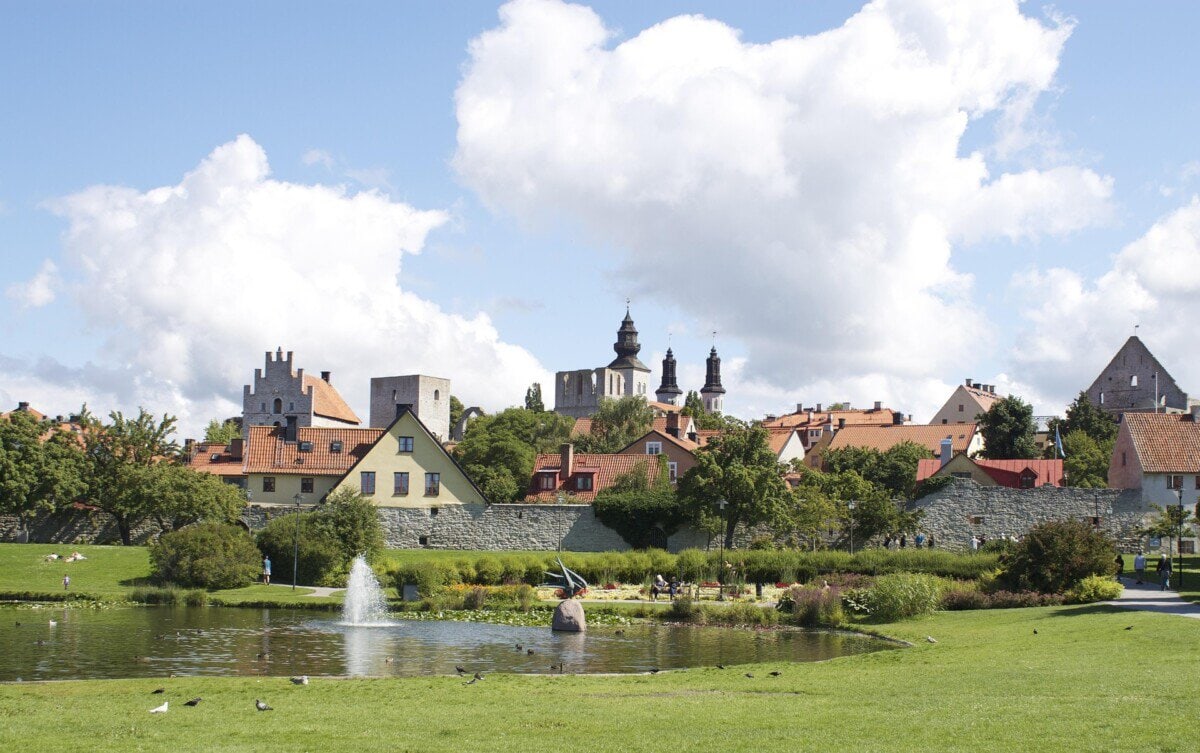
Visby is the only real town on Gotland, Sweden’s largest island, and it happens to be one of the best-preserved medieval towns anywhere in Scandinavia. A ring of 13th and 14th-century limestone walls still encloses the old town almost completely, and the streets inside them are lined with roses, timbered merchant houses and the roofless shells of a dozen medieval churches rather than the tidy reconstructions found in many rebuilt European old towns.
Beyond Visby itself, Gotland is a genuinely large island: flat, easy to cycle, and scattered with limestone sea stacks, quiet beaches and the neighbouring island of Fårö, best known for its connection to the filmmaker Ingmar Bergman. Most visitors base themselves in Visby and make day trips out into the countryside rather than moving between several towns, since there really is only the one.
The island has a distinct rhythm to its year. Summer, and especially early August’s costumed Medieval Week, brings the crowds and the best weather; early July brings Sweden’s political class to town for Almedalen Week; the rest of the year is quieter, cheaper and considerably less busy on the old town’s narrow streets.
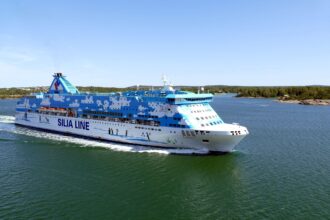
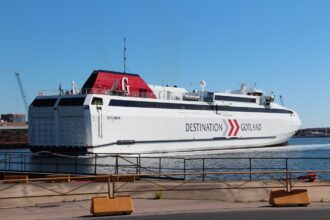
For how to actually get here, our separate Gotland Ferry Routes guide covers both mainland ports and flying into Visby Airport. This guide covers what to actually do once ashore.
Visby and Gotland at a Glance
| Attraction | Why Visit | Time to Spend |
|---|---|---|
| Visby City Wall | Scandinavia’s best-preserved medieval town wall, with towers and a walkable rampart section | 1–2 hours |
| Church Ruins | Thirteen roofless medieval churches scattered through the old town, the densest concentration in Scandinavia | 1–2 hours |
| Gotland Museum | The world’s finest collection of Viking-age picture stones | 1.5 hours |
| Almedalen Park | The old harbour turned public park, and the venue for Sweden’s political week each July | 30–45 minutes |
| Fårö Island | Ingmar Bergman’s home and filming location, reached by a short ferry from Gotland’s northern tip | Half day |
| Raukar Sea Stacks | Wind and wave-carved limestone pillars, best around Langhammars on Fårö | 1–2 hours |
| Lummelunda Caves | Guided tours through a limestone cave system 14km north of Visby | 1.5–2 hours |
| Tofta Beach | One of Sweden’s best sand beaches, around 16km south of Visby | Half day |
The Visby City Wall and Old Town Streets
Visby’s city wall is the reason the old town earned its UNESCO World Heritage listing in 1995, recognised as the strongest and most complete medieval town wall anywhere in Scandinavia. Around 3.4km of the original 3.6km circuit still stands, built in two main phases through the 13th and 14th centuries, with 27 of the original large towers and 9 of the smaller ones surviving intact.
A walkway along part of the rampart is open to the public, and several towers can be climbed for views back over the old town’s rooftops and out towards the harbour, including Tall Lisa, the tallest at six storeys. The wall is largely free of modern buildings pressed up against it, so the walk feels genuinely medieval rather than squeezed between car parks and shopfronts.
Inside the walls, the streets are narrow, cobbled and lined with timber-framed merchant houses, many now covered in the climbing roses Visby is locally famous for in early summer. The whole old town is compact enough to walk in well under an hour end to end, though most visitors take considerably longer once shops, cafes and church ruins start pulling them off the direct route.
The wall’s oldest fragment actually predates the rest of it: Kruttornet, the squat round tower down by the harbour, is generally dated to around the 1160s and was built purely to defend the waterfront decades before the land-facing circuit was even begun. It stood as Visby’s only permanent fortification for a generation, guarding a harbour that was, at the time, the town’s single greatest vulnerability.
Two of the original gatehouses, Söderport at the southern end of the old town and Norderport to the north, still carry traffic in and out of the walls much as they always have. Söderport’s stonework carries a weathered inscription marking the wall’s completion, and both gates are worth pausing under rather than simply walking through on the way somewhere else.
Look closely and the wall’s landward stretch is noticeably taller and more heavily towered than the section facing the harbour, a detail historians generally trace to a fractious relationship between Visby’s German merchant class and Gotland’s own rural population. That tension turned violent in 1361, when a hastily armed Gotlandic militia was cut down by an invading Danish army just outside the walls in what is still remembered as the Battle of Visby, one of medieval Scandinavia’s bloodiest single days.
Best if you want daily housekeeping and a front desk. Filter by area first, then by price.
Check availabilityBest for groups who want one address and separate bedrooms rather than three hotel rooms.
See holiday homesBest if you have already picked a hotel. Checks the big booking sites for the same room and shows who is cheapest.
Check dealsThirteen Church Ruins and the Gotland Museum
Visby holds thirteen medieval church ruins, the densest concentration of roofless churches anywhere in Scandinavia, a legacy of the town’s wealth as a Hanseatic trading post that later declined sharply enough that most of its churches were never rebuilt after damage or disrepair. St Nikolai, St Per and St Lars are among the best known, their stone walls and empty window frames now open directly to the sky.
The ruin of St Katarina is put to particularly good use during Medieval Week each August, when open-air concerts are staged beneath its Gothic stonework, one of the more atmospheric ways to experience the ruins after dark rather than simply walking past them by day.
For context on what built this wealth in the first place, the Gotland Museum in the old town holds the finest collection of Viking-age picture stones (bildstenar) anywhere in the world, carved limestone slabs from the 5th to 11th centuries depicting battles, ships and Norse mythology in remarkable detail. It is the natural place to properly understand the island’s history before or after wandering the ruins outside.
Of the thirteen ruins, one medieval church is conspicuously missing from the list: Visby Cathedral, dedicated to St Maria, is the sole church in the old town that was never abandoned and still holds regular services today. Built by German merchants in the 13th century and heavily restored after a fire, it makes an obvious contrast to walk between, one roofed and still in use, the rest open to the sky.
The ruin of Helgeandskyrkan, the Church of the Holy Spirit, is architecturally the odd one out among the thirteen, an unusual octagonal building that was originally built on two levels rather than the standard single nave. It served a hospital and almshouse attached to the church, and its shape alone makes it worth seeking out beyond the better-known ruins along the main streets.
The Gotland Museum’s most striking exhibit has a darker origin than the picture stones: mass graves discovered at Korsbetningen, just outside the walls, hold the remains of Gotlandic militiamen killed in the 1361 Battle of Visby, several still wearing chainmail at the time of excavation in 1905. That armour, known internationally as the Wisby armour, is one of the best-preserved collections of 14th-century mail anywhere in Europe and is displayed at the museum today.
Almedalen Park and the Harbour
Almedalen Park sits on the site of Visby’s original medieval harbour, long since silted up and turned into a green, open public space right at the edge of the old town. It is a straightforward, pleasant place for a walk or a picnic for most of the year, with the old harbour’s outline still traceable in the shape of the park itself.
For one week each July, the park and the whole town transform for Almedalen Week, when Sweden’s political parties, journalists and lobbyists descend on Visby for a week of open-air debates and speeches that has become one of the country’s most important annual political events. Visitors uninterested in Swedish politics should simply expect a busier, more expensive week for hotels and restaurants if travelling during this period.
The park’s transformation from working harbour to dry land is itself a piece of geology rather than deliberate engineering: Gotland’s whole coastline has been slowly rising out of the Baltic since the last ice age eased its weight off the land, a process called post-glacial rebound that gradually silted up Visby’s original anchorage until it stopped functioning as a harbour at all. The modern harbour, used by ferries and cruise ships today, sits further out along the coast as a direct result.
Almedalen Week itself traces back to 1968, when the Swedish politician Olof Palme gave an impromptu summer speech from the back of a truck parked in the park while on holiday on the island. What started as one politician talking to whoever happened to be passing has grown into a week hosting every major Swedish party, thousands of seminars and heavy national broadcast coverage.
Outside both festival weeks, Almedalen Park still earns its keep as Visby’s default outdoor events space, hosting open-air concerts and community gatherings through the summer months on the same flat ground where merchant ships once unloaded. It is worth a slow lap even on a quiet weekday, if only to picture the water that used to be there.
Fårö, the Raukar and Ingmar Bergman
Fårö is a smaller island off Gotland’s northern tip, reached by a short, free car ferry, and it is where the Swedish filmmaker Ingmar Bergman lived for much of his later life and shot several of his films. The island’s stark, treeless landscape and dramatic coastline are recognisably the backdrop to that work, and a small museum and archive dedicated to Bergman operates seasonally near his former home.
Fårö is also the best place on Gotland to see raukar, the limestone sea stacks carved by wind and wave action out of ancient coral reef formations, standing in scattered groups along the shoreline. Langhammars on Fårö’s northern coast is generally considered the most striking spot, a beach scattered with dozens of these pillars in a way that feels genuinely otherworldly rather than a single roadside curiosity.
A car makes Fårö far easier to explore properly than relying on the island’s limited bus service, and a full day allows time for the ferry crossing, a proper walk among the raukar and a stop at whichever Bergman sites are open that season.
The seasonal Bergman Center, at Dämba near the island’s ferry landing, holds an archive of scripts, photographs and equipment alongside a small screening room showing his films, and it anchors a dedicated Bergman Week festival each summer that draws film scholars and fans from well beyond Sweden. Bergman himself is buried in the graveyard of Fårö’s small parish church, a modest grave for a filmmaker whose late work is inseparable from the island around it.
Langhammars is not Fårö’s only raukar field: the nearby Digerhuvud nature reserve, a little further along the coast, offers a second, quieter concentration of sea stacks scattered through low pine and juniper scrub rather than open beach. Visitors with limited time generally head straight for Langhammars, but Digerhuvud rewards anyone willing to spend an extra hour with noticeably fewer other tourists.
The island’s name is no accident: Fårö translates literally as “sheep island”, and its treeless, wind-scoured pastures still support a distinctive breed of hardy sheep whose wool turns up in knitwear sold across Gotland. Locals also speak their own dialect, distinct enough from mainland Gotlandic that outsiders sometimes need a moment to follow it.

Lummelunda Caves and Gotland’s Beaches
About 14km north of Visby, the Lummelunda Caves form one of Sweden’s largest limestone cave systems, open for guided tours of around 90 minutes through chambers of stalactites and underground passages that stay a constant, cool temperature regardless of the season outside. It is a genuinely different kind of Gotland attraction after a day of medieval streets and open coastline.
The caves were only found by accident in 1948, when two boys chasing a fox stumbled on a narrow opening in the ground that turned out to lead into the chambers below. The full mapped system actually runs considerably further underground than the section open to visitors, with the guided route covering only the accessible first stretch of a network cavers have since traced much deeper into the limestone.
For beaches, Tofta, around 16km south of Visby, is regularly ranked among Sweden’s best, with genuine white sand and shallow water that can warm above 20°C in a good summer, unusual for the Baltic Sea. It gets busy on hot weekends but rarely feels crowded by the standards of a Mediterranean beach resort.
On the island’s east coast, Ljugarn is the other beach worth building a day around, a laid-back seaside village with its own sandy shoreline and, just outside town, the Folhammar raukar field, a smaller and easier-to-reach alternative to Fårö’s sea stacks for anyone not making the trip north. Back on Fårö itself, Sudersand combines a long, dune-backed sweep of sand with a campsite and cabins, making it the practical choice for anyone wanting to turn a raukar day trip into an overnight stay.
Gnisvärd and Gotland’s Bronze Age Ship Settings
On Gotland’s west coast, a short walk inland from Tofta beach, the Gnisvärd stone ships are among the finest Bronze Age monuments anywhere on the island. Skeppssättningar, literally “ship settings,” are burial markers built from upright stones arranged in the outline of a vessel, and Gnisvärd holds two substantial examples rather than the single small ship found at many other Gotland sites.
The larger of the two runs to roughly 45 metres long and 7 metres wide, built from around a hundred closely packed stones with bow and stern markers standing about 1.3 metres tall; a second ship nearby measures 36 by 4 metres. Both sit alongside stone circles up to 16 metres across and a substantial burial mound, together forming one of the densest concentrations of prehistoric monuments on Gotland’s coastline.
The site’s history runs deeper than the ships themselves: a Neolithic megalithic tomb close by predates them by well over a thousand years, and archaeologists think the Bronze Age builders deliberately chose to build near a place already considered sacred. Excavated remains suggest the tomb was reused as a collective grave for centuries afterwards, with burials continuing into the early first millennium AD.
For visitors already planning a day at Tofta, Gnisvärd adds a genuinely different kind of stop rather than more beach: strange, weathered rows of stone standing in open grassland, with almost none of the crowds that gather a short walk away on the sand. There is no admission charge and no fixed opening hours, since the monuments simply sit in the open landscape year-round.
Bunge Museum: Gotland’s Open-Air Heritage Village
On the road north toward the Fårö ferry, Bungemuseet at Fårösund is Gotland’s largest open-air museum, a collection of around 77 historic buildings relocated from farms across the island and arranged into three reconstructed farmsteads spanning several centuries of rural life.
The museum owes its existence to one man’s determination: the local schoolteacher Th. Erlandsson, born in 1869, grew alarmed at how quickly Gotland’s traditional farm buildings were disappearing and began moving threatened structures onto protected land, with the first arriving in 1908 and the museum’s supporting society formally founded the following year.
Wandering the grounds turns up timber bulhus houses built from tarred post-and-plank construction, stone farm dwellings with distinctive wall cupboards built into the masonry, windmills, sawmills, limekilns and the tar-extraction pits that were once a genuine Gotland industry. A small collection of prehistoric picture stones from nearby Hammarsänge, carved between the 5th and 8th centuries, adds an older layer of history again beneath the farm buildings above ground.
Entry runs to around SEK 175 (roughly £13/$17/€15) for an adult in summer 2026, with children under 18 admitted free alongside a paying adult, and guided tours in English or German can be arranged on request. Since the museum sits directly on the route to the Fårö ferry, it slots naturally into a day already built around the raukar and Bergman sites further north rather than needing a special trip of its own.
Best for long or awkward journeys. Builds one itinerary out of separate flights.
View flightsBest for short trips. Install the eSIM at home and arrive in Sweden with working data, no shop queue.
Browse eSIMsBest after a long flight or a late landing. Price agreed before you travel, and no taxi queue.
Check transfersGotlandRing: A Circuit for Motoring Enthusiasts
North of Visby near Lärbro, GotlandRing is a genuinely unexpected addition to a Gotland itinerary: a 7.3km, 28-turn motor racing circuit that opened in 2008 and has been marketed, only half in jest, as Sweden’s answer to the Nürburgring. It was built partly as a vehicle testing facility for manufacturers, taking advantage of the island’s isolation to run development programmes away from public roads and prying cameras.
Public track days run through the season, and the circuit is emphatically not reserved for race cars: ordinary roadgoing vehicles are welcome, and the operator is explicit that no special car is needed to come and learn the layout. Sessions typically run across the day, with instructors on hand for anyone who wants coaching rather than simply lapping alone.
For visitors without their own car to drive, or without a track day booked, GotlandRing also runs tourist laps, a passenger-seat way to experience the circuit’s sweeping corners without needing a racing licence or a hire car insured for track use. It is a distinctly different kind of Gotland stop from the island’s medieval streets and prehistoric monuments, and one that motoring enthusiasts touring Scandinavia are unlikely to find anywhere else nearby.
Combined with Bungemuseet a short drive away, the Lärbro area makes a reasonable half-day loop for anyone heading north toward Fårö who wants more than a straight drive through, whether or not a lap of the circuit itself is on the agenda.
Medieval Week and Almedalen Week
Medeltidsveckan, or Medieval Week, takes over Visby for several days each early August, when much of the town dresses in period costume for markets, jousting tournaments, concerts among the church ruins and a genuinely large-scale historical festival atmosphere. It is by far the busiest week of the year, and accommodation is often booked out close to a year in advance.
Almedalen Week in early July is a completely different kind of crowd, drawing Swedish politicians and media rather than costumed re-enactors, but it produces a similar squeeze on hotel rooms and restaurant tables. Travellers wanting a quieter, cheaper visit are generally better served by late spring, September or early autumn, when the weather is still reasonable but neither event is underway.
Medieval Week traces back to 1984, when a small group of local history enthusiasts staged the first costumed market inside the walls, a modest event that has since grown into one of the largest historical festivals in Northern Europe. The market stalls still cluster thickest along Strandgatan and the streets nearest the harbour, selling everything from leatherwork to roasted almonds in the medieval style.
The week’s jousting tournaments and mounted combat displays are staged on Galgberget, Gallows Hill, just outside the old town walls, a genuinely open grassy arena rather than a purpose-built showground. Arriving early for a good vantage point is worth it, since the free displays draw large crowds on the festival’s busiest afternoons.
Almedalen Week, by contrast, has grown into a genuinely enormous political gathering, with every major Swedish party represented and thousands of seminars, panel discussions and press events packed into a single week, much of it broadcast live by Swedish national television. The two festivals overlap in scale but not at all in atmosphere, and visitors sometimes find they much prefer one to the other.
Things to Do in Visby in the Rain
The Gotland Museum is the obvious wet-weather anchor, with enough Viking-era picture stones, archaeological finds and local history on display to comfortably fill an hour and a half indoors. The Lummelunda Caves further out work just as well on a wet day as a dry one, since the tour is entirely underground regardless of what the sky is doing above.
Failing that, Visby’s old town has enough small cafes, craft shops and the covered Saluhall market hall to make an unhurried, indoor-leaning wander through the streets a genuinely pleasant way to pass a rainy morning, particularly with a stop for the island’s own saffron pancake somewhere along the way.
Visby Cathedral itself is worth adding to a wet-weather list, since it is the one medieval church on this list still fully roofed and open to visitors regardless of the forecast, unlike the thirteen open-air ruins nearby. Its restored interior and tower views make it a natural pairing with the Gotland Museum a short walk away.
Families with children escaping the rain are generally best served by Kneippbyn, a resort just south of Visby that has an indoor and outdoor water park alongside a recreated version of Pippi Longstocking’s house, built for Astrid Lindgren’s 1969 film adaptations shot on the site. It is a firmly commercial attraction rather than a historical one, but it solves a rainy afternoon with children far more reliably than another round of church ruins.
Food Scene and Food Halls
Gotland’s food culture leans heavily on what the island itself produces. Gotlandslamb, lamb raised on the island’s limestone meadows, is widely considered among the best in Sweden, and saffranspannkaka, a thick, oven-baked saffron pancake served with cream and jam, is a genuinely local dish found nowhere else in the country in quite the same form.
Strömming, Baltic herring, appears pan-fried or pickled on menus across the island, and Visby Saluhall, the town’s covered market hall, is the easiest single stop for a range of local produce and quick meals without committing to a sit-down restaurant. A handful of restaurants inside the old town’s medieval cellars, including one with a Michelin recommendation, push the island’s produce into more formal fine dining territory for anyone wanting a proper evening out.
The island also has its own brewing tradition, from craft beer taprooms using local ingredients to gotlandsdricke, a traditional unhopped farmhouse-style beer that predates modern brewing and is still made on a small scale by a handful of producers.
Outside Visby itself, Gotland’s countryside roads are dotted with small farm shops selling lamb, cheese and preserves directly from the producer, often little more than an honesty-box stall beside a farmhouse gate. It is a genuinely different way to eat the island’s produce than a restaurant menu, and popular with visitors touring by car or bicycle between the coastal sights.
Saffron itself has no obvious reason to be a Gotland speciality, since none of it is grown locally, and the tradition is generally traced back to the spice trade that once passed through Visby as a wealthy Hanseatic port. Whatever its origin, saffranspannkaka has stuck around as a genuinely distinct piece of the island’s food identity ever since.
A handful of the old town’s medieval cellar restaurants have leaned into that Hanseatic history directly, serving tasting menus built almost entirely around Gotland lamb, Baltic fish and foraged ingredients from the island’s own limestone grasslands. Booking ahead in July and August is worth doing, since the best of these small dining rooms genuinely do fill up during the summer season.
Nightlife and After Dark
Visby is not a nightlife destination in the way a mainland Swedish city might be, and outside Medieval Week and Almedalen Week most evenings in the old town are genuinely quiet rather than lively. What does exist tends to cluster around the harbour and a handful of bars in the old town, popular with both locals and the summer crowd for a relaxed evening drink rather than a big night out.
The most memorable after-dark experience on the island has little to do with bars at all: a summer evening walk along the city wall or through the church ruins, quiet and softly lit, is a genuinely atmospheric way to end a day, and arguably the thing most visitors remember longest.
On warm summer evenings, Donners Plats, the small square just inside the wall near the harbour, becomes the closest thing Visby has to a social hub, its outdoor terraces filling with locals and visitors alike over a late drink. It is a good place to simply sit rather than move between venues, since most of what nightlife exists in Visby is genuinely within a few minutes’ walk of it.
Visitors used to buying wine or spirits at a supermarket should note Sweden’s alcohol monopoly, Systembolaget, is the only place to buy anything stronger than light beer to take away, and it keeps limited hours and closes early on weekday evenings. Bars and restaurants are unaffected by this and serve as normal, but anyone planning a self-catered evening should shop earlier in the day than they might elsewhere in Europe.
Shopping and Markets
Visby’s old town streets hold a genuine concentration of small, independent craft shops rather than chain retail, with local glassblowing, ceramics and Gotland wool and sheepskin products among the more distinctive souvenirs on offer. Gotland’s sheep, the same breed behind the island’s well-regarded lamb, also produce wool that turns up in knitwear and rugs sold across the old town.
Visby Saluhall doubles as the best single stop for local food to take away, from cheese and cured meats to preserves made with island-grown berries, and is a more useful shopping stop than a typical souvenir shop for anyone wanting to bring a genuine taste of Gotland home.
During Medieval Week, Kapitelhusgården, a medieval chapter house complex near the cathedral, becomes one of the best places on the island to buy genuinely handmade goods, with craftspeople demonstrating and selling leatherwork, forged ironware and woven textiles on site rather than through a shop counter. Outside the festival it runs as a quieter craft and cultural centre, still worth a look for anyone interested in how the objects are actually made.
Several small glassblowing studios around the old town and further into the countryside allow visitors to watch pieces being made before buying, which tends to make for a more considered souvenir than something picked off a shelf. The Gotland Museum shop, meanwhile, sells well-made replicas of the picture stones on display inside, a distinctive alternative to the usual fridge magnets and postcards.
Best for a short stop where being central matters more than the room. Dorms and private rooms both listed.
See hostelsBest for anyone flying more than once or twice a year. Handles the compensation claim so you are not chasing the airline.
See AirHelp+Best if your room is not ready yet. Left luggage booked in advance, so you are not hunting for a locker.
Check storageGetting Around Gotland
Visby’s old town is car-restricted and entirely walkable, so a vehicle is only really useful once a visitor wants to explore beyond the walls. For the rest of the island, a hire car or a bicycle is the practical choice, since Gotland’s local bus network covers the main towns but runs too infrequently for a day trip built around several stops.
Gotland’s largely flat terrain and network of quiet rural roads make it a genuinely popular cycling destination in its own right, and bikes can be hired in Visby for anyone travelling without one on the ferry. For Fårö specifically, the short car ferry across the strait is free and runs frequently enough not to need advance planning.
That cycling reputation is backed up by infrastructure rather than just flat scenery: Gotland has built up somewhere around 300km of dedicated cycle paths radiating out from Visby, a genuinely unusual amount for an island this size and enough to string together several of the countryside sights on this page without touching a main road. Multi-day cycling itineraries around the island have become popular enough that several operators now offer luggage transfer between overnight stops.
The island’s regional bus network, run under the Kollektivtrafiken brand, connects Visby to the main towns and villages reasonably well for a single point-to-point journey, but its timetables thin out fast once a day trip needs more than one or two stops. A hire car remains the more practical choice for anyone trying to cover the City Wall, Fårö and a beach in the same day.
The Fårö car ferry itself runs from Fårösund, at Gotland’s northern tip, and the crossing takes only a few minutes, short enough that it barely counts as an interruption to the drive north. Anyone arriving by air rather than sea should note Visby Airport sits only a few kilometres from the old town, close enough for a short taxi transfer rather than a lengthy onward journey.
How Many Days Do You Need on Gotland?
One day is enough to see Visby properly if that is genuinely the whole trip: the city wall, a couple of church ruins and the Gotland Museum comfortably fill a day between a morning ferry and an evening one, which suits a stop already built into a wider Stockholm itinerary rather than a dedicated island holiday.
Two to three days is the more realistic minimum for anyone wanting more than the old town, since it allows a full day out to Fårö for the raukar and Bergman sites, plus either a beach day at Tofta or Ljugarn, or a countryside loop taking in Bungemuseet and the Gnisvärd stone ships along the way.
A longer trip of four days or more suits cyclists and slower travellers more than sightseers working through a checklist, since Gotland’s genuinely large size and its roughly 300km of cycle paths reward several unhurried days rather than a tight itinerary. It also leaves enough slack to build a visit around Medieval Week or Almedalen Week without every remaining day being scheduled around festival crowds.
Whatever the length, basing in Visby throughout works better than trying to move between towns, since it is genuinely the only one on the island: day trips out and back leave more flexibility than relocating accommodation partway through a short stay.
Gotland Without a Car: Making the Decision
Whether to bring or hire a car really comes down to one question: how much of Gotland beyond Visby’s walls does the trip actually need to cover? Visby itself is car-restricted and entirely walkable, so nobody needs a car for the old town, the harbour or a straightforward day trip built around the city wall and its museums.
Going without a car works fine for a Visby-only visit, or for a beach day at Tofta reached by local bus, but it starts to strain once Fårö, Lummelunda or more than one countryside stop are on the list for the same day, since the island’s Kollektivtrafiken bus network covers the main towns without the frequency a multi-stop day trip really needs.
A bicycle is the genuine middle option rather than a fallback, given roughly 300km of dedicated cycle paths radiating out from Visby and the island’s largely flat terrain. It suits travellers building a slower, multi-day trip around one or two areas more than anyone trying to cover the whole island in a single outing.
For anyone planning to reach Fårö, several beaches and the countryside sights in one trip, hiring a car once ashore, through Mickes Biluthyrning near the ferry terminal or one of the airport desks, is simply the more practical choice than stitching together bus connections and a bike hire around a tight schedule.

Rupert’s Handy Travel Tips
Gotland rewards a bit of planning around its ferries and its two big festival weeks, so here are a few tips before setting off.
- Book accommodation months ahead for Medieval Week: early August sells out the whole town, sometimes close to a year in advance.
- Hire a car or bike for anything beyond Visby: the old town is walkable, but Fårö and the raukar need your own transport.
- Bring a car ticket for Fårö only if you need it: the crossing is short, free and frequent, so there’s no need to plan it days in advance.
- Try saffranspannkaka at least once: it’s a genuinely local dish found nowhere else in Sweden in quite the same form.
- Walk the city wall in the evening: it’s quieter, softly lit, and arguably the single best experience on the island.
Want to meet the reindeer behind our travel tips? Find out more in our page Who is Rupert?.





Frequently Asked Questions About Visby and Gotland
How many days do you need in Visby and Gotland?
A single day covers the old town’s wall, church ruins and museum comfortably, but two to three days allows time to add Fårö, the raukar and a proper beach day without rushing.
Is Visby’s city wall the best-preserved in Scandinavia?
Yes, it is widely regarded as the strongest and most complete medieval town wall anywhere in Scandinavia, with around 3.4km of the original 3.6km circuit still standing.
When is Medieval Week in Visby?
Medeltidsveckan runs for several days each early August, transforming the town with period costume, markets and jousting, and is by far the busiest and most expensive week of the year to visit.
Do you need a car on Gotland?
Not for Visby itself, which is walkable and largely car-restricted, but a car or bicycle is genuinely useful for reaching Fårö, the raukar and beaches further out on the island.
What is the Ingmar Bergman connection to Gotland?
The filmmaker lived on the neighbouring island of Fårö for much of his later life and shot several films there, and a small museum and archive dedicated to him operates seasonally near his former home.
Further Reading & Related Guides
For how to actually reach the island, our dedicated Gotland Ferry Routes guide covers both mainland ferry ports and flying into Visby Airport in full.
Travellers starting this trip in the Swedish capital should also read our things to do in Stockholm guide before heading south to the ferry terminal.
Our wider Ferry Routes from Stockholm guide covers the city’s other Baltic connections for anyone extending the trip onward, and travellers arriving through Arlanda or Bromma can check our Arlanda Airport Transfers guide for the first leg of the journey.
Anyone nervous about the three-hour Baltic crossing itself should also read our practical Seasickness Travel Guide before booking a sailing.