Reviewed by our editorial team Updated
Nuremberg is one of the best-connected cities in Bavaria for day trips, sitting at the point where several regional rail lines converge across Franconia. From Nürnberg Hauptbahnhof, you can reach medieval walled towns, riverside UNESCO World Heritage old towns and a genuine baroque opera house, all within a single day out and back.
Deutsche Bahn’s regional RE and RB trains do the heavy lifting here, and they cover the whole region without ever requiring a car. Several of the best destinations sit under an hour from the city, which means an early train still leaves a full afternoon for exploring before the return journey.
Bamberg’s UNESCO-listed old town and its famous smoked beer sit less than an hour away, while Würzburg’s baroque Residence and Regensburg’s medieval riverside streets both make an easy day out in either direction. Further afield, the walled town of Rothenburg ob der Tauber and Bayreuth’s opera house reward a slightly longer journey.
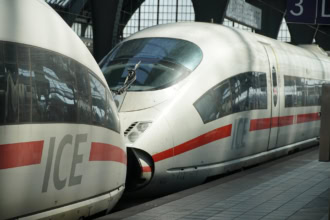
Travelling by regional train rather than the faster ICE network also saves real money, particularly for groups. The Bayern-Ticket covers unlimited regional travel across the whole of Bavaria for a single flat price shared between up to five people, which we cover in detail further down this guide.
Every destination in this guide can realistically be visited on a single day out from Nuremberg, with time to explore properly before catching a train home in the evening. A handful, including Rothenburg and Bayreuth, work best with an early start given the longer journey time involved.
Below, an at-a-glance table compares journey times and transport options for each destination, followed by a dedicated section on every town covered in this guide. A final section explains exactly how the regional ticket system works, so you can plan the cheapest and simplest route for your own trip.
| Destination | Journey Time | How to Get There | Best For |
|---|---|---|---|
| Bamberg | Around 45 minutes | Direct regional or InterCity train from Nürnberg Hbf | UNESCO old town and smoked beer |
| Würzburg | Under an hour | Direct regional train from Nürnberg Hbf | Baroque palace and Franconian wine |
| Regensburg | 1 hour to 1 hour 20 minutes | Direct regional or InterCity train from Nürnberg Hbf | Medieval old town on the Danube |
| Amberg | Around 50 minutes | Direct regional train from Nürnberg Hbf | Quiet baroque old town on the Vils |
| Rothenburg ob der Tauber | 1 hour 15 minutes to just under 2 hours | Regional train, usually with a change at Steinach | A completely walled medieval town |
| Dinkelsbühl | Around 2 hours | Regional train to Ansbach or Dombühl, then a local bus | A quieter walled town on the Romantic Road |
| Bayreuth | 1 hour to 1 hour 30 minutes | Regional train, usually with one change | Margravial Opera House and Wagner heritage |
| Coburg | Around 1 hour 20 minutes | Direct regional or InterCity train from Nürnberg Hbf | Fortress and royal family history |
Bamberg: Beer, Bishops and a UNESCO Old Town
Bamberg’s entire old town has been a UNESCO World Heritage Site since 1993, and it’s easy to see why after even a short walk. Seven low hills carry church spires above a tangle of cobbled lanes, half-timbered houses and canals that have earned Bamberg the nickname the Franconian Venice.
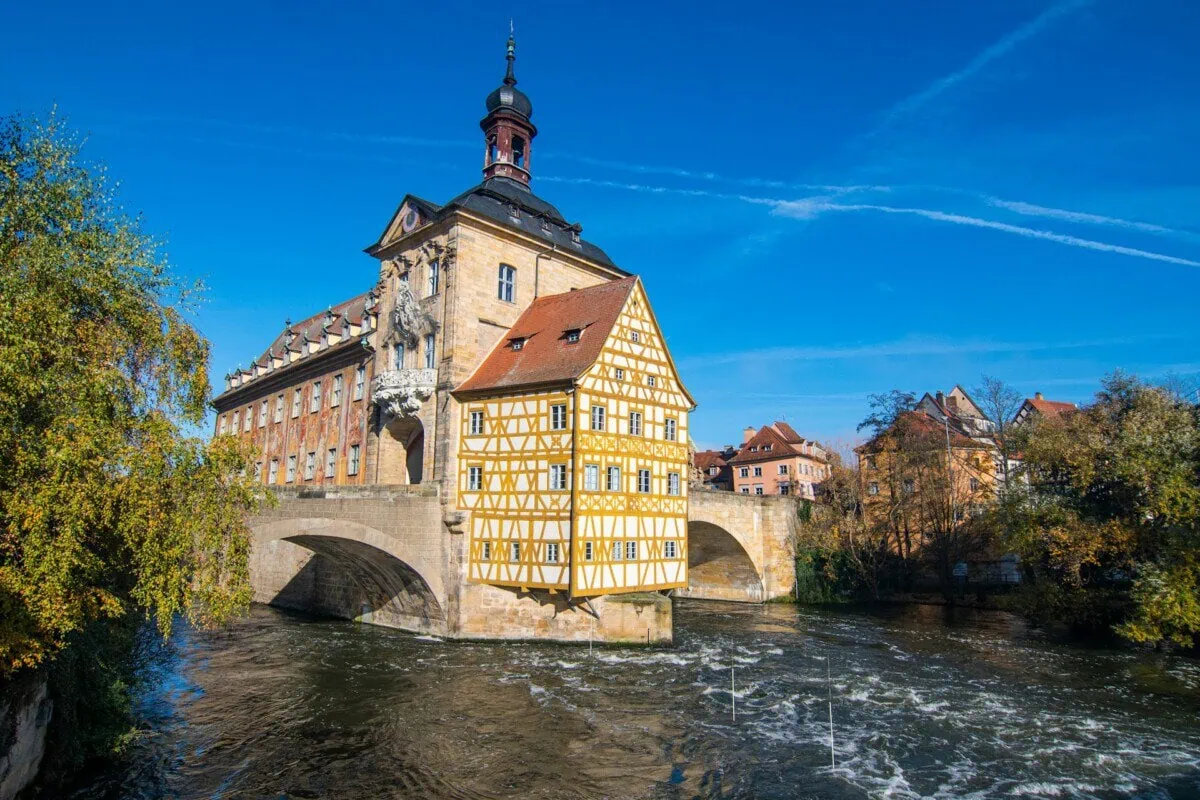
The Altes Rathaus, Bamberg’s old town hall, is the town’s most photographed building, built directly on an artificial island in the middle of the Regnitz river because the bishop and the town council could never agree on whose land it should stand on. Half of the building even has a fresco painted to look three-dimensional, extending onto a stone angel’s leg that appears to burst through the wall.
Bamberg is just as famous for what’s in the glass as what’s on the skyline. The town is home to nine breweries, and its signature Rauchbier, a smoked beer made with malt dried over an open beechwood fire, is unlike anything most visitors will have tasted before.
The Bamberger Dom, a four-towered cathedral dating back to the eleventh century, anchors the upper part of town and houses the Bamberg Horseman, one of Germany’s most significant surviving medieval sculptures. Below it, the New Residence’s rose garden offers one of the best panoramic views over the old town’s red rooftops.
Trains from Nürnberg Hauptbahnhof reach Bamberg directly in around 45 minutes, making it one of the quickest and easiest day trips on this list. That short journey time, combined with genuinely one of a kind sights, makes Bamberg a strong candidate for a first day trip from Nuremberg.
Würzburg: A Baroque Palace and Franconian Wine Country
Würzburg’s biggest draw is the Würzburg Residence, a vast eighteenth-century palace that UNESCO added to its World Heritage list in 1981 for its staircase hall, home to the largest ceiling fresco ever painted by a single artist, Giovanni Battista Tiepolo.
The palace took prince-bishops more than two decades to complete, and the result is widely considered one of the finest baroque buildings anywhere in Europe. Beyond the state rooms, the Court Garden’s formal hedges and fountains are free to wander and make a relaxed stop after the tour.
The old town below the Residence sits on the banks of the River Main, crossed by the Alte Mainbrücke, a stone bridge lined with statues of saints and princes that has carried foot traffic since the twelfth century. Locals gather here with a glass of local wine most evenings, especially once the sun starts to set over the river.
Würzburg sits at the southern end of Franconia’s wine region, and the vineyard-covered hillside beneath the Marienberg Fortress produces some of Germany’s best dry white wines, particularly Silvaner. A short climb up to the fortress rewards visitors with sweeping views back across the old town and the river below.
Direct regional trains from Nürnberg Hauptbahnhof reach Würzburg in under an hour, making it comfortably one of the simplest and most rewarding day trips from Nuremberg.
Best for two or three nights. The widest choice of rooms, with filters for free cancellation and included breakfast.
View staysBest for groups who want one address and separate bedrooms rather than three hotel rooms.
See holiday homesBest if you have already picked a hotel. Checks the big booking sites for the same room and shows who is cheapest.
Check dealsRegensburg: Medieval Streets on the Danube
Regensburg’s old town survived the Second World War almost entirely intact, and UNESCO recognised the result as a World Heritage Site in 2006, calling it one of Germany’s best preserved medieval city centres.
The Steinerne Brücke, a twelfth-century stone bridge across the Danube, was considered an engineering marvel in its day and remained the only fixed river crossing between Ulm and Vienna for centuries. Right beside it, the Historische Wurstkuchl claims to be one of the oldest continuously operating sausage kitchens in the world, still grilling sausages over an open beechwood fire.
Away from the river, narrow medieval lanes wind between tall merchant houses and defensive towers built during Regensburg’s time as a wealthy free imperial city and trading hub. St Peter’s Cathedral, with its twin gothic spires visible from across the old town, took more than 600 years to complete.
Regensburg also has a genuinely lively student population, and its riverside beer gardens and small independent shops give the old town a relaxed, lived-in feel rather than a purely museum-like atmosphere. It’s an easy city to wander without much of a plan.
Direct regional and InterCity services connect Nürnberg Hauptbahnhof to Regensburg in around one hour to one hour twenty minutes depending on the connection, comfortably manageable as a single day trip with time to spare.
Amberg: A Baroque Old Town on the Vils
Amberg is one of the least visited destinations on this list among international tourists, despite having one of Bavaria’s best preserved historic centres, largely intact behind its medieval walls and towers.
The River Vils loops directly through the old town, crossed by several small bridges including the Stadtbrille, or town spectacles, where the bridge’s twin arches and their reflection in the water form a perfect circle. It’s one of the most photographed spots in the whole of the Oberpfalz region.
Amberg’s skyline is dominated by St Martin’s Church, a soaring gothic hall church, and the Electoral Palace, a former residence of the Bavarian dukes that now houses local government offices behind an elegant baroque facade. Wandering the surrounding lanes reveals brightly coloured merchant houses that have barely changed in appearance for centuries.
Because so few international visitors make it this far, Amberg’s cafes, bakeries and small shops feel refreshingly ordinary rather than geared towards tourism, which is exactly the appeal for anyone who has already ticked off Bavaria’s better known old towns.
Direct regional trains from Nürnberg Hauptbahnhof reach Amberg in around 50 minutes, making it a genuinely easy half day trip that still leaves time to combine it with something else nearby.
Rothenburg ob der Tauber: Germany’s Most Complete Walled Town
Rothenburg ob der Tauber is the single most complete medieval walled town on the Romantic Road, with nearly the entire circuit of its fourteenth-century town walls still standing and open for visitors to walk along for free.
Inside the walls, half-timbered houses lean over cobbled lanes that look almost unchanged since the town’s wealth, and its town planning, effectively froze after the Thirty Years’ War. The Plönlein, a small fork in the road framed by two towers and a fountain, is one of the most photographed street corners in Germany.
The Rathausturm, the town hall’s tower, can be climbed for panoramic views across the walls and the surrounding Tauber valley, while the Criminal Museum next door covers centuries of medieval law and punishment in more detail than most visitors expect.
Getting here takes real commitment: the journey from Nürnberg Hauptbahnhof typically runs from around one hour fifteen minutes to just under two hours, usually with a change at Steinach bei Rothenburg and sometimes a second change at Ansbach. It’s worth checking your specific connection on the DB Navigator app before you travel, since timings vary through the day.
Despite the longer journey, Rothenburg rewards an early start with one of the most complete medieval townscapes anywhere in Germany, and it remains one of the most popular stops on the entire Romantic Road for good reason.
Dinkelsbühl: Rothenburg’s Quieter Walled Twin
Dinkelsbühl is often overlooked in favour of Rothenburg ob der Tauber, yet its complete medieval town wall, with sixteen towers, bastions and four gates, is arguably just as impressive. Built between 1380 and 1440, the wall still forms an unbroken ring around the old town, something only a handful of German towns can claim.
The town’s centrepiece is St George’s Minster, a late Gothic hall church built between 1448 and 1499 and considered one of the finest of its kind in southern Germany. Nearby, the Deutsches Haus, a lavishly carved Renaissance timber-framed building, is regularly ranked among the most photographed half-timbered facades on the entire Romantic Road.
Dinkelsbühl became a Free Imperial City in 1351 and later grew into one of only four bi-confessional imperial cities in the empire, where Catholic and Protestant residents held equal civic rights long before that became common elsewhere. That unusual history is remembered every July at the Kinderzeche festival, a children’s pageant re-enacting a local legend in which the town’s children persuaded Swedish troops to spare Dinkelsbühl during the Thirty Years’ War.
There’s no direct train from Nuremberg, so the usual route involves a regional train to Ansbach or Dombühl followed by a short local bus into the walled centre, a journey of around two hours door to door. It takes longer to reach than Rothenburg, but the reward is a walled town with an equally well preserved medieval streetscape and noticeably fewer visitors.
Bayreuth: A Margravial Opera House and Wagner’s Festival Town
Bayreuth’s Markgräfliches Opernhaus, the Margravial Opera House, is one of the best preserved baroque theatres in Europe and earned UNESCO World Heritage status in 2012 for its lavishly decorated wooden interior, built almost entirely without a single nail.
Commissioned in the 1740s by Margravine Wilhelmine, the opera house’s original stage machinery and gilded box seating survive largely intact, giving visitors on a guided tour a genuine sense of an eighteenth-century royal audience’s experience. It remains too fragile for full scale opera productions today, which is exactly what has preserved it so well.
Bayreuth’s other major claim to fame is its connection to composer Richard Wagner, who built the Bayreuth Festspielhaus specifically to stage his own operas and founded the Bayreuth Festival, still held every summer and still one of the hardest opera tickets in the world to obtain.
Away from music history, Bayreuth’s compact old town has an elegant, unhurried feel, with baroque townhouses, quiet squares and the landscaped Hofgarten palace grounds all within easy walking distance of the station.
Regional trains from Nürnberg Hauptbahnhof reach Bayreuth in around one hour to one hour thirty minutes, usually with one change depending on the connection, making it a comfortable day trip for anyone with even a passing interest in architecture or classical music.
Coburg: A Fortress with Royal Connections Across Europe
Coburg’s Veste Coburg, one of Germany’s largest and best preserved medieval fortresses, sits on a wooded hill directly above the old town and houses an extensive art collection including works by Dürer and Cranach.
The town’s real claim to fame, though, is its role as the ancestral seat of the House of Saxe-Coburg and Gotha, whose descendants went on to sit on the thrones of Britain, Belgium, Portugal and Bulgaria. Prince Albert, husband of Queen Victoria, was born in Coburg’s Schloss Ehrenburg, the family’s town palace, which remains open to visitors today.
Coburg’s old town is filled with grand nineteenth-century architecture that reflects this royal wealth, centred on the Marktplatz and its ornate town hall, alongside quieter medieval lanes closer to the fortress that have changed far less over the centuries.
The town also has one of Germany’s better known sausage traditions, with Coburger Bratwurst, grilled over pinecones rather than charcoal, sold from stalls around the market square most days of the week.
Direct regional and InterCity trains connect Nürnberg Hauptbahnhof to Coburg in around one hour twenty minutes, with the fastest services covering the route in under an hour, making it an easy addition to a Franconia focused itinerary.
Best if you can move a day either way. Shows how the fare changes across the month.
Compare flightsBest if you want maps and messaging working the moment you switch your phone on.
See eSIM plansBest when public transport has stopped, or when you are travelling with children and bags.
Book a transferGetting Around: Trains and Tickets
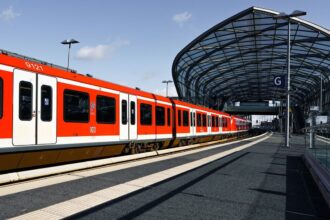
Every destination in this guide is reachable from Nürnberg Hauptbahnhof on Deutsche Bahn’s regional network, made up mainly of RE (Regional-Express) and RB (Regionalbahn) services, alongside occasional InterCity trains on the busier main lines towards Bamberg, Würzburg and Regensburg.
Regional trains run less frequently than the high speed ICE network and make more stops along the way, so journeys typically take longer, but they’re also considerably cheaper and, crucially, covered by Bavaria’s regional day ticket rather than a separate full priced fare.
The Bayern-Ticket is genuinely the best value option for a day trip from Nuremberg, covering unlimited travel on regional trains and most local buses across the whole of Bavaria for a single day. It costs from €34 (£29/$40) for one traveller, rising to €74 (£64/$87) shared between up to five people, as we cover in more depth in our German rail tickets guide.
On weekdays the ticket is valid from 9am until 3am the following morning, while on weekends and public holidays it’s valid from midnight, so an early Saturday start genuinely gets full use out of it. It can be bought from station ticket machines, the DB Navigator app or directly through Deutsche Bahn’s official Bayern-Ticket page, without needing a German bank account or any proof of residency.
For destinations closer to Nuremberg, such as Bamberg or Amberg, a standard point to point ticket bought on the day can occasionally work out cheaper for a single traveller, so it’s worth comparing both options before you commit, particularly if you’re travelling alone rather than as a group.
Which Day Trip Should You Choose?
With eight destinations now covered in this guide, the right choice usually comes down to how much time you have and what interests you most. If you only have one day to spare, Bamberg and Würzburg are the safest picks, both under an hour from Nuremberg and packed with enough sights to fill a full day without feeling rushed.
Travellers with a specific interest have an easy shortcut: beer drinkers should head straight to Bamberg, wine lovers to Würzburg, and anyone drawn to royal history to Coburg, whose fortress and Saxe-Coburg connections span half of Europe’s former royal houses. Opera fans and architecture lovers get the same clear answer in Bayreuth, where the Margravial Opera House alone justifies the journey.
For the classic fairytale walled town experience, Rothenburg ob der Tauber remains the obvious first choice despite its longer journey time, though Dinkelsbühl is worth considering instead if you would rather see similar medieval walls with noticeably fewer crowds. Amberg suits travellers who have already ticked off Bavaria’s better known old towns and want something quieter and more local.
Solo travellers and couples can comfortably fit any destination on this list into a single day out. Families with young children tend to do best in Bamberg or Regensburg, where open squares, riverside paths and plenty of casual food stops give children room to run between sights without a rigid itinerary.

Rupert’s Handy Travel Tips
Day trips from Nuremberg reward a bit of planning around tickets and train times, so here’s what actually makes a difference.
- Check the Bayern-Ticket’s 9am start on weekdays: it only becomes valid at 9am Monday to Friday, so an early regional train before then needs a separate ticket for that first leg.
- Double check your Rothenburg connection on DB Navigator: the route usually involves a change at Steinach bei Rothenburg, sometimes with a second change at Ansbach, and timings vary noticeably through the day.
- Bring a downloaded map for Bamberg’s old town: the tangle of lanes across its seven hills is easy to get turned around in, and mobile signal can be patchy in the narrower streets.
- Travel as a group where you can: the Bayern-Ticket is priced for up to five people, so splitting it with company brings the per-person cost down significantly.
- Book ahead for the Würzburg Residence in peak season: the staircase hall and state rooms can move to timed entry slots when busy, so arriving without checking risks a long wait.
- Allow extra time around Bayreuth’s Festival dates: guided tours of the opera house run on a fixed schedule and can sell out when the Wagner Festival is in town, so check timings before you travel.
Want to meet the reindeer behind our travel tips? Find out more in our page Who is Rupert?.




Frequently Asked Questions About Day Trips from Nuremberg
What is the best day trip from Nuremberg?
Bamberg is usually considered the best single day trip from Nuremberg, combining a UNESCO listed old town, a short 45 minute train journey and a genuinely unique local beer culture that’s hard to find anywhere else.
How do I get around on day trips from Nuremberg without a car?
Deutsche Bahn’s regional RE and RB trains connect every destination in this guide directly from Nürnberg Hauptbahnhof, and the Bayern-Ticket covers unlimited travel on all of them for a single flat price.
Is the Bayern-Ticket worth it for a solo traveller?
It can be, but it’s really designed for groups. Travelling alone, it’s worth comparing the Bayern-Ticket’s price against a standard point to point fare before you commit, since a single ticket can sometimes work out cheaper.
How far is Rothenburg ob der Tauber from Nuremberg?
The journey typically takes between around one hour fifteen minutes and just under two hours, usually with a change at Steinach bei Rothenburg and occasionally a second change at Ansbach depending on the specific connection.
Is Dinkelsbühl worth visiting instead of Rothenburg?
Dinkelsbühl has an equally complete set of medieval town walls and towers with far fewer visitors, though it takes longer to reach from Nuremberg and involves a regional train followed by a local bus rather than a direct train.
Can I visit more than one destination in a single day?
It’s possible for towns that sit close together, but most of the destinations in this guide comfortably fill a full day on their own, particularly Bamberg, Würzburg and Regensburg.
Do I need to book train tickets in advance?
No. Regional trains covered by the Bayern-Ticket don’t require reservations, and the ticket itself can be bought on the day from a station machine or the DB Navigator app right up until you travel.
Which day trip is best for families?
Bamberg and Regensburg both work well for families, with plenty of open squares, riverside walks and easy stops to break up the sightseeing, while the Bayern-Ticket lets children aged six to fourteen travel free in groups of up to three per adult.
Is Bayreuth worth visiting if I’m not interested in opera?
Yes. The Margravial Opera House’s UNESCO listed interior is worth seeing purely as a piece of baroque architecture, and Bayreuth’s compact old town and Hofgarten gardens make for a pleasant day out regardless of any interest in Wagner.
Further Reading
For the full breakdown of how Germany’s regional ticket system works beyond the Bayern-Ticket, including the nationwide Deutschland-Ticket and other states’ equivalents, our German Rail Tickets Explained guide covers every option in detail. If your trip extends beyond Bavaria and involves several long distance journeys on the faster ICE network, our Interrail Germany Pass guide is worth comparing against buying individual tickets.
For wider planning across the country, our Germany Travel Guide covers the practical essentials for a first visit, including the Romantic Road that runs directly through Rothenburg ob der Tauber. And for travellers building a longer European itinerary around hidden discounts like the Bayern-Ticket, our guide to Europe’s cheapest train tickets and rail passes rounds up similar regional deals in several other countries.
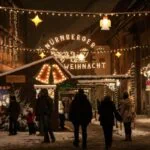
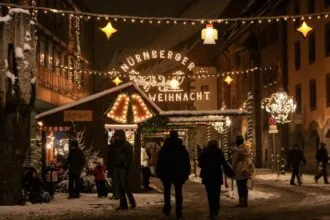
Before heading out of the city, our Best Things to Do in Nuremberg guide and Nuremberg Airport Transfers guide cover the city itself and getting in from the terminal. Visiting between late November and Christmas Eve? Our Nuremberg Christmas Market guide is worth reading before you plan a day trip around the Christkindlesmarkt’s dates.