Reviewed by our editorial team Updated
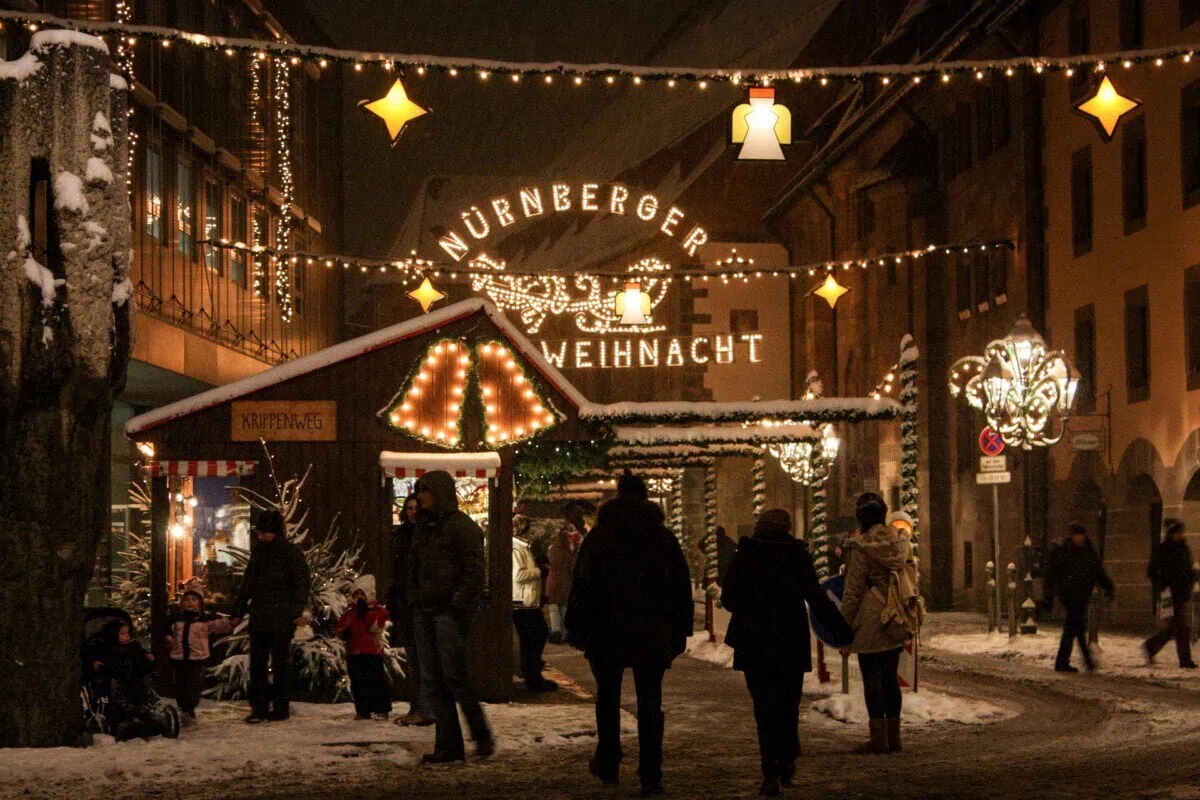
Nuremberg’s Christkindlesmarkt is one of the most famous Christmas markets in the world, filling the medieval Hauptmarkt square with red and white striped wooden stalls every Advent. It has run in some form since at least the 1600s, making it one of Germany’s oldest and most closely watched festive traditions.
The market takes its name from the Christkind, a living figure who opens the season with a prologue spoken from the balcony of the Frauenkirche. Unlike markets built around a generic Santa figure, Nuremberg’s opening ceremony is a genuinely local tradition rooted in the city’s history rather than a modern import.
Beyond the main square, the Christkindlesmarkt spreads into several linked events across the old town, including a dedicated children’s market and a market run by Nuremberg’s international sister cities. Each has its own atmosphere, so visitors who only see the Hauptmarkt are missing part of the wider picture.
Food is central to the experience, and Nuremberg has two EU-protected specialities to show for it: Nürnberger Lebkuchen gingerbread and the small, marjoram-seasoned Nürnberger Rostbratwurst. Both are sold across the market alongside mulled Glühwein and the city’s distinctive Zwetschgenmännle prune figures.
Bavaria’s December weather is genuinely cold, so this is a market best visited well wrapped up, ideally in the late afternoon or evening when the stalls are lit. Millions of visitors come to the Hauptmarkt each season, so timing a visit carefully makes a real difference to how enjoyable it feels.
This guide covers the market’s history, its key traditions and satellite events, what to eat and drink, the 2026 opening dates, and how to get there and stay nearby for the season.
Nuremberg Christmas Markets at a Glance
Nuremberg actually runs three connected Christmas markets during Advent, each in a different part of the old town. The table below summarises where to find each one and what makes it different.
| Market | Location | Typical Dates | What It’s Known For |
|---|---|---|---|
| Christkindlesmarkt (main market) | Hauptmarkt, in front of the Frauenkirche | 27 Nov to 24 Dec 2026 | Around 180 wooden stalls, the Christkind opening ceremony, Lebkuchen and Rostbratwurst |
| Kinderweihnacht (children’s market) | Hans-Sachs-Platz | Runs alongside the main market | Carousel, children’s rides and activities, family-focused stalls |
| Markt der Partnerstädte (Sister Cities Market) | Rathausplatz | Runs alongside the main market | Stalls run by Nuremberg’s international sister cities |
Because all three sit within easy walking distance of each other in the old town, it is entirely possible to visit all three in a single afternoon without needing any transport between them.
A Market With Nearly Four Centuries of History
The Christkindlesmarkt’s exact starting point is genuinely uncertain, and reputable sources do not fully agree on a single date. The most commonly cited piece of evidence is an oval bentwood box inscribed 1628, held today in Nuremberg’s Germanisches Nationalmuseum, which was reportedly sold at the market that year.
Other official sources, including Nuremberg’s own tourist board, instead point to the market being first documented in 1678, while noting that its roots likely trace back further into the Lutheran Reformation era of the 1500s and 1600s. Historians broadly agree the market grew gradually out of ordinary weekly trading rather than being founded on a single day.
What is better documented is the market’s more recent history. It closed entirely between 1939 and 1948 during and immediately after the Second World War, and between 1898 and 1933 it was relocated away from the Hauptmarkt before returning to the square in the 1930s, where it has remained ever since.
Traditional Nuremberg craftspeople have long been part of the market’s identity, from gingerbread bakers and wood carvers to the brass smiths who once made the market’s distinctive Rauschgold angels, delicate figures made from thin sheets of gilded brass. That craft heritage is still visible in the stalls today, even as the market has grown into a major international attraction.
Whichever date you take as the true starting point, the market has been called the Christkindlesmarkt for centuries and is widely regarded as one of the oldest continuously evolving Christmas markets in the German-speaking world.
Compare hotels and other places to stay for your trip.
Check availabilityBrowse apartments, holiday homes and self-catering stays.
View rentalsCompare hotel prices across multiple booking sites.
Compare ratesThe Hauptmarkt: Nuremberg’s Festive Stage
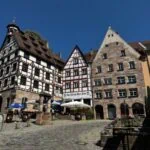
The main Christkindlesmarkt takes place on the Hauptmarkt, Nuremberg’s central square, directly in front of the Gothic Frauenkirche. The square has been the city’s main marketplace for centuries, and its combination of historic architecture and open space is a large part of why the market feels so atmospheric.
Around 180 wooden booths fill the square, each decorated with the market’s signature red and white striped cloth roofs, a design that has earned it the nickname “the little town of wood and cloth”. Stalls are arranged in tight rows, so the square feels dense and busy even though it is not especially large.
The Schöner Brunnen, a 14th century ornamental fountain at the edge of the square, sits right in the middle of the market and is one of its most photographed features, particularly once it is lit up after dark. Its golden ring, set into the surrounding railings, is a popular spot for visitors to make a wish.
Because the Hauptmarkt is compact, it can feel genuinely crowded during peak weekends and in the evenings, especially close to the opening weekend and the final days before Christmas Eve. Arriving earlier in the day or on a weekday generally makes it far easier to actually browse the stalls rather than just shuffle through the crowd.
The Christkind: A Living Tradition
Nuremberg’s Christmas market is named after the Christkind, a role played by a young local woman rather than a generic Father Christmas figure. She is dressed in a white and gold robe with a crown and angel-wing sleeves, an image closely associated with the city.
The Christkind has been elected every two years since 1969, chosen from local candidates typically aged between 16 and 19. Candidates are judged on qualities such as public speaking and stage presence, and the role comes with a busy schedule of appearances throughout the festive season.
The market officially opens each year when the Christkind recites a prologue from the balcony of the Frauenkirche, overlooking the packed Hauptmarkt below. It is one of the most photographed moments of the German Christmas market calendar, and crowds gather in the square well before the ceremony begins.
Away from the opening ceremony, the Christkind continues to make appearances throughout December, including visits to hospitals, care homes and children’s events, making the role as much a civic ambassador as a Christmas figurehead.
2026 Opening Dates, Hours and the Opening Ceremony
For the 2026 season, the Christkindlesmarkt is scheduled to run from 27 November to 24 December 2026, following the tradition of opening on the Friday before the first Sunday of Advent. It always closes on Christmas Eve itself, usually with shortened hours on the final day.
The opening ceremony is set for the evening of 27 November at 5.30pm, when the Christkind delivers the prologue from the Frauenkirche balcony. Stalls are typically open daily from around 10am to 9pm, though it is worth checking the official market website closer to the date, since hours can shift slightly year to year.
Hours are not identical every day, with the opening day and Christmas Eve both running to a different schedule than the rest of the season. The table below sets out the confirmed pattern for 2026, based on the official Christkindlesmarkt and City of Nuremberg listings.
| Date / Day Type | Hours |
|---|---|
| Opening day, 27 November 2026 | 10am to 10pm, extended for the “Lange Nacht” opening-night celebrations, with stalls pausing briefly around 5.30pm to 6pm for the Christkind’s balcony ceremony |
| Standard days, 28 November to 23 December | 10am to 9pm daily, including Sundays |
| Christmas Eve, 24 December 2026 | 10am to 2pm, after which the market closes for the season |
These times are the most specific published so far for 2026, but markets of this size occasionally adjust individual stall hours, so it is still worth a quick check of the official site shortly before travelling rather than relying on this table alone.
The market does not run continuously through to New Year in the way some other German cities do. Once 24 December arrives, the Hauptmarkt closes for the season, so travellers hoping to combine Nuremberg with a late December or New Year trip should plan their dates carefully.
For the most accurate, year-specific information, it is always worth checking the official Christkindlesmarkt website before booking travel, as exact hours and any programme changes are published there each autumn.
Nürnberger Lebkuchen: The Protected Gingerbread
Nürnberger Lebkuchen is Nuremberg’s most famous export and the food most associated with its Christmas market. It is a soft, spiced gingerbread, often baked on a wafer base and topped with chocolate, icing or almonds, and the name carries genuine legal weight.
Since 1996, Nürnberger Lebkuchen has held Protected Geographical Indication (PGI) status under EU law, meaning only gingerbread made to a defined recipe within the Nuremberg area can legally use the name. That protection is a large part of why the product still matters commercially, not just as a festive souvenir.
At the market, Lebkuchen is sold everywhere, from simple paper bags of loose biscuits to elaborately decorated tins costing considerably more, often around €10 to €20 (£8.60 to £17.20, $11.70 to $23.40) depending on size and decoration. Many stalls offer samples, which makes browsing between them a genuinely enjoyable part of a visit.
Because Lebkuchen keeps well, it is one of the most practical souvenirs to bring home from the market, and tins bought here are generally considered more authentic than versions sold in supermarkets outside Bavaria.
Nürnberger Rostbratwurst: The City’s Famous Sausage
The other major Nuremberg speciality is the Nürnberger Rostbratwurst, a small grilled pork sausage seasoned with marjoram and traditionally cooked over a beechwood fire. It is notably smaller than most German sausages, measuring roughly 7 to 9cm long and weighing around 20 to 25 grams each.
Like the city’s gingerbread, the Rostbratwurst has held EU Protected Geographical Indication status since 2003, and the specification requires it to be produced within Nuremberg’s city limits. The protection covers the names Nürnberger Bratwurst and Nürnberger Rostbratwurst specifically, rather than the word Rostbratwurst on its own.
At the market, the classic order is “drei im Weckla”, three sausages served in a bread roll, typically priced around €4 to €5 (£3.44 to £4.30, $4.68 to $5.85) depending on the stall. Sauerkraut and mustard are the traditional accompaniments, and the smell of grilling sausages is one of the market’s most distinctive features.
With so many stalls selling variations of the same sausage, prices and quality can vary noticeably between them, so it is worth following the queues of locals rather than simply choosing the nearest stand.
Glühwein and Festive Drinks
As at most German Christmas markets, Glühwein, mulled red or white wine served hot, is the drink most visitors come for. Nuremberg’s version is typically served in branded ceramic mugs, which are usually included in the price through a returnable deposit system.
Expect to pay roughly €4 to €5 (£3.44 to £4.30, $4.68 to $5.85) for a mug of Glühwein, with a small additional deposit, often around €3 to €5, refunded when you return the mug. Many visitors choose to keep the mug as a souvenir instead, since the annual designs are often collected year to year.
Non-alcoholic options are widely available too, including Kinderpunsch, a warm spiced fruit punch aimed at children and anyone avoiding alcohol, along with hot chocolate and warm apple juice. These are usually served in the same style of mug as the Glühwein.
Drinking a hot Glühwein while standing among the stalls, rather than sitting down, is very much part of the market’s culture, and the small crowded standing areas around each stall are often where the atmosphere feels strongest.
Search routes and flight options for your journey.
Search flightsUse an eSIM to get online without hunting for a local SIM after arrival.
See eSIM optionsArrange a private pickup before travel instead of sorting transport after landing.
Book a transferZwetschgenmännle: The Prune People
One of the market’s most distinctive souvenirs is the Zwetschgenmännle, small figures made from dried prunes, figs and other dried fruit, built into tiny human-like characters. They are usually dressed as traditional tradespeople or market characters, complete with miniature tools and costumes.
The tradition is believed to date back to the 19th century, when the figures were originally made by poorer families using leftover dried fruit rather than expensive materials. Over time, they became a recognised craft in their own right, closely associated with Nuremberg specifically rather than German Christmas markets in general.
A handful of specialist stalls at the Hauptmarkt still make and sell Zwetschgenmännle by hand, and prices vary considerably depending on size and detail, from a few euros for a simple figure to significantly more for elaborate designs. They make a lightweight, distinctive souvenir that is genuinely specific to this market.
Because they are handmade and relatively delicate, it is worth asking stallholders for advice on packing them safely for the journey home, particularly if you are travelling by plane rather than car.
Kinderweihnacht: The Children’s Christmas Market
A short walk from the Hauptmarkt, Kinderweihnacht, Nuremberg’s children’s Christmas market, has run at Hans-Sachs-Platz since 1999. It is a deliberately calmer, family-focused alternative to the busier main square.
The market includes a traditional carousel and other gentle fairground-style rides, alongside stalls selling children’s crafts, decorations and treats. It runs for the same period as the main Christkindlesmarkt, making it easy to combine both in one visit.
Because Hans-Sachs-Platz is smaller and quieter than the Hauptmarkt, it tends to suit families travelling with younger children who might struggle with the crowds and noise of the main market, particularly in the evening.
Visiting Kinderweihnacht earlier in the day, before the main market gets busy, is generally the most comfortable option for families, leaving the evening free for the atmosphere of the Hauptmarkt once children are back at the hotel.
Markt der Partnerstädte: The Sister Cities Market
At Rathausplatz, just behind the Hauptmarkt, Nuremberg runs a market dedicated to its international sister cities, known as the Markt der Partnerstädte. It has operated in this form since 1998 and offers a noticeably different atmosphere from the main German market nearby.
Stalls here are typically run by representatives from Nuremberg’s partner cities, which include places such as Nice, Glasgow, Kraków and Prague among others, each bringing their own food, crafts and decorations. It is a useful way to sample a wider range of European festive traditions without leaving Nuremberg.
The market is generally smaller and less crowded than the Hauptmarkt, which makes it a good place to take a break from the busiest parts of the Christkindlesmarkt while still staying within the festive area.
Because it sits so close to the main square, most visitors simply walk between the two without needing to plan a separate trip, treating Rathausplatz as a natural extension of the Hauptmarkt experience.

More Things to Do in Nuremberg This Christmas
The Christkindlesmarkt is the main draw, but Nuremberg’s old town has a handful of genuinely December-specific extras worth building into a market trip. Most sit within a short walk of the Hauptmarkt, so they slot easily around a day at the stalls.
The Nuremberg Toy Museum (Spielzeugmuseum), housed in the Renaissance-era Hallersches Haus, holds around 87,000 objects tracing the city’s centuries-old identity as a toy-making centre. It pairs naturally with a visit to the nearby Kinderweihnacht children’s market, especially for families with younger visitors.
Inside St. Lorenz, one of the old town’s two great Gothic churches, free lunchtime recitals called “Musik zum Christkindlesmarkt” run on weekday afternoons throughout December, alongside separately ticketed Advent concerts including a Bach Weihnachtsoratorium performance. Exact dates and tower-tour times are best confirmed on the church’s own website closer to your visit.
Unlike some German cities, Nuremberg does not run a seasonal ice rink alongside the Christmas market itself. Its outdoor rink, Nuremberg Winter World, instead operates after the festive season, typically from late January into March.
For the castle, old town walls and other year-round sights worth combining with a market visit, our Best Things to Do in Nuremberg guide covers them in full.
Crowds, Scale and the Best Time to Visit
The Christkindlesmarkt is genuinely one of the busiest Christmas markets in Germany, with the Hauptmarkt regularly described as attracting around two million visitors across the season, according to commonly cited estimates. Given the compact size of the square, that scale is very noticeable on the ground.
The opening weekend and the final days before Christmas Eve are consistently the busiest periods, along with weekend evenings throughout December. Weekday mornings and early afternoons are considerably quieter and generally the easiest time to actually see the stalls properly.
For visitors who want photographs without heavy crowds, arriving shortly after the market opens for the day is usually the best compromise, since the stalls are lit but the square has not yet filled up. Evenings look the most magical but are also, unsurprisingly, when the square is at its most packed.
If your schedule allows it, visiting on a weekday rather than a weekend makes a genuine difference to how relaxed the visit feels, particularly if you plan to sit or stand at a Glühwein stall for a while.
New Year’s Eve in Nuremberg
The Christkindlesmarkt itself closes on 24 December, so travellers staying into late December see a very different Nuremberg for New Year’s Eve, known locally as Silvester. The old town switches from market stalls to fireworks, church concerts and a busy restaurant and bar scene.
Private fireworks are a big part of a German Silvester, though Nuremberg restricts them tightly around its most historic buildings. The city bans fireworks entirely on 31 December and 1 January around the Lorenzkirche, Frauenkirche, Sebalduskirche and Jakobsplatz, and around the castle from 9pm to 2am, with bag checks in place there.
Despite the restrictions, the Burgfreiung, the open area below the castle, remains a popular unofficial spot for watching the wider skyline light up at midnight. Several old town churches, including St. Sebald, also hold organ and brass concerts on Silvester evening rather than a countdown event.
For an active alternative, the Nürnberger Silvesterlauf, a New Year’s Eve fun run with 10km, 5km and shorter family distances, has taken place in the city since 2003. Bars, clubs and restaurants across the old town run their own midnight events, so booking ahead is wise if you want a specific venue for the evening.
Browse hostels and budget-friendly stays.
See hostelsGet help with compensation, eligible lounge access and disruption support.
Explore AirHelp+Arriving before check-in or leaving later? Store your luggage and enjoy the extra time hands-free.
Store your bagsGetting to the Christkindlesmarkt
Nuremberg’s old town is compact and largely pedestrianised, and the Hauptmarkt sits close to the city’s main public transport hub. Nuremberg’s own U-Bahn (underground) and tram network makes reaching the old town straightforward from most parts of the city.
The nearest stops are around Lorenzkirche and Rathaus on the U-Bahn and tram lines, both within a short walk of the Hauptmarkt. Nuremberg Hauptbahnhof, the city’s main train station, is also within easy walking distance or a very short tram ride of the market.
Because the old town streets around the Hauptmarkt are largely closed to general traffic during the market period, driving directly to the square is not practical, and visitors arriving by car should plan to park further out and walk or use public transport for the final stretch.
Nuremberg Airport is a short distance from the city centre and is served by regular public transport links into town, making it a realistic option for visitors flying in specifically for the market.
Where to Stay Near the Market
For the easiest access to the Christkindlesmarkt, staying inside or close to Nuremberg’s old town walls is the most convenient option, keeping the Hauptmarkt and its satellite markets within easy walking distance. Many of the city’s historic hotels sit only a few minutes from the square.
Staying near Nuremberg Hauptbahnhof is also a practical choice, particularly for visitors arriving by train or combining Nuremberg with other German or Central European Christmas market cities. The station area has a wide range of hotels within a short tram ride of the old town.
December is a genuinely busy period for accommodation in Nuremberg, particularly around the opening weekend and the final weekend before Christmas, so booking well in advance is strongly advisable rather than leaving it until closer to the date.
Travellers on a tighter budget may find better value staying slightly outside the old town and taking the tram or U-Bahn in each day, since prices for centrally located hotels rise noticeably during the market season.
Weather and What to Wear
Nuremberg in December is genuinely cold, with average daytime highs around 3°C (37°F) and overnight lows commonly dropping to around minus 2°C (28°F). Wind chill can make it feel noticeably colder while standing around outdoor stalls for extended periods.
Light rain or snow is fairly common but usually not heavy, so a warm, waterproof coat is generally more useful than an umbrella, which can be awkward to manage in crowded stalls. Layering is the most practical approach, since indoor spaces such as churches and shops are heated.
Sturdy, warm footwear matters more than most visitors expect, since a market visit usually involves standing on cobbled or paved ground for long stretches rather than continuous walking. Thermal socks and insoles make a noticeable difference on longer evenings.
Gloves, a warm hat and a scarf are close to essential, and many visitors find that holding a hot Glühwein or Kinderpunsch mug is itself a useful way to keep hands warm while browsing the stalls.

Rupert’s Handy Travel Tips
Planning a trip to Nuremberg’s Christkindlesmarkt this winter? Here are a few useful tips to make your visit smoother.
- Go early or on a weekday: the Hauptmarkt gets seriously crowded on evenings and weekends, especially near the opening and closing dates.
- Watch the opening ceremony from a distance: the square in front of the Frauenkirche fills up fast, so arrive well before 5.30pm if you want to see the Christkind.
- Try all three markets: Hauptmarkt, Kinderweihnacht and the Sister Cities Market are all within walking distance of each other.
- Keep your Glühwein mug: the annual designs are collectible, and keeping the mug is usually cheaper than paying the deposit refund fee.
- Wrap up properly: Nuremberg’s December temperatures regularly sit around freezing, so warm boots and gloves matter more than a stylish coat.
- Book accommodation early: hotels near the old town fill up quickly for the opening and final weekends of the market.
Want to meet the reindeer behind our travel tips? Find out more in our page Who is Rupert?.



Frequently Asked Questions About Nuremberg’s Christmas Market
When does Nuremberg’s Christmas market open in 2026?
The Christkindlesmarkt is scheduled to run from 27 November to 24 December 2026, with the opening ceremony taking place on the evening of 27 November. It always follows the tradition of opening on the Friday before the first Sunday of Advent.
How old is the Nuremberg Christmas market?
Its exact founding date is genuinely uncertain, with sources citing evidence from as early as 1628 and Nuremberg’s official tourist board citing a first documented mention in 1678. Either way, it is widely considered one of Germany’s oldest Christmas markets.
Who is the Christkind at Nuremberg’s Christmas market?
The Christkind is a young local woman, typically aged 16 to 19, elected every two years to represent the market and open the season with a prologue from the Frauenkirche balcony. She is not a generic Santa figure but a specifically Nuremberg tradition.
Where exactly is the Christkindlesmarkt held?
The main market takes place on the Hauptmarkt, Nuremberg’s central square, directly in front of the Frauenkirche. Two connected markets also run nearby, the Kinderweihnacht children’s market at Hans-Sachs-Platz and the Markt der Partnerstädte at Rathausplatz.
What food should I try at the Nuremberg Christmas market?
Do not miss Nürnberger Lebkuchen gingerbread and Nürnberger Rostbratwurst sausages, both EU-protected local specialities, usually ordered as “drei im Weckla” (three in a roll). Glühwein and the dried-fruit Zwetschgenmännle figures round out the classic market experience.
Is the Nuremberg Christmas market busy?
Yes, it is one of the busiest Christmas markets in Germany, with an estimated two million visitors across the season according to commonly cited figures. Evenings, weekends and the opening and closing dates are consistently the most crowded times.
How do I get to the Christkindlesmarkt without a car?
Nuremberg’s U-Bahn and tram network connects easily to the old town, with stops around Lorenzkirche and Rathaus within a short walk of the Hauptmarkt. Nuremberg Hauptbahnhof, the main train station, is also within easy walking distance.
What should I wear to visit in December?
Expect average highs around 3°C (37°F) and lows near minus 2°C (28°F), so a warm waterproof coat, gloves, a scarf and sturdy footwear are all recommended. Layering is more practical than a single heavy coat, since indoor spaces are usually well heated.
What time does the market close on Christmas Eve?
The Christkindlesmarkt closes at 2pm on 24 December 2026, several hours earlier than its usual 10am to 9pm schedule, after which it shuts for the season. The opening day, 27 November, instead runs later than usual, until 10pm, for the “Lange Nacht” celebrations.
Is the Christmas market open for New Year’s Eve?
No, the Christkindlesmarkt closes for the season on 24 December and does not reopen for New Year. Nuremberg still marks Silvester separately, with fireworks restrictions around the old town’s churches and castle, church concerts and a busy bar and restaurant scene instead.
Further Reading
If you are planning a wider Christmas market trip across the continent, our European Christmas Markets: Cities, Dates and Trips guide covers other major destinations such as Vienna, Prague and Budapest, along with typical opening dates and how to combine multiple cities on one trip.
Because a Christmas market trip to Germany still means budgeting carefully even within a single currency, it is worth packing a mix of cash and card, since some smaller market stalls remain cash-only. Comparing Nuremberg against other historic markets is also a useful way to decide whether it fits the kind of trip you have in mind, particularly if you are choosing between a classic German market and the more palace-set atmosphere of somewhere like Vienna.
Beyond the market itself, our Best Things to Do in Nuremberg guide covers the castle, old town churches and underground tours worth fitting around your market visit. For the journey in from the terminal, our Nuremberg Airport Transfers guide covers every option, and if your December trip has a spare day, our Day Trips from Nuremberg guide covers Bamberg, Würzburg and beyond. Our Germany’s Christmas Markets Compared guide pulls all nine of the country’s biggest markets together side by side.