Reviewed by our editorial team Published
Bremen tends to get overlooked in favour of Hamburg further up the Weser, and that says more about marketing than about the city itself. This is Germany’s smallest federal state, a genuine city-state with around 586,000 residents, and it sits as the largest city on the River Weser, roughly 60 kilometres upstream from where the river meets the North Sea at Bremerhaven. Bremen joined the Hanseatic League in the 13th century, and that trading heritage still shapes the compact, walkable centre that visitors find today.
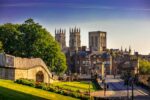
The city’s calling card is its market square, where the Rathaus and the Roland statue together form a UNESCO World Heritage Site, one of the smaller and more concentrated entries on Germany’s UNESCO list. A few streets away, Böttcherstraße packs an entire Expressionist architecture experiment into barely a hundred metres, and the Bremen Town Musicians statue, tucked beside the town hall, gives every visitor a genuinely odd little ritual involving a bronze donkey’s front legs.
Beyond the old town, Bremen holds a genuinely well-rounded spread of things to do. The Kunsthalle Bremen and the Übersee-Museum cover art and world cultures respectively, the Universum Bremen science centre gives families a properly hands-on afternoon, and the Bürgerpark offers over 200 hectares of green space maintained, unusually, by a citizens’ association rather than the city council. Add the Schlachte riverside promenade, a working Beck’s Brewery tour, and a genuinely old-school Christmas market each winter, and the pattern is clear: Bremen rewards a properly unhurried couple of days rather than a rushed afternoon between trains.
This guide works through Bremen’s sights roughly in order of how essential they are for a first visit, along with food, shopping, family options and rainy day backups that round out a trip. For step by step help getting from Bremen Airport into the centre, a separate guide on this site covers every transfer option in detail, including tram line 6, which reaches the Hauptbahnhof in around 16 minutes.
| Section | What you’ll find |
| The Rathaus and Roland Statue | Bremen’s UNESCO-listed market square, the town hall and the 1404 knight statue |
| Böttcherstraße | A 100-metre Brick Expressionist lane with the Paula Modersohn-Becker Museum and a chiming Glockenspiel |
| The Schnoorviertel | Bremen’s oldest quarter, narrow medieval lanes filled with craft shops and cafes |
| The Bremen Town Musicians Statue | The bronze animals from the Grimm fairy tale and the lucky-legs ritual |
| Bremen Cathedral (St. Petri Dom) | The twin-towered Dom, a climbable south tower and the mummies in the Bleikeller |
| Kunsthalle Bremen | Six centuries of art from Dürer and Rembrandt to French Impressionism |
| The BremenCARD | Bremen’s city pass for free public transport and up to 50% off attractions |
| Übersee-Museum | Immersive ethnology, trade history and natural history galleries near the Hauptbahnhof |
| Universum Bremen | A hands-on science centre in a shell-shaped building, good for adults and children |
| Bürgerpark and the Stadtwald | Over 200 hectares of citizen-run parkland with boat hire and playgrounds |
| The Weser River and the Schlachte Promenade | A riverside quay lined with restaurants, beer gardens and boat tours |
| Beck’s Brewery Tour | A three-hour guided tour of the working brewery, ending with a tasting |
| Shopping Along Sögestraße and Obernstraße | The city’s main shopping streets and the bronze Sögeschweine pig sculptures |
| Food and Drink | Local specialities including Knipp, Bremer Klaben and Bremen’s Beck’s and coffee heritage |
| Bremen’s Christmas Markets and the Freimarkt | The Marktplatz and Schlachte-Zauber markets, plus the centuries-old Freimarkt funfair |
| Family-Friendly Things to Do in Bremen | The best attractions for children, from Universum to the Bürgerpark |
| Rainy Day Options in Bremen | Indoor backups for wet weather, from the Kunsthalle to covered shopping streets |
The Rathaus and Roland Statue: Bremen’s UNESCO World Heritage Market Square
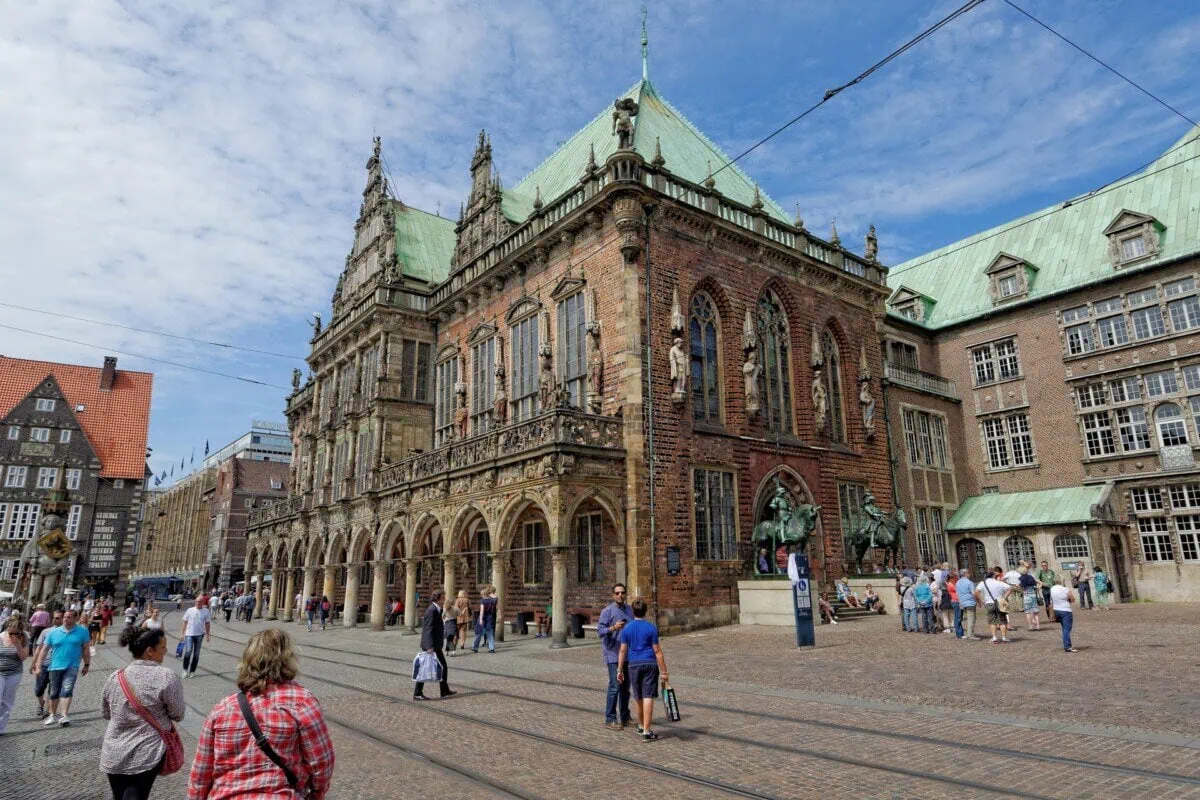
Bremen’s Marktplatz is the obvious place to start any visit, since the Rathaus (town hall) and the neighbouring Roland statue were jointly inscribed as a UNESCO World Heritage Site in 2004, recognised for representing civic autonomy and market rights as they developed in the Holy Roman Empire. The Old Town Hall itself dates to the early 15th century in Gothic style, was reworked in the ornate Weser Renaissance style in the early 17th century, and gained an adjoining New Town Hall in the early 20th century, giving the building line a genuinely layered history to look at rather than a single uniform facade.
Standing directly in front of the Rathaus, the Roland statue has kept watch over the square since 1404, making it one of the oldest surviving Roland statues anywhere in Germany. At 5.5 metres tall, the stone knight carries a sword and shield and symbolises the rights and privileges of Bremen as a free imperial city, a status the merchants who commissioned it were keen to advertise to any visiting bishop or emperor.
Local legend holds that as long as Roland stands, Bremen remains free, and the statue survived the Second World War’s bombing largely intact even as much of the surrounding old town did not. The square itself remains protected under Bremen’s cultural monument preservation laws, and it functions as a genuinely working civic space rather than a museum piece, hosting markets, events and the winter Christmas market covered later in this guide.
The Rathaus interior, including the grand Upper Hall with its model ships hanging from the ceiling, can be visited on guided tours run through the Bremen tourist office, generally a few times daily, though tour times are worth confirming in advance since the hall also hosts official civic functions. Entry to the square itself, and a walk around the Rathaus exterior and Roland statue, costs nothing and takes only a few minutes, making it an easy first stop straight off the tram from the Hauptbahnhof.
Böttcherstraße: A Hundred Metres of Brick Expressionism
A short walk from the Marktplatz, Böttcherstraße is one of the more unusual streets in Germany, a roughly 100 metre lane that began life in the Middle Ages as a working street of coopers (Böttcher) connecting the market to the Weser. Its modern identity, though, comes entirely from one man: the Bremen coffee merchant Ludwig Roselius, who began buying up the street’s medieval properties from 1902 and, between 1922 and 1931, rebuilt almost the entire lane as a single architectural statement.
Working with architect Bernhard Hoetger, Roselius turned the street into a showcase for Brick Expressionism, a genuinely idiosyncratic style built from dark clinker brick, sculpted reliefs and curving, almost organic facades that feel closer to sculpture than conventional architecture. Roselius himself described the project as “an attempt to think German,” and the finished street has been protected as a listed monument since 1973.
Two buildings anchor a visit here. The Paula Modersohn-Becker Museum, opened in 1926, is dedicated to the pioneering Expressionist painter and was itself one of the first purpose-built museums anywhere devoted to a single female artist. The Atlantis House, finished in 1931, mixes glass, steel and concrete into a distinctly modernist stairwell that stands out sharply against the brick surrounding it.
The street’s best-known quirk is the Glockenspiel House, whose gable holds a carillon of Meissen porcelain bells that chimes three times daily, drawing a small crowd that gathers below to watch a rotating wooden panel reveal scenes from famous seafarers and explorers. Between the two museums, the Glockenspiel, and a scattering of craft workshops and cafes, most visitors find an hour is enough for a proper look, longer if the bells happen to be chiming during the visit.
Compare hotels and other places to stay for your trip.
Check availabilityBrowse apartments, homes and self-catering accommodation.
Browse rentalsCompare prices from multiple hotel booking sites.
Check dealsThe Schnoorviertel: Bremen’s Oldest Quarter
On the other side of the Marktplatz from Böttcherstraße, the Schnoorviertel is Bremen’s oldest surviving district, tracing its roots back to a fishermen’s settlement founded on a small island between two rivers as early as the 10th century. The name itself comes from the Low German word for “string,” a nod to the ropemaking and cord trades that once filled these lanes alongside fishing, a very different social class from the wealthy merchants who built the grander streets nearer the market.
Most of what survives today dates from the 17th and 18th centuries, with a handful of structures tracing back further still, and the plots here were genuinely tiny by design, often barely enough space for a single house of around 55 square metres. That cramped medieval footprint is exactly what gives the Schnoor its atmosphere now: narrow, winding lanes barely wide enough for two people to pass, lined with small half-timbered houses that lean gently into one another.
The quarter came surprisingly close to being lost. It suffered only minimal damage in the Second World War, but by the 1950s it had fallen into genuine disrepair, and Bremen’s Senate only began a dedicated restoration programme in 1959, offering financial incentives to property owners. The district finally received formal heritage protection in 1973, the same year as Böttcherstraße, and it has been carefully maintained ever since.
Today the Schnoor is filled with small craft shops, galleries and cafes rather than fishermen’s cottages, and it is a genuinely pleasant place simply to wander without a fixed itinerary. Entry is free and unrestricted at any time, and the whole quarter can be covered on foot in well under an hour, though a slower pace, ducking into a workshop or stopping for coffee, is really how it is meant to be seen.
The Bremen Town Musicians Statue and Its Lucky Legs
Tucked against the western wall of the Rathaus, the Bremen Town Musicians statue is a small bronze sculpture with an outsized reputation, depicting a donkey, dog, cat and rooster stacked one on top of another in the pose made famous by the Brothers Grimm fairy tale, first published in 1819. In the story, four ageing farm animals flee their masters and head towards Bremen hoping to become town musicians, only to stumble on a robbers’ cottage along the way, scare off its occupants with their combined racket, and settle down there permanently, never actually reaching the city itself.
The statue was created by sculptor Gerhard Marcks and installed in 1953, standing just two metres tall despite its outsized fame, and it has since become arguably Bremen’s single most photographed landmark. Look closely and the reason becomes obvious: the donkey’s front legs gleam noticeably brighter than the rest of the bronze, polished smooth by generations of visitors touching them.
Local tradition holds that grasping the donkey’s legs with both hands and making a wish brings good luck, and there is a genuinely charming bit of local folklore attached to the ritual too: using only one hand supposedly marks a visitor as a newcomer, since “it’s just one donkey shaking the hand of another.” Whether or not the luck is real, it is a harmless bit of fun that takes thirty seconds and costs nothing.
Because it sits directly beside the Rathaus, the statue slots naturally into the same stop as the UNESCO market square covered earlier, and it is one of the easiest additions to any Bremen itinerary, requiring no admission fee, no opening hours and barely a detour from the main square. Children in particular tend to love it, and it photographs well at almost any time of day.
Bremen Cathedral (St. Petri Dom) and the Mummies of the Bleikeller
Rising over the northern side of the Marktplatz, St. Petri Dom, Bremen Cathedral, has origins stretching back to 789, when the missionary bishop Willehad built a first timber church on the site. That structure was destroyed within a few years, and a sandstone cathedral rose in its place from 805, later rebuilt as a Romanesque pillared basilica under Archbishop Adalbert in the 11th century, before major Gothic vaulting and remodelling followed in the 13th century. Restoration work in the late 19th century and again between 1972 and 1981 has kept the building in the mixed Romanesque and Gothic form visitors see today.
The cathedral’s twin towers reach 89 metres, and the south tower is open to the public for a climb, with genuinely sweeping views back across the Marktplatz and the old town for anyone willing to tackle the stairs. Tower admission costs €4.00 (£3.44/$4.68) for adults and €2.00 (£1.72/$2.34) for children aged six to eighteen, with the tower generally open Wednesday to Saturday from 10am to 5pm and on Sunday afternoons after services conclude.
The cathedral’s genuinely strange highlight, though, sits beneath it. The Bleikeller, or lead cellar, originally stored roofing lead, but for more than 300 years it has drawn visitors for a very different reason: a small collection of naturally mummified bodies, including Swedish officers and an English countess, preserved in the cellar’s unusually dry air and displayed in glass-topped coffins. Entry to the Bleikeller costs €5.00 (£4.30/$5.85) for adults and €3.00 (£2.58/$3.51) for children, with the same Wednesday to Sunday, 11am to 5pm schedule.
The cathedral’s own nave and the Dom Museum are free to enter, generally open daily from around 10am, though hours shift seasonally and around services, so it is worth checking the current schedule before planning a visit purely around one element. Between the free interior, the paid tower climb and the genuinely unusual Bleikeller, the Dom rewards at least 45 minutes, longer for anyone climbing the tower.
Kunsthalle Bremen: Old Masters to Modernism
A short walk from the old town, the Kunsthalle Bremen is one of the more significant art collections in northern Germany, spanning roughly six centuries from Dürer and Rembrandt through to French Impressionism and 20th century modernism. The museum grew out of a private art society founded in the 19th century and has expanded steadily since, giving it a genuinely broad sweep rather than a narrow specialist focus.
The collection’s real strength lies in its French Impressionist holdings, with works by Monet, Manet and Degas sitting alongside a strong run of German Romantic and Expressionist painting, including pieces connected to the nearby artists’ colony at Worpswede that also produced Paula Modersohn-Becker. A dedicated prints and drawings cabinet, one of the largest of its kind in Germany, adds real depth for anyone with more specialist interests beyond the main galleries.
Through late October 2026, the museum opens Tuesday from 10am to 9pm and Wednesday to Sunday from 10am to 5pm, closing entirely on Mondays, with winter hours extending slightly later on the Wednesday to Sunday slots from late October. Adult admission during the summer schedule costs €12.00 (£10.32/$14.04), dropping to €6.00 (£5.16/$7.02) at the reduced rate, with under-19s admitted free on production of ID.
Group rates of €10.00 (£8.60/$11.70) per person apply for parties of ten or more, and prices rise slightly for the winter season from late October, when an evening ticket becomes available roughly 90 minutes before closing. Allow at least 90 minutes for a proper walk through the permanent collection, longer if a major temporary exhibition happens to be showing during the visit.
The BremenCARD: Free Transport and Up to 50% Off Attractions
Bremen’s official city pass, the BremenCARD, bundles unlimited public transport with discounted entry to many of the sights covered elsewhere in this guide. One card covers a single adult travelling with up to three children aged 14 and under, making it a genuinely useful pickup for any family planning more than one paid stop.
The card is valid on buses, trams and DB regional trains within Bremen and Bremen-Nord, and its validity window runs from 6pm on the evening before activation through 3am after the final calendar day, effectively adding a free extra evening’s travel onto whatever length is purchased. A short free ferry crossing of the Weser, between Osterdeich and Café Sand, is also included for cardholders.
Beyond transport, holders get discounts of up to 50% on entry to a range of Bremen’s museums, tours and cultural venues, plus smaller savings at selected restaurants and shops, though reductions generally apply only to full-price tickets rather than group rates or temporary exhibitions. Cards are sold in 1-day, 2-day and longer versions, with a 1-day card priced from around €10.90 (£9.37/$12.75) and a 2-day card from roughly €15.90 (£13.67/$18.60).
The card can be bought online in advance or picked up at Bremen’s tourist information points, including the one on the Marktplatz covered earlier in this guide, and it arrives as a printable voucher for anyone ordering ahead of arrival. For a trip built mostly around the old town’s free sights, the BremenCARD’s value tends to show up once a museum visit or two and a handful of tram rides enter the plan, rather than for a single afternoon spent purely around the Marktplatz and Böttcherstraße.
Übersee-Museum: World Cultures Under One Roof
The Übersee-Museum, literally the “overseas museum,” reflects Bremen’s centuries as a port city trading with the wider world, combining ethnology, trade history and natural history collections under a single roof close to the Hauptbahnhof. Rather than displaying artefacts in isolated glass cases, the museum is built around large, immersive recreations of different world regions, from Asian marketplaces to South Sea island settings, that visitors physically walk through.
That approach makes the Übersee-Museum genuinely different from a standard ethnology collection, since entire sections feel more like a stage set than a conventional gallery, with reconstructed shopfronts, boats and dwellings sitting alongside more traditional cabinets of objects gathered by Bremen’s merchants and explorers over more than a century of overseas trade. A dedicated natural history wing rounds out the collection with taxidermy and geological displays.
The museum opens Tuesday to Friday from 9am to 5pm and Saturday and Sunday from 10am to 5pm, closing on Mondays, with slightly later opening during school holidays. Adult admission costs €15.00 (£12.90/$17.55), with a reduced rate of €7.50 (£6.45/$8.78) applying to children aged six to seventeen as well as students and other concessions, and children under six admitted free.
A family package brings the adult rate down to roughly €12.00 (£10.32/$14.04) with children at €6.00 (£5.16/$7.02) each, and a discounted “Good Evening” ticket is available in the hour before closing for anyone arriving later in the day. Budget at least two hours to see the collection properly, since the scale of the immersive displays genuinely rewards a slower pace than a standard museum walk-through.
Search flights and useful route combinations in one place.
View flightsBrowse Airalo eSIM options for convenient travel data.
Check eSIMsArrange a private pickup before travel instead of sorting transport after landing.
Book a transferUniversum Bremen: A Science Centre Built to Be Touched
Instantly recognisable from its shining, shell-shaped exterior, Universum Bremen is a hands-on science centre built around the idea that visitors learn better by doing than by reading a label. Inside, exhibits are grouped loosely around humans, technology and nature, with hundreds of interactive stations covering everything from optical illusions and simple physics demonstrations to hands-on experiments most visitors would never get to try anywhere else.
Unlike a traditional science museum built primarily for school trips, Universum genuinely works for adults too, and its distinctive curved, metallic building has become something of a landmark in its own right on Bremen’s skyline near the university district. An outdoor area extends the exhibits into the open air during warmer months, though it closes earlier, generally by 5pm, once winter sets in.
Adult admission costs €18.00 (£15.48/$21.06), with children over six, students, seniors and visitors with significant disabilities paying a reduced €12.00 (£10.32/$14.04). A family ticket covering two adults and up to two children under 18 costs €42.00 (£36.12/$49.14), while a single-parent family ticket for one adult and up to two children runs to €24.00 (£20.64/$28.08).
A discounted “Good Evening” ticket, valid 90 minutes before closing, costs just €6.00 (£5.16/$7.02), and annual passes are available from €40.00 (£34.40/$46.80) for anyone likely to return more than once. Given the sheer number of interactive stations, most visitors need a genuine two to three hours to work through even a fraction of what is on offer, and children in particular can easily fill a whole afternoon here.
Booking an entrance ticket for Universum Bremen online ahead of a visit is worth doing during school holidays, when the ticket desk can get busy, and the option below shows current availability and pricing for exactly that ticket.
Bürgerpark and the Stadtwald: A Park Run by Its Own Citizens
Few city parks anywhere have quite as unusual a backstory as Bremen’s Bürgerpark. The park began as a genuine citizens’ initiative in 1865, after a stretch of former pasture land called the Bürgerweide fell out of agricultural use, with ground formally broken on 28 June 1866. Landscape architect Wilhelm Benque designed the final layout, blending the geometric and naturalistic garden styles typical of 19th century public parks into a genuinely graceful whole.
The park covers 136 hectares on its own, and the adjoining Stadtwald forest, added after 1900, brings the combined green space to more than 200 hectares, making it one of the largest connected areas of parkland anywhere in Bremen. Remarkably, the Bürgerpark receives no regular public funding at all: it has been maintained since 1872 by the Bürgerparkverein, a citizens’ association that covers running costs through donations and a dedicated Bürgerpark lottery.
Inside the grounds, visitors will find small animal enclosures, a boat hire service on the park’s lake, a Finnish fitness trail through the woods, mini golf and boules pitches, five separate playgrounds, and a toboggan hill for winter snow. A handful of traditional coffee houses sit dotted through the grounds too, giving the park a genuinely relaxed, old-fashioned atmosphere rather than feeling like a purely functional patch of green.
Access to both the Bürgerpark and the Stadtwald is free and unrestricted at any time, and both sit within easy walking distance of the Hauptbahnhof, making the park an easy addition to a first day in Bremen rather than a planned excursion. Allow at least an hour for a proper walk, considerably longer with children keen to try the boat hire or the playgrounds.
The Weser River and the Schlachte Promenade
Bremen’s relationship with the River Weser runs through the entire city, and the Schlachte, a riverside promenade stretching roughly two kilometres along the eastern bank, is the most obvious place to feel it. The Schlachte has functioned as a harbour since 1247, handling wood, limestone and flat-bottomed river barges for centuries, and it remained Bremen’s principal harbour until the early 19th century, before the arrival of the railway in the 1860s ended its commercial shipping role for good.
Rather than leaving the old quay to decline, Bremen redeveloped the Schlachte in two phases: a pedestrian zone introduced in 1985, followed by a much larger reconstruction between 1993 and 2000 as part of the city’s “Stadt am Fluss” (Town on the River) initiative tied to Expo 2000. A footbridge to the Teerhof peninsula, added in 1996, extended the promenade’s reach further still.
Today the Schlachte is lined with restaurants, beer gardens and bars, many occupying converted historic warehouse buildings with extensive open-air seating right on the water. River boat tours depart regularly from jetties along the promenade, giving a genuinely different perspective on Bremen’s old town from the water, and the Schlachte hosts regattas and open-air festivals through the summer months.
A slow walk along the full length of the Schlachte takes under an hour, though most visitors end up stopping for a drink or a meal somewhere along the way rather than walking it end to end without pausing. It sits a short walk from both the Marktplatz and the Schnoorviertel, making it easy to fold into the same afternoon as the old town’s other sights.

Beck’s Brewery Tour: A Hanseatic Beer Institution
Few German beer brands travel as widely as Beck’s, and its home brewery in Bremen makes for a genuinely worthwhile detour for anyone with an interest in how it is made. The brewery was founded on 27 June 1873 by Heinrich Beck, Lüder Rutenberg and Thomas May as the Kaiser-Brauerei Beck & May, and it grew steadily through the following century into one of Germany’s largest brewers before being acquired by Interbrew, now part of Anheuser-Busch InBev, in 2001.
Despite the change in ownership, the Bremen brewery remains fully operational, and guided tours run regularly through the working site, typically lasting around three hours and covering the brewing process from raw ingredients through to bottling, alongside a look at the brewery’s history since the 19th century. Most tours end with a proper Beck’s tasting session, giving visitors a chance to sample the beer fresh from the source rather than from a bottle bought elsewhere.
Tours generally need to be booked in advance rather than turning up on the day, since spaces are limited and the brewery remains a genuine working production site rather than a purpose-built visitor attraction. Comfortable, closed-toe footwear is worth wearing given the walking involved across an active industrial facility, and it is worth confirming the current tour schedule and language options before travelling specifically for a slot.
For anyone not able to fit in the full tour, Beck’s beer is served throughout Bremen’s bars and restaurants, including along the Schlachte covered above, so the brand’s local roots are never far away even without a dedicated visit to the brewery itself. The tour works best for beer enthusiasts specifically rather than as a general first-time sightseeing stop.
Since a Beck’s Brewery tour needs booking in advance regardless, reserving a spot through the option below locks in a time slot and current pricing rather than leaving it to chance closer to the visit.
Shopping Along Sögestraße and Obernstraße
Bremen’s main shopping streets, Sögestraße and the pedestrianised Obernstraße, run between the Hauptbahnhof and the Marktplatz, and together they form the natural spine of the city centre’s retail district. The mix here runs to fairly standard high street fashion and homeware chains, but the genuinely walkable, compact layout means the whole stretch is easy to cover without much backtracking.
Sögestraße carries a distinctly medieval backstory worth knowing before walking it. In the Middle Ages it was known as Saustraße, “pig street,” since it was the route along which pigs were driven from the farms outside the city to market, and that history is now marked by the Sögeschweine, a set of bronze sculptures by Peter Lehmann erected in 1974 depicting a shepherd, his dog and a small herd of pigs. The sculptures have become an genuinely popular local meeting point, with children clambering onto the pigs and adults using them as an impromptu bench.
Where Obernstraße leans towards larger chain stores and a shopping centre or two, the side streets nearer the Marktplatz and Schnoorviertel hold smaller independent boutiques and galleries that tend to get overshadowed by the main drag’s footfall. The Böttcherstraße covered earlier also doubles as a useful stop for craft goods and gifts with more character than a standard souvenir shop.
Weekday mornings and early afternoons tend to be the most comfortable time to browse before the after-work crowds build, and the whole stretch from the Hauptbahnhof to the Marktplatz is walkable in well under 30 minutes even allowing for a stop or two along the way. Saturday remains the busiest shopping day, as in most German cities, with many shops closing entirely on Sundays.
Food and Drink: Klaben, Knipp and Bremen’s Coffee Trade
Bremen’s food culture leans on hearty north German comfort cooking, and Knipp, a regional dish of minced pork, oats and onions fried into a thick patty, is about as close as the city gets to a genuinely local speciality, traditionally served with bread, apple sauce or pickled beetroot. It rarely appears far outside the region, which makes it worth actively seeking out on a menu rather than expecting to stumble across it by accident.
Come winter, Bremer Klaben takes over, a dense, buttery stollen-style fruit loaf studded with raisins, candied peel and marzipan that Bremen bakers have produced for generations, and it appears on virtually every bakery counter and Christmas market stall through the festive season. Alongside it, Bremen has a genuinely deep connection to coffee, since it was Böttcherstraße’s own Ludwig Roselius who developed one of the first commercially viable methods of decaffeinating coffee in the early 20th century, launching the Kaffee HAG brand that is still sold across Germany today.
On the drinks side, Beck’s, covered in detail earlier in this guide, remains the city’s most famous export, and it is served everywhere from riverside bars on the Schlachte to traditional Gaststätten around the old town. As a Hanseatic trading city, Bremen’s restaurant scene also has a genuine fondness for fish, with North Sea catches such as herring and plaice turning up regularly on menus close to the harbour district.
Between traditional Gaststätten around the Schnoorviertel, the restaurants and beer gardens lining the Schlachte, and smaller independent cafes tucked into Böttcherstraße’s workshops, Bremen’s dining scene rewards a little wandering rather than sticking purely to the streets immediately around the Marktplatz.
Browse hostels and budget-friendly stays.
See hostelsAccess compensation support, eligible lounge benefits and faster payouts.
See the benefitsLeave your luggage somewhere convenient and explore hands-free.
View storageBremen’s Christmas Markets and the Freimarkt
Each winter, Bremen’s UNESCO World Heritage market square transforms into one of Germany’s more atmospheric Christmas markets, spreading across the Marktplatz and the neighbouring Domshof with traditional wooden stalls selling mulled wine, roasted almonds and handmade crafts beneath the Rathaus and Roland statue. Running roughly from late November through 23 December in a typical year, the market draws heavily on Bremen’s Hanseatic setting for atmosphere, with the illuminated Dom and Rathaus forming a genuinely striking backdrop after dark.
A short walk away, the Schlachte-Zauber takes the market in a completely different direction, transforming the riverside promenade covered earlier in this guide into a medieval and pirate-themed winter market, complete with fire pits, costumed performers and a distinctly different atmosphere from the more traditional stalls back at the Marktplatz. Running the same market together with its riverside cousin gives Bremen genuinely two very different Christmas market experiences within a short walk of each other.
Bremen’s other great annual event sits at the opposite end of the calendar. The Freimarkt traces its origins back to 16 October 1035, when Emperor Conrad II granted Bremen the right to hold a market, making it one of the oldest fairs anywhere in Germany. Today it runs for 17 days across the final two weeks of October, spreading across the Bürgerweide near the Hauptbahnhof as one of the largest funfairs in northern Germany, drawing more than four million visitors a year for rides, food stalls and the traditional Freimarktsumzug parade.
Exact dates for both the Christmas markets and the Freimarkt shift slightly year to year, so it is worth confirming the current season’s opening dates before building a trip specifically around either event, particularly given how differently the two experiences feel from each other.
Family-Friendly Things to Do in Bremen
Bremen handles a family visit better than many first-time visitors expect, largely because several of its biggest attractions already double as genuine family days out. Universum Bremen is the obvious anchor, with hundreds of hands-on stations giving children an actively engaging science experience rather than a walk past static displays, and the outdoor exhibits add a further layer for warmer months.
The Bremen Town Musicians statue works surprisingly well for younger children too, since the donkey-rubbing tradition is genuinely novel enough to hold their attention, and it costs nothing to enjoy. The Bürgerpark‘s boat hire, playgrounds and small animal enclosures suit an active family afternoon well, with flat, buggy-friendly paths running through much of the grounds for families not up for a longer walk.
The Übersee-Museum‘s immersive, walk-through displays tend to land well with children who might otherwise find a traditional glass-case museum hard going, since the recreated marketplaces and settings give them something to physically explore rather than simply look at from behind a rope. A dedicated family ticket keeps the cost down for a full visit.
For a slower afternoon, the Schnoorviertel‘s narrow lanes and small craft shops give children a genuinely different, almost storybook environment to wander through, particularly fitting given the city’s own connection to the Brothers Grimm. Combined with a stop at the Town Musicians statue nearby, it makes for an easy, low-cost pairing that needs no advance planning at all.
Rainy Day Options in Bremen
Northern Germany is not known for reliably dry weather, so it helps that several of Bremen’s best sights sit entirely indoors to begin with. The Kunsthalle Bremen and the Übersee-Museum both work as full, unhurried visits regardless of what is happening outside, and both sit close enough to the Hauptbahnhof and old town to combine easily on a single wet afternoon.
The Universum Bremen science centre offers a genuinely reliable covered option too, since the bulk of its hands-on exhibits sit indoors even though an outdoor area extends the experience in fine weather. Bremen Cathedral‘s nave and the free Dom Museum provide another dry stop in the heart of the old town, with the Bleikeller’s underground setting meaning a downpour outside makes no difference at all to that particular visit.
The Schnoorviertel‘s small shops and cafes give a pleasant, if piecemeal, covered wander for anyone happy to duck between doorways rather than needing a single large indoor space, and Böttcherstraße‘s museums and workshops work the same way. Failing that, the shopping centres and covered stretches along Obernstraße and Sögestraße give a straightforward backup, since much of the retail here sits under cover or close enough together to hop between shops without getting properly soaked.
For a longer wet day, pairing the Kunsthalle with the Übersee-Museum and a leisurely lunch somewhere along the Schlachte’s covered terraces rarely leaves much time spare, and between the museums, the cathedral and the old town’s covered lanes, a rainy day in Bremen rarely needs to be a wasted one.

Rupert’s Handy Travel Tips
Planning a visit to Bremen? Rupert has a few tips worth knowing before you go:
- Touch the donkey with both hands: local tradition says the Bremen Town Musicians’ luck only counts if you grasp the donkey’s front legs with both hands, not one.
- Book the Beck’s Brewery tour ahead of time: spaces are limited on the working site, and walk-up slots are rarely available.
- Climb the Dom tower on a clear day: the view over the Marktplatz is worth far more with good visibility, and the tower closes earlier than the cathedral itself.
- Pair the Marktplatz with Böttcherstraße and the Schnoor: all three sit within a five-minute walk of each other, making an easy half-day loop without much backtracking.
- Check whether Schlachte-Zauber or the traditional Marktplatz market suits your evening: the two Christmas markets have genuinely different atmospheres despite sitting so close together.
- Avoid driving into the centre: Bremen’s tram and bus network covers the old town well, and parking near the Marktplatz is limited and metered.
Want to meet the reindeer behind our travel tips? Find out more in our page Who is Rupert?.




Frequently Asked Questions About Things to Do in Bremen
What is Bremen’s biggest attraction?
The Rathaus and Roland statue on the Marktplatz, a UNESCO World Heritage Site since 2004, is generally considered the city’s top sight, closely followed by Böttcherstraße and the Schnoorviertel.
How many days do you need in Bremen?
Two full days cover the essentials comfortably, including the Marktplatz, Böttcherstraße, the Schnoorviertel and Bremen Cathedral, with a third day useful for the Kunsthalle, Übersee-Museum or a slower museum pace.
Why is Bremen a UNESCO World Heritage Site?
The Rathaus and Roland statue were jointly inscribed in 2004 for representing civic autonomy and market rights as they developed in the Holy Roman Empire, with the Roland statue dating to 1404.
What is the story behind the Bremen Town Musicians statue?
It depicts the donkey, dog, cat and rooster from the 1819 Brothers Grimm fairy tale, and local tradition holds that touching the bronze donkey’s front legs with both hands brings good luck.
Is Bremen Cathedral free to visit?
The nave and Dom Museum are free. Climbing the south tower costs €4.00 (£3.44/$4.68) for adults, and the Bleikeller lead cellar with its preserved mummies costs €5.00 (£4.30/$5.85).
What food is Bremen known for?
Knipp, a fried pork and oat dish, is the genuinely local speciality, alongside the winter favourite Bremer Klaben fruit loaf and the internationally exported Beck’s beer.
Can you tour the Beck’s Brewery in Bremen?
Yes. Guided tours of the working brewery, founded in 1873, run regularly and typically last around three hours, ending with a tasting session, though advance booking is recommended.
Is Bremen good for a family trip?
Yes. Universum Bremen’s hands-on science exhibits, the Bürgerpark’s boat hire and playgrounds, and the free Bremen Town Musicians statue all work well for children.
Further Reading & Related Guides
For getting into the city in the first place, our Bremen Airport Transfers guide covers tram line 6, taxis and every other option from BRE. Anyone building a wider Germany itinerary will find our Things to Do in Hanover and Things to Do in Dortmund guides useful companions elsewhere in the country’s growing content on this site.
For another northern German Hanseatic city with a similarly compact centre, our Best Things to Do in Hamburg guide is worth a look, and if onward rail travel around northern Germany is part of the plan, our German Rail Tickets Explained guide breaks down the Deutschland-Ticket and regional fares, while our Interrail Germany Pass Guide explains when a country-specific pass beats buying tickets individually for a longer trip.