Reviewed by our editorial team Updated
Germany’s Christmas markets grew out of medieval trading fairs held in the weeks before Christmas, when town councils granted merchants the right to sell meat, bread and provisions to residents stocking up for winter. Dresden’s Striezelmarkt, first documented in 1434, and Frankfurt’s own market, with trading stalls recorded on the Römerberg as early as 1393, both point to genuinely medieval roots rather than a modern festive invention.
Nuremberg’s Christkindlesmarkt, running in some form since at least the 1600s, is the market most people picture when they imagine a German Christmas market, with its red and white striped stalls and a Christkind who opens the season from the Frauenkirche balcony. That image is a genuine part of the tradition, but it is also only one version of it among dozens of very different markets across the country.
Some German cities build an entire festive season around one historic square. Frankfurt does it around the Römerberg, Dresden around the Altmarkt, and Stuttgart spreads a single market, one of the country’s largest by stall count, across four connected squares in its old town.
Other cities take the opposite approach entirely. Cologne and Düsseldorf each run seven distinct markets with their own individual character, while Berlin scatters more than a hundred separate markets across its twelve districts rather than settling on any single centrepiece at all.
This guide compares all ten German cities covered in depth on this site, setting out what genuinely distinguishes one market from another. Each city already has its own full guide elsewhere on this site, so the sections below are a starting point for deciding where to go rather than a replacement for them.
If Germany is only one stop on a longer festive itinerary, our European Christmas Markets guide is worth reading alongside this one, since it covers cities, dates and trips right across the continent. Everything below stays focused specifically on Germany’s own ten markets.
It also covers what applies to almost any German Christmas market, from the deposit-cup Glühwein system to the country’s tightly restricted Sunday trading rules, before closing with guidance on which city suits which kind of trip. Every date and detail below is pulled directly from this site’s own dedicated guide to that city’s market rather than guessed.
Germany’s Christmas Markets at a Glance
The table below pulls together the genuinely distinguishing facts for each city’s market, rather than repeating the same generic description ten times. Full detail on every date, price and tradition sits on each city’s own dedicated guide, linked throughout the sections that follow.
| City | Market Name(s) | Known For | Typical Dates (2026) |
|---|---|---|---|
| Berlin | More than 100 markets citywide, including WeihnachtsZauber at Gendarmenmarkt, Charlottenburg Palace and Potsdamer Platz | Scattered across twelve districts rather than one square, from an upscale ticketed market to a fairground-style market | Most run late Nov to late Dec; Gendarmenmarkt runs 23 Nov to 31 Dec |
| Hamburg | Rathausmarkt, Jungfernstieg’s Weißer Zauber, Santa Pauli, HafenCity Maritime Market | A genuine spread of separate markets shaped by the city’s port geography, with the only central ice rink at HafenCity | Rathausmarkt 23 Nov to 23 Dec; other markets vary |
| Stuttgart | Stuttgarter Weihnachtsmarkt | One of Germany’s oldest markets (documented from 1692) and largest by stall count, around 250 stalls across four squares | 25 Nov to 23 Dec |
| Frankfurt | Frankfurter Weihnachtsmarkt | Trading stalls recorded from 1393, spread across six old town squares centred on the Römerberg’s single fir tree | 23 Nov to 22 Dec |
| Dresden | Striezelmarkt | Germany’s oldest documented Christmas-season market (1434), a giant Erzgebirge pyramid, and the Stollenfest parade | 25 Nov to 24 Dec |
| Leipzig | Leipziger Weihnachtsmarkt | Documented from 1458, spread across seven old town locations, with a genuine link to Bach and the Thomanerchor choir | 24 Nov to 23 Dec |
| Nuremberg | Christkindlesmarkt | The Christkind opening ceremony, red and white striped stalls, and two EU-protected foods, Lebkuchen and Rostbratwurst | 27 Nov to 24 Dec |
| Cologne | Seven markets, including the Cathedral Market, Angels’ Market and Heinzels Wintermärchen | Seven markets anchored by the Cathedral Market beside the Kölner Dom, each with a distinct character | Most run mid to late Nov to 23 Dec; harbour market into early Jan |
| Düsseldorf | Seven markets, including the Altstadt-Markt, the Winter Village on the Kö and Roncalli’s Weihnachtspromenade | Seven markets built to contrast each other, from a designer Winter Village to a raucous Old Town and a circus-themed riverside market | 19 Nov to 30 Dec |
| Munich | Christkindlmarkt at Marienplatz, plus Wittelsbacherplatz, the Chinesischer Turm and Tollwood | First recorded in 1310, a nearly 30-metre donated Alpine tree, and a genuine scatter of distinct smaller markets | 20 Nov to 24 Dec |
Berlin: Variety Over a Single Square
Berlin does not build its festive season around one square the way most other German cities do. Instead the city runs more than a hundred separate markets across its twelve districts, from the ticketed WeihnachtsZauber on the elegant Gendarmenmarkt to a free market set against the baroque Charlottenburg Palace.
That spread makes Berlin the best choice for a trip built around variety rather than one signature scene. Alexanderplatz leans into fairground spectacle with a roller rink and nightly music, while Potsdamer Platz adds a genuine outdoor ice rink and a toboggan run.
The Gendarmenmarkt market is one of the few in the country to charge for entry, with general admission priced at €2 (£1.72/$2.34) and free access most weekdays between noon and 2pm. It still draws more than 600,000 visitors across a run from 23 November to 31 December 2026, one of the longest seasons of any market in this comparison, and Spandau’s old town adds a further contrast again with its own genuinely medieval-themed market inside the Zitadelle Spandau in some years.
For the full picture, our Berlin Christmas Markets guide breaks down eight of the city’s best-known markets, along with ice skating, Sunday shopping dates and how to get between districts.
Best if you want daily housekeeping and a front desk. Filter by area first, then by price.
Check availabilityBest for groups who want one address and separate bedrooms rather than three hotel rooms.
See holiday homesBest for double-checking. Runs the same Germany search across several booking sites so you are not leaving money behind.
Compare pricesHamburg: Shaped by the Harbour
Hamburg’s Christmas season is shaped by its own geography, a port city built around water and warehouses rather than a single medieval square. The historic Rathausmarkt remains the traditional centrepiece, staged in front of the ornate town hall and run by the circus company Roncalli.
A short walk away, Jungfernstieg’s Weißer Zauber trades that civic grandeur for a lakeside setting beside the Binnenalster, complete with a Ferris wheel that has turned since 1899. HafenCity’s own maritime-themed market is the only one in the city with a genuine ice rink, set against the UNESCO-listed Speicherstadt warehouses.
The historic Rathausmarkt market is also one of the country’s most sustainability-minded, running on 100% green electricity and switching off its lights at 11pm each night to limit energy use. Its best-known spectacle is a Santa Claus who appears to fly above the square in a sleigh three times a day, a signature touch from the market’s operator, the circus company Roncalli, that has helped make Rathausmarkt one of the most photographed stops in the city each December.
All seven of the city’s markets, including the adults-only Santa Pauli on the Reeperbahn, get the full treatment in our Hamburg Christmas Markets guide, along with Sunday trading rules.
Stuttgart: Scale and Decorated Stall Roofs
The Stuttgarter Weihnachtsmarkt is one of Germany’s oldest markets, officially documented as an established event from 1692, and one of its largest, with around 250 stalls spread across four connected old town squares. It draws between 3.5 and 4 million visitors each season, a scale that puts it among the biggest single markets covered on this site.
What genuinely sets Stuttgart apart is not only size but detail, since many of its wooden stalls carry elaborately decorated roofs, judged informally each year in a “most beautiful stall” tradition. A separate roller-skating rink, Wintertraum, shares Schlossplatz with the stalls for most of December.
The market’s most beautiful stall competition is judged informally each year by a jury from the organisers alongside visitors themselves, rewarding stalls whose roofs carry fairy lights, hand-carved nativity scenes or miniature winter landscapes rather than a plain awning. It is a small but genuine point of civic pride, reflecting how much weight Stuttgart’s own market planners place on craftsmanship and presentation rather than simply filling squares with stalls.
Every square, the market’s green-electricity commitment and the separate Christmas Garden light trail at the Wilhelma are covered in full in our Stuttgart Christmas Market guide.
Frankfurt: Six Squares and Deep History
Frankfurt’s Weihnachtsmarkt is one of Germany’s oldest, with trading stalls recorded on the Römerberg as early as 1393. Rather than confining itself to one square, it now spreads across six connected sites in the old town, anchored by a single, carefully chosen fir tree on the Römerberg itself.
The market leans on genuine Frankfurt specialities rather than only the usual Glühwein, serving hot mulled apple wine, Heißer Apfelwein, alongside marzipan Bethmännchen biscuits. It closes on 22 December, well before Christmas Eve, so it suits an earlier trip rather than one built around the holiday itself.
The market’s signature biscuit, Bethmännchen, has its own specific history, created in 1838 by a pastry chef for the Frankfurt banking family the treat is named after. Each small marzipan dome is traditionally topped with three almonds rather than four, a detail bakers still follow nearly two centuries later, and the Weihnachtsmarkt around it now draws roughly three million visitors a season.
The Turmbläser brass tradition, the city’s Zeil shopping street and all six squares get a proper look in our Frankfurt Christmas Market guide.

Dresden: The Striezelmarkt’s Claim to Oldest
Dresden’s Striezelmarkt, first documented in 1434, is widely regarded as Germany’s oldest genuine Christmas-season market, and it takes its name from Striezel, an old Saxon word for the fruit loaf now known as Dresdner Stollen. A 14.61-metre Erzgebirge pyramid, billed as the world’s largest of its kind, anchors the Altmarkt.
The market’s biggest single event, Stollenfest, parades a ceremonial stollen weighing around 1,800 kilograms through the old town every December, and because the market itself runs right up to Christmas Eve, it suits travellers combining a visit with the holiday. Genuine ice skating sits a short walk away at Dresdner Winterlichter.
Beyond the pyramid, the market also claims the title of the world’s largest usable Christmas arch, a wooden structure spanning 13.5 metres and standing more than 5 metres tall on the Altmarkt. Striezelmarkt itself now fills the square with roughly 240 stalls and draws close to three million visitors a season, figures that put it comfortably among the biggest markets in this comparison despite Dresden’s reputation resting more on history than scale.
For the Stollenfest parade in detail, the Dresdner Kreuzchor’s Christmas Eve service and the city’s other festive markets, our Dresden Christmas Market guide is the one to read.
Leipzig: Seven Squares and a Musical Heritage
The Leipziger Weihnachtsmarkt, documented from 1458, describes itself as Germany’s second-oldest Christmas market and spreads across seven old town locations, from a children’s fairytale forest on Augustusplatz to a historical craft market at Naschmarkt. Its strongest point of difference is musical rather than architectural.
Leipzig is home to the Thomanerchor, the boys’ choir Bach once directed, which performs his Weihnachtsoratorium at Thomaskirche every Advent. The city’s own ice rink, the Leipziger Eistraum, does not overlap with the market at all, since it runs a separate January-to-March season on the same square.
Leipzig’s market now runs to around 300 stalls and draws well over two million visitors a season, figures that place it comfortably alongside the country’s largest despite its reputation resting more on history and music than scale. Its own Erzgebirge pyramid stands around eight metres tall on the Markt, smaller than Dresden’s, but set within a market whose 1458 founding date makes it, by its own account, Germany’s second-oldest.
Our dedicated Leipzig Christmas Market guide works through all seven locations, the Thomanerchor’s concert schedule and Sunday shopping dates under Saxon law.
Nuremberg: The Christkindlesmarkt
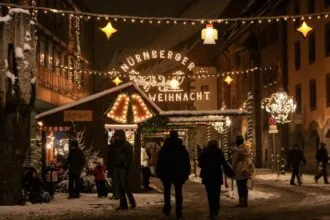
Nuremberg’s Christkindlesmarkt has run in some form since at least the 1600s and is named for the Christkind, a young local woman elected every two years who opens the season with a prologue from the Frauenkirche balcony. Around 180 red and white striped stalls fill the Hauptmarkt, earning the market its nickname, the little town of wood and cloth.
Food is central to a visit, and Nuremberg has two EU-protected specialities to show for it, Nürnberger Lebkuchen gingerbread and the small, marjoram-seasoned Nürnberger Rostbratwurst sausage. Two linked markets, a children’s market and a sister-cities market, both sit within easy walking distance of the main square.
Since 1969, the Christkind role has been decided every two years through a public application process open to local women aged 16 to 19, followed by a jury selection rather than a public vote. Nuremberg’s protected sausage is tiny by design, each Rostbratwurst weighing around 20 grams and measuring only 7 to 9 centimetres, and the recipe’s reputation reaches back far enough that Goethe himself is recorded having them shipped to Weimar.
The Christkind tradition, the city’s protected foods and how to avoid the market’s busiest hours are all covered properly in our Nuremberg’s Christmas Market guide.
Best for finding routes the airlines do not sell as a single ticket. Combines carriers to bring the fare down.
Search flightsBest for anyone whose home plan charges by the megabyte abroad. Pay a fixed price up front.
Check eSIMsBest after a long flight or a late landing. Price agreed before you travel, and no taxi queue.
Check transfersMunich: The Oldest Claim and a Scattered Season
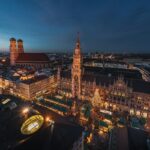
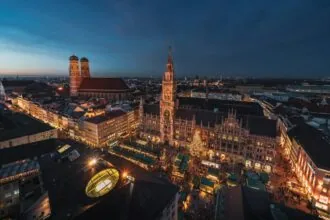
Munich’s Christkindlmarkt at Marienplatz was first recorded as a Nikolaimarkt in 1310, a claim to age that rivals anything else in this comparison even though it wasn’t renamed Christmarkt until 1806 and only settled on its current square in 1972. Around 140 stalls now fill Marienplatz and the neighbouring Rindermarkt each winter, anchored by a nearly 30-metre tree donated by a different Austrian or Italian town every year.
What sets Munich apart from the single-square cities elsewhere in this comparison is its own genuine scatter of distinct smaller markets. A medieval-themed market fills Wittelsbacherplatz with costumed traders and blacksmiths, while a quieter market wraps around the Chinesischer Turm’s wooden pagoda deep inside the Englischer Garten.
The Tollwood Winter Festival adds a genuinely different character again, building an organic, fair-trade alternative to the main market on the Theresienwiese, the same field that hosts Oktoberfest. Munich is also a genuine outlier on Sunday trading, since the city does not permit shop openings on a Sunday at all, unlike the confirmed Advent Sundays running in Berlin, Dresden and several of the other cities covered here.
Anyone weighing up whether Munich’s history or its variety matters more to a trip should look at both properly before deciding. Every date, price and market covered above gets the full depth treatment in our dedicated Munich Christmas Markets guide, which is worth reading in full before building an itinerary around it.
Cologne: Seven Markets Around the Dom
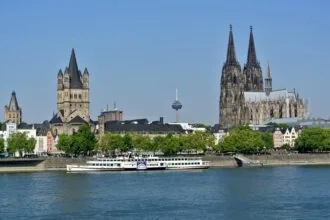
Cologne does not run one Christmas market, it runs seven, spread from the foot of the Kölner Dom cathedral to the Rhine waterfront. The Cathedral Market is the biggest and most photographed, while Neumarkt’s Angels’ Market leans romantic and Heinzels Wintermärchen spreads a whimsical elf theme across two connected Old Town squares.
That range gives Cologne the strongest claim among the ten cities to sheer number of markets within one compact centre, with four of the seven sitting within a 20-minute walk of each other. The harbour market at Rheinauhafen runs the longest season of the seven and stays noticeably calmer.
The Cathedral Market alone fills Roncalliplatz with more than 130 wooden stalls and around 70,000 LED lights strung above the square beside the Kölner Dom, a scale that makes it the most visited of Cologne’s markets by a wide margin. Down at the Rhine, the harbour market’s own 48-metre Ferris wheel gives it a genuinely different skyline from the cathedral backdrop elsewhere in the city, and its season stretches into early January, well past when most of the others have already packed up.
Read our Cologne Christmas Markets guide for all seven markets in turn, including the Heumarkt ice rink and how to combine Cologne with a trip to Düsseldorf.
Düsseldorf: Deliberate Contrast
Düsseldorf also runs seven separate markets, but the point of difference here is contrast rather than count. A designer Winter Village of white glass pavilions sits on the exclusive Königsallee, pouring champagne rather than Glühwein, barely fifteen minutes’ walk from an Old Town famous as the longest bar in the world.
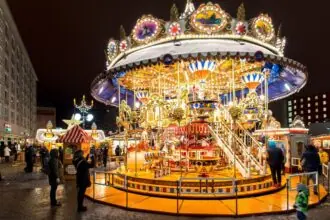
Between the two, Roncalli’s Weihnachtspromenade runs a circus-themed market directly along the Rhine, with vintage circus wagons and live acrobatic performances rather than standard stalls. The city’s own Lichterdom, a domed light structure spanning the Königsallee, illuminates the Kö from early November, well before the markets open.
That Lichterdom is a fairly recent addition, first lit above the Kö in 2016 and rebuilt every year since by a team of around 50 people working for weeks before opening. Standing up to 15 metres tall and strung with roughly 3,500 lights, it stays lit as a backdrop to the Winter Village and the wider avenue long after the market stalls below have gone dark for the night.
For the full seven markets, the Kö on Ice rink and the honest picture on New Year’s Eve fireworks restrictions, head to our Düsseldorf Christmas Markets guide.
Other German Christmas Markets Worth a Mention
The ten cities above are the ones with a full dedicated guide on this site, but they are far from the only German markets worth building a trip around. A handful of others have just as strong a claim to a place on anyone’s list, even without their own in-depth page here yet.
Rothenburg ob der Tauber’s Reiterlesmarkt trades scale for atmosphere, spreading just 61 stalls through a genuinely medieval walled old town rather than one large square. A rider on horseback opens the season each year before the mayor lights the town’s tree, and the half-timbered streets around the market stay lit long after the stalls themselves close for the night.
Aachen leans hard into its imperial history, staging its market in front of a cathedral that predates every other building in this comparison by centuries, on the site Charlemagne made the centre of his empire in the 8th century. The city’s own spiced gingerbread, Aachener Printen, is sold nowhere else in quite the same variety, and makes a genuinely different souvenir from the Lebkuchen sold further south in Nuremberg.
Heidelberg spreads its own market across six old town squares, but the real draw is the view rather than any single stall, since the ruined Heidelberg Castle sits floodlit on the hillside above the whole market every evening. Karlsplatz keeps an open-air ice rink running into January, directly beneath the illuminated castle, well after most of the other stalls covered in this guide have already packed away for the season.
Further south still, the market in the Ravenna Gorge takes a completely different approach from every city square covered above, since it isn’t built around a square at all. Wooden stalls sit in a wooded Black Forest ravine beneath a working railway viaduct that trains still cross while the market is open, and access runs through timed online tickets rather than an open square anyone can wander into. Our Ravenna Gorge Christmas Market guide covers the tickets, the shuttle buses and the illuminated viaduct in full.
Visiting a German Christmas Market: What Stays the Same
Most German Christmas markets follow a similar broad calendar, opening in the second half of November and running through to somewhere between 22 December and Christmas Eve, with only a handful, like Cologne’s harbour market, stretching into early January. Exact dates still vary city to city, so checking a market’s own official listing, or the German National Tourist Board’s own Christmas in Germany overview, is worth doing before booking travel.
Glühwein, hot mulled wine, is served almost everywhere in a ceramic or glass mug that carries a small refundable deposit on top of the drink’s own price of around €4 to €5 (£3.44 to £4.30/$4.68 to $5.85). Most visitors simply keep the mug as a souvenir rather than queueing to reclaim the deposit, since the design changes every season.
Sunday shopping is tightly restricted across Germany, and each state allows only a handful of verkaufsoffene Sonntage, confirmed Sunday trading days, each year, usually timed to coincide with the Christmas markets themselves. Outside those specific dates, shops stay closed on Sundays as standard, so a Sunday visit is better planned around the market stalls than a wider shopping trip.
December in Germany is genuinely cold, with daytime highs typically hovering between about 3°C and 7°C (37°F to 45°F) depending on the city and region, and evenings dropping close to freezing. A warm, waterproof coat, sturdy footwear and gloves matter more than a stylish outfit, since a market visit usually means standing outside on cobbled streets for long stretches.
How to Choose Which City Suits Your Trip
Anyone drawn to tradition and centuries of history should look first at Nuremberg or Dresden, since both markets can point to genuinely medieval roots and a single historic square that has hosted the market for generations. Munich’s own Christkindlmarkt actually predates both on paper, first recorded as a Nikolaimarkt in 1310, though its move to Marienplatz only in 1972 makes that history feel less continuous than Nuremberg’s or Dresden’s. Leipzig sits close behind them on age, with the added pull of a real link to Bach for anyone whose trip has a musical angle.
For sheer number of markets within one walkable city, Cologne and Düsseldorf are the strongest choices, though they suit different moods, Cologne’s seven markets share a broadly similar cathedral-city character, while Düsseldorf’s deliberately contrast a designer Winter Village against a raucous Old Town. Anyone who wants variety and scale over a single centrepiece should look at Berlin instead.
Stuttgart is worth prioritising for scale within one market rather than several, since its four connected squares and around 250 stalls make it one of the largest single Christmas markets in the country. Frankfurt and Hamburg both suit a shorter city-break trip, Frankfurt for its compact six-square old town, Hamburg for a genuine mix of markets shaped by its port setting.
Anyone on a tighter budget should note that nearly all ten markets are free to enter, Berlin’s Gendarmenmarkt is the lone exception, so cost differences between cities mostly come down to travel and accommodation rather than the market itself. First-time visitors torn between two similarly appealing cities might do best to simply pick whichever has the easier flight or train connection and treat the rest of this comparison as a bonus rather than a deciding factor.

Rupert’s Handy Travel Tips
Planning to compare Germany’s Christmas markets this winter? Here are a few useful tips to make choosing easier.
- Compare before you commit: each of these ten cities already has its own full guide on this site, so use this page to narrow things down before reading the detail.
- Don’t assume every market runs to Christmas Eve: Frankfurt and Leipzig both close a day or two earlier, while Dresden and Nuremberg run right through to 24 December.
- Keep your Glühwein mug: the small deposit is rarely worth queuing to reclaim, and the annual designs are genuinely collectible.
- Check Sunday dates before you travel: most German shops stay closed on Sundays outside a handful of confirmed verkaufsoffene Sonntage each year.
- Dress for genuine cold: December temperatures across Germany’s Christmas market cities regularly sit close to freezing by evening.
- Combine cities where the geography allows it: Cologne and Düsseldorf sit around 20 minutes apart by fast train, making a two-city weekend realistic.
- Visit on a weekday evening if you can: weekends get noticeably busier at every market on this page, so a Monday to Thursday evening trip usually means shorter food queues and calmer photos.
Want to meet the reindeer behind our travel tips? Find out more in our page Who is Rupert?.



Best if you would rather spend the money on Germany than on the room. Compare hostels by location and rating.
Search hostelsBest if you have ever given up on a claim. AirHelp checks whether the flight qualifies and pursues it for you.
See the benefitsBest if your room is not ready yet. Left luggage booked in advance, so you are not hunting for a locker.
Check storageFrequently Asked Questions About Germany’s Christmas Markets
Which is the oldest Christmas market in Germany?
Dresden’s Striezelmarkt, first documented in 1434, is widely regarded as Germany’s oldest continuously Christmas-focused market, though Munich’s own Christkindlmarkt points to an even earlier Nikolaimarkt record from 1310. Frankfurt and the town of Bautzen both have earlier general trading market records too, but those, like Munich’s, predate or sit outside the specifically Christmas-focused, continuously documented tradition that defines Dresden’s claim.
What is the difference between a Weihnachtsmarkt and a Christkindlesmarkt?
Weihnachtsmarkt is simply the generic German term for a Christmas market, while Christkindlesmarkt refers specifically to Nuremberg’s own market, named after the Christkind who opens it each year. Most other cities use Weihnachtsmarkt or a locally specific name, such as Dresden’s Striezelmarkt.
When do German Christmas markets open and close in 2026?
Most open in the second half of November and close somewhere between 22 December and Christmas Eve, though a handful, including Cologne’s harbour market, run into early January. Exact 2026 dates vary by city and are covered in full on each individual guide linked throughout this page.
Which German city has the most Christmas markets?
Berlin runs more than a hundred separate markets across its twelve districts each December, more than any other German city covered on this site. Cologne and Düsseldorf both run seven markets apiece within a single, more compact city centre.
Do German Christmas markets charge admission?
The great majority are free to enter, with visitors only paying for what they eat, drink or ride once inside. A small number of exceptions exist, such as Berlin’s WeihnachtsZauber at Gendarmenmarkt and the Historischer Weihnachtsmarkt at RAW-Gelände, both of which charge a modest entry fee.
What should I eat and drink at a German Christmas market?
Glühwein, hot mulled wine, is the standard drink almost everywhere, typically €4 to €5 (£3.44 to £4.30/$4.68 to $5.85) a mug. Regional specialities are worth seeking out too, from Nuremberg’s protected Lebkuchen and Rostbratwurst to Dresden’s Stollen and Frankfurt’s own Apfelwein.
Is there ice skating at German Christmas markets?
It depends entirely on the city, since several markets have no rink at all on their main square. Hamburg’s genuine rink sits at HafenCity rather than the Rathausmarkt, Dresden’s sits a short walk away at Winterlichter, and Berlin’s is at Potsdamer Platz rather than its more famous Gendarmenmarkt market.
Are German Christmas markets open on Sundays?
Yes, the markets themselves generally open on Sundays, though shops elsewhere in the same city usually do not. Germany’s Sunday trading laws keep most retail closed outside a handful of confirmed verkaufsoffene Sonntage each year, so the market stalls are often the only thing reliably open on a Sunday.
Which German Christmas market is best for families?
Nuremberg’s Kinderweihnacht and Düsseldorf’s smaller markets are both built with younger visitors in mind, with gentle rides and a calmer atmosphere than each city’s main square. Stuttgart’s Children’s Fairyland on Schlossplatz and Leipzig’s fairytale forest on Augustusplatz offer a similar family-first alternative within a bigger market.
Can I combine more than one German city’s Christmas markets on a single trip?
Yes, and several pairings make genuine sense given how close the cities sit to each other. Cologne and Düsseldorf are around 20 minutes apart by fast train, and Dresden and Leipzig both sit within Saxony, making either pairing realistic for a single longer trip.
Further Reading
Each of the ten cities covered above has its own full Christmas market guide on this site, and they are worth reading in full once a shortlist narrows down. Our Berlin Christmas Markets guide, Munich Christmas Markets guide, Nuremberg’s Christmas Market guide and Dresden Christmas Market guide are a sensible place to start if tradition and scale are the priority.
For the Rhineland’s own take on the season, our Cologne Christmas Markets guide and Düsseldorf Christmas Markets guide cover two genuinely different cities worth comparing directly. Our Stuttgart Christmas Market guide, Frankfurt Christmas Market guide, Hamburg Christmas Markets guide and Leipzig Christmas Market guide round out the rest of the country’s biggest markets.
A Christmas market trip is also a good excuse to see the rest of a city, and our Things to Do in Berlin guide and Best Things to Do in Cologne guide cover the sights worth building into a longer stay beyond the stalls themselves. For dates, cities and trips across the wider continent, our European Christmas Markets guide is a useful starting point too.