Reviewed by our editorial team Published
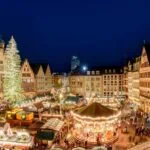
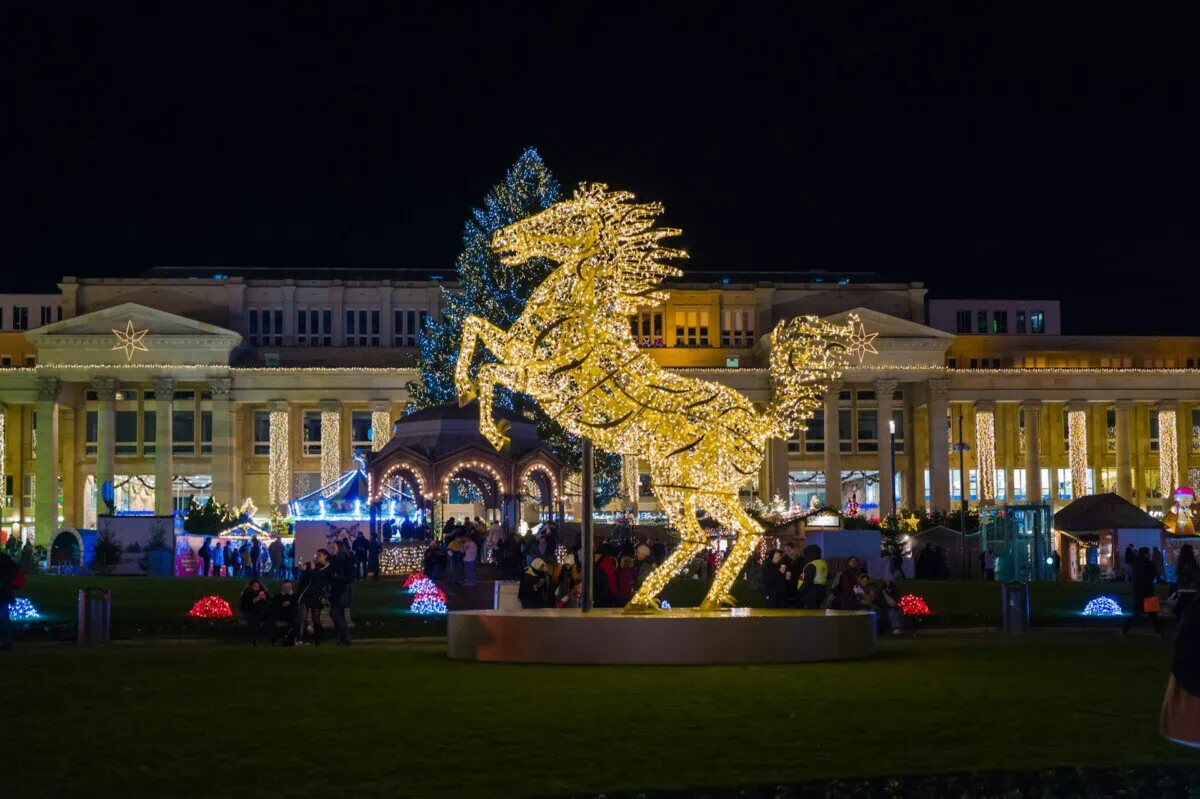
Every winter, Stuttgart’s Schlossplatz and Marktplatz fill with around 250 wooden stalls for the Stuttgarter Weihnachtsmarkt, one of Germany’s oldest and largest Christmas markets. It is officially documented as an established “traditional Stuttgart event” as far back as 1692, though a market privilege granted by Duke Ulrich of Württemberg can be traced to 1507, and today it draws between 3.5 and 4 million visitors across its four-week run.
Unlike some German markets confined to a single square, Stuttgart’s spreads across four central locations, Schlossplatz, Marktplatz, Schillerplatz and Karlsplatz, connected by pedestrianised streets running off Königstraße. The market covers roughly 4,200 square metres of the old town, and that scale is a large part of why locals describe it as one of the most beautiful Christmas markets in Europe.
What sets Stuttgart apart from many other German markets is not just its size but its detail. The stalls’ elaborately decorated roofs, judged informally each year in a “most beautiful stall” recognition, have become as much a draw as the Glühwein and Maultaschen sold beneath them.
This guide covers that history in more depth, the confirmed 2026 dates and hours, what fills each of the market’s four squares, the roller-skating rink that actually shares Schlossplatz with the stalls, the separate light trail at the Wilhelma, Sunday trading rules under Baden-Württemberg law, and how the city sees in the new year once the market has closed.
A Market Rooted in Württemberg’s Trading History
The Stuttgarter Weihnachtsmarkt’s exact starting point is debated in much the same way as several other German markets’ origins. A market privilege dates back to 1507, when Duke Ulrich of Württemberg granted Stuttgart the right to collect stall fees at its annual fairs, and the market itself is officially documented as an established “traditional Stuttgart event” from 1692.
In its earliest form the market was not a festive occasion at all but a general annual fair, originally tied to a horse market held around St Ottmar’s Day in mid-November. Over the following centuries the fair gradually shifted later into the calendar and narrowed its focus toward Christmas, evolving into what was once known locally as the Christkindleinmarkt.
That slow evolution from trading fair to Christmas market mirrors the pattern seen at several of Germany’s oldest markets, where a medieval trading privilege only later took on a specifically festive character. Stuttgart’s own tourism board now markets the event as one of the oldest and most tradition-rich Christmas markets anywhere in Europe.
Today the market employs around 1,500 people directly and indirectly across its four-week run, and organisers report receiving roughly 1,500 stallholder applications each year for a fraction of that many pitches. That level of demand is one of the clearer signs of how established the market has become within Stuttgart’s own civic calendar.
2026 Opening Dates and Hours
For the 2026 season, the Stuttgarter Weihnachtsmarkt is scheduled to run from 25 November to 23 December 2026. That gives it a slightly longer season than some other German markets, though like Frankfurt and Leipzig it closes ahead of Christmas Eve rather than running through it.
Standard opening hours across the market’s four squares run from around 10am to 9pm on most days, opening slightly later at 11am on Sundays. Individual stalls, particularly food and drink vendors, sometimes stay open later on Friday and Saturday evenings, so this pattern is worth treating as a reliable guide rather than a fixed rule.
| Date / Day Type | Hours |
|---|---|
| Opening date, 25 November 2026 | Market opens for the season |
| Monday to Saturday | Around 10am to 9pm |
| Sunday | Around 11am to 9pm |
| Closing date, 23 December 2026 | Market closes for the season |
Entry to the Stuttgarter Weihnachtsmarkt is free, as with every German Christmas market covered on this site, and visitors only pay for what they actually eat, drink or ride. There is no ticket or gate to pass through at any of the four squares.
For the most accurate, year-specific information, it is always worth checking the official Stuttgarter Weihnachtsmarkt website before booking travel, since exact hours and any last-minute changes are published there each autumn. That evergreen caveat applies to every German Christmas market guide on this site, simply because official schedules this far ahead can shift slightly as the city finalises its winter programme.
Best for two or three nights. The widest choice of rooms, with filters for free cancellation and included breakfast.
View staysBest for longer stays. Whole apartments and houses, so you are not eating out three times a day.
View rentalsBest as a last check before booking. Compares hotel rates across several sites in one search.
Compare ratesSchlossplatz, Marktplatz and the Market’s Other Squares
The market’s largest single space is Schlossplatz, the sweeping square in front of the Neues Schloss, where a Ferris wheel, a children’s fairyland and a miniature railway sit alongside the wooden stalls. It is also where Wintertraum, the separate roller-skating attraction covered later in this guide, sets up for the winter.
A short walk away, Marktplatz sits in front of Stuttgart’s Rathaus (town hall) and hosts the market’s main concert stage alongside a run of stalls selling handmade decorations, toys and festive food. The Rathaus itself is dressed with an advent-calendar-style window display through December, a small but genuinely charming detail that is easy to miss if you are not looking up.
Schillerplatz, tucked beside the Altes Schloss (Old Castle) and its Renaissance inner courtyard, has a noticeably calmer atmosphere than Schlossplatz or Marktplatz, with covered seating built around several of its food stalls. Karlsplatz, the fourth of the market’s locations, hosts a dedicated Finnish winter market and a collectors’ fair, giving it a genuinely distinct character from the other three squares.
Across all four locations, the market fields around 250 stalls spread over roughly 4,200 square metres of the old town. Because the squares are connected by short, pedestrianised streets running off Königstraße, walking the full loop between all four is genuinely manageable in a single afternoon.
| Square | What’s There | Atmosphere |
|---|---|---|
| Schlossplatz | Ferris wheel, Children’s Fairyland, miniature railway, Wintertraum roller rink | Largest and busiest of the four |
| Marktplatz | Rathaus concert stage, advent-calendar window display, handmade decorations and toys | Central and lively, in front of the town hall |
| Schillerplatz | Altes Schloss courtyard concerts, covered seating, food stalls | The calmest of the four squares |
| Karlsplatz | Finnish winter market (Glögi), collectors’ and antiques fair | The most distinct in character, with a Nordic feel |
The Market’s Decorated Stall Roofs
What genuinely distinguishes Stuttgart’s market from most other German Christmas markets is not only its scale but the craftsmanship above the stalls themselves. Many of the market’s wooden huts carry elaborately decorated roofs, built up each year with fairy lights, miniature winter landscapes, sleigh scenes and carved figures rather than plain canopies.
The market’s own organisers describe the roofs as “true works of art” and one of the event’s biggest visual draws, and an informal “most beautiful stall” recognition has grown up around the tradition. Visitors genuinely look upward as much as they browse the counters, since a stall’s roof is often more elaborate than anything sold beneath it.
The tradition rewards a slower walk through the market rather than a quick pass through the busiest stretches near Schlossplatz. Early evening, once the lights are lit but before the heaviest crowds arrive, tends to be the best time to appreciate the roofs properly.
Because the decoration varies noticeably from stall to stall, first-time visitors are usually better off wandering all four squares rather than assuming the best examples sit in one particular spot. Marktplatz and Schillerplatz, both slightly quieter than Schlossplatz, are worth a careful look for exactly this reason.
Food and Drink: Maultaschen, Flammkuchen and Glögi
Food at Stuttgart’s market leans heavily on Swabian regional cooking rather than only the standard German Christmas market staples. Maultaschen, the region’s own oversized ravioli-style dumpling usually filled with meat and bread, are sold across several stalls in a handheld version designed to eat straight from the wrapper without cutlery.
Flammkuchen, a thin, Alsatian-style flatbread topped with cream, bacon and onion, is another regular sight, typically served on wooden boards large enough to share. Zimtsterne, star-shaped cinnamon biscuits, and Lebkuchenherz gingerbread hearts round out the sweeter side of the market’s food stalls.
A mug of Glühwein across most of the market’s stalls typically costs around €4 to €5 (£3.44 to £4.30/$4.68 to $5.85), broadly in line with other German markets, usually with a small refundable deposit for the mug itself. At the dedicated Finnish winter market on Karlsplatz, stalls instead pour Glögi, the Nordic spiced wine variant, giving visitors a genuinely different option from standard German mulled wine.
Many visitors simply keep their mug as a souvenir each year rather than queueing to reclaim the small deposit, since the design changes every season. Sampling across two or three stalls in different squares is worth doing here, since the food and drink on offer shifts noticeably between Schlossplatz’s main stalls and Karlsplatz’s Nordic corner.
Wintertraum: Roller Skating on Schlossplatz
Stuttgart’s market shares Schlossplatz with Wintertraum, a separate seasonal attraction built around an outdoor roller-skating rink rather than the ice rinks found at some other German markets. For the 2026 to 2027 season, Wintertraum is scheduled to run from 18 November 2026 to 6 January 2027, which means it actually opens before the Weihnachtsmarkt and stays open for two weeks after the market closes.
Because Wintertraum runs on wheels rather than blades, it suits visitors who have never skated before, and skate hire is included in the admission price rather than charged separately. In recent seasons, admission with skate hire has cost around €15 (£12.90/$17.55) for adults and around €10 (£8.60/$11.70) for children aged six to twelve, with a cheaper rate for under-sixes and seniors.
The rink typically opens daily from around 11am, with last entry roughly ninety minutes before closing each evening. Visitors bringing their own skates usually pay only the standard admission fee, and non-skating companions can generally enter for a small separate charge to sit and watch.
Because Wintertraum’s own season overlaps with the Weihnachtsmarkt for most of December, it is one of the few German Christmas markets where a winter rink genuinely runs alongside the stalls rather than opening only once they have packed up. It is worth checking the current season’s exact prices and hours on Wintertraum’s own website before building a visit specifically around it.
Children’s Fairyland: Rides and Activities on Schlossplatz
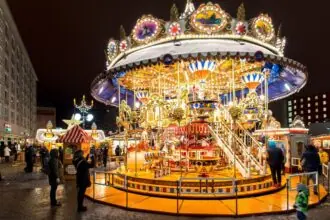
Schlossplatz’s Ferris wheel and miniature railway sit inside a dedicated Children’s Fairyland, a themed corner of the square built specifically for younger visitors rather than folded into the main run of stalls. A nostalgic children’s carousel joins the miniature train and mini Ferris wheel as the area’s main rides, giving families several options within a few steps of each other.
Beyond the rides, the Fairyland runs a hands-on gingerbread heart decorating activity, where children can pipe icing and add sprinkles to a Lebkuchenherz before taking it home. It is a simple, low-cost way to give younger visitors something to do beyond watching the lights and queuing for rides.
Because the Fairyland sits on Schlossplatz itself, it is easy to combine with the square’s Ferris wheel and the wider market stalls without needing to detour to a separate part of the old town. Families splitting time between the rides and the main Weihnachtsmarkt stalls generally find the whole area manageable within an hour or two.
The attractions broadly follow the market’s own opening hours, though individual ride operators can vary slightly from the standard pattern of around 10am to 9pm. Checking conditions on a specific visit day is worth doing if a particular ride is the main reason for the trip.
Tower Music at the Stiftskirche
Stuttgart’s own answer to the balcony carol traditions found at some other German markets comes from the Stiftskirche, the city’s central collegiate church a short walk from Marktplatz. Tower musicians, usually a trombone choir drawn from Stuttgart and the surrounding region, climb 232 steps to the roughly 60-metre-high west tower to play Advent and Christmas music live over the market below.
During the Weihnachtsmarkt itself, performances typically take place every evening from Friday to Sunday across the market’s weekends. Outside the Christmas season, the tradition runs on a much older pattern, with tower blowing recorded at the Stiftskirche since 1618 on regular Tuesday and Thursday market mornings.
Beyond the tower musicians, the Stiftskirche and its resident Stiftsmusik ensemble run a separate programme of Advent concerts and organ recitals through December, generally requiring a ticket rather than being a free, walk-up event like the tower performances. Checking the church’s own published concert calendar closer to a visit is worth doing if a specific date or programme matters to the trip.
Because the tower performances happen outdoors and are audible across a wide stretch of the market, no ticket or advance planning is needed to catch them, only reasonable timing. Arriving on Marktplatz or Schillerplatz in the early evening on a market weekend gives the best chance of hearing the trombones without needing to look up a schedule first.
Best if you can move a day either way. Shows how the fare changes across the month.
Compare flightsBest for short trips. Install the eSIM at home and arrive with working data, no shop queue.
Browse eSIMsBest if you would rather not work out the transport on arrival. Book it now and forget it.
View transfersFree Concerts in the Altes Schloss Courtyard
Beyond the tower musicians at the Stiftskirche, Stuttgart’s market runs a second, free concert programme inside the Renaissance inner courtyard of the Altes Schloss on Schillerplatz. Regional choirs and music groups from Stuttgart and the surrounding area perform there through the season, adding to the market’s Advent atmosphere without requiring a ticket.
The setting is part of the appeal, since the courtyard’s covered arcades and stone galleries wrap around performers in a way the open squares nearby cannot match. Visitors already browsing Schillerplatz’s quieter stalls can simply step inside rather than planning a separate outing.
Unlike the Stiftskirche’s dedicated Advent concert series, which generally needs a paid ticket, the Altes Schloss courtyard performances are free to attend and open to anyone passing through. That makes the courtyard one of the few places at the market where a full live performance costs nothing beyond the walk to Schillerplatz.
Exact performance dates and times vary through the season and are published closer to the event, so checking the market’s official concerts listing is worth doing before planning around a specific evening. Pairing an early evening at the courtyard with the Stiftskirche’s tower music on the same weekend is an easy way to catch both without much extra walking.
Christmas Garden at the Wilhelma
For a genuinely different festive experience away from the market’s stalls, Christmas Garden Stuttgart runs each winter at the Wilhelma, the city’s combined zoological and botanical garden a short tram ride from the old town. It is a ticketed, after-dark walking trail built around large-scale light installations and music rather than a Christmas market in its own right.
For the 2026 to 2027 season, Christmas Garden Stuttgart is scheduled to run from 18 November 2026 to 16 January 2027, giving it a considerably longer season than the Weihnachtsmarkt itself. Because it operates on a timed-entry basis with a capped number of visitors per slot, it tends to feel noticeably calmer than the crowded stalls in the old town.
Pricing varies by date, with cheaper family-focused sessions offered on selected dates through the season. One such family day rate for the 2026 to 2027 run was priced at around €41.90 (£36.03/$49.02) per ticket, though standard admission on other dates is priced separately and is worth checking directly on the event’s own website before booking.
Because Christmas Garden sits at the Wilhelma rather than in the old town, it needs a short separate journey by tram or bus rather than being something to fold into a walk between the market’s four squares. Treating it as its own evening out, rather than an add-on to a market visit, is the more realistic way to plan around it.
Christmas Shopping and Sunday Trading Rules
Beyond the market’s own stalls, Stuttgart’s main shopping street, Königstraße, runs directly from the Hauptbahnhof toward Schlossplatz and is lined with department stores, high street chains and independent boutiques. It is easy to combine with a market visit, since it forms the natural walking route between the station and the stalls.
Standard shop hours in Baden-Württemberg are governed by the state’s own shop opening law, which keeps most retail closed on Sundays as a matter of course. Regular weekday and Saturday trading hours in central Stuttgart typically run from around 10am to 8pm, with some flagship stores on Königstraße staying open slightly later.
Baden-Württemberg law does allow local councils to permit a limited number of verkaufsoffene Sonntage (Sunday shop openings) across the year, usually tied to a specific event or a particular city district. Stuttgart’s city council publishes a full list of these confirmed dates annually, spread across different districts rather than concentrated purely on the Christmas market season.
As of research for this guide, a specific verkaufsoffener Sonntag for Stuttgart’s city centre during the 2026 Weihnachtsmarkt season had not yet been confirmed on the city’s own published listings. Rather than guess at a date this far ahead, it is worth checking Stuttgart’s official Sundays-open listings or the local retail association’s own announcements closer to a planned visit, since outside a confirmed date the city’s shops, unlike the market stalls themselves, stay closed on Sundays as standard.

New Year’s Eve in Stuttgart
Stuttgart’s Christmas market closes on 23 December, well ahead of the new year, so Silvester in the city runs as a genuinely separate occasion built around private celebrations rather than one official market-linked event. Rather than a single centrepiece show, recent years have seen the city’s New Year’s Eve activity spread across private parties, restaurant dinners and informal street gatherings rather than an organised Schlossplatz countdown.
Private fireworks remain a major part of how Stuttgart sees in the new year, legal nationally between 6pm on 31 December and 7am on 1 January. In recent seasons the city has restricted higher-category fireworks within a defined city-ring zone around the centre, with fines reported to run as high as €200 to €5,000 (£172 to £4,300/$234 to $5,850) for setting off banned fireworks inside that restricted area.
Smaller items such as sparklers, firecrackers and spinning tops generally remain permitted even within the restricted zone, so the ban tends to affect larger rockets rather than the smaller, more common fireworks. Fireworks are typically only available to buy in shops for a few days immediately before New Year’s Eve, in line with the same national rules that apply across Germany.
For visitors staying through the new year, checking the city’s current-year guidance on any restricted zones is worth doing before bringing or buying fireworks, since the exact boundaries and penalties are reviewed and republished each winter. Riverside and elevated spots slightly outside the immediate centre tend to offer a good, informal view of the wider fireworks display without needing a ticket to anything.
Getting to and Around the Stuttgart Christmas Market
Stuttgart’s old town is compact, and the market’s four squares sit within easy walking distance of the city’s main transport hub. Stuttgart Hauptbahnhof is only a short walk from Schlossplatz along Königstraße, the pedestrianised street that also doubles as the city’s main shopping strip.
The nearest Stadtbahn (light rail) and S-Bahn stops sit right around the market’s footprint, with Schlossplatz, Rathaus and Charlottenplatz all within a few minutes’ walk of one of the four squares. For most visitors staying centrally, walking between locations is genuinely simpler than working out individual tram routes for such short distances.
Travellers flying into Stuttgart Airport (STR) can reach the Hauptbahnhof on the S2 or S3 S-Bahn lines, which run roughly every 15 minutes and take around 25 to 30 minutes for the full journey into the city centre. From there, Schlossplatz and the rest of the market are within the short walk described above, so no further transfer is generally needed.
Because the old town streets around the market are largely closed to general traffic during the season, driving directly to any of the four squares is not practical. December is also a genuinely busy period for accommodation in Stuttgart, given the market’s scale and its draw from across the wider region, so booking well in advance is worth doing rather than leaving it until closer to the date.
A Market Powered by Green Electricity
Since 2014, the Stuttgarter Weihnachtsmarkt has run entirely on green electricity supplied by Stadtwerke Stuttgart, the city’s own municipal utility. That covers everything from the stalls’ fairy lights to the rides on Schlossplatz, rather than being a partial or symbolic gesture.
Organisers describe the market’s energy use as producing zero CO2 emissions as a direct result of that switch, a detail that sets it apart from markets still running on standard grid power. It is one of the less visible ways Stuttgart’s market differs from some of its German counterparts, since it does not show up in photographs of the stalls themselves.
The market’s reusable mug system for Glühwein and Glögi, covered earlier in this guide, works alongside the green electricity supply as part of the same broader effort to reduce the event’s environmental footprint. A small deposit on every mug encourages stallholders and visitors to keep glassware in circulation rather than switching to disposable cups.
None of this is heavily promoted at the market itself, and most visitors are unlikely to notice it while wandering between Schlossplatz and Karlsplatz. It is nonetheless one of the longer-running sustainability commitments among Germany’s major Christmas markets, having been in place for more than a decade by the 2026 season.
Best for short city stops where being central matters more than the room. Dorms and private rooms both listed.
See hostelsBest if you have ever given up on a claim. AirHelp checks whether the flight qualifies and pursues it for you.
See the benefitsBest for the gap between checking out and your train. Drop bags at a shop or hotel nearby and carry on.
Store your bagsBeyond the Christmas Market
Everything above covers what fills Stuttgart’s four Christmas market squares each December, but the city has plenty going on that has nothing to do with Advent at all. Its motor museums, its position at the foot of vineyard-covered hills and its lively student and music scene are easy to overlook if a visit is planned purely around Glühwein and stalls.
For everything else worth prioritising beyond the market’s own seasonal content, our complete Things to Do in Stuttgart guide rounds up the sights, museums and neighbourhoods that make the city worth visiting whatever the season. It is worth a look before finalising an itinerary if a Stuttgart trip stretches beyond a single day at the market.

Rupert’s Handy Travel Tips
Planning a trip to Stuttgart’s Weihnachtsmarkt this winter? Here are a few useful tips to make your visit smoother.
- Walk all four squares, not just Schlossplatz: Marktplatz and Schillerplatz are both quieter and reward a slower look at the decorated stall roofs.
- Look up at the stall roofs: the market’s informal “most beautiful stall” tradition means some of the best craftsmanship is above the counters, not on them.
- Try the Glögi at Karlsplatz: the Finnish winter market pours Nordic spiced wine rather than standard Glühwein, a genuinely different option worth seeking out.
- Wintertraum is roller skating, not ice: its wheeled rink on Schlossplatz actually overlaps with the Weihnachtsmarkt for most of December, unlike ice rinks at some other German markets.
- Book Christmas Garden separately: the Wilhelma’s light trail needs its own ticket and a short tram ride, so treat it as a separate evening rather than an add-on.
- Take the S2 or S3 from the airport: both reach the Hauptbahnhof in around 25 to 30 minutes, a short walk from Schlossplatz.
- Book accommodation early: hotels near the old town fill up quickly given the market’s scale and its pull from across the wider region.
- Don’t expect Sunday shopping without checking first: Baden-Württemberg’s Sunday closing law applies as standard outside a confirmed verkaufsoffener Sonntag.
Want to meet the reindeer behind our travel tips? Find out more in our page Who is Rupert?.



Frequently Asked Questions About Stuttgart’s Christmas Market
When does Stuttgart’s Christmas market open in 2026?
The Stuttgarter Weihnachtsmarkt is scheduled to run from 25 November to 23 December 2026, with hours of around 10am to 9pm on most days and 11am to 9pm on Sundays.
How old is Stuttgart’s Christmas market?
It is officially documented as an established “traditional Stuttgart event” from 1692, with a market privilege granted by Duke Ulrich of Württemberg traced back to 1507, putting it among Germany’s oldest markets.
Where is the Stuttgart Christmas market held?
The market spans four locations in the old town: Schlossplatz, Marktplatz, Schillerplatz and Karlsplatz, each connected by pedestrianised streets and each with its own distinct character.
Is the Stuttgart Christmas market free to enter?
Yes. There is no ticket or gate for any of the four squares, and visitors only pay for what they eat, drink or ride once inside.
What makes Stuttgart’s market different from other German Christmas markets?
Its elaborately decorated stall roofs, built up each year with lights, miniature scenes and carved figures, are a genuine visual draw judged informally in a “most beautiful stall” recognition.
What should I eat and drink at the market?
Try handheld Maultaschen and shareable Flammkuchen alongside standard Glühwein, and look out for Glögi, the Nordic spiced wine poured at the Finnish winter market on Karlsplatz.
Is there ice skating at the Stuttgart Christmas market?
Not ice skating, but Wintertraum, a separate roller-skating rink on Schlossplatz, runs from 18 November 2026 to 6 January 2027, overlapping with most of the Weihnachtsmarkt itself.
Is there anything for children at the market?
Yes. Schlossplatz hosts a children’s fairyland, a miniature railway and a Ferris wheel, alongside the town hall’s advent-calendar-style window display on Marktplatz.
Can I hear live music at the market?
Yes. Trombone tower musicians play from the Stiftskirche’s west tower every evening from Friday to Sunday during the market’s weekends, and the church runs a separate ticketed concert programme through December.
Is there a separate Christmas light show in Stuttgart?
Yes. Christmas Garden Stuttgart, a ticketed after-dark light trail at the Wilhelma, runs from 18 November 2026 to 16 January 2027, entirely separate from the Weihnachtsmarkt itself.
Are shops open on Sundays during the Christmas market?
Generally no, since Baden-Württemberg law keeps shops closed on Sundays outside a small number of confirmed verkaufsoffene Sonntage, none of which had been confirmed for the city centre’s 2026 market season at the time of writing.
Does Stuttgart have a New Year’s Eve celebration?
There is no single official market-linked event. Silvester in Stuttgart is spread across private parties and informal street gatherings, with higher-category fireworks restricted within a defined city-ring zone in recent years.
How do I get to the market without a car?
Stuttgart Hauptbahnhof is a short walk from Schlossplatz along Königstraße, and the S2 or S3 S-Bahn reaches the Hauptbahnhof from Stuttgart Airport in around 25 to 30 minutes.
Further Reading
Landing in Baden-Württemberg before the market opens? Our Stuttgart Airport Transfers guide covers every realistic way of reaching the city centre from STR, while our Things to Do in Stuttgart guide rounds up the sights worth prioritising beyond the market itself.
Comparing Stuttgart against Germany’s other major markets is also worth doing before committing to a single-city trip. Our Nuremberg’s Christmas Market guide covers the Christkindlesmarkt’s own centuries of history, our Dresden Christmas Market guide covers the Striezelmarkt’s giant Erzgebirge pyramid and Stollenfest parade, and our Frankfurt Christmas Market guide covers a market spread across six squares with its own six-century-old history.
Further north, our Leipzig Christmas Market guide covers a market spread across seven old town locations, with its own Erzgebirge pyramid, fairytale forest and Bach-linked choral tradition. Our Berlin Christmas Markets guide covers the capital’s Gendarmenmarkt WeihnachtsZauber and Charlottenburg Palace market, while our Hamburg Christmas Markets guide covers the historic Rathausmarkt and Jungfernstieg’s Weißer Zauber. Our Germany’s Christmas Markets Compared guide pulls all nine of the country’s biggest markets together side by side.