Reviewed by our editorial team Published
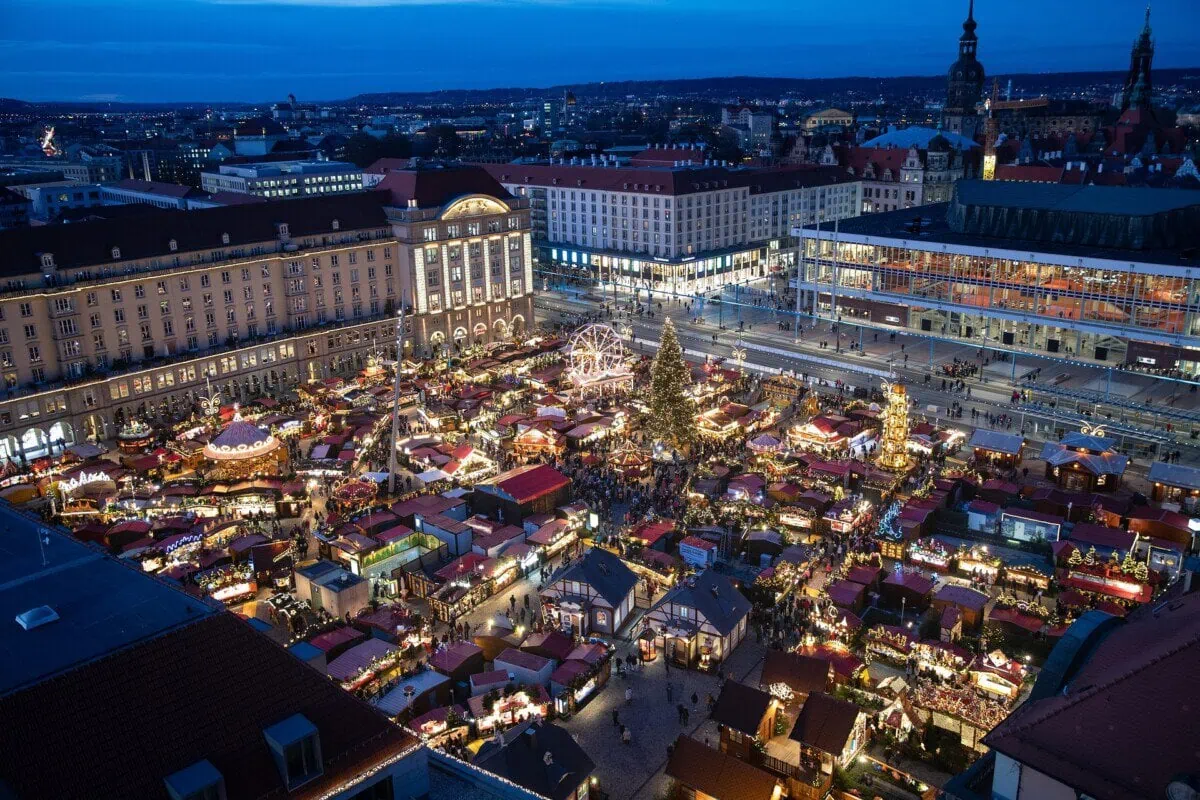
Every winter, Dresden’s Altmarkt square fills with wooden stalls for the Striezelmarkt, first documented in 1434 under Friedrich II, Elector of Saxony. That written record, a formal permission for a one-day meat market held the Monday before Christmas, makes it one of the oldest continuously referenced Christmas markets anywhere in the German-speaking world.
The market’s “oldest in Germany” reputation is worth stating carefully rather than simply repeating. Frankfurt’s own market can point to trading stalls recorded on the Römerberg as early as 1393, and the smaller Saxon town of Bautzen cites an even earlier market record from 1384.
What sets Dresden apart is not being first overall, but being first specifically as a Christmas-season market rather than a general trading fair that only later took on festive character. The 1434 permission was explicitly granted for the run-up to Christmas, which is why Dresden’s own tourist board and most historians describe the Striezelmarkt as Germany’s oldest genuine Christmas market rather than its oldest market of any kind.
The name itself comes from Striezel, an old Saxon word for the region’s dense, fruit-studded Christmas loaf, now known worldwide as Dresdner Stollen. That link between the market’s name and its most famous export has held for nearly six centuries, and it still shapes what visitors come here to buy.
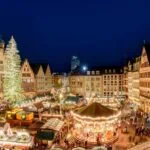
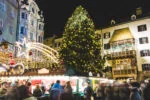
Today the market has grown from a single day of meat stalls into a sprawling, month-long event with more than 200 traders and a genuine claim to being one of the largest Christmas markets in Germany. A towering Erzgebirge pyramid, a giant lit Christmas arch and an annual parade built around a colossal stollen cake have all become as central to a Striezelmarkt visit as the stalls themselves.
This guide covers that history in more depth, the confirmed 2026 opening dates and hours, and what actually fills the Altmarkt each December, before moving into the Stollenfest parade and the Dresdner Christstollen tradition behind it. It also covers where to find genuine ice skating away from the market stalls, the city’s carol singing and church concert tradition centred on the Frauenkirche and the Dresdner Kreuzchor, Christmas shopping and Saxony’s Sunday trading rules, New Year’s Eve on the Elbe, the city’s other festive markets, and how to get there.
A Market With Roots in Medieval Saxony
The Striezelmarkt’s founding is dated to 1434, when Friedrich II, Elector of Saxony, granted the city permission to hold a single-day meat market on the Altmarkt the Monday before Christmas. It was a genuinely practical event rather than a festive attraction, letting Dresden’s residents stock up on meat after weeks of Advent fasting rather than giving them somewhere to browse for gifts.
Over the following centuries, that one-day meat market gradually grew into a longer event selling toys, sweets and decorations alongside the original butchers’ stalls. By the 18th century, under August the Strong, the market had already become closely associated with the fruit bread that gave it its name, Striezel, and with the elaborate court celebrations that would later inspire the modern Stollenfest.
Like most German markets, the Striezelmarkt was disrupted through the Second World War, and Dresden’s own devastating firebombing in February 1945 destroyed much of the Altmarkt and the old town around it. The market returned to the rebuilt square in the postwar decades and has run there every December since, gradually expanding from a modest postwar event into the scale it operates at today.
Traditional Erzgebirge craftspeople, from the Ore Mountains region south of Dresden, have long been part of the market’s identity, bringing carved nutcrackers, incense smokers and wooden pyramids that are as much a Saxon export as the stollen itself. That craft heritage, now recognised by UNESCO as part of the Ore Mountains’ mining and metalworking tradition, is still visible across the stalls today.
Whichever way the “oldest” debate is settled, Dresden’s own tourist authorities and most independent historians treat 1434 as the market’s genuine founding date, rather than a marketing flourish. That nearly six-hundred-year run is a large part of why the Striezelmarkt draws visitors from across Europe rather than remaining a purely local event.
2026 Opening Dates and Hours
For the 2026 season, the Striezelmarkt is scheduled to run from 25 November to 24 December 2026, giving it a genuinely long run compared with some other German markets that close well before Christmas Eve. That makes it one of the more forgiving markets to plan a late-December visit around.
Standard opening hours run from 10am to 9pm daily across most of the season, with two exceptions either end of the run. The market opens later on its first day and closes earlier on Christmas Eve itself, both worth building into a travel plan rather than assuming the usual hours apply throughout.
These are the most specific times published so far for the 2026 season, based on the pattern the market has followed in recent years. As with other German Christmas markets, individual stalls occasionally adjust their own hours slightly, so this should be treated as a reliable pattern rather than a guaranteed schedule.
The table below sets out the confirmed 2026 pattern based on the most recent official listings available at the time of writing.
| Date / Day Type | Hours |
|---|---|
| Opening date, 25 November 2026 | 4pm to 9pm |
| 26 November to 23 December | 10am to 9pm daily |
| Christmas Eve, 24 December 2026 | 10am to 2pm, market closes for the season |
Because the Striezelmarkt runs all the way to Christmas Eve, it suits travellers combining the market with a Christmas trip far better than markets that close a week or more beforehand. It does not, however, reopen for New Year, so anyone hoping to see the stalls again after Christmas should plan around the 24 December closing date rather than assuming they will still be there.
For the most accurate, year-specific information, it is always worth checking the official Striezelmarkt website before booking travel, since exact hours and any last-minute changes are published there each autumn. That evergreen caveat applies to every German Christmas market guide on this site, simply because official dates for markets this far ahead can shift slightly as the city finalises its winter programme.
Best for two or three nights. The widest choice of rooms, with filters for free cancellation and included breakfast.
View staysBest for families, or any stay past about four nights. A kitchen and a washing machine start paying for themselves.
Browse rentalsBest for double-checking. Runs the same search across several booking sites so you are not leaving money behind.
Compare pricesThe Pyramid, the Stalls and Erzgebirge Crafts
The Striezelmarkt’s single most recognisable feature is its giant Christmas pyramid, a tiered wooden structure with a fan-bladed top that spins from the rising heat of its own candles. Standing at 14.61 metres (48 feet), it is billed as the world’s largest Erzgebirge step pyramid, and it anchors the Altmarkt as firmly as the market’s stalls do.
Alongside the pyramid stands a similarly outsized Schwibbogen, a traditional Erzgebirge candle arch, billed as the world’s largest usable example at around 13.5 metres wide and more than five metres tall. A twenty-metre spruce tree completes the square’s centrepiece trio, lit each evening once the stalls open.
More than 200 stalls fill the rest of the Altmarkt, some seasons pushing closer to 240, selling everything from handmade decorations to toys, candles and festive food. A dedicated wooden fairy-tale Advent calendar gives families a reason to return to the square daily rather than visiting only once during a longer trip.
The market’s craft stalls lean heavily on the Erzgebirge, the Ore Mountains region south of Dresden that has produced traditional wooden Christmas decorations for centuries. Carved nutcrackers, incense-smoking Räuchermänner figures, miniature pyramids and candle arches like the one anchoring the Altmarkt are all genuine regional crafts rather than imported souvenirs.
That regional craft tradition earned UNESCO recognition in 2019 as part of the Ore Mountains’ mining and metalworking heritage, a status that reflects centuries of skilled woodworking passed down through Erzgebirge families. Buying a hand-carved piece at the Striezelmarkt is, in that sense, a genuinely traceable connection to the region rather than a generic market purchase.
Because the Altmarkt is a large, open square rather than a cramped medieval lane, the market feels noticeably less claustrophobic than some smaller German markets even at its busiest. That extra space is worth knowing about for anyone who has found other German Christmas markets overwhelming on a previous trip.
A mug of Glühwein at the Striezelmarkt typically costs around €4 to €5 (£3.44-4.30/$4.68-5.85), in line with the rest of Germany’s markets, usually with a small refundable deposit for the mug itself. Many visitors simply keep the mug as a souvenir rather than queueing to reclaim the deposit, since each season brings its own new design.
Stollenfest and the Dresdner Christstollen Tradition
Dresdner Christstollen is the market’s true namesake, a dense, fruit-studded loaf dusted in icing sugar and wrapped around a core of marzipan or nuts. Only stollen baked to a defined recipe within Dresden’s own district can legally use the protected name, a status overseen by the Schutzverband Dresdner Stollen, the bakers’ association that safeguards the tradition.
Genuine Dresdner Christstollen carries its own Stollensiegel, a wax seal depicting King August the Strong, which distinguishes association-certified loaves from cheaper imitations sold elsewhere. It is one of the more practical, well-travelling souvenirs available at the market, similar in spirit to the protected gingerbread sold at Nuremberg’s own Christkindlesmarkt.
A modest-sized certified stollen typically costs from around €10 to €15 (£8.60-12.90/$11.70-17.55) at the market’s dedicated stollen stalls, with larger or more elaborately packaged loaves priced higher. Buying directly from a stall carrying the association’s own signage is the simplest way to be sure of getting the genuine, protected version.
The market’s biggest single event, Stollenfest, celebrates that tradition every year on the Saturday before the second Sunday of Advent. The 2026 edition falls on 5 December and marks the festival’s 31st modern staging, run by the Schutzverband Dresdner Stollen with hundreds of participating bakers.
Its centrepiece is a genuinely enormous ceremonial stollen weighing around 1,800 kilograms, paraded through Dresden’s historic centre in a procession that begins at the Kulturpalast stage at 11am. The route passes the Residenzschloss and the golden Fürstenzug mural before ending at the Frauenkirche, where the giant cake is ceremonially cut and divided into roughly 24,000 portions for visitors.
The modern festival traces its roots to 1730, when August the Strong commissioned a similarly outsized stollen for a lavish baroque court celebration. The contemporary Stollenfest revived that tradition in 1994, and it has run every year since as the Striezelmarkt’s single most photographed event.
Because Stollenfest falls on a single Saturday rather than running for the market’s full month, it is worth building a trip specifically around 5 December 2026 for anyone who wants to see the parade rather than stumbling across it by chance. Arriving early along the Fürstenzug or near the Frauenkirche gives the best view of the procession’s final stretch.
Ice Skating in Dresden During the Christmas Season
The Striezelmarkt itself does not include an ice rink among its Altmarkt attractions, so anyone hoping to skate needs to look a short distance away rather than expecting it on the main square. The genuine option during the Christmas season sits at Dresdner Winterlichter, a separate Christmas market strung along Prager Straße between the Hauptbahnhof and the Altmarkt, running from 25 November to 23 December 2026, essentially the same dates as the Striezelmarkt itself.
Winterlichter’s rink is a genuine open-air ice surface with skate rental on site, open Friday and Saturday from 10am to 9pm and Sunday to Thursday from 11am to 8pm. Recent seasons have priced adult entry at around €8 (£6.88/$9.36), dropping to €4 (£3.44/$4.68) in the final hour of the day, with children at around €6 (£5.16/$7.02) and a family ticket around €20 (£17.20/$23.40); skate rental adds roughly €5 (£4.30/$5.85) on top. Prices for the 2026 season are worth confirming closer to the date, though that pattern has held for the past couple of seasons.
A second, more atmospheric option sits well outside the centre at Christmas Garden Dresden, the illuminated light trail through Schloss & Park Pillnitz, which runs from 19 November 2026 to 10 January 2027. Its own ice rink is one of several paid extras alongside the main lighted walk, worth combining with a visit if a full trip out to Pillnitz is already on the itinerary, though it is not a realistic add-on to a quick Altmarkt visit given the distance involved.
One name worth being careful with is Dresdner Winterfest, also staged on the Altmarkt and also built around an ice rink, since it is easy to assume it runs alongside the Christmas market. In fact it opens in late January and runs into March, well after the Striezelmarkt and the rest of the Christmas season have finished, so it is not a genuine Christmas market feature despite sharing the same square.
Carol Singing and Christmas Concerts
Dresden’s Advent season runs on more than market stalls, and two of the city’s great churches anchor a genuine tradition of carol singing and choral concerts worth building into a December visit. The Frauenkirche, the rebuilt baroque landmark overlooking the Neumarkt market, runs a full December programme of services and concerts, including an Adventsliedersingen, a public carol-singing evening led by the church’s own choir, on 19 December 2026, alongside its televised ZDF Adventskonzert and a full slate of Christmas Eve and New Year services.
The more famous choral tradition belongs to the Kreuzkirche on the Altmarkt itself, home to the Dresdner Kreuzchor, one of the world’s oldest boys’ choirs, in continuous existence since the 13th century. Its Adventskonzert, staged on 19 and 20 December 2026, pairs Benjamin Britten’s A Ceremony of Carols with a cappella Christmas music accompanied by harp and organ, and tickets bought in advance double as VVO public transport fare for several hours either side of the performance.
The choir’s best-known fixture is its Christvesper on Christmas Eve itself, 24 December 2026, staged twice at 2pm and 4pm, in which the boys present the Christmas story from Luke’s Gospel through Rudolf Mauersberger’s setting, sung in traditional choir dress. Entry runs on a small programme fee of around €5 (£4.30/$5.85) per person, paid at the door rather than booked online, with under-14s and severely disabled visitors admitted free. The choir closes the year with a Silvestervesper on 31 December.
Given the Kreuzkirche sits directly on the Altmarkt, pairing a Striezelmarkt visit with one of these services is straightforward, though the popular Christmas Eve vespers are worth arriving early for given how quickly the church fills.
Other Festive Markets and Events Around Dresden
Beyond the Striezelmarkt itself, Dresden runs a genuine cluster of smaller Christmas markets worth building into a winter visit. Around the Frauenkirche, on Neumarkt and Münzgasse, a market styled to resemble stalls from a century ago spreads out beneath the rebuilt dome, offering a quieter, more atmospheric alternative to the busier Altmarkt.
Inside the Stallhof, the Renaissance courtyard of Dresden’s Royal Palace, a dedicated medieval market runs with vendors in period costume and castle- and tavern-themed stalls. It is a genuinely different atmosphere from the main market, closer to a themed historical event than a typical row of Christmas chalets.
Across the Elbe in the Neustadt, the Augustusmarkt brings an international flavour to the season, with a row of white pagoda-style stalls run by vendors from across Europe. It also runs the longest of Dresden’s festive markets, typically staying open into early January long after the Striezelmarkt itself has closed.
A smaller, more intimate Romantic Christmas Market sets up near the Taschenbergpalais, with only a handful of stalls but a noticeably calmer atmosphere than the crowds around the Altmarkt. It is worth a short detour for anyone who wants a break from the Striezelmarkt’s busier stretches.
Dresden’s concert halls, including the Kulturpalast, home to the Dresden Philharmonic, and the Semperoper opera house, keep a full December programme of orchestral and operatic seasonal concerts running through Advent. Checking listings closer to a planned visit is worth doing if a specific performance matters to the trip.
Away from the markets entirely, Christmas Garden Dresden turns Schloss & Park Pillnitz into a two-kilometre illuminated trail each winter, running from 19 November 2026 to 10 January 2027 with timed entry tickets from around €19.90 (£17.11/$23.28). It is a genuinely different kind of festive outing from anything on the Altmarkt, built around light installations and music through the palace gardens rather than stalls and Glühwein, and it is well worth combining with a wider Pillnitz day trip rather than treating it as a quick add-on.
Because several of these markets sit within a short walk of the Altmarkt or a single tram ride across the Elbe, it is entirely realistic to combine two or three in a single afternoon. None of them individually justifies a special trip on its own, but together they give a Dresden Christmas visit more depth than the Striezelmarkt alone.
Christmas Garden Dresden: A Light Trail at Schloss Pillnitz
Christmas Garden Dresden takes over the baroque grounds of Schloss & Park Pillnitz, the riverside palace complex a short distance from central Dresden along the Elbe. Rather than market stalls, the event turns the palace park into a two-kilometre illuminated trail that visitors walk after dark.
More than 25 large-scale light installations line the route, paired with an ambient soundtrack that shifts from one part of the garden to the next. Most visits take around two hours to complete, and tickets are sold in timed entry slots to keep the paths from feeling overcrowded.
Food and drink stations along the way sell the same Glühwein and bratwurst found at the Altmarkt, alongside waffles and mulled treats, plus a seasonal ice rink with skate hire for anyone who wants to combine the walk with a skate. Standard entry tickets bought online run from around €19.90 (£17.11/$23.28), with a separate family-day rate of €39.90 available on selected dates through the season.
The 2026-27 season runs from 19 November 2026 to 10 January 2027, well beyond the Striezelmarkt’s own Christmas Eve close. That longer run, combined with its light-and-sound format rather than craft stalls, makes it a genuinely different outing from the Altmarkt rather than a rival version of the same market.
Best for finding routes the airlines do not sell as a single ticket. Combines carriers to bring the fare down.
Search flightsBest if you want maps and messaging working the moment you switch your phone on.
See eSIM plansBest if you would rather not work out the transport on arrival. Book it now and forget it.
View transfersChristmas Shopping in Dresden
Beyond the market’s own stalls, Dresden’s main shopping streets are worth building into a Christmas trip, particularly for anyone whose gift list needs more than stollen and wooden nutcrackers. Prager Straße, the pedestrianised route linking the Hauptbahnhof to the Altmarkt and also home to the Winterlichter ice rink covered above, carries the bulk of the city’s department stores and chain retailers, while the Altmarkt-Galerie shopping centre, directly beside the Striezelmarkt itself, packs more than 200 shops under one roof.
Germany’s general rule, reinforced in Saxony by its own Ladenöffnungsgesetz, keeps shops closed on Sundays outside a small number of exceptions each year, so gift shopping is worth planning around weekdays rather than assuming Sunday browsing will be an option. Standard hours at the Altmarkt-Galerie and most city-centre retailers run from around 10am to 8pm Monday to Saturday, broadly in line with the rest of the country.
Saxony’s law does allow individual municipalities a limited number of verkaufsoffene Sonntage, Sunday shopping exceptions, each year, and Dresden typically uses two of these during Advent. For the 2026 season, the confirmed dates are 29 November and 13 December, both running from midday to 6pm across participating city-centre retailers including the Altmarkt-Galerie, timed deliberately to coincide with the Striezelmarkt’s early weeks. Outside those two Sundays, shops stay closed as normal, so a Sunday visit built specifically around shopping needs one of those two dates rather than any weekend at random.
Smaller, independent shops across the river in the Neustadt district often keep more flexible hours of their own, and are worth a browse for anyone looking for something less mainstream than the chain stores along Prager Straße.
New Year’s Eve in Dresden
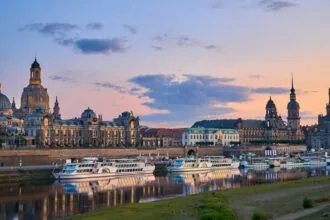
The Striezelmarkt closes on Christmas Eve, so Silvester in Dresden is a genuinely separate occasion from the market itself. Rather than one official countdown event, the city’s New Year’s Eve is spread across private fireworks, restaurant dinners and a handful of paddle-steamer cruises along the Elbe.
Private fireworks remain legal across most of the city within the national rules allowing category F2 rockets between 6pm on 31 December and 7am on 1 January. Locals traditionally gather along the Elbe riverbanks and on bridges including the Augustusbrücke to watch the wider skyline light up at midnight.
The Brühlsche Terrasse, the elevated riverside promenade overlooking the Elbe in the old town, is one of the most popular vantage points, though fireworks cannot be set off from the terrace itself. Dress for standing outside in near-freezing temperatures if that is the plan, since Dresden’s December and January nights are genuinely cold.
Several hotels and restaurants run their own dedicated Silvester events, from gala dinners to river cruises with live music, and booking ahead is sensible given how popular the city has become as a festive destination. Anyone wanting a more contemplative start to the evening can pair the fireworks with the Dresdner Kreuzchor’s Silvestervesper at the Kreuzkirche, covered above, before heading down to the river for midnight. For a quieter alternative to a big party, a walk along the Elbe away from the busiest bridges offers a good, informal view of the fireworks lighting up from multiple directions at once.
Getting to the Dresden Christmas Market
Dresden’s old town is compact and largely pedestrianised, and the Altmarkt sits within easy reach of the city’s main transport hubs. It faces the Kulturpalast on Wilsdruffer Straße, a short walk from both the Frauenkirche and the Zwinger Palace for anyone combining the market with a day of sightseeing.
The Altmarkt tram stop, served by trams 1, 2 and 4 along with several bus routes, sits directly beside the market itself. A standard single VVO ticket costs around €3.60 (£3.10/$4.21) and covers the same tariff zone used across the wider region, including the airport’s own S-Bahn line.
Travellers arriving by train can reach the market easily from Dresden Hauptbahnhof, roughly a 15 to 20 minute walk or a short tram ride away. Flying into Dresden Airport, the S2 line reaches the Hauptbahnhof in around 23 minutes, with the tram network covering the final stretch into the old town.
Because the old town streets around the Altmarkt are largely closed to general traffic during the market period, driving directly to the square is not practical. Visitors arriving by car should plan to park further out and walk or use public transport for the final stretch, in the same way as at most other German Christmas markets.
December is a genuinely busy period for accommodation in Dresden, given the Striezelmarkt’s long season and its reputation as one of Germany’s most popular Christmas destinations. Booking well in advance, particularly for hotels near the old town or Hauptbahnhof, is worth doing rather than leaving it until closer to the date.
Beyond the Market: The Rest of Dresden Worth Your Time
Everything above covers the Striezelmarkt and its Christmas-season neighbours, but a December trip to Dresden does not have to stop at the market stalls. The baroque old town sits within a few minutes’ walk of the Altmarkt, and landmarks like the Zwinger Palace, the Residenzschloss’s treasury and the Semperoper opera house are just as worth seeing in winter as at any other time of year, especially on a day when the market itself only takes up an afternoon.
For everything else worth building into a Dresden visit, from museums and viewpoints to how to sequence a longer stay, our Things to Do in Dresden guide covers the city beyond its Christmas market season, and is worth reading alongside this one before finalising an itinerary.

Rupert’s Handy Travel Tips
Planning a trip to Dresden’s Striezelmarkt this winter? Here are a few useful tips to make your visit smoother.
- Time your trip for Stollenfest: the giant stollen parade on 5 December 2026 is one of the market’s genuine highlights, and it only happens once a season.
- Look for the Stollensiegel: buy Dresdner Christstollen carrying the association’s wax seal if you want the genuine, protected version rather than an imitation.
- Skate at Winterlichter, not the Altmarkt: the Striezelmarkt itself has no ice rink, but Dresdner Winterlichter on Prager Straße runs one a short walk away across roughly the same dates.
- Book Kreuzchor tickets ahead for Christmas Eve: the Christvesper at the Kreuzkirche is a genuine local tradition, and the church fills quickly for both sittings.
- Shop on 29 November or 13 December: those are the only two verkaufsoffene Sonntage during Advent, so plan any Sunday shopping around one of those two dates.
- Don’t stop at the Altmarkt: the Frauenkirche market and the Stallhof medieval market are both a short walk away and noticeably calmer.
- Book your trip around 24 December: unlike some other German markets, the Striezelmarkt runs right up to Christmas Eve itself.
- Take the tram, not a taxi: trams 1, 2 and 4 stop directly at Altmarkt, and the standard VVO ticket covers the whole journey from the Hauptbahnhof or airport.
- Book accommodation early: hotels near the old town fill up quickly given Dresden’s growing reputation as a Christmas market destination.
Want to meet the reindeer behind our travel tips? Find out more in our page Who is Rupert?.



Frequently Asked Questions About Dresden’s Christmas Market
When does Dresden’s Christmas market open in 2026?
The Striezelmarkt is scheduled to run from 25 November to 24 December 2026, with standard hours of 10am to 9pm daily, a later 4pm start on opening day and an earlier 2pm close on Christmas Eve.
Is Dresden’s Christmas market really the oldest in Germany?
It is widely described as Germany’s oldest genuine Christmas market, first documented in 1434. Other cities, including Frankfurt and Bautzen, have earlier general trading market records, but those predate the Striezelmarkt’s specifically Christmas-focused origins.
Where is the Striezelmarkt held?
The market takes place on the Altmarkt, Dresden’s historic main square, opposite the Kulturpalast on Wilsdruffer Straße in the heart of the old town.
What is Stollenfest?
Stollenfest is an annual festival celebrating Dresdner Christstollen, held on the Saturday before the second Sunday of Advent. In 2026 it falls on 5 December and features a parade of a giant ceremonial stollen weighing around 1,800 kilograms, cut and shared among visitors.
Is there ice skating at Dresden’s Christmas market?
Not on the Altmarkt itself. The nearest genuine ice rink runs at Dresdner Winterlichter on Prager Straße, a short walk away, open across roughly the same dates as the Striezelmarkt.
Are shops open on Sundays in Dresden during Advent?
Only on two verkaufsoffene Sonntage each December, 29 November and 13 December 2026, both running midday to 6pm. On other Sundays, shops stay closed as normal under Saxony’s shop opening law.
What should I buy at the Dresden Christmas market?
Look for genuine Dresdner Christstollen carrying the Stollensiegel wax seal, and Erzgebirge wooden crafts such as nutcrackers, incense-smoking Räuchermänner figures and miniature pyramids from the Ore Mountains region.
How big is the Christmas pyramid at the Striezelmarkt?
The market’s Erzgebirge step pyramid stands 14.61 metres (48 feet) tall, billed as the world’s largest of its kind, and anchors the Altmarkt alongside a giant Schwibbogen candle arch and a twenty-metre spruce tree.
Is the market open on Christmas Eve or over New Year?
Yes to Christmas Eve, when it runs shortened hours until 2pm before closing for the season. It does not reopen for New Year, and Dresden marks Silvester separately with fireworks along the Elbe rather than a market-linked celebration.
How do I get to the Altmarkt without a car?
Trams 1, 2 and 4 stop directly at Altmarkt, and Dresden Hauptbahnhof is around a 15 to 20 minute walk or a short tram ride away. Flying in, the S2 line reaches the Hauptbahnhof from Dresden Airport in around 23 minutes.
Further Reading
Landing in Saxony before the market opens? Our Dresden Airport Transfers guide covers every realistic way of reaching the city centre from DRS, while our Things to Do in Dresden guide rounds up the sights worth prioritising beyond the Altmarkt itself.
If your December visit has a spare day, our Best Day Trips from Dresden guide covers Saxon Switzerland, Meissen and beyond, and if a match falls during your stay, our How to Get to the Stadium in Dresden guide covers Dynamo Dresden’s Rudolf-Harbig-Stadion.
Comparing Dresden against Germany’s other major markets is also worth doing before committing to a single-city trip. Our Frankfurt Christmas Market guide covers a market with its own six-century-old history, while our Nuremberg’s Christmas Market guide covers the Christkindlesmarkt’s own centuries of tradition.
Further west, our Cologne Christmas Markets and Düsseldorf Christmas Markets guides cover two very different takes on the Rhineland’s own festive tradition. Closer to home, our Berlin Christmas Markets guide, Hamburg Christmas Markets guide and Stuttgart Christmas Market guide round out the rest of Germany’s biggest festive markets. Our Germany’s Christmas Markets Compared guide pulls all nine of the country’s biggest markets together side by side.