Reviewed by our editorial team Published
Frankfurt’s Christmas market is one of Germany’s oldest, tracing its roots to 1393, when mystery plays and trading stalls are first recorded on the Römerberg, the square in the heart of Frankfurt’s medieval old town. That places it among a small handful of German markets whose history stretches back more than six centuries, alongside better known names such as Nuremberg and Dresden.
Other sources instead point to 1498, when a market tied to a royal wedding celebration in the city first used the name Christkindchesmarkt, an early forerunner of today’s Weihnachtsmarkt. Historians do not fully agree on which date marks a true beginning, much as they disagree over the exact origins of several other ancient German markets, but either date puts Frankfurt comfortably among the country’s earliest festive traditions.
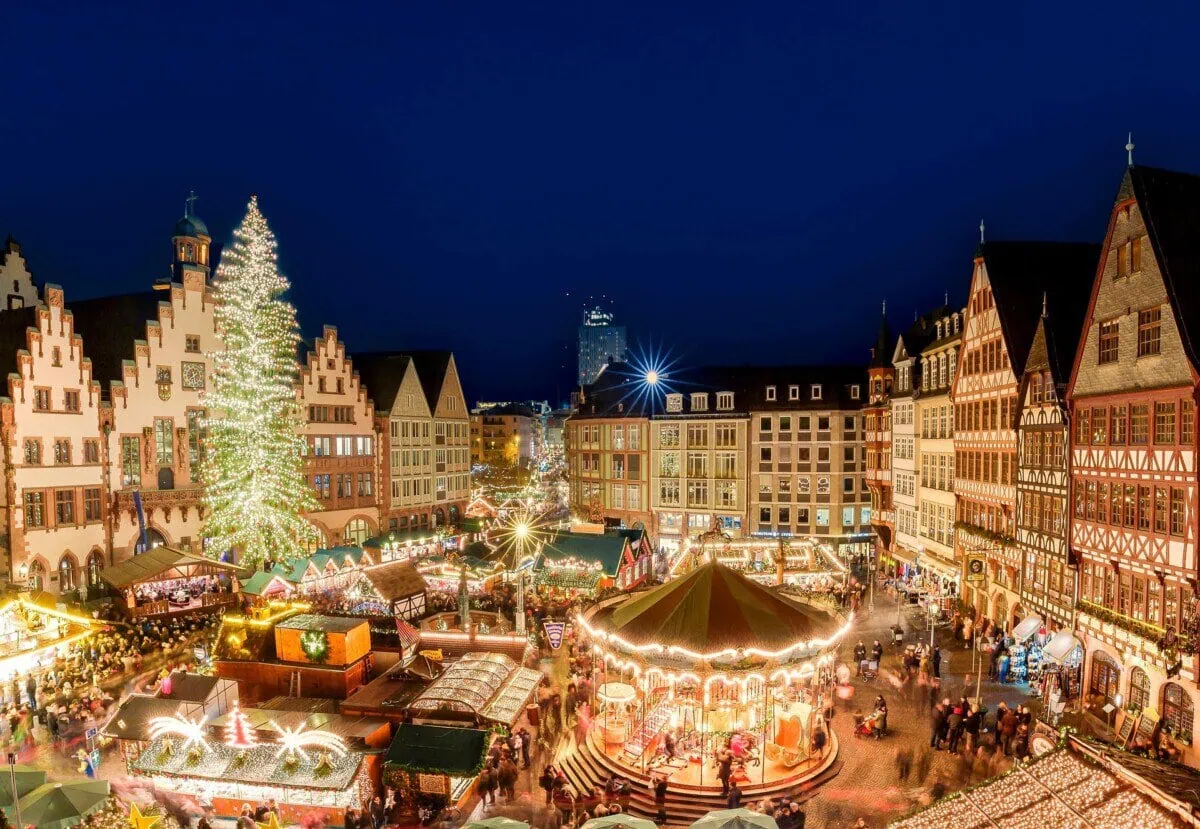
The market’s fir tree tradition only became fixed in the early 1800s, when traders from Saxony began bringing trees to sell alongside toys, gingerbread and confectionery. A single, carefully chosen tree still anchors the Römerberg each December, and it has become as recognisable a symbol of Frankfurt’s Christmas as the half-timbered Römer buildings that frame the square behind it.
Today the market has grown well beyond a single square, spreading across six sites in the old town and drawing an estimated three million visitors each season. This guide covers that history in more depth, the 2026 opening dates and hours, what actually fills the stalls across the market’s different squares, the food and drink worth trying, other festive events and carol concerts worth building into a trip, Christmas shopping on the Zeil, New Year’s Eve in the city, and how to get there.
A Market With Roots in Medieval Frankfurt
Frankfurt’s Weihnachtsmarkt is most commonly dated to 1393, when mystery plays and trading stalls are recorded as having taken place on the Römerberg, the square in front of Frankfurt’s medieval town hall. That would make it one of the oldest continuously referenced Christmas markets anywhere in Germany, predating many of the country’s other famous markets by a century or more.
Other sources instead trace the market to 1498, when a market linked to a royal wedding in the city first used the name Christkindchesmarkt. Whichever date is taken as the true starting point, Frankfurt’s market has clearly existed in some form since the late medieval period, long before Christmas itself became the occasion it is celebrated as today.
In its earliest centuries, the market served a genuinely practical purpose, letting residents stock up on goods and provisions before winter set in rather than functioning as a festive attraction. It only gradually took on a more recognisably Christmas character over the following centuries, as toys, sweets and decorations became a bigger part of what was sold.
The fir tree tradition that now defines the market’s Römerberg centrepiece did not become fixed until the early 1800s, when traders from Saxony began bringing trees to sell alongside the market’s other festive goods. Around the same period, the market also inspired Frankfurt writer Heinrich Hoffmann’s 1851 tale featuring a nutcracker, thought to be the earliest known story built around that now-familiar Christmas figure.
Like most German markets, Frankfurt’s Weihnachtsmarkt was disrupted through the Second World War and the years of reconstruction that followed. It returned fully to its traditional old town squares by the 1970s, and it has run there every December since, gradually expanding from a single site into the multi-square event it is today.
That expansion is a large part of why the market feels so different from more compact single-square markets elsewhere in Germany. Rather than one dense cluster of stalls, Frankfurt’s market spreads its history, and its crowds, across six separate old town locations.
2026 Opening Dates and Hours
For the 2026 season, Frankfurt’s Christmas market is scheduled to run from 23 November to 22 December 2026, a shorter window than markets that stretch into late December or January. That makes it one of the earlier German markets to close each year, so travellers planning a Christmas Eve visit to Frankfurt specifically for the market should double check the closing date before booking.
Standard opening hours across the market’s squares run from 10am to 9pm Monday to Saturday, with a slightly later 11am start on Sundays. These are the most specific hours published so far for the 2026 season, based on the pattern the market has followed in recent years.
Markets of this size occasionally adjust hours at individual stalls or on specific dates, so these times should be treated as a reliable pattern rather than a guaranteed schedule. As with other German Christmas markets covered on this site, it is always worth a quick check of the official Visit Frankfurt website shortly before travelling.
The table below sets out the confirmed 2026 pattern based on the most recent official listings available at the time of writing.
| Date / Day Type | Hours |
|---|---|
| Opening date, 23 November 2026 | Market opens for the season |
| Monday to Saturday | 10am to 9pm |
| Sunday | 11am to 9pm |
| Closing date, 22 December 2026 | Market closes for the season |
Because Frankfurt’s market closes on 22 December rather than Christmas Eve, it does not run through to New Year in the way some other German cities’ markets do. Travellers hoping to combine the market itself with a Christmas or New Year trip to Frankfurt should build their dates around that earlier closing date rather than assuming the market will still be running.
For the most accurate, year-specific information, it is always worth checking the official Visit Frankfurt Christmas market page before booking travel, since exact hours and any last-minute changes are published there each autumn. That evergreen caveat applies to every German Christmas market guide on this site, simply because official dates for markets this far ahead can shift by a day or two as councils finalise their winter programmes.
Browse hotels and accommodation for your visit to Frankfurt.
View staysBrowse apartments, homes and self-catering accommodation in Frankfurt.
Browse rentalsSee hotel prices from multiple booking sites in one search.
Compare ratesSquares, Stalls and the Römerberg Tree
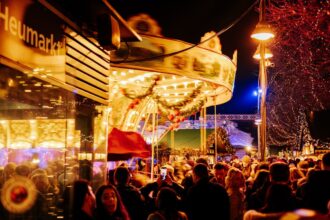
Frankfurt’s Christmas market is not confined to a single square. It spreads across six connected sites in the old town, Römerberg, Paulsplatz, Mainkai, Hauptwache, Friedrich-Stoltze-Platz and Roßmarkt, each with a slightly different character.
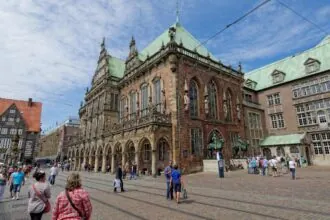
The Römerberg remains the market’s centrepiece, framed by the half-timbered facades of the reconstructed Ostzeile buildings and Frankfurt’s medieval Römer town hall. A single, individually chosen fir tree stands at the centre of the square each December, selected specifically for its size and shape and treated as something of a local celebrity in its own right.
Across the market’s six squares, more than 230 decorated stalls sell everything from handmade decorations to toys and festive food. Paulsplatz and Mainkai, the latter running along the Main riverbank, tend to feel noticeably calmer than the packed Römerberg, making them a good option for visitors who want the atmosphere without the crowds.
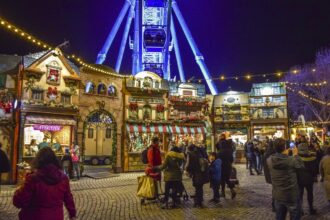
Roßmarkt hosts its own dedicated ferris wheel as part of the wider WeihnachtsRoßmarkt, giving families a reason to walk the short distance from the main square. Mainkai, meanwhile, runs a children’s market with its own smaller-scale activities, separate from the adult-focused stalls closer to the Römerberg.
On Wednesday and Saturday evenings, the Turmbläser brass ensemble plays carols from the gallery of the Nikolaikirche, the small church that overlooks the Römerberg itself. It is one of the market’s more understated traditions, easy to miss if you are not looking up at the right moment, but it is worth timing a visit around if live music matters to your trip.
Because the market spreads across six separate squares rather than one dense cluster, it rewards a slower, more exploratory visit than markets built around a single central space. Walking the full loop between all six sites takes a good hour on its own, even before factoring in time spent actually browsing the stalls.
Glühwein, Apfelwein and Frankfurt’s Festive Food
Frankfurt’s market sells the usual German Christmas market staples, but it also leans heavily on the city’s own regional specialities rather than relying purely on imported traditions. Alongside Glühwein, the market’s signature drink is Heißer Apfelwein, hot mulled apple wine, a reflection of Frankfurt’s long-standing reputation as Germany’s apple wine capital.
A mug of Glühwein or Heißer Apfelwein typically costs around €4 to €5 (£3.44 to £4.30/$4.68 to $5.85), usually with a small refundable deposit for the mug itself. As at other German markets, many visitors simply keep the mug as a souvenir rather than queueing to reclaim the deposit.
On the food side, Bethmännchen, small marzipan biscuits studded with almonds, are one of Frankfurt’s most distinctive exports, alongside Brenten, a firmer spiced almond biscuit with its own local following. Both make practical, well-travelling souvenirs, similar in spirit to the protected gingerbread sold at Nuremberg’s own Christkindlesmarkt.
Quetschemännchen, small figures made from dried plums and other dried fruit, are Frankfurt’s answer to the prune figures found at several other German markets. They are usually dressed as tiny tradespeople, and a handful of specialist stalls still make them by hand rather than sourcing them ready-made.
Savoury options include grilled sausages, Reibekuchen potato pancakes and roasted chestnuts, priced similarly to the rest of Germany’s markets at around €4 to €6 (£3.44 to £5.16/$4.68 to $7.02) per portion. Sampling your way between a few different stalls is generally more rewarding than settling on the first one you pass, since quality and portion size can vary noticeably between them.
Each season also brings a newly designed collectible mug, with recent editions tying into wider Frankfurt themes such as the city’s turn as a World Design Capital. Collecting a different mug each year has become its own small tradition for regular visitors, in the same way it has at other major German markets.
Other Festive Events, Ice Skating and Carol Concerts
Beyond the main Christmas market, Frankfurt runs a handful of other festive events worth building into a winter visit. The Winterlichter light trail at the Palmengarten botanical garden transforms the grounds into an illuminated evening walk each December, a genuinely different kind of festive atmosphere from the market’s stalls and Glühwein.
City Alm, a rooftop Christmas market and Alpine-style lodge above the city, offers a different vantage point on the season entirely, trading old town squares for rustic food and drink with rooftop views. It has become a popular add-on for visitors who have already covered the main market and want a change of scene.
Ice skating is not part of the official market itself. None of the six squares that make up Frankfurt’s Weihnachtsmarkt includes a rink, unlike some German cities where skating sits right inside the main square. Visitors who fancy skating during their trip still have genuine options a short journey away rather than a reason to invent one. Skyline Plaza’s seasonal Winterzauber rink runs as an outdoor winter attraction each year from early November into January, near Frankfurt Hauptbahnhof rather than the old town, with adult sessions priced at around €6 (£5/$7) and children’s sessions around €4 (£3/$5) per hour. For a year-round option, the Eissporthalle Frankfurt, a permanent indoor rink in the Bornheim district, is reachable by tram from the old town. Both require a separate trip across the city, so most visitors treat a Frankfurt Christmas break as a market-and-food occasion first and add skating only if the schedule allows it.
Frankfurt’s churches move beyond a passing mention into a genuine seasonal concert programme of their own. The Kaiserdom, Frankfurt’s Gothic-towered cathedral overlooking the Main a short walk from the Römerberg, runs a dedicated Frankfurter Domkonzerte series through Advent. Recent seasons have included a Pre-Christmas Concert in early December, pairing the cathedral’s own Vocalensemble and orchestra under conductor Andreas Boltz with Baroque and Romantic cantatas from composers including Telemann and Mendelssohn, and a separate Christmas in Europe organ concert built around festive works played on the Kaiserdom’s own organ. Exact 2026 dates and programmes are published on the Domkonzerte website each autumn and are worth checking before building an evening around one.
Beyond the cathedral, the Frankfurter Domsingschule, the boys’ choir attached to the Kaiserdom, takes part in seasonal carol singing and Advent services through December, and the city’s other old town churches and the Alte Oper concert hall run their own choral and orchestral programmes through the same period. None of this needs booking months ahead in the way the biggest Christmas markets sometimes do, but a specific date and choir is worth confirming before a trip rather than assumed. The Turmbläser brass ensemble covered earlier in this guide, playing from the Nikolaikirche gallery on Wednesday and Saturday evenings, counts as the market’s own informal answer to a full concert programme, and pairing an evening at the Kaiserdom or Nikolaikirche with a walk through the illuminated squares makes for one of the more atmospheric ways to spend a Frankfurt evening in December.
For families, several of the market’s six squares run their own smaller children’s activities alongside the main stalls, particularly around Mainkai. None of these individually justifies a special trip on their own, but together they give a Frankfurt Christmas visit more depth than the market alone.
Christmas Shopping on the Zeil
Frankfurt’s market stalls are not the only place to shop during Advent. The Zeil, the pedestrianised shopping street running east from Hauptwache, one of the market’s own six squares, is regularly named Germany’s busiest shopping street by footfall, and it sits close enough to the market that combining both in one afternoon is entirely realistic.
The street’s anchor is MyZeil, a glass-fronted shopping centre with a distinctive funnel-shaped atrium, alongside a Galeria department store and the older Zeilgalerie arcade. Between them, the Zeil covers most of what a market visit does not, from high street fashion chains to department store gift halls, without needing to leave the old town on foot.
Beyond the Zeil itself, a few other spots round out a Christmas shopping stop in the old town. The Kleinmarkthalle, a covered market hall a short walk south of Hauptwache, is the place for festive food, cheese and wine to take home rather than gifts, and the quieter Fressgass (Kalbächer Gasse) and Goethestraße offer a calmer, more upmarket alternative to the Zeil’s chain stores for anyone who wants to escape the market crowds for an hour.
Shop hours in Hesse are largely unrestricted from Monday to Saturday under the state’s own Hessisches Ladenöffnungsgesetz (Hesse shop opening law), and most Zeil stores open from around 10am to 8pm on those days, with MyZeil running slightly later on Fridays and Saturdays. Sundays are a different matter. Germany’s shop closing laws keep most retail closed on Sundays nationwide, and Hesse’s law caps exceptions at four verkaufsoffene Sonntage, Sunday shopping days, per year in any one municipality, each tied to a public occasion such as a market or festival.
Frankfurt has used one of its annual Sunday shopping days during the Christmas market season in past years, but as of research for this guide in September 2026, no verkaufsoffener Sonntag date had yet been published for Frankfurt for the 2026 season, on either the city’s own event listings or the independent trackers that cover Hesse’s confirmed Sunday shopping dates. Rather than guess at a date this far ahead, it is worth checking Frankfurt’s official tourism site or the Frankfurt Chamber of Commerce (IHK) listings closer to a planned visit, since outside a confirmed date the Zeil’s shops, unlike the market stalls themselves, stay closed on Sundays as standard.
New Year’s Eve in Frankfurt
Frankfurt’s Christmas market closes well before New Year, so Silvester in the city is a genuinely separate occasion from the market itself. Rather than one official countdown event, Frankfurt’s New Year’s Eve is spread across a wide mix of hotel parties, restaurant dinners and private fireworks rather than a single centrepiece show.
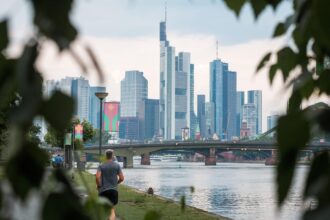
Private fireworks remain legal across most of the city within the national rules allowing category F2 rockets and fireworks between 6pm on 31 December and 7am on 1 January. Riverside spots along the Main are a popular, informal vantage point for watching the wider skyline light up at midnight.
Several hotels run their own dedicated New Year’s Eve events, from gala dinners with a private fireworks display to rooftop bars offering city views over the celebrations. Booking ahead is sensible for any of these, since Frankfurt’s business-traveller reputation means hotel rooms and restaurant tables can be scarcer than expected around the holiday period.
For a quieter alternative to a big party, a walk along the Museumsufer or across the Eiserner Steg footbridge offers a good, free view of the fireworks lighting up the skyline from multiple directions at once. Dress for standing outside in near-freezing temperatures if that is the plan, since Frankfurt’s December nights are genuinely cold.
Getting to the Frankfurt Christmas Market
Frankfurt’s old town is compact and largely pedestrianised, and the market’s six squares sit within easy walking distance of the city’s main transport hubs. The Römerberg itself is a short walk from Frankfurt Hauptbahnhof, Germany’s busiest railway station, making the market easy to reach for both local visitors and travellers passing through.
The nearest U-Bahn and tram stops are around Römer/Paulskirche and Willy-Brandt-Platz, both within a few minutes’ walk of the Römerberg. Frankfurt’s S-Bahn and U-Bahn network makes reaching the old town straightforward from most parts of the city without needing a car.
Travellers flying into Frankfurt Airport can reach the market easily by train, since the S8 and S9 S-Bahn lines run directly from the airport to Frankfurt Hauptbahnhof in around 12 to 15 minutes. From there, it is a short walk or a single tram or U-Bahn stop on to the old town.
Because the old town streets around the market are largely closed to general traffic during the season, driving directly to the Römerberg is not practical. Visitors arriving by car should plan to park further out and walk or use public transport for the final stretch, in the same way as at most other German Christmas markets.
December is a genuinely busy period for accommodation in Frankfurt, given the city’s usual business-traveller crowd is joined by market visitors on top. Booking well in advance, particularly for hotels near the old town or Hauptbahnhof, is worth doing rather than leaving it until closer to the date.
Search flights and useful route combinations for your trip.
View flightsChoose an Airalo eSIM and arrange mobile data before you arrive.
Browse eSIMsHave a private airport pickup arranged before you travel.
Book a transferBeyond the Market: The Rest of Frankfurt
The market, its festive food and the Zeil’s Christmas shopping make for a full few days in Frankfurt, but the city has a far wider range of year-round attractions worth building into a longer trip, from the skyscraper viewing platforms of the financial district to the museum-lined Museumsufer and the older corners of the old town beyond the market’s six squares. Our complete Things to Do in Frankfurt guide rounds up everything else worth seeing and doing in the city, and it is worth a look before finalising an itinerary if a Frankfurt trip stretches beyond a single day at the market.

Rupert’s Handy Travel Tips
Planning a trip to Frankfurt’s Christmas market this winter? Here are a few useful tips to make your visit smoother.
- Don’t stop at the Römerberg: the market spreads across six squares, and Paulsplatz and Mainkai are noticeably calmer than the main square.
- Book your trip before 22 December: unlike some other German markets, Frankfurt’s closes well before Christmas Eve.
- Try the Apfelwein, not just the Glühwein: hot mulled apple wine is Frankfurt’s own festive drink and genuinely worth trying.
- Listen for the Turmbläser: the brass ensemble plays from the Nikolaikirche gallery on Wednesday and Saturday evenings.
- Take the train from the airport: the S8 and S9 reach Frankfurt Hauptbahnhof in around 12 to 15 minutes, and the old town is a short walk from there.
- Book accommodation early: hotels near the old town fill up quickly given Frankfurt’s usual business-traveller demand.
Want to meet the reindeer behind our travel tips? Find out more in our page Who is Rupert?.




Frequently Asked Questions About Frankfurt’s Christmas Market
When does Frankfurt’s Christmas market open in 2026?
The market is scheduled to run from 23 November to 22 December 2026, with standard hours of 10am to 9pm Monday to Saturday and 11am to 9pm on Sundays.
How old is Frankfurt’s Christmas market?
It is most commonly dated to 1393, when mystery plays and trading stalls were first recorded on the Römerberg, though some sources instead trace it to a 1498 market linked to a royal wedding. Either date puts it among Germany’s oldest Christmas markets.
Where is Frankfurt’s Christmas market held?
It spans six connected squares in the old town: Römerberg, Paulsplatz, Mainkai, Hauptwache, Friedrich-Stoltze-Platz and Roßmarkt, with the Römerberg and its central fir tree as the main centrepiece.
What should I eat and drink at Frankfurt’s Christmas market?
Try Heißer Apfelwein, Frankfurt’s own hot mulled apple wine, alongside Bethmännchen marzipan biscuits, Brenten almond biscuits and the dried-fruit Quetschemännchen figures.
Is there ice skating at Frankfurt’s Christmas market?
Not at the market itself; none of its six squares includes a rink. Skyline Plaza runs a seasonal outdoor rink near Hauptbahnhof each winter, and the Eissporthalle Frankfurt offers year-round indoor skating, but both need a separate trip across the city.
Can I go Christmas shopping beyond the market stalls?
Yes. The Zeil, one of Germany’s busiest shopping streets, runs from Hauptwache and includes MyZeil and Galeria. Shops open Monday to Saturday but stay closed on Sundays outside the handful of confirmed verkaufsoffene Sonntage each year.
Is the market open on Christmas Eve or over New Year?
No, it closes on 22 December 2026 and does not reopen for Christmas Eve or New Year. Frankfurt still marks Silvester separately, with private fireworks and hotel events rather than a market-linked celebration.
Has Frankfurt’s Christmas market inspired markets elsewhere?
Yes. Birmingham runs its own Frankfurt Christmas Market as a direct import from the city’s German sister-city relationship, and Florence hosts a similarly German-style transplanted market of its own.
How busy is Frankfurt’s Christmas market?
It draws an estimated three million visitors across the season, with the Römerberg the busiest single square. Paulsplatz and Mainkai tend to feel noticeably calmer if you want the atmosphere without the crowds.
How do I get to the market without a car?
Frankfurt’s U-Bahn, tram and S-Bahn network connects easily to the old town, with stops around Römer/Paulskirche and Willy-Brandt-Platz within a few minutes’ walk of the Römerberg. Frankfurt Hauptbahnhof is also within easy reach on foot or by a short tram ride.
Further Reading
Frankfurt’s market has inspired transplants well beyond Germany’s own borders, and two of the more surprising examples already have their own guides on this site. Our Birmingham Christmas Markets guide covers the city’s own Frankfurt Christmas Market, imported directly through its German sister-city relationship, while our Florence Christmas Markets guide covers a similar German-style market transplanted into a Tuscan piazza.
For the rest of a Frankfurt trip, our Frankfurt Airport Transfers guide covers every route from FRA into the old town, and our Things to Do in Frankfurt guide rounds up the city’s sights beyond the market itself. If your December visit has a spare day, our Best Day Trips from Frankfurt guide covers Heidelberg and the Rhine Valley, and if a match falls during your stay, our How to Get to the Stadium in Frankfurt guide covers Eintracht Frankfurt’s Deutsche Bank Park.
Comparing Frankfurt against Germany’s other major markets is also worth doing before committing to a single-city trip. Our Nuremberg’s Christmas Market guide covers the Christkindlesmarkt’s own centuries of history, while our Cologne Christmas Markets and Düsseldorf Christmas Markets guides cover two very different takes on the Rhineland’s own festive tradition. For the rest of the country’s big markets, our Berlin Christmas Markets guide, Hamburg Christmas Markets guide and Stuttgart Christmas Market guide round out the rest of Germany’s biggest festive markets. Our Germany’s Christmas Markets Compared guide pulls all nine of the country’s biggest markets together side by side.