Reviewed by our editorial team Published
Eintracht Frankfurt do not carry the sheer trophy weight of Bayern Munich or Borussia Dortmund, but few clubs in Germany generate a fiercer, more travelled following. Founded in 1899, the club has won a single Bundesliga title back in 1959, yet its modern reputation rests on something else entirely: a 2022 UEFA Europa League triumph, the club’s first European trophy since 1980, sealed with a penalty shootout win over Rangers in Seville.
That Seville final is still the reference point for anyone trying to understand Eintracht’s identity. An estimated 30,000 or more Frankfurt fans travelled to Spain, many without a match ticket at all, simply to be part of it, and the sight of a city-sized away following taking over an entire stadium end became one of the defining images of that European season.
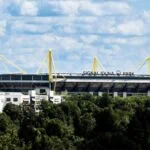
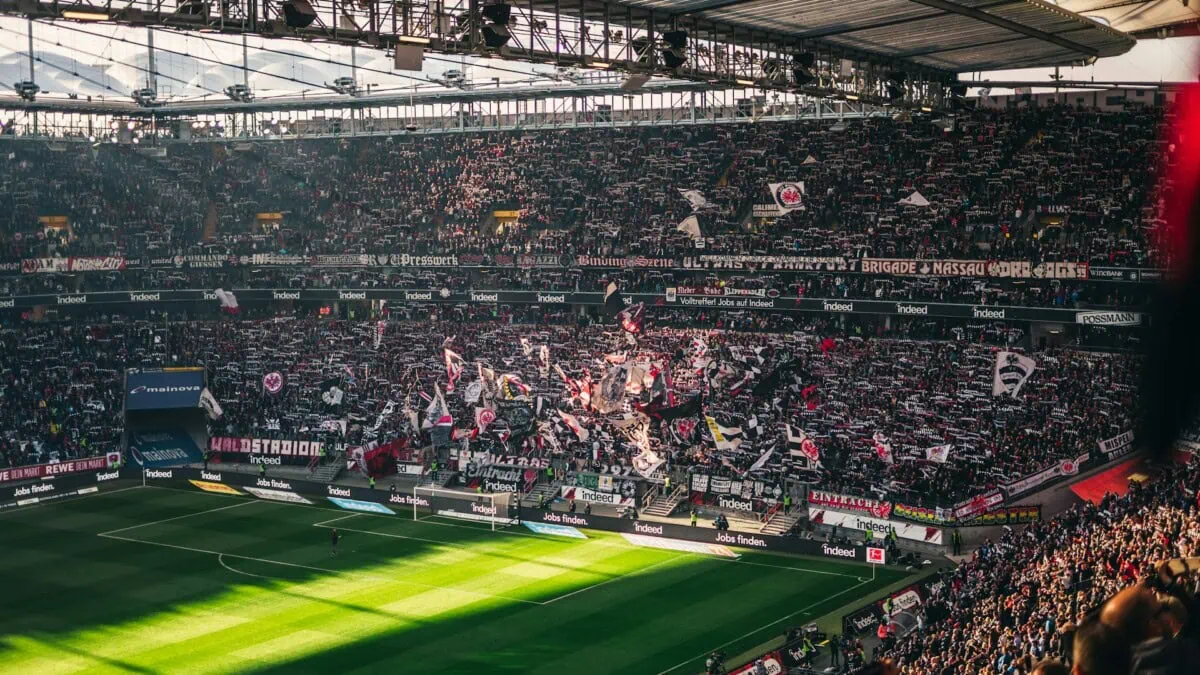
The club’s home ground reflects that same intensity. Deutsche Bank Park, still widely known by its older name of the Waldstadion, sits in the forested Niederrad district on the southern edge of Frankfurt, close to the Main river, and has hosted football in some form on this site since 1925. It underwent a full football-only rebuild for the 2006 World Cup, when it staged a semi-final, and has been expanded in stages since.
Capacity has now passed 60,100 for Bundesliga fixtures after a 2026 tweak to the press and business areas pushed it just over that landmark, making it the fifth-biggest ground in German top-flight football. A large share of that capacity is standing terrace, concentrated in the Nordwestkurve, widely rated one of the loudest single stands anywhere in the Bundesliga.
This guide covers how to actually get to Deutsche Bank Park, not just which S-Bahn line happens to run nearby: a realistic journey from Frankfurt Hauptbahnhof, what genuinely happens once matchday crowds build around Niederrad, an honest take on driving and parking, and how buying a ticket for one of Germany’s most passionately supported clubs actually works. It also covers the club museum built into the stadium and what makes a visit here worth the trip beyond ninety minutes of football.
| Club | Stadium | Capacity | Nearest Station | League (2025/26) |
|---|---|---|---|---|
| Eintracht Frankfurt | Deutsche Bank Park | 60,100 (Bundesliga) | S-Bahn Stadion (S7/S8/S9) | Bundesliga |
Transport at a Glance: Nearest Stops for Deutsche Bank Park
Before the full breakdown below, here is every nearest stop serving the ground in one place, covering every rail, tram and bus option that puts you within a 10 to 15 minute walk of the gates.
| Mode | Stop / Station | Line(s) | Walk Time to Stadium |
|---|---|---|---|
| S-Bahn | Stadion | S7, S8, S9 | 10 to 15 min (plus a ~6 min ride from Hauptbahnhof) |
| Tram | Stadion | 21 | 10 to 15 min |
| Bus | Stadionbad or Osttribüne | 61 | 10 to 15 min |
| Bus (matchdays only) | Stadionbad or Osttribüne | 80 | 10 to 15 min |
Getting to Deutsche Bank Park by S-Bahn and Tram
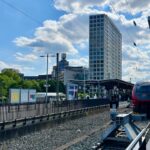
The single practical fact worth knowing before a matchday in Frankfurt is that almost everyone arrives by rail. The S-Bahn lines S7, S8 and S9 all run from Frankfurt Hauptbahnhof towards Frankfurt Flughafen or Wiesbaden and stop directly at the station simply named Stadion, with the ride itself taking around six minutes according to the club’s own official directions.
From the Stadion platform, the walk to the ground takes a further 10 to 15 minutes through the Waldstadion sports complex, on flat, well-signed paths that are easy to follow even on a first visit. A realistic door-to-seat estimate from Hauptbahnhof, including the walk and a queue through the turnstiles, runs to roughly 30 to 40 minutes in total.
Frankfurt’s tram line 21 offers a genuine alternative, running from Hauptbahnhof to the same Stadion stop, with extra trams added roughly every three minutes on matchdays. It suits fans holding tickets for the main or east stands in particular, since the tram stop sits slightly closer to those entrances than the S-Bahn exit.
Bus routes fill in the gaps for anyone not near a rail line. Line 61, and the special matchday line 80 connecting the airport and the southern station, both stop at Stadionbad or Osttribüne, each around a 10 to 15 minute walk from the ground.
The S-Bahn to Stadion is the best default for most visitors, simply because it is the most frequent option and does not depend on catching a specific tram in the crush before kickoff. Niederrad itself sits well away from Frankfurt’s medieval old town, so even a short S-Bahn ride like this one needs building into your timings rather than treated as an afterthought.
Anyone holding a match ticket should also check whether it doubles as a transport pass. Frankfurt’s RMV network, like several German transport authorities, often lets a valid matchday ticket cover the journey on public transport within the city on the day of the fixture, which is worth confirming before buying a separate fare.
Best if you want daily housekeeping and a front desk. Filter by area first, then by price.
Check availabilityBest for families, or any stay past about four nights. A kitchen and a washing machine start paying for themselves.
Browse rentalsBest if you have already picked a hotel. Checks the big booking sites for the same room and shows who is cheapest.
Check dealsWhy the Walk Out Takes Longer Than the Walk In
A stadium holding over 60,000 fans fills a fairly modest suburban station well beyond its everyday capacity, and the Stadion platform genuinely fills with supporters for twenty to thirty minutes either side of kickoff and full time. Anyone travelling with children or reduced mobility should expect a crowded platform rather than an immediate, comfortable ride back into the centre.
Extra S-Bahn services and additional trams on line 21 are the standard response to a full house, rather than any separate shuttle-bus network, since the rail and tram capacity is considered sufficient for a ground of this size. Stewards and transport staff are a routine sight around the Stadion stop and the walking paths through the Waldstadion complex on any sold-out fixture.
The Nordwestkurve, Eintracht’s famous safe-standing home end, adds its own texture to the crowd flow. A large standing section empties more slowly and less predictably than rows of numbered seats, so anyone parked nearby waiting to walk out with friends should expect the exit to take longer than the walk in.
Leaving right on the final whistle expecting a quick getaway from a stand this size rarely works out. The smarter move is either lingering inside the concourse for ten to fifteen minutes while the first surge clears, or accepting a slower walk back to the Stadion platform as simply part of the experience.
Arriving at least 60 minutes before kickoff is the simplest way to avoid both the inbound crush on the S-Bahn and any last-minute security queue at the turnstiles. Big European nights, in particular, draw noticeably heavier crowds through Niederrad than a routine midweek Bundesliga fixture, so building in extra time matters more for those matches specifically.
Building in real time either side of the match, rather than treating a 60,000-capacity crowd as an abstract number, is the single biggest factor in a stress-free Deutsche Bank Park matchday. The stadium’s own scale is exactly why the S-Bahn and tram 21, rather than a car, are built to be the default route for almost everyone attending.
Parking at Deutsche Bank Park: Cheap to Arrive, Slow to Leave
Driving to Deutsche Bank Park is entirely possible, and the stadium sits close to both the A3 and A5 motorways, with football-symbol signs marking the route from either direction towards the Frankfurt-Süd junction. Drivers should look out for the Oberforsthaus or Niederrad exits, both of which feed directly into the matchday parking areas around the ground.
Parking itself is genuinely cheap by big-stadium standards. The main lots at Gleisdreieck, Waldparkplatz and Isenburger Schneise cost €6 (£5/$7) per car, while the Sandhofstraße lot near the Niederrad exit costs €5 (£4/$6), with further overflow parking around the Bürostadt Niederrad business district for anyone willing to walk 15 to 20 minutes.
The honest problem is not finding a space but getting away afterwards. Thousands of vehicles try to leave the same limited network of lots and slip roads within the same narrow window after the final whistle, and that queue routinely takes far longer than the 30 to 40 minute S-Bahn journey covered earlier in this guide.
Cyclists have their own dedicated option worth knowing about. A supervised Bike Point, run as a training and employment project near the main E1 ticket windows, charges a nominal €2 (£2/$2) for adults and €1 (£1/$1) for children under 12, with basic maintenance available on the day.
Unless travelling from well outside Frankfurt’s rail network with genuinely no alternative, the S-Bahn will get you there and, more importantly, get you home again far faster than a car once the post-match car park queue is factored in. Cheap, plentiful parking does not automatically mean an easy exit: the lots themselves are the easy part, and it is the road network afterwards that causes the real delay.
Anyone driving specifically for accessibility reasons should check ahead with the club for accessible parking near the stadium’s dedicated entrances, since standard matchday lots fill quickly and are not necessarily the closest option to accessible seating blocks.
Why an Eintracht Frankfurt Ticket Usually Starts with Club Membership
Buying a ticket for an Eintracht Frankfurt match is not quite as simple as picking a date and checking out. The club’s official ticket shop is the sensible place to start, but a standard direct purchase generally requires club membership, and Eintracht counts roughly 160,000 members among Europe’s most engaged fan bases.
International visitors are not locked out of this system. The club runs an English-language membership application aimed specifically at supporters outside Germany, though it is worth applying well in advance of a trip, since processing can take two to three weeks and each membership generally permits one ticket purchase per match.
Prices vary considerably by fixture and category. Standing terrace tickets in categories such as the Nordwestkurve run from around €13 to €15 (£11 to £13/$15 to $18), while the best seated categories for in-demand matches can reach €48 to €76 (£41 to £65/$56 to $89), with derbies and European nights pushing demand, and prices, noticeably higher.
For fans who end up with a spare ticket, or want to buy from someone who genuinely holds one, Eintracht runs its own official Ticketbörse exchange, where season-ticket holders can resell unused seats at face value with no buyer fee. That official exchange is the sensible route for anything beyond a standard purchase, since it keeps the transaction inside a system the club itself recognises.
Bundesliga tickets are also personalised, with identification checks a routine part of entry at German grounds, which is the practical reason buying outside official channels carries real risk rather than a theoretical one. A ticket bought from an unrecognised source can simply be refused at the turnstile if the name does not match.
The plain advice here is to start the membership process, or check official hospitality packages for a one-off visit, as soon as a fixture list is confirmed. Assuming a club without Bayern Munich’s global following means tickets stay easy to find right up to matchday is a costly assumption, since demand for Frankfurt’s biggest fixtures regularly says otherwise.
What You Can’t Bring: Stadium Rules and Prohibited Items at Deutsche Bank Park
Deutsche Bank Park enforces a strict bag policy that trips up plenty of first-time visitors. Suitcases, backpacks and any bag larger than A4 size are refused at the gate, so it is worth packing light before setting off from the hotel.
Weapons of any kind, along with anything that could double as a cutting or striking tool, are banned outright, and so is disguise clothing such as jackets with a built-in face shield. Pyrotechnics are treated just as seriously, with torches, sparklers, fireworks, flares and smoke powder all explicitly prohibited.
Glass bottles, cans, jars and any drink container made from breakable or hard material are refused, and the stadium goes further than most by banning all outside food and drink entirely rather than just alcohol. Bringing your own snacks in for the match, common practice at some grounds, simply will not get past security here.
Drones and laser pointers are banned, and so is professional photographic or film equipment, along with selfie sticks for anyone without media accreditation. Flagpoles are allowed only up to 2 metres in length and 3cm in diameter, and large-scale banners need clearing with the club in advance.
The rules are enforced consistently at every entrance, and staff have discretion to refuse anything they judge unsafe even if it is not explicitly listed. The full regulations are published on the club’s own Deutsche Bank Park stadium regulations, worth a quick check before setting off. Rules are occasionally updated between seasons, so it pays to check again close to your visit date rather than relying on an old printout.
In and Around the Ground: Merch, the Fan Zone and Matchday Hospitality
Gates at Deutsche Bank Park open two hours before kickoff, and the stadium’s Fanmeile fan zone starts up the moment they do, spread around the approach to the ground rather than confined to one corner. Expect a membership tent, a Speed-Kick radar game with prizes on offer, and curling on artificial ice, alongside a beer garden running a second-screen setup that lets fans catch an early kickoff elsewhere or the day’s build-up coverage before turning their attention to the main event.
The club’s own Fanshop sits at the stadium itself, at Mörfelder Landstraße 362, a short walk from the Stadion S-Bahn stop. Outside matchdays it opens Monday to Friday from 10am to 6pm and Saturday from 10am to 4pm, selling official Adidas-made Eintracht kit, including shirts personalised with a name and number, alongside the rest of the club’s merchandise range. On a matchday, entry requires a valid ticket and the shop runs to the same hours as the stadium gates, with a self-service kiosk opening purely for home fixtures.
Catering inside the ground leans on a Self-Service-Cube for a quick grab-and-go option away from the main kiosk queues, and the mainpay system lets fans tap a phone or smartwatch to pay rather than queuing at a till for cash or card. Six free drinking water fountains are dotted around the concourses too, a small but genuinely useful detail on an early-season Saturday afternoon kickoff.
Anyone after more than a standing ticket has a genuine spread of hospitality on offer at Deutsche Bank Park. The stadium runs five separate products: private Loges, the Premium Business Seat through the stadium’s Adler Business Club, Panorama Lounge seating, the regionally themed Adler Wirtschaft, and Zum Jürgen, a sports-bar-style hospitality space with its own matchday atmosphere. Packages are sold on a best-location basis rather than a specific seat, invoiced after booking through Eintracht Frankfurt Stadion GmbH, and include one VIP parking permit for every two tickets bought; the stadium’s own hospitality team can be reached directly at [email protected] or +49 (0)69 95503 1585 for current pricing and availability.
The Eintracht Frankfurt Museum and Why the Atmosphere Is the Real Draw
Unlike some clubs whose grounds only come alive on a matchday, Deutsche Bank Park runs a genuine visitor attraction built into the stadium itself. The Eintracht Frankfurt Museum is open Tuesday to Sunday from 10am to 6pm, and on home matchdays it opens at the same time as the stadium gates, usually two hours before kickoff.
A standard adult ticket costs €6 (£5/$7), with a discounted rate of €4 (£3/$5) for concessions, and free entry for members of the museum’s own supporters’ association or holders of the MuseumsuferCard, Frankfurt’s museum pass covering dozens of the city’s other attractions. FrankfurtCard holders also receive a 50% discount on admission.
For anyone unable to visit in person, the club also offers a digital stadium tour, letting visitors explore Deutsche Bank Park and the museum remotely from a phone, tablet or laptop, a genuinely useful option for fans researching a future trip before committing to travel dates.
What makes a visit here special is not primarily the trophy cabinet, since Eintracht’s honours list is modest next to Germany’s biggest names. It is the Nordwestkurve itself, a fully safe-standing stand that regularly ranks among the loudest single sections in the Bundesliga, and an away-fan reputation cemented by that Seville pilgrimage in 2022.
Away allocations at Deutsche Bank Park typically run to around 2,500 tickets in sections equipped with their own standing facilities, a detail that reflects how seriously the club and stadium take travelling support rather than treating it as an afterthought. Few Bundesliga away days carry quite that same reputation for noise from both sets of fans at once.
Booking a museum slot for a separate day from a matchday visit is generally the simpler approach, since the museum’s hours shift around fixtures and stadium preparation can restrict access to some areas beforehand. Checking the museum’s own calendar around a planned trip avoids arriving to find a shortened visit rather than the full 10am to 6pm window.

Rupert’s Handy Travel Tips
Heading to an Eintracht Frankfurt matchday? Rupert has a few tips that can save both time and a lot of standing around:
- Take the S-Bahn to Stadion, not a taxi: it is around six minutes from Hauptbahnhof and the walk into the ground from the platform is flat and well signed.
- Start the membership process early if you need a direct ticket: the international application can take two to three weeks to process.
- If you drive, plan for the exit, not just the arrival: the lots themselves are cheap and easy, but clearing the road network afterwards takes far longer than the drive in.
- Use the official Ticketbörse for a resale ticket: season-ticket holders sell unused seats there at face value with no buyer fee, and it keeps you inside a system the club recognises.
- Book a museum slot on a non-matchday if you can: hours shift around fixtures, and some areas can be restricted while the stadium is being prepared for a game.
Want to meet the reindeer behind our travel tips? Find out more in our page Who is Rupert?.




Best for long or awkward journeys. Builds one itinerary out of separate flights.
View flightsBest if you want maps and messaging working the moment you switch your phone on.
See eSIM plansBest when public transport has stopped, or when you are travelling with children and bags.
Book a transferFrequently Asked Questions About Getting to Deutsche Bank Park
How do I get to Deutsche Bank Park from central Frankfurt?
Take the S7, S8 or S9 S-Bahn from Frankfurt Hauptbahnhof to the Stadion stop, around six minutes, then follow the signed 10 to 15 minute walk through the Waldstadion complex to the ground.
Is there a tram to the stadium as well as the S-Bahn?
Yes. Tram line 21 runs directly from Hauptbahnhof to the same Stadion stop, with extra trams added roughly every three minutes on matchdays, and it suits fans in the main or east stands in particular.
Should I drive to an Eintracht Frankfurt match?
It is possible, and parking near the ground costs as little as €5 to €6 (£4 to £5/$6 to $7), but the honest reality is that clearing the road network afterwards takes considerably longer than the S-Bahn journey back into the city.
Do I need to be a club member to buy Eintracht Frankfurt tickets?
Generally yes for a standard direct purchase, though the club offers an English-language international membership application, and its official Ticketbörse exchange lets fans buy resold tickets at face value without membership.
Can I buy Eintracht Frankfurt tickets from resale websites?
This is not recommended. Bundesliga tickets are personalised with identification checks at the turnstile, so a ticket bought outside official channels can be refused entry if the name on it does not match.
What is the capacity of Deutsche Bank Park?
The stadium holds 60,100 spectators for Bundesliga fixtures, making it the fifth-biggest ground in Germany’s top flight, with a large share of that capacity concentrated in the standing Nordwestkurve.
Can I visit Deutsche Bank Park without a match ticket?
Yes. The Eintracht Frankfurt Museum is open Tuesday to Sunday from 10am to 6pm inside the stadium, with adult admission at €6 (£5/$7), and a digital stadium tour is also available online for anyone planning ahead.
Is Eintracht Frankfurt known for a good atmosphere?
Yes, genuinely so. The Nordwestkurve is one of the Bundesliga’s loudest single stands, and the club’s away support became famous in 2022 when an estimated 30,000 or more fans travelled to the Europa League final in Seville, many without tickets.
Further Reading & Related Guides
Landing in the city before a match? Our Frankfurt Airport Transfers guide covers every realistic way of reaching the centre from FRA, while our Things to Do in Frankfurt guide rounds up the sights worth prioritising around a matchday visit.
If a match falls on a free day, our Best Day Trips from Frankfurt guide covers Heidelberg, the Rhine Valley and beyond for the rest of your stay. If your trip lands in winter, our Frankfurt Christmas Market guide covers the Römerberg’s six festive squares and how to fit both a market visit and a matchday into the same stay.