Reviewed by our editorial team Published
Borussia Dortmund needs no introduction to anyone who has followed European football over the last three decades. Founded in 1909, the club has won eight Bundesliga titles, a Champions League in 1997, and built one of the largest and loudest fanbases in world football, a following that stretches well beyond Germany’s borders and fills a stadium most clubs can only dream of matching.
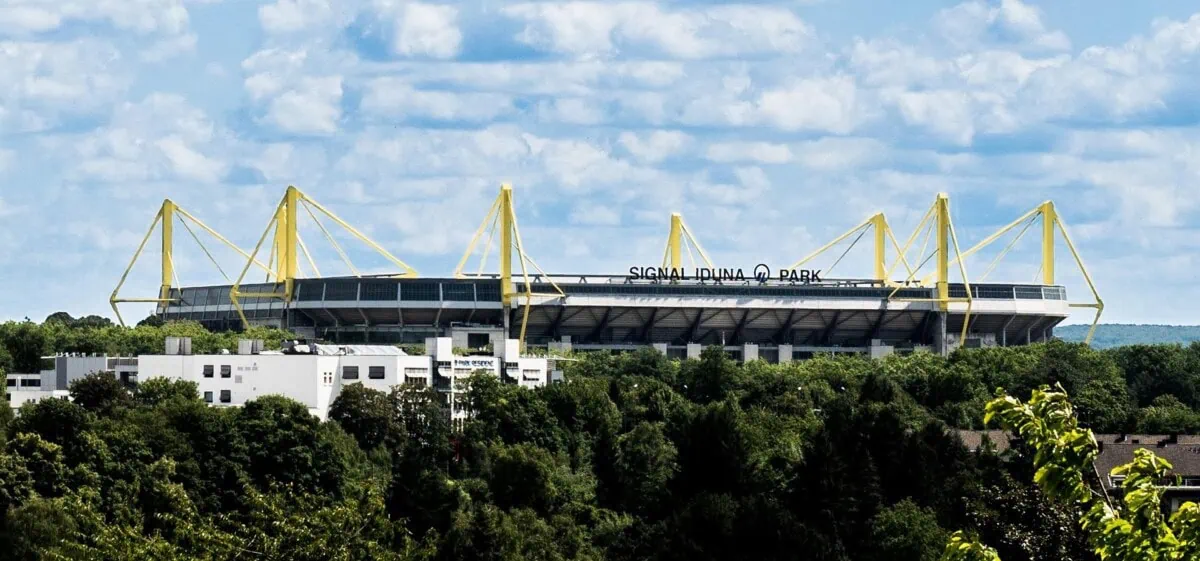
That scale is written into the ground itself. Signal Iduna Park, still known to many fans by its older name Westfalenstadion, opened in 1974 and has been expanded through several major renovations since, most recently ahead of the 2006 World Cup. It now holds 81,365 supporters for Bundesliga fixtures, making it comfortably the largest football stadium in Germany and one of the biggest club grounds anywhere in Europe.
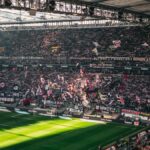
The stadium’s reputation rests on more than raw seat count. The south stand, known worldwide as the Yellow Wall, holds around 24,454 standing supporters and is widely regarded as the largest free-standing terrace anywhere in European football, a genuinely unusual thing to find inside a modern top-flight ground still hosting Champions League nights.
A ground this size brings genuinely different logistics from a normal Bundesliga away day. Moving tens of thousands of fans in and out of one part of the city twice inside a few hours takes more planning than a smaller stadium ever needs, and Dortmund’s own transport network is built specifically around handling it.
This guide breaks down the U45 and regional rail journey from central Dortmund, what actually happens once matchday crowds build around the stadium, an honest take on driving and parking, and how buying a ticket for one of the world’s most fervently supported clubs actually works. It also covers the Yellow Wall itself and what makes a visit here different from almost anywhere else in football.
| Club | Stadium | Capacity | Nearest Station | League (2026/27) |
|---|---|---|---|---|
| Borussia Dortmund | Signal Iduna Park | 81,365 (Bundesliga) / 66,099 (UEFA) | Stadion (U45) / Dortmund Signal Iduna Park (regional rail) | Bundesliga |
Transport at a Glance: Nearest Stops for Signal Iduna Park
Before the full breakdown below, here is every nearest stop for Signal Iduna Park in one place, covering the U-Bahn, regional rail and bus options that between them handle the bulk of matchday arrivals.
| Mode | Stop / Station | Line(s) | Walk Time to Stadium |
|---|---|---|---|
| U-Bahn (Stadtbahn) | Stadion | U45 | 10 to 15 min |
| U-Bahn (Stadtbahn) | Theodor-Fliedner-Heim | U42 | Short walk to the north side |
| U-Bahn (Stadtbahn) | Westfalenhallen | U46 | Short walk to the east side |
| Regional Rail | Dortmund Signal Iduna Park | RB52, RB53, RB59 (plus Dortmund-Sauerland-Express on matchdays) | Under 5 min, station sits directly beside the ground |
| Bus | Westfalenhallen | 450 (reinforced on matchdays) | Short walk, same area as the U46 stop |
Getting to Signal Iduna Park by U-Bahn and Rail
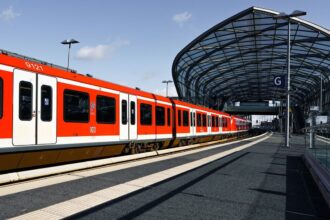
Almost every visiting fan reaches Signal Iduna Park the same way. The U45 Stadtbahn line runs directly from Dortmund Hauptbahnhof to the Stadion stop, and on matchdays it runs at least every five minutes from around three hours before kickoff until ninety minutes after the final whistle, which is a genuinely serious frequency built specifically for a crowd this size.
From the Stadion stop, the walk to the stadium is short and clearly signposted, generally reckoned at around ten to fifteen minutes depending on which entrance a ticket points to. The route runs alongside Westfalenpark for much of the way, which makes it a pleasant enough walk even in a large crowd.
Two further light rail lines offer alternative approaches for anyone whose ticket points to a different side of the ground. U42 stops at Theodor-Fliedner-Heim and U46 at Westfalenhallen, both a short walk from the stadium’s northern and eastern sides respectively.
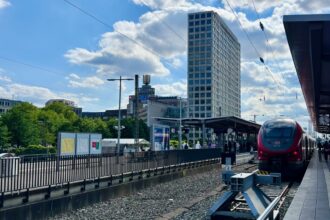
Anyone arriving by regional train has a dedicated option too. Dortmund Signal Iduna Park station sits directly beside the ground and is served by the RB52, RB53 and RB59 regional lines, and on home matchdays the Dortmund-Sauerland-Express adds extra stops there specifically to help fans travelling in from further out.
A standard VRR ticket covers the whole journey on either the U-Bahn or the regional trains, since none of this runs as a football-specific fare. A short single fare costs in the region of €3.60 (£3.10/$4.21), and the same ticket works for the return trip home.
Buy that ticket before setting off rather than queuing at a machine at the Hauptbahnhof, since platforms get busy in the hour before kickoff. It is easy to assume Germany’s biggest stadium needs some special matchday service, when in Dortmund’s case the everyday U45 and regional rail network genuinely is the plan built for it.
Best if you want daily housekeeping and a front desk. Filter by area first, then by price.
Check availabilityBest for groups who want one address and separate bedrooms rather than three hotel rooms.
See holiday homesBest as a last check before booking. Compares hotel rates across several sites in one search.
Compare ratesHow Dortmund Actually Moves 81,000 Fans on Matchday
A stadium holding 81,365 people is not a normal Bundesliga away day, and the club’s own advice reflects that scale directly. BVB’s official guidance for every home fixture is blunt: travel by public transport, fan buses, on foot or by bike, because the roads around the stadium genuinely cannot absorb tens of thousands of cars arriving and leaving inside the same short window.
The U45’s five-minute frequency exists precisely because of this crush, and even at that frequency the platforms at both the Hauptbahnhof and the Stadion stop feel genuinely packed for twenty to thirty minutes either side of kickoff. Anyone travelling with children or reduced mobility should expect a crowded platform rather than a quiet, comfortable ride.
Extra stewards and transport staff are a routine sight around the stadium’s approaches on any well-attended fixture, and the club runs additional Dortmund-Sauerland-Express stops at the dedicated regional station purely to spread the load across more than one line. Roads throughout this part of the city are officially described as very busy on BVB matchdays, not just around the ground itself.
Leaving right on the final whistle expecting an immediate ride home rarely works out at a ground this size. The smarter move is either lingering inside the concourse for ten to fifteen minutes while the first surge clears, or simply accepting a fuller-than-usual U45 as part of the experience.
Arriving at least 60 to 90 minutes before kickoff is the realistic minimum for a stadium of this size, and fixtures against major rivals or in European competition draw noticeably heavier crowds through every approach than a routine midweek league game. Building in real time either side of the match, rather than treating an 81,000 capacity as an abstract number, is the single biggest factor in a stress-free visit here.
Nothing about this is unique to Dortmund among Europe’s biggest clubs, but few grounds combine this capacity with a fanbase quite this large and vocal. It is exactly why the transport plan matters more here than at almost any other German stadium.
Driving to Signal Iduna Park: Ten Thousand Spaces and One Big Catch
Driving to Signal Iduna Park is possible, and the stadium’s surroundings do offer a genuinely large amount of parking by German standards. More than 10,000 spaces are spread across dedicated matchday car parks run by two separate operators, Messe Dortmund and DOPARK 21, which between them cover most of the area immediately around the ground.
The catch is that almost none of it works on a turn-up-and-pay basis. Messe Dortmund’s lots (A1 through A8) and DOPARK 21’s lots (C1/C2, D1/D2 and E1 through F3) both require a parking permit bought online in advance, typically priced somewhere in the region of €10-20 (£8.60-17.20/$11.70-23.40) depending on the lot and how far ahead it is booked.
A separate university shuttle offers a cheaper backup route in. The Otto-Hahn-Straße car park at TU Dortmund runs a shuttle bus to the Theodor-Fliedner-Heim U-Bahn stop for a flat €2 (£1.72/$2.34) fee, operating from three hours before kickoff until two hours after the final whistle.
The club’s own official advice mirrors the transport reality covered earlier in this guide: travel by public transport, fan bus, on foot or by bike rather than by car, because the roads around the stadium get genuinely congested on every BVB home matchday, not just for the biggest fixtures.
Anyone without a specific reason to drive, such as travelling with a large group from outside the rail network, will have a considerably easier day on the U45 or a regional train than hunting for a pre-booked space among 10,000 others. A stadium with this much parking does not automatically mean an easy drive, since the sheer scale of the crowd makes the roads themselves the real bottleneck.
Anyone who does decide to drive should book a permit as early as possible, since spaces for popular fixtures sell out well before matchday. Checking the current pricing and availability directly through Messe Dortmund or DOPARK 21’s own booking pages before travelling is the safest way to avoid arriving to find nothing left.
Getting Hold of a Borussia Dortmund Ticket: What the Closed Waiting List Really Means
Buying a ticket for a Borussia Dortmund match is not the simple, walk-up process a club this size might suggest to a first-time visitor. The season ticket waiting list was closed a few years ago because of the sheer volume of requests, a genuinely striking fact for a club that already fills over 81,000 seats for almost every home fixture.
Single match tickets are sold exclusively through the club’s official online ticket shop or its partner Adrenalin-Trips, and whether a given fixture gets a members-only presale window or opens straight to general sale varies match by match. Checking the official shop as soon as a fixture list is confirmed is the only reliable way to plan around this.
BVB’s global following, built in large part on the reputation of the Yellow Wall itself, means demand for marquee fixtures against major rivals or in European competition regularly outstrips supply within the club’s own presale windows. Visitors flying in specifically for a match should treat a big Dortmund fixture with the same seriousness as a ticket for one of Europe’s most famous clubs, because that is exactly what it is.
For fans who end up with a spare ticket, or need one after general sale has closed, the club runs its own official ticket exchange once a match sells out, open until two and a half hours before kickoff. That official channel is the safest route for anyone hoping to pick up a late ticket.
Buying a ticket from an unofficial source outside these channels is best avoided here. German match tickets are routinely checked against identification at the turnstile, so anything bought outside the club’s own system carries a real risk of being refused entry on the day.
The plain advice is to plan well ahead, watch the official shop for presale dates, and rely on the club’s own exchange rather than a general secondary market if plans change. First-time visitors often assume a huge, world-famous club automatically means tickets stay available right up to matchday, when for Dortmund specifically the opposite is generally closer to the truth.
What You Can’t Bring: Stadium Rules and Prohibited Items at Signal Iduna Park
Signal Iduna Park runs one of the strictest bag policies in the Bundesliga. Backpacks are banned outright, and any other bag is capped at A4 size with a maximum depth of 15cm, though the club runs dedicated bag storage points near the northwest entrance and the guest gates for anything bigger.
Weapons or objects that could be used as weapons, hazardous substances and laser pointers are all banned, and pyrotechnics are treated just as strictly, covering flares, smoke bombs and anything else designed to burn or explode. Noise-making devices such as air horns and electric megaphones are also refused at the gate.
Glass containers and anything made from hard, splintering material are banned, and the rule goes further than most grounds by prohibiting all outside food, drink and drugs rather than just alcohol. Bulky items including stools, prams and walking frames are also turned away, so anyone with mobility needs should contact the club in advance for the accessible entrances instead.
Flag and banner poles are allowed only up to 1.5 metres in length and 3cm in diameter, and professional cameras, recording equipment and drones all need prior accreditation. Anything designed to conceal someone’s identity, including full-face coverings, is refused entry on the same basis as a weapon would be.
Racist, xenophobic or extremist material of any kind is banned outright, and opposing club colours are specifically restricted inside the Yellow Wall and other designated home sections. The full, current rules are published on BVB’s own stadium regulations page, worth checking before a big European night in particular.
In and Around the Ground: the Fanshop, the Bars and the VIP Option
The official BVB Fanwelt, also called BVB Fan World, sits at the northwest corner of Signal Iduna Park and works as the club’s one-stop shop for anything supporter-related. The roughly 2,000-square-metre building houses two separate 600-square-metre merchandise halls stocking around a thousand different items, plus ticketing, travel bookings, stadium tour sign-ups and membership services all under one roof. On matchdays the club opens as many as twenty checkout counters at once to keep queues moving, and the building has direct access to both the stadium and the B1 road, with its own parking so visitors are not left hunting for a space among the general matchday car parks.
The immediate area around the ground has its own pre-match culture rather than relying on the concourse alone. Strobels, on Strobelallee right by the stadium, is the closest matchday bar and beer garden, packed with big screens and grill food and only steps from the gates, while the neighbouring Biergarten im Stadion Rote Erde, inside BVB’s former 1937 to 1974 home ground next door, also opens as a beer garden on fixture days. Fans who prefer a proper pub crawl before kickoff tend to start further out in the Kreuzviertel, a bar district around thirty minutes’ walk from the stadium, and drift toward the ground from there. Anyone hoping to stand with the Yellow Wall itself should know the regulars are not casual about it either, arriving up to two hours early purely to claim a good spot on the terrace.
For visitors who want more than a standard seat, Borussia Dortmund runs its own official hospitality and VIP programme through the club’s website, covering VIP lounge access, premium VIP seating and a dedicated hospitality app for managing bookings. The club markets these as offering luxurious lounges, dedicated catering and exclusive service for fans and business partners alike, and packages are sold directly through BVB’s own hospitality pages rather than the general ticket shop, so anyone interested should check availability there well before a fixture rather than assuming standard sale channels cover it.
The Yellow Wall: Why Signal Iduna Park Is Different
What sets Signal Iduna Park apart from almost every other major European ground is the Südtribüne, universally known as the Yellow Wall. It holds around 24,454 standing supporters and is widely regarded as the largest free-standing terrace anywhere in European football, a scale that has survived decades of stadiums elsewhere converting entirely to all-seater grounds.
The stand’s reputation is not marketing exaggeration. Opposing players, including Bayern Munich’s own Bastian Schweinsteiger, have described it as the most intimidating atmosphere anywhere in the Bundesliga, and the sheer wall of noise and colour it produces is credited with helping Dortmund go unbeaten at home throughout their run to the 2012-13 Champions League final.
That capacity is not fixed, either. For UEFA competition, where standing terraces are not permitted, the Yellow Wall converts to seating and the stadium’s overall capacity drops to 66,099, a genuinely unusual detail that shows just how much of the ground’s Bundesliga capacity comes from this one stand alone.
The stadium itself has grown into this scale gradually rather than all at once. It opened in 1974 for that year’s World Cup with a considerably smaller capacity, and successive renovations through 1992, 1995-99, 2002-03 and 2006 steadily expanded it into the 81,365-capacity ground it is today, taking the Signal Iduna Park name from a 2005 sponsorship deal along the way.
What makes a visit here special is not simply the trophy cabinet, respectable as it is, but the combination of a genuinely massive crowd with a terrace culture that most of the continent’s biggest clubs abandoned decades ago. Standing among 24,454 people singing in one stand is an experience very few stadiums in world football can still offer.
Even a walk around the stadium’s exterior on a non-matchday, past the Yellow Wall’s vast curved facade, gives some sense of the scale involved before a ball is even kicked. It is, quite simply, one of the defining sights in German football.
Best for finding routes the airlines do not sell as a single ticket. Combines carriers to bring the fare down.
Search flightsBest for short trips. Install the eSIM at home and arrive with working data, no shop queue.
Browse eSIMsBest after a long flight or a late landing. Price agreed before you travel, and no taxi queue.
Check transfersVisiting Signal Iduna Park Beyond Matchday
Signal Iduna Park is not just a matchday venue. The stadium’s own club museum and tour programme run on non-matchday afternoons, taking visitors through the changing rooms, the pitchside tunnel and, for some tour options, out onto the Yellow Wall itself, and the merchandise store beside the ground stays open daily regardless of fixtures.
A short tram ride away, the German Football Museum near Dortmund Hauptbahnhof covers the wider story of the national game in a purpose-built venue, and pairing the two makes for a genuinely full football day even without a ticket for a fixture. Because there is enough detail here to deserve its own space, this site covers both in full in our dedicated Things to Do in Dortmund guide rather than repeating tour times and prices in this one.
Anyone planning a trip specifically to see the stadium without a match ticket should check current tour dates before travelling, since access to parts of the ground is naturally restricted while it is being prepared for a fixture. Tours generally run in small groups on set weekly slots rather than on demand throughout the day.
Combining a stadium visit with the wider city is straightforward given how central Dortmund’s main sights are. The football museum, the Dortmunder U art gallery and Westfalenpark’s rose garden all sit within a short tram ride of each other, making a non-matchday football day easy to build around.
For a club of Borussia Dortmund’s stature, the stadium itself functions as a genuine attraction independent of the fixture list. Few grounds in Germany reward a closer look at the empty stands and the scale of the Yellow Wall quite as much as this one does.

Rupert’s Handy Travel Tips
Heading to a Borussia Dortmund matchday? Rupert has a few tips that can save both time and a lot of standing around:
- Take the U45 to Stadion, not a taxi: it runs every five minutes on matchdays and the whole approach to the ground is built for it.
- Buy your VRR ticket before you set off: machines at the Hauptbahnhof get busy in the hour before kickoff.
- Check the official ticket shop the moment a fixture is confirmed: the season ticket list has been closed for years, and single tickets for big matches go fast.
- If you drive, book a permit online well in advance: the 10,000-plus spaces around the stadium are not available on a turn-up-and-pay basis.
- Arrive 60 to 90 minutes early: a crowd of 81,000 needs more time than a smaller stadium ever does.
- Save the museum and tour for a separate day if you can: both run on non-matchday schedules rather than fitting neatly around a fixture.
Want to meet the reindeer behind our travel tips? Find out more in our page Who is Rupert?.


Frequently Asked Questions About Getting to Signal Iduna Park
How do I get to Signal Iduna Park from central Dortmund?
Take the U45 Stadtbahn line from Dortmund Hauptbahnhof to the Stadion stop, which runs at least every five minutes on matchdays and drops you a ten to fifteen minute walk from the ground.
Is there a train station right at the stadium?
Yes. Dortmund Signal Iduna Park station sits beside the ground on the RB52, RB53 and RB59 regional lines, with extra Dortmund-Sauerland-Express stops added there on home matchdays.
Should I drive to a Borussia Dortmund match?
The club’s own advice is to travel by public transport, fan bus, on foot or by bike, since the roads around the stadium get genuinely congested on every home matchday. Driving is possible, but any of the 10,000-plus parking spaces must be booked online in advance.
Are Borussia Dortmund tickets easy to get hold of?
Not generally. The season ticket waiting list has been closed for several years due to demand, and single tickets for popular fixtures can sell out within the club’s own members’ presale before general sale even opens.
Can I buy Borussia Dortmund tickets from resale websites?
This is not recommended. Tickets are checked against identification at German turnstiles, so anything bought outside the club’s official ticket shop or its own official exchange risks being refused at the gate.
What is the Yellow Wall?
The Yellow Wall is the nickname for the Südtribüne, Signal Iduna Park’s south stand, which holds around 24,454 standing supporters and is widely regarded as the largest free-standing terrace in European football.
What is the capacity of Signal Iduna Park?
Signal Iduna Park holds 81,365 spectators for Bundesliga fixtures, making it the largest football stadium in Germany. For UEFA competition, where standing terraces are not permitted, capacity drops to 66,099 all-seated.
Can I visit Signal Iduna Park without a match ticket?
Yes. The stadium runs a club museum and tour programme on non-matchday schedules, covered in full alongside the German Football Museum in our Things to Do in Dortmund guide.
Further Reading & Related Guides
Landing in the city before a match? Our Dortmund Airport Transfers guide covers every realistic way of reaching the centre from DTM, while our Things to Do in Dortmund guide rounds up the sights worth prioritising around a matchday visit, including the German Football Museum and the club’s own tour programme.
If a match falls on a free day, our Best Day Trips from Dortmund guide covers Essen, Bochum, Cologne and Düsseldorf for the rest of your stay. For the wider picture on getting around by rail, our German Rail Tickets Explained guide breaks down the Deutschland-Ticket and regional VRR fares that also cover the U45 and regional trains used to reach Signal Iduna Park.