Reviewed by our editorial team Published
Werder Bremen is one of the founding names of German professional football, a club whose green and white shirts have been a fixture of the top flight for the vast majority of the Bundesliga’s existence. Founded on 4 February 1899, the club has won four Bundesliga titles, most recently in 2003-04, and six DFB-Pokal trophies stretching from 1960-61 through to 2008-09, a haul that puts Werder comfortably among Germany’s most decorated clubs outside the very biggest names.
That history sits alongside a genuinely committed modern fanbase. Werder Bremen count over 40,000 members, and the club’s oldest and fiercest rivalry, the Nordderby against Hamburger SV, remains one of the most historically loaded fixtures anywhere in the north of the country, rooted in a civic rivalry between the two Hanseatic cities that predates football itself. After a genuinely nervy finish to the 2025-26 season, Werder’s Bundesliga survival was confirmed in May 2026, and the club opens the 2026-27 campaign back in the top flight rather than the second tier.
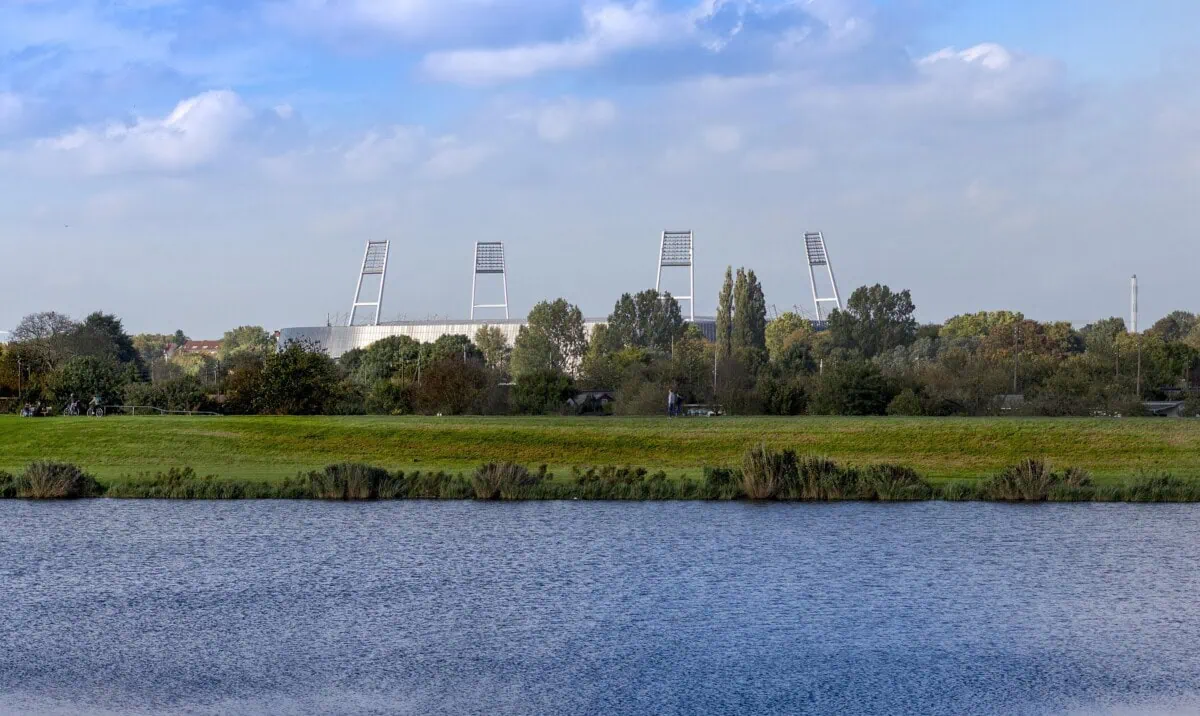
The club’s home ground carries one of German football’s most distinctive settings. Officially the wohninvest WESERSTADION, though almost everyone, including this guide, simply calls it the Weserstadion, it sits at Franz-Böhmert-Straße 1 in the Peterswerder district, directly on the north bank of the River Weser and barely a kilometre from Bremen’s old town. That riverside position is not just scenery: it makes arriving by boat a genuine, currently operating option for matchday travel, something almost no other Bundesliga ground can claim.
Capacity now stands at 42,100 for Bundesliga fixtures, dropping to 37,441 for UEFA competitions once additional seating requirements are applied. The ground traces its origins back to 1909, took the Weserstadion name in 1930, and was rebuilt in stages between roughly 2005 and 2011, with the pitch lowered and the athletics track removed in 2002 followed by a €76.5 million (£65.79 million/$89.51 million) overhaul of the stands, roof and facade completed in 2011.
What follows is a practical breakdown of every way to reach the Weserstadion: the tram and bus routes from central Bremen, an honest look at driving and the club’s Park and Ride options, how ticket buying works for one of the Bundesliga’s most loyal fanbases, and the genuinely unusual option of arriving by boat along the Weser. It also covers the ground’s history and naming, the Ostkurve atmosphere, the riverside area for food and drink, and accessibility and safety on a matchday.
| Club | Stadium | Capacity | Nearest Station | League (2026/27) |
|---|---|---|---|---|
| Werder Bremen | wohninvest WESERSTADION | 42,100 (Bundesliga) | Tram Weserstadion (Line 3) | Bundesliga |
Transport at a Glance: Every Way to Reach the Weserstadion
Before the full breakdown below, here is every nearest stop and route to the ground in one place, including the boat option most Bundesliga stadiums cannot offer.
| Mode | Stop / Station | Line(s) | Walk Time to Stadium |
|---|---|---|---|
| Tram | Weserstadion | Line 3 | Short, flat walk, the stop is named for the ground |
| Tram | St.-Jürgen-Straße | Lines 2, 10 | Short walk, a little further out than the Weserstadion stop |
| Bus (matchday only) | An Weserstadion (event terminus) | Special event buses, e.g. 24E, 26E, 27E, 37E, 41E, 91E, 94E | Buses terminate directly beside the ground |
| Boat | Stadium dock (departs Vegesack, Waterfront/Pier2, Martinianleger) | hal-oever.de boat transfer, reservation required | Dock sits right beside the ground |
Getting to the Weserstadion by Tram and Bus
The single most useful fact for a first-time visitor is that tram line 3, part of Bremen’s BSAG-run network, stops directly at a purpose-named Weserstadion halt, putting riders within a short, flat walk of the turnstiles rather than leaving them to work out a longer approach from a generic city-centre stop.
Two further lines offer a genuinely useful backup. Tram lines 2 and 10 both call at St.-Jürgen-Straße, a stop close enough to the ground to serve as a second approach when the direct Weserstadion platform is at its busiest, and independent journey-time estimates put the ride from Bremen Hauptbahnhof at somewhere in the region of 15 to 20 minutes depending on the exact line and time of day.
A standard BSAG single ticket covers the whole journey without any special matchday supplement, priced at around €3.40 (£2.92/$3.98) and available from a platform machine or the BSAG app before boarding. Crucially, anyone holding a valid matchday ticket can travel free on BSAG and VBN buses and trams on the day of the game, which removes the need to buy a separate transport ticket at all for most visitors.
This free-travel perk is worth building into planning from the outset, since it applies equally to trams heading in from the Hauptbahnhof and to services returning from any of Bremen’s outlying Park and Ride sites covered later in this guide. It is worth checking BSAG’s own event traffic page in the days before a fixture, since additional matchday schedules and any temporary diversions are typically published there roughly three days ahead.
The nearest-sounding stop is not always the closest one to your actual entrance in practice, since the Weserstadion stop on line 3 and the St.-Jürgen-Straße stop on lines 2 and 10 suit different sides of the ground depending on which block your ticket points to. Walking from central Bremen is also genuinely realistic, since the ground sits well under two kilometres from the Marktplatz along the riverside.
Compare hotels and other places to stay for your trip.
Check availabilityExplore holiday homes and apartments for your trip.
See holiday homesCompare hotel prices across multiple booking sites.
Compare ratesHandling the Crowds at Weserstadion and St.-Jürgen-Straße on Matchday
A ground holding 42,100 fans can turn even a purpose-named tram stop into a genuinely crowded platform, and the Weserstadion and St.-Jürgen-Straße stops both feel busy for twenty to thirty minutes either side of kickoff on a well-attended fixture. Werder’s status as one of the Bundesliga’s longest continuously supported clubs means crowds here rarely thin out for a routine midweek match the way they might elsewhere.
Extra trams are the standard response to a full house rather than a separate shuttle network, since Bremen’s own BSAG timetable publishes additional matchday services on the relevant lines ahead of every home fixture. Stewards and transport staff are a routine, visible presence around both approaches on any well-attended game, particularly the Nordderby against Hamburger SV.
The Ostkurve, Werder’s standing home end, adds its own texture to the crowd flow once the final whistle goes. A large standing section empties more slowly and less predictably than rows of numbered seats, so anyone planning to meet friends outside should expect the exit to take rather longer than the walk in did.
Leaving right on the final whistle expecting an immediate tram home rarely pays off. The smarter move is either lingering inside the concourse for ten minutes while the first surge clears, or simply accepting a fuller-than-usual service back into the centre as a normal part of the experience at a ground this size.
Arriving at least 45 to 60 minutes before kickoff is the simplest way to avoid both the inbound crush and any last-minute queue at the turnstiles. Fixtures against Hamburger SV, or any side with a large travelling following, tend to draw noticeably heavier crowds through both stops than a routine home game elsewhere in the calendar.
Driving to the Weserstadion: Routes, Restrictions and Park and Ride Options
Driving to the Weserstadion is entirely possible, with the ground reachable from the A1 motorway for anyone arriving from Hamburg, Hannover, Osnabrück or Oldenburg, and from the A27 for traffic coming in from Bremerhaven, with matchday signage directing drivers rather than leaving visitors to navigate local junctions unassisted.
The stadium’s own regular car parks, numbered 1 through 6, are closed to general traffic on matchdays and reserved for permit holders, so casual drivers should not plan on finding a space immediately beside the ground itself. Paid parking does exist further out for anyone determined to drive right up to the stadium, though availability tightens considerably as kickoff approaches.
For anyone coming from further afield, Werder Bremen and the regional transport network run two genuinely useful Park and Ride options. Hemelinger Hafen, reached via the A1, offers a free shuttle bus that reaches the Weserstadion in around ten minutes for anyone holding a valid matchday ticket, while Hansa-Carré, reached via the A27, connects straight into the tram network on line 3 free of charge, with the club specifically asking football fans to use the upper parking deck there.
Unless there is a specific reason to need a car right at the ground, the free Hemelinger Hafen or Hansa-Carré Park and Ride sites will get most visitors there, and more importantly get them home again, with considerably less hassle than hunting for a paid space close to Franz-Böhmert-Straße once matchday traffic builds through the surrounding streets.
The ground’s own numbered lots are not available on a turn-up basis, whatever a map might suggest; they are restricted to permit holders on every home fixture. Anyone driving specifically for accessibility reasons should contact the club in advance, since designated disabled parking exists close to the ground but allocations are limited and best confirmed ahead of matchday rather than discovered on arrival.
Buying Werder Bremen Tickets: What to Expect
Buying a ticket for a Werder Bremen home match is not the casual, walk-up affair a mid-table Bundesliga side might otherwise suggest. The club’s official ticket shop at werder.de is the only sensible place to start, and it is worth checking well ahead of a fixture given how loyal and long-standing much of the club’s support base is.
Season-ticket holders and Werder’s more than 40,000 club members get first claim on every home league fixture, with whatever remains then opening to general sale. That membership base is a genuine factor in how quickly popular matches sell through, and it is one of the reasons Bremen’s average attendances hold up well regardless of the club’s position in the table on any given weekend.
Prices vary by category and fixture, with standing terrace tickets in the Ostkurve generally among the more affordable options in the ground, while seated tickets for the Nordderby against Hamburger SV, or a visit from one of the Bundesliga’s other big-name clubs, tend to move through the pre-sale tiers considerably faster than a routine midweek fixture.
International visitors are not locked out of this system, but it is worth checking the official shop as soon as a fixture list is confirmed rather than assuming tickets will still be available close to matchday, especially for the club’s biggest home games of the season.
German match tickets are also routinely checked against identification at the turnstile, which is the practical reason buying outside official channels carries real risk rather than a theoretical one. A ticket bought from an unrecognised source can simply be refused entry if the name does not match, so the plain advice here is to start with the official shop and treat any other offer with real caution.
What You Can’t Bring: Stadium Rules and Prohibited Items at the Weserstadion
The Weserstadion caps bags, backpacks and gym bags at DIN A4 size, so anything bulkier should be left behind or dropped off before heading to the turnstiles. Staff carry out routine checks at every gate, and a bag that’s clearly oversized will simply be turned away.
Weapons of any kind under German weapons law, along with imitation weapons and anything designed to injure someone or damage property, are banned outright. Gas spray cans, corrosive substances, flammable liquids and pressurised containers are also refused, with an exception for standard toiletries up to 100ml.
Glass bottles, cans, cups and jugs made from breakable or particularly hard material are banned at the gate, and pyrotechnics are treated with equal seriousness, covering fireworks, flares, Bengal fire and smoke bombs of any kind. None of this is negotiable regardless of the fixture.
Professional or semi-professional cameras and video equipment need written permission in advance, and laser pointers are banned outright, as is anything designed to obscure someone’s identity. Oversized flags, banners and transparents need clearing with the club first, and motorised noise-making instruments are also refused. Away fans in particular should double check these limits before travelling, since visiting supporters are searched just as thoroughly as home fans.
Outside food and drink is banned beyond a small allowance, with non-alcoholic drinks limited to 0.33 litre Tetra Paks and nothing else getting past security. The full, current rules are published on the stadium’s own Stadionordnung, worth a quick check before travelling for a bigger fixture, particularly if arriving from outside Germany where norms can differ.
In and Around the Weserstadion: Fanshop, Fan Bars and Hospitality
Werder Bremen’s official club shop, the WERDER Fan-Welt, sits on the eastern side of the ground at Franz-Böhmert-Straße 5a, a couple of minutes’ walk from the turnstiles. Outside matchday it keeps fairly ordinary hours, open Monday to Friday from 10am to 6pm and Saturday from 10am to 3:30pm, and online orders can also be collected there on a matchday itself, though the club’s own advice is to pick things up after the final whistle rather than before, since certain items cannot be taken into the stadium under the ground’s own entry rules.
The streets around the ground have their own established matchday meeting points rather than leaving everything to the concourse. Two long-standing pubs, the Eisen and the Taubenschlag, sit close to the Weserstadion and are where a good number of Werder fans gather to build up to kickoff or carry on afterwards, and the riverside Osterdeich walk into the ground is treated by regulars as part of the matchday ritual rather than just a route in.
Hospitality is genuinely available for anyone wanting more than a standing ticket. Werder Bremen runs a full VIP and business hospitality programme at the Weserstadion, spanning VIP day tickets, business seats and dedicated VIP boxes, with catering handled through Supreme Sports Hospitality Bremen rather than the standard concourse kiosks. Packages are booked through the club’s own VIP ticket shop or by contacting the hospitality team directly, and it is worth registering and enquiring well ahead of a fixture, particularly for a high-demand match like the Nordderby.
The Unique Way In: Taking the Boat to the Weserstadion
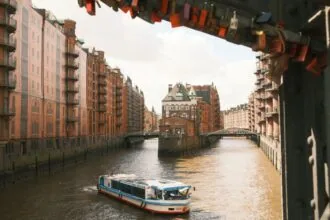
Few Bundesliga grounds anywhere in Germany offer a genuine boat-arrival option, but the Weserstadion’s position directly on the River Weser makes exactly that a real, currently operating part of Werder Bremen’s matchday transport network rather than a novelty mentioned once and forgotten.
Operated by hal-oever.de, a fleet of five ships shuttles fans before and after every home match from three separate points along the river: Vegesack in the north of the city, the Waterfront/Pier2 development closer to the centre, and the Martinianleger jetty right by Bremen’s old town, all sailing directly to a dedicated dock beside the stadium itself.
Between them, the five vessels can carry up to 4,000 fans on a single matchday, a genuinely meaningful slice of the ground’s 42,100 capacity rather than a token gesture, and the service requires a separate reservation and payment through the operator rather than being covered by a standard match ticket or BSAG transport pass.
The appeal here goes well beyond simple novelty. Arriving by river avoids the tram and road congestion around the Weserstadion stop entirely, gives a genuinely striking view of the stadium from the water as the boat pulls in, and turns an ordinary matchday journey into something closer to a proper Bremen experience, particularly for visitors who have already covered the tram and driving options on previous trips.
Booking well ahead through hal-oever.de directly is the smart move, since capacity across the fleet is fixed and popular fixtures such as the Nordderby can see the boats fill before general match-ticket sales even close. This is not some kind of tourist gimmick tacked on for novelty’s sake; Bremen’s own tourism authority and the club’s official matchday guidance both list it as a genuine, practical way in.
Compare routes and fares for your next trip.
Compare flightsChoose an Airalo eSIM and arrange mobile data before you arrive.
Browse eSIMsBook a private airport transfer in advance and have your ride planned before you arrive.
Check transfersFrom ATSB Kampfbahn to Weserstadion: History and the 2005-2011 Rebuild
The ground’s story stretches back further than its current sleek appearance suggests. It was first built in 1909 by the local sports club Allgemeiner Bremer Turn- und Sportverein, and after a significant update in 1926 it briefly carried the name ATSB Kampfbahn before taking the name it has kept ever since, in one form or another, in 1930: the Weserstadion.
Development continued in stages across the following decades. The ground gained its first covered grandstand in 1963, coinciding with the launch of the Bundesliga itself, and further stands were built and updated step by step through the following thirty years, including one of German football’s first dedicated VIP boxes added in 1992.
The stadium’s current form owes most to a major rebuild carried out in stages between 2005 and 2011. The pitch was lowered by 2.1 metres and the surrounding athletics track removed in 2002 to bring spectators closer to the action, before a further overhaul between 2008 and 2011, costing around €76.5 million (£65.79 million/$89.51 million), rebuilt both end stands, replaced the roof and added a distinctive photovoltaic panel facade to the exterior.
Sponsorship arrived on top of that rebuilt structure rather than driving it. The ground has carried the name wohninvest WESERSTADION since the naming rights deal came into effect, though it is worth knowing before a trip that older maps, taxi drivers and plenty of locals still refer to it simply as the Weserstadion, exactly as this guide does throughout.
That layered history is a genuine reason to see the ground even beyond a matchday. Werder Bremen runs its own stadium tour programme, bookable through the club, typically covering the changing rooms, the players’ tunnel and the pitchside technical areas, a route that gives a real sense of the scale of the 2005 to 2011 rebuild up close.
The Ostkurve and Werder Bremen’s Matchday Atmosphere
The Ostkurve, Werder Bremen’s standing home end, is where the club’s matchday atmosphere is genuinely made. It is the cheapest category in the ground and consistently the loudest, and it fills early for any fixture with real stakes attached, from the Nordderby against Hamburger SV to a visit from one of the Bundesliga’s traditionally bigger clubs.
Werder’s fanbase carries a genuine weight that goes beyond a single trophy count. As a club with over 40,000 members and one of the Bundesliga’s longest unbroken presences in German top-flight football, Werder Bremen is regularly cited as having one of the most loyal, longest ever-present fanbases in the entire division, a support that shows up in solid attendances regardless of where the team sits in the table on a given weekend.
The club’s recent history has kept that intensity sharp rather than letting it fade. A nervy relegation battle through much of the 2025-26 season, confirmed as survived only in May 2026, has given the current squad and its supporters a genuinely tense recent story, rather than the mid-table comfort a club of Werder’s stature might otherwise settle into.
Away fixtures at the Weserstadion are treated seriously by visiting clubs and local police alike, and travelling support arriving for the Nordderby or another big Bundesliga fixture should expect a noticeably fuller, louder stadium than a routine mid-table match elsewhere in the division would generate.
First-time visitors sometimes assume a club fighting nearer the bottom of the table will feel subdued on a matchday. The Ostkurve on a full house says otherwise, and it is precisely that gap between Werder’s recent table position and its genuinely deep, decades-long fanbase that gives the ground its edge.
Riverside Walks, Local Food and Where to Drink Around Peterswerder
The Weserstadion’s riverside setting is not just useful for the boat option covered earlier; it also makes a walk along the Weser itself a genuinely easy addition either side of a match, particularly for anyone approaching from the direction of Bremen’s old town along the water rather than cutting straight through the city streets.
The Peterswerder district around the ground offers a solid spread of everyday Gaststätten and bars within easy walking distance, generally quieter and less tourist-priced than anything closer to Bremen’s Marktplatz or the Schlachte promenade further into the centre.
Bremen’s own food culture is worth sampling around a matchday too. Knipp, a regional dish of minced pork, oats and onion fried into a thick patty, is about as close as the city gets to a genuinely local speciality, and it turns up on menus around the ground as readily as anywhere else in the city.
Inside the ground itself, standard stadium catering covers Bratwurst, pretzels and currywurst at the concourse kiosks, alongside local Beck’s beer, Bremen’s own internationally exported brew, priced in line with other German top-flight grounds, with queues at their longest in the fifteen minutes either side of half time.
Eating either well before arriving or waiting until after full time rather than fighting the half-time queue is the smarter play, and a short riverside walk built into the trip either side of kickoff is one of the easiest, no-planning-required additions to a Bremen matchday anywhere in the city.

Wheelchair Access and Accessible Transport to the Weserstadion
Getting to the Weserstadion as a wheelchair user or with reduced mobility is broadly manageable, and the ground’s 2005 to 2011 rebuild means much of its current infrastructure is considerably newer than the older parts of the original 1909 structure it grew from.
On the driving side, disabled parking is available close to the stadium, though spaces are limited on the club’s busier fixtures, and contacting Werder Bremen ahead of a visit removes one common source of matchday stress for visiting fans rather than discovering a full allocation on arrival.
By public transport, the tram network serving both the Weserstadion stop on line 3 and St.-Jürgen-Straße on lines 2 and 10 runs step-accessible services, and the walking routes from either stop to the ground are flat, though the busiest twenty minutes either side of kickoff can still mean a crowded platform for anyone needing extra space or time.
Wheelchair spaces and accompanying-carer seating are available inside the ground itself, and the club’s official ticket shop and fan service team are the right first point of contact for booking these, since accessible allocations are limited and best arranged well ahead of a specific fixture rather than on arrival. The boat service via hal-oever.de is worth checking directly for its own accessibility provisions before relying on it as a primary route.
Leaving accessibility arrangements until matchday itself is the one thing worth avoiding. Contacting Werder Bremen’s service team in advance, whether for parking, seating or general guidance around the ground, remains the simplest way to avoid any last-minute uncertainty on the day.
Safety and What to Expect as a Visitor
German football grounds are, on the whole, well organised and safe for visiting fans, and the Weserstadion is no exception. Bag checks and ticket scans are routine at the turnstiles, and stewards are a constant, visible presence around the tram approaches and the riverside boat dock alike on any matchday.
Standing sections such as the Ostkurve involve genuine crowd movement during goals and big moments, which is a normal part of the experience for regular attendees but worth being mentally prepared for if you have never stood in a large German ultras section before.
Neutral fans and away supporters attending the Nordderby or another big Bundesliga fixture should expect a noticeably more intense atmosphere than a routine weekend out, reflecting Werder’s genuinely loyal and committed fanbase, but organised trouble is rare and heavily policed when it does occur.
As with any large stand, being aware of your nearest exit, keeping valuables secure in a zipped inner pocket rather than a back pocket, and following steward instructions during the post-match crush are the same basic precautions worth taking here as at any large German ground, whether you leave by tram, by car or by boat.
The plain advice is to treat a Werder Bremen matchday with the same common sense as any major German fixture: arrive early, follow the crowd rather than fighting it, and keep an eye on official Werder Bremen and BSAG channels for any last-minute changes around transport or entry on the day itself.

Rupert’s Handy Travel Tips
Heading to a Werder Bremen matchday? Rupert has a few tips that can save both time and a lot of standing around:
- Take tram line 3 straight to the Weserstadion stop: it is named for the ground itself, while lines 2 and 10 land you at St.-Jürgen-Straße a short walk further out.
- Don’t bother buying a transport ticket if you already have a match ticket: ticket holders travel free on BSAG and VBN buses and trams on matchday.
- Book the boat through hal-oever.de well in advance: the five-ship fleet from Vegesack, the Waterfront/Pier2 and the Martinianleger carries up to 4,000 fans, but it needs its own reservation and payment.
- If you drive, head for Hemelinger Hafen or Hansa-Carré Park and Ride: both connect free for ticket holders, unlike the ground’s own numbered lots, which are permit-only on matchday.
- Check the official ticket shop early for the Nordderby: Werder’s 40,000-plus membership base means the Hamburger SV fixture in particular sells through fast.
Want to meet the reindeer behind our travel tips? Find out more in our page Who is Rupert?.



Frequently Asked Questions About Getting to the Weserstadion
How do I get to the Weserstadion from central Bremen?
Take tram line 3 directly to the Weserstadion stop, or lines 2 or 10 to the nearby St.-Jürgen-Straße stop, both roughly 15 to 20 minutes from Bremen Hauptbahnhof.
Can I really take a boat to the Weserstadion?
Yes. A fleet of five ships operated by hal-oever.de shuttles fans before and after every home match from Vegesack, the Waterfront/Pier2 and the Martinianleger to a dedicated dock beside the ground, carrying up to 4,000 fans, though it needs separate booking and payment.
Do I need to pay for the tram if I already have a match ticket?
No. Ticket holders travel free on BSAG and VBN buses and trams on the day of a Werder Bremen home match, so a standard transport ticket is not needed.
Should I drive to a Werder Bremen match?
It is possible, but the stadium’s own numbered car parks are reserved for permit holders on matchday, so most drivers are better served by the free Hemelinger Hafen or Hansa-Carré Park and Ride sites.
Can I buy Werder Bremen tickets from resale websites?
This is not recommended. German match tickets are personalised and checked against identification at the turnstile, so a ticket bought outside official channels can be refused entry if the name does not match.
What is the capacity of the Weserstadion?
The stadium holds 42,100 spectators for Bundesliga fixtures, dropping to 37,441 for UEFA competitions once additional seating requirements are applied.
What is the Weserstadion officially called now?
Its official name is the wohninvest WESERSTADION, following a naming rights agreement, though almost everyone, including locals and this guide, still calls it simply the Weserstadion.
What league does Werder Bremen play in?
Werder Bremen compete in the Bundesliga for the 2026/27 season, having confirmed their survival from relegation danger in May 2026 after a tense finish to the previous campaign.
Compare hostels and lower-cost accommodation for your trip.
Search hostelsAccess compensation support, eligible lounge benefits and faster payouts.
See the benefitsLeave your luggage somewhere convenient and explore hands-free.
View storageFurther Reading & Related Guides
Landing in the city before a match? Our Bremen Airport Transfers guide covers every realistic way of reaching the centre from BRE, while our Things to Do in Bremen guide rounds up the sights worth prioritising around a matchday visit.
If a match falls on a free day, our Best Day Trips from Bremen guide covers Bremerhaven, Worpswede, Verden and Oldenburg for the rest of your stay, and our Bremerhaven Cruise Port Guide is worth a look if a matchday lines up with a sailing from the Columbus Cruise Center. For getting around the wider region by rail, our German Rail Tickets Explained and Interrail Germany Pass Guide both break down the ticket options.