Reviewed by our editorial team Published
Frankfurt gets treated as a stopover more often than a destination, but the city’s real advantage is what sits within an hour or so of its main station. Frankfurt am Main Hauptbahnhof is one of the busiest rail hubs in Europe, and that density of connections means a genuine mix of castles, cathedrals, wine villages and spa towns are all reachable without ever needing a car.
Deutsche Bahn runs the long-distance ICE and IC services that cover the further destinations in well under an hour, while the regional RMV network, Frankfurt’s local transport authority, handles the shorter hops on RE and RB trains at a fraction of the price. Several of the trips below sit inside RMV’s own fare zones, so a day ticket or the nationwide Deutschland-Ticket can genuinely beat buying individual fares.
The single best day trip from the city is Heidelberg, a red sandstone castle ruin above one of Germany’s most romantic old towns, and one of the most popular day trips in the entire country. The Rhine Valley around Rüdesheim trades castle interiors for vineyards, cable cars and a UNESCO-listed river gorge, while Wiesbaden and Mainz both sit closer still, offering an imperial spa town and a cathedral city built around the birthplace of printing respectively. Marburg rounds out the closer group with a hilltop castle and a proper student-town atmosphere further north, and further afield still, Darmstadt, Würzburg, Cologne and Bonn extend the list to nine genuine options, spanning a UNESCO art colony barely twenty minutes away and a Bavarian baroque palace over an hour in the other direction. Below, an at-a-glance table compares journey times and transport for each destination, followed by a dedicated section on every place and a final verdict on which trip suits which kind of traveller.
| Destination | How to Get There | Journey Time | Suggested Time Needed |
|---|---|---|---|
| Heidelberg | Direct ICE or IC train from Frankfurt Hbf | About 50 minutes to 1 hour 10 minutes | Full day |
| Rhine Valley (Rüdesheim) | Direct RB10 RheingauLinie regional train from Frankfurt Hbf | Around 1 hour 10 minutes | Full day |
| Wiesbaden | Direct ICE or regional train from Frankfurt Hbf | About 30 to 40 minutes | Half day |
| Mainz | Direct ICE or IC train from Frankfurt Hbf | About 30 to 40 minutes | Half day |
| Marburg | Direct ICE or RE train from Frankfurt Hbf | About 55 minutes to 1 hour 10 minutes | Half day to full day |
| Darmstadt | Direct RE or ICE train from Frankfurt Hbf | About 15 to 25 minutes | Half day |
| Würzburg | Direct ICE train from Frankfurt Hbf | About 1 hour 5 minutes to 1 hour 25 minutes | Full day |
| Cologne | Direct ICE train from Frankfurt Hbf | About 1 hour to 1 hour 15 minutes | Full day |
| Bonn | Direct or one-change ICE/IC train from Frankfurt Hbf | About 1 hour 15 minutes to 1 hour 45 minutes | Half day to full day |
Heidelberg: Germany’s Most Romantic Castle and Old Town
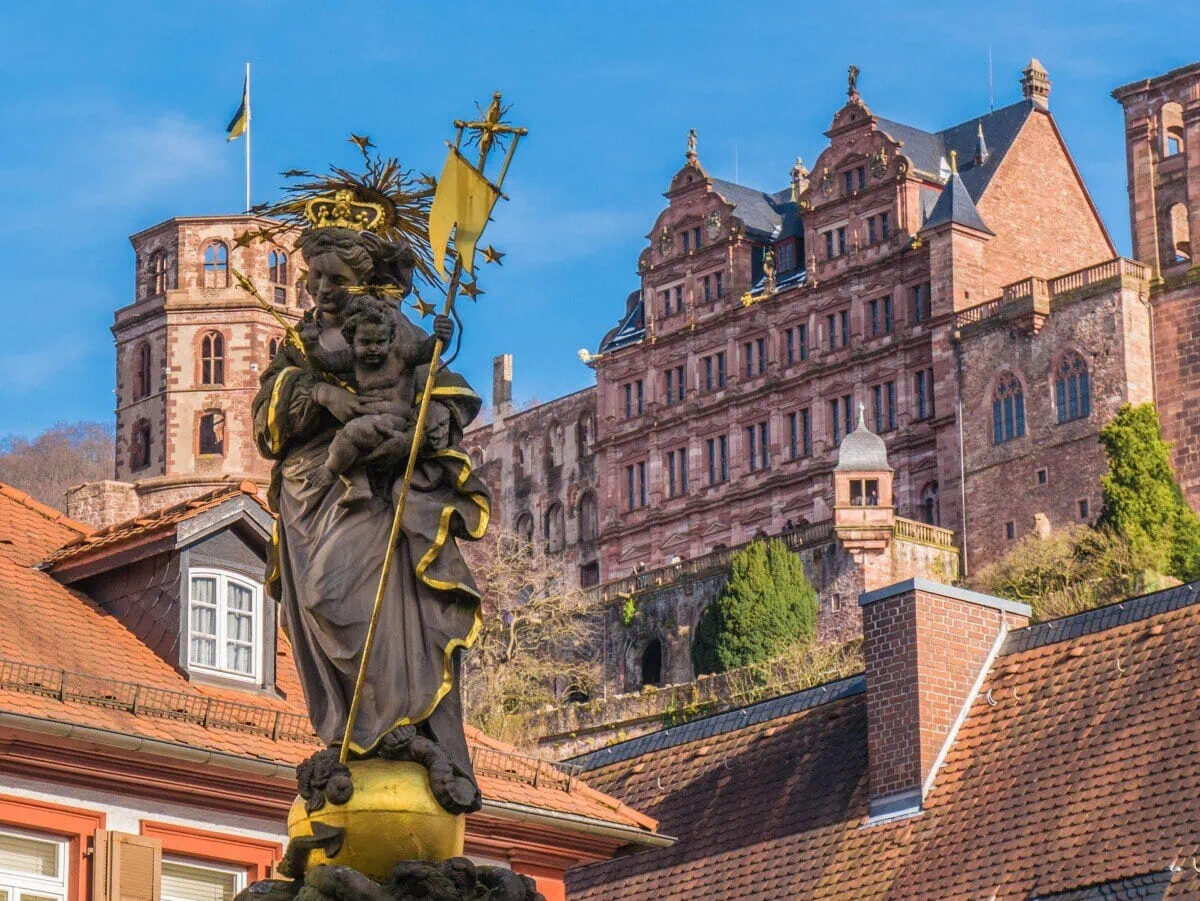
Heidelberg is consistently ranked among the very best day trips in Germany, and it earns that reputation honestly. The red sandstone ruins of Heidelberg Castle sit on a wooded hillside directly above the old town, half-collapsed since a series of wars and a lightning strike centuries ago, yet still one of the most photographed buildings in the country.
Getting there is simple. Direct ICE and IC trains run from Frankfurt Hauptbahnhof roughly every 20 to 30 minutes, with around 30 direct daily departures covering the distance in as little as 50 minutes and typically closer to an hour, and advance Sparpreis fares start from around €7 (£6/$8) each way if booked ahead of time.
The castle itself is reached by the historic Heidelberger Bergbahn funicular, and the standard castle ticket at €11 (£9/$13) covers the round-trip funicular ride, entry to the castle courtyard and the vast wine barrel cellar, and the quirky German Pharmacy Museum housed inside the castle walls. Walking up instead of riding is also entirely possible and adds only about fifteen minutes through wooded switchback paths.
Below the castle, the old town is one of the best preserved in Germany, having largely escaped the bombing that flattened so many other historic centres in the Second World War. The Marktplatz, the Church of the Holy Spirit and the baroque Old Bridge (Alte Brücke), guarded by a bronze bridge monkey statue, all sit within a compact, walkable stretch along the Neckar river.
Across the river, the Philosophers’ Walk (Philosophenweg) climbs the opposite hillside and delivers the single best view back across the old town, the bridge and the castle together, a genuinely worthwhile detour for anyone with an extra hour to spare. It is a proper uphill walk rather than a stroll, so save it for whichever end of the day feels less rushed.
Because the castle, the old town and the Philosophers’ Walk together comfortably fill a whole day, this is one destination on this list worth booking an early train for rather than a leisurely late start. Heidelberg University, founded in 1386 and the oldest in Germany, also gives the city a genuine student-town energy that separates it from a purely tourist-facing old town elsewhere in the country.
Rhine Valley and Rüdesheim: Wine, Cable Cars and a UNESCO Gorge
The Upper Middle Rhine Valley is a UNESCO World Heritage Site running roughly from Rüdesheim and Bingen north to Koblenz, a stretch of river gorge lined with vineyards, half-timbered wine villages and hillside castles at almost every bend. Rüdesheim am Rhein is the easiest gateway into this landscape from Frankfurt, and it packs a surprising amount into a single day.
The RB10 RheingauLinie regional train runs directly from Frankfurt Hauptbahnhof to Rüdesheim with no changes required, taking around 70 minutes and calling at Wiesbaden and a run of wine villages including Eltville, Hattenheim and Geisenheim on the way. A standard single ticket runs to roughly €14 (£12/$16) per person, though the Hessenticket or the Deutschland-Ticket both cover the route and are usually the better option for two or more travellers.
Once in Rüdesheim, the cable car (Seilbahn) climbs 15 minutes through the vineyards above town to the Niederwald Monument, a huge 19th-century monument commemorating German unification, with adult tickets priced at €7.50 (£6/$9) one-way or €12 (£10/$14) return, and children’s fares roughly half that. The monument’s viewing terrace looks straight down the Rhine gorge, and it is genuinely one of the best panoramic views in the whole region.
Travellers with more time can combine the cable car with the Ring Tour, a loop priced at €24 (£21/$28) for adults that adds a short hiking stretch along the Rheinsteig trail, a chairlift descent into the neighbouring village of Assmannshausen, and a short boat crossing back across the river, taking two to four hours depending on pace. Operators KD Köln-Düsseldorfer and Bingen-Rüdesheimer also run longer scenic river cruises further into the gorge toward the famous Loreley rock, a worthwhile add-on for anyone staying past the early afternoon.
Back at ground level, Rüdesheim’s Drosselgasse, a narrow lane packed with wine taverns and live music, is the obvious place to try a glass of Rheingau Riesling before heading home. Because the return journey is another 70 minutes, this is a full day out rather than a quick half-day add-on, and it rewards an early start more than a lazy one.
See hotel options and places to stay in Frankfurt.
Browse hotelsBrowse apartments, holiday homes and self-catering stays in Frankfurt.
View rentalsCompare hotel deals in Frankfurt from multiple booking sites.
Compare pricesWiesbaden: An Imperial Spa Town on Frankfurt’s Doorstep
Wiesbaden is the actual state capital of Hesse, despite Frankfurt’s far bigger profile, and it trades skyscrapers for a genuinely elegant 19th-century spa town atmosphere. It is also the closest destination on this list, making it an easy half-day trip that pairs well with a lighter afternoon back in Frankfurt itself.
Direct ICE and regional trains leave Frankfurt Hauptbahnhof roughly every few minutes given the sheer frequency of the route, and the fastest services cover the 30 kilometres in as little as 32 minutes, with the typical journey closer to 40. A standard RMV single fare costs in the region of €9 (£8/$11), and the ticket also covers Wiesbaden’s own buses and trams once you arrive.
The centrepiece is the Kurhaus, a grand 1907 building topped with a glass dome and fronted by rows of columns, built during Kaiser Wilhelm II’s reign at the height of the city’s popularity as a European spa resort. Its interior casino, the Spielbank Wiesbaden, has a longstanding reputation for some of the highest roulette odds in Europe and once counted Fyodor Dostoevsky among its gamblers in 1865, an experience he later turned into his novel The Gambler.
Surrounding the Kurhaus, the Kurpark spreads out with a manicured lawn known as the Bowling Green, cascading fountains, a colonnade and a bandstand that still hosts concerts through the warmer months. It is a genuinely relaxing place to spend an hour or two, closer in spirit to a spa weekend than a typical city sightseeing stop.
Wiesbaden’s spa heritage is not just architectural, either: the Kochbrunnen fountain bubbles up naturally hot, mineral-rich spring water in a small pavilion right in the city centre, and it is entirely free and normal to fill a cup and taste it, sulphurous smell and all. Between the Kurhaus, the park and a walk through the compact old town, half a day here feels unhurried rather than rushed.
Mainz: A Cathedral City Built Around the Birth of Printing
Mainz, the capital of Rhineland-Palatinate, sits just on the other side of the Rhine from Wiesbaden and is best known as the birthplace of Johannes Gutenberg, the inventor of the movable-type printing press. That single fact shapes much of what is worth seeing here, though the city’s thousand-year-old cathedral gives it plenty of substance beyond one famous resident.
Direct ICE and IC trains run from Frankfurt Hauptbahnhof roughly every 10 to 15 minutes given how many long-distance routes pass through Mainz, with the fastest journeys taking under 30 minutes and the average sitting closer to 36. Advance fares start from around €7 (£6/$8), making this one of the cheapest day trips on the whole list.
The Mainz Cathedral (Mainzer Dom), over a thousand years old and still a working cathedral today, dominates the old town with its distinctive six towers and red sandstone facade, and entry to the main body of the building is free. A short walk away, the Gutenberg Museum displays two original Gutenberg Bibles alongside working reproductions of his printing press, priced at €10 (£9/$12) for adults, €6 (£5/$7) reduced, €4 (£3/$5) for children aged 4 to 18, and €16 (£14/$19) for a family ticket.
Beyond the two headline sights, St. Stephan’s Church holds a set of striking blue-toned stained glass windows designed by Marc Chagall in the final years of his life, one of his last completed works before his death in 1985, and the quiet, half-empty church makes for a genuinely moving stop. The old town itself, particularly around the Kirschgarten square, is full of the kind of colourful half-timbered houses that photograph better than almost anywhere else nearby.
Mainz works well as a half-day trip on its own, or as a natural pairing with Wiesbaden given how close the two cities sit across the river from each other. Either way, book the cathedral and museum visits for the morning, since both close relatively early in the afternoon compared with attractions further along this list.
Marburg: A Hilltop Castle and Genuine Student-Town Charm
Marburg sits further north than the other destinations on this list, but it is genuinely comparable to Heidelberg in miniature: a castle on a hill, a steep old town climbing the slope beneath it, and a university that dominates the character of the whole place. It is a less obvious choice than Heidelberg, and that is largely why it stays quieter.
Direct ICE and RE trains run from Frankfurt Hauptbahnhof roughly every 30 to 60 minutes, with the fastest ICE services covering the 80 kilometres in around 54 minutes and typical journeys closer to 1 hour 5 minutes. Advance fares start from around €5 (£4/$6), and the regional RE trains, though slower, are covered by the Deutschland-Ticket for anyone already holding one.
The hilltop Landgrafenschloss (Marburg Castle) looks out over the red rooftops of the old town and the Lahn valley beyond, and the museum inside covers the history of the Hessian landgraves who once ruled from here, priced at €8 (£7/$9) for adults and €5 (£4/$6) reduced, with entry free for anyone under 18. Simply walking the steep, narrow lanes of the Oberstadt up to the castle is an attraction in itself, lined with half-timbered houses leaning at odd angles after centuries of settling.
Down in the lower town, the Elisabethkirche (St. Elizabeth’s Church) is one of the earliest Gothic churches built in Germany, constructed to house the tomb of Elizabeth of Hungary, a princess turned charitable saint whose shrine drew pilgrims here for centuries. Philipps-Universität Marburg, founded in 1527 and one of Germany’s oldest universities, keeps the whole town feeling genuinely lived-in rather than preserved purely for visitors.
Marburg rewards a slower pace than the bigger names on this list, with plenty of student cafes and bars to sit in between the castle and the church rather than a checklist of paid attractions. Treat it as a half day if you are efficient, or a full day if you would rather wander the Oberstadt’s lanes without hurrying.
Darmstadt: A UNESCO Art Colony Only Twenty Minutes from Frankfurt Hbf
Most of the trips on this list ask for a full day away from Frankfurt. Darmstadt does not, and that makes it the easiest addition to an itinerary that already has other plans pencilled in. The city sits so close to Frankfurt that it barely registers as a separate journey, yet it holds one of the more unusual sights on this entire list.
That sight is the Mathildenhöhe, a hillside artists’ colony founded in 1899 by Grand Duke Ernst Ludwig of Hesse and inscribed as a UNESCO World Heritage Site in 2021. The complex gathers an entire cluster of Art Nouveau, or Jugendstil, buildings in one place, including the gold-domed Wedding Tower (Hochzeitsturm), the onion-domed Russian Chapel built for Tsar Nicholas II’s wife, and the Museum Künstlerkolonie, which documents the colony’s original artists and craftspeople.
Direct RE regional and ICE trains leave Frankfurt Hauptbahnhof almost continuously, with close to sixty direct services a day covering the 26 kilometres in as little as 15 minutes and typically closer to 21. The route sits fully inside the RMV network, so a standard RMV single or day ticket, or the nationwide Deutschland-Ticket, covers the whole trip without needing a separate long-distance fare.
Beyond the Mathildenhöhe, the Hessisches Landesmuseum and a compact old town around the Marktplatz fill out a half day comfortably, though the short journey time also makes Darmstadt a realistic add-on to a longer stay rather than a destination that demands its own dedicated day. Families and anyone travelling with limited time tend to get the most out of it.

Compare Trains and Buses with Omio
Choosing between trains and buses is not always obvious. Some routes are faster by train, while others are cheaper or easier by bus. Omio helps you compare routes, journey times, prices, and tickets in one place.
It is useful for city-to-city travel, cross-border journeys, and trips where flexibility matters. You can quickly see which option works best for your route, budget, and schedule before booking.
Würzburg: Baroque Palaces at the Start of Franconia’s Wine Country
Cross into Bavaria for the day and Würzburg is the reward, a Main river city that trades the Rhineland’s vineyards for Franconia’s, and swaps castle ruins for one of the finest baroque palaces in Germany. It also marks the official starting point of the Romantic Road, the touring route that continues south toward Rothenburg ob der Tauber and beyond.
The Würzburg Residence, a UNESCO World Heritage Site since 1981, was built for the city’s prince-bishops and houses a staircase hall crowned by a single ceiling fresco painted by Giovanni Battista Tiepolo, widely cited as the largest fresco in the world. Standard admission costs €10 (£9/$12), reduced to €9 (£8/$11), though the adjoining Court Church and Court Garden are both free to enter.
Above the old town, the hilltop Fortress Marienberg looks back down across the river and the terraced vineyards climbing the opposite bank, while the Alte Mainbrücke, an old stone bridge lined with statues of saints, is where locals gather in the evening to drink a glass of Franconian wine standing up rather than seated, a genuine local custom rather than a tourist performance.
Direct ICE trains from Frankfurt Hauptbahnhof cover the roughly 120 kilometres in as little as 1 hour 5 minutes, with the typical journey closer to 1 hour 20 minutes. A walk-up single fare on the day tends to run to around €20 (£17/$23), though booking a Sparpreis fare a few weeks ahead can cut that substantially. Given the distance, this is a full day out rather than a half-day add-on, so an early departure is worth planning for.
Cologne: A Cathedral That Took Six Centuries to Finish
The Cologne-Frankfurt high-speed line makes Cologne one of the more efficient long-distance trips on this list despite covering over 150 kilometres, and the payoff at the other end is one of the most recognisable buildings in the country. Cologne Cathedral (Kölner Dom), a UNESCO World Heritage Site, looms directly over the main train station, its twin spires visible from the platform the moment you step off the train.
Construction on the cathedral began in 1248 and was not completed until 1880, a gap of over six centuries that makes it one of the longest building projects in European history. Entry to the main body of the cathedral is free, while climbing the 533 steps of the south tower to the viewing platform costs €8 (£7/$9) for adults and rewards the climb with a genuine panorama over the Rhine and the old town.
Just behind the cathedral, the Hohenzollern Bridge is covered in tens of thousands of padlocks left by couples, and it leads across the Rhine toward views back at the cathedral that are worth the short detour alone. Down by the river, the old town (Altstadt) is a dense grid of narrow lanes, breweries serving the local Kölsch beer in small glasses, and the Chocolate Museum for anyone travelling with children.
Fast ICE Sprinter services cover the route in as little as 62 to 66 minutes with no stops, while typical direct ICE trains, departing roughly every 30 minutes, take closer to 1 hour 10 to 1 hour 15 minutes. Advance fares start from around €10 (£9/$12) each way if booked ahead. Because the cathedral and old town alone can fill a full day, this is one trip worth pairing with an earlier start rather than a late one.
Compare routes and fares for your journey to Frankfurt.
Compare flightsBrowse Airalo eSIM options for convenient travel data.
Check eSIMsHave a private airport pickup arranged before you travel.
Book a transferBonn: Beethoven’s Birthplace and West Germany’s Former Capital
Bonn served as the capital of West Germany from 1949 until reunification shifted the seat of government to Berlin, and it carries that history alongside a much older claim to fame as the birthplace of Ludwig van Beethoven. The Beethoven-Haus, the composer’s childhood home, now holds the world’s largest Beethoven collection, while the former government quarter and the twin-towered Bonn Minster round out a compact, walkable centre.
Direct and one-change ICE and IC services from Frankfurt Hauptbahnhof cover the route in around 1 hour 15 minutes to 1 hour 45 minutes depending on the specific train, since some services route via the Cologne-Frankfurt high-speed line’s Siegburg/Bonn stop rather than straight into Bonn Hbf. Because Bonn already has its own dedicated guide on this site covering the full spread of things to do in far more depth, this section stays deliberately short: see our Best Things to Do in Bonn guide for the complete picture before you go.
Which Day Trip Should You Choose?
If you only have time for one day trip from Frankfurt, make it Heidelberg. It is the single most complete day out on this list, combining a genuinely spectacular castle with one of the best-preserved old towns in Germany, all within an hour of the city.
Travellers drawn to wine, scenery and the outdoors should head for the Rhine Valley and Rüdesheim instead, where the cable car, the Niederwald Monument and a boat back along the gorge turn the day into an activity rather than a museum crawl. Anyone short on time but still keen to get out of the city should stick to Wiesbaden or Mainz, both comfortably doable as a half day without sacrificing an evening back in Frankfurt.
History-minded travellers have a genuine choice to make between Mainz, for the birthplace of printing and a thousand-year-old cathedral, and Marburg, for a hilltop castle and one of Germany’s oldest universities. Marburg is the better pick for anyone who has already done Heidelberg on a previous trip and wants a similar atmosphere without the crowds.
Wiesbaden suits travellers who want something closer to a relaxing afternoon than a sightseeing mission, particularly anyone curious about the Kurhaus, its casino and the city’s genuine spa heritage. As a general rule, pair Heidelberg or Rüdesheim with a lighter, closer trip like Wiesbaden or Mainz later in the same visit rather than trying to fit every destination on this list into a single short stay.
For a genuine change of scenery beyond the Rhineland, Würzburg and Cologne both work well as full days in their own right, one trading vineyards for Bavarian baroque, the other built almost entirely around a single cathedral that took over six centuries to finish. Darmstadt is the destination to reach for when time is genuinely tight, doable in barely more time than a long lunch, while Bonn suits anyone with a specific interest in Beethoven or West Germany’s postwar history, and is covered in far more depth in its own dedicated guide on this site.

Rupert’s Handy Travel Tips
Day trips from Frankfurt are refreshingly straightforward on the whole, but a few destinations have quirks worth knowing before you set off.
- Book Heidelberg tickets for the morning: the castle, old town and Philosophers’ Walk together easily fill a whole day, so an early train leaves you far more room to enjoy all three properly.
- Check the Rüdesheim cable car’s season dates before travelling: it typically runs from late March to early November, so anyone visiting in deep winter should check current opening times first.
- Compare a day ticket against single fares for the Rhine Valley: the Hessenticket or Deutschland-Ticket often beats buying individual tickets, especially if there are two or more of you travelling together.
- Pair Wiesbaden and Mainz on the same day if you are short on time: the two cities sit almost directly across the Rhine from each other, and the journey between them takes only a few minutes by train.
- Visit the Mainz Cathedral and Gutenberg Museum in the morning: both close earlier in the afternoon than most attractions further along this list.
- Bring comfortable shoes for Marburg’s Oberstadt: the lanes up to the castle are steep, narrow and cobbled, and are considerably easier in flat shoes than anything with a heel.
Want to meet the reindeer behind our travel tips? Find out more in our page Who is Rupert?.




Frequently Asked Questions About Day Trips from Frankfurt
What is the best day trip from Frankfurt?
Heidelberg is generally considered the best single day trip from Frankfurt, combining a dramatic castle ruin with one of Germany’s best-preserved old towns, all around an hour away by direct train.
Can I visit the Rhine Valley without a car?
Yes, the direct RB10 RheingauLinie regional train runs from Frankfurt Hauptbahnhof straight to Rüdesheim in around 70 minutes with no changes needed, and the cable car and river boats there are also easy to use without your own transport.
Is Heidelberg Castle worth visiting?
Yes, the combined ticket covering the funicular, castle courtyard, barrel cellar and German Pharmacy Museum costs a modest €11 (£9/$13) and is one of the most photographed sights in Germany for good reason.
How long does it take to get from Frankfurt to Wiesbaden or Mainz?
Both cities are around 30 to 40 minutes from Frankfurt Hauptbahnhof by direct train, making them the two easiest half-day trips on this list.
Is Marburg worth visiting if I have already been to Heidelberg?
Yes, Marburg offers a genuinely similar hilltop castle and old town atmosphere to Heidelberg but with far fewer visitors, making it a strong choice for a second, quieter castle-town day trip.
Do I need to book the Rüdesheim cable car in advance?
It is not usually necessary outside of peak summer weekends, though arriving earlier in the day avoids the longest queues for both the cable car and the Niederwald Monument viewing terrace.
What ticket should I use for these day trips from Frankfurt?
Shorter hops to Wiesbaden or Mainz are cheaply covered by a standard RMV single or day ticket, while the nationwide Deutschland-Ticket or a regional Hessenticket often works out better value for the Rhine Valley or Marburg, especially for two or more travellers.
Do I need a car for any of these day trips?
No, every destination in this guide is reachable by direct or near-direct train from Frankfurt Hauptbahnhof, and a car would add little beyond the flexibility of stopping in extra wine villages along the Rhine.
Further Reading
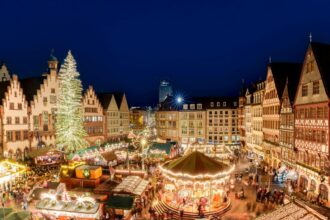
Landing at the airport before any of these trips? Our Frankfurt Airport Transfers guide covers every realistic way of reaching the city centre from FRA, while our Best Things to Do in Frankfurt guide rounds up the sights worth prioritising in the city itself before you head out on any of the trips above. If your visit falls in December, our Frankfurt Christmas Market guide covers the Römerberg tree and the rest of the city’s six festive squares.
For the wider picture on getting around by rail, our German Rail Tickets Explained guide breaks down the Deutschland-Ticket, regional day tickets and how they compare with buying single fares for trips like these, while our Interrail Germany Pass guide explains when a country-specific pass beats individual tickets for a longer stay.
Continuing your trip through Germany? Our Best Day Trips from Nuremberg guide covers Bamberg, Würzburg and Bavaria’s own excellent day-trip country, a useful comparison if your itinerary covers both ends of Germany.