Reviewed by our editorial team Updated
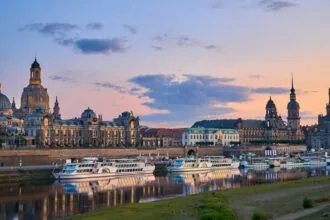
Dresden’s rebuilt Baroque skyline sits right at the edge of Saxony’s wildest scenery, and the Elbe river that curls through the city centre keeps cutting a path south-east into sandstone cliffs, vineyard hills and half-timbered towns that most visitors only ever see from a train window. Beyond the Zwinger and the Frauenkirche, this is genuinely one of the best-positioned German cities for a day trip, with a handful of excursions covering everything from the country’s most photographed hiking bridge to a porcelain factory that has been perfecting the same white clay for over three centuries.
The VVO regional transport network and Deutsche Bahn’s regional trains cover almost every destination below without needing a car, and several of these trips sit close enough together to combine a train, a bus or even a paddle steamer into the same day out. Saxony’s compact geography also means most of these places are genuinely close, and even the furthest, right on the Polish border, is still comfortably reachable there and back within a single day.
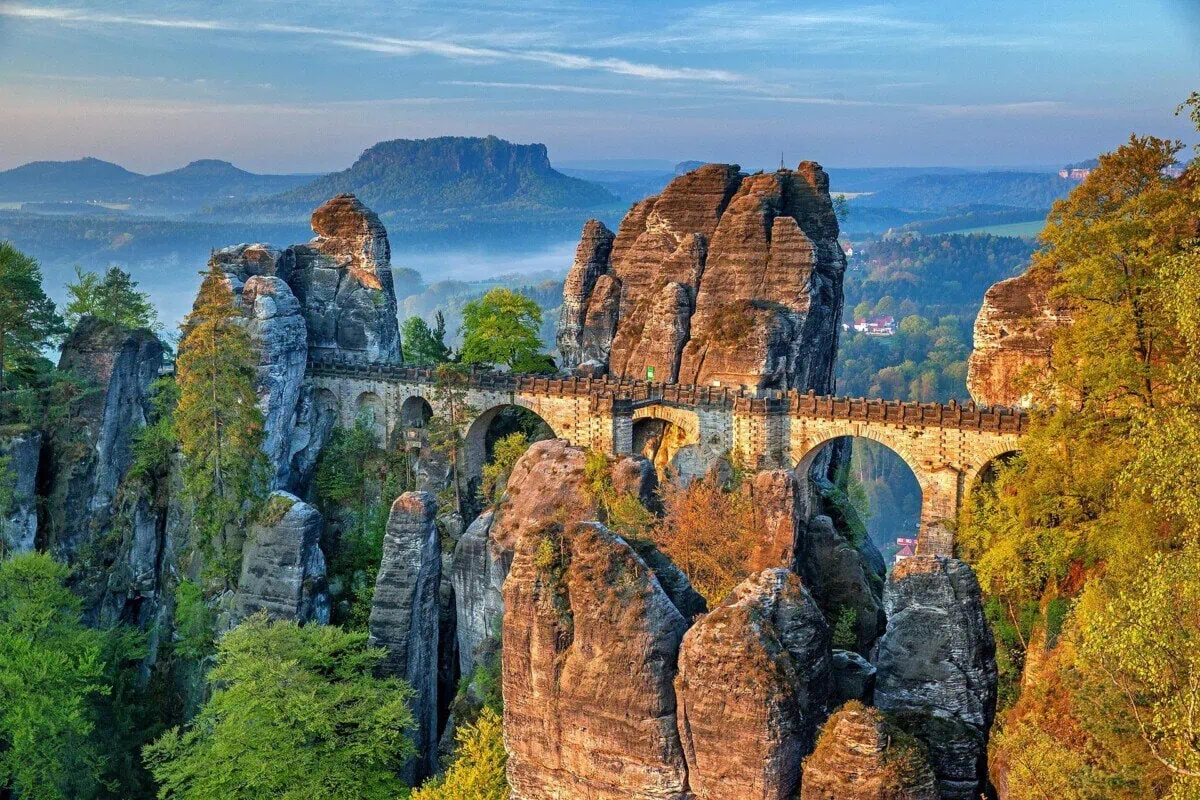
The single best day trip from Dresden, without much competition, is Saxon Switzerland National Park and its iconic Bastei Bridge, a sandstone rock formation and 1850s bridge that has become one of the most photographed hiking spots in Germany. Meissen offers a completely different, more genteel day out built around porcelain and a hilltop castle, while Moritzburg’s baroque hunting lodge pairs neatly with a genuine steam-powered narrow-gauge railway.
Görlitz rewards anyone willing to commit to the longer train ride with one of the best-preserved historic town centres in the country, familiar to anyone who has watched The Grand Budapest Hotel or Inglourious Basterds. Pillnitz Palace, meanwhile, is the easiest half-day escape of the lot, reachable by a genuinely charming paddle steamer straight up the Elbe.
Five more destinations round out this guide to a fuller ten. Pirna and Königstein Fortress sit further along the very same Elbe valley line as the Bastei, easy to bolt onto a Saxon Switzerland day or visit on their own at a gentler pace, while Bautzen pushes east into Sorbian Lusatia for a walled medieval town most visitors never hear about. Prague turns the day trip idea into a genuine cross-border adventure on a direct train, and Leipzig, Saxony’s biggest city, rounds things out for anyone after a change of pace from castles and old towns.
All but one of the destinations above, Prague aside, sit inside the state of Saxony, which makes the Sachsen-Ticket worth knowing about before buying single fares for any of them. It covers unlimited travel on regional trains and local transport across Saxony, Saxony-Anhalt and Thuringia for a full day, priced at €35 (£30/$41) for a single traveller plus around €8 (£7/$9) per extra passenger up to five people, and it comfortably beats individual VVO fares the moment a small group is travelling together or the day involves more than one stop. One thing to plan around: it isn’t valid before 9am on weekdays, only opening up from midnight on Saturdays, Sundays and public holidays, so an early weekday departure needs a standard fare for that first leg instead. The table below compares journey times and transport for all ten destinations at a glance, followed by a dedicated section on each place and a final verdict on which trip suits which kind of traveller.
| Destination | How to Get There | Journey Time | Suggested Time Needed |
|---|---|---|---|
| Saxon Switzerland / Bastei Bridge | S1 train from Dresden Hbf to Kurort Rathen, then a ferry and a hillside hike | About 40 minutes by train, plus the ferry and a 30-45 minute hike | Full day |
| Meissen | Direct regional train from Dresden Hauptbahnhof | About 34 to 40 minutes | Half day to full day |
| Moritzburg Castle | Bus 477 from Dresden-Neustadt, or S1 to Radebeul Ost then the Lössnitzgrundbahn steam railway | About 30 minutes either way | Half day |
| Görlitz | Direct RE1 regional train from Dresden Hauptbahnhof | About 1 hour 30 minutes | Full day |
| Pillnitz Palace | Elbe paddle steamer from Dresden’s Terrassenufer pier, or bus 63 | About 1 hour 15 minutes by steamer, or 30-40 minutes by bus | Half day |
| Pirna | Direct S1 train from Dresden Hauptbahnhof | About 22 minutes | Half day |
| Königstein Fortress | S1 train from Dresden Hbf to Königstein, then a signed woodland walk or seasonal shuttle up to the fortress | About 40 minutes by train, plus 30-45 minutes on foot (or a short shuttle ride) | Half day to full day |
| Bautzen | Direct regional train (RE or trilex) from Dresden Hauptbahnhof | About 50 minutes | Full day |
| Prague, Czech Republic | Direct EC (EuroCity) train from Dresden Hauptbahnhof | About 2 hours 10 minutes to 2 hours 40 minutes | Full day |
| Leipzig | Direct ICE or regional train from Dresden Hauptbahnhof | About 1 hour to 1 hour 20 minutes | Full day (see dedicated guide) |
Saxon Switzerland and Bastei Bridge: Dresden’s Unmissable Day Trip
Saxon Switzerland National Park, and specifically the Bastei Bridge inside it, is the single most famous day trip from Dresden, and honestly the reason many visitors add Saxony to a German itinerary at all. The Bastei is a dramatic run of sandstone pillars rising 194 metres above the Elbe, capped since 1851 by a sandstone bridge with seven arches that has become one of the most photographed viewpoints in the country.
Getting there starts with the S1 line, which runs directly from Dresden Hauptbahnhof to Kurort Rathen in around 40 minutes, with trains departing roughly every 30 minutes throughout the day. A standard VVO ticket covering the zones out to Rathen costs around €9 (£7.74/$10.53) one-way, and the S1 also calls at Dresden-Neustadt for anyone starting from the northern side of the river.
From Kurort Rathen station, the platform sits on the opposite bank to the village itself, so every visitor crosses the Elbe on a small passenger ferry that runs continuously through the day for €1.50 (£1.29/$1.76) one-way or €3 (£2.58/$3.51) return. The climb up to the Bastei from the ferry landing takes around 30 to 45 minutes on a well-marked woodland trail, with steep sections and plenty of steps, so comfortable shoes matter more here than on almost any other trip in this guide.
The reward at the top is genuinely worth the climb: the bridge itself, several rock-top viewpoints over the Elbe valley, and the ruins of a small medieval castle built into the sandstone. Beyond the immediate Bastei viewpoint, the wider national park has hundreds of kilometres of marked hiking trails through the Elbe Sandstone Mountains, and many visitors extend the day with a longer loop rather than heading straight back to the ferry.
Set aside a full day for this trip rather than trying to squeeze it into an afternoon, since the round journey alone eats up nearly two hours before any hiking even begins. Arriving early is a genuine advantage, both for cooler hiking conditions and for beating the crowds that build steadily through late morning, especially at the main viewing platform on the bridge itself. One catch for weekday visitors relying on the Sachsen-Ticket: it isn’t valid before 9am on Mondays to Fridays, so a genuinely early start on a weekday needs a standard VVO fare for that first leg instead, or a weekend departure, when the ticket opens up from midnight.
No booking is required for the train, the ferry or the hike itself, which makes this one of the most spontaneous trips on the whole list despite being the most physically demanding. If only one day trip from Dresden makes the cut on a short visit, this sandstone landscape and its famous bridge should be it.
Meissen: Porcelain, a Hilltop Castle and Saxony’s Origin Story
Meissen is Dresden’s more refined day trip, a small town on the Elbe famous as the birthplace of European porcelain and home to a hilltop castle that predates the porcelain by several centuries. The town gave its name to Meissen porcelain, first produced here in 1710 after August the Strong’s alchemists finally cracked the secret the Chinese had guarded for hundreds of years.
Direct regional trains leave Dresden Hauptbahnhof roughly every 30 minutes, reaching Meissen in around 34 to 40 minutes on the fastest services. Meissen has two stations, and most visitors want the main Meissen stop rather than Meißen Altstadt, since it sits a shorter walk from both the porcelain manufactory and the old town.
The House of MEISSEN, the manufactory’s visitor experience, includes an audio-guided tour through the demonstration workshops and its own porcelain museum, priced at €15 (£12.90/$17.55) online or €16 (£13.76/$18.72) at the door. Watching a painter freehand the manufactory’s famous crossed-swords mark or a modeller shape a figurine by hand is genuinely more absorbing than it sounds, even for visitors with no prior interest in ceramics.
Above the town, Albrechtsburg Castle occupies the hilltop that gave Meissen its start as a fortified frontier settlement in the 10th century, long before any porcelain existed. Entry costs €12 (£10.32/$14.04) for an adult, and the castle’s Gothic vaulted halls and wall frescoes depicting Saxon history are worth the climb up from the old town on their own.
Meissen’s compact old town, with its own market square, cathedral and steep cobbled lanes, easily fills the gaps between the manufactory and the castle, and most of it can be covered on foot in under an hour. Both major sights close on Mondays outside peak season, so it is worth checking opening days before building a whole itinerary around a single visit.
Meissen works well as a half-day trip focused on either the porcelain or the castle, or a fuller day if both are on the list, and it is one of the few destinations in this guide where advance booking genuinely is not necessary for either site. It is the obvious choice for travellers with an interest in craft, design or Saxon royal history rather than hiking or dramatic scenery.
Best for two or three nights. The widest choice of rooms, with filters for free cancellation and included breakfast.
View staysBest for groups who want one address and separate bedrooms rather than three hotel rooms.
See holiday homesBest as a last check before booking. Compares hotel rates across several sites in one search.
Compare ratesMoritzburg Castle: A Baroque Hunting Lodge and a Genuine Steam Railway
Moritzburg Castle is Saxony’s fairytale baroque hunting lodge, a moated pink-and-white palace surrounded on all sides by its own lake, built for the electors of Saxony as a retreat for hunting parties and lavish autumn feasts. Its best-known claim to fame outside Germany is as a filming location for the beloved fairytale Three Wishes for Cinderella, still shown on television across Central Europe every Christmas.
The most direct route is bus 477 from Dresden-Neustadt station, which reaches Moritzburg in around 30 minutes for a fare of about €6.10 (£5.25/$7.14), running regularly through the day and dropping passengers a short walk from the castle gates.
A more memorable alternative is the Lössnitzgrundbahn, a genuine narrow-gauge steam railway that has run through the Lössnitzgrund valley since 1884. Take the S1 line to Radebeul Ost, then transfer to the steam train toward Radeburg, alighting at the Moritzburg stop after a scenic 30-minute run through forest and farmland for around €9.90 (£8.51/$11.58).
Inside, the castle houses one of Europe’s largest collections of hunting trophies alongside baroque interiors largely unchanged since the 18th century, with an adult ticket costing €12 (£10.32/$14.04) and including a HistoPad multimedia guide. The surrounding park and lake are free to walk, and the reflection of the castle across the water is one of the more photographed views in all of Saxony for good reason.
A half day comfortably covers the castle interior, a walk around the lake and a ride on the steam railway, making this one of the easiest, least physically demanding trips on this whole list. The castle keeps reduced hours either side of its main March to November season, so it is worth checking dates before travelling outside peak months.
Moritzburg suits families and anyone who wants a gentler day out than the sandstone cliffs of Saxon Switzerland, especially once the steam railway itself becomes as much a highlight as the castle at the end of the line.
Görlitz: Germany’s Best-Preserved Old Town on the Polish Border
Görlitz sits right on the German-Polish border, split from its twin town of Zgorzelec by the Neisse river, and its old town survived the Second World War almost entirely intact, leaving one of the largest collections of well-preserved historic buildings anywhere in Germany.
That untouched streetscape has made Görlitz a favourite Hollywood filming location, doubling as the setting for The Grand Budapest Hotel, Inglourious Basterds and The Book Thief, and locals have leaned fully into the nickname Görliwood that followed. Walking the same cobbled lanes and market square used in those productions is a genuine draw even for visitors who have never seen the films.
Direct RE1 regional trains leave Dresden Hauptbahnhof roughly every one to two hours, and the journey takes about 1 hour 30 minutes each way, making this the longest single trip in this guide. Advance fares start from around €8 (£6.88/$9.36), though a standard walk-up single fare runs closer to €24 (£20.64/$28.08), so booking ahead genuinely pays off on this route.
The Untermarkt and Obermarkt squares anchor the old town, ringed by Renaissance merchant houses, while the nearby Schönhof is generally reckoned the oldest Renaissance building in Germany and now houses the Silesian Museum. St. Peter and Paul’s Church is worth a stop for its Sonnenorgel organ alone, and the Altstadtbrücke footbridge across the Neisse offers an easy, informal step into Poland for anyone carrying the right documents.
Because of the long round trip, Görlitz deserves a genuine full day rather than a rushed half day squeezed around other plans, with most of that time simply spent wandering the old town’s largely traffic-free streets rather than ticking off a strict list of sights.
Görlitz rewards travellers with a real interest in architecture, film locations or borderland history, and its distance from Dresden’s other day trips is exactly what keeps it uncrowded compared with more obvious stops like Meissen or Moritzburg.
Pillnitz Palace: A Paddle Steamer Ride Up the Elbe
Pillnitz Palace is the easiest, most relaxed half-day trip on this list, a riverside summer residence built for the electors of Saxony around three linked pavilions in a distinctly Chinese-influenced style that was unusual for 18th century Europe.
The genuinely special way to arrive is aboard one of the Saxon Steamship Company’s historic paddle steamers, part of the oldest and largest paddle steamer fleet in the world, which depart from Dresden’s Terrassenufer pier and cruise directly up the Elbe to a landing stage right in front of the palace.
The cruise itself takes around 1 hour 15 minutes each way and turns the journey into as much of an attraction as the destination, gliding past the same riverbank views painted by Canaletto centuries ago. Schedules and prices vary by season, so it is worth checking the current timetable on the steamship company’s own website before planning a day around a specific departure.
For a quicker or more flexible option, bus line 63 runs directly from central Dresden to stops near the palace in around 30 to 40 minutes, useful for anyone short on time or travelling outside the steamer’s operating season.
The palace’s Baroque garden includes a genuine 230-year-old camellia, one of the oldest and largest in Europe, sheltered each winter beneath its own custom-built glass pavilion that is wheeled into place every October. Admission to the palace itself costs €8 (£6.88/$9.36) for an adult and €7 (£6.02/$8.19) reduced, while the extensive gardens are free to wander.
A half day comfortably covers the gardens, the camellia and a look inside one of the palace wings, making Pillnitz the natural choice for a shorter, gentler day out or a relaxed finish to a longer Dresden stay.
Pirna: The Postcard View Painters Got There First
Long before day-trippers arrived with cameras, the Italian painter Bernardo Bellotto, still known locally by his uncle’s name Canaletto, set up his easel in Pirna’s Am Markt square and painted the exact view that greets visitors today. The finished canvas now hangs in Dresden’s Old Masters Gallery, and standing in the square itself feels like stepping inside the frame, since the late-Gothic town hall and the gabled houses around it have barely changed since the 1750s.
Reaching Pirna could hardly be simpler: the S1 line that also serves Rathen and Königstein runs directly from Dresden Hauptbahnhof in around 22 minutes, with departures roughly every 30 minutes and no change required. It is the shortest train ride of any destination in this guide, and a short-hop VVO ticket covers the whole journey for only a few euros each way.
Inside the old town, the Marienkirche is worth the short detour on its own, a late-Gothic hall church with a vaulted ceiling completed between 1502 and 1546 that ranks among the more striking parish churches in Saxony. Narrow lanes lined with painted house signs and stepped gables fan out from the main square, and the whole old town can be walked at an easy pace in an hour or two.
Pirna also doubles as the main gateway into Saxon Switzerland National Park, and local bus 237 continues on from the station toward both Bastei and Königstein Fortress, making it a natural stop to break up a longer day rather than a strictly separate trip. Travellers with a full day free can treat Pirna as a slower first act before pushing on into the sandstone hills.
On its own, Pirna suits a relaxed half day for anyone after an easy, low-effort outing with almost no planning required, or as a scenic add-on either side of a bigger day trip further down the same rail line.

Compare Trains and Buses with Omio
Choosing between trains and buses is not always obvious. Some routes are faster by train, while others are cheaper or easier by bus. Omio helps you compare routes, journey times, prices, and tickets in one place.
It is useful for city-to-city travel, cross-border journeys, and trips where flexibility matters. You can quickly see which option works best for your route, budget, and schedule before booking.
Königstein Fortress: A Sandstone Stronghold the Size of a Small Town
Perched on a sheer plateau above the Elbe, Festung Königstein is often described as the largest hilltop fortress in Europe, an entire fortified township of barracks, magazines and bastions rather than a single castle keep. It never fell to a successful siege in over 750 years, and Saxon rulers used it both as a treasury vault and, less happily, as a prison for political dissidents.
The same S1 line that runs out to Rathen continues on to Königstein station in around 40 minutes from Dresden Hauptbahnhof, on that same regular half-hourly service. From the station, it is a signed woodland walk of roughly 30 to 45 minutes up to the fortress gates, or, between April and October, the seasonal Festungsexpress mini-train shuttles visitors from the town centre for €6 (£5.16/$7.02) one-way or €8 (£6.88/$9.36) return.
Adult entry costs €17 (£14.62/$19.89) during the high season from late March to early November, dropping to €15 (£12.90/$17.55) over winter, with concessions priced at €13 (£11.18/$15.21) and €11 (£9.46/$12.87) respectively. The ticket includes lift access up the rock face and every exhibition inside, so there is little reason to skip the museums once the entrance fee is paid.
Once inside, the ramparts deliver some of the widest views over the Elbe valley of any stop in this guide, taking in Saxon Switzerland’s sandstone towers on one side and the river winding back toward Dresden on the other. The fortress well, sunk deep into the rock to guarantee water during a siege, remains one of the deepest of its kind anywhere in Europe.
Because it sits on the very same line as the Bastei, Königstein works well either as its own full day exploring the ramparts and museums, or as a shorter half day for travellers who want fortress views without the steeper Bastei hike.
Bautzen: Fourteen Towers and a Living Slavic Culture
Bautzen anchors Upper Lusatia, the historic homeland of the Sorbs, Germany’s only officially recognised Slavic minority, and its skyline of fourteen surviving medieval towers makes it one of the most distinctive old towns in eastern Saxony. Street signs throughout the centre appear in both German and Sorbian, a small but constant reminder that this corner of the country has its own separate language and traditions.
Direct regional services, run jointly by Deutsche Bahn and the trilex operator, leave Dresden Hauptbahnhof roughly every hour and reach Bautzen in around 50 minutes. Advance fares start from around €17 (£14.62/$19.89) one-way, while a standard walk-up ticket typically costs closer to €20 (£17.20/$23.40).
The Ortenburg, a castle complex overlooking the Spree river gorge, houses the Sorbian Museum, and the nearby St. Peter’s Cathedral is unusual for splitting its nave between Catholic and Protestant congregations, a compromise dating back to the Reformation that still holds today. Climbing the Alte Wasserkunst waterworks tower rewards visitors with a panorama over the Spree valley and the rest of the old town’s tower-studded rooftops.
Bautzen also happens to be Germany’s mustard capital, and its long-running Mustard Museum and specialist shops make a fitting lunch stop before the train back, pairing a plate of local sausage with a jar of the town’s own sharp, grainy Senf to take home.
Set aside a full day for Bautzen given the near two-hour round trip, and treat it as the culture-and-history counterpart to Görlitz further down the same eastern rail corridor, best suited to travellers with a genuine interest in architecture or Central Europe’s smaller ethnic minorities.
Best for finding routes the airlines do not sell as a single ticket. Combines carriers to bring the fare down.
Search flightsBest for short trips. Install the eSIM at home and arrive with working data, no shop queue.
Browse eSIMsBest after a long flight or a late landing. Price agreed before you travel, and no taxi queue.
Check transfersPrague, Czech Republic: Crossing the Border for the Day
Of every trip in this guide, Prague asks the most of a single day, but it is also the only one that swaps Germany for another country entirely. Direct EuroCity (EC) trains follow the Elbe, known as the Labe once it crosses into Czech territory, through the sandstone gorges of Bohemian Switzerland, a scenic ride that genuinely rivals the destination itself.
Trains leave Dresden Hauptbahnhof for Praha hlavní nádraží roughly every two hours, with around a dozen direct services running each day and a typical journey time of 2 hours 10 minutes to 2 hours 40 minutes depending on the specific service. Advance fares can start as low as €9 (£7.74/$10.53) one-way, though prices climb quickly closer to departure, so booking ahead matters more here than almost anywhere else on this list.
Once in Prague, the obvious highlights, the Old Town Square, Charles Bridge and Prague Castle, sit within about half an hour’s walk of the main station, though a single day realistically allows time to properly enjoy two or three of them rather than everything at once.
Both countries sit inside the Schengen area, so there are no passport checks at the border, but it is still sensible to carry photo ID, and the Czech koruna, not the euro, is the local currency, so a card that avoids foreign transaction fees is worth having on hand.
This is a full day in every sense, best attempted on an early train and reserved for travellers with at least three or four days in Dresden to spare, rather than squeezed into a short weekend visit already built around Saxony’s own sights.
Leipzig: A Big-City Day Trip Covered in Full Elsewhere
Leipzig is Saxony’s largest city and, in character, almost the opposite of Dresden, trading Baroque palaces for university-town energy built on Bach’s old choir school, a thriving street art scene and a wave of post-industrial spaces turned into galleries, bars and markets.
Direct ICE and regional trains run from Dresden Hauptbahnhof to Leipzig Hauptbahnhof roughly every 30 minutes, with the fastest ICE services covering the route in about an hour and regional trains taking closer to 1 hour 20 minutes. Advance fares start from around €7 (£6.02/$8.19) one-way on the slower services.
Because Leipzig has enough going on to fill an entire guide of its own, this section stays deliberately brief. Our full Leipzig Things to Do guide covers the Thomaskirche, the Spinnerei art district and the rest of the city’s sights in proper depth.
As a day trip from Dresden, Leipzig suits travellers wanting a genuine change of pace partway through a longer Saxony stay, rather than another round of castles, churches and river views.
Which Day Trip Should You Choose?
If you only have time for one day trip from Dresden, make it Saxon Switzerland and the Bastei Bridge. Nothing else on this list matches its combination of dramatic scenery, a genuinely iconic viewpoint and a proper hike, and it remains the trip most visitors mention first when they talk about Dresden’s surroundings.
Travellers drawn to craft, design or royal history are usually happiest in Meissen, where the porcelain manufactory and Albrechtsburg Castle give a full day of substance without any hiking involved. Families and anyone wanting a gentler pace should lean toward Moritzburg instead, where the steam railway alone makes the trip feel like an event rather than a checklist.
Anyone with a genuine interest in architecture, film locations or the German-Polish borderlands should commit to the longer trip out to Görlitz, ideally on a day with no other plans given the near three-hour round trip. Pillnitz Palace is the opposite case entirely, the trip to pick when time is short or energy is low, especially for anyone who wants the paddle steamer experience without a demanding day of walking.
As a general rule, pair one demanding trip with one relaxed one rather than trying to fit several full days into a short stay. Saxon Switzerland plus Pillnitz makes a genuinely varied pairing across a longer visit, covering both the region’s wildest scenery and its gentlest riverside escape without repeating the same kind of day twice.
Whichever trip you choose, book train tickets a little in advance where fares vary by time of day, and never treat Saxon Switzerland as an afternoon add-on when it genuinely deserves a full day of its own.

Rupert’s Handy Travel Tips
Day trips from Dresden are refreshingly easy on the whole, but a few destinations have quirks worth knowing before you set off.
- Bring cash for the Kurort Rathen ferry: the small kiosk at the crossing does not always take cards, and the ferry itself only costs a couple of euros either way.
- Wear proper shoes for the Bastei hike: the sandstone steps and woodland trail get slippery when wet, and trainers with some grip make a real difference.
- Check Albrechtsburg and MEISSEN opening days before travelling: both sites close on Mondays outside peak season, which can derail a tightly planned itinerary.
- Book the Lössnitzgrundbahn steam train ahead in summer: the most popular departures to Moritzburg do sell out on busy weekends.
- Check the Pillnitz paddle steamer timetable before travelling: sailings are reduced or suspended outside the main season, so confirm a specific departure rather than just turning up.
- Book Görlitz train tickets ahead of time: advance fares on the RE1 are considerably cheaper than a walk-up ticket bought on the day.
- Compare the Sachsen-Ticket before buying single fares: every destination here except Prague sits inside Saxony, so a day ticket at €35 (£30/$41) solo, or with extra passengers added for around €8 (£7/$9) each, often beats paying leg by leg.
Want to meet the reindeer behind our travel tips? Find out more in our page Who is Rupert?.




Frequently Asked Questions About Day Trips from Dresden
What is the best day trip from Dresden?
Saxon Switzerland National Park and its Bastei Bridge are generally considered the best single day trip from Dresden, combining a dramatic sandstone landscape with one of Germany’s most photographed viewpoints.
How do I get to Bastei Bridge from Dresden?
Take the S1 train from Dresden Hauptbahnhof to Kurort Rathen in around 40 minutes, cross the Elbe on the small passenger ferry, then hike up to the bridge in roughly 30 to 45 minutes.
Is Meissen worth visiting as a day trip?
Yes, Meissen combines the House of MEISSEN porcelain manufactory with Albrechtsburg Castle, and it is reachable from Dresden Hauptbahnhof in under 40 minutes without any advance booking required.
Do I need to book Moritzburg Castle in advance?
Not for the castle itself, though booking the Lössnitzgrundbahn steam train in advance is worth doing in summer, since the busiest departures do sell out.
How long does it take to get to Görlitz from Dresden?
Direct RE1 regional trains take about 1 hour 30 minutes each way, making Görlitz the longest single trip in this guide and one best suited to a full day.
Can I visit Pillnitz Palace without taking the paddle steamer?
Yes, bus line 63 runs directly from central Dresden to stops near the palace in around 30 to 40 minutes, though the paddle steamer remains the more memorable way to arrive.
Do I need a car for any of these day trips?
No, every destination in this guide is reachable by train, bus or boat from central Dresden, and a car would add very little beyond the flexibility of stopping wherever you like along the way.
Is the hike to Bastei Bridge difficult?
It is moderate rather than difficult, with steep sections and plenty of steps over roughly 30 to 45 minutes, so comfortable walking shoes are recommended rather than strictly necessary hiking gear.
Is there a single ticket that covers most of these day trips?
Yes, the Sachsen-Ticket covers unlimited regional trains and local transport across Saxony for a day, priced at €35 (£30/$41) for one person plus around €8 (£7/$9) per extra passenger up to five, and it applies to every destination in this guide except Prague, which sits across the Czech border.
Further Reading
Landing in Saxony before any of these trips? Our Dresden Airport Transfers guide covers every realistic way of reaching the city centre from DRS, while our Things to Do in Dresden guide rounds up the sights worth prioritising in the city itself before you head out on any of the trips above. If your trip falls in December, our Dresden Christmas Market guide covers the Striezelmarkt, the giant Erzgebirge pyramid and the Stollenfest parade.
For the wider picture on getting around by rail, our German Rail Tickets Explained guide breaks down the Deutschland-Ticket, the Sachsen-Ticket and how they compare with buying single fares for trips like these, while our Interrail Germany Pass guide explains when a country-specific pass beats individual tickets for a longer stay.
Continuing your trip further across Germany? Our Best Day Trips from Nuremberg guide covers Bamberg, Würzburg and Bavaria’s own excellent day-trip country, a useful comparison if your itinerary covers both ends of Germany.