Reviewed by our editorial team Published
Leipzig spent much of the last century in Dresden’s shadow among foreign visitors, yet within Germany it has always been understood as one of the country’s genuine cultural heavyweights. This is Saxony’s largest city, home to around 620,000 residents, and it built its wealth not on royal patronage like Dresden but on trade, since the Leipzig Trade Fair dates back to 1190 and remains one of the oldest surviving trade fairs anywhere in the world. That commercial history left the city with a dense, walkable centre threaded with historic passages and courtyards rather than a single grand palace quarter.
Music runs through Leipzig more deeply than almost any other German city. Johann Sebastian Bach spent the final 27 years of his life here, directing the Thomanerchor boys’ choir at St. Thomas Church, and the Leipzig Gewandhaus Orchestra, founded in 1743, is one of the oldest symphony orchestras on earth. Richard Wagner was born here, Felix Mendelssohn ran the Gewandhaus for over a decade, and that unbroken musical lineage still fills the city’s churches and concert halls today.
Leipzig’s more recent history carries just as much weight. The city was the epicentre of the Peaceful Revolution of 1989, when Monday evening prayers at Nikolaikirche grew into the mass demonstrations that helped bring down the East German government without a single shot fired. Further back, the fields just outside the centre hosted the Battle of the Nations in October 1813, the largest battle fought in Europe before the First World War, now marked by one of the continent’s most imposing war memorials.
Beyond the historic core, Leipzig has spent the last two decades building a genuinely serious contemporary art reputation. The former cotton mill at the Spinnerei now houses galleries that gave the world the New Leipzig School of painting, while former industrial canals in the west of the city have been reclaimed for boat trips and waterside cafes. This guide works through Leipzig’s sights roughly in order of how essential they are for a first visit, along with food, shopping, family options and rainy day backups. For help getting from Leipzig/Halle Airport into the centre, a separate guide on this site covers the S5 and S5X lines and every other transfer option in detail.
| Section | What you’ll find |
| Augustusplatz, the Gewandhaus and Oper Leipzig | Leipzig’s grand civic square between the historic concert hall and opera house |
| St. Thomas Church, Bach’s Grave and the Thomanerchor Boys’ Choir | Bach’s grave, the choir he once directed, and a bookable climb up the tower |
| Nikolaikirche and the Peaceful Revolution of 1989 | The church at the heart of the 1989 protests that helped end East Germany |
| The Völkerschlachtdenkmal: Monument to the Battle of the Nations | The 91-metre monument marking the 1813 Battle of Leipzig, with a climbable viewing platform |
| Museum der bildenden Künste Leipzig | Leipzig’s main fine art museum, housed in a modern glass cube in the old town |
| Leipzig by Hop-On Hop-Off Bus: The 13-Stop Loop | A 24-hour bus ticket for covering the city’s more spread out sights in one day |
| Zeitgeschichtliches Forum: Germany’s Contemporary History Museum | Free museum covering divided Germany, the Stasi and the Peaceful Revolution |
| The Panometer Leipzig | Giant 360-degree panoramic paintings inside a converted gasometer |
| Spinnerei: Leipzig’s Arts District and the New Leipzig School | A former cotton mill turned contemporary art district and gallery quarter |
| Karl-Heine-Kanal and Boat Trips Through Little Venice | Canal boat trips through Leipzig’s reclaimed post industrial waterway |
| Auerbachs Keller and the Mädler Passage | The historic cellar restaurant that inspired Goethe’s Faust, beneath a grand shopping arcade |
| The Markt, Altes Rathaus and Leipzig’s Old Town | The old town’s central square, Renaissance town hall and historic trading passages |
| Leipzig Zoo | One of Germany’s top rated zoos, built around the indoor Gondwanaland rainforest hall |
| Shopping Around Petersstraße and the Höfe | The main shopping streets and Leipzig’s network of historic covered courtyards |
| Food and Drink: Leipziger Allerlei, Lerchen and Gose Beer | Local specialities including a vegetable dish, marzipan pastries and a tart local beer |
| Leipzig’s Christmas Markets | The Weihnachtsmarkt’s history and the separate Finnish and medieval markets nearby |
| Family-Friendly Things to Do in Leipzig | The best sights in this guide for a visit with children |
| Rainy Day Options in Leipzig | Indoor backups for wet weather, from museums to covered shopping arcades |
Augustusplatz, the Gewandhaus and Oper Leipzig
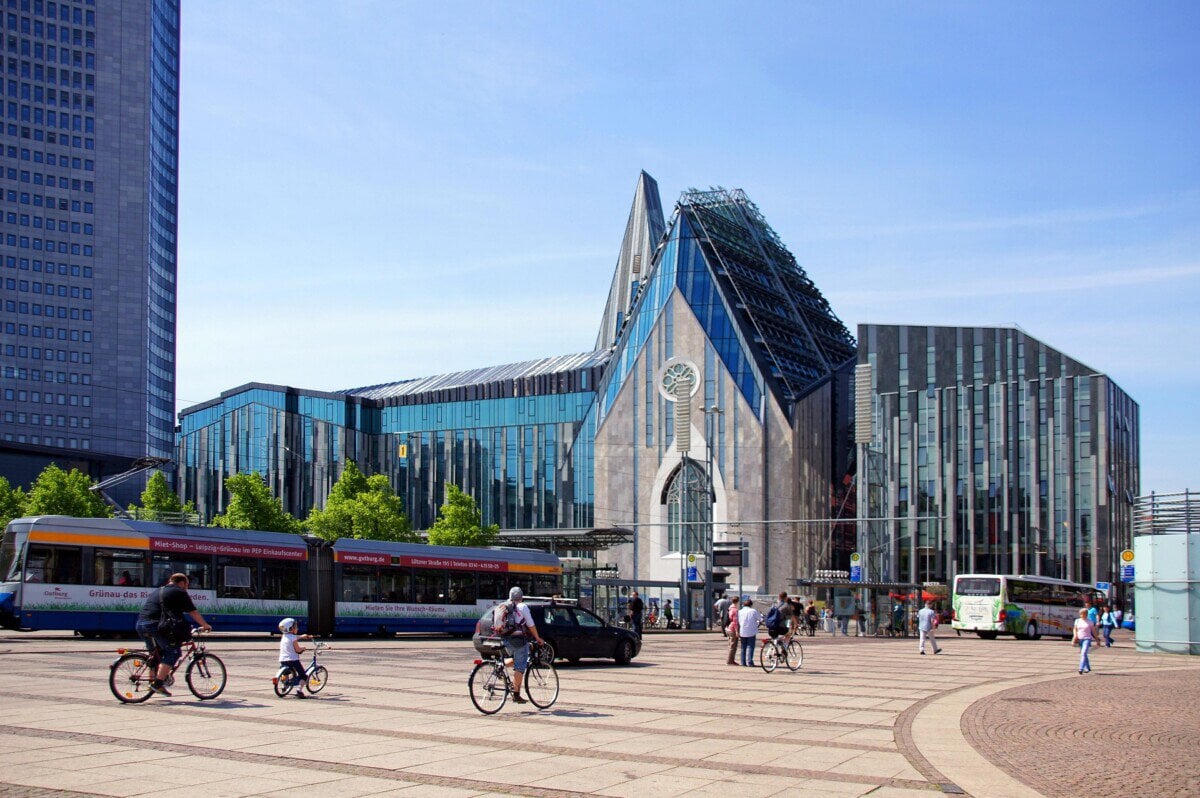
Few German city squares operate on the scale of Augustusplatz, one of the largest urban squares anywhere in the country and the natural starting point for understanding Leipzig’s musical identity. The square sits directly between Leipzig University’s modern campus and the two institutions that anchor the city’s classical music scene, giving first time visitors an immediate sense of how central performance and learning are to daily life here rather than being confined to a single museum quarter.
On the square’s southern side stands the Neues Gewandhaus, home to the Leipzig Gewandhaus Orchestra, founded in 1743 and one of the oldest continuously operating symphony orchestras in the world. The orchestra takes its name from the original Gewandhaus, a former cloth merchants’ hall where concerts were first held, and its current home, opened in 1981, holds two concert halls known for their exceptional acoustics, still drawing serious classical audiences from across Europe for a full season of orchestral, chamber and choral programming.
Facing the Gewandhaus across the square, Oper Leipzig traces its own roots back to 1693, making it one of the oldest opera houses in Europe, with the current building dating to a 1960 reconstruction after wartime bombing destroyed its predecessor. The company stages a busy year round programme of opera and ballet, and tickets are generally easier to secure with a little advance planning than at some of Germany’s more famous opera houses.
Between the two buildings, the Mendebrunnen fountain and a scattering of modern sculpture give Augustusplatz a genuinely lived in civic feel rather than a purely ceremonial one, with students crossing between lecture halls and concertgoers gathering before an evening performance sharing the same open space. Simply standing in the square and taking in both facades costs nothing and takes only a few minutes, though anyone with even a passing interest in classical music should try to build an evening concert into a Leipzig itinerary if the schedule allows, since hearing the Gewandhaus Orchestra in its purpose built hall is a genuinely different experience from a recording.
St. Thomas Church, Bach’s Grave and the Thomanerchor Boys’ Choir
No sight in Leipzig carries more musical weight than St. Thomas Church, the Gothic hall church where Johann Sebastian Bach served as cantor for the final 27 years of his life, from 1723 until his death in 1750. Bach composed the bulk of his church cantatas here, and the building itself dates back to the 13th century, though the tall Gothic nave visitors see today largely reflects a major late 15th century rebuilding, with later additions carrying the church’s history forward through the centuries.
Bach’s remains were moved to the church in 1950, and his simple bronze grave marker, set into the floor near the altar, draws a steady stream of visitors paying quiet respects to one of the most influential composers in Western music. A dignified statue of Bach stands just outside the church on Thomaskirchhof, and the small Bach Museum across the square adds further depth for anyone wanting more than the church visit alone provides.
The church’s living connection to Bach is arguably its most remarkable feature. The Thomanerchor, the boys’ choir Bach himself once directed, traces its own history back to 1212 and continues performing motets most weeks of the year, keeping a genuinely unbroken tradition running for more than 800 years. Regular performances take place on Fridays at 6pm and Saturdays at 3pm, with a printed programme, which doubles as the entry ticket, costing around €3.00 (£2.58/$3.51) per person at the church doors from 45 minutes before each performance; Leipzig Pass holders and under 18s attend free, and Sunday services carry no charge at all.
Entry to the church itself is free at any time outside performances, and the interior’s soaring white vaulting is worth a look even without a concert scheduled. For anyone building a trip specifically around the choir, it is worth checking the Thomanerchor’s own published calendar in advance, since school holidays and touring commitments occasionally interrupt the usual Friday and Saturday rhythm.
The church also offers a separate, ticketed tower climb up 232 steps to a panoramic platform near the top, passing through the historic tower keeper’s apartment and a section of roof timber that still holds a cannonball lodged there during the 1813 Battle of the Nations. Tickets for that climb can be booked through the widget below.
Browse hotels and accommodation for your journey.
View staysBrowse apartments, holiday homes and self-catering stays.
View rentalsCompare hotel deals from multiple booking sites in one search.
Compare pricesNikolaikirche and the Peaceful Revolution of 1989
A short walk from the Markt, Nikolaikirche is Leipzig’s oldest and largest church, with construction beginning around 1165 in Romanesque style before Gothic extensions in the early 16th century and a Baroque tower added in 1730 reshaped its exterior. Between 1784 and 1797, architect Johann Carl Friedrich Dauthe redesigned the entire interior in a Neoclassical style, giving the nave its distinctive pastel green and white colour scheme and columns topped with sculpted palm frond capitals rather than conventional Gothic or Baroque ornamentation, a genuinely unusual sight inside a German parish church of this age.
The church’s architecture, striking as it is, matters far less to most visitors than what happened here in the autumn of 1989. Nikolaikirche had hosted regular Monday peace prayers since 1982, and through September and October 1989 those quiet gatherings swelled into mass demonstrations that spilled out across the surrounding Ring boulevard, drawing tens of thousands of protesters demanding political reform from a regime that had shown no tolerance for dissent. The demonstration of 9 October 1989, involving an estimated 70,000 people, passed without the violent crackdown many had feared, and is widely credited as a decisive turning point in the collapse of East Germany’s communist government a month later.
A local cabaret artist’s description of the movement, that it had no single leader because “the head was the Nikolaikirche and the body the centre of the city,” captures how genuinely central this one building was to a peaceful revolution that reshaped the map of Europe. A commemorative column outside the west entrance, topped with a bronze reproduction of one of the church’s own palm capitals, marks the site today.
Entry to Nikolaikirche is free and the church is generally open daily outside services, though visitors should expect the building to remain a working parish church rather than a static memorial, with occasional closures for weddings, funerals and rehearsals. Peace prayers continue most Mondays at 5pm, open to anyone who wants to sit quietly in the same pews where a peaceful revolution genuinely began.
The Völkerschlachtdenkmal: Monument to the Battle of the Nations
Rising from the fields southeast of the centre, the Völkerschlachtdenkmal, or Monument to the Battle of the Nations, is one of the largest monuments anywhere in Europe, standing 91 metres tall and completed in 1913 to mark the centenary of the Battle of Leipzig. Fought in October 1813, the battle pitted Napoleon’s forces against a coalition of Prussian, Russian, Austrian and Swedish armies in what remains the largest battle fought in Europe before the First World War, involving more than half a million soldiers and ending in a decisive defeat for Napoleon that helped end French dominance over central Europe.
The monument’s scale is genuinely overwhelming up close, built from more than 26,000 blocks of granite porphyry in a heavy, almost brutalist style that predates the term by decades, and its huge stone figures, including the twelve looming warriors ringing the base, were designed to inspire a sense of solemn national memory rather than triumphant celebration. A crypt at the base honours the roughly 100,000 soldiers who died in the three day battle, and the acoustics inside the vast interior hall amplify even a whispered conversation into an unsettling echo.
Visitors willing to climb can reach a viewing platform near the top for genuinely sweeping views back across Leipzig and the surrounding Saxon countryside, though the site itself warns that the climb represents a real physical effort and is not recommended for anyone with a fear of heights or enclosed spaces. Wheelchair users can reach an inner gallery at 47 metres via lift, taking in views through glazed windows without tackling the stairs.
The monument is open daily from 10am to 6pm between April and October, and 10am to 4pm from November to March, closing only on 24 and 31 December. Adult admission costs €10.00 (£8.60/$11.70), and the adjoining Forum 1813 exhibition hall, included in the same ticket, covers the battle’s history in more depth for anyone who wants context before or after the climb. A tram from the city centre reaches the monument directly, making it an easy half day trip rather than a dedicated excursion.
Museum der bildenden Künste Leipzig
Leipzig’s principal fine art collection, the Museum der bildenden Künste, holds one of the more significant gallery holdings in eastern Germany, spanning roughly five centuries from early Dutch and German Old Masters through to the contemporary painters of the New Leipzig School covered later in this guide. The museum’s current home, a striking glass cube completed in 2004 in the heart of the old town, replaced an earlier building destroyed in the Second World War, giving the collection a genuinely modern setting distinct from most German art museums housed in converted palaces.
The permanent collection’s real strength lies in its depth of German Romantic painting, including major works by Caspar David Friedrich and Max Klinger, alongside a substantial run of 19th and 20th century pieces that trace the region’s artistic development right up to the present day. A dedicated sculpture collection and rotating temporary exhibitions add further layers for anyone spending more than an hour inside, and the building’s open, light filled galleries make even a fairly large collection feel navigable rather than overwhelming.
The museum opens Tuesday, Thursday, Friday, Saturday and Sunday from 10am to 6pm, and Wednesday from 12pm to 8pm, closing entirely on Mondays, a schedule worth checking carefully since it differs from a standard Monday closure model seen at many German galleries. Adult admission costs €10.00 (£8.60/$11.70), with a reduced rate of €7.00 (£6.02/$8.19) applying to students, apprentices and other concessions, and group rates available for parties of ten or more.
Given the collection’s scale, budgeting a genuine 90 minutes to two hours is realistic for a proper walk through the permanent galleries, longer if a major temporary exhibition happens to be running. The museum sits within easy walking distance of both the Markt and Augustusplatz, making it simple to combine with several of the sights already covered in this guide on the same day.
Leipzig by Hop-On Hop-Off Bus: The 13-Stop Loop
For visitors who would rather cover Leipzig’s spread-out sights without hopping between tram lines all day, a hop-on hop-off bus ticket loops through 13 stops across the city on a single blue and yellow double-decker route, starting from Augustusplatz outside the Gewandhaus and Oper Leipzig covered earlier in this guide. The loop also calls at the Völkerschlachtdenkmal, Leipzig Zoo, the central station, the Markt and Bach Museum area, and the Mädler Passage, with buses running roughly every 30 to 60 minutes depending on the season, so a missed departure rarely means a long wait.
A single ticket stays valid for 24 hours rather than a single loop, so riders can step off at the monument in the morning, spend a couple of hours inside Gondwanaland at the zoo in the afternoon, and still catch a later bus back into the old town on the same pass. Recorded onboard commentary plays automatically in several languages, including English, giving first time visitors context on each stop’s history without needing to book a separate live guided tour.
Tickets typically cost around €24.00 (£20.64/$28.08) per adult and cover transport only, since admission to the Völkerschlachtdenkmal, Leipzig Zoo and the Bach Museum is booked separately at each individual site. For a first visit with only a day or two to spare, though, stringing together several of this guide’s more spread out sights on one straightforward loop is a genuinely efficient alternative to relying purely on Leipzig’s regular tram network for every single leg.
Zeitgeschichtliches Forum: Germany’s Contemporary History Museum
Just off the Markt, the Zeitgeschichtliches Forum Leipzig tells the story of a divided Germany from the end of the Second World War through to reunification, using the very city where the Peaceful Revolution began as its natural setting. The permanent exhibition works through the founding of East Germany, everyday life under the Stasi surveillance state, the steady buildup of civic protest through the 1980s, and the eventual collapse of communist rule in 1989 and 1990, using original artefacts, video testimony and full scale reconstructions rather than text panels alone.
A genuinely striking section reconstructs a typical East German living room alongside surveillance equipment used by the Ministry for State Security, giving visitors a concrete sense of how closely private life was monitored under the regime, and a separate area covers the mass demonstrations that filled Leipzig’s Ring boulevard in the autumn of 1989, tying the museum directly back to the Nikolaikirche and Augustusplatz sights covered earlier in this guide.
Remarkably for a museum of this depth and scale, admission is completely free, a deliberate policy reflecting the museum’s role as a national institution documenting a period of history central to modern German identity rather than a purely local attraction. The museum opens Tuesday to Sunday from 10am to 6pm, closing on Mondays, and it generally stays open through most German public holidays, with the notable exception of Christmas Eve and New Year’s Eve.
Given the free admission and the genuine depth of the collection, this is one of the easiest additions to make to any Leipzig itinerary, and it rewards at least 90 minutes for a proper visit rather than a rushed half hour walk through. English language information is available throughout, and the museum’s central location, a few minutes from both the Markt and Nikolaikirche, makes it simple to combine with a wider walking tour of the old town on the same day.
The Panometer Leipzig
A short tram ride south of the centre in the former industrial district of Connewitz, the Panometer Leipzig occupies a disused 1910s gasometer, a huge circular steel and brick structure originally built to store town gas, now converted into one of the largest panoramic exhibition spaces in the world. Inside, artist Yadegar Asisi installs enormous 360 degree painted panoramas, often exceeding 100 metres in circumference and rising more than 30 metres, that wrap entirely around the viewer standing on a central platform.
The effect is genuinely immersive rather than simply large, since carefully staged lighting shifts gradually through a simulated day and night cycle while ambient sound design fills the space, and visitors are free to walk the full circumference of the platform to take in details from multiple angles rather than viewing the work from a single fixed point. Exhibitions rotate periodically between historical recreations, such as vast reconstructed cityscapes or ancient civilisations, and dramatic natural subjects, so it is worth checking the current theme before a visit.
Adult admission costs €16.00 (£13.76/$18.72), with a reduced rate of €14.00 (£12.04/$16.38) for students, seniors and disabled visitors, and children aged 6 to 16 paying €8.00 (£6.88/$9.36), with under 6s admitted free. A parent and child ticket, covering up to two adults and two children aged 6 to 16, starts from €35.00 (£30.10/$40.95), and a combined ticket covering both the Leipzig and Dresden Panometer venues is available for €25.00 for anyone visiting both cities on the same trip.
The industrial setting is worth appreciating in its own right, since the gasometer’s original riveted steel shell remains largely visible around the exhibition space, giving the Panometer a genuinely different atmosphere from a conventional gallery. Allow roughly an hour for a full visit, and it is worth checking current opening hours on the official site before travelling, since the schedule varies with the exhibition programme rather than running to a single fixed timetable year round.
Search flights and useful route combinations in one place.
View flightsBrowse Airalo eSIM options for convenient travel data.
Check eSIMsCheck private airport pickup options and plan the first part of your journey in advance.
View transfersSpinnerei: Leipzig’s Arts District and the New Leipzig School
In the western district of Plagwitz, the Spinnerei is a former cotton spinning mill that grew, at its industrial peak in the early 20th century, into one of the largest such complexes in continental Europe, employing thousands of workers across dozens of red brick factory buildings. Production wound down after German reunification, and rather than demolishing the site, a group of artists began converting the empty halls into studios through the 1990s, laying the groundwork for what has become one of Germany’s most respected contemporary art districts.
The Spinnerei is where the New Leipzig School took shape, a loose movement of figurative painters, most famously Neo Rauch, whose work blends photorealistic precision with surreal, unsettling composition and drew international critical attention through the 2000s, putting Leipzig on the contemporary art map in a way its Baroque neighbours in Dresden rarely have been. Today the complex houses roughly a dozen commercial galleries alongside artist studios, a small cinema and a handful of cafes, all spread across a genuinely sprawling campus of preserved industrial architecture.
Individual galleries set their own hours, though most cluster around Wednesday to Saturday afternoons, and entry to the galleries themselves is generally free, making a visit here considerably cheaper than a ticketed museum even though the quality on display is comparable. The Spinnerei’s open studio weekends, held periodically through the year, give visitors a rare chance to see working artists’ spaces rather than only finished, curated shows.
Reaching the Spinnerei takes a short tram ride from the centre, and the district rewards a slow, unhurried couple of hours rather than a rushed pass through, since much of the appeal lies in wandering between buildings rather than following a fixed route. Combining a visit with the nearby Karl-Heine-Kanal, covered next in this guide, makes for a genuinely rewarding half day exploring Leipzig’s post industrial west.
Karl-Heine-Kanal and Boat Trips Through Little Venice
Running through the western districts of Plagwitz and Schleussig, the Karl-Heine-Kanal is a 19th century industrial waterway, named after the local entrepreneur who financed it, originally built to connect factories in Leipzig’s west with the wider river network for shipping raw materials and finished goods. Much of that industry has since closed or relocated, and the canal has been steadily reclaimed over the past two decades as one of the more pleasant, low key corners of the city, earning the nickname Klein-Venedig, or Little Venice, among locals.
A network of towpaths runs the full length of the canal, popular with joggers and cyclists, and small motorboat and gondola style tours depart regularly from jetties near the Spinnerei and the Schleussig district, giving visitors a genuinely different perspective on Leipzig’s industrial heritage from the water. Trips typically run around an hour and pass beneath a series of low stone bridges, with several operators offering both narrated sightseeing routes and quieter, more relaxed evening cruises through the warmer months.
Leipzig’s wider network of connected waterways, part of what the city markets as its Leipziger Neuseenland, or New Lakeland, links the Karl-Heine-Kanal onward towards former open cast mining pits that have been flooded and landscaped into recreational lakes, though the canal itself is easily explored on a shorter half day trip without needing to cover the full network.
Along the banks, a growing cluster of cafes, bars and small galleries has moved into former factory buildings, giving the canal a genuinely different character from the historic old town a short tram ride away. Prices for a standard sightseeing boat trip typically run from around €12.00 (£10.32/$14.04) per adult, though it is worth checking current operators and schedules locally, since several smaller companies run the route on a seasonal basis rather than year round.
One long running operator runs a 70 minute motorboat cruise departing from the Stadthafen, passing the old Baedeker publishing family’s villa and the red brick Buntgarnwerke textile works on the way through the Karl-Heine-Kanal into Plagwitz. Tickets for that specific cruise can be booked through the widget below.
Auerbachs Keller and the Mädler Passage
Few restaurants anywhere in Germany carry as much literary weight as Auerbachs Keller, a wine cellar restaurant with roots stretching back to at least 1438, making it the second oldest restaurant in Leipzig. The current name comes from Dr. Heinrich Stromer, a 16th century physician known locally as “Doctor Auerbach” after his home town, who rebuilt the cellar and made it one of the city’s most fashionable meeting places for scholars and merchants alike.
The cellar’s real fame, though, comes from a young student who drank here while studying at Leipzig University between 1765 and 1768: Johann Wolfgang von Goethe. Goethe saw two 1625 wooden paintings in the cellar depicting the legendary Doctor Faust, one showing him carousing with students and another riding a wine barrel out of the cellar, and those images directly inspired the famous Auerbachs Keller scene in his drama Faust I, the very first place Mephistopheles takes Faust on their travels together.
Two bronze sculptures, Mephisto and Faust and the Bewitched Students, were installed at the cellar’s entrance in 1913, following a rebuilding that placed Auerbachs Keller beneath the ornate Mädler Passage above, one of Leipzig’s grandest historic shopping arcades, itself worth a slow walk for its vaulted glass ceiling and upmarket boutiques even without stopping to eat.
Today the restaurant operates across five separate historic dining rooms, each with a distinct atmosphere, serving traditional Saxon cooking alongside a genuinely serious wine list befitting a five century old wine cellar. Reservations are worth making in advance, particularly in the evening, since the Faust connection draws a steady stream of visitors keen to eat somewhere with such a direct literary pedigree rather than simply passing through.

The Markt, Altes Rathaus and Leipzig’s Old Town
Leipzig’s central market square, simply called the Markt, has functioned as the commercial heart of the city since the Middle Ages, and it remains the natural starting point for exploring the old town on foot. The square’s dominant building, the Altes Rathaus, was built in a remarkably swift nine months in 1556 in Renaissance style, and its long, asymmetrical facade with a distinctive off centre tower is regarded as one of the finest examples of German Renaissance civic architecture anywhere in the country.
Inside, the Altes Rathaus now houses the Stadtgeschichtliches Museum, Leipzig’s city history museum, covering the city’s development from its medieval trading origins through to the present day across a series of grand historic rooms, including the barrel vaulted Rathaus cellar and a hall once used for civic ceremonies. The museum makes a natural pairing with a walk around the square itself, since the building’s interior and exterior tell complementary parts of the same civic story.
Radiating out from the Markt, a dense network of historic passages and courtyards, including the Mädler Passage covered above alongside the Specks Hof and Barthels Hof arcades, thread through the old town’s compact grid, a legacy of Leipzig’s centuries as a trade fair city where merchants needed covered space to display goods away from the weather. Wandering between them, rather than sticking purely to the main streets, is genuinely the best way to experience the old town’s character.
Entry to the Markt itself is free and unrestricted at all times, and the Stadtgeschichtliches Museum charges a modest admission fee, though several city run museums including this one offer free entry on selected days each month, worth checking before a visit. Allow at least an hour for a proper loop of the square and its surrounding passages, longer with a stop at one of the historic cafes tucked into the arcades.
Leipzig Zoo
A short walk from the city centre, Leipzig Zoo ranks among the most highly regarded zoos in Germany, consistently praised for its ambitious, immersive enclosure design rather than the more traditional cage based layouts still common elsewhere. The zoo’s flagship attraction, Gondwanaland, is a vast indoor tropical hall covering more than 16,000 square metres, recreating a South American and Asian rainforest environment under a single glass roof, complete with a boat ride that carries visitors through the canopy.
Beyond Gondwanaland, the zoo is organised into a series of large themed habitats rather than a conventional walk past sequential enclosures, including Pongoland, a dedicated great ape facility that has made the zoo an internationally recognised centre for primate research, and expansive outdoor areas for elephants, lions and a wide range of other species spread across the grounds.
Opening hours run from 9am to 7pm during the peak season from May to September, shortening to 9am to 6pm across the shoulder seasons of late March, April and October, and 9am to 5pm through the winter months from November to March, with reduced hours on Christmas Eve and New Year’s Eve. Adult admission costs €27.00 (£23.22/$31.59) in summer and €23.00 (£19.78/$26.91) in winter, with a family ticket covering two adults and up to four children priced at €70.00 (£60.20/$81.90) in summer and €60.00 (£51.60/$70.20) in winter, and children under six admitted free year round.
Given the scale of the site and the sheer number of immersive habitats, most visitors need a genuine three to four hours to see the collection properly, and the zoo’s online tickets bundle in local public transport within the relevant fare zone, a detail worth knowing since it can offset some of the admission cost for visitors already travelling by tram.
Shopping Around Petersstraße and the Höfe
Leipzig’s principal shopping streets, Petersstraße and Grimmaische Straße, run out from the Markt and together form the backbone of the city centre’s retail district, mixing international fashion chains with a scattering of independent boutiques tucked into side streets. Both streets are fully pedestrianised, making the whole stretch easy to cover on foot without much backtracking, and their proximity to the Markt means shopping slots naturally into the same walking loop as the old town sights covered earlier in this guide.
What sets Leipzig apart from a fairly standard German high street, though, is its network of historic Höfe, covered passages and courtyards built by trade fair merchants who needed weatherproof space to display goods to visiting buyers. The Mädler Passage, home to Auerbachs Keller covered earlier, is the grandest of these, but Specks Hof and Barthels Hof nearby hold their own mix of independent shops, cafes and small galleries, giving shoppers a genuinely different atmosphere from a standard mall.
The Höfe am Brühl, a modern shopping centre near the old town’s northern edge, adds a more conventional retail option for anyone after larger chain stores under one roof, and it sits close enough to the historic passages that both styles of shopping can be combined without much extra walking involved.
As in most German cities, Saturday is the busiest shopping day, and the majority of shops close entirely on Sundays, so weekday mornings tend to offer the most comfortable browsing before crowds build later in the day. Between the main streets and the historic Höfe, most visitors find an hour or two more than enough to get a genuine feel for Leipzig’s retail scene.
Compare hostels and budget-friendly places to stay.
Browse hostelsAccess compensation support, eligible lounge benefits and faster payouts.
See the benefitsLeave your luggage somewhere convenient and explore hands-free.
View storageFood and Drink: Leipziger Allerlei, Lerchen and Gose Beer
Leipzig’s signature dish, Leipziger Allerlei, is a colourful mix of young vegetables, traditionally peas, carrots, asparagus and morel mushrooms, served together in a light sauce, and it began life as a genuinely aristocratic dish before becoming a staple on traditional Saxon menus across the city. It rarely travels far outside the region, which makes it worth actively seeking out on a Leipzig menu rather than assuming it will turn up elsewhere in Germany.
On the sweeter side, Leipziger Lerchen, literally “Leipzig larks,” are small pastries filled with marzipan and jam, named after the songbirds that were once trapped and eaten as a local delicacy until a 19th century hunting ban ended the practice, with bakers substituting the pastry version that survives on shelves across the city today. Alongside it, the city’s historic coffee house culture runs deep, with venues such as Zum Arabischen Coffe Baum, one of the oldest continuously operating coffee houses in Europe, tracing its own roots back to the early 18th century.
On the drinks side, Gose, a tart, slightly salty wheat beer style originally brewed in the town of Goslar but adopted and refined in Leipzig from the 18th century onward, is the city’s genuinely distinctive local beer, having survived a near total disappearance after the Second World War before a small revival brought it back onto menus across the old town. It pairs naturally with the hearty, comfort focused cooking found in traditional Gaststätten around the Markt and Nikolaikirche.
Between the historic passages’ cafes, traditional Saxon restaurants near the old town, and the newer, more experimental dining scene that has grown up around the Spinnerei and Karl-Heine-Kanal districts covered earlier, Leipzig’s food scene rewards a little wandering rather than sticking purely to streets immediately around the Markt.
Leipzig’s Christmas Markets
Each winter, Leipzig’s Weihnachtsmarkt spreads across the Markt and the surrounding old town squares in one of the oldest documented Christmas markets in Germany, with records tracing the tradition back to 1458, giving it a genuine claim to being one of the country’s most historic festive markets rather than a modern tourist addition. Wooden stalls fill the square with mulled wine, roasted almonds and handmade crafts beneath the Altes Rathaus, and the market traditionally runs from late November through 23 December in a typical year.
A dedicated Finnish Christmas Village near Augustusplatz adds a distinct Nordic flavour to the wider market, complete with Finnish crafts and food stalls, while a separate medieval market near Nikolaikirche brings costumed performers, open fire cooking and a rougher, more historically themed atmosphere than the polished stalls back on the Markt, giving Leipzig several genuinely different festive experiences within a short walk of each other.
The market’s scale reflects Leipzig’s status as a genuine cultural capital, and the illuminated facade of the Altes Rathaus after dark, framed by stalls and the towering Christmas tree traditionally set up in front of it, gives the whole square a striking backdrop worth timing an evening visit around rather than passing through purely during the day.
Exact opening and closing dates shift slightly year to year, so it is worth confirming the current season’s schedule before building a trip specifically around the market. Given how central the old town’s squares are to the rest of this guide’s sights, though, a winter visit rarely needs much extra planning to combine the market with St. Thomas Church, Nikolaikirche and the Markt itself on the same day. Our dedicated Leipzig Christmas Market guide covers the Weihnachtsmarkt’s stalls, dates and both smaller markets in far more depth than fits here.
Family-Friendly Things to Do in Leipzig
Leipzig handles a family visit considerably better than its reputation as a music and history city might suggest, largely because several of its biggest attractions already double as genuine family days out. Leipzig Zoo is the obvious anchor, and the immersive Gondwanaland rainforest hall in particular gives children an actively engaging environment to explore with a boat ride through the canopy, rather than a walk past static enclosures.
The Panometer‘s vast, immersive panoramas tend to land well with children too, since the scale and the gradual day to night lighting cycle hold attention in a way a conventional gallery of paintings rarely manages, and the format works equally well for younger children and teenagers. A boat trip along the Karl-Heine-Kanal makes for an easy, low effort family outing as well, giving children a genuinely different view of the city from the water without much walking involved.
For a slower afternoon, the historic passages around the Markt, including the Mädler Passage’s glass roofed arcade, give children a genuinely different environment to wander through than an open street, and the Stadtgeschichtliches Museum in the Altes Rathaus offers hands on elements suited to a family visit alongside its more traditional exhibits.
Combined with the free entry and genuinely engaging displays at the Zeitgeschichtliches Forum, though its subject matter suits older children and teenagers better than very young visitors, Leipzig offers a wider spread of family friendly options than its Baroque neighbour Dresden, and most of the sights covered in this guide sit close enough together to combine two or three into a single day without excessive walking.

Rainy Day Options in Leipzig
Saxony’s weather is no more reliable than the rest of Germany’s, so it helps that several of Leipzig’s best sights sit entirely indoors to begin with. The Museum der bildenden Künste and the free Zeitgeschichtliches Forum both work as full, unhurried visits regardless of what is happening outside, and both sit close enough to the Markt and to each other to combine easily on a single wet afternoon.
The Panometer‘s huge indoor panoramas offer another genuinely reliable covered option, and St. Thomas Church and Nikolaikirche both provide free, dry stops in the heart of the old town, with a Friday or Saturday motet at St. Thomas turning an otherwise grey afternoon into a genuine highlight of the trip rather than simply a shelter from the rain.
Leipzig Zoo’s Gondwanaland hall and Pongoland ape house keep a rainy zoo visit entirely viable too, since the bulk of the most impressive exhibits sit under cover even though the site includes substantial outdoor grounds as well. The Spinnerei‘s galleries, largely housed in converted factory buildings, give a similarly dry option for anyone happy to duck between exhibition spaces rather than needing a single large indoor venue.
Failing that, the historic passages around the Markt, including the Mädler Passage and Höfe am Brühl shopping centre, give a straightforward covered backup, since much of the retail here sits under cover or close enough together to hop between shops without getting properly soaked. Between the museums, the churches and the old town’s covered arcades, a rainy day in Leipzig rarely needs to be a wasted one.

Rupert’s Handy Travel Tips
Planning a visit to Leipzig? Rupert has a few tips worth knowing before you go:
- Check the Thomanerchor’s calendar before travelling for a motet: performances usually run Fridays at 6pm and Saturdays at 3pm, but school holidays and touring can interrupt the schedule.
- Note the Museum der bildenden Künste’s unusual Wednesday hours: it opens 12pm to 8pm on Wednesdays rather than following the same schedule as the rest of the week.
- Budget real time for the Völkerschlachtdenkmal climb: the site itself warns it is a genuine physical effort, so allow plenty of time and skip it if heights or enclosed stairwells are a concern.
- Don’t skip the Zeitgeschichtliches Forum because it sounds heavy: it is completely free and genuinely one of the best value museums in the city.
- Pair the Spinnerei with a Karl-Heine-Kanal boat trip: both sit in the same western district, making an easy half day loop without much backtracking.
- Book Auerbachs Keller ahead for evenings: its Faust connection draws steady demand, and walk-up tables are not guaranteed at peak times.
Want to meet the reindeer behind our travel tips? Find out more in our page Who is Rupert?.




Frequently Asked Questions About Things to Do in Leipzig
What is Leipzig’s biggest attraction?
The historic centre around the Markt and St. Thomas Church draws the most visitors, closely followed by the Völkerschlachtdenkmal monument and the contemporary art scene at the Spinnerei.
How many days do you need in Leipzig?
Two full days cover the essentials comfortably, including the Markt, St. Thomas Church, Nikolaikirche and the Völkerschlachtdenkmal, with a third day useful for the Spinnerei, Karl-Heine-Kanal or Leipzig Zoo.
Where is Bach buried in Leipzig?
Johann Sebastian Bach is buried inside St. Thomas Church, marked by a simple bronze floor plaque near the altar, close to where he directed the Thomanerchor choir for 27 years.
When does the Thomanerchor perform?
The boys’ choir performs motets on Fridays at 6pm and Saturdays at 3pm at St. Thomas Church, with a printed programme doubling as the entry ticket at around €3.00 (£2.58/$3.51).
Why is Nikolaikirche important to German history?
Weekly Monday peace prayers held there from 1982 grew into the mass demonstrations of autumn 1989 that helped trigger the Peaceful Revolution and the eventual collapse of East Germany’s government.
Is the Zeitgeschichtliches Forum free to visit?
Yes. Admission to this contemporary history museum covering divided Germany and the Peaceful Revolution is completely free, and it opens Tuesday to Sunday from 10am to 6pm.
What is the connection between Auerbachs Keller and Goethe’s Faust?
Goethe drank at the cellar as a student and saw 17th century paintings of the legendary Doctor Faust there, which directly inspired the famous Auerbachs Keller scene in his drama Faust I.
Is Leipzig good for a family trip?
Yes. Leipzig Zoo’s immersive Gondwanaland hall, the Panometer’s giant panoramas and a Karl-Heine-Kanal boat trip all work well for children of varying ages.
Further Reading & Related Guides
For getting into the city in the first place, our Leipzig Airport Transfers guide covers the S5 and S5X lines and every other option from LEJ. Anyone building a wider Saxony itinerary will find our Things to Do in Dresden guide a useful companion, covering the state capital’s own Baroque old town and Elbe riverfront.
For other German cities in this site’s growing content, our Things to Do in Bremen and Things to Do in Dortmund guides cover two very different corners of the country, and if onward rail travel around Saxony and beyond is part of the plan, our German Rail Tickets Explained guide breaks down the Deutschland-Ticket and regional fares, while our Interrail Germany Pass Guide explains when a country-specific pass beats buying tickets individually for a longer trip.