Reviewed by our editorial team Published
Dresden spent decades known mainly for what it lost, a Baroque capital flattened in a single night of bombing in February 1945 and then rebuilt so carefully that most visitors now struggle to tell old stone from new. The Elbe river curls through the middle of the city, splitting the grand Baroque Altstadt from the looser, more bohemian streets of the Neustadt on the opposite bank. Saxony’s rulers spent three centuries filling Dresden with palaces, galleries and a treasury so dense with gold and gemstones that Napoleon reportedly refused to loot it out of sheer admiration.
That royal wealth still anchors the city today. The Zwinger Palace holds one of Europe’s great Old Masters collections, the Residenzschloss guards a treasury that survived the war in underground vaults, and the golden Fürstenzug mural still parades three centuries of Saxon princes across an outer wall a short walk from both.
Music and rebuilding sit just as close together. The Semperoper has been destroyed and reconstructed twice, while the domed Frauenkirche spent forty-five years as a pile of blackened rubble before reopening in 2005 as the single most powerful symbol of the city’s recovery.
Beyond the postcard Altstadt, Dresden rewards travellers who cross the river or head slightly out of town. The Neustadt trades palaces for street art and independent bars, the Volkswagen Transparent Factory builds electric cars behind glass walls a few tram stops from the centre, and a fleet of century-old paddle steamers still runs proper cruises along the Elbe Valley most afternoons.
The quick-reference table below merges every section on this page into a single list, with the area, time needed and price for each attraction alongside a note on what you’ll find there. Sections without a fixed area, duration or cost are marked N/A rather than given invented figures.
| Section | Area | Time Needed | Price | What You’ll Find |
| Frauenkirche: A Church Rebuilt from Ruins | Altstadt, Neumarkt | 30-90 minutes | Free entry, dome climb €12 (£10.32/$14.04) | The rebuilt Baroque church and its dome viewing platform. |
| Zwinger Palace: Baroque Courtyards and Old Masters | Altstadt | 2-3 hours | €18 (£15.48/$21.06) adult | The Old Masters Gallery, porcelain collection and the Nymphenbad fountain courtyard. |
| Semperoper: Dresden’s Opera House on Theaterplatz | Theaterplatz | 45-60 minutes (tour) | Tour from €13 (£11.18/$15.21) | Dresden’s twice-rebuilt opera house and its 45-minute guided interior tour. |
| Residenzschloss and the Green Vault: A Royal Treasury | Altstadt | 2-3 hours | €18 (£15.48/$21.06) each section | The royal palace and the Historic Green Vault’s treasury collections. |
| Dresden’s Hop-On-Hop-Off Bus: Covering More Ground Without Driving | N/A | N/A | N/A | A 22-stop city bus loop for covering ground quickly between sights. |
| Fürstenzug: The Procession of Princes in Porcelain | Augustusstrasse | 15-20 minutes | Free | The porcelain-tiled mural depicting three centuries of Saxon rulers. |
| Brühl’s Terrace: The Balcony of Europe | Riverside, Altstadt | 30-45 minutes | Free | A riverside promenade with views across the Elbe. |
| Neustadt: Dresden’s Bohemian Side of the River | Across the Elbe | 2-4 hours | Free to explore | Street art, bars and independent shops on the opposite bank. |
| Dresden Castle General Admission: The Ticket That Skips the Green Vault Queue | N/A | N/A | N/A | A cheaper palace ticket covering the museum collections outside the Historic Green Vault. |
| Pfunds Molkerei: The World’s Most Beautiful Dairy Shop | Neustadt, Bautzner Strasse | 15-30 minutes | Free entry | An ornately tiled historic dairy shop in the Neustadt. |
| Cruising the Elbe: Paddle Steamers Through the Valley | Terrassenufer piers | 1-2 hours | From €16 (£13.76/$18.72) | Historic paddle steamer sailings along the Elbe, including sunset trips. |
| Dresden’s Military History Museum: A Bundeswehr Landmark | Albertstadt | 2-3 hours | €5 (£4.30/$5.85) adult | A modern military history museum inside a former arsenal building. |
| Volkswagen’s Transparent Factory: Cars Built Behind Glass | Strassburger Platz | 1-2 hours | Self-guided free, tours from €7 (£6.02/$8.19) | Guided tours of VW’s glass-walled electric car factory. |
| Dresden’s Food Scene: Stollen and Saxon Specialities | Citywide, Altmarkt in December | Flexible | Stollen from €12 (£10.32/$14.04) | Where to try stollen and other regional Saxon dishes. |
| Shopping in Dresden: From the Altmarkt to the Neustadt | Altmarkt, Neustadt | 1-3 hours | Free to browse | Shopping options across both the Altstadt and Neustadt districts. |
| Family-Friendly Dresden: What Works With Kids | Citywide | Half day+ | Varies, see section | What works well for a family visit with children. |
| Rainy Day Dresden: The Best Indoor Options | Citywide | Flexible | Varies, see section | Indoor options for a wet-weather day in the city. |
Frauenkirche: A Church Rebuilt from Ruins
The Frauenkirche, Dresden’s great domed Lutheran church, dominates the Neumarkt square and much of the Altstadt skyline beyond it. It is a Baroque masterpiece by architect George Bähr, completed in 1743 after seventeen years of construction.
That original church survived more than two centuries before the Allied bombing raids of 13 to 15 February 1945 gutted the city centre. The Frauenkirche itself withstood the initial firestorm, only for the intense heat to weaken its sandstone pillars so badly that the whole dome collapsed two days later under its own weight.
For forty-five years, East Germany’s communist government left the ruined shell as a deliberate war memorial, a blackened mound of rubble at the heart of the rebuilt city. Only after German reunification in 1990 did a citizens’ initiative and an international fundraising campaign, which drew donations from more than fifty countries, make full reconstruction possible.
Rebuilding ran from 1994 to 2005 and used computer modelling to sort roughly 8,500 salvaged original stones back into their exact former positions wherever they had survived. Those original blocks are still visible today as noticeably darker patches scattered across the pale new sandstone facade, a deliberate choice to keep the building’s history legible rather than hide it.
The church reopened with a full reconsecration on 30 October 2005, and general entry to view the restored interior remains free, with donations welcomed to help fund ongoing upkeep. Visitors should still budget at least thirty minutes, since the interior rewards a slow look rather than a quick pass-through.
Climbing to the dome viewing platform, roughly 67 metres above the Neumarkt, is a separate paid experience costing €12 (£10.32/$14.04) for adults, €7 (£6.02/$8.19) reduced, or €24 (£20.64/$28.08) for a family ticket. The route covers around 170 steps, and opening hours run shorter in winter, so checking the schedule beforehand is worth it.
Zwinger Palace: Baroque Courtyards and Old Masters
The Zwinger is Dresden’s great Baroque pleasure palace, a low, curving complex of galleries wrapped around a formal courtyard garden right in the heart of the Altstadt. It was built between 1709 and 1728 under Augustus the Strong, the Saxon elector whose taste for spectacle shaped much of the city’s historic core.
Today the complex houses several separate museums under one roof, and the undisputed highlight is the Gemäldegalerie Alte Meister, or Old Masters Gallery. Its collection includes Raphael’s Sistine Madonna, Vermeer’s Girl Reading a Letter at an Open Window, and major works by Titian, Rembrandt and Canaletto.
Alongside the picture gallery sits the smaller Royal Cabinet of Mathematical and Physical Instruments, a genuinely surprising room of ornate clocks, globes and scientific devices built as much to impress visiting dignitaries as to advance actual science. The neighbouring porcelain collection, one of the largest in the world, reflects Saxony’s role as the birthplace of European porcelain at nearby Meissen.
A standard adult ticket covering the Old Masters Gallery and the related collections up to 1800 costs €18 (£15.48/$21.06), with the mathematical instruments cabinet or porcelain collection available separately at €6 (£5.16/$7.02) each if bought alone. Visitors planning several SKD museums across a longer stay may find the €28 (£24.08/$32.76) day ticket or €32 (£27.52/$37.44) two-day ticket works out cheaper overall.
Beyond the galleries, the palace’s formal courtyard is free to enter and worth a slow walk in its own right. The Nymphenbad fountain grotto and the curved colonnades make for some of the most photographed corners of the entire city.
Budget at least two hours for the Old Masters Gallery alone, and closer to three if the mathematical instruments cabinet is on the itinerary too. Wednesday closures apply at most SKD museums, so it is worth double-checking opening days before building the Zwinger into a tight schedule.
Booking the combined entry ticket online in advance covers the Old Masters Gallery, the Porcelain Collection and the Mathematical-Physical Salon for around €18 (£15.48/$21.06), and it is worth doing before turning up on a day when a coach group has the same idea.
Best for two or three nights. The widest choice of rooms, with filters for free cancellation and included breakfast.
View staysBest for groups who want one address and separate bedrooms rather than three hotel rooms.
See holiday homesBest as a last check before booking. Compares hotel rates across several sites in one search.
Compare ratesSemperoper: Dresden’s Opera House on Theaterplatz
The Semperoper is Dresden’s grand opera house, a sweeping Renaissance Revival building facing the Elbe on Theaterplatz, right beside the Zwinger and the Residenzschloss. It takes its name from architect Gottfried Semper, whose original 1841 design set the template for a building that has since been rebuilt twice.
A fire destroyed Semper’s first opera house in 1869, and his son Manfred Semper rebuilt it to a similar but expanded design that reopened in 1878. That second building was then gutted by the same February 1945 bombing that flattened the Frauenkirche, leaving only the outer walls standing.
Reconstruction took decades under East Germany’s limited resources, and the opera house finally reopened in 1985, deliberately timed to mark the fortieth anniversary of the wartime destruction. Its interior, faithfully recreated with the original ornate plasterwork and a lavish red and gold auditorium, gives little hint today of the ruin it once was.
The Semperoper remains a full working opera and ballet house, home to the Sächsische Staatskapelle Dresden, one of the world’s oldest orchestras, tracing its history back to 1548. Seeing a performance is the best way to experience the building properly, though tickets for popular productions can sell out weeks in advance during the main season.
For visitors not attending a show, forty-five minute guided tours run most days and cover the auditorium, the foyers and some of the building’s wartime history, typically priced from around €13 (£11.18/$15.21) for adults. Tours often sell out during peak season, so booking a slot online a day or two ahead is a sensible precaution rather than an overreaction.
Even without a ticket, the exterior and the statue-lined facade facing Theaterplatz are worth a few minutes on any Altstadt walk. The building looks particularly striking at dusk, when the square’s lighting picks out the pale stone against the darker Zwinger and Residenzschloss beside it.
The 45-minute guided tour covers the foyers, the auditorium and some backstage areas, and reserving a slot online removes the guesswork around whether a same-day ticket will still be available.
Residenzschloss and the Green Vault: A Royal Treasury
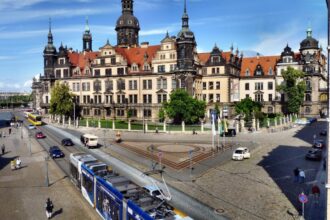
The Residenzschloss, Dresden’s royal palace, sits at the historic centre of the Saxon court, a rebuilt Renaissance and Baroque complex that housed Saxony’s rulers for nearly five centuries. Its distinctive Hausmannsturm tower is visible from much of the surrounding Altstadt and offers panoramic views for anyone willing to climb it.
Inside, the palace holds several separate collections, including armouries, a print room and a coin cabinet, with a standard adult ticket covering most of these sections priced at €18 (£15.48/$21.06). The building itself was heavily damaged in 1945 and only fully restored decades later, with some wings not reopening until well into the 2000s.
The palace’s true showpiece, though, is the Grünes Gewölbe, or Green Vault, one of the oldest and richest treasure collections in Europe. Assembled largely by Augustus the Strong, it holds gold, silver, ivory and gemstone pieces so fine that Napoleon reportedly declined to plunder it.
The vault is split into two sections. The Historic Green Vault recreates the original eighteenth-century baroque display rooms exactly as designed, with a strict timed-entry system and a standard adult ticket costing €18 (£15.48/$21.06), while the separate New Green Vault presents further highlights in a more conventional modern museum layout.
Booking the Historic Green Vault online well in advance is genuinely necessary rather than optional advice, since daily visitor numbers are capped and walk-up tickets frequently sell out, especially in summer. The vault also made international headlines in November 2019, when thieves stole several eighteenth-century jewelled pieces in a dramatic overnight raid, several of which have since been recovered.
Visitors with limited time should prioritise the Historic Green Vault over the wider palace museums, since it is genuinely unlike anything else in the city. Pairing it with the Zwinger earlier in the day makes sense logistically, since both sit within a few minutes’ walk of each other around Theaterplatz.
Dresden’s Hop-On-Hop-Off Bus: Covering More Ground Without Driving
Dresden’s hop-on-hop-off bus runs a loop of 22 stops around the city, linking the Baroque Altstadt with sights further out that would otherwise mean a long walk or a separate tram ticket. A ticket is valid for a full day, and buying one after 4pm extends that validity into the following day as well.
The route takes in the Zwinger Palace, the Fürstenzug mural and the Frauenkirche among its stops, alongside sights outside the immediate old town that are trickier to reach on foot. An onboard audio guide is available in seventeen languages, which makes the loop workable for a genuinely international group of travellers.
Double-decker buses depart every 15 to 30 minutes depending on the season, running more frequently between April and October than over the winter months. Riders who would rather stay seated the whole way can take the full loop as a roughly 90-minute continuous tour instead of hopping off along the way.
It suits a first visit better than a longer stay, since the value comes from covering distance quickly rather than from lingering at any one stop. Anyone planning to spend real time inside the Zwinger or the Residenzschloss is better off pairing a single loop of the bus with walking between the closely clustered Altstadt sights on foot.
A ticket costs around €24.50 (£21.07/$28.66) per adult and can be booked online in advance, which is useful during busier summer weekends when queues build at the main boarding point on Theaterplatz.
Fürstenzug: The Procession of Princes in Porcelain
The Fürstenzug, or Procession of Princes, is a monumental mural running along the outer wall of the Residenzschloss on Augustusstrasse, just a short walk from the Frauenkirche. It depicts a mounted procession of 35 Saxon rulers and notable figures, stretching back to the twelfth century, riding in historically accurate costume across a wall around 100 metres long.
The original mural was painted in the 1870s using the sgraffito technique, scratching an image into layers of different coloured plaster, but that version proved too fragile to survive Dresden’s weather over the long term. Between 1904 and 1907, the entire design was recreated using around 24,000 hand-painted Meissen porcelain tiles instead.
That switch to porcelain turned out to be a stroke of luck few could have predicted. The tiled Fürstenzug survived the February 1945 bombing almost entirely intact, one of the few large-scale artworks in the historic centre to come through the firestorm without major restoration needed afterwards.
Standing at the far end of the mural, near Schlossplatz, gives the best overall view of the full procession in one glance. Individual figures are labelled, making it easy to trace the House of Wettin’s rulers in order without needing a guidebook in hand.
Because it sits on an outdoor wall facing a public street, the Fürstenzug is entirely free to view at any hour, and it makes a natural link between the Neumarkt around the Frauenkirche and the Theaterplatz cluster around the Zwinger and Semperoper. Fifteen to twenty minutes is enough for most visitors.
Early morning or late afternoon light tends to work best for photos, since the mural faces roughly east and can wash out under harsh midday sun. It is a low-effort, high-reward stop that fits neatly between almost any two other Altstadt sights on this list.
Dresden’s Elbe sunset sailings get their own fuller write-up later in this guide, but the same paddle steamer crossing can be booked directly from here as well, which is useful if a sailing time is filling up while still reading through the rest of the page.
Brühl’s Terrace: The Balcony of Europe
Brühl’s Terrace, known locally as Brühlsche Terrasse, is the raised riverside promenade running along the Altstadt bank of the Elbe, directly behind the Residenzschloss and the Semperoper. It sits on top of what were originally Renaissance-era fortress ramparts, repurposed into a formal garden terrace in the eighteenth century.
The terrace takes its name from Heinrich von Brühl, a powerful Saxon minister who acquired the site in the 1730s and transformed the old fortifications into private gardens and a palace of his own. Much of that eighteenth-century landscaping survives in outline today, though Brühl’s own palace was later demolished.
Its nickname, the Balcony of Europe, dates back to the terrace’s popularity among eighteenth and nineteenth-century travellers, who considered the view across the Elbe towards Neustadt among the finest urban river panoramas on the continent. That reputation holds up remarkably well today, particularly at sunset when the water reflects the Altstadt skyline behind the terrace.
Several notable buildings line the terrace itself, including the Albertinum art museum at its eastern end and grand stone staircases leading down to the riverside path and the paddle steamer piers below. The Academy of Fine Arts, with its distinctive glass dome nicknamed the Lemon Squeezer by locals, sits just off the terrace too.
Walking the full length takes around thirty minutes at an easy pace, and the terrace costs nothing to enjoy, making it one of the best free things to do in the entire city. Benches along the route make it a natural place to pause between the Theaterplatz museums and a riverside cruise departure.
Evenings bring out street musicians and a steady flow of locals rather than just tour groups, giving the terrace a genuinely lived-in atmosphere once the day’s coach parties have moved on. It pairs naturally with dinner at one of the restaurants along Münzgasse, just below the terrace on the Neumarkt side.
Neustadt: Dresden’s Bohemian Side of the River
Cross the Augustus Bridge or the Carola Bridge from the Altstadt and the whole atmosphere of Dresden shifts within a few blocks. The Neustadt, and particularly the Äußere Neustadt district around Alaunstrasse and Louisenstrasse, is Dresden’s alternative and student quarter, filled with independent bars, vintage shops and street art rather than Baroque facades.
The district largely escaped the worst of the 1945 bombing, since Allied targeting focused on the Altstadt and the rail yards to the south. That survival means the Neustadt still has genuine nineteenth-century tenement blocks lining narrow streets, a rarity in a city where so much else had to be rebuilt from photographs and salvaged stone.
The area’s best-known set piece is the Kunsthofpassage, a chain of five interconnected courtyards each decorated to a different theme, including one covered in rain-activated drainpipes shaped like musical instruments. Walking through all five courtyards takes about twenty minutes and costs nothing, making it one of the more unusual free attractions anywhere in the city.
Evenings in the Neustadt look nothing like the quieter Altstadt after dark. Alaunstrasse and the surrounding streets fill with bars, small live music venues and late-opening restaurants, and the area has a reputation as one of eastern Germany’s more energetic nightlife districts, particularly on weekends.
Daytime visits work just as well for browsing the district’s independent shops, vintage clothing stores and small galleries tucked into side streets away from the main thoroughfares. A slow wander with no fixed itinerary genuinely suits the Neustadt better than a checklist of specific addresses.
Budget at least two hours to get a real feel for the district, and closer to four if bars and dinner are part of the plan. It sits close enough to the Altstadt that combining both in a single day is entirely realistic, especially since the walk across the river takes only about fifteen minutes.
Best if you can move a day either way. Shows how the fare changes across the month.
Compare flightsBest for anyone whose home plan charges by the megabyte abroad. Pay a fixed price up front.
Check eSIMsBest after a long flight or a late landing. Price agreed before you travel, and no taxi queue.
Check transfersDresden Castle General Admission: The Ticket That Skips the Green Vault Queue
A general admission ticket to Dresden Castle covers most of the Residenzschloss’s museum collections without touching the Historic Green Vault at all, which keeps it simpler and considerably cheaper than trying to add that separately ticketed treasury on. It typically costs around €18 (£15.48/$21) per adult and includes an optional audio guide.
The ticket covers the New Green Vault, the Turkish Chamber, the Renaissance Wing and the Armoury, four collections that between them span several centuries of Saxon court life without the timed-entry restrictions that apply to the Historic Green Vault next door. Visitors who only have an hour or two to spare, rather than a full half-day, often find this the more realistic option.
During the summer months the ticket can also include a climb up the Hausmannsturm tower, a 327-step staircase that ends on a viewing platform above the surrounding Altstadt rooftops. It is a seasonal add-on rather than a year-round feature, so it is worth checking availability before counting on it.
Booking online in advance is worthwhile even for this less time-pressured ticket, since it comes with free cancellation up to 24 hours before the visit and avoids a second queue at the ticket desk after already walking across from the Neustadt. It is a straightforward way to see inside the palace without committing to the earlier planning that the Historic Green Vault demands.
Pfunds Molkerei: The World’s Most Beautiful Dairy Shop
Tucked into a stretch of Bautzner Strasse in the Neustadt, Pfunds Molkerei looks nothing like a typical dairy shop from the outside, and even less like one inside. Every wall, ceiling and pillar is covered in hand-painted, hand-glazed ceramic tiles, an interior so elaborate that it holds a Guinness World Record as the world’s most beautiful dairy shop.
The Pfund brothers founded the dairy in 1880, and the current shop’s Neo-Renaissance tiled interior dates from a major renovation completed in 1892. The tiles were designed by Villeroy & Boch, and their intricate patterns of cows, flowers and pastoral scenes cover nearly every surface.
Remarkably, the shop functioned as a working dairy right through the GDR era and survived the Second World War with its interior largely intact, a rare piece of continuous commercial history in a city where so much else was destroyed or repurposed. It remains a genuine, functioning shop today rather than a museum piece behind glass.
Shelves stock cheeses, milk products and a range of Saxon specialities, alongside souvenirs for visitors who want a tangible reminder of the tiled interior. The shop can get genuinely crowded during peak tourist hours, since its small footprint fills quickly once a coach tour or two arrives at the same time.
Entry to look around costs nothing, though buying something from the shelves is the polite way to justify lingering for photos, since it remains a working shop rather than a tourist attraction. Fifteen to thirty minutes covers a proper look, longer if the queue for photos runs long.
Visiting earlier in the day, particularly on weekday mornings, gives the best chance of a relatively quiet look at the tilework without a crowd blocking every angle. It pairs naturally with a wider wander through the Neustadt, since it sits only a short walk from the district’s bars and independent shops.
Cruising the Elbe: Paddle Steamers Through the Valley
Dresden sits at the heart of what is generally considered the world’s largest fleet of historic paddle steamers still in regular passenger service. Several of the vessels operating today date back to the late nineteenth and early twentieth centuries, and they run scheduled routes along the Elbe from piers on the Terrassenufer, directly below Brühl’s Terrace.
Short city cruises typically run around fifty minutes to an hour, covering stretches of the river close to the Altstadt with commentary on the buildings visible from the water. These shorter routes cost from roughly €16 (£13.76/$18.72) per adult, making them an easy add-on rather than a full afternoon commitment.
Longer excursions head further afield in either direction, including routes upstream towards Pillnitz Palace and its riverside gardens, or downstream through the vineyard-covered slopes of the Saxon Wine Route. Trips into the dramatic sandstone landscape of Saxon Switzerland National Park, roughly an hour outside the city, also run seasonally for visitors with a full day to spare.
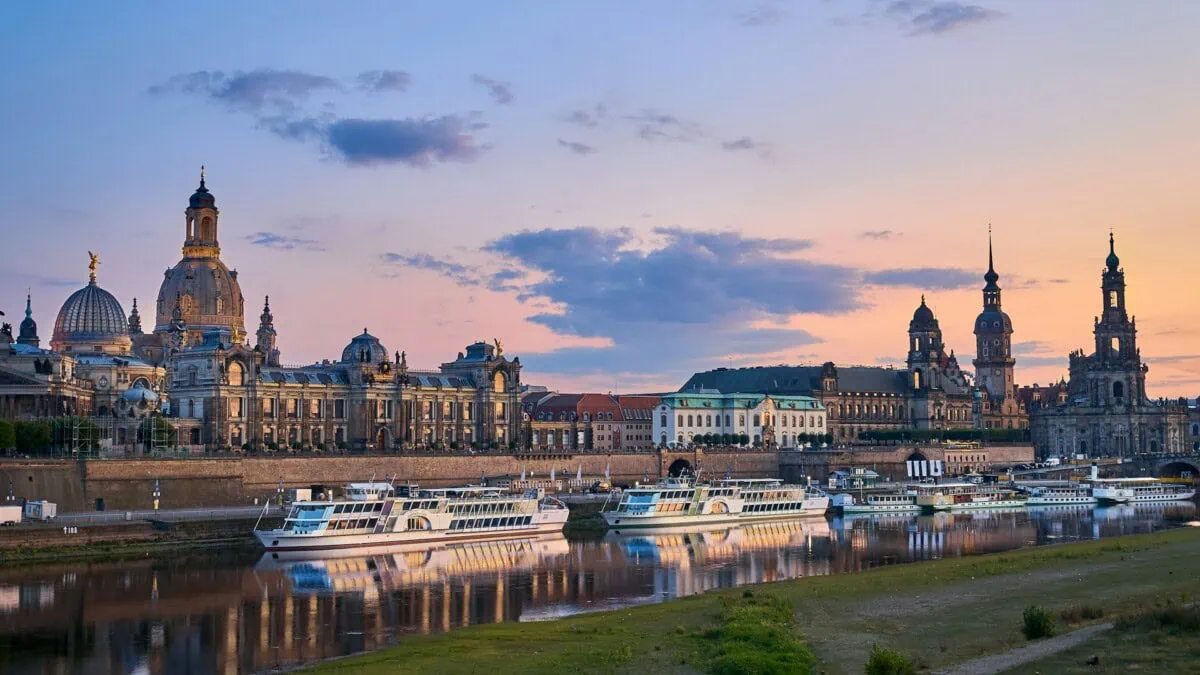
Seeing Dresden’s skyline from the water genuinely changes the perspective on the Altstadt’s rebuilt domes and towers, and it is one of the few vantage points that takes in the Frauenkirche, the Zwinger and the Semperoper in a single sweep. Photographers in particular tend to rate the river view above any single vantage point on land.
Tickets can usually be bought at the pier on the day, though pre-booking online is worth considering on summer weekends and during the Advent season, when popular sailings can fill up. Boarding roughly fifteen minutes before departure avoids any last-minute rush at the gangplank.
Bring a layer even in summer, since the breeze off the water is noticeably cooler than the streets of the Altstadt, and the open upper decks offer little shelter. Sunset sailings in particular tend to sell out fastest, so booking a day or two ahead makes sense for that specific slot.
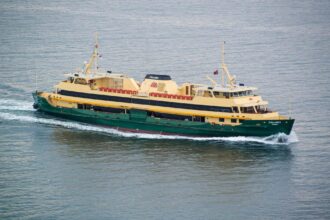
The historic paddle steamer itself, run by Weiße Flotte Sachsen, turns around at Pillnitz Castle before heading back to the Terrassenufer pier, and a seat can be reserved online ahead of the sailing.
Dresden’s Military History Museum: A Bundeswehr Landmark
The Militärhistorisches Museum, Germany’s central Bundeswehr military history museum, occupies a former nineteenth-century arsenal in the Albertstadt district north of the Altstadt. It is one of the largest and most architecturally striking museums of its kind anywhere in the country.
The building’s defining feature is a dramatic wedge-shaped steel and glass extension, designed by architect Daniel Libeskind and completed in 2011, which cuts straight through the original neoclassical structure at an angle. That deliberate collision of old and new architecture is itself meant to comment on the violence and disruption the museum’s collection explores.
Exhibits inside take a notably critical, thematic approach rather than a simple chronological march through Saxon or German military history. Displays cover topics including animals in warfare, the technology of destruction and the everyday experience of soldiers, drawing on the museum’s own extensive collection alongside temporary special exhibitions.
Visitors can climb into the Libeskind wedge itself for a genuinely striking viewing platform, which frames Dresden’s skyline through angled glass in a way that feels deliberately unsettling rather than simply scenic. That platform alone is worth the visit for anyone interested in contemporary architecture as much as military history.
Standard adult admission to the permanent collection costs €5 (£4.30/$5.85), with a combined ticket covering both the permanent and any special exhibition priced at €7 (£6.02/$8.19). The museum closes on Wednesdays, and Monday evenings offer extended opening until 9pm for visitors who prefer a quieter, later slot.
Reaching the museum takes around fifteen minutes by tram from the Altstadt on lines 7 or 8, and free on-site parking is available for anyone driving. Budget at least two hours, since the collection is genuinely large and the Libeskind wing rewards a slow, deliberate walk rather than a rushed circuit.
Volkswagen’s Transparent Factory: Cars Built Behind Glass
The Gläserne Manufaktur, or Transparent Factory, is one of Dresden’s most genuinely unusual attractions, a full working Volkswagen production facility built almost entirely from glass walls rather than the windowless sheds most car plants hide behind. It sits on Strassburger Platz, close to the Grosser Garten park, only a few tram stops from the Altstadt.
Volkswagen opened the factory in 2002, originally to build the top-end Phaeton luxury saloon in front of paying visitors as a deliberate statement of manufacturing confidence. Production has since shifted to electric vehicles, and the factory floor now assembles models from VW’s ID electric range for visitors to watch.
Self-guided visits along the elevated walkways are free, giving anyone the chance to watch battery packs, chassis and final assembly happen a few metres away through floor-to-ceiling glass. Guided tours go further, taking visitors closer to specific production stages with commentary from staff, and these typically start from around €7 (£6.02/$8.19) depending on the tour chosen.
Family-friendly tour options are available too, pitched at a level that keeps younger visitors engaged with the robotics and moving parts rather than lost in technical detail. A restaurant on site, SPEISEWERK, serves regional Saxon dishes for anyone wanting to make a longer stop of the visit rather than just a quick look at the factory floor.
The building itself is worth a glance regardless of any interest in cars, since its glass-and-timber structure, capped by a striking curved roof, was always designed to be an architectural statement as much as a functioning plant. Evening visits catch the whole building lit from within, arguably its most impressive look.
Opening hours run Monday to Friday from 9am to 6pm and Saturday from 10am to 6pm, with the factory closed on Sundays. Booking a guided tour slot in advance online is sensible during busy periods, since group sizes are limited to keep the production floor genuinely walkable.
The basic 45 to 75 minute tour runs with a live guide in several languages and costs around €8.90 (£7.65/$10.39) per person, and a slot can be reserved online in advance.
Dresden’s Food Scene: Stollen and Saxon Specialities
Dresden’s best-known culinary export is Dresdner Christstollen, a dense, fruit-and-nut-studded Christmas bread dusted heavily in powdered sugar that has been baked in the city since at least the fifteenth century. Genuine Dresdner Stollen carries a protected geographical status within the European Union, meaning only loaves baked within the city and surrounding area under strict recipe rules can legally use the name.
A small loaf from a genuine bakery typically starts from around €12 (£10.32/$14.04), rising well past €30 (£25.80/$35.10) for a large, traditionally wrapped Stollen suitable for gifting. Bakeries across the Altstadt and Neustadt sell it year-round for visitors who cannot time a trip for the Advent season, though it is at its freshest and most widely available in the weeks before Christmas.
Beyond Stollen, Saxon cuisine leans hearty and unpretentious. Sächsische Sauerbraten, a slow-marinated pot roast typically made with horse or beef, and Eierschecke, a layered egg-custard cheesecake unique to the region, both show up regularly on menus across the Altstadt and Neustadt.
The Neustadt generally offers better value and a wider international spread than the more tourist-focused restaurants clustered directly around the Neumarkt and Frauenkirche. Wandering a block or two off the main squares tends to turn up smaller, family-run kitchens serving Saxon staples at noticeably lower prices than the postcard views nearby.
Coffee culture also runs deep here, since Dresden claims to be home to one of continental Europe’s oldest surviving coffee houses. Pairing a slice of Eierschecke with a proper Saxon coffee makes a genuinely pleasant mid-afternoon stop between sightseeing stretches.
For a deeper dive into the Christmas side of Dresden’s food culture, including the annual Stollenfest parade through the Altstadt, our dedicated Dresden Christmas Market guide covers that ground in far more detail than fits here. This section deliberately keeps things brief, since the market itself deserves its own proper write-up.
Best for solo travellers and anyone watching the budget. Dorm beds and private rooms in the same search.
Browse hostelsBest if you have ever given up on a claim. AirHelp checks whether the flight qualifies and pursues it for you.
See the benefitsBest if your room is not ready yet. Left luggage booked in advance, so you are not hunting for a locker.
Check storageShopping in Dresden: From the Altmarkt to the Neustadt
Dresden’s main shopping strip runs through the Altmarkt Galerie and the surrounding pedestrianised streets between the Altmarkt square and the Prager Strasse boulevard leading to the Hauptbahnhof. This stretch covers familiar international high street chains alongside larger department stores, making it the obvious first stop for practical shopping rather than souvenirs.
For something more distinctly Saxon, several shops around the Neumarkt and Frauenkirche sell Meissen porcelain, the region’s most famous export, alongside handcrafted wooden items from the Ore Mountains further south. Prices for genuine Meissen pieces run high, but even browsing the display cases gives a sense of the craftsmanship behind the Fürstenzug’s tiles a few streets away.
The Neustadt offers a completely different shopping experience, built around independent boutiques, vintage and second-hand clothing stores, and small design studios rather than chain retail. Alaunstrasse and the surrounding streets are the best starting point for anyone after something that will not be sold in an airport gift shop back home.
Pfunds Molkerei, covered earlier in this guide, also doubles as a genuinely enjoyable shopping stop, selling cheeses and Saxon dairy products from inside its famously tiled interior. It sits within easy walking distance of the wider Neustadt shopping streets, making it easy to combine both in one outing.
Weekend markets add another layer worth checking before a visit, since Dresden runs a regular farmers’ market on the Altmarkt alongside occasional flea markets and craft fairs in the Neustadt. Timing a visit around one of these adds genuine local flavour that the fixed shopfronts alone cannot provide.
Most shops in the Altstadt keep standard German retail hours, generally closing by 8pm on weekdays and earlier on Saturdays, with almost everything shut on Sundays under national trading laws. The Neustadt’s smaller independent stores sometimes keep looser, more unpredictable hours, so checking ahead for a specific shop is worth the effort.
Family-Friendly Dresden: What Works With Kids
Dresden works better for families than its reputation as a serious art-and-history city might suggest, largely because so many of its best sights are outdoor, free, and genuinely interesting to children. The Fürstenzug mural and a walk along Brühl’s Terrace both cost nothing and give younger visitors plenty to look at without the fatigue of a full museum circuit.
The Elbe river cruises covered earlier tend to be a genuine highlight for children, since a paddle steamer with visible machinery and an open deck holds attention far better than a static museum gallery. Shorter city cruises around fifty minutes suit shorter attention spans better than the longer excursions further along the valley.
The Volkswagen Transparent Factory also works surprisingly well for families, with dedicated kids’ tours pitched to keep the robotics and moving parts engaging rather than technical. Watching an actual car come together through floor-to-ceiling glass tends to land better with children than most adults expect going in.
The Grosser Garten, Dresden’s large central park just beyond the Transparent Factory, adds a genuinely useful family stop with a small zoo, a botanical garden and a narrow-gauge park railway that circles the grounds. It is an easy, low-cost way to burn off energy between the more structured sightseeing stops on this list.
Pfunds Molkerei’s tiled interior tends to fascinate younger visitors just as much as adults, even if the historical detail goes over their heads, since the sheer density of colour and pattern is genuinely striking at any age. It also makes a natural, low-cost stop between the Neustadt’s other family-friendly wandering.
For families balancing museum time with genuine downtime, spreading the Zwinger, Residenzschloss and Military History Museum across separate days rather than cramming all three into one visit tends to work better than an ambitious single-day itinerary. Dresden’s compact centre makes that kind of relaxed pacing genuinely easy to manage.
Rainy Day Dresden: The Best Indoor Options
Dresden’s weather can turn quickly, particularly in autumn and winter, but the city’s museum density means a rainy day rarely has to mean a wasted one. The Zwinger’s Old Masters Gallery alone can easily fill two or three hours indoors, and its scale means a single wet afternoon barely scratches the surface of what is on display.
The Residenzschloss and Green Vault offer another substantial indoor option, and since the Historic Green Vault requires timed entry anyway, it is worth booking a rainy-looking day in advance rather than leaving it to chance. Both sit close enough to the Zwinger to combine into a single covered museum day around Theaterplatz.
The Militärhistorisches Museum‘s Libeskind wing and wider galleries also work well as a wet-weather stop, particularly given its extended Monday evening hours for anyone whose day starts elsewhere. Its location slightly outside the immediate Altstadt makes it a useful way to break up a multi-day itinerary.
The Panometer Dresden, housed in a former gasometer on the edge of the city, is worth adding to a wet-weather list too, showing enormous 360-degree panoramic artworks with themes that change periodically. It is a genuinely different kind of indoor attraction from the city’s traditional museums.
Volkswagen’s Transparent Factory is fully covered and glass-walled rather than open-air, making it a comfortable rainy-day choice despite its industrial setting, and the SPEISEWERK restaurant on site means a wet lunch stop is covered too. Pfunds Molkerei similarly works regardless of weather, given its short, entirely indoor visit.
Even the Neustadt’s Kunsthofpassage courtyards, while technically outdoor, are compact enough to duck through quickly between heavier showers if the rest of the day’s plans call for staying mobile. Building one indoor museum and one shorter covered stop into any rainy-day plan tends to keep spirits up better than committing to a single long museum visit alone.

Rupert’s Handy Travel Tips
Dresden packs a huge amount of history into a genuinely walkable centre, so a little planning goes a long way here:
- Book the Historic Green Vault well in advance: daily numbers are capped, and walk-up tickets regularly sell out, especially in summer.
- Pair the Zwinger with the Residenzschloss on the same day: both sit within a few minutes’ walk of Theaterplatz, so save a separate day for sights further out.
- Check SKD museum opening days before you go: several close on Wednesdays, which can derail a tightly planned itinerary.
- Visit Pfunds Molkerei on a weekday morning: its small footprint fills quickly once coach tours arrive later in the day.
- Take an Elbe cruise for the best Altstadt skyline view: the river is one of the only vantage points that takes in the Frauenkirche, Zwinger and Semperoper in a single sweep.
- Cross the river for dinner in the Neustadt: it is generally better value than the more tourist-focused restaurants right around the Neumarkt.
Want to meet the reindeer behind our travel tips? Find out more in our page Who is Rupert?.





Frequently Asked Questions About Things to Do in Dresden
How many days do I need in Dresden?
Two full days cover the Altstadt highlights, including the Frauenkirche, Zwinger and Residenzschloss, though three or four days allow time for the Neustadt, an Elbe cruise and the Transparent Factory without rushing.
Is the Frauenkirche free to visit?
General entry to the church interior is free, though climbing the dome viewing platform costs €12 (£10.32/$14.04) for adults.
Do I need to book the Green Vault in advance?
Yes, strongly recommended. The Historic Green Vault uses timed entry with capped daily numbers, and walk-up tickets often sell out.
What is the Fürstenzug made of?
The mural is made from around 24,000 hand-painted Meissen porcelain tiles, added between 1904 and 1907 to replace a more fragile original.
Is the Volkswagen Transparent Factory worth visiting?
Yes. Self-guided viewing along the walkways is free, and it offers a genuinely unusual look at electric car production behind glass walls close to the city centre.
What is the best way to see Dresden’s skyline?
An Elbe river cruise, starting from around €16 (£13.76/$18.72), gives the best single view of the Frauenkirche, Zwinger and Semperoper together.
Is Dresden good for families?
Yes. Free outdoor sights like the Fürstenzug and Brühl’s Terrace, plus family-friendly options like the Transparent Factory and Grosser Garten park, make it an easy city for children.
What should I do in Dresden if it rains?
The Zwinger, Residenzschloss, Military History Museum and Panometer Dresden are all fully indoor and make reliable rainy-day options.
Further Reading & Related Guides
Dresden joins a growing Germany cluster on AST, so if you are flying in, our Dresden Airport Transfers guide covers every realistic way of reaching the city centre from DRS, including the S2 line, local buses, taxis and private transfers.
For another major German city built around a rebuilt historic centre and its own layered wartime history, our Best Things to Do in Nuremberg guide covers the Kaiserburg, the Christkindlesmarkt and Nuremberg’s underground bunkers in similar detail to this page.
If you are travelling onward by train, our German Rail Tickets Explained guide breaks down the Deutschland-Ticket and regional Saxony fares, while our Interrail Germany Pass Guide explains when a country-specific pass beats buying individual tickets for a wider German rail trip.
Travellers building a wider Germany itinerary around Dresden may also want our Best Things to Do in Berlin guide, the flagship page in this same Germany cluster, which covers the capital’s landmarks and Cold War history in the same level of detail as this page.