Reviewed by our editorial team Published
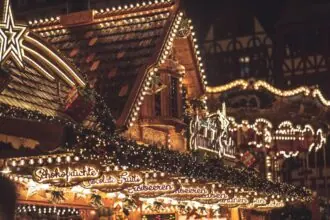
Every winter, Leipzig’s Markt square and six neighbouring locations across the old town fill with wooden stalls for the Leipziger Weihnachtsmarkt, first documented in 1458 when Frederick II, Elector of Saxony, granted the city the right to hold a Christmas market. That written privilege makes it one of the oldest Christmas markets anywhere in the German-speaking world, and its own tourist board describes it as Germany’s second-oldest.
The “second-oldest” claim is worth stating carefully rather than simply repeating. Bautzen cites a market record from 1384, Frankfurt’s own trading stalls are recorded on the Römerberg from 1393, and Dresden’s Striezelmarkt dates to 1434, all earlier than Leipzig’s 1458 privilege. Leipzig’s genuine claim to fame is less about being first and more about the sheer scale it has grown into since.
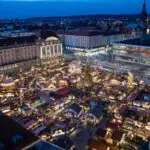
Today the market has grown from a single documented privilege into a sprawling event spread across seven locations in Leipzig’s compact old town, with more than 300 stalls and an estimated two million visitors each season, roughly half of them travelling in from outside the city. A fairytale forest for children, a Finnish village, a South Tyrolean chalet cluster, a Swiss village and a historic carousel have all become as central to a Leipzig visit as the Markt’s own towering fir tree.
What follows covers that history in more depth, the confirmed 2026 opening dates and hours, and a location-by-location breakdown of what fills each of the market’s seven old town squares. It also gets into details many Leipzig guides skip entirely: the Thomanerchor’s genuine Advent concerts at Bach’s own church, the city’s real ice rink at Augustusplatz (and why it does not actually run during the market itself), Sunday shopping rules under Saxon law, and how Leipzig sees in the new year once the stalls have gone.
A Market With Roots in Medieval Saxony
The Leipziger Weihnachtsmarkt’s founding is dated to 1458, when Frederick II, Elector of Saxony, formally granted Leipzig the privilege of holding a Christmas market, reportedly in recognition of loyal service the city had shown him. It was a genuinely practical civic grant rather than a tourist attraction, letting traders and craftspeople sell goods to residents stocking up ahead of the festive season.
Over the following centuries, that founding privilege grew alongside Leipzig’s own rise as one of Europe’s great trading and fair cities, a status the city had already built through its historic trade fairs. The market gradually expanded from a single square into a network of stalls spreading across the old town’s medieval streets and courtyards, mirroring the city’s wider growth as a commercial and cultural centre.
Like most German markets, the Weihnachtsmarkt was disrupted through the Second World War, and Leipzig’s historic centre suffered heavy bombing in the conflict’s final years. The market returned to the rebuilt Markt in the postwar decades and has run there every December since, with the notable exception of 2020 and 2021, when the market was cancelled entirely due to the coronavirus pandemic.
Leipzig’s own musical heritage, home to Johann Sebastian Bach and the historic Thomanerchor boys’ choir, still shapes the market’s character today, most visibly through the daily brass performances from the Old Town Hall balcony covered later in this guide. That layering of trade history, musical tradition and festive commerce is a large part of why the market feels distinct from other Saxon markets nearby.
Whichever way the “oldest” debate across German cities is settled, Leipzig’s own tourism authority treats 1458 as the market’s genuine founding date, and its near six-century run is a large part of why the Weihnachtsmarkt now draws roughly two million visitors from across Europe rather than remaining a purely local event.
2026 Opening Dates and Hours
For the 2026 season, the Leipziger Weihnachtsmarkt is scheduled to run from 24 November to 23 December 2026, with an official opening ceremony on the market’s first evening. Unlike Dresden’s market, Leipzig’s does not stretch through to Christmas Eve, so travellers hoping to combine a visit with the day itself should plan around the earlier closing date.
Standard opening hours run from 11am to 9pm Sunday to Thursday, extending to 11am to 10pm on Fridays and Saturdays. The opening ceremony on 24 November is scheduled for 5pm, so visitors arriving on the very first day should expect stalls to be fully open only from the early evening rather than the standard 11am start.
These are the most specific times published so far for the 2026 season. As with other German Christmas markets, individual stalls occasionally adjust their own hours slightly, so this should be treated as a reliable pattern rather than a guaranteed schedule.
| Date / Day Type | Hours |
|---|---|
| Opening date, 24 November 2026 | Opening ceremony at 5pm |
| Sunday to Thursday | 11am to 9pm |
| Friday and Saturday | 11am to 10pm |
| Closing date, 23 December 2026 | Market closes for the season |
Because the market closes on 23 December rather than running into Christmas Eve, it suits travellers who want their festive shopping and Glühwein wrapped up before the holiday itself rather than combining the two. It does not reopen for New Year, so anyone hoping to see the stalls again after Christmas should plan a different trip rather than assuming they will still be running.
For the most accurate, year-specific information, it is always worth checking the official Leipzig Christmas market page before booking travel, since exact hours and any last-minute changes are published there each autumn. That evergreen caveat applies to every German Christmas market guide on this site, simply because official dates for markets this far ahead can shift slightly as the city finalises its winter programme.
Best for a short trip. Compare rooms by neighbourhood, price and guest rating before you book.
Compare hotelsBest for families, or any stay past about four nights. A kitchen and a washing machine start paying for themselves.
Browse rentalsBest as a last check before booking. Compares hotel rates across several sites in one search.
Compare ratesThe Markt: Leipzig’s Christmas Tree and Main Stalls
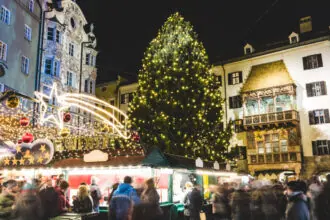
The market’s centrepiece remains the Markt, Leipzig’s historic main square, framed by the ornate Renaissance facade of the Altes Rathaus (Old Town Hall) on one side and the King’s House on the other. A towering 20-metre spruce, decorated with roughly 300 red and gold ornaments and around 3,000 lights, anchors the square each December and is lit every evening once the stalls open.
The densest concentration of the market’s 300-plus stalls sits here and along the surrounding streets, selling everything from handmade decorations and toys to candles and festive food. Because the Markt is a genuinely large, open square rather than a cramped medieval lane, it feels noticeably less claustrophobic than some smaller German markets even during the busiest weekend evenings.
A mug of Glühwein at the Markt typically costs around €4 to €5 (£3.44-4.30/$4.68-5.85), in line with the rest of Germany’s markets, usually with a small refundable deposit for the mug itself. Many visitors simply keep the mug as a souvenir rather than queueing to reclaim the deposit, since each season brings its own new design specific to Leipzig.
Beyond the tree and the main stalls, the Markt also serves as the natural starting point for exploring the rest of the market’s seven locations, since Grimmaische Straße and Nikolaistraße both lead directly off the square toward Augustusplatz and the Nikolaikirche. Treating the Markt as a hub rather than the whole visit is the single best piece of orientation advice for a first-time trip.
Augustusplatz: The Fairytale Forest and Alpine Villages
Augustusplatz, the grand square framed by the Leipzig Opera and the Gewandhaus concert hall, sits directly across from Leipzig Hauptbahnhof and hosts a genuinely different atmosphere from the Markt’s traditional stalls. Here the market gives over its ground to a dedicated children’s fairytale forest, with themed walkways and storybook scenes built specifically for younger visitors.
Alongside the fairytale forest, Augustusplatz hosts a Finnish village and a South Tyrolean village, two themed clusters of chalet-style stalls selling regional Nordic and Alpine food, drink and crafts rather than standard German Christmas market fare. The South Tyrolean chalets in particular lean into hearty Alpine cuisine, from cheese specialities to spiced hot drinks quite different from a standard Glühwein.
A Ferris wheel also operates on Augustusplatz through the season, giving visitors an elevated view across the square and the old town beyond, and it is one of the more reliable ways to entertain children who have already worked through the fairytale forest. Because the square is so large, it rarely feels as packed as the narrower streets closer to the Markt.
Given its position facing the Hauptbahnhof, Augustusplatz is often the first part of the market that arriving travellers see, and it is worth building in time here rather than walking straight past toward the Markt. The combination of themed villages, the fairytale forest and the Ferris wheel makes it one of the more distinctive single locations across the whole market.
Naschmarkt: Leipzig’s Historical Market and Its Craft Stalls
Tucked beside the Alte Handelsbörse and overlooked by a statue of Goethe, Naschmarkt is home to the market’s dedicated historical market, and it is genuinely the section that distinguishes Leipzig from many other German Christmas markets. Rather than modern prefabricated stalls, Naschmarkt’s traders work from period-styled wooden booths and lean into a lived-in, centuries-old atmosphere rather than a generic festive backdrop.
The craftspeople here span traditional trades rather than souvenir sellers alone, with candle makers, metalsmiths, glassblowers and woodturners demonstrating their work in front of visitors much as they would have done centuries ago. Watching a craft actually being made, rather than simply buying a finished item, is what sets this corner of the market apart from the busier stalls closer to the Markt.
It is a genuinely good stop for anyone wanting a hand-finished souvenir rather than a mass-produced decoration, since prices reflect the individual craftsmanship involved and stallholders are generally happy to explain the techniques behind their work. The relative calm of Naschmarkt compared with the Markt or Augustusplatz also makes it an easier place to browse without being jostled by crowds.
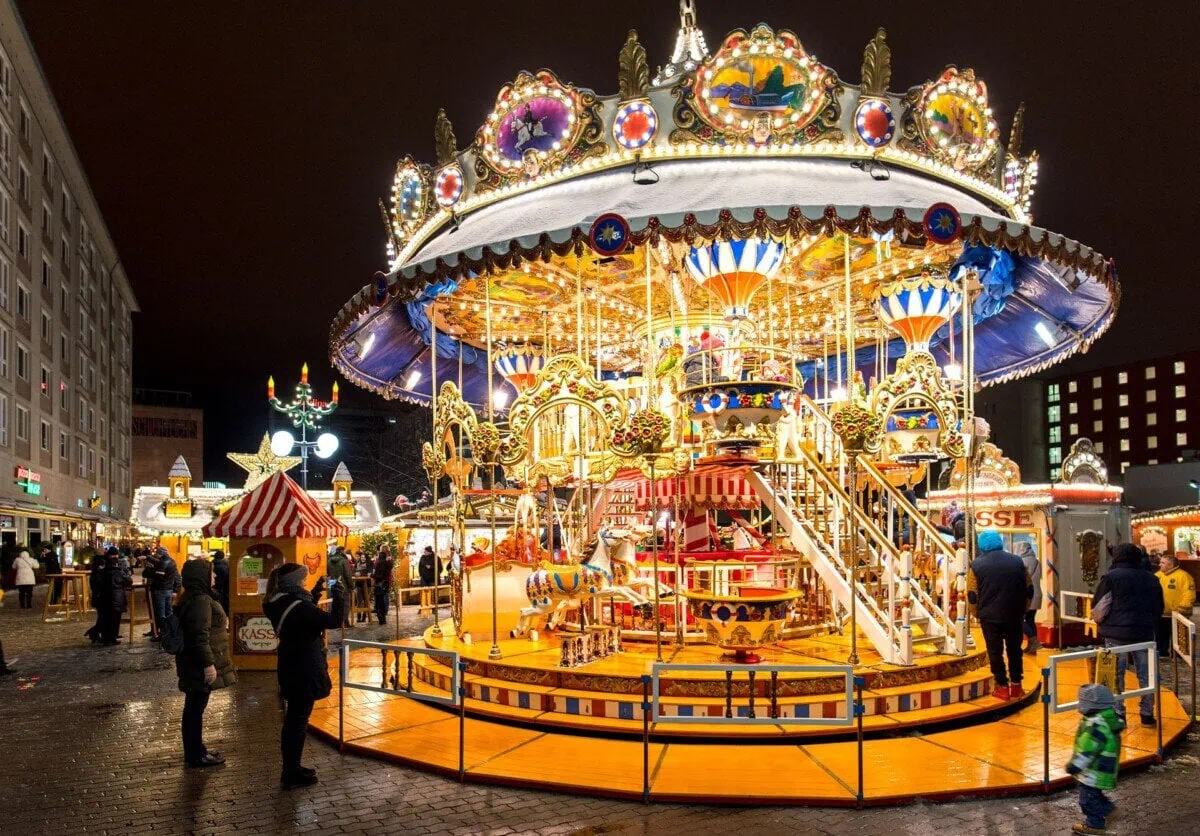
Just off Naschmarkt in the narrow Salzgäßchen lane, a historic multi-level carousel, more than a century old and rebuilt in 2010 after fire damage, adds a genuinely family-friendly note to this quieter corner of the market. Pairing the carousel with the historical market’s craft stalls makes for one of the more relaxed hours anywhere across the whole event.
Nikolaikirchhof: The Erzgebirge Pyramid and Nativity Scene
Nikolaikirchhof, the square beside the Nikolaikirche, is home to one of the market’s most photographed features, an eight-metre wooden Erzgebirge pyramid with tiered candle platforms and carved figures that turn slowly from the rising heat of its own lights. It is a smaller cousin of the giant pyramids found at markets like Dresden’s, but it anchors this corner of Leipzig’s market just as firmly.
Alongside the pyramid, Nikolaikirchhof hosts a traditional nativity scene complete with live sheep, a genuinely popular stop for families and one of the few places in the market where children can get close to real animals rather than wooden figures alone. The combination of the pyramid and the nativity scene makes this one of the more atmospheric corners of the whole event, especially once darkness falls.
The Nikolaikirche itself carries weight well beyond the Christmas market, since its Monday evening prayers grew into the mass demonstrations of the Peaceful Revolution in 1989 that helped bring down the East German government. Visiting the church itself, which remains open to the public, adds a genuinely different dimension to a stop at this part of the market.
Because Nikolaikirchhof sits just a short walk from both the Markt and Naschmarkt, it is easy to fold into a wider loop through the old town rather than requiring a special detour. Arriving in the early evening, once the pyramid’s lights are on, gives the best view of its slowly turning tiers.
The Swiss Village at Burgplatz
One of the market’s newer additions, the Swiss Village at Burgplatz, first introduced in 2024, returns for the 2026 season as a dedicated cluster of chalet-style stalls built around Swiss regional food, drink and craft goods rather than the standard German Christmas market staples found elsewhere across the event.
The village’s standout feature is a dedicated Eisstockschiessen lane, a form of Alpine ice stock sport similar to curling, giving visitors a genuinely hands-on activity rather than only browsing stalls. Covered seating areas around the lane mean spectators and players alike have somewhere sheltered to sit even on a cold December evening.
Food and drink here lean firmly toward Swiss specialities, from melted cheese dishes to Alpine-style hot drinks, giving visitors who have already sampled Leipzig’s own Glühwein and gingerbread a genuinely different flavour to try without leaving the market’s footprint. It is a useful stop for anyone travelling with a group that wants variety across an afternoon rather than sticking to one cuisine throughout.
Because Burgplatz sits a little further from the Markt than Augustusplatz or Nikolaikirchhof, it rewards visitors who are prepared to walk slightly further for a quieter, more novel corner of the market. As one of the event’s more recent additions, it is also worth checking ahead for any changes to its exact footprint or opening pattern before building a visit specifically around it.
Food and Drink: Glühwein, Stollen and Pulsnitzer Gingerbread
Roughly a third of the market’s stalls specialise in baked goods and sweets, making food and drink as central to a Leipzig visit as the stalls’ crafts and decorations. Roasted almonds, coated in cinnamon and sugar and scooped hot into paper cones, are one of the market’s most recognisable smells, drifting across several of the seven locations at once.
Pulsnitzer Pfefferkuchen, a protected gingerbread specialty from the nearby Saxon town of Pulsnitz, is sold widely across the market’s stalls and makes a genuinely well-travelling souvenir given its long shelf life. Stalls also sell Dresdner Christstollen, the dense, fruit-studded loaf associated with neighbouring Dresden, alongside more general festive baked goods native to Leipzig’s own stalls.
A mug of Glühwein across the market’s stalls typically costs the same €4 to €5 (£3.44-4.30/$4.68-5.85) found at the Markt, though the Swiss Village and South Tyrolean chalets on Augustusplatz both offer their own regional alternatives, from Alpine hot drinks to melted cheese dishes, for travellers wanting something different from a standard mulled wine.
Savoury options across the market run from grilled sausages to Reibekuchen potato pancakes, generally priced similarly to the rest of Germany’s markets. Sampling across two or three different locations rather than settling on the first stall passed is genuinely worthwhile here, since the food on offer varies noticeably between the Markt’s traditional stalls and the themed villages on Augustusplatz and Burgplatz.
Best if you can move a day either way. Shows how the fare changes across the month.
Compare flightsBest if you want maps and messaging working the moment you switch your phone on.
See eSIM plansBest after a long flight or a late landing. Price agreed before you travel, and no taxi queue.
Check transfersTurmbläser, Santa’s Arrival and the Bergparade
Every evening at 6pm, a brass ensemble known as the Turmbläser performs carols from the balcony of the Altes Rathaus overlooking the Markt, a genuinely understated tradition that is easy to miss if you are not looking up at the right moment. It is one of the market’s most atmospheric daily rituals, and timing an evening visit around it adds a layer most first-time visitors never plan for.
On the Saturday before the first Sunday of Advent, Leipzig marks the market’s true opening with Santa’s arrival by special train at Leipzig Hauptbahnhof, greeted at around 11am by crowds of families before making his way toward the Markt. It is a popular, family-friendly event worth building an early trip around if the exact date lines up with a planned visit.
In alternating years, Leipzig also hosts a Bergparade, an Erzgebirge miners’ parade drawing on the same mining heritage celebrated at Dresden’s own Striezelmarkt, with hundreds of musicians and uniformed participants marching in traditional dress through the old town. Because it does not run every single year, it is worth checking the current season’s programme before assuming it will feature.
Together, these traditions give the Leipzig market a rhythm beyond simply browsing stalls, from a fixed daily highlight in the Turmbläser to rarer set-piece events like Santa’s arrival and the Bergparade. Checking the market’s own published programme closer to a planned trip is worth doing if any of these specific traditions matter to the visit.
Ice Skating: The Leipziger Eistraum at Augustusplatz
Leipzig does have a genuine, large-scale ice rink close to the Christmas market’s own footprint, but it is worth being precise about timing before building a visit around it. The Leipziger Eistraum, described locally as one of Germany’s largest round ice rinks, sets up on Augustusplatz each winter alongside huts, mulled wine stalls, fire bowls and its own Ferris wheel, giving the same square a second, distinct winter identity once the Weihnachtsmarkt has packed up for the year.
Crucially, the Eistraum does not run during Advent, and it is worth being precise about which winter each season actually covers. Its most recently completed run went from 16 January to 1 March 2026, months before this year’s Weihnachtsmarkt even opens, since the rink is published as a wholly separate season from the Christmas market itself rather than a follow-on event in the same winter. Following that same pattern, the next Eistraum season is expected to open in mid-January 2027, roughly three weeks after this market’s own 23 December close, though the city had not yet confirmed exact 2027 dates at the time of writing. Anyone hoping to catch both the Weihnachtsmarkt and the Eistraum needs two separate visits rather than one, since the rink and the market never actually overlap.
Admission to the rink itself costs around €7 (£6.02/$8.19) for adults and €5 (£4.30/$5.85) for children, students and seniors with valid ID, with skate hire priced separately at around €5 (£4.30/$5.85) and a stabilising skating aid available for young or first-time skaters at the same price. The rink operates daily from 10am to 10pm throughout its run.
For travellers specifically chasing both the Weihnachtsmarkt and the Eistraum on one trip, splitting a visit across two separate dates, one in December and one in January or February, is the only realistic way to catch both, since none of Leipzig’s seven Christmas market locations has an ice rink of its own.
Carol Singing and Church Concerts: St Thomas Church and the Thomanerchor
Leipzig’s claim to Christmas music runs far deeper than the Turmbläser’s nightly balcony performance. St Thomas Church (Thomaskirche), where Bach worked as Thomaskantor for the last 27 years of his life and where he is now buried, is still home to the Thomanerchor, the boys’ choir Bach himself once directed and one of the oldest and most celebrated choirs in the world.
The Thomanerchor sings a genuine, unbroken weekly tradition of motets at Thomaskirche, performed most Fridays at 6pm and Saturdays at 3pm across the year, including through Advent. A printed programme, currently priced at around €3 (£2.58/$3.51) per person, covers admission, and entry is free for under-18s and Leipzig Pass holders. These are proper working church services rather than tourist performances, so checking Thomaskirche’s own published calendar closer to a visit is worth doing.
The genuine highlight for a Christmas trip, though, is the Thomanerchor’s performance of Bach’s Weihnachtsoratorium (Christmas Oratorio) at Thomaskirche each Advent, sung with the Gewandhausorchester across a short run of concerts. Demand is intense: the 2026 concerts were already sold out well ahead of the season, with travel packages for 2027 opening for registration a year in advance. Tickets for individual concerts, when available, are handled through the Gewandhauskasse on Augustusplatz rather than the church itself.
For anyone whose interest in Leipzig’s Christmas market extends to its musical heritage, pairing an evening at the market with a Thomaskirche motet, or planning a whole trip around securing Weihnachtsoratorium tickets a year ahead, is arguably the strongest differentiator this market has over every other German Christmas market covered on this site.
Christmas Shopping in Leipzig: Beyond the Market Stalls
Leipzig’s own retail streets are worth building into a market visit alongside the stalls themselves, particularly the pedestrianised stretch of Petersstraße and Grimmaische Straße running off the Markt, plus the historic Mädler-Passage and Specks Hof arcades, both lined with independent boutiques, jewellers and food shops rather than just chain retail.
Standard shop hours in Germany, and in Saxony specifically, are governed by the state’s own Ladenschlussgesetz, which generally keeps shops closed on Sundays. Regular weekday and Saturday trading hours in central Leipzig typically run from around 10am to 8pm, though exact hours vary by individual retailer and shorter hours are common away from the main streets.
Saxon law does allow local councils to permit a limited number of verkaufsoffene Sonntage (Sunday shop openings) each year, usually tied to a specific event or the Christmas market itself. For the 2026 season, Leipzig’s city centre has confirmed Sunday openings on 29 November and 13 December 2026, with participating shops generally trading from around midday to 6pm on both dates. These are the only two confirmed Sunday shopping dates published so far, so anyone planning a shopping trip around a Sunday should build it around one of these two dates specifically rather than assuming every Sunday works.
Outside those two dates, Sunday is best treated as a market and sightseeing day rather than a shopping day, since Sunday closing is a genuine, consistently enforced feature of German trading law rather than a quirk specific to Leipzig. Saturdays, by contrast, carry no such restriction and are consistently the busiest shopping day of the week in the run-up to Christmas.
New Year’s Eve in Leipzig
Leipzig’s Christmas market itself closes well before the new year, on 23 December, but the city has a genuine, well-established New Year’s Eve tradition worth knowing about for anyone extending a winter trip into early January.
Augustusplatz, the same square that hosts the market’s fairytale forest and Ferris wheel through December, becomes the city’s main Silvester gathering point once the stalls have gone. Framed by the Opera House, the Gewandhaus and the university’s high-rise tower, the square fills with locals bringing their own fireworks and sparklers, a genuinely public, informal celebration rather than a ticketed event, and it is treated locally as the natural place to see in the new year.
For a quieter view of the wider fireworks display across the city, the Völkerschlachtdenkmal, Leipzig’s 91-metre Battle of the Nations Monument, and the Fockeberg, an elevated park roughly 153 metres up on the edge of the centre, both offer genuinely wide vantage points over the surrounding skyline. The Markt itself, with the Altes Rathaus lit up behind it, also draws its own smaller crowd for a more atmospheric, less crowded alternative to Augustusplatz.
Beyond the informal street celebrations, the Gewandhaus and several of the city’s theatres and restaurants run organised Silvester concerts, dinner shows and themed parties each year, generally requiring advance booking given how popular the season is for accommodation across the city.
Because private fireworks are legal and widely used on the night itself, expect a genuinely loud, smoky atmosphere across the old town from mid-evening onward, and dress for cold, crowded streets if joining the Augustusplatz crowd directly.
Getting to the Leipzig Christmas Market
Leipzig’s old town is compact and largely pedestrianised, and the market’s seven locations sit within easy walking distance of each other and of the city’s main transport hub. Leipzig Hauptbahnhof, genuinely Europe’s largest railway station by floor area, sits directly beside Augustusplatz, making it an unusually convenient arrival point for a Christmas market trip.
From the Hauptbahnhof, it is roughly a ten-minute walk along Nikolaistraße or Grimmaische Straße to reach the Markt, passing directly through or beside Augustusplatz and Nikolaikirchhof along the way. For most visitors staying centrally, walking between locations is genuinely simpler than trying to work out local tram routes for such short distances.
Travellers flying into Leipzig/Halle Airport (LEJ) can reach the Hauptbahnhof on the S5 or S5X regional trains in around 14 minutes, with a standard single ticket costing around €4.20 (£3.61/$4.91). From there, the Markt and Augustusplatz are both within the short walk described above, so no further transfer is generally needed.
Because the old town streets around the market are largely closed to general traffic during the season, driving directly to any of the seven locations is not practical. December is also a genuinely busy period for accommodation in Leipzig, given the market’s long season and growing reputation, so booking well in advance, particularly for hotels near the old town or Hauptbahnhof, is worth doing rather than leaving it until closer to the date.
Best for short city stops where being central matters more than the room. Dorms and private rooms both listed.
See hostelsBest arranged before you fly rather than after. Covers claim handling, plus lounge access on eligible delays.
Explore AirHelp+Best for a day with a suitcase and nowhere to put it. Find a storage point near where you already are.
View storageBeyond the Market: The Rest of Leipzig Worth Seeing
Everything above covers what fills Leipzig’s seven Christmas market locations each December, but the city itself has far more going on than the market’s own footprint, and most of it runs year-round rather than only through Advent. Leipzig’s reputation as a music, art and student city, built on names running from Bach to Mendelssohn to a genuinely thriving contemporary gallery scene, is easy to miss if a visit is planned purely around Glühwein and stalls.
For everything else worth prioritising beyond the market’s own seasonal content, from the Völkerschlachtdenkmal and Leipzig’s museum quarter to the Spinnerei art district and the wider musical heritage touched on above, our complete Things to Do in Leipzig guide rounds up the sights, neighbourhoods and day-to-day attractions that make Leipzig worth visiting whatever the season.

Rupert’s Handy Travel Tips
Planning a trip to Leipzig’s Weihnachtsmarkt this winter? Here are a few useful tips to make your visit smoother.
- Treat the Markt as a hub, not the whole visit: Augustusplatz, Naschmarkt and Nikolaikirchhof are all a short walk away and each has its own distinct character.
- Don’t miss the Turmbläser at 6pm: the daily brass performance from the Old Town Hall balcony is easy to walk straight past if you don’t know to look up.
- Book your trip before 23 December: unlike Dresden’s market, Leipzig’s closes ahead of Christmas Eve rather than running through it.
- Head to Naschmarkt for genuine craftsmanship: the historical market’s candle makers, metalsmiths and glassblowers offer a calmer, more hands-on alternative to the busier main stalls.
- Take the S5 or S5X from the airport: both reach the Hauptbahnhof in around 14 minutes, right beside Augustusplatz and a short walk from the rest of the market.
- Book accommodation early: hotels near the old town fill up quickly given Leipzig’s growing reputation as a Christmas market destination.
- Don’t expect the ice rink during the market: the Leipziger Eistraum at Augustusplatz doesn’t open until mid-January, well after the Weihnachtsmarkt has packed up for the year.
- Book Weihnachtsoratorium tickets a year ahead if music matters to your trip: the Thomanerchor’s Advent performances of Bach’s Christmas Oratorio at Thomaskirche sell out fast, though the regular Friday and Saturday motets need no advance booking at all.
Want to meet the reindeer behind our travel tips? Find out more in our page Who is Rupert?.




Frequently Asked Questions About Leipzig’s Christmas Market
When does Leipzig’s Christmas market open in 2026?
The Leipziger Weihnachtsmarkt is scheduled to run from 24 November to 23 December 2026, with an opening ceremony at 5pm on the first evening and standard hours of 11am to 9pm Sunday to Thursday, extending to 11am to 10pm on Fridays and Saturdays.
Is Leipzig’s Christmas market really one of the oldest in Germany?
It is widely described as one of Germany’s oldest, first documented in 1458 and sometimes called the country’s second-oldest. Bautzen, Frankfurt and Dresden all have earlier market records, but Leipzig’s 1458 privilege still puts it among a small handful of markets with genuinely medieval origins.
Where is the Leipzig Christmas market held?
The market spans seven locations across the old town: the Markt, Augustusplatz, Naschmarkt, Nikolaikirchhof, Salzgäßchen, Burgplatz and the surrounding streets connecting them, each with its own distinct theme and stalls.
What makes Augustusplatz different from the rest of the market?
Augustusplatz hosts a dedicated children’s fairytale forest alongside a Finnish village and a South Tyrolean village, both themed clusters of chalet-style stalls selling regional Nordic and Alpine food and crafts rather than standard German Christmas market fare.
What should I buy at the Leipzig Christmas market?
Naschmarkt’s historical market is the best stop for hand-finished crafts from candle makers, metalsmiths, glassblowers and woodturners, while stalls across the market also sell protected Pulsnitzer Pfefferkuchen gingerbread and Erzgebirge-style wooden decorations.
Is there anything for children at the market?
Yes. Augustusplatz’s fairytale forest and Ferris wheel, the nativity scene with live sheep at Nikolaikirchhof, and the century-old carousel at Salzgäßchen near Naschmarkt all give families plenty to do beyond browsing stalls.
Is the market open on Christmas Eve or over New Year?
No. The market closes on 23 December 2026, ahead of Christmas Eve, and does not reopen for New Year, unlike some other German markets that run through to 24 December.
How do I get to the market without a car?
Leipzig Hauptbahnhof sits directly beside Augustusplatz, and the Markt is around a ten-minute walk away through the pedestrianised old town. Flying in, the S5 or S5X reaches the Hauptbahnhof from Leipzig/Halle Airport in around 14 minutes.
Is there an ice rink at Leipzig’s Christmas market?
Not during the market itself. The Leipziger Eistraum, a large outdoor ice rink at Augustusplatz, runs as a wholly separate winter season, most recently from 16 January to 1 March 2026, and is expected to return on a similar mid-January to early-March pattern after this year’s market closes, so the two never overlap.
Can I hear Bach’s choir perform in Leipzig at Christmas?
Yes. The Thomanerchor, the boys’ choir Bach directed at St Thomas Church, sings regular Friday and Saturday motets year-round and performs Bach’s Weihnachtsoratorium with the Gewandhausorchester each Advent, though tickets for the Christmas Oratorio concerts sell out well in advance.
Are shops open on Sundays during the Christmas market?
Generally no, since Saxon law keeps shops closed on Sundays outside a small number of approved exceptions. Leipzig’s confirmed verkaufsoffene Sonntage for 2026 fall on 29 November and 13 December, with participating shops trading from around midday to 6pm.
Does Leipzig have a New Year’s Eve celebration?
Yes. Augustusplatz becomes the city’s main informal Silvester gathering point once the Christmas market has closed, with locals setting off their own fireworks, alongside organised concerts and dinner shows at venues including the Gewandhaus.
Further Reading
Landing in Saxony before the market opens? Our Leipzig Airport Transfers guide covers every realistic way of reaching the city centre from LEJ, while our Things to Do in Leipzig guide rounds up the sights worth prioritising beyond the market itself. If a Bundesliga fixture lines up with your trip, our How to Get to the Stadium in Leipzig guide covers reaching the Red Bull Arena for an RB Leipzig matchday.
If your December visit has a spare day, our Best Day Trips from Leipzig guide covers Weimar, Wittenberg and Naumburg, and if you’re planning onward travel by train, our German Rail Tickets Explained guide breaks down the Sachsen-Ticket and the Deutschland-Ticket in full.
Comparing Leipzig against Germany’s other major markets is also worth doing before committing to a single-city trip. Our Dresden Christmas Market guide covers the neighbouring Striezelmarkt’s own centuries of tradition, while our Frankfurt Christmas Market guide covers a market spread across six squares with its own six-century-old history. Our Berlin Christmas Markets guide, Hamburg Christmas Markets guide and Stuttgart Christmas Market guide round out the rest of Germany’s biggest festive markets. Our Germany’s Christmas Markets Compared guide pulls all nine of the country’s biggest markets together side by side.