Reviewed by our editorial team Published
RB Leipzig is the newest name in German top-flight football by a considerable distance, and its story is unlike anything else in the Bundesliga. Founded on 19 May 2009 by Red Bull GmbH, the club began life in the fifth-tier NOFV-Oberliga Süd and reached the Bundesliga within seven seasons, a rise that took in four separate promotions and remains one of the fastest climbs through Germany’s league pyramid in the modern era.
That speed of ascent sits alongside a genuinely divisive reputation. RB Leipzig’s ownership structure, built around Red Bull’s corporate backing rather than a traditional membership base, sidesteps the spirit of Germany’s 50+1 rule in a way that has made the club a lightning rod across German football culture. Ultras groups at rival clubs regularly protest against RB Leipzig specifically, while others point out the club has followed the letter of DFL licensing rules and built a genuinely strong footballing operation on the pitch. This guide handles that debate factually rather than taking a side, since it is a real and ongoing part of any visit here.
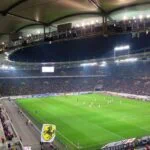
The club’s home ground is the Red Bull Arena, sitting at Am Sportforum 3 in the Zentrum-Nordwest district, inside the wider Leipzig Sportforum complex just north of the city centre. Unlike most Bundesliga grounds, which tend to sit well outside a city’s core, the Red Bull Arena is genuinely close to central Leipzig, a detail that shapes almost every practical part of a matchday visit here.
Capacity currently stands at 47,069 for Bundesliga fixtures, rising to as many as 50,000 for concerts and other non-football events. The ground’s story stretches back much further than RB Leipzig’s own history, since it was built directly on the site of the old Zentralstadion, a 100,000-capacity mass-gathering stadium opened in 1956 during the East German era, and its current form only emerged after a major rebuild completed in 2004 and a further expansion between 2015 and 2021.
This guide covers the practical side of a Red Bull Arena matchday in detail: the realistic tram journey and the genuinely walkable route from Leipzig Hauptbahnhof, an honest take on driving and parking, and how buying a ticket for one of the Bundesliga’s more accessible clubs actually works. It also covers the stadium’s layered East German history, the matchday atmosphere, RB Leipzig’s rise and its ownership debate, the Sportforum area for food and drink, and accessibility and safety on a matchday.
| Club | Stadium | Capacity | Nearest Station | League (2026/27) |
|---|---|---|---|---|
| RB Leipzig | Red Bull Arena | 47,069 (Bundesliga) | Tram Sportforum (Lines 3, 7, 8, 15) | Bundesliga |
Transport at a Glance: Nearest Stops for the Red Bull Arena
Before the full breakdown below, here is every nearest stop for the stadium in one place, covering both the tram and the S-Bahn.
| Mode | Stop / Station | Line(s) | Walk Time to Stadium |
|---|---|---|---|
| Tram | Sportforum | 3, 7, 8, 15 | ~5 min |
| S-Bahn | Leipzig Nord | S2, S4, S6 | ~10 min |
Getting to the Red Bull Arena by Tram, or on Foot from the Hauptbahnhof
The single most useful fact for a first-time visitor is that four separate tram lines, numbers 3, 7, 8 and 15, all call at a stop named Sportforum, putting riders within a short, flat walk of the turnstiles rather than a single vulnerable line with no backup if something goes wrong.
From Leipzig Hauptbahnhof, the tram ride out to Sportforum takes somewhere in the region of seven to ten minutes, and the Sportforum stop itself sits only a short, well-signed walk of around five minutes from the stadium entrances.
What makes the Red Bull Arena genuinely unusual among Bundesliga grounds is that walking is a realistic option too. The stadium sits roughly two and a half kilometres from the Hauptbahnhof, a walk of about twenty to twenty-five minutes through the city and the Sportforum parkland, which is simply not an option at most other big German grounds tucked away on a city’s outskirts.
A standard single ticket from LVB, Leipzig’s transport operator, costs around €3.80 (£3.27/$4.45) and covers an hour of unlimited transfers across the tram, bus and S-Bahn network, bought from a platform machine, the LVB app, or the driver on board. Details of matchday timetables and any temporary diversions are published on LVB’s own website.
It is easy to assume a stadium this central needs no real planning at all, but the tram remains the faster and less crowded option for most visitors, especially in poor weather or after full time, and it is worth checking which of the four lines is running an extended matchday service before deciding to walk both ways.
Best for a short trip. Compare rooms by neighbourhood, price and guest rating before you book.
Compare hotelsBest for groups who want one address and separate bedrooms rather than three hotel rooms.
See holiday homesBest as a last check before booking. Compares hotel rates across several sites in one search.
Compare ratesHow Busy the Sportforum Approach Gets on a Full House
A ground holding 47,069 fans can still turn a small tram platform into a genuinely crowded spot, and the Sportforum stop feels busy for roughly twenty minutes either side of kickoff on a well-attended fixture, even with four separate lines sharing the load.
Extra trams are the standard response to a full house rather than a separate shuttle network, since LVB publishes additional matchday services on all four lines ahead of every home fixture, spreading the crowd across more departures than a normal weekday timetable would offer.
Because walking is genuinely realistic here, a sizeable chunk of the crowd simply heads off on foot after the final whistle rather than queuing for a tram, which in practice thins the platform crush faster than at a ground where public transport is the only way in or out.
Fixtures against Bayern Munich, Borussia Dortmund or a Champions League night draw noticeably heavier crowds through the Sportforum approach than a routine midweek Bundesliga fixture, and stewards and transport staff are a visible, constant presence around the tram stop and the walking routes on any well-attended game.
Arriving at least 45 minutes before kickoff is the simplest way to avoid both the inbound tram crush and any last-minute queue at the turnstiles, and first-time visitors often assume a genuinely central stadium means a genuinely quiet approach, which it very much is not on a big matchday.
Why the Car Is Rarely the Smart Choice for a Red Bull Arena Matchday
Driving to the Red Bull Arena is possible, with the stadium reachable from the A9 and A14 motorways that meet just north of Leipzig, and matchday signage directing drivers into the Sportforum area rather than leaving visitors to navigate unfamiliar local streets alone.
The honest picture, though, is that parking here is genuinely limited. The premium parking directly beneath the stadium is reserved for VIPs and hospitality guests, and there is no designated car park set aside for away fans at all, a detail the club itself is upfront about in its own matchday guidance.
General visitors are left with a genuinely tighter set of options than at most Bundesliga grounds, including the Festwiese lot directly south of the stadium and further spaces on the far side of the Elster river, both of which fill up well before kickoff on any popular fixture.
Given the stadium’s unusually central position, the tram or a walk from the Hauptbahnhof will get most visitors there faster and with far less hassle than circling the Sportforum area looking for a space that a few thousand other fans are also hunting for at the same time.
Assuming a stadium this size will have stadium-scale parking to match is a natural but mistaken expectation. It does not, and anyone driving specifically for accessibility reasons should contact the club well in advance, since designated disabled parking exists close to the ground but allocations are limited and best confirmed before matchday rather than discovered on arrival.
Getting Hold of an RB Leipzig Ticket Rarely Takes Months of Planning
Buying a ticket for an RB Leipzig home match is, in practice, one of the more straightforward processes in the Bundesliga. The club’s official ticket shop at rbleipzig.com is the right place to start, and unlike some of Germany’s older, more heavily oversubscribed clubs, general sale tickets do not require a paid club membership at all for most fixtures.
That relative ease is a direct consequence of RB Leipzig’s younger, smaller membership base compared with a club like Borussia Dortmund or VfB Stuttgart, both of which run closed waiting lists or multi-month presale delays. Mid-table fixtures here regularly remain available closer to matchday than the equivalent game would at almost any of Germany’s more traditional big clubs.
Prices vary by category and opponent, with standing tickets starting from around €15 (£12.90/$17.55) and seated categories generally running from around €20 to €55 (£17.20-47.30/$23.40-64.35), though a marquee fixture against Bayern Munich, Dortmund or a European night will move through the pre-sale tiers considerably faster than a routine weekend match.
International visitors genuinely benefit from this accessibility, since it is realistically possible to decide on a trip and still find a ticket for a mid-table home game without months of advance planning. It is still worth checking the official shop as soon as a fixture list is confirmed for anything involving one of the league’s biggest travelling followings.
German match tickets are also routinely checked against identification at the turnstile, so buying outside official channels still carries real risk here even with tickets easier to come by than elsewhere. The plain advice is to start with the official shop regardless of how straightforward the process generally is.
What You Can’t Bring: Stadium Rules and Prohibited Items at the Red Bull Arena
The Red Bull Arena sets one of the smallest bag limits in the Bundesliga: anything bigger than a 25 x 25 x 25cm cube is refused at the gate, alongside suitcases, backpacks and umbrellas longer than 30cm. It is worth measuring a bag before travelling rather than discovering it is too big at the turnstile. Staff carry out bag checks at every turnstile, so packing light keeps the queue moving.
Weapons of any kind, gas spray cans and caustic or colouring substances are all banned outright, and so, less commonly, are helmets, protective footwear and body armour, a rule aimed squarely at organised trouble rather than genuine safety gear. Objects usable as projectiles are refused on the same basis.
Glass bottles, PET bottles, cups and cans made from breakable or particularly hard material are banned, with a narrow exception for sealed 330ml drinks for infants under six. Pyrotechnics and drones are both prohibited outright, covering fireworks, flares, confetti cannons and any other flying object.
Flag and banner poles are limited to 200cm in length and 3cm in diameter, and large banners need registering with the club in advance. Professional cameras, telescopic rods and laser pointers all need prior consent, and mechanical or electrical noise instruments are refused at every gate.
Given RB Leipzig’s own contested reputation among German ultras groups, the club is explicit about banning racist, extremist and political material, including clothing from brands associated with the far right such as Thor Steinar. The full, current rules are published in the club’s own Stadionordnung, worth checking before a big fixture.
The RB Leipzig Fanshop, Nearby Bars and Hospitality Options Around the Ground
The RBL-Store Stadionvorplatz sits right on the stadium forecourt at Am Sportforum 3, the same address as the ground itself, and is the obvious stop for a shirt, scarf or matchday gift on the way in. Regular hours run Monday to Friday, 10:00 to 18:00, and Saturday, 10:00 to 16:00, but on a matchday the store opens three hours before kickoff and stays open for roughly an hour after the final whistle, with card payments only during that extended window. A second branch, the RBL-Store Petersbogen at Peterstraße 36-48 in the city centre, covers the same range for anyone not making it out to the Sportforum itself.
For a pre-match drink close to the ground rather than in the old town, the Arena Sportsbar on Am Sportforum 2 is the most convenient option, a short walk from both the tram stop and the stadium entrances. The immediate approach to the ground itself functions as a genuinely mixed area welcoming home and away supporters alike, though the stands directly behind each goal are reserved for RB Leipzig’s own ultras and generate most of the noise on matchday.
Hospitality packages are available for anyone wanting a step up from a standard seat. RB Leipzig sells business seats and VIP hospitality through its own ticketing channels, covering premium seating in favoured areas of the main stand, entry through separate business entrances, access to dedicated lounge areas, and food and drink served before kickoff, at half time and after the final whistle. These packages are aimed primarily at corporate visitors and vary by fixture, so anyone interested should contact RB Leipzig’s business and hospitality team directly rather than expecting walk-up availability on the day.
From the 1956 Zentralstadion to the Red Bull Arena: A Genuinely Layered History
The ground’s story runs far deeper than RB Leipzig’s own short history suggests. The original Zentralstadion opened in 1956 as one of the largest stadiums in Europe, a 100,000-capacity mass-gathering venue built in the East German tradition of huge open bowls designed for both sport and state-organised rallies and parades.
Various Leipzig clubs used the Zentralstadion across the following decades, but by the 1990s, after German reunification, the vast concrete bowl had deteriorated badly and become prohibitively expensive to maintain at anything like its original scale.
Rather than demolish the old stadium outright, planners took the genuinely unusual decision to build an entirely new, modern football ground inside the footprint of the old one, retaining much of the original 1956 stadium bowl and its grassed embankments around the new structure. Construction ran from 2000 to 2004 at a cost of more than €90 million (£77.4 million/$105.3 million), and the rebuilt stadium opened in November 2004, going on to host five matches at the 2006 World Cup under the Zentralstadion name.
The ground only became the Red Bull Arena once RB Leipzig arrived as tenants in 2010, and a further expansion between 2015 and 2021 brought the stadium up to its current 47,069 capacity. Walking around the exterior today, past the grass-covered remnants of the old 1956 terracing that still surround the modern bowl, gives a genuine sense of just how much East German history this one site has quietly carried.
That layering, a 1956 mass-gathering stadium wrapped around a 2004 football ground now sponsored by an energy drinks company, is arguably the single most interesting fact about a visit here, and it is worth a slow look around the exterior even for visitors with no particular interest in RB Leipzig itself.
Best for long or awkward journeys. Builds one itinerary out of separate flights.
View flightsBest for anyone whose home plan charges by the megabyte abroad. Pay a fixed price up front.
Check eSIMsBest if you would rather not work out the transport on arrival. Book it now and forget it.
View transfersRB Leipzig’s Rise Through the Leagues and the Ownership Debate
No club in the modern Bundesliga has moved faster than RB Leipzig. Founded in 2009, the club won the fifth-tier NOFV-Oberliga Süd in its first season, worked through the Regionalliga and 3. Liga, reached 2. Bundesliga by 2014-15, and secured Bundesliga promotion just two seasons later in 2015-16, a rise through four divisions inside seven years that has no real precedent in recent German football.
The results since arriving in the top flight have been genuinely substantial. RB Leipzig reached the UEFA Champions League semi-finals in 2019-20, won back-to-back DFB-Pokal titles in 2021-22 and 2022-23, and lifted the DFL-Supercup in 2023, a trophy haul most clubs founded in the same decade could only dream of.
That success is inseparable from the club’s ownership structure. RB Leipzig was founded and is funded by Red Bull GmbH, and its governance was built in a way that meets the letter of Germany’s 50+1 rule, which normally reserves majority control of a club for its members, while still keeping practical decision-making concentrated with the company rather than a large, independent membership base.
This is a genuinely contested point in German football culture rather than a settled one. Supporters at many rival clubs, including some of the country’s most historic names, regularly protest against RB Leipzig specifically, viewing the model as working around the spirit of member-owned football that shapes almost every other Bundesliga club. Others argue the club followed the DFL’s own licensing rules in full and simply built a well-run modern football operation.
Visitors do not need to take a side to enjoy a matchday here, but it is worth knowing before travelling that the club’s reputation genuinely divides opinion, and that away fixtures at other German grounds can carry a noticeably sharper edge specifically because of it.
Matchday Atmosphere at the Red Bull Arena
The atmosphere at the Red Bull Arena is a genuinely different proposition from the older, more traditional grounds covered elsewhere on this site. The stadium’s curved roof does a good job of amplifying crowd noise, and the ground can feel properly loud for a big European night or a visit from Bayern Munich or Borussia Dortmund.
For a routine midweek or lower-stakes weekend fixture, though, the honest description is quieter than a comparably sized ground with decades of accumulated fan culture behind it, a direct consequence of the club’s youth and the smaller, newer support base it has built since 2009 compared with a 100-year-old institution.
That is not to say the support is thin. RB Leipzig has built a genuinely committed core following in a relatively short space of time, and the club’s rapid run of Champions League nights and cup finals has given that support plenty of big occasions to rally around rather than years of quiet mid-table football to sit through first.
Away fixtures at other Bundesliga grounds are worth flagging separately here. Because of the ownership debate covered above, RB Leipzig’s travelling support is sometimes met with a genuinely hostile atmosphere from home fans at more traditional clubs, something visiting neutrals should be aware of if attending an away fixture rather than a home game at the Red Bull Arena itself.
First-time visitors sometimes expect the same decades-deep terrace culture found at a club like Borussia Dortmund or Werder Bremen. The Red Bull Arena offers a modern, comfortable, genuinely well-run matchday experience instead, and it is worth going in with that expectation rather than one shaped by Germany’s older grounds.
From Stadium Bratwurst to Leipziger Allerlei in the Old Town
The Red Bull Arena sits within the wider Leipzig Sportforum, a genuinely large sports and parkland complex built up over decades and still home to athletics tracks, swimming facilities and other sporting venues alongside the football stadium itself, which makes the immediate surroundings feel more like a park than a typical stadium precinct.
Because the ground is genuinely close to the centre, visitors have a real choice here that fans at more remote German stadiums simply do not. Walking or taking a short tram ride into central Leipzig opens up the city’s dense old town, with its historic passages, courtyards and a proper spread of bars and restaurants well beyond anything found immediately around the Sportforum itself.
Leipzig’s own food culture is worth building into any matchday trip too. Leipziger Allerlei, a traditional regional dish of mixed vegetables, and the city’s strong café culture around the old town both reward a bit of time either side of kickoff, and the compact centre means little walking is needed to find a decent spot.
Inside the ground itself, standard stadium catering covers bratwurst, pretzels and beer at the concourse kiosks, priced in line with other Bundesliga grounds, with queues running longest in the fifteen minutes either side of half time.
It is worth making the most of the stadium’s central location rather than treating it purely as a matchday-only trip, since few other Bundesliga grounds let visitors combine a proper city-centre evening with a short tram ride home quite this easily.
Getting to the Red Bull Arena with a Wheelchair or Reduced Mobility
Getting to the Red Bull Arena as a wheelchair user or with reduced mobility is broadly manageable, and the stadium’s 2000 to 2004 rebuild plus the further 2015 to 2021 expansion mean the current infrastructure is considerably newer than the site’s original 1956 origins might suggest.
On the driving side, designated disabled parking is available close to the ground, though spaces are limited given how tight general parking already is here, and contacting RB Leipzig ahead of a visit removes one common source of matchday stress rather than discovering a full allocation on arrival.
By public transport, all four tram lines serving the Sportforum stop run step-accessible services, and the walking routes from both the tram stop and the Hauptbahnhof are flat, though the busiest twenty minutes either side of kickoff can still mean a crowded platform for anyone needing extra space or time.
Wheelchair spaces and accompanying-carer seating are available inside the ground, and the club’s official ticket shop and fan service team are the right first point of contact for booking these, since accessible allocations are limited and best arranged well ahead of a specific fixture rather than on arrival.
Leaving accessibility arrangements until matchday itself risks unnecessary stress. Contacting RB Leipzig’s service team in advance, whether for parking, seating or general guidance around the ground, remains the simplest way to avoid any last-minute uncertainty on the day.
Safety and What to Expect as a Visitor
German football grounds are, on the whole, well organised and safe for visiting fans, and the Red Bull Arena is no exception. Bag checks and ticket scans are routine at the turnstiles, and stewards are a constant, visible presence around the Sportforum approach on any matchday.
Given the club’s divisive reputation covered earlier in this guide, it is worth knowing that fixtures involving RB Leipzig away from home can carry a sharper edge than a routine Bundesliga away day, though organised trouble remains rare and heavily policed whenever it does occur, at the Red Bull Arena itself or elsewhere.
Neutral fans and away supporters attending a big fixture against Bayern Munich or Dortmund should expect a noticeably fuller, louder stadium than a routine mid-table match would generate, even allowing for the Red Bull Arena’s generally quieter reputation on an average weekend.
As with any large stand, being aware of your nearest exit, keeping valuables secure in a zipped inner pocket rather than a back pocket, and following steward instructions during the post-match crush are the same basic precautions worth taking here as at any large German ground.
The plain advice is to treat an RB Leipzig matchday with the same common sense as any major German fixture: arrive early, follow the crowd rather than fighting it, and keep an eye on official RB Leipzig and LVB channels for any last-minute changes around transport or entry on the day itself.

Rupert’s Handy Travel Tips
Heading to an RB Leipzig matchday? Rupert has a few tips that can save both time and a lot of standing around:
- Take tram 3, 7, 8 or 15 to Sportforum: all four lines stop right by the ground, and the walk in from the platform is a short, flat five minutes.
- Consider walking from the Hauptbahnhof if the weather is good: it is only around twenty to twenty-five minutes, genuinely unusual for a Bundesliga ground this size.
- Don’t expect a dedicated away fan car park: parking is limited and VIP spaces beneath the stadium are off limits, so factor in a longer search or use the tram instead.
- Check the official shop even close to matchday: RB Leipzig’s tickets are genuinely easier to find than at most big Bundesliga clubs, especially for a mid-table fixture.
- Take a slow look at the stadium’s exterior: the grassed embankments still visible around the modern bowl are genuine remnants of the 1956 Zentralstadion, one of German football’s more interesting layered histories.
Want to meet the reindeer behind our travel tips? Find out more in our page Who is Rupert?.


Frequently Asked Questions About Getting to the Red Bull Arena
How do I get to the Red Bull Arena from central Leipzig?
Take tram line 3, 7, 8 or 15 to the Sportforum stop, around seven to ten minutes from Leipzig Hauptbahnhof, then follow the short, flat walk of around five minutes to the stadium.
Can I really walk to the stadium from the train station?
Yes. The Red Bull Arena sits roughly two and a half kilometres from Leipzig Hauptbahnhof, a walk of about twenty to twenty-five minutes, unusually central for a Bundesliga ground.
Should I drive to an RB Leipzig match?
It is possible, but there is no designated car park for away fans and the premium parking beneath the stadium is reserved for VIPs, so most visitors are better served by tram or on foot.
Are RB Leipzig tickets easy to get?
Relatively speaking, yes. Most general sale tickets do not require a paid club membership, which makes mid-table fixtures noticeably easier to buy close to matchday than at more traditional, heavily oversubscribed Bundesliga clubs.
Can I buy RB Leipzig tickets from resale websites?
This is not recommended. German match tickets are personalised and checked against identification at the turnstile, so a ticket bought outside official channels can be refused entry if the name does not match.
What is the capacity of the Red Bull Arena?
The stadium holds 47,069 spectators for Bundesliga fixtures, and can accommodate up to 50,000 for concerts and other non-football events.
Was the Red Bull Arena always called that?
No. The current stadium was built between 2000 and 2004 on the site of the 1956 Zentralstadion, a 100,000-capacity East German mass-gathering venue, and only took the Red Bull Arena name once RB Leipzig became tenants in 2010.
Why is RB Leipzig a controversial club?
The club’s ownership structure, funded and effectively controlled by Red Bull GmbH, is widely seen as working around the spirit of Germany’s 50+1 rule, which normally keeps clubs majority-owned by their members, and this remains a genuinely contested point in German football culture.
What league does RB Leipzig play in?
RB Leipzig compete in the Bundesliga for the 2026/27 season, having reached the top flight in 2016-17 after one of the fastest rises through the German league pyramid in modern football history.
Best if you would rather spend the money on the trip than on the room. Compare hostels by location and rating.
Search hostelsBest arranged before you fly rather than after. Covers claim handling, plus lounge access on eligible delays.
Explore AirHelp+Best if your room is not ready yet. Left luggage booked in advance, so you are not hunting for a locker.
Check storageFurther Reading & Related Guides
Landing in the city before a match? Our Leipzig Airport Transfers guide covers every realistic way of reaching the centre from LEJ, while our Things to Do in Leipzig guide rounds up the sights worth prioritising around a matchday visit.
If a match falls on a free day, our Best Day Trips from Leipzig guide covers Weimar, Wittenberg, Halle and Naumburg for the rest of your stay, and if the trip lines up with the festive season, our Leipzig Christmas Market guide covers the Weihnachtsmarkt’s seven locations across the old town. For getting around the wider region by rail, our German Rail Tickets Explained and Interrail Germany Pass Guide both break down the ticket options for a wider trip through Saxony.