Reviewed by our editorial team Published
VfB Stuttgart is one of German football’s most consistently well supported clubs, and its history goes back further than most casual fans realise. Founded on 9 September 1893, the club has won five Bundesliga titles, most recently in 2006-07, and four DFB-Pokal trophies, with the newest of those arriving in May 2025 after a 4-2 final win over Arminia Bielefeld sealed the club’s return to European competition.
That cup win capped a turbulent decade for the club. VfB was relegated from the Bundesliga twice, in 2015-16 and again in 2018-19, and bounced straight back up both times, before finishing as Bundesliga runners-up in 2023-24 and fourth in 2025-26. Off the pitch, the numbers are just as striking: VfB counts more than 100,000 members, making it the largest sports club in Baden-Württemberg and the eighth-largest football club in Germany by membership alone.
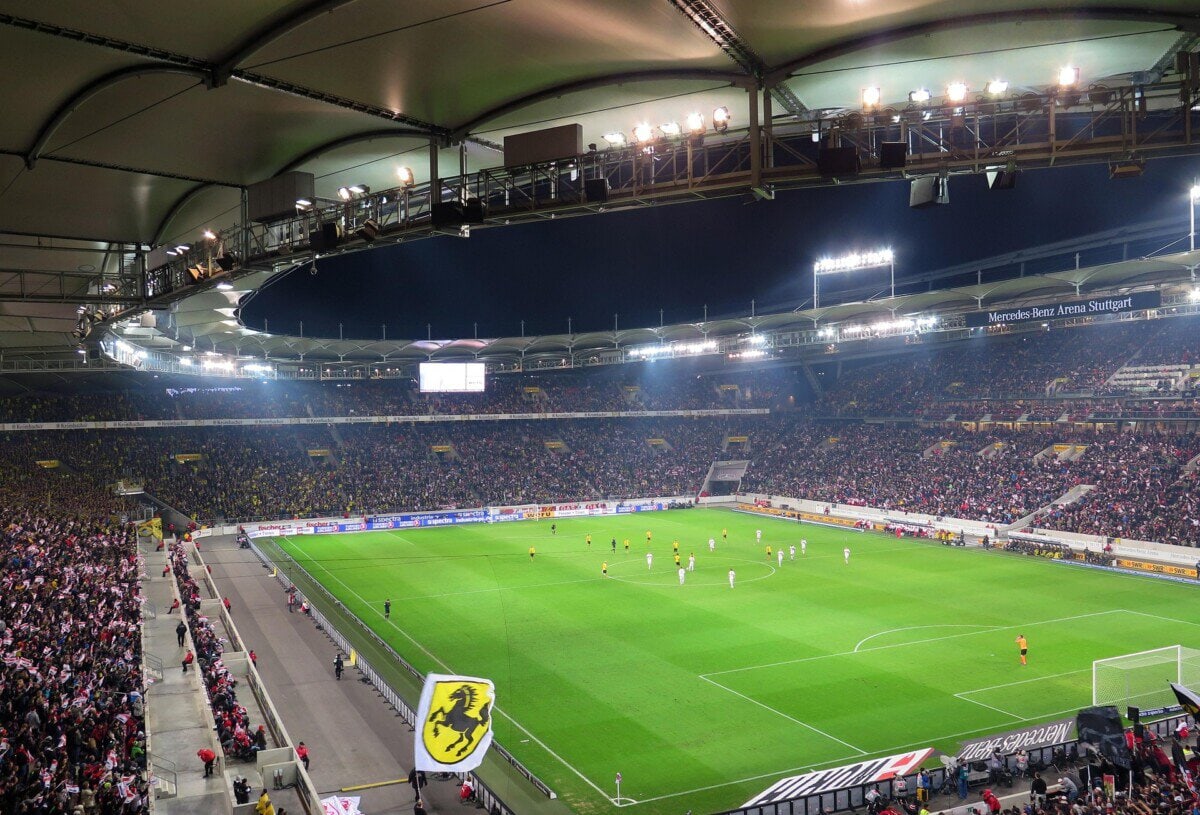
The club’s home ground has changed its name more often than most. Today it is the MHPArena, sitting in the Neckarpark area of Bad Cannstatt on the eastern side of Stuttgart, close to the river Neckar. It has carried three earlier names since first opening in 1933 as the Adolf-Hitler-Kampfbahn and being rebuilt after the war: Neckarstadion from 1949 to 1993, Gottlieb-Daimler-Stadion from 1993 to 2008, and Mercedes-Benz Arena from 2008 to 2023, before the Ludwigsburg-based consulting firm MHP took over the naming rights on 1 July 2023.
Capacity now stands at 60,058 for Bundesliga fixtures, dropping to 54,812 for UEFA competitions once extra seating requirements are applied. The ground hosted six matches at the 2006 World Cup, including a Round of 16 tie and the third-place play-off, and it went through a further €139.5 million (£120 million/$163 million) renovation between 2022 and 2024 that rebuilt the lower tier of the main stand and extended the roof, finishing just in time to help host UEFA Euro 2024.
What follows is a practical route into the MHPArena rather than a single throwaway line about the nearest S-Bahn stop: the realistic journey from Stuttgart Hauptbahnhof via Neckarpark station, what actually happens once matchday crowds build around Bad Cannstatt, an honest look at driving and parking, and how buying into one of the Bundesliga’s biggest membership bases actually works in practice. It also digs into the stadium’s history under four different names, the noise generated by the Cannstatter Kurve, the Cannstatter Wasen showground right next door, and what to expect around accessibility and safety on a matchday.
| Club | Stadium | Capacity | Nearest Station | League (2026/27) |
|---|---|---|---|---|
| VfB Stuttgart | MHPArena | 60,058 (Bundesliga) | S-Bahn Neckarpark (S1) | Bundesliga |
Transport at a Glance: Nearest Stops for the MHPArena
Before the full breakdown below, here is every nearest stop for the MHPArena in one place, since the ground is served by more than the single S1 line most visitors default to.
| Mode | Stop / Station | Line(s) | Walk Time to Stadium |
|---|---|---|---|
| S-Bahn | Neckarpark (Mercedes-Benz) | S1 | ~5-7 min, flat and well signed |
| S-Bahn | Bad Cannstatt | S2, S3 | ~10 min along the riverside |
| Stadtbahn (tram) | NeckarPark (Stadion) | U11 (matchdays only), U19 | ~3-5 min |
| Stadtbahn (tram) | Mercedesstraße | U1 | Short walk to the gates |
| Bus | NeckarPark (Stadion) | 45 (from Bad Cannstatt station) | ~3-5 min |
Getting to the MHPArena by S-Bahn and Tram
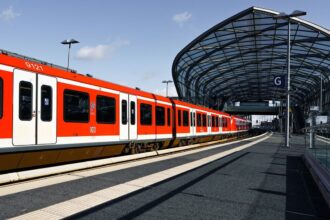
The single practical fact worth knowing before a matchday in Stuttgart is that almost everyone arrives by rail. The S1 S-Bahn line runs from Stuttgart Hauptbahnhof towards Kirchheim (Teck) and stops directly at Neckarpark station, with the ride itself taking around seven to eight minutes according to independent timings of the route.
From the Neckarpark platform, the walk to the MHPArena is short, just a few minutes along a flat, well-signed path through the Neckarpark development. A realistic door-to-seat estimate from Hauptbahnhof, including the walk and a queue through the turnstiles, runs to roughly 20 to 25 minutes in total on a normal matchday.
A dedicated matchday tram also exists as a genuine alternative. The U11 runs directly from Hauptbahnhof to the Neckarpark/Stadion stop on fixture days, typically starting around four hours before kickoff and continuing for roughly two hours after the final whistle, which makes it a useful backup once the S-Bahn platforms fill up.
The S2 and S3 lines offer a second rail option, stopping instead at Bad Cannstatt station, a short walk further from the ground along the riverside than Neckarpark itself. This is worth knowing as a fallback if the direct S1 stop is disrupted, since it is the same route the club itself recommends during engineering closures.
Most visitors are best taking the S1 to Neckarpark, simply because it is the shortest single-line journey and drops fans closest to the main entrances. Bad Cannstatt is often assumed to sit close to Stuttgart’s pedestrianised old town around Königstraße; it does not, and the short S-Bahn hop still needs building into your timings rather than treated as an afterthought.
Occasional engineering works on the wider Stuttgart 21 rail project have, at times, meant the S1 skips Neckarpark entirely for a short period, with the club and local transport authority directing fans instead to walk from Bad Cannstatt station or take the U11 tram. Checking the VVS journey planner for service alerts before setting off is worth the two minutes it takes, rather than discovering a diversion on the platform itself.
Best for a short trip. Compare rooms by neighbourhood, price and guest rating before you book.
Compare hotelsBest for families, or any stay past about four nights. A kitchen and a washing machine start paying for themselves.
Browse rentalsBest for double-checking. Runs the same search across several booking sites so you are not leaving money behind.
Compare pricesThe Bad Cannstatt Crush: What a Full MHPArena Actually Means for Transport
A stadium holding over 60,000 fans fills a fairly compact suburban station well beyond its everyday capacity, and the Neckarpark platform genuinely fills with supporters for twenty to thirty minutes either side of kickoff and full time. Anyone travelling with children or reduced mobility should expect a crowded platform rather than an immediate, comfortable ride back into the centre.
Extra S1 services and additional U11 trams are the standard response to a full house, rather than any separate shuttle-bus network, since the rail and tram capacity is considered sufficient for a ground of this size. Stewards and transport staff are a routine sight around the Neckarpark stop and the walking paths through the development on any well-attended fixture.
The Cannstatter Kurve, VfB’s famous standing home end, adds its own texture to the crowd flow. A large standing section empties more slowly and less predictably than rows of numbered seats, so anyone parked nearby waiting to walk out with friends should expect the exit to take longer than the walk in.
Leaving right on the final whistle rarely gets you a quick getaway from a stand this size. The smarter move is either lingering inside the concourse for ten to fifteen minutes while the first surge clears, or accepting a slower walk back to the Neckarpark platform as simply part of the experience.
Arriving at least 60 minutes before kickoff is the simplest way to avoid both the inbound crush on the S-Bahn and any last-minute security queue at the turnstiles. Fixtures against Bayern Munich, Borussia Dortmund or a European night, in particular, draw noticeably heavier crowds through Bad Cannstatt than a routine midweek Bundesliga fixture, so building in extra time matters more for those matches specifically.
Building in real time either side of the match, rather than treating a 60,000-capacity crowd as an abstract number, is the single biggest factor in a stress-free MHPArena matchday. The stadium’s own scale is exactly why the S1 and U11, rather than a car, are built to be the default route for almost everyone attending.
Driving to the MHPArena: What the Parking Options Really Look Like
The MHPArena is easy enough to reach by car, and a dedicated traffic guidance system called NeckarPark directs matchday drivers from the surrounding motorway network via the B10 or B14 federal roads straight to the ground, rather than leaving visitors to work out local junctions themselves.
Parking itself splits into a few clear tiers. Free public parking is available along Mercedesstraße close to the stadium, while paid spaces sit nearer the VfB Fan-Center and VfB Clubzentrum for anyone who would rather guarantee a closer spot than rely on the free roadside option filling up early.
For anyone coming from further out, VfB and the regional transport authority also run a network of Park and Ride sites at stations outside Stuttgart’s low-emission environmental zone, including Plochingen, Waiblingen, Winnenden and Backnang, charging around €1 to €2 (£1-2/$1-2) a day with an S-Bahn connection onward that reaches the arena in roughly 20 to 40 minutes depending on the station.
That environmental zone is worth flagging on its own. Central Stuttgart, including the roads around Bad Cannstatt, requires a valid green emissions sticker (Umweltplakette) to drive through legally, something visitors bringing a car from outside Germany should sort out before travelling rather than discovering at a checkpoint.
The straightforward reality is this: unless travelling from well outside Stuttgart’s rail network with genuinely no alternative, the S1 will get you there and, more importantly, get you home again with far less hassle than a car once matchday traffic around the Neckar valley is factored in. Free roadside parking on Mercedesstraße routinely fills well before an hour before a big fixture, so treat a spot there as a bonus rather than the plan.
Anyone driving specifically for accessibility reasons has a genuinely straightforward option here. Designated disabled parking exists on decks P7 (100 spaces), P2a (80 spaces, between the arena and the VfB offices) and additional bays at P10 on the neighbouring Cannstatter Wasen showground, and none of these require advance registration for permit holders.
How VfB Stuttgart’s Membership System Shapes Who Gets a Ticket
Buying a ticket for a VfB Stuttgart match is not quite as simple as picking a date and checking out. The club’s official ticket shop at shop.vfb.de is the sensible place to start, and it sits behind a tiered pre-sale system built around the club’s huge membership base.
Season-ticket holders get first claim on every home league fixture, with whatever remains then opening to club members (Vereinsmitglied), who receive pre-sale access and a discount on the general price, and only after that to the wider public. New members typically need to wait around three months from the day they join before pre-sale access kicks in, and each membership generally covers a maximum of two tickets per match.
Prices vary considerably by category and fixture. Standing terrace tickets in the Cannstatter Kurve have recently started from around €29 (£25/$34) for the most affordable categories, while seated tickets for in-demand matches against Bayern Munich, Borussia Dortmund or a European night regularly run well beyond that, reflecting how quickly the bigger fixtures move through the pre-sale tiers.
International visitors are not locked out of this system, but it is worth applying for a membership, or checking official hospitality packages for a one-off visit, well in advance of a trip rather than assuming tickets will still be available close to matchday, especially for the club’s biggest home fixtures.
Bundesliga tickets are also personalised, with identification checks a routine part of entry at German grounds, which is the practical reason buying outside official channels carries real risk rather than a theoretical one. A ticket bought from an unrecognised source can simply be refused at the turnstile if the name does not match.
The plain advice here is to start the membership process, or check hospitality options, as soon as a fixture list is confirmed. A common mistake is assuming a club with over 100,000 members will always have spare seats going right up to matchday, when demand for Stuttgart’s biggest fixtures regularly says otherwise.
What You Can’t Bring: Stadium Rules and Prohibited Items at the MHPArena
The MHPArena sets a specific bag size limit rather than a blanket ban: suitcases, trolleys, laptop bags and rucksacks are all refused once they exceed 390 x 350 x 150mm, so anything close to that size is worth measuring before you leave the hotel. Staff carry out routine bag checks at every turnstile, so packing light keeps the queue moving.
Weapons of any kind, including anything usable as a cutting, thrusting or stabbing tool, are banned outright, along with gas sprays, pressurised cylinders and any caustic or flammable substance. Objects that could cause injury or be thrown as a projectile are refused on the same basis.
Glass containers, PET bottles, cups, jugs and cans made from fragile or especially hard material are all banned at the gate, and pyrotechnics are treated with equal seriousness, covering flares, sparklers, fireworks, smoke bombs and distress flares of any kind. None of this is negotiable at the turnstile regardless of the occasion.
Drones and laser pointers are prohibited, and so is professional camera or video equipment, tripods and telephoto lenses for anyone without media accreditation. Flag and banner poles are limited to 2 metres in length and 30mm in diameter, and any choreography needs registering with the club in advance.
Face-covering items are refused on security grounds, and racist or extremist material of any kind is banned outright, alongside clothing carrying the same message. The full, current regulations are published on the arena’s own stadium regulations page, worth a quick check before a big fixture.
From Neckarstadion to MHPArena: History and Naming Rights
The ground’s story stretches back to 1933, when it first opened on the same Neckarpark site under a name from a very different era of German history. It was substantially rebuilt after the Second World War and reopened as the Neckarstadion in 1949, the name it carried for more than four decades and the one many older Stuttgart fans still use out of habit.
Sponsorship arrived in 1993, when the ground became the Gottlieb-Daimler-Stadion, honouring the Stuttgart-born engineer whose name sits behind one of the world’s biggest car brands. It kept that name until 2008, when Mercedes-Benz took over the naming rights directly and the ground became the Mercedes-Benz Arena, a name that stuck for the next fifteen years.
The current era began on 1 July 2023, when MHP, a management and IT consulting firm based just outside the city in Ludwigsburg and part of the Porsche group, took over the naming rights and the ground became the MHPArena. It is a change worth knowing before a trip, since older maps, taxi drivers and even some signage around the city can still reference an earlier name.
The stadium’s biggest moment on the international stage came at the 2006 World Cup, when it staged six matches including a Round of 16 tie and the third-place play-off. Nearly two decades later, a €139.5 million (£120 million/$163 million) renovation between 2022 and 2024 rebuilt the lower tier of the main stand and extended the roof, work timed specifically to have the ground ready to host matches at UEFA Euro 2024.
That renovation is a genuine reason to see the ground even beyond a matchday. VfB runs its own official arena tour, bookable through the club’s shop, typically covering the players’ tunnel, the home dressing room, the pitchside technical areas and the press conference room, a route that gives a real sense of the scale of the recent rebuild.
What makes a visit here special is not primarily VfB’s trophy cabinet, respectable as five Bundesliga titles and four DFB-Pokal wins are next to Germany’s very biggest clubs. It is a stadium that has quietly carried the whole sweep of modern German football history under four different names, on the same patch of ground beside the Neckar, for more than ninety years.
The Cannstatter Kurve and VfB’s Matchday Atmosphere
The Cannstatter Kurve, VfB’s standing home end, is where the club’s matchday atmosphere is genuinely made. It is the cheapest category in the ground and consistently the loudest, and it fills early for any fixture with real stakes attached, from a Baden-Württemberg derby against Karlsruher SC to a visit from Bayern Munich or Dortmund.
VfB’s fanbase carries a genuine regional weight that goes beyond the stadium itself. As the largest sports club in Baden-Württemberg and Germany’s eighth-largest football club by membership, the support here reflects a state, not just a city, and that scale shows up clearly in how the Cannstatter Kurve sounds on a big night.
The club’s recent history has only sharpened that intensity. Two relegations inside a decade, followed by two immediate promotions, a runners-up finish in the Bundesliga in 2023-24 and a first DFB-Pokal win in nearly three decades in 2024-25 have given the current squad and its supporters a genuinely emotional recent story, rather than the quiet mid-table comfort a club of this size might otherwise settle into.
Away fixtures at the MHPArena are treated seriously by visiting clubs and local police alike, and travelling support arriving for a big Bundesliga fixture should expect a noticeably fuller, louder stadium than a routine mid-table match elsewhere in Germany would generate.
First-time visitors often assume a club without Bayern Munich’s global following will feel like a quiet afternoon out. The Cannstatter Kurve on a full house says otherwise, and it is precisely that gap between VfB’s modest recent trophy count and its genuinely enormous membership base that gives the ground its edge.
Best for finding routes the airlines do not sell as a single ticket. Combines carriers to bring the fare down.
Search flightsBest for anyone whose home plan charges by the megabyte abroad. Pay a fixed price up front.
Check eSIMsBest if you would rather not work out the transport on arrival. Book it now and forget it.
View transfersEating, Drinking and the Cannstatter Wasen Showground Next Door
The MHPArena sits directly beside the Cannstatter Wasen, the huge showground that hosts the Cannstatter Volksfest each autumn, widely regarded as the second-largest beer festival in the world after Munich’s Oktoberfest, along with the smaller Stuttgarter Frühlingsfest each spring. A fixture that happens to fall during either festival turns a normal matchday into a genuinely different kind of trip.
Outside festival dates, the wider Bad Cannstatt district still offers a solid spread of traditional Swabian restaurants and beer halls within easy walking distance of the ground, generally quieter and less tourist-priced than the equivalents around central Stuttgart’s Marktplatz or Schlossplatz.
Bad Cannstatt has its own claim to fame beyond football, too. Its mineral springs are among the most productive in Europe, second only to Budapest’s, and the district built a genuine spa town identity around them long before VfB ever played here, which is worth knowing for anyone with a free morning before kickoff.
Inside the ground itself, standard stadium catering covers the usual range of bratwurst, pretzels and beer at the concourse kiosks, priced in line with other big Bundesliga grounds, with queues at their longest in the fifteen minutes either side of half time.
The smart move is to eat either well before arriving or to wait until after full time rather than fighting the half-time queue, and to check the festival calendar for the Cannstatter Wasen before booking a trip, since a match weekend that overlaps with the Volksfest changes the whole character of the visit, for the better if that is what you are looking for.
In and Around the MHPArena: Fanshop, Bars and Hospitality
The club’s main retail outpost is the VfB Fanshop, part of the VfB Fan-Center at Mercedesstraße 73A, right on the approach to the ground from the Neckarpark and Mercedesstraße side, stocking the current kit, training wear and general merchandise well beyond what the small concourse kiosks carry on a matchday itself. A second, city-centre branch operates inside the Königsbau Passagen shopping arcade on Schlossplatz, handy for picking up a shirt or scarf before heading out to Bad Cannstatt rather than queuing at the ground.
There is no single official fan zone fenced off inside the stadium perimeter, so the pre-match atmosphere spills into the streets around Bad Cannstatt instead. Karlseck on Daimlerstraße, near Wilhelmsplatz, is the closest thing the district has to a dedicated VfB pub, lined with Cannstatter Kurve scarves and busy well before kickoff on anything but a quiet midweek fixture, while a bar sitting right by the arena itself gives anyone who would rather stay close to the gates a screen and a beer without the walk into the district.
Hospitality at the MHPArena is a genuine, bookable option rather than something reserved purely for season-ticket holders. VfB’s business division runs several packages inside the ground, including pitch-facing boxes in the MECHATRONIK Württemberg Lounge, table seating in Club 1893, the larger Mercedes-Benz Business Center, and the Porsche Tunnel Club beside the players’ tunnel, and single-match hospitality is genuinely available rather than restricted to full-season clients. These packages sit outside the standard shop.vfb.de sales flow, so enquiries go through the club’s official hospitality team via vfb.de rather than the regular ticket shop.
Accessibility at the MHPArena: Parking, Transport and Booking Ahead
Getting to the MHPArena as a wheelchair user or with reduced mobility is genuinely well catered for compared with some older German grounds, largely thanks to the 2022 to 2024 renovation that rebuilt much of the lower stand.
On the driving side, disabled parking is available on decks P7 and P2a right beside the stadium, plus further bays at P10 on the neighbouring Cannstatter Wasen site, and none of it requires advance registration, which removes one common source of matchday stress for visiting fans.
By public transport, both the S1 to Neckarpark and the S2/S3 to Bad Cannstatt run step-accessible services, and the walking routes from either station to the ground are flat, though the busiest twenty minutes either side of kickoff can still mean a crowded platform for anyone needing extra space or time.
Wheelchair spaces and accompanying-carer seating are available inside the ground itself, and the club’s official ticket shop and fan service team are the right first point of contact for booking these, since accessible allocations are limited and best arranged well ahead of a specific fixture rather than on arrival.
Leaving accessibility arrangements until matchday itself is the thing most likely to cause problems. Contacting the club’s service team in advance, whether for parking, seating or general guidance around the ground, remains the simplest way to avoid any last-minute uncertainty on the day.
Safety and What to Expect as a Visitor
German football grounds are, on the whole, well organised and safe for visiting fans, and the MHPArena is no exception. Bag checks and ticket scans are routine at the turnstiles, and stewards are a constant, visible presence around the Neckarpark approach on any matchday.
Standing sections such as the Cannstatter Kurve involve genuine crowd movement during goals and big moments, which is a normal part of the experience for regular attendees but worth being mentally prepared for if you have never stood in a large German ultras section before.
Neutral fans and away supporters attending a big fixture should expect a noticeably more intense atmosphere than a routine weekend out, reflecting VfB’s genuinely large and committed fanbase, but organised trouble is rare and heavily policed when it does occur.
As with any large stand, being aware of your nearest exit, keeping valuables secure in a zipped inner pocket rather than a back pocket, and following steward instructions during the post-match crush are the same basic precautions worth taking here as at any 60,000-capacity ground anywhere in Europe.
The plain advice is to treat a VfB Stuttgart matchday with the same common sense as any major European fixture: arrive early, follow the crowd rather than fighting it, and keep an eye on official VfB and VVS channels for any last-minute changes around transport or entry on the day itself.

Rupert’s Handy Travel Tips
Heading to a VfB Stuttgart matchday? Rupert has a few tips that can save both time and a lot of standing around:
- Take the S1 to Neckarpark, not a taxi: it is around seven to eight minutes from Hauptbahnhof and the walk into the ground from the platform is flat and well signed.
- Check for engineering diversions before you travel: the S1 has occasionally skipped Neckarpark during Stuttgart 21 works, with the U11 tram or a walk from Bad Cannstatt station as the backup.
- Start the membership process early if you need a direct ticket: pre-sale access typically only kicks in around three months after joining.
- If you drive, head for Mercedesstraße early or use Park and Ride: free roadside parking fills fast, and outlying stations like Plochingen or Waiblingen keep the S-Bahn onward journey cheap.
- Check the Cannstatter Wasen festival calendar before booking: a matchday that overlaps with the Volksfest or Frühlingsfest turns into a genuinely different kind of trip.
Want to meet the reindeer behind our travel tips? Find out more in our page Who is Rupert?.




Frequently Asked Questions About Getting to the MHPArena
How do I get to the MHPArena from central Stuttgart?
Take the S1 S-Bahn from Stuttgart Hauptbahnhof to Neckarpark station, around seven to eight minutes, then follow the short, flat walk through the Neckarpark development to the ground.
Is there a tram to the stadium as well as the S-Bahn?
Yes. The matchday U11 tram runs directly from Hauptbahnhof to the Neckarpark/Stadion stop, typically starting around four hours before kickoff and running for roughly two hours after full time.
Should I drive to a VfB Stuttgart match?
It is possible, with free parking on Mercedesstraße and paid spaces nearer the Fan-Center, but free spaces fill early and the S1 will generally get you home again faster once matchday traffic around Bad Cannstatt is factored in.
Do I need to be a club member to buy VfB Stuttgart tickets?
Not strictly, but membership brings earlier pre-sale access and a discount, and season-ticket holders and members are given priority over general sale for most home league fixtures.
Can I buy VfB Stuttgart tickets from resale websites?
This is not recommended. Bundesliga tickets are personalised with identification checks at the turnstile, so a ticket bought outside official channels can be refused entry if the name on it does not match.
What is the capacity of the MHPArena?
The stadium holds 60,058 spectators for Bundesliga fixtures, dropping to 54,812 for UEFA competitions once additional seating requirements are applied.
What was the MHPArena called before 2023?
It was the Mercedes-Benz Arena from 2008 to 2023, and before that the Gottlieb-Daimler-Stadion from 1993 to 2008 and the Neckarstadion from 1949 to 1993.
Is VfB Stuttgart’s home end known for its atmosphere?
Yes, genuinely so. The Cannstatter Kurve is the club’s standing home end and consistently one of the louder single stands in the Bundesliga, backed by a membership base of more than 100,000, the largest of any sports club in Baden-Württemberg.
Further Reading & Related Guides
Landing in the city before a match? Our Stuttgart Airport Transfers guide covers every realistic way of reaching the centre from STR, while our Things to Do in Stuttgart guide rounds up the sights worth prioritising around a matchday visit, from the Mercedes-Benz and Porsche museums to the old town around Schlossplatz.
If a match falls on a free day, our Best Day Trips from Stuttgart guide covers Tübingen, Heidelberg and the Swabian Jura for the rest of your stay. For getting around the wider region by rail, our German Rail Tickets Explained and Interrail Germany Pass Guide both break down the ticket options for anyone extending the trip further into Baden-Württemberg or beyond.