Reviewed by our editorial team Updated
Stuttgart sits in a natural bowl surrounded by vineyards and forested hills, and that position puts it within easy reach of some of southern Germany’s most rewarding day trips. The city anchors Baden-Württemberg, a state that packs a university town on a river bend, a Baroque royal palace, a Renaissance old town, and a genuine limestone plateau full of castles into a radius most visitors can cover without ever needing a car.
This is a more compact, regional set of excursions than the sprawling day-trip country around Berlin or Munich, and that is really the appeal of it. Stuttgart’s neighbours pack a university town with punting boats, a palace with more rooms than Versailles, a walkable medieval old town, and a hilltop castle straight out of a fairy tale into a corridor that rarely takes more than an hour and a half to reach.
The standout for a first visit is Tübingen, a picture-perfect university town on the Neckar where half-timbered houses lean over narrow lanes and traditional punt boats drift beneath Hölderlin’s Tower. Ludwigsburg Palace, sometimes nicknamed the “Versailles of Swabia,” sits barely thirty minutes away and claims more rooms than its French namesake.
For a proper change of scene, the Swabian Jura rises south of the city in a band of limestone plateau riddled with caves and topped by castles, including the turreted Hohenzollern Castle that looks like it was drawn for a storybook. Heidelberg and the walkable old town of Esslingen am Neckar round out a genuinely varied set, each reachable from Stuttgart Hauptbahnhof without a single change of plan.
Five more destinations round out the list for anyone staying longer or simply wanting more range: Ulm, whose cathedral spire held the record for the tallest church in the world for well over a century; Karlsruhe, a fan-shaped city built outward from a single palace; the spa town of Baden-Baden, home to a Roman-Irish bathhouse and a casino Marlene Dietrich once called the most beautiful in the world; the salt town of Schwäbisch Hall, whose church steps double as an open-air stage each summer; and the UNESCO-listed Maulbronn Monastery, the best-preserved medieval abbey north of the Alps.
The table below compares journey times and transport for all ten destinations at a glance, followed by a dedicated section on each place and a final verdict on which trip suits which kind of traveller.
| Destination | How to Get There | Journey Time | Suggested Time Needed |
|---|---|---|---|
| Tübingen | Direct regional train (RE/IRE) from Stuttgart Hauptbahnhof | About 45 minutes to 1 hour | Half day to full day |
| Ludwigsburg Palace | Direct S-Bahn (S4/S5) or regional train from Stuttgart Hauptbahnhof | About 15-25 minutes | Half day to full day |
| Schwäbische Alb (Hohenzollern Castle) | Regional train to Hechingen, then bus 306 to the castle | About 1 hour 15 minutes to 1.5 hours total | Full day |
| Heidelberg | Direct regional train (RE) or IC from Stuttgart Hauptbahnhof | About 40 minutes to 1 hour | Full day |
| Esslingen am Neckar | Direct S-Bahn (S1) from Stuttgart Hauptbahnhof | About 15-20 minutes | Half day |
| Ulm | Direct ICE/IC, or regional IRE, from Stuttgart Hauptbahnhof | About 40-50 minutes | Half day to full day |
| Karlsruhe | Direct ICE, IC or regional train from Stuttgart Hauptbahnhof | About 40 minutes to 1 hour | Half day to full day |
| Baden-Baden | Direct train from Stuttgart Hauptbahnhof, then local bus into town | About 1 hour 15 minutes to 1 hour 40 minutes total | Full day |
| Schwäbisch Hall | Regional train to Hessental, then local train or bus 1E into town | About 1 hour to 1 hour 20 minutes total | Full day |
| Maulbronn Monastery | Regional train to Mühlacker, then bus 700 to the monastery | About 1 hour 10 minutes total | Full day |
Tübingen: Punting Boats and a Genuine University Town
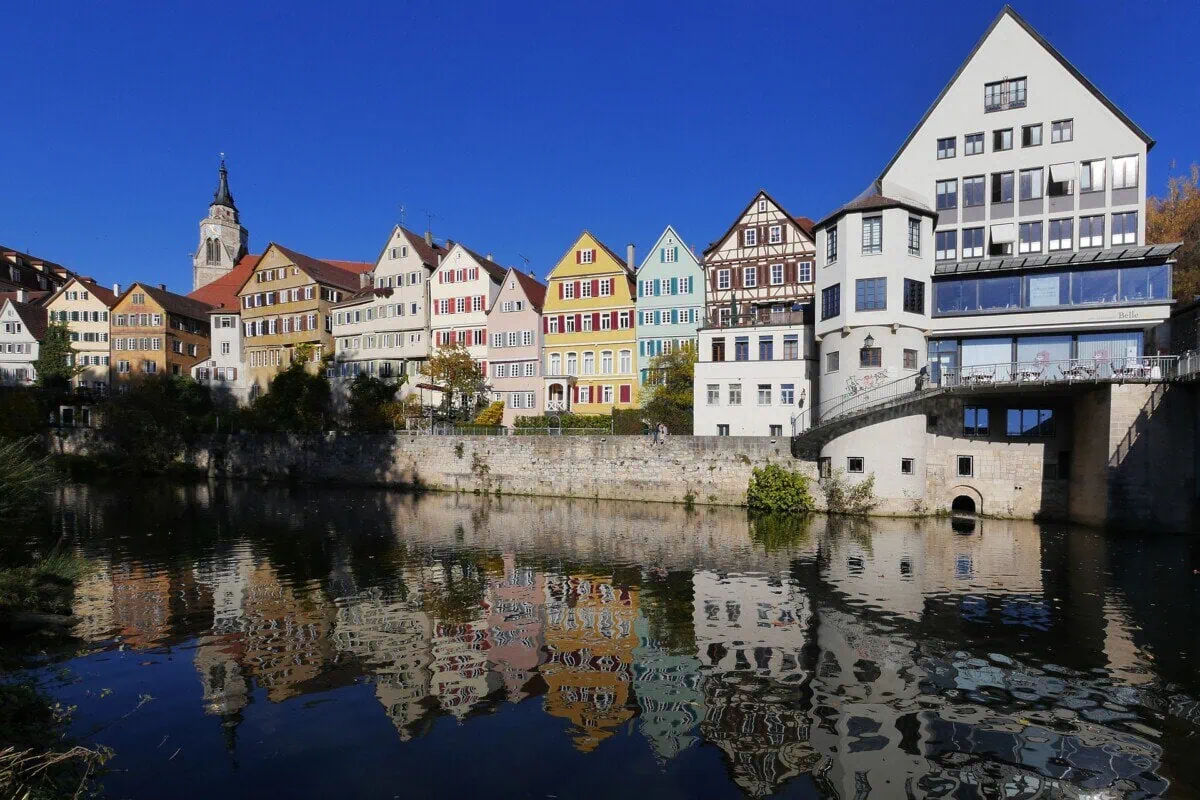
Tübingen is the closest thing this list has to an obvious highlight, a medieval university town stacked up a hillside above a bend in the Neckar where half-timbered houses in ochre, red and blue lean over the Ammergasse and Kirchgasse. The Eberhard Karls University, founded in 1477, still shapes the whole town, and its students fill the cafés and riverside terraces every term.
Regional trains run directly from Stuttgart Hauptbahnhof to Tübingen Hauptbahnhof in around 45 minutes to an hour, with services departing roughly every 30 minutes throughout the day. A single ticket covering the route typically costs around €13 (£11.18/$15.21), though a Baden-Württemberg-Ticket covering the whole day for up to five people often works out cheaper for a small group.
The town’s signature experience is a ride on a traditional Stocherkahn, a flat-bottomed punt boat steered with a long wooden pole along the Neckar beneath the famous Hölderlin Tower, where the poet Friedrich Hölderlin lived out his final decades. Public punting trips run regularly in the warmer months, with prices typically in the region of €8-12 (£6.88-10.32/$9.36-14.04) per person for a leisurely half-hour drift past the old town’s waterfront facades.
Above the river, the Altstadt’s market square, the Rathaus with its painted astronomical clock, and the Gothic Stiftskirche are all free to wander, while the hilltop Hohentübingen Castle offers sweeping views over the rooftops for anyone willing to climb the final stretch. Students famously race hand-built punts each June in the Stocherkahnrennen, a raucous, costumed regatta that is worth timing a visit around if the dates line up.
Booking a punt trip is rarely necessary outside the busiest summer weekends, since operators run boats from the Neckarbrücke landing on a rolling basis whenever there is demand. A half day comfortably covers the old town and a punt ride, while a full day allows time for the castle, the university’s botanical garden, and a proper lunch on one of the riverside terraces.
Tübingen rewards travellers who want the classic postcard image of a German university town without the crowds that pile into Heidelberg on a summer afternoon. It is the single best answer on this list for anyone who only has time for one trip out of Stuttgart.

Compare Trains and Buses with Omio
Choosing between trains and buses is not always obvious. Some routes are faster by train, while others are cheaper or easier by bus. Omio helps you compare routes, journey times, prices, and tickets in one place.
It is useful for city-to-city travel, cross-border journeys, and trips where flexibility matters. You can quickly see which option works best for your route, budget, and schedule before booking.
Ludwigsburg Palace: The “Versailles of Swabia”
Ludwigsburg Palace is the largest Baroque palace complex in Germany, a sprawling, honey-coloured statement of ambition built by Duke Eberhard Ludwig from 1704 onwards and long nicknamed the “Versailles of Swabia.” With well over 400 rooms across 18 buildings arranged around three courtyards, it genuinely out-sizes its French namesake in room count even if it lacks the same worldwide fame.
Direct S-Bahn trains, mainly the S4 and S5, run from Stuttgart Hauptbahnhof to Ludwigsburg in around 15 to 25 minutes, departing several times an hour throughout the day. A standard VVS single ticket for the short hop costs around €4.60 (£3.96/$5.38), and the palace itself is a straightforward 10-minute walk from Ludwigsburg station.
The Residential Palace tour, which is the only way to see the state apartments, theatre and porcelain collection, costs €10 (£8.60/$11.70) full price or €5 (£4.30/$5.85) reduced, and runs on a fixed hourly schedule with English-language tours generally departing at 11:15am, 1:15pm and 3:15pm. A family ticket covering the tour costs around €25 (£21.50/$29.25), making it a reasonable outing for a group.
Surrounding the palace, the Blühendes Barock gardens run a separate seasonal ticket from mid-March to early November, layering formal Baroque parterres, a fairy-tale garden for children, and rotating flower displays across the grounds. The Ludwigsburg Ceramics Museum and the Fashion Museum, both housed within the complex, are covered by a single combined museum ticket rather than the palace tour itself.
Booking the palace tour a little ahead online is worth doing on weekends, since the hourly English slots can fill up during the main summer season. A half day covers the palace tour and a stroll through the gardens, while a full day allows time for the ceramics museum and a slower walk through every themed section of Blühendes Barock.
Ludwigsburg is the trip to pick for anyone who wants a genuine royal palace experience without the queues that build up at Neuschwanstein or Schönbrunn. Its closeness to Stuttgart also makes it easy to pair with a second, shorter stop on the same day if time allows.
Best if you want daily housekeeping and a front desk. Filter by area first, then by price.
Check availabilityBest for families, or any stay past about four nights. A kitchen and a washing machine start paying for themselves.
Browse rentalsBest for double-checking. Runs the same search across several booking sites so you are not leaving money behind.
Compare pricesThe Swabian Jura and Hohenzollern Castle: Caves and Castles on a Limestone Plateau
The Schwäbische Alb, known in English as the Swabian Jura, is a limestone plateau that rises south of Stuttgart in a broad arc, riddled with caves and crowned by a string of hilltop castles built along its dramatic escarpment. It is the trip on this list that swaps city streets for genuine landscape, and the single most photographed spot on the whole plateau is Hohenzollern Castle, ancestral seat of the Prussian royal family.
Reaching the castle takes a little more planning than the other trips here, starting with a regional train from Stuttgart Hauptbahnhof to Hechingen, a journey of around 50 minutes to an hour depending on the connection. From Hechingen station, bus 306 covers the final leg up to the castle’s car park in about 20 minutes, with a shuttle then available for the steep last stretch up to the gatehouse.
A Baden-Württemberg-Ticket, covering unlimited regional trains and connecting buses for up to five people in a day, is the most sensible way to cover this whole route rather than buying tickets leg by leg. Admission to the castle, which includes the grounds, a tour of the state rooms, parking and the shuttle bus, runs to around €26 (£22.36/$30.42) full price or €16 (£13.76/$18.72) reduced when booked online, rising a little further during the castle’s winter Christmas market season.
Inside, the castle’s Treasure Chamber holds the Prussian crown of 1888 and Frederick the Great’s letters and uniform, while the turreted silhouette outside is what draws most of the day’s visitors in the first place. Travellers with more time, and ideally their own car or a well-planned regional ticket, can extend the day to the Bärenhöhle or Nebelhöhle show caves nearby, two of the Alb’s best-known limestone caverns.
Booking the castle’s timed entry slot online ahead of a visit is genuinely worth doing, since walk-up tickets at the cash desk cost more and popular slots can fill on clear-weather weekends. This is a full day trip given the connection at Hechingen, and it is not realistic to combine it with anywhere else on this list in the same day.
The Swabian Jura is the trip to choose for anyone who wants a genuine landscape day out, trading city streets for limestone cliffs and a castle that looks like it belongs in a storybook rather than a tourist brochure. It rewards an early start given the journey involved.
Heidelberg: A Ruined Castle Above the Old Town
Heidelberg is best known for its part-ruined Renaissance castle, perched on the Königstuhl hillside above a Baroque old town that survived the Second World War largely intact, making it one of the few major German cities where the historic centre feels genuinely unbroken. From Stuttgart, it makes a realistic and genuinely rewarding day out in its own right, distinct from how the city might feature on a Frankfurt-based itinerary further north.
Direct regional trains, and some Intercity services, run from Stuttgart Hauptbahnhof to Heidelberg Hauptbahnhof in around 40 minutes to an hour, with departures roughly every 30 minutes throughout the day. A standard single fare typically runs to around €22 (£18.92/$25.74), though a Baden-Württemberg-Ticket again offers better value for a group travelling together.
The castle ticket, priced at €11 (£9.46/$12.87) full price or €5.50 (£4.73/$6.44) reduced, includes a return ride on the historic Bergbahn funicular up to the castle terrace, along with entry to the courtyard, the enormous Königstuhl wine barrel and the German Pharmacy Museum inside. The terrace itself gives one of the best panoramic views in the whole region, looking straight down over the old town’s rooftops to the Neckar and the Philosophers’ Walk on the opposite bank.
Below the castle, the Hauptstraße runs for well over a kilometre through the old town, one of the longest pedestrian shopping streets in Germany, past the Baroque Marktplatz and the university’s original buildings. The Alte Brücke, or Old Bridge, and its gate towers make an easy add-on for anyone wanting the classic view of the castle reflected in the Neckar.
Booking the castle ticket online ahead of a summer weekend avoids the longer queue at the funicular’s valley station, particularly around midday when tour groups tend to cluster. A full day is the realistic minimum here given the length of the round trip and how much the old town rewards a slower pace.
Heidelberg suits travellers who want a genuinely famous German sight without diverting north to Frankfurt’s own day-trip circuit, and the castle terrace view alone justifies the length of the trip from Stuttgart. It is the pick for anyone prioritising one unmissable landmark over a quieter, more local experience.
Esslingen am Neckar: Half-Timbered Streets Without the Crowds
Esslingen am Neckar is the shortest trip on this list, a genuinely well-preserved medieval town barely fifteen minutes from Stuttgart that somehow stays well off the main tourist circuit. Its Altstadt holds one of the densest collections of half-timbered buildings anywhere in southern Germany, many dating back to the 14th and 15th centuries, spread across a compact centre that is easy to cover on foot in a single visit.
Direct S-Bahn trains, mainly the S1, run from Stuttgart Hauptbahnhof to Esslingen in around 15 to 20 minutes, with services departing every few minutes throughout the day. A standard VVS single ticket costs around €3.20 (£2.75/$3.74), making this comfortably the cheapest excursion on this whole list.
The town’s Rathausplatz and Innere Brücke are lined with timber-framed houses in every colour, while the Gothic Frauenkirche’s spire and the ruined Burg Esslingen above the vineyards both give genuinely rewarding viewpoints. The surrounding hillsides carry some of the steepest terraced vineyards in Germany, a striking sight from the old town below, especially when the vines turn colour in autumn.
Climbing to the castle ruins is free and takes around 20 to 30 minutes, and the town’s Weinbaumuseum, a small museum devoted to the local wine-growing tradition, charges only a modest entry fee for anyone wanting to dig deeper into the vineyards outside. Esslingen also runs one of the region’s most atmospheric medieval Christmas markets each December, worth knowing about for a winter visit.
Nothing here needs booking in advance, and the town’s small size means a visit can be squeezed into a half day without feeling rushed. A morning or afternoon comfortably covers the old town, the castle ruins and a coffee on Rathausplatz, leaving the rest of the day free.
Esslingen is the trip to choose for anyone short on time, or looking to pair a second, quieter stop with one of the longer excursions elsewhere on this list. It is proof that a genuinely photogenic German old town does not always need a long journey to reach.
Ulm: A Spire That Held the World Record for 135 Years
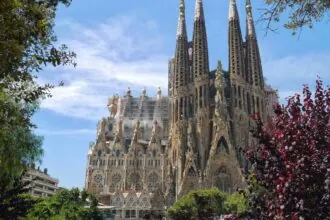
For more than a century, Ulm Minster held a genuine world record: at 161.53 metres, its lattice-thin Gothic spire was the tallest church tower on the planet from its completion in 1890 until Barcelona’s Sagrada Familia finally overtook it in October 2025. It remains the tallest church in Germany, and the view from inside its narrow stone stairwell is still one of the most dramatic in the region.
Direct ICE and IC trains run from Stuttgart Hauptbahnhof to Ulm Hauptbahnhof in as little as 40 minutes, with the average journey closer to 50 minutes across roughly 47 daily departures. A slower regional IRE service covers the same route along the Fils Valley line in around an hour, and unlike the ICE, it is covered by a Baden-Württemberg-Ticket or a Deutschland-Ticket.
Climbing the tower means tackling 768 spiral steps to a viewing platform at 143 metres, and there is no lift, so it is a genuinely demanding climb rather than a quick photo stop. Tickets cost €9 (£7.74/$10.53) full price or €6 (£5.16/$7.02) reduced, bought on the day at the minster itself rather than online.
Below the tower, the Fischerviertel, or Fishermen’s and Tanners’ Quarter, is a maze of narrow canals and crooked half-timbered houses, including the aptly named Schiefes Haus, a hotel that leans visibly over the water. Ulm is also the birthplace of Albert Einstein, marked by a small sculptural monument a short walk from the minster square.
Nothing here needs pre-booking beyond the tower ticket bought on arrival, though anyone with mobility concerns should plan around the climb rather than the rest of the visit, since the Fischerviertel and minster nave are both flat and easy walking. A half day covers the minster and old town comfortably, while a full day allows a slower wander through the canals and a proper lunch by the water.
Ulm suits travellers who want a genuine engineering and architectural landmark rather than another half-timbered market square, and the record-breaking spire’s backstory gives the visit a hook that few other stops on this list can match.
Karlsruhe: A City Built Like a Fan Around One Palace
Few German cities have a street plan as distinctive as Karlsruhe’s. When Margrave Karl Wilhelm founded the city in 1715, he laid its streets out as 32 spokes radiating from a single point, the tower of his new palace, and that fan-shaped plan is still legible on any city map today. Climbing the Schlossturm for a panoramic view straight down those converging streets is the single best reason to make the trip.
Fast ICE trains from Stuttgart Hauptbahnhof reach Karlsruhe Hauptbahnhof in as little as 39 minutes, with the average journey closer to 58 minutes across around 47 daily departures. Slower IC and regional services also run the route and tend to work out cheaper for anyone holding a Baden-Württemberg-Ticket or Deutschland-Ticket, since the ICE itself is not covered by either pass.
The palace grounds and Schlossgarten are free to walk, and the building itself now houses the Badisches Landesmuseum, a ticketed collection spanning Baden’s regional history and archaeology. A short walk away, the ZKM Center for Art and Media fills a converted munitions factory with contemporary digital and media art, a genuinely unusual pairing with the Baroque palace at the other end of town.
On the central Marktplatz, a red sandstone pyramid marks the grave of the city’s founder, Karl Wilhelm, an unusually understated monument for the man who designed the whole layout around it. The palace tower’s viewing platform opens seasonally rather than year-round, so it is worth checking hours before building a day around the climb.
Nothing here generally needs advance booking outside special ZKM exhibitions, and the city’s flat, walkable centre makes it easy to cover the palace, Marktplatz and museum district on foot. A half day suits a focused visit to the palace and tower, while a full day allows time for the ZKM and a slower loop through the Schlossgarten.
Karlsruhe rewards anyone curious about urban planning and design rather than castles or old towns, and the view from the Schlossturm down the fan of streets below is unlike anything else on this list.
Baden-Baden: A Spa Town Once Nicknamed Europe’s Summer Capital
Long before wellness tourism was a marketing term, Baden-Baden was drawing European royalty, writers and gamblers to its thermal springs, a reputation the town leaned into so thoroughly that it earned the nickname Europe’s Summer Capital in the 19th century. That legacy survives today in a genuine Roman-Irish bathhouse and a casino that still trades on the visitors who once filled its gaming rooms.
This is the longest journey on the list: direct trains from Stuttgart Hauptbahnhof take around 1 hour 37 minutes on average, with the fastest services covering it in about 1 hour 11 minutes. The station itself sits in the Baden-Oos district, a few kilometres outside the town centre, so onward buses (routes including 201, 201E, 244, 218, X45 and 213) are needed to reach the spa district and Kurhaus. A Baden-Württemberg-Ticket covers the regional train and every one of those onward buses on the same flat group fare, and it is worth comparing against a standard single fare given the length of this particular round trip.
The star attraction is Friedrichsbad, a 19th-century Roman-Irish bathhouse where a full visit works through a sequence of steam rooms, thermal pools and warm-air chambers over roughly three hours. Admission costs €39 (£33.54/$45.63), and bathing is textile-free on most days of the week, with only Wednesdays and Saturdays requiring swimwear, so it is worth checking the calendar before travelling if that matters to you.
A few minutes’ walk away, the Kurhaus casino, once called “the most beautiful casino in the world” by Marlene Dietrich, still hosts an evening gaming room where Dostoevsky reportedly gambled away enough money to help inspire his novel The Gambler. Daytime guided tours run before the tables open, and the adjoining Lichtentaler Allee is a long, tree-lined park walk beside the Oos river that costs nothing at all.
Given the length of the round trip, this only really works as a full day, and an early start is worth planning around rather than a leisurely late-morning departure. Evening casino visits carry a dress code and a minimum age of 18 with photo ID required at the door.
Baden-Baden is the pick for travellers chasing relaxation and old-world grandeur rather than another castle or old town, though the journey length means it suits a dedicated day rather than a rushed add-on to something else.
Best for long or awkward journeys. Builds one itinerary out of separate flights.
View flightsBest for anyone whose home plan charges by the megabyte abroad. Pay a fixed price up front.
Check eSIMsBest when public transport has stopped, or when you are travelling with children and bags.
Book a transferSchwäbisch Hall: A Salt Town Whose Church Steps Become a Stage
The name Hall comes from an old word for salt, and this town on the Kocher river built its early wealth on saltworks dating back to the Middle Ages. What survives today is a tightly packed Altstadt of timber-framed houses climbing the riverbank, crowned by St Michael’s Church and its dramatic 53-step monumental staircase leading up to the entrance.
Regional trains from Stuttgart Hauptbahnhof reach Schwäbisch Hall-Hessental station in around an hour, with the fastest services taking 57 minutes and the typical journey closer to 1 hour 11 minutes on an hourly service. Hessental station sits a short distance outside the old town itself, so the final leg needs either a connecting local train (about 5 minutes) or bus route 1E (about 11 minutes, roughly every 20 minutes) into the centre. Both legs, the regional train to Hessental and the connecting local train or bus into town, sit within a single Baden-Württemberg-Ticket, worth comparing against individual fares given how much of this trip is spent on connecting transport.
Those church steps are not just for climbing. Each summer, they become the stage for the Freilichtspiele, an open-air theatre festival that turns St Michael’s staircase into genuine tiered seating and performance space, one of the more unusual venues for outdoor drama anywhere in Germany.
Away from the church, the Hällisch-Fränkisches Museum covers the town’s salt-making and regional history, while the riverside paths along the Kocher and the town’s own Kocherinsel islands make for an easy, unhurried wander between sights.
Wandering the old town needs no booking at all, though anyone visiting during the summer festival season should check performance dates and the Hessental connection timetable before setting off, since a missed bus adds real time to an already longer journey. Budget a full day given the combined train and onward connection.
Schwäbisch Hall suits travellers who have already done Tübingen or Esslingen and want a similarly atmospheric old town without the crowds, ideally timed for a summer evening when the church steps are doing double duty as a theatre.
Maulbronn Monastery: The Best-Preserved Medieval Abbey North of the Alps
UNESCO inscribed Maulbronn Monastery as a World Heritage Site in 1993, citing it as the most completely preserved medieval monastic complex north of the Alps. Founded by Cistercian monks in 1147, the abbey’s church and cloister blend late Romanesque and early Gothic architecture in a way that survived largely intact through the centuries, unlike most monasteries of its age.
There is no direct train to Maulbronn itself. The practical route is a regional train from Stuttgart Hauptbahnhof to Mühlacker, followed by bus route 700 on to Maulbronn’s old town, a combined journey of around 1 hour 11 minutes. Both legs are covered together by a single Baden-Württemberg-Ticket or Deutschland-Ticket, which makes this one of the more affordable trips on the whole list once a group is travelling together.
The novelist Hermann Hesse attended the monastery’s Protestant seminary as a teenager, an experience that later shaped his novel Narcissus and Goldmund, and visitors can still walk the cloister walks and refectory halls that inspired it. Admission costs €10 (£8.60/$11.70) full price or €5 (£4.30/$5.85) reduced, rising to €13 (£11.18/$15.21) and €6.50 (£5.59/$7.61) with a guided tour or audio guide included, and a family ticket covers the basic entry for €25 (£21.50/$29.25).
The site opens daily from 9:30am to 5:30pm between March and October, and Tuesday to Sunday from 10am to 4:30pm over winter, with last entry roughly 45 minutes before closing in both seasons.
This is the least flexible connection on the whole list, since it depends on a single bus meeting a single train, so it is worth checking the bus 700 timetable before leaving Stuttgart rather than risking a long wait in Mühlacker. Treat it as a full day trip once the connection and return journey are factored in.
Maulbronn is the pick for anyone who wants genuine medieval architecture and a quieter, more contemplative visit than the castles and palaces elsewhere on this list, without another coach party in sight.
Which Day Trip Should You Choose?
If you only have time for one day trip from Stuttgart, make it Tübingen. Nothing else on this list combines an easy sub-hour journey with such a complete, postcard-ready German university town, half-timbered lanes, a hilltop castle and a punt ride on the Neckar all within an easy walk of the station.
Travellers short on time, or looking for a low-effort second stop, should head to Esslingen am Neckar instead, where the journey takes barely 15 minutes and the medieval old town still rewards a proper look. Ludwigsburg Palace sits in a similar bracket, a genuine royal palace reachable inside half an hour that suits anyone who wants grandeur without a long day of travel.
Anyone chasing a single famous landmark should commit to Heidelberg, ideally on a day set aside for it rather than squeezed in around something else, given the length of the round trip and how much the castle terrace and old town reward a slower pace. The Swabian Jura and Hohenzollern Castle suit travellers who want a genuine change of landscape, trading city streets for limestone cliffs, though the connection through Hechingen makes it the least flexible trip on this list.
As a general rule, pair a short, cheap trip like Esslingen or Ludwigsburg with a longer excursion like Heidelberg or Hohenzollern Castle on a different day of the same stay, rather than trying to fit two very different days into one. Whichever trip you choose, a Baden-Württemberg-Ticket is worth comparing against individual fares whenever two or more people are travelling together.
The five additional destinations above widen the choice further. Ulm and Karlsruhe both sit inside an hour on fast ICE trains and suit anyone who wants a landmark building, a record-breaking spire or a fan-shaped city plan, without the longer commitment that Heidelberg or Hohenzollern Castle demand. Baden-Baden is the trip to save for a day built entirely around relaxation, given its longer journey and the three hours a proper Friedrichsbad visit deserves.
Schwäbisch Hall and Maulbronn Monastery both reward travellers willing to plan around a connecting bus, trading a little convenience for genuinely quieter, less-visited destinations than anywhere else on this list. Either pairs well with a shorter stop like Esslingen or Ludwigsburg earlier in the same trip, provided the onward connection times are checked before setting off.

Rupert’s Handy Travel Tips
Day trips from Stuttgart are easy to reach by rail, but a few destinations have quirks worth knowing before you set off.
- Compare a Baden-Württemberg-Ticket against single fares: it covers unlimited regional trains for up to five people in a day and often beats buying tickets leg by leg.
- Book Ludwigsburg Palace’s English tour slot ahead on weekends: the fixed 11:15am, 1:15pm and 3:15pm departures can fill up during peak summer.
- Book Hohenzollern Castle’s timed entry online: walk-up tickets cost more at the cash desk, and popular slots fill fast on clear-weather weekends.
- Plan the Hechingen bus connection before travelling: bus 306 links the station to the castle car park, and missing a connection adds real time to the day.
- Book Heidelberg Castle’s funicular ticket ahead in summer: the valley station queue builds fast around midday when tour groups cluster.
- Check punting trip availability in Tübingen before travelling in winter: the Stocherkahn boats run a reduced or seasonal schedule outside the warmer months.
Want to meet the reindeer behind our travel tips? Find out more in our page Who is Rupert?.



Frequently Asked Questions About Day Trips from Stuttgart
What is the best day trip from Stuttgart?
Tübingen is generally considered the best single day trip from Stuttgart, combining a genuine university-town atmosphere, half-timbered streets and traditional punting boats with a journey of around 45 minutes to an hour.
How do I get from Stuttgart to Ludwigsburg Palace?
Direct S-Bahn trains, mainly the S4 and S5, run from Stuttgart Hauptbahnhof to Ludwigsburg in around 15 to 25 minutes, with the palace itself a short walk from the station.
Is Hohenzollern Castle worth the journey from Stuttgart?
Yes, its turreted silhouette is one of the most photographed sights in Baden-Württemberg, though the connection through Hechingen and its onward bus makes it a full-day rather than half-day trip.
How long does it take to get from Stuttgart to Heidelberg?
Direct regional and Intercity trains take around 40 minutes to an hour, making Heidelberg one of the longer trips on this list and one best suited to a full day.
Does the Heidelberg Castle ticket include the funicular?
Yes, the €11 full-price ticket includes a return ride on the historic Bergbahn funicular from the valley station up to the castle terrace.
Is Esslingen or Ludwigsburg the better short trip from Stuttgart?
Esslingen is slightly closer and cheaper, at around 15 minutes by S-Bahn, while Ludwigsburg offers a genuine royal palace experience for a similarly short journey.
Do I need to book Tübingen’s punt boats in advance?
Not usually outside the busiest summer weekends, since operators run boats from the Neckarbrücke landing on a rolling basis whenever there is demand.
Do I need a car for any of these day trips?
No, every destination in this guide is reachable by direct S-Bahn or regional train from Stuttgart Hauptbahnhof, with only Hohenzollern Castle needing a short onward bus connection.
Further Reading
Landing in Stuttgart before any of these trips? Our Stuttgart Airport Transfers guide covers every realistic way of reaching the city centre from STR, while our Things to Do in Stuttgart guide rounds up the sights worth prioritising in the city itself before you head out on any of the trips above.
Planning onward rail travel around the region? Our German Rail Tickets Explained guide breaks down the Baden-Württemberg-Ticket and the Deutschland-Ticket in full, while our Interrail Germany Pass guide explains when a country-specific pass beats buying tickets individually for a longer trip.
Continuing further into Germany’s rail network from here? Our Best Day Trips from Nuremberg guide covers another well-connected regional base, useful for anyone extending a Baden-Württemberg stay into Bavaria on the same trip. And if a visit falls in the run-up to Christmas, our Stuttgart Christmas Market guide covers the Stuttgarter Weihnachtsmarkt’s four squares, dates and stalls.