Reviewed by our editorial team Updated
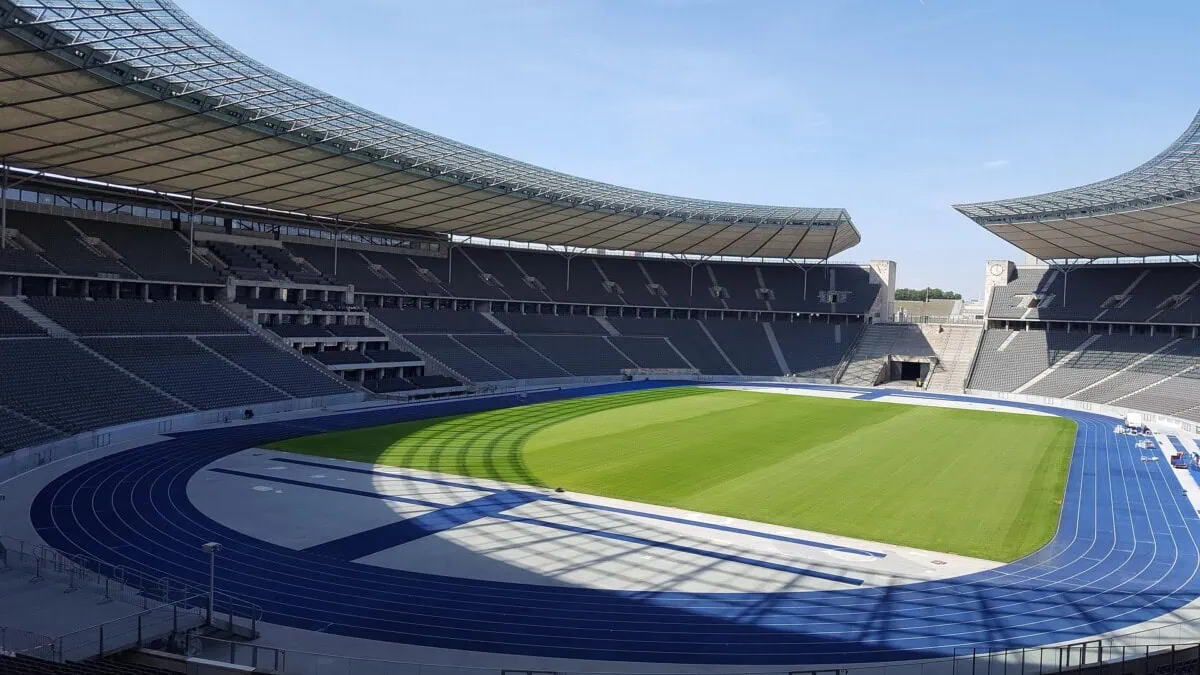
Berlin is unusual among Europe’s football capitals in having two grounds worth planning a day around, and they feel nothing alike. Hertha BSC plays out of the vast Olympiastadion, a 1936-built arena soaked in Cold War-era West Berlin history, while 1. FC Union Berlin plays a short S-Bahn ride away in a rustic, fan-built ground that only looks the way it does because thousands of supporters turned up with shovels.
Hertha carries the identity of old West Berlin, a club that has spent most of its recent history shuttling between the top two divisions and currently plays in 2. Bundesliga after relegation. Union, by contrast, is a genuinely East Berlin institution, a club whose supporters kept it going through the GDR years and then rebuilt its own home with their own hands after reunification.
Both grounds are worth knowing about for different reasons. The Olympiastadion gives visitors one of the largest, most historically loaded stadiums in world football, a building that hosted Jesse Owens in 1936 and a World Cup final in 2006, while the Alte Försterei offers something closer to what German football looked like before money reshaped the sport.
This guide covers how to actually get to both grounds, not just which line happens to run nearby: realistic door-to-seat journey times from central Berlin, what genuinely happens once matchday crowds show up, an honest take on driving and parking, and how ticket buying actually works for both clubs.
It also covers what makes each stadium worth the trip beyond ninety minutes of football, from the Olympiastadion’s guided tours to the story behind Union’s supporter-funded rebuild. Neither ground is hard to reach, but the two experiences waiting at the other end are different enough to know what you are choosing before you buy a ticket.
| Club | Stadium | Capacity | Nearest Station | League (2025/26) |
|---|---|---|---|---|
| Hertha BSC | Olympiastadion Berlin | 74,649 | U2/S3/S9 Olympiastadion (Westend) | 2. Bundesliga |
| 1. FC Union Berlin | Stadion An der Alten Försterei | 22,012 | S3 Köpenick, or tram from Schöneweide | Bundesliga |
Transport at a Glance: Nearest Stops for Both Stadiums
Before the full breakdown below, here is every nearest stop for both grounds in one place, since Berlin’s two stadiums sit on opposite sides of the city and are reached in completely different ways.
| Stadium | Mode | Stop / Station | Line(s) | Walk Time to Stadium |
|---|---|---|---|---|
| Olympiastadion (Hertha BSC) | U-Bahn | Olympia-Stadion | U2 | ~6 min (East Gate, 500m) or ~11 min (South Gate, 870m) |
| Olympiastadion (Hertha BSC) | S-Bahn | Olympiastadion | S3, S9 | ~3 min from either exit (200-250m) |
| Olympiastadion (Hertha BSC) | Bus | Flatowallee | M49, 218 | Short walk to the gates |
| Olympiastadion (Hertha BSC) | Bus | Neu-Westend | 143 | Onward walk or U2 connection |
| Alte Försterei (Union Berlin) | S-Bahn | Köpenick | S3 | 10 to 15 min (forest path via Hämmerlingstraße) |
| Alte Försterei (Union Berlin) | Tram | Alte Försterei (from Schöneweide) | 60, 67 | Under 1 min, stop sits directly opposite the ground |
Getting to the Olympiastadion by Public Transport
The Olympiastadion sits in Berlin’s western Westend district, but it is genuinely well served by rail. The U2 U-Bahn line stops directly at Olympia-Stadion station, a walk of around 500 metres to the East Gate or 870 metres to the South Gate, and it takes 13 minutes from Zoologischer Garten or around 36 minutes from Alexanderplatz.
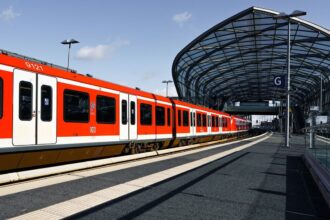
Two S-Bahn lines, the S3 and S9, also call at their own Olympiastadion station, with much shorter walks of 200 metres via the Flatowallee exit or 250 metres via Trakehner Allee. From central stations the S9 takes around 26 minutes from Alexanderplatz and just 7 minutes from Spandau, according to the stadium’s own official directions page.
Buses fill the gaps for anyone not on the two rail options. Lines M49 and 218 stop at Flatowallee close to the stadium, while line 143 runs to Neu-Westend station for onward U-Bahn connections.
For a realistic door-to-seat estimate from Alexanderplatz, budget on the S9 taking around 26 minutes, plus a five-minute walk from the platform, plus time queuing to clear the turnstiles at a 74,000-capacity ground. On a normal matchday that adds up to roughly 40 to 50 minutes gate to gate, longer if you cut it fine on kickoff. Our full guide to Berlin’s public transport network covers how to buy and validate the AB ticket you will need for the ride out.
Taking the S9 or S3 into the dedicated Olympiastadion S-Bahn station rather than the U2 is the better move, simply because the walk from the S-Bahn platform is shorter than from either U2 exit. A common mistake is leaving the U2 at Olympia-Stadion and walking the longer 870-metre route to the South Gate when the S-Bahn exit is barely a couple of minutes from the same gate.
Best for a short trip. Compare rooms by neighbourhood, price and guest rating before you book.
Compare hotelsBest for families, or any stay past about four nights. A kitchen and a washing machine start paying for themselves.
Browse rentalsBest for double-checking. Runs the same Berlin search across several booking sites so you are not leaving money behind.
Compare pricesMatchday Crowds, Shuttle Buses and Road Closures
A 74,000-seat stadium empties fast, and both U2 Olympia-Stadion and the Olympiastadion S-Bahn platform get genuinely packed for twenty to thirty minutes after full time. Anyone travelling with children or reduced mobility should factor in standing on a crowded platform rather than an immediate, comfortable ride home.
The stadium’s own guidance is blunt about the sensible approach on a matchday: it explicitly recommends public transport for visiting on event days, rather than driving, and reserves detailed parking information for non-event days instead. That single line is worth taking at face value rather than assuming your own car will be fine.
BVG, Berlin’s transport authority, typically increases service frequency on the U2 and S-Bahn lines around Olympiastadion for major fixtures, and additional staff are usually on hand to manage crowd flow. There is no dedicated shuttle bus network beyond the existing routes, since U-Bahn and S-Bahn capacity is considered sufficient for the ground’s size.
Roads immediately around the stadium, including sections of Passenheimer Straße and the approach via Trakehner Allee, are subject to local restrictions and pedestrian priority on matchdays, mainly to keep the walking routes from the stations clear. Drivers dropping passengers off should expect to be redirected away from the immediate perimeter rather than pulling up at a gate.
It is easy to underestimate how long the post-match crush at the station takes to clear, especially after a sell-out fixture or a derby against a promotion rival. Building in an extra 20 minutes of slack after the final whistle avoids the worst of the standing-room-only platform experience.
Arriving early, ideally 60 to 75 minutes before kickoff, is the simplest way to avoid both the inbound crush and any last-minute security queue. It also leaves time to explore the wider Olympiapark grounds around the stadium, which reward a slow walk in their own right.
Why the Olympiastadion Would Rather You Took the Train
It is entirely possible to drive to the Olympiastadion, and the stadium’s own site publishes detailed route directions from Hamburg, Munich and the Brandenburg Gate area for exactly that purpose. On a non-matchday, parking near the ground is straightforward and reasonably priced.
On a matchday, the picture changes considerably. As already noted, the stadium’s own advice is to use public transport for event days, a polite way of saying road access and parking are not really built for tens of thousands of cars arriving and leaving within the same narrow window.
Anyone who does drive should expect significant traffic on approach roads in the hour before kickoff and again immediately after the final whistle, when thousands of vehicles try to leave the same limited road network at once. Car parks near the stadium fill quickly for popular fixtures and are not guaranteed to have space even for early arrivals.
The straightforward reality is this: unless you are travelling from well outside Berlin’s rail network with genuinely no alternative, the U2 or S9/S3 will get you there faster and with far less stress than a car on matchday. First-time visitors often assume a big stadium automatically means big, convenient parking, when the opposite is closer to true.
Ride-hailing apps such as Uber and Bolt do operate in the area, but drivers are often reluctant to enter the immediate stadium perimeter during the pre- and post-match crush, and pickup points are usually set some distance away. Walking to a quieter side street is often faster than waiting for a car to reach the main entrance.
Buying Hertha BSC Tickets in 2. Bundesliga
Hertha BSC sell tickets to home matches through their official online ticket shop, linked directly from the club’s own website, with a separate portal for away fixtures at other clubs’ grounds. This is the safe, straightforward route for almost every visiting fan, and it is worth using without hesitation.
Because Hertha currently play in 2. Bundesliga rather than the top flight, demand for most fixtures is generally lower than it was during their Bundesliga years, and tickets for routine league games are usually available closer to matchday than fans of Germany’s biggest clubs might expect. Bigger fixtures, particularly against promotion rivals or Berlin’s other clubs, sell through faster.
Do not assume a 74,000-capacity stadium automatically means tickets are always easy to find on the day. For genuinely popular fixtures, especially anything with promotion or relegation stakes, buying at least a week or two in advance through the official shop is the sensible approach.
The plain advice on ticket buying reality is to stick to the club’s own official channels rather than third-party resale sites, both for price and for the risk of invalid tickets at the turnstile. The official shop also clearly separates seating categories and away-fan blocks, which resale listings do not always represent accurately.
Membership is not required to buy a standard matchday ticket, though the club does offer membership schemes with their own pricing benefits for regular attendees. For a one-off visit as a travelling fan, a straightforward single-match ticket through the official shop is all that is needed.
Stadium Tours: Why the Olympiastadion Itself Is Worth the Trip
Unlike Union Berlin’s ground, the Olympiastadion runs an extensive guided tour programme even outside matchdays, reflecting its status as a historic monument as much as a working football stadium. The standard Highlight Tour runs 60 minutes and costs €17 (£15/$20) for adults or €44 (£38/$51) for a family ticket, covering VIP areas, changing rooms and the underground warm-up hall.
A longer Premium Tour extends to 120 minutes for €19 (£16/$22) adult, adding access to non-public areas of the Olympiapark and, when available, the dome hall. There is also a dedicated Hertha BSC Tour at €18 (£15/$21) adult, going behind the scenes into the dressing room, relaxation pool and press conference room used by the club itself.
For genuine enthusiasts, a Matchday Tour priced at €45 (£39/$53) adult lets visitors experience a fixture from the players’ perspective on a non-matchday, right down to sitting on the team bench, plus a €5 fan shop voucher. There is also an Into the Roof-Tour at €20 (£17/$23), climbing 39 metres up into the roof structure with full safety equipment, though it carries a minimum age of 18.
All tours can be booked online through the official Olympiastadion tours page, and it is worth noting the stadium is closed to tours on Hertha match days and major event days. Booking a slot at least a few days ahead avoids disappointment, particularly for the more limited-capacity Roof or Matchday tours.
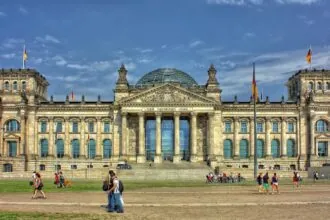
What makes the Olympiastadion genuinely special is not just its size but its layered history: a building constructed for the 1936 Olympics, famous for Jesse Owens’ four gold medals, then extensively modernised for the 2006 World Cup at a cost of €242 million, and host to the 2006 World Cup final, the 2015 Champions League final and the 2024 Euros final. Very few football grounds anywhere carry that much twentieth and twenty-first century history under one roof.
Getting to the Alte Försterei: S-Bahn, Tram and the Forest Walk
Union Berlin’s ground has no direct U-Bahn link at all, and that is very much part of its character. The standard route is the S3 S-Bahn line to Köpenick, taking around 21 minutes from Alexanderplatz, followed by a 10 to 15 minute walk along the railway embankment via Hämmerlingstraße through a genuinely wooded stretch of Köpenick.
That walk through the trees is not a detour to tolerate but arguably the single most distinctive part of visiting this ground. Supporters describe the approach through the forest, with the noise of the crowd building gradually rather than arriving all at once out of a station concourse, as one of the things that sets a matchday at the Alte Försterei apart from almost anywhere else in German football.
An alternative route avoids the walk almost entirely. From Schöneweide S-Bahn station, reachable from BER Airport via the S45/S9, tram lines 60 and 67 run directly towards Friedrichshagen or Krankenhaus Köpenick and stop at Alte Försterei, a stop that sits directly opposite the stadium itself.
For a realistic door-to-seat estimate from Alexanderplatz, budget on the 21-minute S3 journey to Köpenick, plus the 10 to 15 minute forest walk, plus a few minutes queuing at the turnstiles of a much smaller, more compact ground than the Olympiastadion. That works out at roughly 40 to 45 minutes in total, similar to the Olympiastadion despite Köpenick sitting in the opposite direction from the centre.
Taking the S3 to Köpenick and doing the forest walk at least once, rather than defaulting to the tram from Schöneweide, is worth prioritising simply because the walk is part of the experience that makes this fixture memorable. Arriving right on Köpenick’s platform with only ten minutes to kickoff and rushing the walk misses the point of the route entirely, when giving yourself proper time to enjoy it is the whole idea.
What a Sold-Out Alte Försterei Actually Feels Like
A 22,012-capacity ground generates a far smaller crowd surge than a 74,000-seat stadium, but Köpenick station and the forest path both narrow considerably compared with the wide plazas around bigger Bundesliga grounds. On a sell-out matchday, which is common given the club’s popularity, expect the path from the station to genuinely fill with fellow supporters rather than being an empty walk.
The S3 typically runs a normal service frequency even on matchdays, since the ground’s relatively modest capacity does not usually require the kind of extra shuttle provision seen at much larger stadiums. That said, the platform at Köpenick does get busy in the thirty minutes either side of kickoff and full time, and standing back to let a train clear before boarding is often quicker than forcing onto a packed carriage.
Because a large share of the ground is standing terracing rather than seating, latecomers face a genuine practical problem beyond simple politeness: finding a decent view once a terrace section has filled in is much harder than shuffling along a row of seats. Arriving with real time to spare, at least 45 minutes before kickoff, matters more here than at most stadiums.
There is no significant vehicle-based matchday shuttle system at the Alte Försterei, largely because the stadium’s own guidance channels most visitors towards rail and tram rather than car travel in the first place. The forest walk and the tram from Schöneweide effectively function as the ground’s own crowd management system, spreading arrivals across two distinct routes rather than funnelling everyone through one choke point.
Treating this as a small, low-key fixture simply because the capacity is modest is a mistake plenty of first-timers make. Union’s home atmosphere is famously loud and full for almost every match, and turning up at the last minute expecting an easy, half-empty terrace is a good way to end up standing at the very back with a restricted view.
Best if you can move a day either way. Shows how the fare to Berlin changes across the month.
Compare flightsBest for short trips. Install the eSIM at home and arrive in Berlin with working data, no shop queue.
Browse eSIMsBest if you would rather not work out the transport on arrival. Book it now and forget it.
View transfersDriving and Parking at the Alte Försterei: Why 450 Spaces Isn’t Enough
Driving to Union Berlin’s ground is more realistic than it is at the Olympiastadion, largely because of scale: the stadium provides 450 parking spaces, including 20 disabled spaces, directly around the ground. Drivers coming from outside the city should take the A113 towards Berlin-Central, exit at Berlin-Adlershof, and follow Ernst-Ruska-Ufer and Glienicker Weg to reach the stadium.
Even so, 450 spaces is a small number set against a regularly sold-out 22,012-capacity ground, and the honest reality is that parking fills quickly for almost any fixture. Arriving well over an hour before kickoff is close to essential if a parking space is the plan, rather than a nice-to-have.
The same logic applies here as at the Olympiastadion, if for slightly different reasons: the S3 to Köpenick plus the forest walk is not just easier than driving, it is genuinely part of what makes a visit here memorable, so treating the car as a fallback rather than the default plan makes sense on both practical and experiential grounds.
Visitors often assume a smaller stadium in a suburban district will have correspondingly easy, plentiful parking, when in practice the residential streets around Köpenick fill with matchday traffic and informal parking well before kickoff. Local residents are understandably unenthusiastic about visiting fans blocking their own street parking.
If driving is the only realistic option, whether for accessibility reasons or a longer journey from outside Berlin, planning to arrive at least 90 minutes before kickoff and expecting a walk from an overflow spot rather than a guaranteed on-site space is the sensible way to do it.
Buying Union Berlin Tickets: the Raffle and Why It Exists
Union Berlin’s ticket situation is genuinely different from almost every other Bundesliga club, and it is worth understanding before you plan a trip around a specific fixture. According to the club’s own official ticket pricing page, day tickets for men’s home matches are raffled among club members rather than sold on a simple first-come, first-served basis.
That raffle system exists because demand vastly outstrips supply at a 22,012-capacity ground in the Bundesliga, and it is the club’s way of giving its large membership base a fair shot at tickets rather than letting the fastest clickers or deepest pockets win every time. For a visiting fan without club membership, this makes casual walk-up attendance at men’s matches genuinely difficult to guarantee.
Where official prices are published, seated tickets for men’s Bundesliga matches run from around €33 to €48 (£28 to £41/$39 to $56), while standing terrace tickets run from roughly €14 to €16 (£12 to £14/$16 to $19), with a further discount of around €2 for members, students and seniors. Women’s Bundesliga matches are considerably easier to attend, with tickets usually available for general sale rather than a raffle.
The plain ticket-buying advice here is to check the official club ticket page as early as possible once a fixture list is announced, rather than assuming tickets will still be available a week or two out. Relying on resale marketplaces for this particular ground is not advisable, since prices there can run well above face value precisely because of how scarce official allocations are.
Booking flights and accommodation around a specific Union Berlin fixture before actually securing a ticket is a real risk given the raffle system. It is worth treating the match itself as the least certain part of the trip and building in a backup plan, such as the Olympiastadion or another Berlin outing, in case the raffle does not go your way.
The Fan-Owned Story That Makes This Ground Special
The Alte Försterei is not just old in name. By the mid-2000s the ground’s terracing had deteriorated so badly that German football’s governing body, the DFL, stopped renewing the stadium’s temporary safety licence in 2006, putting Union’s ability to keep playing at their own home in genuine doubt.
What happened next is one of the most-told stories in German football. Starting at the end of the 2007-08 season, over 2,300 volunteer supporters turned up to help rebuild the ground themselves, handling general labour while specialist firms tackled complex work such as installing the new cantilever roof, with Union relocating to the Friedrich-Ludwig-Jahn-Sportpark while the work was finished by July 2009.
A second phase of redevelopment followed between 2012 and 2013, this time funded in a distinctly Union way: over 4,000 members and sponsors bought shares in a purpose-formed holding company set up specifically to own and manage the stadium, rather than relying on an outside investor or a naming-rights deal. The rebuilt ground sold out for the first time on 31 August 2013, when 21,717 fans watched Union beat FC St. Pauli 3-2.
That history is not a museum piece; it shapes the matchday experience today. Fans who literally helped build the terraces they now stand on sing with an intensity that is hard to manufacture, and the club’s identity as a fan-run, working-class East Berlin institution feels earned rather than marketed, in a way that is increasingly rare in modern top-flight football.
For visiting football fans, that is really the pitch for choosing Union over a bigger, glossier ground elsewhere in Germany: this is a stadium whose bricks and terraces carry a genuine, documented story of supporter ownership, not just a marketing tagline borrowed for a matchday programme. Few clubs anywhere can make that claim quite so literally.
In and Around the Ground: Shops, Bars and Hospitality at Both Stadiums
Both clubs run proper matchday infrastructure beyond the turnstiles, though what is actually on offer differs a fair bit between a stadium built for the 1936 Olympics and one rebuilt by its own supporters with shovels.
Hertha BSC runs an official fan shop inside the Olympiastadion itself, open Thursday and Friday from 11am to 6pm and Saturday and Sunday from 10am to 6pm, plus a second Club Office Fan Shop on Hanns-Braun-Straße, both a short walk from the U-Bahn and S-Bahn Olympiastadion stops, according to the club’s own fan shop listings. Four further city-centre branches, at LP12 Mall of Berlin, Europacenter, Gropius Passagen and Hauptbahnhof, cover fans not making the trip out to Westend.
Hospitality at the Olympiastadion is genuinely broad for a 2. Bundesliga club: Hertha’s own hospitality page lists ten separate VIP areas, from a steakhouse and a chillout lounge to corporate boxes and historic sections of the ground, all offering table service and full catering and bookable through the club’s dedicated VIP ticket portal. What is harder to find is a single, obvious fan pub right outside the gates; the stadium sits inside the wider Olympiapark rather than a built-up neighbourhood, so most supporters rely on the ground’s own catering points rather than a pre-match local.
1. FC Union Berlin does this differently. Its main fan shop, the Union-Zeughaus Waldseite, sits directly beside the Alte Försterei at An der Wuhlheide 263, and doubles as the place to collect season tickets and handle membership paperwork rather than just buy a shirt, according to the club’s own Zeughaus information. Two further Zeughaus branches, on Bahnhofstraße and at the Ring-Center, serve fans elsewhere in Berlin, alongside the club’s online shop.
Köpenick’s fan pub culture is a real part of matchday here, not an afterthought. Union’s own site has previously named venues including the CBC Bowling Centre and Casino Eiche as pubs of genuine importance to the club’s supporter scene, and Abseitsfalle Berlin, a Köpenick bar describing itself as the fan community’s living room, screens every Union fixture for those without a ticket. At the ground itself, the ticketed events side of the stadium’s own site mentions rustic beer gardens holding up to 1,500 people, though these are mainly used for non-matchday functions rather than a general pre-game crowd.
Union also runs hospitality packages at the ground, spanning an interior box for up to 16 guests with its own hostess and catering, a covered main-stand Eisern Lounge with panoramic pitch views, and Schlosserei seating that includes the chance to meet players and coaching staff, according to the club’s own hospitality page. Day hospitality tickets for a single match are handled through an online request form rather than a simple checkout, so anyone wanting one should build in extra lead time rather than leaving it to the week of the game.
Which Berlin Match Should You See?
If you can only fit in one Berlin match, the honest answer depends on what you want from the afternoon. Anyone drawn to scale, history and architecture should head for the Olympiastadion, a genuinely vast stadium with an Olympic and World Cup pedigree that very few grounds anywhere can match.
Anyone drawn to raw atmosphere, terrace culture and a genuine underdog story should aim for the Alte Försterei instead. The forest walk, the standing terraces and the sheer volume generated by 22,012 fans packed into a compact, fan-owned ground produce an intensity that a bigger, quieter stadium rarely matches.
Ticket availability is arguably the deciding factor for most visitors. Hertha’s current spot in 2. Bundesliga generally means tickets are easier to secure through the official shop with a week or two of notice, while Union’s raffle system for men’s matches makes their fixtures genuinely difficult to guarantee without club membership.
Practically speaking, both grounds sit on a similar journey-time band from central Berlin, somewhere between 35 and 50 minutes door to seat once matchday crowds are factored in, so travel time alone should not decide it. History buffs and first-time visitors generally get more out of the Olympiastadion, while fans who already know German football tend to rate the Alte Försterei as the more memorable experience.
If your schedule allows it, and both clubs have home fixtures during your stay, seeing one of each is genuinely the best answer. Few cities let you experience two such different versions of German football culture within the same afternoon’s travel time of each other.
What You Can’t Bring: Stadium Rules and Prohibited Items at Both Grounds
Both Berlin stadiums enforce strict entry rules that catch out first-time visitors more often than seasoned matchgoers. Glass bottles, cans and any drink in a rigid container are banned at both grounds, along with all fireworks, flares and smoke bombs.
Bag size is the biggest practical difference between the two. The Olympiastadion allows reasonably sized bags but bans large backpacks, suitcases and folding chairs, while the Alte Försterei enforces a much stricter A4-size limit (21 x 29.7cm) on handbags, so anything bigger genuinely will not get past the gate.
Weapons of any kind, laser pointers and items that could double as a projectile are prohibited at both stadiums, and neither ground allows standalone video cameras or professional recording equipment without prior accreditation. Flagpoles are permitted only within set limits, capped at 1 metre at the Olympiastadion and 2 metres at the Alte Försterei, both under 3cm in diameter.
Alcohol is banned inside both grounds, though soft drinks are allowed in small cartons, up to 0.25 litres at the Olympiastadion and up to 1 litre at Union’s ground. Both clubs also prohibit discriminatory, political or unauthorised promotional material, reflecting rules common across German football’s stadium safety standards.
Security checks are thorough at both stadiums, and staff have discretion to refuse entry for anything they judge unsafe, even if it isn’t explicitly listed. Arriving with a smaller bag than the rules technically allow still speeds up the queue, since fewer items to inspect means a faster walk through the turnstiles.
The full, current regulations are worth checking before travelling, since clubs update them season to season. Hertha BSC publishes its Olympiastadion rules of conduct online, and Union Berlin does the same via its own official stadium regulations page.

Rupert’s Handy Travel Tips
Heading to a Berlin matchday? Rupert has a few tips that can save both time and a lot of standing around:
- Take the S-Bahn exit at the Olympiastadion, not the U2: the walk from the S3/S9 platform is far shorter than either U2 exit to the gates.
- Do the forest walk from Köpenick at least once: it is one of the most distinctive approaches to any football ground in Europe, so do not rush it.
- Sort your Union Berlin ticket before booking flights: men’s matches are raffled among members, so treat the ticket as the least certain part of the trip.
- Arrive at least 45 to 60 minutes early for both grounds: a wide stadium and a busy terrace both fill more of your time than you expect.
- Skip driving on matchday at either ground: parking is limited or actively discouraged at both stadiums, and the trains genuinely are faster once traffic is factored in.
Want to meet the reindeer behind our travel tips? Find out more in our page Who is Rupert?.


Best for solo travellers and anyone watching the budget. Dorm beds and private rooms in the same search.
Browse hostelsBest for anyone flying more than once or twice a year. Handles the compensation claim so you are not chasing the airline.
See AirHelp+Best if your room is not ready yet. Left luggage booked in advance, so you are not hunting for a locker.
Check storageFrequently Asked Questions About Getting to Berlin’s Football Stadiums
How do I get to the Olympiastadion from central Berlin?
Take the U2 U-Bahn to Olympia-Stadion, or the S3/S9 S-Bahn to the dedicated Olympiastadion station, both around 26 to 36 minutes from Alexanderplatz depending on the line.
How do I get to Union Berlin’s stadium?
Take the S3 S-Bahn to Köpenick, around 21 minutes from Alexanderplatz, followed by a 10 to 15 minute walk through the forest, or take a tram from Schöneweide station directly to the Alte Försterei stop.
Is it worth driving to either stadium on a matchday?
Not really. The Olympiastadion’s own guidance recommends public transport on event days, and while the Alte Försterei has 450 parking spaces, that is a small number against a regularly sold-out 22,012-capacity ground.
Why are Union Berlin tickets so hard to get?
Day tickets for men’s home matches are raffled among club members because demand for a 22,012-capacity Bundesliga ground vastly outstrips supply, making walk-up attendance genuinely difficult without membership.
Are Hertha BSC tickets easier to buy than Union Berlin tickets?
Generally yes. Hertha currently play in 2. Bundesliga, and tickets for most fixtures are available through the official ticket shop without the raffle system Union uses for men’s matches.
Can I tour the Olympiastadion when there is no match on?
Yes. The stadium runs multiple guided tours, from a 60-minute Highlight Tour at €17 (£15/$20) up to a 90-minute Into the Roof-Tour at €20 (£17/$23), bookable through the official tours page.
Is the walk to Union Berlin’s stadium really through a forest?
Yes. The standard route from Köpenick station follows a genuinely wooded embankment path via Hämmerlingstraße, widely considered one of the more distinctive approaches to any football ground in Germany.
Which stadium should a first-time visitor choose?
The Olympiastadion generally suits first-time visitors and history-focused travellers better, while the Alte Försterei tends to be rated more highly by fans who already know German football and want a fan-owned atmosphere over sheer scale.
Further Reading & Related Guides
Landing in the city before a match? Our Berlin Airport Transfers guide covers every realistic way of reaching the centre from BER, while our Best Things to Do in Berlin guide rounds up the sights worth prioritising around a matchday visit.
If a match falls on a free day, our Best Day Trips from Berlin guide covers Potsdam, the Spreewald and beyond for the rest of your stay. For the wider picture on getting around by rail, our German Rail Tickets Explained guide breaks down the Deutschland-Ticket and regional fares that also cover the VBB network used to reach both stadiums. Curious about the Cold War history behind Hertha’s West Berlin identity and Union’s East Berlin roots? Our Berlin Wall and Cold War History guide covers the Wall, Checkpoint Charlie and the Stasi Museum in full.