Reviewed by our editorial team Updated
Berlin is the one European capital where a single street can still show you where a country used to end. For twenty-eight years, a concrete barrier ran through the middle of the city, separating families, friends and neighbours almost overnight. Walking sections of that route today, past preserved watchtowers, memorial chapels and open-air murals, is one of the most powerful things a visitor can do in Berlin.
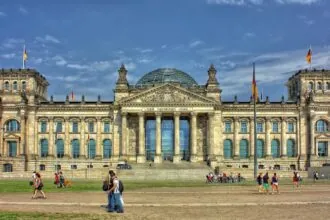
Our Berlin Things To Do guide touches on the Wall and the Cold War as part of a much wider city itinerary, alongside the Brandenburg Gate, Museum Island and the Reichstag. This guide goes further, focused entirely on the division of Berlin, the Wall itself, and the sites that explain how ordinary life worked either side of it.
None of these are conventional tourist attractions. The Berlin Wall Memorial, the Stasi Museum and the Topography of Terror are all places connected to surveillance, imprisonment and, in some cases, death. Treat them the way you would any memorial site: allow proper time to read the material, keep noise and phone calls to a minimum inside documentation centres, and remember that many older Berliners lived through the events these sites describe.
Approached that way, this is also some of the most rewarding history you can experience anywhere in Europe. It covers the construction of the Wall in 1961, the best places to understand what the border actually looked like, the fall of the Wall in 1989, and how to fit the key sites into a single, well-planned day.
Cold War Berlin at a Glance
Before the detail, here is how the main sites compare on cost, location and time needed, so you can slot them into a day that suits your pace.
| Site | Cost (Adult) | Nearest Station | Suggested Time |
|---|---|---|---|
| Berlin Wall Memorial, Bernauer Strasse | Free | Bernauer Strasse (U8) / Nordbahnhof (S-Bahn) | 1.5 hours |
| Checkpoint Charlie site & Through the Iron Curtain exhibition | Free | Checkpoint Charlie (U6) | 20 to 30 minutes |
| Mauermuseum (optional, at Checkpoint Charlie) | €18.50 (£15.91/$21.65) | Checkpoint Charlie (U6) | 1 to 1.5 hours |
| East Side Gallery | Free | Warschauer Strasse (U1, S3, S5, S7, S9) / Ostbahnhof | 1 hour |
| Topography of Terror | Free | Potsdamer Platz (S-Bahn/U2) | 1 hour |
| DDR Museum | €13.90 (£11.95/$16.26) | Hackescher Markt (S-Bahn) | 1 to 1.5 hours |
| Stasi Museum | €12 (£10.32/$14.04), reduced €9 (£7.74/$10.53) | Magdalenenstrasse (U5) | 1.5 to 2 hours |
How the Wall Divided Berlin Overnight
Construction began overnight on 13 August 1961, when East German troops and police sealed the border between East and West Berlin with barbed wire, later replaced by concrete. The immediate trigger was migration. Around 3.5 million East Germans, roughly a fifth of the population, had already left for the West since 1949, and the exodus was accelerating.
The finished barrier was not a single wall but a heavily fortified border system stretching around 155 kilometres in total, of which about 106 kilometres was concrete wall roughly 3.6 metres high. Between an inner and outer wall ran the so-called death strip, an open area around 100 metres wide covered in raked sand or gravel so that footprints would show, watched over by roughly 300 watchtowers and patrolled by armed guards under shoot-to-kill orders.
At least 140 people died attempting to cross, according to research by Berlin’s Centre for Contemporary History, with some estimates placing the true figure higher. For twenty-eight years the Wall cut through streets, cemeteries and even buildings, separating people from jobs, relatives and, in the case of the Chapel of Reconciliation, their own church.
Best for two or three nights. The widest choice of rooms, with filters for free cancellation and included breakfast.
View staysBest for groups who want one address and separate bedrooms rather than three hotel rooms.
See holiday homesBest as a last check before booking. Compares Berlin hotel rates across several sites in one search.
Compare ratesBernauer Strasse: The Wall’s Most Complete Memorial
Bernauer Strasse is the place to start, and the one site on this list you should not skip. It is the largest and most complete surviving section of the border system anywhere in Berlin, run by the Berlin Wall Foundation rather than left as a standalone ruin.
A roughly 1.4-kilometre outdoor route follows the former death strip, with preserved fencing, a watchtower, and steel markers showing where escape tunnels once ran underneath. The Documentation Centre explains the wider history of the divided city through film and archive material, while the nearby Chapel of Reconciliation stands on the site of a church that East German authorities demolished in 1985 because it stood inside the border strip.
Every part of the memorial, including the Documentation Centre, Visitor Centre and outdoor grounds, is free to enter. The Documentation Centre is open Tuesday to Sunday, 10am to 6pm, and the outdoor route is open daily from 8am to 10pm, so it can anchor either the start or the end of a Cold War day.
The nearest stations are Bernauer Strasse on the U8 and Nordbahnhof on the S-Bahn (S1, S2, S25, S26), both a short walk from the entrance, and the route itself is flat and step-free throughout.
Once you have finished at the memorial, Mauerpark is a short walk further along the old border route, best known for its Sunday flea market and the open-air karaoke sessions held in its amphitheatre. It sits directly on land once occupied by the death strip, making it a striking, informal contrast to the preserved seriousness of the Documentation Centre.
Checkpoint Charlie: Replica, Real History and a Souvenir Warning
Checkpoint Charlie was the best known Allied crossing point between the American and Soviet sectors, named simply for being the third checkpoint after Alpha and Bravo. It became a genuine Cold War flashpoint in October 1961, when American and Soviet tanks faced each other at close range across the border for several tense days.
It is worth being honest about what stands here now. The original guard hut was removed in 1990 and is preserved in the Allied Museum in Zehlendorf, and the structure at the site today is a replica, often surrounded by actors in period uniforms charging for photographs. Treat that part as a photo stop rather than a historical artefact.
The genuine history sits alongside it. As of 2026, the site is in the early stages of a funded redevelopment led by the Berlin Wall Foundation, and the long-running BlackBox Cold War pavilion closed permanently in January 2026 after operating there since 2012. In its place, a free open-air exhibition called Through the Iron Curtain now covers the forecourt with themed panels on Cold War history, while the privately run Mauermuseum (Museum Haus am Checkpoint Charlie) across the road continues to operate its own, more crowded collection of escape stories and artefacts. A permanent memorial is planned for the site from 2028.
The nearest station is Checkpoint Charlie on the U6 (formerly Kochstrasse), directly above the site, with Stadtmitte on the U2 and U6 a few minutes further on foot.
Gendarmenmarkt, a five-minute walk away, is one of Berlin’s most elegant squares, framed by the German and French Cathedrals and the Konzerthaus concert hall, and makes a pleasant contrast after the Cold War material. It is also worth knowing that the souvenir stalls clustered around Checkpoint Charlie sell so-called Berlin Wall fragments whose authenticity usually cannot be verified, so treat a piece bought this way as a novelty rather than a genuine relic unless it comes from the Mauermuseum shop or a named, certificate-backed dealer such as Berliner Mauermanufaktur.
East Side Gallery: The Wall as an Open-Air Canvas
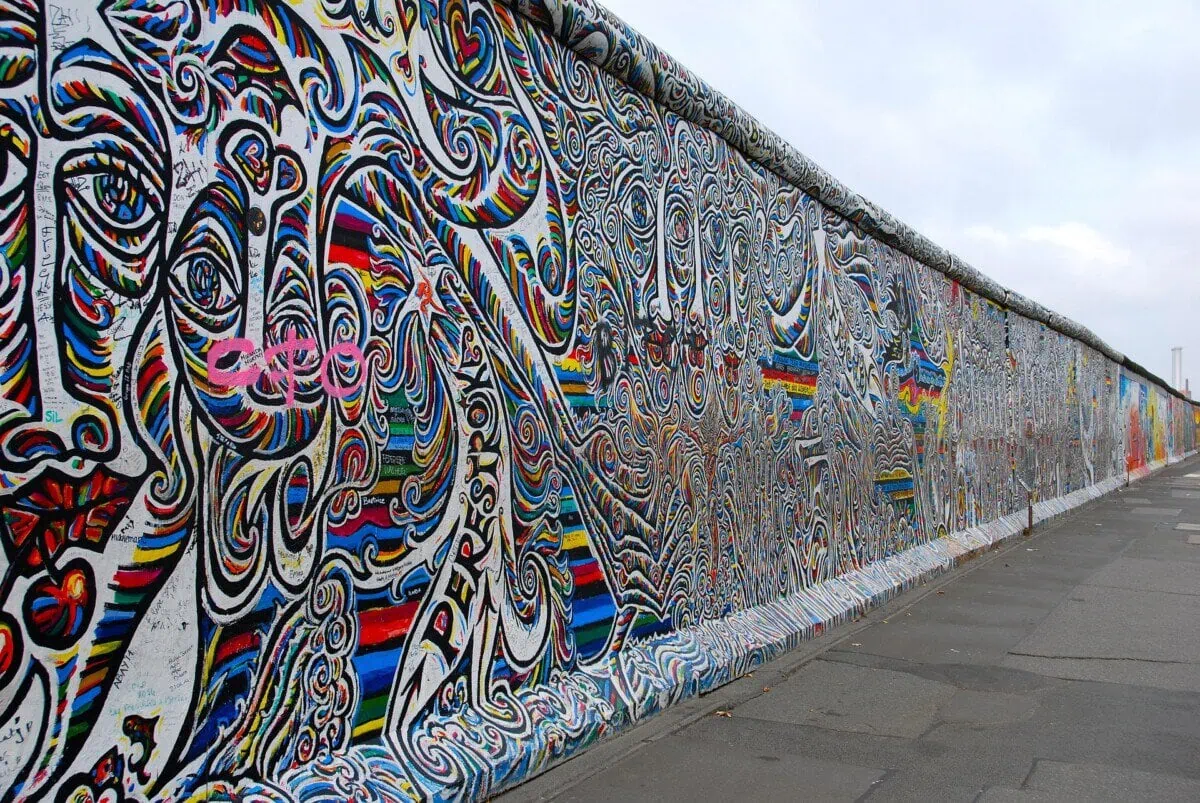
Running for around 1.3 kilometres along the Spree in Friedrichshain, the East Side Gallery is the longest continuous stretch of the Wall still standing anywhere. Rather than being preserved as a bare concrete barrier, this section was turned into an open-air gallery in 1990, when 118 artists from 21 countries painted the eastern side of the Wall soon after it fell.
The two most photographed works are Test the Best by Birgit Kinder, showing a Trabant car appearing to burst through the concrete, and My God, Help Me to Survive This Deadly Love by Dmitri Vrubel, the mural of Leonid Brezhnev and Erich Honecker’s staged kiss that has become one of the most recognisable images of the Cold War. The murals have been repainted and restored several times since 1990 as weather and graffiti have taken their toll.
Unlike the Wall’s original purpose, this stretch is now entirely about openness. It is free to visit and accessible at any time, though it is naturally busiest in the middle of the day, so an early morning or early evening visit gives a much clearer view of the artwork without crowds in every photograph.
The nearest stations are Warschauer Strasse (U1, S3, S5, S7, S9) at one end and Ostbahnhof at the other, making it easy to walk the full length in one direction and catch a train back.
Once you have walked its length, Friedrichshain’s RAW-Gelände sits just a few minutes further along Warschauer Strasse, a former railway repair yard turned bar, food-market and nightlife district that is especially lively after dark. The Oberbaumbrücke bridge and Thomas Schütte’s Molecule Man sculpture in the river are also worth the short detour before heading back to the station.
Topography of Terror: Nazi History Beside the Wall
Strictly speaking, the Topography of Terror belongs to the Nazi era rather than the Cold War, but it sits directly beside a surviving stretch of the Wall and is almost always visited alongside the other sites on this route. The building on this plot at Niederkirchnerstrasse 8 once housed the headquarters of the Gestapo, the SS and the Reich Security Main Office between 1933 and 1945.
The permanent exhibition, housed in a purpose-built documentation centre on the site, explains how these institutions ran the machinery of Nazi terror across occupied Europe, using original documents, photographs and testimony rather than reconstructions. An outdoor exhibition along the preserved Wall section outside covers the same ground for visitors who prefer not to go inside.
Entry is completely free, and the site is open daily from 10am to 8pm, with the outdoor areas closing at dusk or 8pm, whichever is earlier. It closes only on 24 and 31 December and 1 January.
The nearest station is Potsdamer Platz (S-Bahn and U2), around 400 metres away, which makes it a natural link between Checkpoint Charlie and the government quarter further north.
Potsdamer Platz itself offers a complete change of pace, with the Sony Center, shopping and the Kulturforum‘s art museums, including the Gemäldegalerie and Neue Nationalgalerie, all within easy reach. It is a useful way to break up a day otherwise built around Cold War history with something lighter.
DDR Museum and Stasi Museum: Daily Life and Surveillance
Where the Wall Memorial and Topography of Terror explain the physical border and its machinery, the DDR Museum shows what everyday life looked like behind it. Housed opposite the Berlin Cathedral, its hands-on exhibits recreate a typical East German living room, a Trabant car you can sit in, and a school classroom, alongside material on consumer shortages, holidays and state surveillance.
Adult admission is €13.90 (£11.95/$16.26), and the museum sits a short walk from Hackescher Markt station on the S-Bahn, easily combined with Museum Island.
For the surveillance side specifically, the Stasi Museum in Lichtenberg is the more serious counterpart. It occupies House 1 of the former headquarters of the Ministry for State Security, the East German secret police, on Ruschestrasse, and its exhibits, many left largely as they were found in 1990, cover the Stasi’s vast network of informants and surveillance equipment used against the country’s own citizens.
Adult admission is €12 (£10.32/$14.04), reduced to €9 (£7.74/$10.53) for concessions, and the nearest station is Magdalenenstrasse on the U5. It is further from the other sites on this page, so it suits a dedicated afternoon rather than being tacked onto the main route.
The DDR Museum’s location opposite the Berlin Cathedral makes it easy to continue straight into Museum Island or the reconstructed old town of the Nikolaiviertel, both a short walk away. The Stasi Museum in Lichtenberg is more residential and has little else nearby, which is exactly why it suits a dedicated visit rather than being tacked onto a day built around the more central sites.
9 November 1989: The Night the Wall Fell
The Wall fell on the evening of 9 November 1989, and the way it happened was almost accidental. At a televised press conference, East German spokesman Günter Schabowski was asked when new, looser travel rules would take effect, and, having been handed the announcement with no briefing on timing, answered that as far as he knew, it was immediately.
Crowds gathered at checkpoints across the city within hours, and overwhelmed border guards, with no clear orders to shoot and no way to hold back the numbers, opened the gates. People climbed onto the Wall itself at the Brandenburg Gate that night, and within days sections were being physically dismantled by hand.
Formal German reunification followed on 3 October 1990, less than a year later, when the states of the former East Germany joined the Federal Republic. That date is now a public holiday across Germany, marked as the Day of German Unity.
Most of the Wall came down quickly afterwards, sold off or crushed for building rubble, which is why the preserved sections at Bernauer Strasse and the East Side Gallery are so significant. They are among the only substantial pieces left in their original location.
Best for finding routes the airlines do not sell as a single ticket. Combines carriers to bring the fare down.
Search flightsBest if you want maps and messaging working the moment you switch your phone on.
See eSIM plansBest if you would rather not work out the transport on arrival. Book it now and forget it.
View transfersHow to Plan a Cold War History Day in Berlin
The sites in this guide are spread across several districts, so it helps to group them rather than crossing the city back and forth. A logical route starts at Bernauer Strasse in the morning, when the Documentation Centre is quiet, allowing an hour and a half to walk the full outdoor route and go through the exhibition properly.
From there, the U8 and a short change link to Checkpoint Charlie and the Topography of Terror, which sit close enough together to cover in a single mid-morning to early afternoon block, including the Mauermuseum if you want the fuller collection. Both are compact enough to fit alongside lunch nearby in Kreuzberg or Mitte.
The East Side Gallery works well as a late afternoon stop, reached directly by U-Bahn or S-Bahn from Stadtmitte or Potsdamer Platz to Warschauer Strasse, with enough daylight left to walk its full length at a relaxed pace. The DDR Museum, being fully indoor, is a useful option to swap in on a wet day, and pairs naturally with a Museum Island visit rather than the outdoor Wall sites. A single AB-zone ticket covers every hop between these sites, and our full guide to Berlin’s public transport network explains how the zones and validation rules work in practice.
A guided walking tour genuinely adds value on this particular subject, more so than on a general city sightseeing route, since much of what happened at these sites is no longer visible without context. A knowledgeable guide can point out where tunnels ran, where buildings once stood, and which surviving details are original, which a self-guided visit can easily miss.

Rupert’s Handy Travel Tips
Planning a day around the Wall and Cold War sites? Here are a few things worth knowing before you set off:
- Start at Bernauer Strasse: It is the most complete site and gives you the context for everything else you see afterwards.
- Keep phones on silent inside documentation centres: These are memorial and archive spaces, not general attractions.
- Do not confuse the replica with the real thing: The Checkpoint Charlie guard hut is a modern reconstruction, so save your deeper questions for the Documentation Centre and Mauermuseum.
- Wear comfortable shoes: The Bernauer Strasse route and East Side Gallery both involve a fair amount of walking on hard pavement.
- Be sceptical of “genuine” Wall pieces sold on the street: Most stalls near Checkpoint Charlie cannot verify what they are selling, so buy from the Mauermuseum shop or a certified dealer if authenticity matters to you.
Want to meet the reindeer behind our travel tips? Find out more in our page Who is Rupert?.



Frequently Asked Questions
When was the Berlin Wall built?
Construction began overnight on 13 August 1961, when East German troops sealed the border between East and West Berlin, initially with barbed wire that was later replaced with concrete.
Why was the Berlin Wall built?
East German authorities built the Wall to stop the growing number of citizens leaving for the West, after around 3.5 million people, roughly a fifth of the population, had already emigrated since 1949.
When did the Berlin Wall fall?
The Wall fell on 9 November 1989, after a confused announcement at a press conference led crowds to gather at checkpoints and overwhelmed guards opened the borders.
Is the Berlin Wall Memorial free?
Yes. Every part of the memorial at Bernauer Strasse, including the Documentation Centre, Visitor Centre and outdoor route, is free to enter.
Is Checkpoint Charlie worth visiting?
The replica guard hut itself is more of a photo stop than a historical site, but the surrounding area is worth visiting for the Mauermuseum and the free open-air exhibition currently covering the forecourt while a permanent memorial is developed.
How long is the East Side Gallery?
The gallery runs for around 1.3 kilometres along the Spree in Friedrichshain, making it the longest continuous surviving stretch of the Wall.
What is the Topography of Terror?
It is a free documentation centre on the site of the former Gestapo, SS and Reich Security Main Office headquarters, covering the Nazi era rather than the Cold War, though it sits beside a preserved section of the Wall.
What is the difference between the DDR Museum and the Stasi Museum?
The DDR Museum is a hands-on museum about everyday life in East Germany, while the Stasi Museum is a more serious site inside the former secret police headquarters, focused specifically on surveillance and state security.
How many people died trying to cross the Berlin Wall?
Research by Berlin’s Centre for Contemporary History has confirmed at least 140 deaths, though some estimates put the true figure higher.
Are the “Berlin Wall pieces” sold by street vendors genuine?
Usually not. Genuine fragments are normally sold with a dealer’s certificate, such as those from Berliner Mauermanufaktur, or through the Mauermuseum shop, while the loose stalls near Checkpoint Charlie and other tourist spots are widely associated with mass-produced fakes that have no verifiable link to the real Wall.
Can I see these sites in one day?
Yes. Bernauer Strasse, Checkpoint Charlie, the Topography of Terror and the East Side Gallery can all be covered in a single, well-planned day using the U-Bahn and S-Bahn, though the Stasi Museum sits further out and suits a separate visit.
Further Reading & Related Guides
For the rest of the city beyond this history, our Berlin Things To Do guide covers the Brandenburg Gate, Museum Island, the Reichstag Dome and dozens of other stops, with real prices and nearest stations throughout.
If you are flying into the city, our Berlin Airport Transfers guide compares the FEX express train, S-Bahn, buses and taxis from BER, and our Berlin Day Trips guide covers ten further destinations reachable by train if you have extra time.
This period sits within a much wider theme of historical travel, and our Dark Tourism Guide covers other significant historic and memorial sites around the world, from Auschwitz in Poland to the Normandy beaches in France.