Reviewed by our editorial team Updated
Getting Around Berlin
Berlin is a sprawling city, but its public transport network makes almost every corner of it reachable without a car. A dense grid of U-Bahn and S-Bahn lines, surface trams and buses covers everything from Mitte’s museums to the lakes and forests on the outer edges of town.
The part that trips up first-time visitors is not the network itself but the fact that two separate companies run the trains. BVG operates the U-Bahn, trams and buses, while the S-Bahn is run by a subsidiary of Deutsche Bahn, yet both sit inside the same regional fare system, so one ticket covers all of them.
Berlin also does something most European capitals do not: it has no ticket barriers anywhere on the network. Trust and spot checks replace gates, which is convenient for visitors but only if you understand how to buy and validate a ticket correctly before boarding.
This guide explains how Berlin’s transport network fits together, what the AB, BC and ABC fare zones actually mean, which ticket suits a short trip versus a longer stay, and how the city’s proof-of-payment system works in practice.
Berlin is also unusually generous with off-peak frequency, and even outer S-Bahn branches rarely leave you waiting more than ten minutes outside the morning and evening rush. The whole network runs on one integrated timetable regardless of which company operates a given line.
Whether you are based centrally in Mitte for a long weekend or staying several weeks further out in Neukölln or Friedrichshain, the same ticket, the same app and the same validation rules apply everywhere. There is no separate system to learn once you step outside the tourist core.
Berlin Public Transport at a Glance
| Transport | Main operator | Best for | Visitor tip |
|---|---|---|---|
| U-Bahn | BVG | Fast journeys around central Berlin | Nine lines (U1-U9), trains every few minutes on weekdays |
| S-Bahn | S-Bahn Berlin (DB) | Longer hops and airport links | Shares the ring line loop around the city centre |
| Trams | BVG | Former East Berlin neighbourhoods | The only way to reach some Prenzlauer Berg and Köpenick streets |
| Buses | BVG | Filling in the gaps | Route 100 passes many major sights |
Best for a short trip. Compare rooms by neighbourhood, price and guest rating before you book.
Compare hotelsBest for groups who want one address and separate bedrooms rather than three hotel rooms.
See holiday homesBest for double-checking. Runs the same Berlin search across several booking sites so you are not leaving money behind.
Compare pricesWho Runs Public Transport in Berlin?
BVG (Berliner Verkehrsbetriebe) is the operator most visitors will recognise. It runs the U-Bahn underground network, the city’s tram lines and almost every bus route within Berlin.
The S-Bahn is a different matter entirely. It is run by S-Bahn Berlin GmbH, a subsidiary of Deutsche Bahn, and it is easy to assume it belongs to BVG because the two networks interconnect so closely at major stations.
What actually holds the system together for a passenger is the VBB, the Berlin-Brandenburg transport association that sets one shared set of tickets and fare zones across BVG, S-Bahn and the regional trains that reach out into Brandenburg.
In practice this means you never need to think about which company you are riding with. A single ticket bought from any machine, app or kiosk works across U-Bahn, S-Bahn, trams and buses without exception.
This VBB umbrella also covers the regional RE and RB trains that pass through Berlin on their way to towns like Cottbus or Frankfurt (Oder), so a standard Berlin ticket is valid on those trains too as long as the journey stays inside the zones you have paid for.
Even Berlin’s smaller private bus operators fall under the same umbrella fare, so you never need to check which company’s logo is on the vehicle before boarding, unlike some German regions where a handful of operators still run separate ticketing.
How the Berlin U-Bahn Works
The U-Bahn is Berlin’s underground metro and the fastest way to cross the city centre. Nine numbered lines, U1 to U9, radiate out from the centre and criss-cross Mitte, Kreuzberg, Charlottenburg and Schöneberg.
You will sometimes see a tenth line, U12, marked on a map or inside the app. It is not a permanent route, just a temporary substitute service that BVG runs between Ruhleben and Warschauer Straße whenever engineering works close part of U1, U2 or U3.
U2 is one of the most useful lines for a first visit, running the full width of the city from Pankow in the north through Alexanderplatz, Potsdamer Platz and Zoologischer Garten out to Ruhleben in the west. U7 is the longest of the nine at almost thirty-two kilometres, cutting east to west between Rathaus Spandau and Rudow through Kreuzberg and Neukölln.
U6 runs north to south from Alt-Tegel to Alt-Mariendorf through Friedrichstraße and Mehringdamm, while U8 forms a similar spine further east, linking Wittenau to Hermannstraße via Alexanderplatz and Kottbusser Tor. Between them, these four lines alone reach most of the districts a typical visitor will want to see.
Trains run every two to five minutes at peak times on the busiest lines, easing to roughly every five minutes for the rest of the day and every ten minutes in the evening. Services continue until around 12:30am on weeknights, and several lines run through the night on Friday and Saturday.
Stations are well signed in German and English, and platform screens show the next train and its final destination, which matters because several lines split into different branches at outer stations. Each line is also colour-coded on maps and at stations, which keeps navigating reasonably intuitive even without much German.
A handful of interchange stations, including Alexanderplatz and Friedrichstraße, connect the U-Bahn directly to S-Bahn platforms under one roof, so changing between the two networks rarely means stepping back out onto the street.
Every U-Bahn station has its own ticket machine right on the platform, so there is rarely any need to detour to a separate ticket hall before boarding. See how to buy and validate a ticket in the sections below for the full detail on machines, the app and stamping across the whole network.
The Berlin S-Bahn: Run by DB, Not BVG
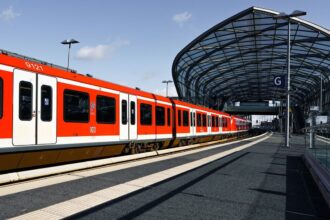
The S-Bahn is Berlin’s suburban and ring rail network, and it is operated separately from the U-Bahn. Around sixteen lines run above ground, lettered rather than numbered, from S1 through S9 with further branches numbered S25, S26, S41, S42, S45, S46, S47, S75 and S85.
S3 forms the east-west Stadtbahn spine, running from Spandau through Charlottenburg, Zoo, Friedrichstraße and Alexanderplatz out to Erkner. S1 runs the full length of the Nord-Süd-Tunnel, connecting Oranienburg in the far north down to the lakeside station of Wannsee in the south.
The most useful line for orientation is the Ringbahn, formed by S41 and S42, a circular route with no fixed start or end that loops clockwise and counter-clockwise around the inner city. S9 and S85 both continue south-east to Berlin Brandenburg Airport, making either a direct option from most central stations.
Because S-Bahn Berlin is a Deutsche Bahn subsidiary rather than part of BVG, its trains and staff carry different branding, but the tickets, fare zones and validity rules are identical across both networks. Trains are generally less frequent than the U-Bahn outside peak hours, so check the departure board before committing to an S-Bahn route when a U-Bahn alternative exists nearby.
Carriages are wider than the U-Bahn’s and carry more standing and luggage space, which makes the S-Bahn the more comfortable option if you are travelling with suitcases to or from the airport. Announcements are made in both German and English on most lines, and digital screens inside confirm the next stop.
Unlike the U-Bahn, S-Bahn ticket machines stand both at street level near station entrances and again on the platform, since many S-Bahn stations have an above-ground concourse rather than a single underground hall. The DB Navigator app is a useful alternative to the BVG app here, particularly if you are already using it for onward regional or ICE trains.
The Best Stations for Changing Lines in Berlin
Three stations matter most for changing lines or arriving in Berlin by train, and each does a different job in a network split between U-Bahn, S-Bahn and long-distance rail. Knowing which one to head for saves a confusing detour through unfamiliar platforms.
Alexanderplatz is Berlin’s busiest interchange, bringing together U-Bahn lines U2, U5 and U8 with S-Bahn lines S3, S5, S7 and S9, plus several tram routes on the surface. It sits right at the heart of the former East Berlin, making it the natural base for anyone exploring Mitte, the TV Tower or the museums nearby.
Friedrichstraße is where the east-west S-Bahn lines, S1, S2, S25, S26, S3, S5, S7 and S9, cross the north-south U6, alongside a cluster of regional RE and RB services out to Brandenburg. It is the most useful station for anyone splitting a stay between Unter den Linden and the government quarter, since it sits almost exactly between the two.
Hauptbahnhof is Berlin’s long-distance rail gateway, with ICE and IC services running to Hamburg, Munich, Frankfurt, Dresden and onward into Prague, Vienna and Amsterdam. The S3, S5, S7, S75 and S9 S-Bahn lines and the U5 U-Bahn line all call here too, and it is the most direct interchange for the S9 run out to Berlin Brandenburg Airport.
For a first stay, Alexanderplatz is the best all-round base for reaching the historic core on foot or by tram, while Hauptbahnhof is the one to head for when arriving or leaving by long-distance train. Friedrichstraße earns its place mainly as a fast interchange between the S-Bahn and U6 rather than a destination in its own right.
| Station | Key Lines | Best For |
|---|---|---|
| Alexanderplatz | U2, U5, U8; S3, S5, S7, S9; trams | Central sightseeing; East Berlin’s main hub |
| Friedrichstraße | U6; S1, S2, S25, S26, S3, S5, S7, S9; RE/RB | Crossing S-Bahn and U6; Unter den Linden |
| Hauptbahnhof | U5; S3, S5, S7, S75, S9; ICE/IC | Long-distance trains; S9 to BER Airport |
Berlin’s Trams: A Legacy of the East
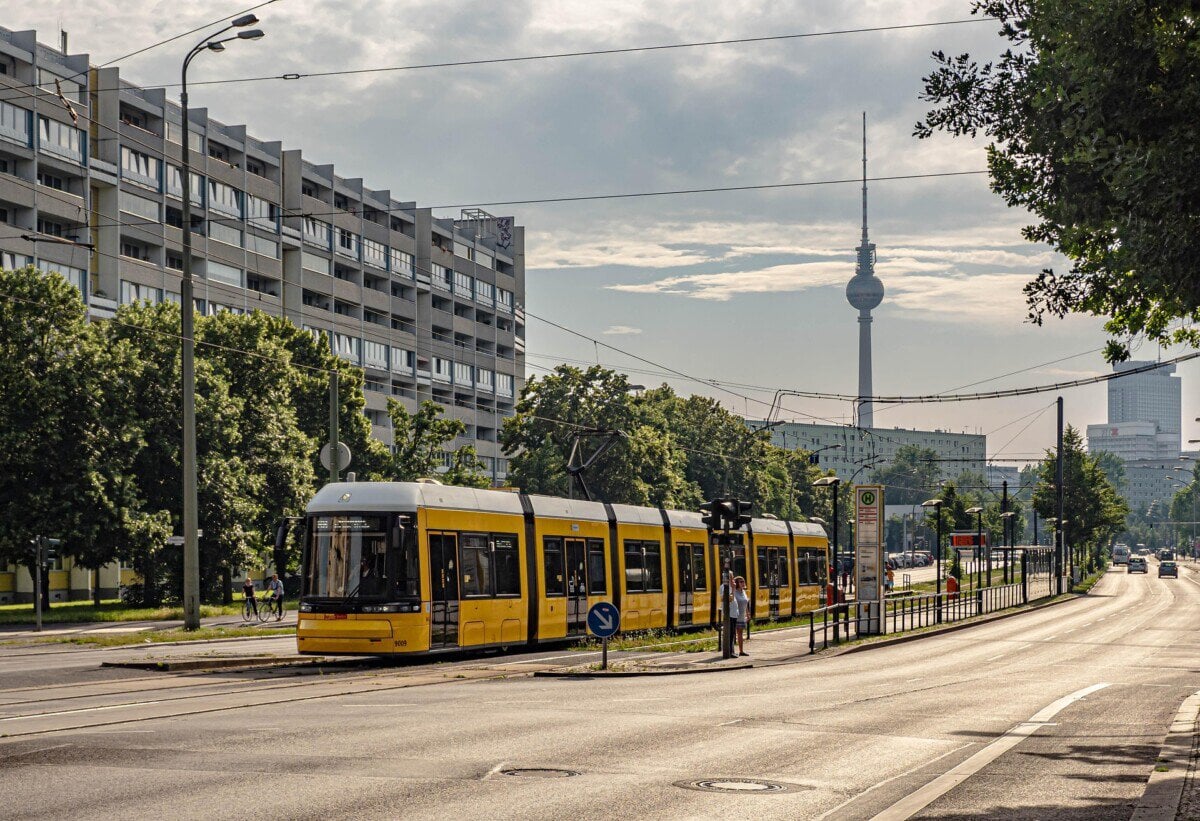
Berlin has one of the largest tram networks in Europe, with 22 lines covering around 193 kilometres of track, but it is not evenly spread across the city. Thirteen standard numbered lines, including the 12, 16, 27 and 68, run alongside nine faster Metrotram lines prefixed with an M, and both operate almost entirely across the boroughs that made up former East Berlin.
M4 and M5 both run from Hackescher Markt out to Hohenschönhausen, while M10 crosses the city from Turmstraße in Moabit to Warschauer Straße through Prenzlauer Berg and Friedrichshain, making it one of the most useful lines for visitors staying east of Mitte. M1 links Niederschönhausen to central Mitte, and M17 runs out toward Adlershof for anyone heading on to Köpenick’s old town.
This spread is a genuine quirk of the city’s divided history. West Berlin removed almost all of its trams decades ago, while the East kept and expanded its network, and reunification never fully evened out the difference.
The nine Metrotram lines run around the clock and roughly as often as the U-Bahn during the day, making them a genuinely fast way to cross Prenzlauer Berg or reach Friedrichshain without detouring underground. Modern low-floor trams cover most routes, so boarding with a pushchair, wheelchair or heavy luggage is straightforward at the majority of stops.
Every tram has a small ticket machine near the middle doors, taking coins on older machines and card or contactless payment on newer ones. A ticket bought on board is already time-stamped at the moment of purchase, so it needs no separate trip to a validator, though a paper ticket bought elsewhere, such as a strip from a 4-Fahrten-Karte, still needs stamping in the tram’s own validator box before you travel.
Berlin Buses
BVG’s bus network fills in every gap the rail lines leave behind, with around 150 regular day routes and close to 50 further night lines across the city. Nineteen of the day routes are MetroBus lines, prefixed with an M and running at high frequency around the clock, including the M11 between Dahlem-Dorf and Schöneweide and the M45 linking Spandau to Zoologischer Garten.
The double-decker route 100 between Zoologischer Garten and Alexanderplatz passes the Reichstag, Brandenburg Gate and Unter den Linden for the price of a normal ticket, while route 200 links the same two stations by a different path, looping via Potsdamer Platz, the Berlin Philharmonie and the Memorial to the Murdered Jews of Europe. Both run roughly every ten minutes and count as some of the cheapest sightseeing routes in the city.
Night buses, marked with an N prefix, take over on many routes once the U-Bahn stops running, with around forty routes covering the whole city plus a further nine that specifically substitute for U-Bahn lines overnight. Thirteen ExpressBus routes, marked with an X prefix, run fewer stops along busy corridors, including the X7 that links Berlin Brandenburg Airport directly to U Rudow.
Most buses are low-floor with a designated wheelchair and pushchair space near the middle doors, and drivers will lower the boarding ramp on request if you signal from the stop. Real-time countdown displays at busier stops show exactly how many minutes until the next bus, and the same live data feeds into the BVG app.
Since September 2024, Berlin’s buses have gone fully cashless, so a ticket bought directly from the driver must now be paid by contactless card, Apple Pay, Google Pay or a BVG prepaid card. Tapping a contactless card or the app at the reader both buys and validates the ticket in the same action, so there is nothing further to stamp once you are on board.
Best for long or awkward journeys. Builds one itinerary out of separate flights.
View flightsBest for short trips. Install the eSIM at home and arrive in Berlin with working data, no shop queue.
Browse eSIMsBest if you would rather not work out the transport on arrival. Book it now and forget it.
View transfersBerlin’s Fare Zones: A, B and C Explained
Berlin’s fare system is built around three lettered zones rather than concentric rings. Zone A covers the inner city up to and including the S-Bahn ring line, and it holds almost every major sight a first-time visitor will want to see.
Zone B stretches from the edge of the ring line out to Berlin’s official city boundary, while Zone C reaches roughly fifteen kilometres further still, covering the wider Brandenburg area and, notably, the city of Potsdam.
Tickets are sold for combined zones: AB covers inner and outer Berlin, which is all most visitors need, while ABC adds Zone C for day trips to Potsdam or a journey to Berlin Brandenburg Airport, which sits within Zone C.
Unless your itinerary includes Potsdam or the airport, an AB ticket is the right choice for almost every trip inside Berlin, and buying ABC by mistake simply wastes money on zones you will not travel through.
A useful shortcut for visitors: if your hotel and every sight on your list sit inside the S-Bahn ring, you may never need to think about Zone B or C at all during a short trip.
Zone boundaries are shown clearly on every official BVG and VBB map, including the ones posted inside stations, so double-checking before a longer day trip only takes a moment.
Berlin Public Transport Ticket Prices
Berlin’s ticket range is straightforward once you know the zone you need. Prices below reflect the fares that took effect in January 2026, and they apply equally across U-Bahn, S-Bahn, trams and buses.
| Ticket | Zones | Price | Validity |
|---|---|---|---|
| Kurzstrecke (short trip) | AB | €2.80 | Three stops by rail or six by tram, no rail transfers |
| Einzelfahrschein (single) | AB | €4.00 | Two hours, one direction, transfers allowed |
| Tageskarte (day ticket) | AB | €11.20 | Until 3am the following day |
| Single ticket | ABC | Higher fare | Adds Potsdam and the airport zone |
One change worth knowing about: the old 7-Tage-Karte weekly pass was discontinued from January 2026. VBB retired it because the Deutschlandticket, covered below, now undercuts it for almost every visitor staying more than a few days.
Children under six travel free on all VBB services, and children aged six to fourteen pay a reduced Ermäßigt fare, which is worth factoring in when budgeting for a family trip.
A 4-Fahrten-Karte, a bundle of four single tickets sold at a small discount versus buying them one at a time, suits a short stay where a day ticket would not quite pay for itself.
All of these fares can be bought from platform ticket machines, BVG customer centres or the app, and machine-bought tickets accept both cash and card at most stations.
How to Buy a Ticket in Berlin
Every U-Bahn and S-Bahn platform has its own yellow or red ticket machine, and these remain the most dependable way to buy a ticket as soon as you arrive. Most accept both cash and card, and the same VBB ticket bought there works straight across U-Bahn, S-Bahn, trams and buses without any extra purchase.
The BVG app, listed on both app stores as “BVG Tickets: Train, Bus & Tram”, is the simplest option for anyone comfortable buying on a phone rather than hunting for a machine. A ticket bought this way is valid the moment you activate it, so there is no separate stamping step to remember afterwards.
BVG customer centres and a handful of staffed kiosks near major stations also sell paper tickets, a useful fallback if a nearby machine is out of order. The DB Navigator app works as an alternative to BVG’s own app too, particularly if you are already using it to book onward regional or long-distance trains.
Buying directly from a bus driver used to be the easiest fallback, but that changed in September 2024, when Berlin’s buses went fully cashless. Drivers no longer accept cash at all, so a ticket bought on board must be paid by contactless card, Apple Pay, Google Pay or a BVG prepaid card instead.
Which ticket actually makes sense depends on how long you are staying and how far you plan to travel. The fare zones and ticket prices covered earlier in this guide set out the AB and ABC options for a single trip or a day out, while the Deutschlandticket section further down explains when the monthly pass beats buying single tickets every day.
| Where to Buy | Payment Accepted | Good to Know |
|---|---|---|
| Platform ticket machine | Cash and card | Paper ticket still needs stamping before boarding |
| BVG app | Card, Apple Pay, Google Pay | Valid instantly, no stamping needed |
| Bus driver (on board) | Contactless only since Sept 2024 | Buys and validates the ticket in one step |
| Customer centre or kiosk | Cash and card | Useful backup near major stations |

How to Validate a Ticket in Berlin
Berlin runs on a genuine honour system, with no ticket gates anywhere on the network. You can walk straight onto a U-Bahn platform, S-Bahn platform, tram or bus without ever scanning or showing a ticket at a barrier, so validating it yourself is what actually makes it valid.
On U-Bahn and S-Bahn platforms, look for the small orange-and-red validator box standing near the ticket machine and stamp any paper ticket there before you go through to the platform. A ticket bought through the BVG or DB Navigator app needs no separate stamping at all, since it becomes valid proof of payment the moment you activate it on your phone.
Trams work slightly differently again, since a ticket bought from the on-board machine is already time-stamped the instant you buy it, as covered in the trams section above. A ticket bought anywhere else, such as a spare paper ticket carried over from an earlier trip, still needs stamping in the tram’s own validator box before it counts as valid for that journey.
This is backed by proof-of-payment checks rather than trust alone. Plain-clothes and uniformed inspectors from BVG and S-Bahn Berlin board trains and trams at random throughout the day to confirm that every passenger holds a valid, validated ticket.
Travelling without a valid ticket carries a fixed fine, known as the Erhöhtes Beförderungsentgelt, currently €60 and payable on the spot by card or within fourteen days afterwards. Season-ticket holders who simply forgot their card can usually prove ownership within seven days and pay a much smaller €7 processing fee instead.
Inspectors typically show a small laminated ID card rather than wearing a uniform, so it is entirely reasonable to ask to see it before handing over a ticket, especially when the inspector is in plain clothes.
The Deutschlandticket and Longer Stays
For anyone in Berlin for more than about a week, the national Deutschlandticket is usually the better deal. At €63 a month it covers unlimited travel on U-Bahn, S-Bahn, trams and buses across the entire VBB area, including Zone C and Potsdam.
It also works on regional trains anywhere in Germany, which makes it genuinely useful for anyone planning day trips beyond Brandenburg during a longer stay.
The ticket is non-transferable and tied to one named person, so a couple or family cannot share a single Deutschlandticket between them the way an older group day ticket worked.
It is sold as a rolling monthly subscription rather than a one-off purchase, though most providers, including BVG, let you cancel before the next billing cycle if your trip ends early.
Because it activates from the first day of the calendar month rather than the day you buy it, arriving mid-month means paying the full monthly price for partial use, so weigh that against single and day tickets first.
Our German Rail Tickets Explained guide covers how the Deutschlandticket compares with regional Länder-Tickets in detail, including where it makes sense to buy one instead of relying on single Berlin tickets.
Apps for Getting Around Berlin
The official BVG app, listed on both app stores as “BVG Tickets: Train, Bus & Tram”, is the simplest way to plan a journey in Berlin. It combines live departures, a full journey planner across BVG and S-Bahn, and mobile ticket purchase in one place, and the interface works in English as well as German.
Alongside it sits Jelbi, BVG’s separate mobility app that bundles e-scooters, rental bikes, car-sharing and ride-hailing from multiple providers into a single login and wallet. It is worth having installed for the last mile once you step off a train somewhere the rail network does not quite reach.
BVG and Hamburg’s HVV are jointly developing a new combined mobility app, reported under the working name Max, intended to eventually fold Jelbi’s shared-mobility features into one ticketing app for both cities. The project has faced delays and public disagreement between the two transport bodies, so the existing BVG and Jelbi apps remain the reliable choice for now.
The DB Navigator app is worth having alongside both, particularly for checking S-Bahn disruptions or booking onward regional and long-distance trains from Berlin’s main stations.
A ticket bought through any of these apps is fully valid proof of payment during a spot check, exactly like a paper ticket, provided your phone has enough battery to show it on the screen.
Best if you would rather spend the money on Berlin than on the room. Compare hostels by location and rating.
Search hostelsBest arranged before you fly rather than after. Covers claim handling, plus lounge access on eligible delays.
Explore AirHelp+Best if your room is not ready yet. Left luggage booked in advance, so you are not hunting for a locker.
Check storageGetting To and From Berlin’s Airport
Berlin Brandenburg Airport sits within fare Zone C, so an ABC ticket is required for the journey. The airport has its own S-Bahn station, served directly from the city centre, alongside express bus and regional train options.
The S9 and S45 S-Bahn lines both run directly to the airport terminal, with a journey of roughly thirty minutes from central stations like Alexanderplatz or Ostkreuz, and departures every ten to twenty minutes through most of the day.
The RE and RB regional trains that also stop at BER are usually the fastest option from Hauptbahnhof, cutting the journey closer to twenty minutes, and they are covered by the same ABC ticket as the S-Bahn.
An express bus, the BER2, links the airport with Zoologischer Garten for anyone staying in western Berlin who would rather avoid a transfer at a central station.
Because this involves choosing between several different services with different journey times and prices, we cover it separately and in far more detail in our dedicated guide.
See our full Berlin Airport Transfers guide for a complete comparison of every option from BER into the city, including prices and timings for each.
Common Berlin Public Transport Mistakes
The single biggest mistake visitors make is assuming that no barriers means no ticket is needed. Spot checks happen regularly and inspectors rarely give warnings, so boarding without a valid, validated ticket is a genuine risk rather than a theoretical one.
A second common error is buying a Kurzstrecke ticket for a journey that is actually longer than three stops, which technically invalidates the ticket even if it feels like a minor overshoot.
Finally, many visitors forget that a machine-printed ticket must still be validated in a small stamping machine before travel, since buying one does not automatically make it valid for that journey.
Another trap is assuming a Deutschlandticket automatically covers every possible trip that day without checking; it does cover the whole VBB area, but visitors sometimes confuse it with more limited regional tickets from other German transport associations.
Some visitors also board the wrong direction on a split U-Bahn line without checking the destination shown on the platform screen, since two trains can arrive on the same platform heading to entirely different outer branches.
Finally, it is easy to forget that night buses and the reduced weekend U-Bahn schedule run on a different timetable to weekday daytime services, so always check the app before relying on a very late or very early connection.

Rupert’s Handy Travel Tips
Berlin’s trains are simple once you know the tricks, and I have picked up a few of these hopping between Prenzlauer Berg and the museums over the years.
- Always validate a paper ticket before boarding, even though nobody stops you at a barrier to check.
- Stick to an AB ticket unless you are heading to Potsdam or the airport, which both need ABC.
- If you are staying more than a week, work out the Deutschlandticket cost before buying single tickets every day.
- Use the S41/S42 Ringbahn loop as a free orientation tool if you are ever unsure which direction is which.
- Head to Prenzlauer Berg or Köpenick if you want to ride one of Berlin’s distinctive trams, since central Mitte has very few.
Want to meet the reindeer behind our travel tips? Find out more in our page Who is Rupert?.


Frequently Asked Questions
Does Berlin public transport have ticket barriers?
No. Berlin runs on a proof-of-payment honour system with no gates, so you must buy and validate a ticket yourself before boarding, since inspectors carry out regular spot checks.
What happens if I am caught without a valid ticket?
You will be issued a fine of €60, payable on the spot or shortly afterwards, regardless of whether you intended to avoid paying.
Is the S-Bahn run by BVG?
No. The S-Bahn is operated by a Deutsche Bahn subsidiary, while BVG runs the U-Bahn, trams and buses, though the same VBB tickets work across both networks.
Which fare zone do I need as a tourist?
An AB ticket covers central and outer Berlin and is enough for almost every sightseeing trip, while ABC is only needed for Potsdam or the airport.
Is the Deutschlandticket worth it for a short trip?
Usually not for a stay under a week, since single and day tickets work out cheaper, but it becomes the better option once a visit stretches past about seven to ten days.
Further Reading
Getting around Berlin is only one part of planning a visit, so a few of our other Berlin guides are worth reading alongside this one. Our Berlin Airport Transfers guide covers every way to reach the city from BER in full detail, while our Best Things to Do in Berlin guide lists the nearest U-Bahn stop for every major sight.
Once the obvious landmarks are covered, our Day Trips From Berlin guide sets out genuine escapes by train, from Sanssouci Palace to the Spreewald, all reachable on the VBB ticket covered above. Travelling in winter, our Berlin Christmas Markets guide rounds up Gendarmenmarkt, Charlottenburg Palace and the dozens of smaller markets scattered across the city.
Would rather see the city from the top deck of a bus than the U-Bahn? Our Berlin Hop-On Hop-Off Bus Tours guide compares the sightseeing routes on offer.
Staying longer or travelling onward by rail, our German Rail Tickets Explained guide breaks down the Deutschlandticket and regional Länder-Tickets for the rest of your trip.