Reviewed by our editorial team Updated
One Airport for a City That Used to Have Three
Berlin is unusual among major European capitals in having gone from three commercial airports down to exactly one. Berlin Brandenburg Airport (BER) opened in October 2020 and has handled every scheduled flight into the city since, backed by a dedicated FEX Airport Express train built specifically to link the terminal with Hauptbahnhof. That level of consolidation makes the first decision of any Berlin trip simpler than in cities still juggling two or three separate airports, and this guide sets out exactly which option suits which kind of arrival.
BER replaced both Tegel Airport and the old Schönefeld Airport, which closed within days of BER opening its doors. Tempelhof, Berlin’s third historic airport, had already stopped flying back in 2008, so BER effectively consolidated the city’s entire air traffic into a single, purpose-built hub for the first time in decades.
That consolidation is good news for transport planning. Unlike Tegel, which had famously limited rail links, BER was designed with a proper underground railway station built directly into the terminal complex, alongside express buses, taxi ranks, and car hire desks all within a short walk of Arrivals.
The airport sits around 18 kilometres south-east of central Berlin, which is further out than Tegel used to be. Because of that distance, the transfer choice actually matters here in a way it might not at a more central airport, since the difference between the fastest and slowest options can be well over half an hour.
This guide covers every realistic way of reaching the city from BER: the dedicated airport express train, the regular S-Bahn network, express and shuttle buses, taxis and ride-hailing apps, pre-booked private transfers, and hiring a car. It also looks at driving and parking for anyone being dropped off or collecting a vehicle at the terminal.
Whichever budget, luggage load, or travel style you are working with, the right answer is rarely “take whatever the first sign points to.” It is worth spending five minutes deciding which option in this guide actually fits your arrival, rather than defaulting to the taxi rank out of habit.
| Transfer Option | Typical Journey Time | Approximate Cost | Best For |
|---|---|---|---|
| FEX Airport Express | ~23 mins to Hauptbahnhof | €5.00 (£4/$6) | Fastest option to the centre |
| S-Bahn (S9/S85) | 40–50 mins to central stations | €5.00 (£4/$6) | Budget travellers, more stops |
| Express Bus (X7/X71) | 16 mins to U Rudow | €5.00 (£4/$6) | Connecting onward by U-Bahn |
| Taxi | 30–45 mins | €49–52 (£42–45/$57–61) | Door-to-door convenience |
| Private Transfer | 30–45 mins | From €58 (£50/$68) | Families and groups |
| Car Hire | Flexible | Varies by season | Exploring beyond Berlin |
| Self-Drive/Drop-off | 30–45 mins | Parking varies | Travellers with their own car |
Understanding Berlin Brandenburg Airport
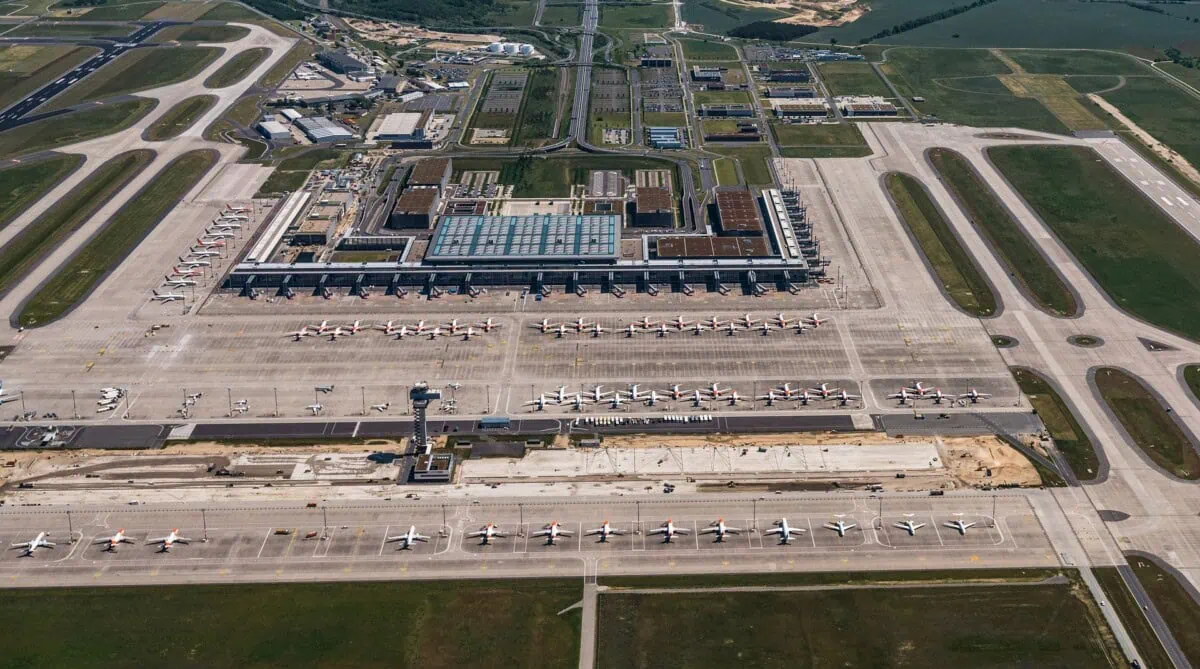
Berlin Brandenburg Airport, generally shortened to BER, opened on 31 October 2020 after a construction process that ran well over a decade behind its original schedule. It replaced Tegel Airport and the old Schönefeld Airport almost immediately, with both closing within days of BER taking over.
The new airport stands on a site right next to the former Schönefeld terminal, technically within the state of Brandenburg rather than Berlin itself. That is where the “BER” name comes from, and it is why the airport is sometimes still referred to informally as Berlin-Schönefeld in older guides and signage.
Two terminals currently handle passengers. Terminal 1 is the large, U-shaped main building and takes the majority of scheduled airlines, while Terminal 2, which opened in March 2022, mainly serves low-cost carriers. The two sit close enough together that moving between them on foot takes only a few minutes.
The single most useful fact for planning any transfer is that BER has its own underground railway station built directly beneath Terminal 1 as part of the original design. Flughafen BER station spans six platforms across a 3.1-kilometre tunnel, and it hosts everything from S-Bahn services to regional and long-distance Deutsche Bahn trains, all within a short walk of Arrivals.
BER sits roughly 18 kilometres south-east of central Berlin, considerably further out than Tegel used to be. The trade-off for that distance is a genuinely well-integrated transport hub, rather than the ageing, rail-poor airport Berlin had to work with for decades.
For most visitors, that means the real decision is rarely whether to use public transport at all, but which of BER’s several rail, bus, taxi, and transfer options actually suits their particular trip. That is exactly what the rest of this guide sets out to answer.
Compare hotels and other places to stay in Berlin.
Check availabilityBrowse apartments, holiday homes and self-catering stays in Berlin.
View rentalsSee hotel prices from multiple booking sites in one search.
Compare ratesThe FEX Airport Express: The Fastest Way Into Berlin
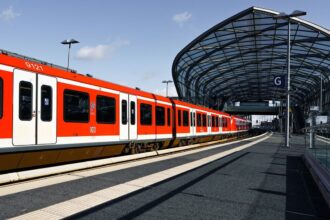
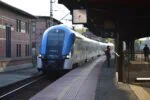
For most travellers, the FEX Flughafen-Express is the single best way to reach central Berlin from BER. It is a dedicated express train operated by DB Regio that runs on its own timetable rather than sharing a slow stopping pattern with local commuter services, and full timetables are published on BER Airport’s public transport page.
Trains depart from the airport station roughly every 15 minutes, operating from around 4am to 1am, which covers the vast majority of arriving flights without a long wait on the platform. Even a late-evening landing usually leaves enough time to catch one before the overnight gap.
The route runs directly to Berlin Hauptbahnhof, the city’s main station, calling at Berlin Südkreuz after around 14 minutes and Potsdamer Platz after around 19 minutes on the way, before reaching Hauptbahnhof in about 23 minutes. That makes it faster than every other public transport option covered in this guide.
A single VBB ABC ticket covers the ride and costs €5.00 (£4/$6) for a standard adult fare, with a reduced fare of €3.50 (£3/$4) available for children and some card holders. Tickets can be bought from machines on the platform, or directly through a phone. BER’s own guidance points to three apps that sell this fare, the VBB app, the BVG Tickets app, and the S-Bahn Berlin app, so there is no need to queue at a machine if your phone has signal on arrival. Our full guide to Berlin’s public transport network breaks down every ticket type and fare zone in more detail once you are in the city.
Keep an eye out for the letters FEX specifically on the departure board rather than boarding the first train marked S-Bahn, since the S-Bahn shares the same platform pattern but calls at every intermediate station the express skips. For a solo traveller heading straight to a hotel near Hauptbahnhof or Potsdamer Platz, this is normally the fastest and simplest way in.
The one drawback is luggage and stairs. Anyone with heavy suitcases and no interest in navigating platforms after a long flight may still prefer a taxi or private transfer, even though the FEX will almost always be quicker once traffic is accounted for.
S-Bahn to Berlin: The S9 and S85 Lines Explained
Alongside the express train, S-Bahn Berlin GmbH operates two suburban lines directly from the airport station, and they are the option most visitors end up using without really choosing to. Because S-Bahn trains are part of the same city network as the U-Bahn, trams, and buses, a single ticket works across all of them.
The S9 runs from BER through south-east Berlin towards Spandau in the west, calling at stops including Friedrichstraße and Hauptbahnhof along the way. It typically takes around 40 minutes to reach Friedrichstraße and closer to 50 minutes to reach Zoologischer Garten, considerably longer than the FEX but with far more stops en route.
The S85 is the newer of the two lines, introduced in the December 2025 timetable change as a replacement for the airport section of the old S45 route. It connects BER with the eastern S-Bahn ring and continues north towards Wittenau and Frohnau, which suits travellers with accommodation in those northern districts.
Both lines run every 20 minutes through the day, with the S9 continuing into the early hours on weekend nights at a reduced 30-minute frequency. Tickets are the same €5.00 (£4/$6) VBB ABC single fare used on the FEX, and one ticket is valid for 120 minutes with transfers between any of these services.
For anyone whose hotel sits directly on the S9 or S85 route, taking one of these instead of changing onto another line at Hauptbahnhof can genuinely save time despite the longer overall journey. Families and solo travellers heading to areas like Neukölln or the eastern Ringbahn stations tend to find the S-Bahn more direct than the FEX plus a connection.
The trade-off against the FEX is simply time: unless your destination sits directly on one of these lines, the express train to Hauptbahnhof followed by a short onward hop is usually still the quicker overall journey for most first-time visitors.
Express Buses: The X7, X71 and BER2 AirportShuttle
Buses are less useful than the rail options for most travellers heading straight into central Berlin, but they matter for two specific journeys. The X7 and X71 express buses, run by BVG, connect BER directly to U Rudow, the southern terminus of U-Bahn line U7.
Both routes depart every five to ten minutes through the day and reach U Rudow in around 16 minutes. From there, the U7 line runs deep into the city, making this a genuinely useful option for anyone staying near stops along that line, such as Neukölln or Rathaus Steglitz.
The second useful service is the BER2 AirportShuttle, operated by Busbetrieb Anger, which runs around 15 times a day between BER and Potsdam, calling at Kleinmachnow, Stahnsdorf, and Teltow along the way. The full run takes around an hour, and it exists specifically because Potsdam has no direct rail link to the airport.
Both services accept the same VBB ABC ticket used on the trains, priced at €5.00 (£4/$6) for a standard adult fare, and no separate booking or reservation is needed for either route. Passengers simply board and validate a ticket bought from a machine or app before travelling.
The X7 only reaches U Rudow rather than running into the centre itself, so anyone boarding it for a city-centre hotel still needs to change onto the U7 for a further 20 to 25 minutes to reach stations like Alexanderplatz. For most travellers with a straightforward city-centre hotel, the rail options above remain quicker.
Where the bus genuinely earns its place is for travellers whose destination sits directly on the U7 line, or for the specific Potsdam journey the BER2 was built to cover, since no train currently makes that connection at all.
Connecting Onward From Berlin Hauptbahnhof
Because the FEX Airport Express and both S-Bahn lines from BER terminate at or pass through Berlin Hauptbahnhof, the station works as a genuine gateway for anyone whose trip does not end in the capital. Long-distance ICE and IC/EC services leave from the same building used by airport arrivals, so connecting onward rarely means crossing the city at all, just changing trains one level down.
Tickets for these onward legs are bought separately from the VBB fare that covers the ride in from BER, and booking ahead online is usually cheaper than buying at the station on the day. Seat reservations are optional on most routes but worth adding for a Friday afternoon departure, when long-distance trains out of Berlin fill up fast. The table below covers some of the nearest major cities reachable directly from Hauptbahnhof, using typical Deutsche Bahn journey times.
| Mode | Destination | Journey Time | Direct? |
|---|---|---|---|
| Train (ICE) | Hamburg | About 1 hour 45 minutes | Yes |
| Train (ICE) | Leipzig | About 1 hour 12 minutes | Yes |
| Train (EC/IC) | Dresden | About 2 hours | Yes |
| Train (ICE) | Hanover | About 1 hour 33 minutes | Yes |
Catching a Taxi or Ride-Hailing Car From the Terminal
Skipping the train altogether and heading straight for a taxi is still the easiest way to get a door-to-door ride from BER. Official ranks sit outside Terminal 1 on Level E0, split into separate north and south queues that are clearly signposted from both terminals, with licensed cabs running around the clock.
According to fare estimates published by the city of Berlin.de, a typical taxi journey costs around €49 (£42/$57) to Alexanderplatz and around €52 (£45/$61) to Zoologischer Garten, with the actual fare depending on traffic and the exact drop-off point. Journey times generally run between 30 and 45 minutes, though congestion on the A113 and A100 can extend that noticeably at peak times.
Ride-hailing apps are also well established at BER. The airport has a dedicated ride-app pick-up zone separate from the taxi rank, used by services including Uber, Bolt, and FreeNow, and drivers typically wait in a marked area a short walk from Arrivals rather than directly outside the doors.
Anyone who would rather phone ahead than queue at the rank can also book through one of Berlin’s citywide taxi dispatch firms, which cover pickups at BER as well as anywhere else in the city. Taxi Funk Berlin, Würfelfunk, and City Funk are three of the longest-established, and all three run their own booking lines and apps rather than relying on the rank alone.
For groups of three or four travelling together, a taxi can work out cheaper per person than buying several separate VBB tickets, particularly once luggage and the walk to the platform are factored in. Accessible vehicles, including those fitted for wheelchairs and with child seats, can be requested at the taxi rank through on-site staff.
Heading straight for the taxi rank out of habit rarely pays off for a solo traveller with light luggage; once the walk to the car and the drive itself are added up, the FEX will almost always beat a taxi into the centre on a like-for-like comparison. Late-night arrivals after the S-Bahn and FEX have thinned out are really where taxis and ride-hailing earn their keep.
Overall, a taxi or ride-hailing app makes the most sense for late arrivals, families with heavy luggage, or anyone travelling to a destination that is awkward to reach by rail, while the train remains the better choice for almost everyone else.
Booking a Private Driver Before You Land
A pre-booked private transfer suits anyone who would rather settle the ride into town before the outbound flight even boards, instead of queuing at a rank after landing. Most operators send a named driver into the arrivals hall holding a board with the passenger’s name, so there is nothing left to negotiate once the doors to Arrivals open.
Because the price is agreed before travel, there is no surprise if traffic is heavier than expected on the A113 or A100, and no awkward conversation about a meter running during a long queue at the taxi rank. Fixed-price private transfers to central Berlin typically start from around €58 (£50/$68) for a standard car, with larger vehicles and further destinations costing more.
Journey times are broadly similar to a taxi, usually around 30 to 45 minutes depending on traffic and the exact drop-off address. The real advantage is not speed but certainty: families, business travellers, and anyone arriving with a lot of luggage tend to find the guaranteed pickup point and fixed fare worth the extra cost over a standard taxi.
Most operators also offer larger vehicles for groups, and some can arrange transfers to destinations well beyond central Berlin, including Potsdam or towns further into Brandenburg, which is useful for travellers who are not simply heading to a city-centre hotel.
A private transfer is particularly worth considering for very early departures or very late arrivals, when public transport frequency drops and a taxi rank may have a longer queue than usual. Booking in advance also avoids any risk of struggling to find a taxi during a genuinely busy period at the airport, such as a big public holiday weekend.
For most solo travellers on a budget, the train remains cheaper and often just as fast, but for anyone prioritising a stress-free, predictable start or end to a trip, a private transfer is worth the extra cost over a standard taxi.

Book Your Berlin Airport Transfer with Welcome Pickups
Arriving in Berlin? You can arrange your airport transfer with Welcome Pickups before you travel, so your driver is ready when your flight arrives.
Pre-booking can be especially convenient after a late flight or when visiting Berlin for the first time, giving you a direct journey from the airport to your accommodation.
Compare transfer options for Berlin. You can also check another transfer provider before booking.
Compare routes and fares for your journey to Berlin.
Compare flightsBrowse Airalo eSIM options for convenient travel data.
Check eSIMsHave a private airport pickup arranged before you travel.
Book a transferRenting a Car for Trips Beyond the City
Anyone planning to see more of Brandenburg or the wider region will find hiring a car at BER straightforward. Avis, Budget, Hertz, SIXT, Europcar, and Enterprise all keep service desks together in Terminal 1 near Arrivals 2 on level E0, so comparing counters in person takes only a few minutes.
After collecting the keys, the rental car park sits just a short walk from the terminal, so there is no shuttle bus or long transfer needed to reach the vehicle. Rates vary considerably by season, vehicle class, and how far in advance a booking is made, so it is worth comparing desks rather than assuming any one company is cheapest on a given day.
A hire car is most useful for reaching destinations that are awkward by rail, such as smaller towns around Brandenburg, the Spreewald biosphere reserve, or a wider road trip through eastern Germany. It also suits families travelling with a lot of luggage who would rather load a boot once than manage stairs and platforms.
Inside Berlin itself, a car is rarely the best choice. The city has an extensive S-Bahn, U-Bahn, tram, and bus network, parking in the centre can be expensive and hard to find, and several central districts have restricted or metered parking that catches out visitors unfamiliar with the signage.
Hiring a car purely to reach the city centre and then leaving it parked outside a hotel for the whole stay rarely makes sense; for that single journey, the train is both cheaper and less stressful, and the car ends up as a sunk cost rather than a convenience.
The travellers who benefit most from car hire at BER are those planning multi-stop trips around Brandenburg and beyond, rather than anyone whose plans are limited to Berlin’s well-connected centre.
Compare Car Hire Prices in Berlin
If you are planning to explore beyond Berlin, hiring a car can give you much more flexibility over where you go and how long you spend there.
Compare prices through Discover Cars and EconomyBookings to check vehicles, rental conditions and offers from multiple car hire companies before you book.
Getting There by Road, Drop-Offs and Long-Stay Parking
Drivers reach BER via the A113, which threads south-east out of the city and links to the A100 Stadtring in about 15 minutes or the Berlin ring road (A10) in roughly 10 minutes heading south. Anyone being dropped off, collecting a hire car, or arriving in their own vehicle will find the signage from all three approaches clear and easy to follow.
From the A113 junction signed “Flughafen Berlin Brandenburg,” the drive into the centre typically takes around 30 to 45 minutes depending on the time of day, with rush-hour traffic on the A100 city motorway being the main variable. Outside peak hours, the journey can be noticeably quicker.
Short drop-offs are free for up to ten minutes at the terminal kerbside, which covers most passenger set-downs without needing to enter a car park. Anyone staying longer, whether to help with luggage or wait for a delayed arrival, needs to use one of the paid car parks instead.
BER offers several multi-storey and open-air car parks, including P1, P2, P3, and P8, along with valet and premium options for travellers who want their car parked and retrieved for them. Rates vary by duration and proximity to the terminal, so comparing the short-stay and long-stay options in advance is worth the five minutes it takes.
Wheelchair-accessible parking bays sit close to the terminal doors, and a fuel station on airport grounds makes it easy to return a hire car with a full tank before dropping off the keys, which most rental agreements require.
Unless a road trip is genuinely on the itinerary, driving only really pays off for the drop-off or the collection. The rail options covered earlier in this guide will beat hunting for a parking space almost every time once you are actually in Berlin.
Matching the Right Transfer to Your Trip
Destination, luggage, budget and group size all factor into the right call here, though Berlin’s excellent rail links mean most visitors land on an easy answer once those four things are settled.
For solo travellers or couples heading to a hotel near Hauptbahnhof, Potsdamer Platz, or Alexanderplatz, the FEX Airport Express is almost always the right call. It is fast, frequent, and considerably cheaper than a taxi, and a real door-to-door estimate including the walk from Arrivals and a short onward tram or bus is usually somewhere around 35 to 45 minutes.
If your accommodation sits directly on the S9 or S85 line, or along the U7 via the X7 bus to U Rudow, taking that route directly can beat changing at Hauptbahnhof, even though the headline journey time looks longer on paper.
Families, late-night arrivals, and anyone carrying substantial luggage should lean towards a taxi or a pre-booked private transfer. The private transfer costs a little more but removes the uncertainty of a queue at the rank, which matters more than the price difference for many travellers after a long-haul flight.
Travellers planning to explore Brandenburg or take a wider road trip through eastern Germany should consider car hire, but should also be honest about whether they will actually use the car once they reach Berlin’s well-connected centre.
As a general rule, default to the FEX or S-Bahn with light luggage and a station-friendly route, save taxis and private transfers for late arrivals, groups, and heavy bags, and only add a hire car once the trip is genuinely leaving Berlin behind. With BER handling the whole city’s air traffic from a single purpose-built hub, there is no second airport to double-check before booking, which is one less variable than travellers face almost anywhere else in Germany.

Rupert’s Handy Travel Tips
Flying into Berlin Brandenburg Airport? Rupert has a few tips that can save both time and money:
- Look for FEX, not just any S-Bahn sign: the dedicated Airport Express is faster than the S9 or S85 into the centre, so check the departure board carefully.
- Buy an ABC ticket, not an AB ticket: BER sits in tariff zone C, so a standard Berlin AB ticket will not cover the ride out of the airport.
- Use the ride-app pick-up zone for Uber and Bolt: it is separate from the taxi rank, so head there rather than waiting at the taxi queue.
- Book a private transfer for very early or late flights: train frequency drops overnight, and a pre-booked driver avoids any risk of a long taxi queue.
- Only hire a car if you are leaving Berlin: the city’s own transport network is excellent, and parking in the centre is expensive and often restricted.
Want to meet the reindeer behind our travel tips? Find out more in our page Who is Rupert?.




Frequently Asked Questions About Berlin Airport Transfers
What is the fastest way to get from BER to central Berlin?
The FEX Airport Express is the fastest option, reaching Berlin Hauptbahnhof in around 23 minutes.
Which S-Bahn lines serve BER Airport?
BER is served by the S9 and S85 lines, both running every 20 minutes into central Berlin.
How far is BER from central Berlin?
Berlin Brandenburg Airport is located approximately 18 kilometres south-east of the city centre.
What ticket do I need for the train from BER?
You need a VBB ABC ticket, priced at €5.00 (£4/$6) for a standard adult fare, since the airport sits in tariff zone C.
Are taxis available at BER Airport?
Yes. Official taxi ranks operate around the clock outside Terminal 1 on Level E0, with fares to the centre typically around €49–52 (£42–45/$57–61).
Is Uber available at BER Airport?
Yes. Uber, Bolt, and FreeNow all operate from a dedicated ride-app pick-up zone separate from the taxi rank.
Can I get a bus from BER to Potsdam?
Yes. The BER2 AirportShuttle runs around 15 times a day between BER and Potsdam, taking roughly an hour.
Is it worth hiring a car at BER?
Only if you are travelling beyond Berlin itself. Within the city, the S-Bahn, U-Bahn, and bus network are usually faster and cheaper than driving.
Further Reading & Related Guides
Once you have made it into the city, our Best Things to Do in Berlin guide rounds up the sights worth prioritising, while our Best Day Trips from Berlin guide covers Potsdam, the Spreewald and beyond for anyone staying longer than a couple of days. Football fans landing before a match should also see our How to Get to the Stadium in Berlin guide, which covers reaching both Hertha BSC’s Olympiastadion and Union Berlin’s Alte Försterei.
Landing in the run-up to Christmas? Our Berlin Christmas Markets guide rounds up Gendarmenmarkt, Charlottenburg Palace and the rest of the city’s festive season, while our Berlin Hop-On Hop-Off Bus guide compares the open-top bus routes worth considering once you have settled in.
If you are planning onward rail travel once you land, our German Rail Tickets Explained guide breaks down the Deutschland-Ticket and regional fares, while our Interrail Germany Pass Guide explains when a country-specific pass beats buying tickets individually.