Reviewed by our editorial team Published
Discover Capri
Capri is the glamorous island at the mouth of the Bay of Naples, a knot of limestone cliffs, clifftop gardens and whitewashed lanes that has drawn wealthy visitors since Roman times. Emperor Tiberius ruled from here, and the island has never quite lost its taste for the high life.
Two main towns sit at either end of a ridge running the length of the island: Capri town, close to the main port and famous for its tiny, café-lined piazzetta, and the quieter, higher Anacapri, home to the island’s best viewpoint and a more local feel.
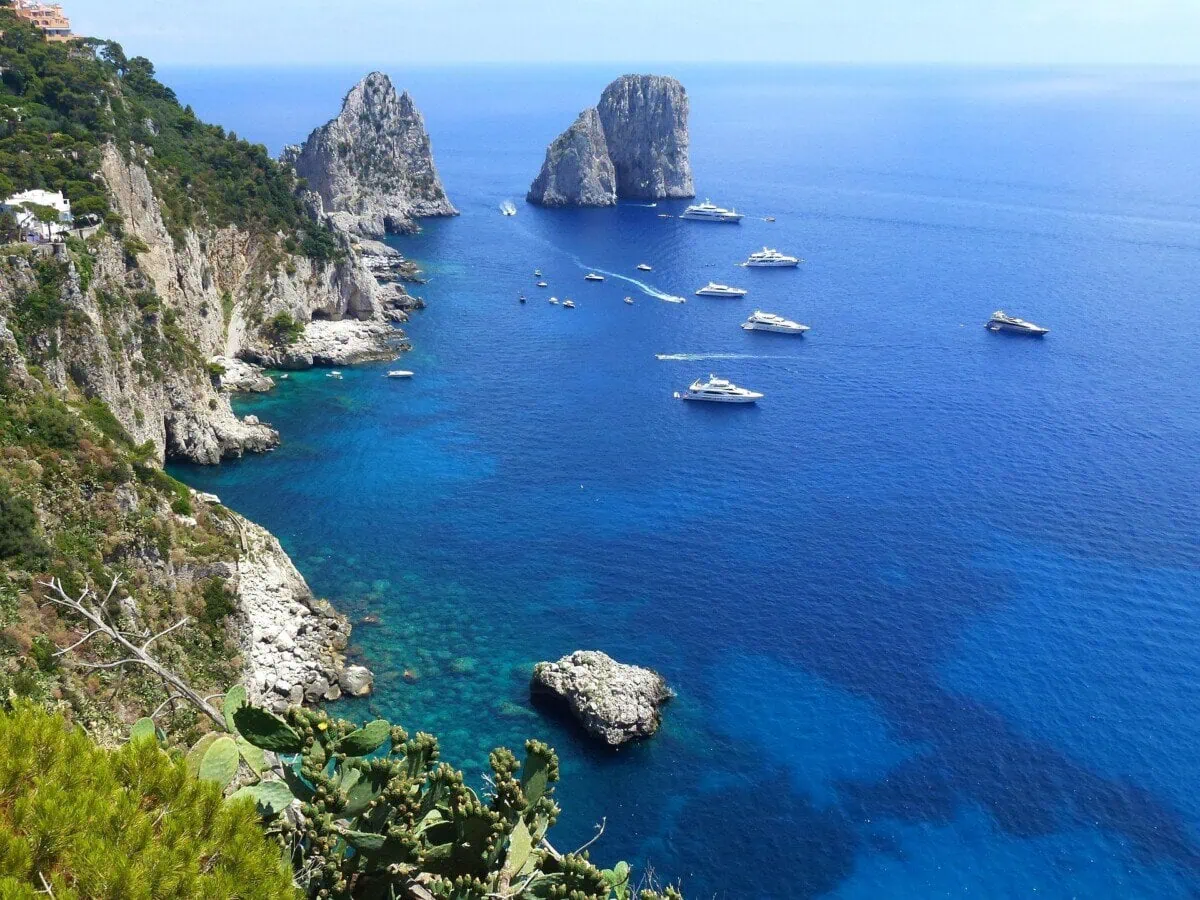
The island’s biggest draw remains the Blue Grotto, a sea cave lit by an eerie electric-blue glow, though Capri’s rocky coastline offers plenty else besides, from the iconic Faraglioni sea stacks to clifftop gardens with views back towards Naples and the Amalfi Coast.
Capri is easily reached as a day trip from Naples or Sorrento, but the island empties out considerably once the afternoon ferries depart, and an overnight stay lets visitors see the piazzetta and coastline without the midday crush of day-trippers and cruise excursions.
This guide covers Capri’s essential sights, how to reach the Blue Grotto, getting to and around the island, and the best time of year to visit, along with practical notes for weighing a day trip against staying longer.
Capri Attractions at a Glance
A quick overview of the sights covered below, with the area of the island each one sits in, who it suits best, and roughly how long to set aside.
| Attraction | Area | Best For | Time Needed |
|---|---|---|---|
| Blue Grotto | North coast | Iconic sea cave, photos | 1.5-2 hours |
| Piazzetta | Capri town | People-watching, aperitivo | 1 hour |
| Gardens of Augustus & Via Krupp | Capri town | Clifftop views | 30-45 minutes |
| Faraglioni & Marina Piccola | South coast | Swimming, boat tours | 2-3 hours |
| Villa Jovis | Capri town (uphill) | Roman ruins, quiet | 2-3 hours |
| Arco Naturale & Pizzolungo Path | East coast | Free hiking, views | 1.5-2 hours |
| Anacapri & Monte Solaro | Anacapri | Panoramic views | Half day |
| Villa San Michele & Certosa | Anacapri / Capri town | Gardens, history | 1-2 hours |
| Punta Carena Lighthouse | Anacapri (west) | Sunset, swimming | 2-3 hours |
Which sights to prioritise depends heavily on whether a visit is a single day trip or an overnight stay, since the island empties out noticeably once the afternoon ferries leave. The sections below cover each attraction in turn, followed by practical notes on reaching and getting around Capri itself.
Best for two or three nights. The widest choice of rooms, with filters for free cancellation and included breakfast.
View staysBest for families, or any stay past about four nights. A kitchen and a washing machine start paying for themselves.
Browse rentalsBest as a last check before booking. Compares hotel rates across several sites in one search.
Compare ratesThe Blue Grotto
The Blue Grotto (Grotta Azzurra) is Capri’s most famous natural attraction, a sea cave on the north coast where sunlight passing through an underwater opening casts the water in an intense electric blue. Visitors transfer from a larger boat to small rowboats to enter through the low, narrow mouth.
A combined visit, covering the cave entrance and the rowboat fee, runs to around €31 (£27/$36) per person, while a roundtrip boat transfer from Marina Grande, excluding the grotto entry itself, starts from around €25 (£21/$29).
Access depends entirely on the sea: the cave’s opening is barely a metre tall, so the grotto closes without notice whenever swell or high water makes entry unsafe, with the decision typically made by boat operators each morning.
Visiting early, before tour groups arrive from Naples and Sorrento, gives both a shorter wait and calmer water. Building some flexibility into the day is worth it, since conditions can change the plan at short notice.
Beyond the Blue Grotto itself, Capri’s coastline holds several lesser-known sea caves worth a look on the same outing, including the Grotta Verde (Green Grotto) and Grotta Bianca (White Grotto) along the southern shore, each named for the way light reflects off the water inside. These rarely draw the same queues as the Blue Grotto, making them a worthwhile detour for anyone already out on the water.
A dedicated boat trip covering the Blue Grotto alongside these other coastal caves is the easiest way to see them all in a single outing, without arranging separate rowboat transfers at each stop.
Piazza Umberto I: The Piazzetta
Piazza Umberto I, universally known as the Piazzetta, is Capri town’s tiny, café-lined main square and its undisputed social hub, especially lively at aperitivo hour when visitors and islanders alike gather to see and be seen.
The square sits at the top of the funicular from Marina Grande, making it the natural first stop for most arrivals, and its surrounding lanes hold the island’s most exclusive boutiques alongside simpler gelaterias and bars.
Café prices here run considerably higher than elsewhere on the island, a fact locals openly acknowledge as the cost of the view and the people-watching rather than anything about the coffee itself.
An evening spent people-watching from one of the Piazzetta’s terraces, once the day-trip ferries have left, is one of the more quintessentially Capri experiences on the island.
The square is bordered by the Baroque Chiesa di Santo Stefano and the 17th-century Torre dell’Orologio, a clock tower whose tiled dome has become one of the most photographed backdrops on the island. Steps rising from the funicular station pass beneath the tower’s arch, making it the natural gateway into the Piazzetta for almost anyone arriving by sea.
The boutiques ringing the square have carried major Italian and international fashion labels since the mid-20th century, when Capri first became a magnet for European and American celebrities drawn by its glamour and seclusion. That reputation still shapes the Piazzetta today, from the price of an espresso to the crowd it draws each evening.
Gardens of Augustus and Via Krupp
A short walk from the Piazzetta, the Gardens of Augustus (Giardini di Augusto) are terraced clifftop gardens offering the island’s most photographed view, looking straight down over the switchback path of Via Krupp to the sea stacks beyond.
Via Krupp itself is a dramatic zigzagging path carved into the cliff face, linking the gardens down to Marina Piccola below. It is often closed for safety restoration work, so it is worth checking its current status before planning a walk down.
The gardens are a small, easily managed stop that rewards even a brief visit, particularly in the morning light when the colours of the sea and cliffs are at their most vivid.
Combined with a walk through the surrounding lanes, the gardens make a natural extension of a morning spent around the Piazzetta, before the midday heat sets in.
Entry to the gardens costs a modest €2.50 (£2/$3), with free admission for children up to 12, and the site stays open year-round with hours stretching into the evening through the summer months. Multiple terraces at different levels let visitors find a quieter spot away from the main viewing platform, particularly useful when cruise-day crowds fill the busiest section.
Via Krupp itself dates to 1900-1902, commissioned by the German industrialist Friedrich Alfred Krupp to link the Grand Hotel Quisisana with Marina Piccola below, where his research vessel lay at anchor. Rockfall risk has kept the path closed more often than open since 1976, so any current opening should be treated as a bonus rather than something to plan a visit around.

The Faraglioni and Marina Piccola
The Faraglioni are three iconic limestone sea stacks rising from the water off Capri’s southeast coast, best appreciated either from a clifftop viewpoint like the Gardens of Augustus or up close on a boat tour that can pass through the arch of the middle stack.
Below, Marina Piccola is the island’s main beach cove, with bathing platforms and restaurants set against views back up to the Faraglioni themselves. It is one of the better spots on Capri for a proper swim rather than just a photograph.
Boat tours around the Faraglioni are widely available from Marina Grande and Marina Piccola, ranging from shared group trips to private charters for a more flexible route around the island’s coastline.
Late afternoon light on the Faraglioni, seen from the water, is one of the more memorable ways to close out a day on Capri, particularly for anyone staying overnight rather than rushing for the last ferry.
The three stacks each carry their own name: Faraglione di Terra, still connected to the shore; Faraglione di Mezzo, the middle stack pierced by the arch boats pass through; and Faraglione di Fuori (also called Scopolo), the furthest from land and home to a rare blue lizard found nowhere else on Earth. Naturalists occasionally run short excursions focused on spotting the lizard, though most visitors are content simply admiring the rock formations from the water.
Villa Jovis: Tiberius’s Clifftop Retreat
Perched on the island’s northeast tip, Villa Jovis is the ruined remains of Emperor Tiberius’s largest villa, reached via a scenic, uphill walk from Capri town that takes in sweeping Bay of Naples views along the way.
Entry costs €6 (£5/$7) full price, with a reduced rate of €2 (£2/$2) for EU citizens aged 18 to 25, and free entry for anyone under 18. The site sees far fewer visitors than the Piazzetta or the Blue Grotto.
The walk up is the main effort involved, uphill and exposed to the sun, so an early start or comfortable shoes make a real difference to how enjoyable the visit feels.
For anyone interested in Capri’s Roman history beyond the island’s modern glamour, Villa Jovis is the single best stop, and its relative quiet is a welcome contrast to the crowds elsewhere.
The ruins spread across the villa’s original cistern system, private apartments and imperial reception rooms, with the clifftop known as the Salto di Tiberio (Tiberius’s Leap) marking the site’s most dramatic edge, a sheer drop once rumoured, almost certainly apocryphally, to be where the emperor had enemies thrown into the sea. A small chapel, built centuries after Tiberius’s reign, adds a further layer to the site’s long history.
Arco Naturale and the Pizzolungo Path
On the island’s eastern side, the Arco Naturale is a limestone arch roughly 18 metres high, carved by erosion from what was once the roof of a sea cave millions of years ago. It sits at the end of a walking path from Capri town, reached via Via Le Botteghe and Via Matermania in around 30 minutes on foot, passing lemon groves and a scattering of restaurants along the way.
The arch itself costs nothing to visit and is reachable only on foot, making it one of the better free things to do away from the boutiques and cafés of the Piazzetta. A steep flight of roughly 200 steps leads down from the arch to the Grotta di Matermania, a cave once used for ancient rituals, for travellers willing to add the climb back up.
Many visitors combine the arch with the Pizzolungo path, a scenic coastal route that continues on past clifftop viewpoints toward Belvedere di Tragara, with views back over the Faraglioni sea stacks along the way. The full loop from the Piazzetta and back takes around two hours at a comfortable pace, longer with stops for photos.
Sturdy shoes are worth packing for this walk in particular, since parts of the path are uneven and exposed to the sun with little shade. An early morning start avoids both the worst of the midday heat and the small crowds that build up once day-trip visitors arrive from the ferries.
Best for long or awkward journeys. Builds one itinerary out of separate flights.
View flightsBest for anyone whose home plan charges by the megabyte abroad. Pay a fixed price up front.
Check eSIMsBest after a long flight or a late landing. Price agreed before you travel, and no taxi queue.
Check transfersAnacapri and Monte Solaro
Anacapri, the island’s second town, sits higher up and feels noticeably quieter and more local than Capri town, with fewer boutiques and a slower pace worth the short bus ride to reach.
From Anacapri, a chairlift climbs to the summit of Monte Solaro, the island’s highest point at 589 metres, in around twelve to thirteen minutes, giving panoramic views over both Capri and the Amalfi and Sorrentine coasts. A one-way ticket costs €11 (£9/$13), or €14 (£12/$16) round trip.
The Monte Solaro chairlift is arguably Capri’s best value sight, offering views that rival anything on the island for a fraction of the cost of a Faraglioni boat tour.
Pairing Anacapri with the chairlift and Villa San Michele makes a natural half-day, distinct in feel from the busier Capri town and Piazzetta area lower down.
Anacapri’s own square, Piazza Vittoria, is the departure point for the chairlift and a quieter echo of Capri town’s Piazzetta, with its own cluster of cafés and boutiques at a noticeably calmer pace. Nearby, the Chiesa di San Michele is worth a quick stop for its hand-painted majolica tile floor depicting the Garden of Eden, viewed from a raised walkway built specifically so visitors do not walk across the artwork itself.
Villa San Michele and the Certosa
Villa San Michele, in Anacapri, was built in the early 1900s by the Swedish physician Axel Munthe atop Roman ruins, blending antiquities, gardens and sea views into one of the island’s most atmospheric sights.
Entry costs €12 (£10/$14) full price, with a reduced rate of €8 (£7/$9) for students and young visitors, and free entry for children aged 12 and under. The villa closes entirely in February and on Tuesdays from December to January.
Back in Capri town, the Certosa di San Giacomo is a fourteenth-century Carthusian monastery, now a museum and cultural venue with quiet cloisters and gardens, entry costing €10 (£9/$12).
Both sites offer a calmer, more reflective side of Capri, a useful counterpoint to the boutique-lined lanes and busy viewpoints that dominate most visitors’ itineraries.
Munthe’s memoir, The Story of San Michele, became an international bestseller after its publication in 1929, and it was this book that first drew many 20th-century visitors to the island long before mass tourism arrived. The villa’s collection includes genuine Roman marble fragments and a sphinx statue overlooking the sea, gathered by Munthe during decades spent on Capri as both a doctor and an amateur archaeologist.
The Certosa di San Giacomo has served variously as a monastery, a barracks and a school across its long history, and its cloisters remain one of the quietest corners of Capri town even in peak season. A small gallery inside hosts rotating art exhibitions, giving repeat visitors a reason to return beyond the building’s own architecture.
Punta Carena Lighthouse
On Anacapri’s western tip, Punta Carena Lighthouse is Capri’s second-largest lighthouse and one of the island’s best spots for watching the sunset, its red-and-white striped tower rising above a rocky headland facing straight out to open sea. A local bus from Anacapri’s Piazza Vittoria reaches the area in around 15 minutes for a standard €2.40 (£2/$3) fare.
The lighthouse building itself remains a working military site and is not open to visitors, but the surrounding rocks and small coves are freely accessible, with metal ladders bolted into the rock making it possible to swim directly off the point. A couple of simple bars and restaurants sit just back from the water, popular for an evening drink timed to the sunset.
The sea here can run rougher than Capri’s more sheltered coves, with real currents rather than the calm water of Marina Piccola, so it suits confident swimmers more than families with small children. Crowds build noticeably in the evening through summer, when the bus back to Anacapri can involve a short wait at peak times.
Because it faces due west with an open, unobstructed horizon, Punta Carena is generally reckoned the best sunset spot on the island, arguably even better than the Piazzetta’s terraces for the view itself if not the atmosphere. Anyone without a car should build the bus journey and a possible wait into the evening’s plans rather than treating it as a quick stop.

Getting to Capri
From Naples, standard ferries take around 80 minutes and cost €14 to €19 (£12-16/$16-22), while high-speed ferries and hydrofoils cut the crossing to around 50 to 60 minutes for €25 to €31 (£21-27/$29-36), run by operators including Caremar, SNAV and NLG.
From Sorrento, the fastest hydrofoils reach Capri in as little as 20 to 30 minutes, with standard high-speed services taking around 40 minutes; fares start from roughly €19 to €20 (£16-17/$22-23) one-way, with up to 40 daily crossings in high season.
Seasonal hydrofoil links also run from Positano and the Amalfi Coast, roughly Easter to October, though these are worth confirming directly with operators given they run less frequently than the Naples and Sorrento routes.
Fares generally exclude a small per-person port tax of around €5 (£4/$6), charged between April and October, and can carry additional fuel surcharges depending on the operator.
Most Naples departures leave from the Molo Beverello terminal in the historic centre, within walking distance of the Municipio metro stop, while a handful of slower or cargo-linked sailings use the Calata Porta di Massa terminal a short taxi ride further along the waterfront. Checking which pier a specific booking uses is worth doing in advance, since the two are not within easy walking distance of each other.
Naples vs Sorrento: Choosing Your Ferry Crossing
Most visitors reach Capri from either Naples or Sorrento, and the choice matters more than it might first appear. Naples offers by far the widest range of departures, with standard ferries and faster hydrofoils running throughout the day, making it the natural choice for anyone based in the city itself or flying into Naples airport.
Sorrento, by contrast, is the quicker crossing, with the fastest hydrofoils reaching Capri in as little as 20 to 30 minutes against Naples’s 50 to 80 minutes depending on the boat. For travellers staying along the Sorrentine Peninsula or the Amalfi Coast, Sorrento is almost always the more convenient port, cutting a meaningful chunk off a day trip’s travel time.
Cost differences between the two ports are modest once the port tax is added on, so the decision usually comes down to logistics rather than price. Anyone splitting time between Naples and the Amalfi Coast might find it easier to sail out from one port and back into the other, provided onward transport is arranged at the far end.
For a straightforward day trip with the shortest possible crossing, Sorrento wins on speed. For flexibility and frequency, particularly outside peak season, Naples offers more sailings to fall back on if an early boat is missed.
Getting Around and When to Visit
A funicular connects Marina Grande, the main port, to Capri town in around four minutes for €2.40 (£2/$3), running roughly every fifteen minutes, though it closes each January to March for maintenance, replaced by a bus.
Minibuses, suited to the island’s narrow roads, connect the main towns for €2.40 (£2/$3) a single ticket, with an all-day pass available for €7.20 (£6/$8). Distinctive open-top taxis offer a pricier but scenic alternative.
The best windows to visit are April to mid-June and early September to mid-October, when the weather is mild and crowds noticeably thinner than the July and August peak, when the port and marina fill with day-trippers and yachts alike.
Winter brings a far quieter, more authentic island, though most hotels, restaurants and attractions reduce hours or close entirely, so anyone visiting outside the main season should check opening times in advance.
Much of Capri town and Anacapri’s historic centre is closed to private cars entirely, with narrow lanes reserved for pedestrians, delivery carts and the island’s small electric vehicles. Porters known locally as facchini still carry luggage between the port and hotels for visitors without easy road access, a tradition that predates any motorised transport on the island.
Best for short city stops where being central matters more than the room. Dorms and private rooms both listed.
See hostelsBest if you have ever given up on a claim. AirHelp checks whether the flight qualifies and pursues it for you.
See the benefitsBest if your room is not ready yet. Left luggage booked in advance, so you are not hunting for a locker.
Check storageCapri as a Day Trip or an Overnight Stay
The single biggest decision facing anyone planning a Capri visit is whether to treat it as a day trip or to stay overnight. A day trip is by far the cheaper and simpler option, needing only a return ferry ticket and no hotel booking, and it is entirely workable for seeing the Blue Grotto, the Piazzetta and the Faraglioni in a single well-planned day.
The trade-off is crowding. Capri’s port, funicular and main sights fill up from mid-morning once the first ferries and cruise tenders arrive, and the Piazzetta in particular can feel more like a queue than a piazza by early afternoon in peak season.
Staying overnight changes the island considerably. Once the last afternoon ferries depart, the crowds thin dramatically, and an evening on the Piazzetta’s terraces or watching the Faraglioni from the water at sunset are genuinely different experiences from anything a day trip allows.
The obvious downside is cost, since Capri’s hotel prices run high even by Italian coastal standards, particularly in July and August. Anyone on a tight budget or short itinerary should not feel they are missing the island’s best side by sticking to a day trip, but travellers with the time and budget to spare will find an overnight stay shows Capri at its calmest and most atmospheric.
Avoiding the Worst of the Crowds
Crowding follows a fairly predictable pattern on Capri, driven largely by the timetable of ferries and cruise excursions from Naples and Sorrento. The Blue Grotto is the worst offender, with queues for the rowboat transfer regularly stretching well over an hour by late morning once tour groups arrive, and conditions rarely ease before the early afternoon lull.
Arriving at Marina Grande on one of the first boats of the day, ideally before 9:30am, is the most reliable way to beat both the Blue Grotto queue and the crush around the funicular up to Capri town. The Piazzetta follows a similar pattern, quiet in the early morning and again once day-trippers head for the last ferries home.
Seasonally, the shoulder months of April to mid-June and early September to mid-October bring noticeably thinner crowds than the July and August peak, when the port, marina and main viewpoints can feel genuinely overwhelmed. Villa Jovis and the Arco Naturale, both reached on foot, stay comparatively peaceful even in high season simply because fewer visitors make the walk.

Rupert’s Handy Travel Tips
Heading to Capri? Rupert has a few tips that can save both time and money:
- Check the Blue Grotto’s status before setting off: it closes without notice in rough seas, so build in some flexibility.
- Ride the Monte Solaro chairlift for the views: it’s one of the island’s best-value sights compared with a Faraglioni boat tour.
- Stay overnight if you can: Capri empties out considerably once the afternoon ferries leave, and the Piazzetta feels completely different.
- Check Via Krupp’s status first: the dramatic cliffside path is often closed for safety restoration work.
- Book Sorrento hydrofoils over Naples ferries if speed matters: the crossing can be as short as 20 minutes.
- Budget for the port tax: a small per-person charge applies April to October on top of the ferry fare.
Want to meet the reindeer behind our travel tips? Find out more in our page Who is Rupert?.



Frequently Asked Questions About Capri
Is Capri worth visiting as a day trip?
Yes, though staying overnight avoids the busiest midday crowds and lets you see the Piazzetta once the day-trippers have left.
How much does it cost to visit the Blue Grotto?
A combined cave entrance and rowboat fee runs to around €31 (£27/$36) per person, with roundtrip boat transfers from Marina Grande starting from about €25 (£21/$29).
What is the fastest way to reach Capri?
Hydrofoils from Sorrento are quickest, taking as little as 20 to 30 minutes, compared with around 50 to 80 minutes from Naples depending on the boat type.
Can the Blue Grotto close unexpectedly?
Yes. The cave’s low entrance means it closes without notice whenever swell or high water makes it unsafe to enter.
Do you need a car on Capri?
No. A funicular, minibuses and taxis cover the island, and much of the historic centre is pedestrian only.
When is the best time to visit Capri?
April to mid-June and early September to mid-October offer mild weather with far fewer crowds than the July and August peak.

Further Reading & Related Guides
Travelling via Sorrento? Our Things to Do in Sorrento guide covers Piazza Tasso and the lemon groves on the mainland, and our Sorrento Ferry Guide covers the short hydrofoil crossing in full, including operators, luggage rules and what happens when rough seas disrupt the timetable.
Basing yourself in Naples instead? Our Things to Do in Naples guide covers the city’s own castles, museums and pizzerias, while our Day Trips from Naples guide already weighs Capri against Pompeii and the Amalfi Coast for anyone with only a day or two to spare.
Planning the crossing itself or extending further along the coast? Our Naples Ferry Routes Guide explains every practical option to Capri and beyond, and our Things to Do on the Amalfi Coast guide covers the mainland stretch just south of the island for anyone splitting a longer trip between the two.