Reviewed by our editorial team Published
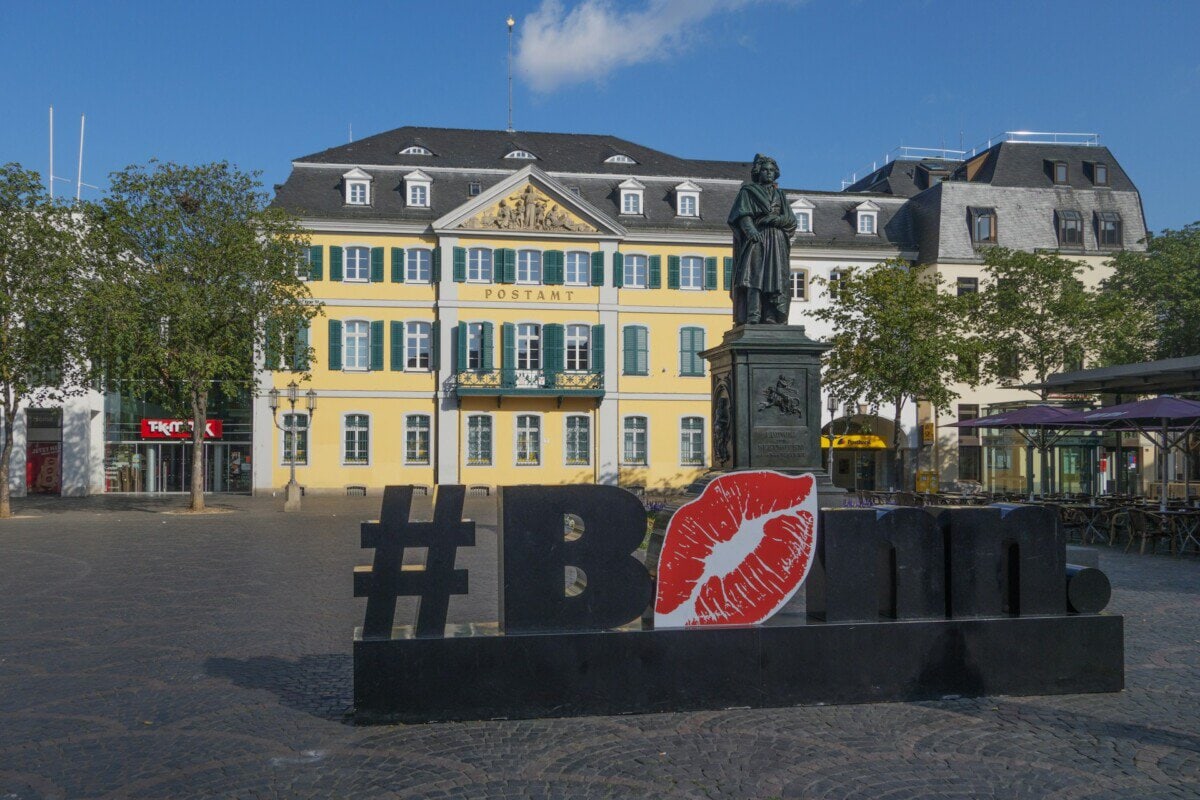
Bonn is a city that spent four decades running a country while officially insisting it wasn’t really the capital at all. From 1949 until 1990, this quiet university town on the Rhine served as the provisional seat of government for West Germany, a deliberately modest choice made specifically so nobody would mistake it for a permanent replacement for Berlin. That strange, self-effacing history still shapes Bonn today, layered on top of an even older claim to fame: this is the city where Ludwig van Beethoven was born in December 1770, and the composer’s presence is stitched into practically every corner of the old town.
The result is a city that rewards a properly curious visitor rather than one chasing a single headline sight. The Beethoven-Haus preserves the actual rooms where the composer grew up, the Museumsmeile strings together five serious museums along one tree-lined avenue, and the Bundeskunsthalle hosts some of Germany’s biggest touring art exhibitions inside a building whose blue rooftop cones have become a Bonn landmark in their own right. The Bonn Münster, one of the oldest churches in the country, anchors a compact old town built for walking rather than driving.
Bonn is also, unmistakably, a university city. The Rhine promenade near the Alter Zoll fills with students most evenings, Poppelsdorf Palace doubles as both a Baroque showpiece and a working botanical garden run by the University of Bonn, and the whole place carries a relaxed, unhurried energy that four decades as a federal capital never quite dented.
This guide works through the sights that make up a proper visit to Bonn, from the Beethoven-Haus and the Museum Mile to the food, shopping and family options that round out a trip. Bonn sits close enough to Cologne that the two cities are easily combined on the same trip, and a separate guide on this site covers Cologne’s own attractions in detail for anyone building a wider Rhineland itinerary.
| Section | What you’ll find |
| Beethoven-Haus | The composer’s birthplace, with the world’s largest collection of Beethoven manuscripts and instruments |
| Bonn’s Provisional Capital Era | How a modest university town ended up running West Germany for four decades |
| The Museumsmeile | Five major museums strung along one avenue, from history to art to science |
| Rhine Panorama Cruise | A round-trip boat ride to Königswinter, passing the government quarter and the Siebengebirge |
| Haus der Geschichte | Germany’s free national history museum, covering the country since 1945 |
| Bundeskunsthalle | Major touring art exhibitions under sixteen distinctive blue rooftop cones |
| Bonn Münster | A Romanesque basilica said to stand over the graves of Bonn’s patron saints |
| Hop-On Hop-Off Sightseeing Bus | A 24-hour ticket looping through the old town, government quarter and Bad Godesberg |
| Rhine Promenade and Alter Zoll | The city’s favourite riverside spot, backed by the University of Bonn’s main building |
| Poppelsdorf Palace and Botanical Garden | A Baroque palace with a university-run garden famous for its giant water lilies |
| The Markt and Old Town Hall | Bonn’s Rococo civic centrepiece, with its own flower and produce market |
| Food and Drink | Bönnsch beer and Rhenish classics like Himmel un Äd and Halve Hahn |
| Shopping | The pedestrian old town’s high street and independent shops around Sternstraße |
| Family-Friendly Bonn | Hands-on museums, parks and rainy day options for visiting with children |
Beethoven-Haus: Inside the Composer’s Birthplace
At Bonngasse 20, a narrow baroque townhouse sitting over medieval cellars is one of the few surviving 18th century buildings left in Bonn’s old town, and it happens to be the single most important address in the composer’s biography. Beethoven’s parents moved into rented rooms here in November 1767, and their son was born in the house in December 1770, baptised on the 17th of that month, a date still used as his official birthday since the exact day was never recorded.
The building now functions as the Beethoven-Haus Museum, and it holds the largest collection of Beethoven manuscripts, instruments and personal effects anywhere in the world, including several of his own pianos, hearing aids from his years of deafness, and a plaster life mask taken in 1812. The ground floor kitchen and utility rooms, first floor living spaces and attic bedrooms all survive close to their original layout, giving the visit a genuinely domestic feel rather than a purely academic one.
Exhibitions currently run Wednesday to Monday from 10am to 6pm, with Tuesdays reserved for pre-booked groups only. Standard admission is €15 (£12.90/$17.55) for adults and €10 (£8.60/$11.70) for children, though prices rise to €17 (£14.62/$19.89) and €12 (£10.32/$14.04) respectively during the museum’s Warhol exhibition running from September 2026 through April 2027, so it is worth checking the Beethoven-Haus official website before a visit for current pricing.
A modern extension beside the historic house adds a chamber music hall and a research library, and the museum’s own shop sells scores, recordings and souvenirs that go well beyond the usual gift shop fare. Allow at least an hour, longer for anyone with a genuine interest in the manuscripts on display, and combine the visit with the Beethoven monument on Münsterplatz a short walk away.
Bonn’s Forty Years as West Germany’s Provisional Capital
Bonn’s improbable stint as a national capital began with the Parliamentary Council, which met in the city through 1948 and 1949 to draft the Basic Law, West Germany’s constitution, promulgated on 23 May 1949. A Bundestag vote that November settled where the new government would actually sit, and Bonn narrowly beat Frankfurt am Main to the job, a result widely credited to intense lobbying by the country’s first chancellor, Konrad Adenauer, who lived nearby in Rhöndorf across the river.
The choice of a small, unassuming university town over a larger city was deliberate rather than accidental. Frankfurt already looked and functioned like a genuine capital, and many in the Bundestag worried that choosing it would signal, however unintentionally, that West Germany had abandoned any hope of reunifying with the east and restoring Berlin as the country’s proper seat of government. Bonn’s modesty was itself the point: this was meant to be, and was always officially called, a “provisional” capital.
For the next four decades, historians came to call the entire period the “Bonn Republic,” and the quiet Rhineland town filled with embassies, ministries and a purpose-built federal quarter along the river that still stands today. Bonn’s population and profile grew enormously without it ever quite shedding its small town character, a contrast that visitors still notice in streets that feel more provincial than a national capital typically does.
German reunification in 1990 reopened the question, and a close Bundestag vote in June 1991 decided the government would move to Berlin after all. The following Berlin/Bonn Act softened the blow considerably, guaranteeing Bonn six federal ministries and giving it the official title of Bundesstadt, or Federal City. The move to Berlin was largely complete by 1999, and Bonn reinvented itself again as a hub for United Nations bodies, hosting more UN institutions than any other German city today.
Best for two or three nights. The widest choice of rooms, with filters for free cancellation and included breakfast.
View staysBest for longer stays. Whole apartments and houses, so you are not eating out three times a day.
View rentalsBest if you have already picked a hotel. Checks the big booking sites for the same room and shows who is cheapest.
Check dealsThe Museumsmeile: Bonn’s Museum Mile
One direct legacy of Bonn’s capital era is the Museumsmeile, a stretch of Adenauerallee and Willy-Brandt-Allee where five major museums sit within easy walking distance of each other, all built or expanded with federal government money while Bonn still had ministries to fill. A dedicated U-Bahn stop, Heussallee/Museumsmeile, drops visitors right at the heart of the row, making it one of the most convenient museum clusters anywhere in Germany.
The two biggest draws, the Haus der Geschichte and the Bundeskunsthalle, sit almost directly opposite each other and both get their own detailed sections below. Alongside them, the Kunstmuseum Bonn holds the city’s own modern art collection, built around a substantial body of work by the Rhineland Expressionist August Macke, while the Deutsches Museum Bonn, a Bonn-specific offshoot of Munich’s famous science museum, focuses on German research and technology since 1945.
Two smaller specialist collections round out the mile. The Arithmeum, run by the University of Bonn, traces the history of calculating machines from mechanical adding devices through to modern computing, while the Akademisches Kunstmuseum holds a collection of classical antiquities and plaster casts used for teaching art history since the 19th century.
Most museums along the Museumsmeile are either free or charge modest admission, and their opening hours generally overlap enough that a determined visitor can realistically cover two or three in a single day. Cafes dotted along the avenue make it easy to break up a longer museum crawl without leaving the strip entirely.
A Rhine Panorama Cruise to Königswinter and the Siebengebirge
Bonn’s stretch of the Rhine also carries its own sightseeing cruise, a 100-minute round trip departing from the landing stages at Brassertufer, right by the Alter Zoll. The boats, MS Moby Dick and MS RheinTreue, run several times a day and loop south to Königswinter and back without a stop ashore.
The route passes some of the most photographed scenery on this section of the river. Passengers get a clear view of the former government quarter’s landmark towers, Langer Eugen and the Posttower, before the boat swings toward the Siebengebirge, where the ruined castle at Drachenfels and the wooded slopes of the Petersberg dominate the skyline.
Commentary runs in German and English throughout, pointing out landmarks along both banks, and a small onboard bar sells drinks and snacks for the journey. Adult tickets cost €21 (£18.06/$24.57), children aged six to thirteen pay €10 (£8.60/$11.70), and under-sixes travel free.
Because the cruise is a closed loop, there is no need to plan a separate return by train or bus, which makes it a straightforward add-on to a day already built around the Museumsmeile or the old town. Sailings typically depart at 11am, 1pm and 3pm, with an extra afternoon departure added during the summer season.
Haus der Geschichte: Germany’s Free National History Museum
The Haus der Geschichte, or House of History, is the federal museum dedicated to telling the story of Germany since 1945, and it does so through the permanent exhibition “You Are Part of History,” tracing the country’s path from occupation and division through to reunification and the present day. It is a genuinely ambitious undertaking for a national museum, covering both West and East German experience side by side rather than treating one as the default narrative.
The collection leans on real objects rather than text panels alone: a section of the Berlin Wall, Konrad Adenauer’s Mercedes limousine, a reconstructed East German supermarket with period packaging still on the shelves, and voting booths and campaign posters that trace West Germany’s democratic development decade by decade. Rotating temporary exhibitions add a further layer, with a current show examining Germany’s reckoning with the Nazi past running alongside the permanent galleries.
Entrance to the museum and all of its exhibitions is genuinely free of charge, one of relatively few national museums in Germany that charges nothing at all. Opening hours run Tuesday to Friday from 9am to 6pm and Saturday and Sunday from 10am to 6pm, with the museum closed on Mondays.
Given both the free admission and the scale of the permanent exhibition, it is worth allowing at least two hours for a proper visit rather than treating it as a quick stop between other sights. The Haus der Geschichte’s official website publishes full current details on the rotating exhibition programme for anyone planning a visit around a specific theme.
Bundeskunsthalle: World-Class Art With No Permanent Collection
The Bundeskunsthalle, formally the Art and Exhibition Hall of the Federal Republic of Germany, opened in 1992 to a design by the Austrian architect Gustav Peichl, and its rooftop is the single most recognisable feature of the whole Museumsmeile. Sixteen blue conical skylights, one for each of Germany’s federal states, punctuate the roofline, while a slightly leaning column near the entrance is popularly said to symbolise a reunification still, in some sense, unfinished.
Unusually for a museum of its scale, the Bundeskunsthalle holds no permanent collection of its own at all. Every exhibition is a temporary one, drawn from loans and international partnerships, which lets the building host genuinely major touring shows covering everything from ancient civilisations to modern and contemporary art, often on a scale few regional museums could otherwise attract.
Opening hours run Tuesday from 10am to 6pm, Wednesday from 10am to 9pm for anyone wanting a late evening visit, and Thursday to Sunday from 10am to 6pm, with the building closed on Mondays outside public holidays. Admission is charged per exhibition rather than at a fixed rate, so it is worth checking the current show and its ticket price on the museum’s own site before travelling.
Because the programme changes so completely between shows, it is genuinely worth checking what is currently on display before building a visit around it, since a blockbuster exhibition can sell out timed entry slots well in advance. Pairing a visit with the neighbouring Kunstmuseum Bonn makes for an easy, art-focused half day on the Museumsmeile.
Bonn Münster: A Romanesque Church Built Over Roman Martyrs
Bonn Münster, the city’s principal church, stands on a site with genuinely ancient roots. Tradition holds that it was built over the graves of Cassius and Florentius, Roman soldiers of the Theban Legion said to have been martyred here for refusing to renounce Christianity, and the pair remain Bonn’s patron saints, commemorated in the city’s own coat of arms to this day.
The church visible today was built mainly between the 11th and 13th centuries, a Romanesque basilica with a distinctive crossing tower and later Gothic additions, and it ranks among the oldest and architecturally significant churches anywhere in the Rhineland. A quiet Romanesque cloister adjoins the main building, offering a calmer counterpoint to the busy Münsterplatz just outside its doors.
Its status was formally recognised in the 20th century when the church was elevated to a minor basilica, a papal honour reserved for churches of particular historical and spiritual significance. Directly outside, the Beethoven Monument, unveiled in 1845 with financial backing that included a benefit concert organised by Franz Liszt, gives the square in front of the Münster its own musical connection to the city’s most famous son.
Entry to the Münster is free, and the church is generally open to visitors daily outside of services, though it is worth checking the schedule if a specific visit time matters. Thirty minutes is generally enough to take in the nave, the cloister and the statue outside without rushing.
Bonn’s 24-Hour Hop-On Hop-Off Sightseeing Bus
Bonn also runs its own hop-on hop-off bus tour, operated by Willms Touristik, looping through the city’s key districts on a single 24-hour ticket. The full circuit takes around two hours without getting off, calling at stops across the old town, the former government quarter and Bad Godesberg.
Recorded commentary plays in eight languages, including English, French, Spanish and Japanese, plus a simplified German track and even one in the local Bönnsch dialect. Buses run three times a day as standard, with extra weekend departures added between April and October.
Adult tickets cost €24 (£20.64/$28.08), dropping to €20.40 (£17.54/$23.87) for holders of the Bonn Regio Welcome Card, while children aged four to fourteen pay €5 (£4.30/$5.85). A registered companion travelling with a disability pass holder rides free.
The unlimited stop-and-start format makes the bus a practical way to reach sights spread further from the old town, particularly Bad Godesberg and the government quarter across the Rhine, without doubling back on foot. Because the ticket covers a full day, it pairs well with an early Beethoven-Haus visit followed by an afternoon loop out to the districts a walking tour would otherwise skip.
Tickets can be bought online in advance or directly from the driver when boarding, and the pass covers every stop on the route without needing to plan a fixed order. Anyone combining a Bonn stop with Cologne or Düsseldorf will find the loop a fast way to get an overview of the city before deciding which sights deserve a longer visit.
Best for finding routes the airlines do not sell as a single ticket. Combines carriers to bring the fare down.
Search flightsBest for short trips. Install the eSIM at home and arrive in Germany with working data, no shop queue.
Browse eSIMsBest after a long flight or a late landing. Price agreed before you travel, and no taxi queue.
Check transfersThe Rhine Promenade and the Alter Zoll
The Alter Zoll, literally the “old customs post,” is a former fortified bastion sitting directly on the riverbank at the edge of Bonn’s old town, and it has long since traded its defensive function for a much gentler one as the city’s favourite spot to watch the Rhine go by. A broad terrace here gives genuinely sweeping views along the river, and it fills most evenings with students, locals and visitors alike.
Immediately behind the Alter Zoll sits the Kurfürstliches Schloss, the former Electoral Palace, now the main building of the University of Bonn. The pairing of a historic bastion with an active university campus gives the whole riverside stretch a genuinely lived-in feel rather than that of a purely preserved monument, and student life spills naturally onto the promenade below.
Further south along the river, the Rheinaue park spreads across land developed for a national garden show in 1979 and still hosts open-air concerts and festivals through the summer months. From landing stages near the old town, Rhine cruises run south toward the Siebengebirge hills and the ruined castle at Drachenfels, a popular half-day excursion for anyone with time to spare.
Access to the promenade and the Alter Zoll terrace is free and unrestricted at any time of day, and sunset is generally regarded as the best moment to be there, when the light catches the river and the hills on the opposite bank.
Poppelsdorf Palace and Bonn’s Botanical Garden
A short walk south west of the old town along the chestnut-lined Poppelsdorfer Allee, Poppelsdorf Palace is Bonn’s other great Baroque set piece. Built between 1715 and 1753 for the prince-elector Joseph Clemens of Bavaria, with the French architect Robert de Cotte involved in its early design, the palace follows a distinctive horseshoe layout more commonly associated with grand French chateaux than German electoral residences.
Badly damaged during the Second World War and carefully rebuilt afterwards, the palace today serves an entirely practical purpose: it houses University of Bonn offices and a mineralogical museum, rather than functioning purely as a tourist attraction. The building’s grand courtyard and facade remain freely viewable regardless of whether the museum interior is on the itinerary.
Surrounding the palace, Bonn’s Botanical Garden, run by the university, is a genuine horticultural draw in its own right. Its greenhouses hold an impressive tropical and subtropical collection, including giant Victoria amazonica water lilies with leaves large enough to support a small child’s weight, and the garden occasionally makes local news when its rare titan arum plants bloom, drawing queues of visitors for the notoriously brief, notoriously pungent event.
The Botanical Garden charges modest admission for most visitors, with reduced and free rates available for students and children, and current opening hours vary seasonally, so it is worth checking ahead if a specific bloom or greenhouse is the goal. Combined with the palace itself, the site makes for an easy, unhurried hour or two away from the busier old town.
The Markt and Bonn’s Baroque Old Town Hall
Bonn’s central Markt square is dominated by the Altes Rathaus, a pink and gold Rococo building completed in 1737 and 1738 that ranks among the most photographed civic buildings in the Rhineland. Its curved double staircase and ornate balcony give it a theatrical quality that a more restrained town hall design would lack entirely, and the building still functions as a ceremonial civic space today.
That balcony has hosted genuinely significant moments in postwar history, since visiting heads of state addressed crowds from it during Bonn’s decades as federal capital, including President John F. Kennedy and Queen Elizabeth II on separate state visits. It is a detail worth pointing out to anyone standing in the square who assumes the building is purely decorative.
The Markt itself hosts a lively flower and produce market on regular weekdays, adding genuine everyday local life to the square’s grander backdrop, and the surrounding pedestrianised lanes lead naturally toward the Münster and the wider old town. The relocated medieval Sterntor gate, a fragment of Bonn’s original city fortifications, stands a short walk away as a quieter historical footnote.
Visiting the Markt costs nothing and requires no set hours, and it is arguably at its liveliest on market mornings or during the run-up to Christmas, when a seasonal market fills the square around the Münster nearby.
Food and Drink: Bönnsch Beer and Rhenish Classics
Bonn has its own distinct local beer, and it is a point of genuine civic pride that it isn’t Kölsch, the pale top-fermented style associated with neighbouring Cologne. Bönnsch is Bonn’s answer, a similarly top-fermented, unfiltered beer brewed by a small number of local breweries, most notably the Bönnsch Brauhaus in the old town, and ordering one rather than a Kölsch is a small but genuine way to signal familiarity with the city.
On the food side, Bonn’s menus lean on the same hearty Rhenish cuisine found across the wider region, including Himmel un Ääd, a comforting plate of mashed potato and apple sauce served with fried blood sausage and onions, and Halve Hahn, confusingly not chicken at all but a rye bread roll topped with mature Gouda, mustard and onion.
The University of Bonn‘s large student population gives the city’s cafe and bar scene a noticeably younger, more casual energy than some equivalent German cities, and the streets around the old town and the Rhine promenade hold a dense mix of traditional Brauhäuser, riverside beer gardens and student-friendly cafes rarely found far outside a university city.
Booking ahead for dinner at a well-known traditional restaurant is sensible on weekends, though Bonn’s compact centre means walking between several options in search of a table rarely takes more than a few minutes.
Shopping in Bonn’s Pedestrian Old Town
Bonn’s main shopping streets, particularly Sternstraße and Remigiusstraße, radiate out from the Markt and Münsterplatz, holding a fairly standard mix of high street chains alongside a genuine density of independent shops that has thinned out in many other German city centres but held on here.
The narrow side streets behind the main pedestrian zone are worth a dedicated wander for anyone after something more distinctive, since a number of small boutiques, bookshops and specialist food shops have set up away from the busiest thoroughfares. Given the university’s presence, secondhand bookshops and record stores are a genuine feature of the city’s retail mix rather than a rarity.
The flower and produce market on the Markt runs on regular weekdays, and a seasonal Christmas market fills the streets around the Münster and Münsterplatz each winter, adding festive stalls selling mulled wine and local crafts to the usual shopping mix.
Saturday remains the busiest shopping day, in keeping with the rest of Germany, and the large majority of shops close entirely on Sundays, so a dedicated shopping morning is best built into a weekday or Saturday itinerary rather than assumed to be available every day of a stay.
Family-Friendly Bonn and Rainy Day Options
Bonn handles a family visit well, largely because several of its biggest attractions already lean toward hands-on rather than purely look-and-read exhibits. The Deutsches Museum Bonn on the Museumsmeile focuses on interactive science and technology displays that tend to hold children’s attention far better than static glass cases, making it a reliable anchor for a family day.
The Haus der Geschichte‘s free admission and object-heavy displays, including a reconstructed East German shop and sections of the Berlin Wall, work surprisingly well for older children and teenagers, giving them something physical and visual to explore rather than lengthy text panels. The Bundeskunsthalle also runs workshops and family-oriented programming alongside its major exhibitions, worth checking before a visit.
For outdoor time, the Rheinaue park offers wide open lawns, playgrounds and a lake, popular with local families on weekends, while the Botanical Garden at Poppelsdorf Palace gives younger children something genuinely different to look at, particularly the giant water lilies and the greenhouse collections.
For a wet afternoon, the museums clustered along the Museumsmeile all work as unhurried indoor visits regardless of the weather, and between the science museum, the history museum and the covered galleries of the Bundeskunsthalle, a family trip or a rainy day in Bonn rarely needs to be a wasted one.

Rupert’s Handy Travel Tips
Planning a visit to Bonn? Rupert has a few tips worth knowing before you go:
- Skip Tuesday for the Beethoven-Haus: exhibitions are closed to general visitors that day, reserved for pre-booked groups only, so plan around a Wednesday to Monday visit instead.
- Check current Bundeskunsthalle prices before you go: since it holds no permanent collection, admission is set per exhibition rather than at a fixed rate, and blockbuster shows can sell out timed slots.
- Order a Bönnsch, not a Kölsch: Bonn has its own distinct local beer style, and asking for it rather than Cologne’s Kölsch is a small way to show you know the city.
- Use the Heussallee/Museumsmeile U-Bahn stop: it drops you right at the heart of the museum row, making it easy to combine two or three museums in a single day.
- Head to the Alter Zoll around sunset: the riverside terrace is at its liveliest and most photogenic in the evening, when students and locals gather to watch the light over the Rhine.
- Build in time for the Haus der Geschichte: it’s free, but the permanent exhibition is genuinely large, so treat it as a two hour stop rather than a quick one.
Want to meet the reindeer behind our travel tips? Find out more in our page Who is Rupert?.


Best for solo travellers and anyone watching the budget. Dorm beds and private rooms in the same search.
Browse hostelsBest if you have ever given up on a claim. AirHelp checks whether the flight qualifies and pursues it for you.
See the benefitsBest for a day with a bag and nowhere to put it. Find a storage point near where you already are.
View storageFrequently Asked Questions About Things to Do in Bonn
Why was Bonn chosen as West Germany’s capital?
A close Bundestag vote in November 1949 selected Bonn over Frankfurt, partly through lobbying by Chancellor Konrad Adenauer, and partly because its modest, unassuming size deliberately avoided suggesting a permanent replacement for Berlin.
Is Bonn still an important German city today?
Yes. Following the Berlin/Bonn Act, Bonn kept six federal ministries and holds official Bundesstadt status, and it now hosts more United Nations institutions than any other city in Germany.
How much does it cost to visit the Beethoven-Haus?
Standard admission is €15 (£12.90/$17.55) for adults and €10 (£8.60/$11.70) for children, though prices rise slightly during special exhibitions such as the museum’s current Warhol show.
Is the Haus der Geschichte free to visit?
Yes, entrance to the museum and all of its exhibitions is completely free, with opening hours running Tuesday to Friday from 9am to 6pm and weekends from 10am to 6pm.
What is Bonn Münster known for?
The Romanesque church is said to stand over the graves of Cassius and Florentius, Roman martyrs and Bonn’s patron saints, and its status as a minor basilica reflects its historical and architectural significance.
What local beer should I try in Bonn?
Bönnsch is Bonn’s own top-fermented beer style, distinct from Cologne’s Kölsch, and it is best tried at a traditional Brauhaus in the old town.
Is Bonn good for a family trip or a rainy day?
Yes. The interactive Deutsches Museum Bonn, the free Haus der Geschichte, and the Botanical Garden’s greenhouses all work well regardless of the weather.
How far is Bonn from Cologne?
Bonn sits a short regional train ride from Cologne, making the two cities easy to combine into a single wider Rhineland trip.
Further Reading & Related Guides
Bonn’s closest big neighbour is an obvious next stop, and our Best Things to Do in Cologne guide covers the cathedral city just up the Rhine in full detail. Anyone building a wider North Rhine-Westphalia itinerary will also find our Best Things to Do in Düsseldorf and Things to Do in Dortmund guides useful companions elsewhere in the region.
If onward rail travel is part of the plan, our German Rail Tickets Explained guide breaks down the Deutschland-Ticket and regional fares that cover journeys between Bonn, Cologne and Düsseldorf, while our Interrail Germany Pass Guide explains when a country-specific pass beats buying tickets individually for a longer trip around the wider Rhineland.