Reviewed by our editorial team Published
Discover the Best Things to Do in Düsseldorf
Düsseldorf rarely gets top billing next to Berlin, Munich or Cologne, and that is exactly what makes it worth a proper look. This is a city that runs on contrast: a Gothic Old Town packed with smoke-filled Altbier pubs sits a short walk from Germany’s most exclusive shopping boulevard, and a Frank Gehry-designed harbour district faces off against a medieval castle tower on the Rhine. Add in one of Europe’s largest Japanese communities, two major art museums holding genuine world-class collections, and a riverside promenade built for slow evening walks, and Düsseldorf turns out to have far more depth than its reputation as a business and trade-fair city suggests.
Most of what matters in Düsseldorf sits within a compact, walkable core along the Rhine, so a first-time visitor can cover the essentials in a long weekend without ever needing a car. If you are flying in, our Düsseldorf Airport Transfers guide covers every route from the airport into the centre, and once you have settled in it is well worth building a wider trip around the city, since our Best Day Trips from Düsseldorf guide covers everywhere from Cologne to the Wuppertal Suspension Railway within an hour or so by train.
Düsseldorf Attractions at a Glance
| Attraction | Time to Allow | Best For |
|---|---|---|
| The Altstadt | Half a day, longer in the evening | Altbier pubs, historic streets and nightlife |
| Königsallee (the Kö) | 1 to 2 hours | Luxury shopping and elegant architecture |
| Rheinturm | 45 minutes to 1 hour | Panoramic city and Rhine views |
| MedienHafen | 1 to 2 hours | Modern architecture and photography |
| Kunstpalast and K21 | Half a day for both | Art lovers and museum fans |
| Rhine Promenade and river cruise | 2 to 3 hours | Relaxed sightseeing and river views |
| Burgplatz and the Schlossturm | 45 minutes to 1 hour | History and Rhine shipping heritage |
| Düsseldorf Christmas Markets | Half a day, seasonal (late November to December) | Festive atmosphere and mulled wine |
| Japanese Quarter | 1 to 2 hours | Culture, gardens and Japanese food |
| Hop-On Hop-Off Bus Tour | 90 minutes per loop, 24-hour ticket | First-time orientation and easy sightseeing |
| Free things to do | Flexible | Budget travellers and rainy days |
| Shopping Beyond the Kö | 1 to 2 hours | Mainstream and independent shopping away from the Kö |
| The Food Scene and Carlsplatz Market | 1 to 2 hours, longer for dinner | Market food, everyday lunch and Michelin-starred dining |
| Shows and Theatres | An evening | Opera, ballet, drama and big-stage musicals |
| Major and Annual Events | Half a day, seasonal | Rheinkirmes, Japan-Tag and Karneval, dates permitting |
| Things to Do in the Rain | Half a day | Zoo and aquarium, contemporary art, film history |
Best for a short trip. Compare rooms by neighbourhood, price and guest rating before you book.
Compare hotelsBest for longer stays. Whole apartments and houses, so you are not eating out three times a day.
View rentalsBest for double-checking. Runs the same Dusseldorf search across several booking sites so you are not leaving money behind.
Compare pricesThe Altstadt and Altbier Pub Culture
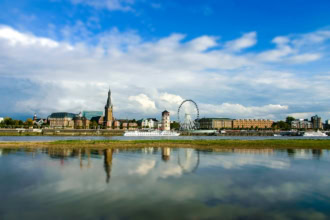
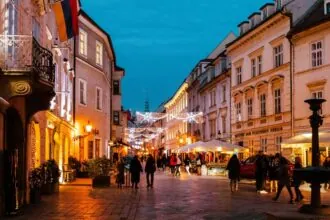
Düsseldorf’s Altstadt (Old Town) is where most visits genuinely begin and end, and it earns its nickname as “the longest bar in the world” honestly: this half a square kilometre of narrow lanes packs in around 260 pubs, bars and restaurants, more per square metre than almost anywhere else in Germany. It is not one continuous bar counter, despite the name, but rather a density of traditional brewery inns that has built up over roughly 350 years of the district acting as a genuine social melting pot for the whole city.
The drink to order here is Altbier, a dark, top-fermented style unique to Düsseldorf that gives the Old Town its identity in the same way Kölsch defines Cologne. Breweries like Uerige and Füchschen still brew it on site and serve it the traditional way, in small 0.2 litre glasses carried around on trays by waiters known locally as Köbes, who have a reputation for brusque but good-natured Rhineland service. Glasses keep coming until you place a beer mat on top of yours, which is the accepted signal that you have had enough.
Beyond the drinking culture, the Altstadt is also where much of Düsseldorf’s genuine history survives. Gothic churches including St Lambertus, recognisable by its distinctively twisted spire, and the Kreuzherrenkirche sit among the pubs, and the whole district is compact enough to wander without a plan and still stumble across something worth stopping for.
Evenings here get lively, particularly on weekends, so if you want a quieter first look it is worth walking through in the late afternoon before the crowds build. Either way, the Altstadt connects directly onto the Rhine promenade and Burgplatz, so it naturally forms one continuous stretch of sightseeing rather than a separate detour.
The Königsallee: Düsseldorf’s Kö
Just a few minutes’ walk from the Altstadt’s beer halls sits a completely different side of Düsseldorf. The Königsallee, universally known as the Kö, is a broad, tree-lined boulevard that has been a protected historical monument since 1994 and remains the city’s premier shopping address. A landscaped canal runs down the centre of the street, crossed by ornate bridges and lined with chestnut trees, which gives the whole boulevard a formal, almost Parisian feel that sets it apart from a typical high street.
The eastern side of the Kö is where the big international luxury names cluster, from established fashion houses to jewellers and flagship department stores, while the western side, closer to the Hofgarten park, tends to have a slightly calmer, more residential character. Even the street furniture was custom-designed for the location, down to the lamps, bollards and clocks, which is part of why it functions as a genuine sightseeing stop rather than just a place to shop.
You do not need a shopping budget to enjoy the Kö. Walking its full length, sitting by the canal, or simply admiring the architecture on either side is a pleasant, free way to spend an hour, and it links neatly with the nearby Kö-Bogen development, a striking modern shopping and office complex with a green, terraced facade that has become an architectural landmark in its own right.
In winter, part of the Königsallee also hosts one of the city’s Christmas markets, giving the boulevard a rather more festive atmosphere without losing its polished, upmarket character.
Shopping Beyond the Kö
The Königsallee gets all the attention, but Düsseldorf’s real everyday shopping happens a few streets over, in districts built for browsing rather than window-shopping at luxury flagships. These streets feel busier and less formal than the Kö’s chestnut-lined canal.
Schadowstraße runs north from the top of the Kö and is genuinely one of the busiest shopping streets in Germany, packed with mainstream names locals actually use day to day. Uniqlo, Peek and Cloppenburg and a large Galeria department store anchor a stretch that trades the Kö’s polish for volume and value.
Inside the Altstadt itself, Flinger Straße is the Old Town’s own shopping run, tucked between the pub-heavy lanes and the river. It has climbed into the city’s top shopping addresses in recent years on the back of independent boutiques rather than chains, giving it a different character to both the Kö and Schadowstraße.
At the top of the Kö, the Kö-Bogen complex is worth a dedicated stop for shoppers, not just a photo of its curved Daniel Libeskind facade. Inside sits a large Breuninger department store alongside an Apple Store and a Tesla showroom, under one glass and travertine roof that opened in 2013.
For the hip end of the spectrum, the streets around Ackerstraße in the Flingern district, a short tram ride from the centre, add concept stores and independent labels favoured by a younger, design-conscious crowd. It rounds out Düsseldorf’s shopping scene with something the Kö and Schadowstraße simply do not offer.
For a genuinely different experience to the Kö, Flinger Straße is the better use of an hour than Schadowstraße, which mostly duplicates chains found in any German city centre.
The Food Scene and Carlsplatz Market
Düsseldorf’s food scene runs on a genuine split between a daily market stall and a Michelin-starred kitchen, and both are worth building a visit around. It is a city that takes eating seriously at every price point, not just at the top end.
Carlsplatz, tucked into the edge of the Altstadt, is the city’s daily food market and has been described as its culinary heart. More than 60 stalls trade Monday to Saturday, selling everything from fresh fish, meat and cheese to exotic fruit and flowers, with a genuinely international lunch crowd gathering around midday for everything from Italian and Persian to Turkish and French food.
It is as much a social hub as a shopping stop. Office workers, tourists and long-time residents share the same handful of standing tables, and it is one of the easiest places in the city to put together a proper lunch without booking anywhere.
At the other end of the scale, Düsseldorf now holds nine Michelin stars across its restaurants, spread across three distinct worlds: established fine dining houses such as Im Schiffchen, an ambitious new generation of chefs, and a genuinely acclaimed run of Japanese kitchens including Nagaya, rooted in the city’s long-standing Japanese community.
That Japanese fine-dining strength is no accident. It grew out of the same community that built the Immermannstraße quarter, and it means a serious sushi or kaiseki dinner sits comfortably alongside Carlsplatz’s stalls and the Altstadt’s Altbier pubs as genuinely different ways to eat in the same city.
For a first visit, Carlsplatz is the one to prioritise: it costs almost nothing to sample several stalls at lunch, while a Michelin-starred table is only worth booking if an evening free and a bigger budget line up.
The Rheinturm and Views Over the City
At 240.5 metres, the Rheinturm (Rhine Tower) is Düsseldorf’s tallest structure and the easiest way to understand how the city fits together along its bend in the river. Built between 1979 and 1981 and still working as an active telecommunications tower, it is topped by a distinctive light installation called the Lichtzeitpegel, said to be the largest digital clock in the world, which uses rings of coloured lights running up the shaft to display the time in a 24 hour format.
The public observation deck sits 168 metres up and gives an uninterrupted panorama across the Altstadt, the Rhine, MedienHafen and, on a clear day, well into the Rhineland countryside beyond the city limits. Tickets currently cost around €13 (£11/$14) for adults and €8 (£7/$9) for children aged 6 to 13, with under sixes admitted free, and the deck is generally open daily from mid-morning until close to midnight.
The tower also houses a bar and restaurant space that operates in the evenings, so it is worth timing a visit for sunset if you want to watch the city’s lights come on over the river rather than only seeing it in daylight. Details and current opening times are best confirmed directly, since restaurant and bar hours run separately from the observation deck’s own schedule.
You can find the tower’s current ticket prices and opening hours on the official Rheinturm website before you go, since both can shift slightly around public holidays. The tower sits right at the southern edge of MedienHafen, so it makes sense to combine the two into a single stop rather than treating them as separate outings.
MedienHafen and Its Modern Architecture
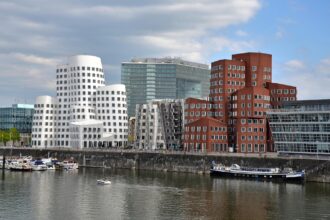
MedienHafen, or the Media Harbour, is the clearest sign of how thoroughly Düsseldorf has reinvented itself. What was once a working industrial dock on the Rhine has been rebuilt over the last few decades into a striking district of glass, steel and brick office buildings, home to media and advertising companies, restaurants and waterside bars, all arranged around the original harbour basin.
The centrepiece is the Neuer Zollhof, three warped, silver and white office buildings designed by American architect Frank Gehry and completed in 1999. No two of the three buildings share the same facade, and their deliberately irregular, almost melting forms make them one of the most photographed pieces of contemporary architecture in Germany, let alone Düsseldorf.
Beyond the Gehry buildings, the whole harbour is worth a slow walk. Other notable structures include the WDR broadcasting building and a run of quirky, colourful office blocks along the quayside, and the district comes alive in the evenings when its restaurants and bars fill up with a genuinely local crowd rather than a purely touristy one.
MedienHafen sits an easy 15 to 20 minute walk south of the Altstadt along the Rhine promenade, or a short tram ride if you would rather save your legs, and pairs naturally with a Rheinturm visit since the tower stands right at the harbour’s edge.
Best for long or awkward journeys. Builds one itinerary out of separate flights.
View flightsBest if you want maps and messaging working the moment you switch your phone on.
See eSIM plansBest if you would rather not work out the transport on arrival. Book it now and forget it.
View transfersKunstpalast and K21: Düsseldorf’s Art Museums
Düsseldorf has a genuinely strong claim as one of Germany’s better art cities, built on a long history as home to the Düsseldorf Academy of Art, whose alumni include Joseph Beuys and Gerhard Richter. That legacy shows up most clearly across its museums, and the two most rewarding for a general visitor are the Kunstpalast and K21.
The Kunstpalast, near the Hofgarten park, holds a broad collection spanning old masters, glass art, photography and modern painting, and is generally open Tuesday to Sunday, with a late finish on Thursdays. Standard admission runs around €17 (£15/$19) for adults and €13 (£11/$14) concessions, with under 18s admitted free, and the museum runs a reduced-rate Wednesday afternoon slot at roughly €9 (£8/$10) that is worth timing a visit around if the full price feels steep.
Across town, K21 occupies the former Ständehaus, Düsseldorf’s 19th-century state parliament building, given a dramatic glass and steel dome during a 2001 renovation that flooded the old chamber with natural light. It focuses on contemporary art from the 1980s onward, with rotating international exhibitions alongside a strong permanent collection, and forms one part of the wider Kunstsammlung Nordrhein-Westfalen alongside its sister site K20.
Both museums are compact enough to see properly in two or three hours each, so a dedicated art day covering both, with a lunch stop at Pardo’s restaurant inside K21, makes a satisfying alternative to another lap of the Altstadt.
Shows and Theatres
An evening at the theatre gives Düsseldorf a completely different rhythm to an evening in the Altstadt, and the city has serious venues to fill it. Between opera, drama and big-stage musicals, there is a genuine night out here whatever the taste.
The Deutsche Oper am Rhein is the city’s opera company, performing at the Opernhaus Düsseldorf, a rebuilt 1875 house near the Hofgarten, and sharing its resources and its Ballett am Rhein dance company with a sister theatre in nearby Duisburg. It stages a broad, changing programme of opera and ballet drawn from a company that has run continuously since 1955.
For straight drama, the Düsseldorfer Schauspielhaus, known locally as D’haus, is North Rhine-Westphalia’s only state theatre and one of the most respected stages in the German-speaking world. Its distinctive white, curved 1960s building on Gustaf-Gründgens-Platz regularly attracts internationally recognised directors to a programme of serious contemporary and classic drama.
For something louder, the Capitol Theater, a converted 19th-century tram depot near the main station, is Düsseldorf’s largest theatre and the natural home for major touring musicals, comedy shows and family-friendly productions. Its industrial brick shell gives even a big commercial show an unusual, atmospheric setting.
Between the three, a visitor can move from grand opera to cutting-edge drama to a full-scale musical without leaving the city centre, and it is worth checking each venue’s own listings before booking, since casts and productions change through the season.
Visitors without German are better served by the Capitol Theater‘s big touring musicals or the physical spectacle of opera and ballet than the Schauspielhaus, whose drama depends entirely on the language.
The Rhine Riverside Promenade and a River Cruise
The Rheinuferpromenade runs along the river’s edge past the Altstadt, and it is arguably the single best free thing to do in Düsseldorf. The promenade only exists in its current, pedestrian-friendly form because the city buried a busy riverside road in a tunnel back in the early 1990s, freeing up the surface for a wide walkway lined with cafes, benches and steps down to the water.
Walking it end to end, from the Rheinkniebrücke bridge past Burgplatz and on toward MedienHafen, takes roughly 30 to 40 minutes at an easy pace, and it is a genuinely different experience by day, when the barges and pleasure boats pass, and after dark, when the Altstadt’s lights and the Rheinturm reflect off the water.
To see the city properly from the water, a short Rhine river cruise is worth building into a visit. Boats run from the promenade’s landing stage and typically offer a round-trip sightseeing cruise past the Altstadt, Rheinturm and MedienHafen lasting around an hour, alongside longer seasonal trips further along the river, with an onboard drink usually included in the ticket price.
Our dedicated Düsseldorf Rhine River Cruise guide covers the different routes, current prices and which sailing suits a short city visit best, so it is worth checking before you commit to a particular departure time.
Burgplatz and the Schlossturm
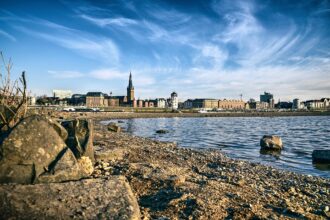
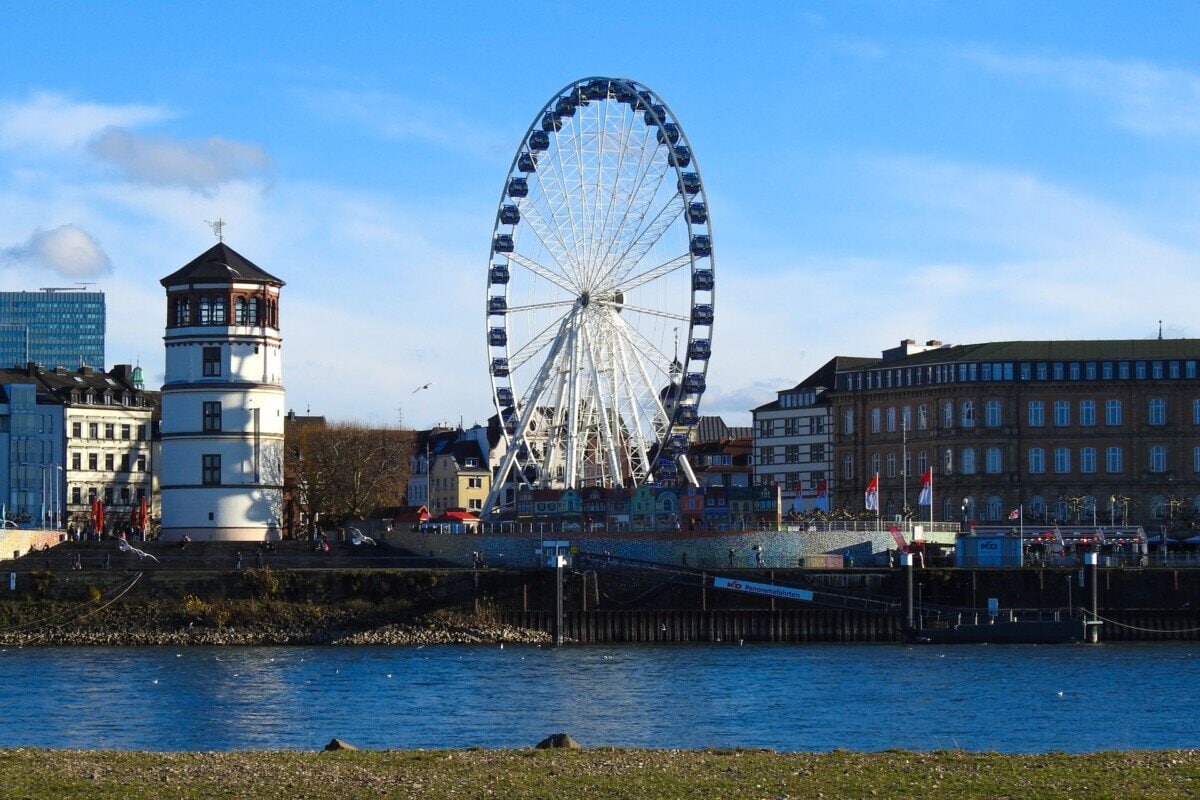
Right where the Altstadt meets the river sits Burgplatz, an open square that has been Düsseldorf’s civic heart since the city’s earliest days, and the last visible remnant of the electoral palace that once stood here before fire destroyed most of it in 1872. The square itself is a good spot to pause on a promenade walk, with wide river views and a scattering of market stalls at various points in the year.
The one surviving piece of the old palace is the Schlossturm, a squat medieval castle tower that now houses a small but genuinely interesting Maritime Museum (Schifffahrtmuseum), spread across seven floors from its old vaults up to the top of the tower. Exhibits cover the history of Rhine shipping through ship models, artefacts and interactive displays, and it is one of those small museums that rewards the twenty minutes it takes to climb through it.
Admission is around €5 (£4/$6) for adults, with a reduced rate of roughly €3 (£2/$3) for students, and the museum is generally open Wednesday to Sunday, with a later closing on Thursdays. It is best reached on foot from the Altstadt or via the Heinrich-Heine-Allee public transport stop a few minutes away.
Because Burgplatz sits directly between the Altstadt and the riverside promenade, it works naturally as a linking point rather than a separate destination, so most visitors pass through it more than once over the course of a day without any extra planning required.
Christmas Markets in Düsseldorf
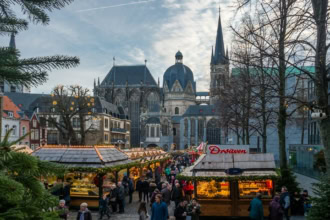
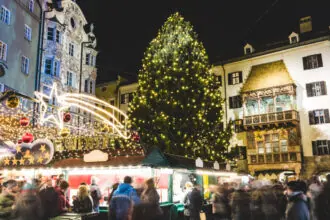
If you happen to visit in the run-up to Christmas, Düsseldorf shifts into one of Germany’s better festive cities. Rather than a single central market, the city spreads a handful of distinct markets across its core, from the traditional Old Town setting around the Altstadt-Markt to a dedicated artisan market at the Marktplatz, a smaller, cosier market at Heinrich-Heine-Platz, and a more upmarket “winter village” of white pavilions along part of the Königsallee itself.
Each market has a genuinely different character rather than repeating the same stalls under a different name. The Altstadt and Marktplatz markets lean into classic mulled wine and hand-carved decorations, the Kö’s winter village goes for polish and champagne, and a themed promenade market along the Rhine adds a more theatrical, circus-inspired atmosphere to the riverside walk described above.
As is typical across German Christmas markets, Düsseldorf’s generally open in mid to late November and run through to just before or just after Christmas Day, with standard daily hours through the late morning into the evening, though exact opening dates and stall line-ups can shift slightly year to year, so it is worth checking current details closer to your visit.
For a full breakdown of exactly which markets to prioritise, what each one specialises in, and how to link them together on foot, our dedicated Düsseldorf Christmas Markets guide covers the whole festive season in far more depth than makes sense to repeat here.
Major and Annual Events
Beyond its Christmas markets, already covered in depth elsewhere in this guide, Düsseldorf runs a genuinely packed calendar of major annual events worth timing a visit around if the dates line up.
The biggest is Rheinkirmes, billed as the largest funfair on the Rhine and running for around ten days in July on the Oberkassel riverbank, with roots stretching back to 1435. Over 300 exhibitors draw close to four million visitors, and entry to the fairground is free, with rides paid for separately, building to closing fireworks over the river on the last Friday.
Japan-Tag, or Japan Day, is a direct expression of the city’s large Japanese community and is billed as the biggest Japanese culture festival in Europe. Held on a Saturday, typically in late May or early June, it fills the city centre with cosplay, food stalls and cultural performances for free, before closing with a fireworks display set off from barges on the Rhine.
Karneval brings a completely different energy in February or March, when the Altstadt becomes the centre of Rhineland carnival tradition. The season peaks on Rosenmontag (Rose Monday), when a huge procession of decorated floats, including the politically satirical designs of artist Jacques Tilly, winds through the city centre to enormous crowds.
Each of these events reshapes the city for its duration, so it is worth checking the exact dates for the year of your visit well in advance, since a trip timed around one of them feels like a genuinely different Düsseldorf to a normal week.
Of the three, Japan-Tag is the one most worth timing a trip around if the date fits: entry is free, and nothing else on this list pairs so naturally with a stop in the Japanese Quarter covered elsewhere on this page.
Best for a short stop where being central matters more than the room. Dorms and private rooms both listed.
See hostelsBest if you have ever given up on a claim. AirHelp checks whether the flight qualifies and pursues it for you.
See the benefitsBest for the gap between checking out and your train. Drop bags at a shop or hotel nearby and carry on.
Store your bagsDüsseldorf’s Japanese Quarter
Few visitors expect it, but Düsseldorf is home to one of the largest Japanese communities in Europe, with more than 8,000 Japanese residents living and working in the city, a legacy of decades of Japanese corporate investment in the region. That community has left a genuine, lived-in mark on the streets around Immermannstraße, near the main train station, an area locals sometimes call “Little Tokyo”.
Walking Immermannstraße and the surrounding streets turns up authentic Japanese supermarkets, bookshops, bakeries and a genuinely dense cluster of ramen bars, izakaya and sushi counters, many run by and for the local Japanese community rather than aimed purely at tourists. It is one of the most reliable places in the city for an authentic, non-touristy meal, and a useful contrast to a day spent among Altbier pubs.
For a deeper look at Japanese culture rather than just Japanese food, the EKŌ-Haus, a Buddhist temple and cultural centre with landscaped Japanese gardens on the edge of the city, has welcomed visitors since 1993. It regularly hosts tea ceremonies, cultural workshops and Buddhist events, and its gardens make a genuinely peaceful, contemplative stop that feels a world away from the Altstadt’s noise.
The EKŌ-Haus sits a little further out than the rest of this list, so check current opening times on the EKŌ-Haus website before making the trip, while Immermannstraße itself is a five-minute walk from the main station and easy to combine with any city-centre day.
Hop-On Hop-Off Bus Tour
For visitors who would rather sit back than walk the whole itinerary, Düsseldorf runs an open-top double-decker hop-on hop-off bus tour covering most of the sights already listed above. The single loop calls at seven stops, including the Königsallee, the Altstadt near Burgplatz, the Rheinturm and MedienHafen, and the Ehrenhof near the Kunstpalast, so it works well either as a first orientation lap or as a way to skip the walk between two stops that sit further apart.
A full circuit takes around 90 minutes without getting off, and tickets are typically sold as a 24-hour pass at roughly €24 (£21/$27) for adults, letting you ride the loop as many times as you like and hop off at any stop to explore before catching the next bus. Multilingual audio commentary, generally covering around ten languages, comes through headphones handed out on board, which makes it a reasonable option for a first-time visitor who wants some context without joining a guided walking tour.
If you are mainly using the bus to get around rather than for the commentary, it is worth comparing it against the Düsseldorf Card first, since the card bundles unlimited travel on the city’s ordinary trams and buses with discounted museum entry, and regular public transport reaches every stop on the hop-on hop-off route in any case. Our Düsseldorf Card Guide works out which option makes more sense for your specific itinerary.
Free and Budget Things to Do in Düsseldorf
Düsseldorf has a reputation as an expensive business city, but a genuinely satisfying day here does not have to cost much at all. Walking the full length of the Rheinuferpromenade, wandering the Königsallee’s canal and architecture, and exploring the Altstadt’s Gothic churches and narrow lanes are all free, and together they cover most of what makes the city worth visiting in the first place.
The Hofgarten, Düsseldorf’s oldest public park, sits just behind the Kö and is a pleasant, free green space to break up a day of sightseeing, while several of the city’s smaller museums, including the Filmmuseum and Stadtmuseum, offer free admission on certain days or with the Düsseldorf Card discussed below. MedienHafen’s Gehry buildings and the general architecture of the harbour cost nothing to admire either, and photographing them is arguably the best free activity in the whole city.
If you do want to visit several paid attractions, it is worth comparing costs against the Düsseldorf Card, which bundles free local public transport with discounted or free entry to a long list of museums and attractions across several validity lengths. Our Düsseldorf Card Guide breaks down current prices and works out exactly when the card pays for itself against buying tickets individually.
A final, genuinely free option worth remembering: many of the Altstadt’s historic churches, including St Lambertus, allow visitors to step inside outside of service times at no cost, which is an easy way to get a break from the crowds and a look at some real medieval architecture without spending a cent.

Things to Do in the Rain
Düsseldorf’s compact centre is built for walking, so a wet day genuinely changes the shape of a visit rather than ruining it. A handful of proper indoor attractions, beyond the free options and the Kunstpalast and K21 already covered elsewhere in this guide, are worth building a rainy afternoon around.
The Aquazoo Löbbecke Museum, out in the Nordpark and reachable by U78/U79 or bus SB52, combines a zoo, aquarium and natural history museum under one roof, with more than 6,000 animals across 570 species. It is open daily from 10am to 6pm, with admission around €11 (£10/$12) for adults and roughly €6.50 (£6/$7) for children aged six to seventeen.
Closer to the centre, near the Kunstpalast on the Ehrenhof, the NRW-Forum runs a rotating programme of contemporary art, design and digital culture exhibitions aimed at a younger, more experimental audience than a traditional museum. Standard admission runs around €11 (£10/$12), with a concession rate of roughly €8 (£7/$9).
In the Altstadt itself, the Filmmuseum traces the history of cinema from its earliest days, with memorabilia connected to figures including Charlie Chaplin, Federico Fellini and Marlene Dietrich. It is open Wednesday to Sunday from midday to 6pm, with one late evening a week, and admission is a modest €5 (£4/$5) for adults and around €2.50 (£2/$3) concession.
Between the three, plus a return trip to the Kunstpalast or K21 if the rain sets in for the whole day, Düsseldorf has enough genuinely worthwhile indoor attractions that a washout need not cost a visit its momentum.
If you only have an hour and are staying central, the NRW-Forum is the easiest choice; the Aquazoo is worth the trip out only if the rain is set in for a whole day.
How Long Do You Need in Düsseldorf?
A focused day in Düsseldorf is enough to see the essentials: a morning walk through the Altstadt and along the Rheinuferpromenade, an hour or two on the Kö, and an evening back in the Old Town’s pubs for Altbier and traditional Rhineland food. It is a genuinely satisfying way to experience the city if you are only passing through.
Two full days lets you slow down considerably. That gives room for the Rheinturm, a proper look at MedienHafen, a river cruise, and either the Kunstpalast or K21, without feeling like you are racing between stops, and it also leaves space for a detour out to the Japanese Quarter or the EKŌ-Haus if that interests you.
A third day opens up options beyond the city centre. Schloss Benrath, an elegant 18th-century Baroque palace and park a short train ride south of the centre, is a genuinely worthwhile half-day trip for anyone who enjoyed K21’s history, and it is also a natural jumping-off point for the wider day trips covered in our Best Day Trips from Düsseldorf guide, which reaches destinations including Cologne and the Wuppertal Suspension Railway within about an hour.
Whatever length of trip you settle on, Düsseldorf’s compact, walkable centre means you rarely lose time to transport between sights, which makes it a genuinely efficient city to explore even on a tight schedule.
Accessibility and Children
Düsseldorf is generally an easy city for visitors with mobility needs. The Rheinuferpromenade, the Königsallee and most of MedienHafen are flat, wide and step-free, and the city’s trams and U-Bahn network are largely accessible, with low-floor vehicles and lift access at most central stations. The Altstadt’s older cobbled streets are the main exception, since narrow, uneven lanes can make some pub entrances and back streets awkward for wheelchair users.
Major museums including the Kunstpalast and K21 are step-free and offer reduced admission for disabled visitors, and the Rheinturm’s observation deck is reached by a dedicated lift rather than stairs. It is worth checking access details in advance for the Schlossturm’s Maritime Museum specifically, since its historic tower layout involves several flights of stairs between floors.
For families, Düsseldorf works well without needing to plan around children specifically. The riverside promenade and Hofgarten park both give kids room to run around between sightseeing stops, the Rheinturm and a river cruise both tend to go down well with younger children, and most museums, including the Kunstpalast, offer free admission for under 18s.
The Altstadt in the evening is more of an adult scene given its pub-heavy character, so families are generally better off treating it as a daytime sightseeing stop and heading elsewhere, such as MedienHafen’s restaurants or the Japanese Quarter‘s food, once dinner time comes around.

Rupert’s Handy Travel Tips
Düsseldorf rewards a little local know-how, so here is what I would want a friend to tell me before my first visit.
- Order your Altbier by the tray, not the round: in the Altstadt’s traditional pubs, a Köbes will keep bringing fresh 0.2 litre glasses until you physically place a beer mat on top of your empty one, so pace yourself if you are not used to the system.
- Walk the Rhine promenade at two different times of day: the riverside path looks completely different by daylight, when the barges pass, and after dark, when the Altstadt and Rheinturm light up across the water, so it is worth the return trip.
- Time the Kunstpalast for a Wednesday afternoon: the museum runs a reduced admission slot from 2pm to 6pm that afternoon, which is an easy way to see a genuinely strong collection without paying full price.
- Don’t skip Immermannstraße just because it isn’t in the guidebooks: Düsseldorf’s Japanese Quarter is a proper working neighbourhood, not a tourist set piece, and it is one of the most reliable spots in the city for an authentic, good value meal.
- Check the Düsseldorf Card before buying individual tickets: if you are planning on visiting more than one or two paid attractions plus using public transport, the card often works out cheaper than paying for each separately.
Want to meet the reindeer behind our travel tips? Find out more in our page Who is Rupert?.




Frequently Asked Questions
How many days do you need in Düsseldorf?
One focused day covers the Altstadt, the Kö and the Rhine promenade, but two to three days lets you add the Rheinturm, MedienHafen, a museum visit and a river cruise without rushing.
Why is the Altstadt called “the longest bar in the world”?
It is not one single bar but a nickname for the whole Old Town, which packs around 260 pubs, bars and restaurants into roughly half a square kilometre, an unusually high density even by German standards.
What is Altbier and where should I try it?
Altbier is a dark, top-fermented beer style unique to Düsseldorf, traditionally served in small glasses in Altstadt brewery pubs such as Uerige and Füchschen, which still brew it on the premises.
Is Düsseldorf worth visiting if I have already been to Cologne?
Yes. The two cities are only around 25 minutes apart by train but feel quite different: Düsseldorf trades Cologne’s cathedral for Gehry architecture, a Japanese Quarter, and a more upmarket, design-led shopping scene.
Does Düsseldorf have a big Japanese community?
Yes, Düsseldorf is home to one of the largest Japanese communities in Europe, with a dedicated Japanese Quarter around Immermannstraße and the EKŌ-Haus cultural centre and gardens a little further out.
Further Reading
If you are still planning the logistics of your trip, our Düsseldorf Airport Transfers guide covers every route from Düsseldorf Airport into the city centre, and our Düsseldorf Card Guide is worth a look before you buy any individual attraction tickets, since it works out exactly when the card saves you money against paying separately.
For a more structured first day, our Self-Guided Düsseldorf Walking Tour links the Altstadt, Burgplatz and the Kö into a single route, and pairs naturally with the Düsseldorf Rhine River Cruise guide if you want to see the same landmarks from the water afterwards.
Once you have covered the city itself, our Best Day Trips from Düsseldorf guide is the natural next stop, covering everywhere from Cologne to Aachen and the Wuppertal Suspension Railway within about an hour by train.
And if your visit falls between late November and Christmas, don’t miss our dedicated Düsseldorf Christmas Markets guide, which breaks down every market in the city, from the traditional Altstadt-Markt to the upmarket winter village on the Kö.