Reviewed by our editorial team Published
Düsseldorf runs seven separate Christmas markets scattered across its compact city centre, and what makes the city worth a dedicated guide isn’t the number but the sheer contrast between them. A designer Winter Village of white glass pavilions sits on the Königsallee, one of Europe’s most exclusive shopping streets, barely fifteen minutes’ walk from an Old Town famous as “the longest bar in the world,” a half-square-kilometre grid of some 260 Altbier pubs. Between the two, a circus-themed market staged by Roncalli runs directly along the banks of the Rhine.
That range is Düsseldorf’s real point of difference against its bigger German neighbour Cologne, an hour down the Rhine. Where Cologne’s seven markets share a broadly similar cathedral-city character and the main decision is simply which one to prioritise, Düsseldorf’s markets pull in genuinely different directions: polished and design-led at one end, raucous and beer-hall at the other, with a literal circus in between. That makes Düsseldorf less a “pick one” city and more a “pick your mood” one.
This guide covers where each of Düsseldorf’s markets actually sits and what sets it apart, the city’s Kö on Ice rink and Wheel of Vision Ferris wheel, what’s genuinely on the stalls (including a few things found nowhere else in Germany), the Lichterdom light display on the Kö, the honest picture on New Year’s Eve fireworks (mostly legal, but banned outright in one specific historic zone), shop and transport hours over the holiday period, and realistic December weather. Prices are shown in euros first, the currency the markets actually trade in, with pound and dollar conversions alongside.
Düsseldorf’s Seven Christmas Markets at a Glance
| Market | Location | Character |
|---|---|---|
| Altstadt-Markt | Flinger Straße & Marktstraße | Historic Old Town stalls, Radschläger pyramid |
| Handwerker-Markt | Marktplatz, by the Rathaus | Live artisan crafts, hand-carved nativity |
| Engelchen-Markt | Heinrich-Heine-Platz | Smallest, golden angels, local favourite |
| Schadow-Markt & Märchen-Markt | Schadowstraße & Schadowplatz | Shopping stop and fairytale-themed huts |
| Kö-Bogen Markt | Jan-Wellem-Platz & Gustaf-Gründgens-Platz | Feuerzangenbowle, modern Libeskind backdrop |
| Winter Village | Königsallee (Kö) | Designer brands, champagne, glass pavilions |
| Roncalli’s Weihnachtspromenade | Rheinuferpromenade | Circus theme, vintage wagons, riverside |
Most of the seven sit within a comfortably walkable core of the city centre, so a single day can realistically take in three or four without needing transport between them. The sections below cover each in turn, along with everything else worth building into a Düsseldorf Christmas trip.
The Old Town Markets: Altstadt-Markt and the Handwerker-Markt
The two markets closest to Düsseldorf’s Old Town pub district sit within a few minutes’ walk of each other, and together they’re the closest thing the city has to a traditional single-square market. The Altstadt-Markt spreads along Flinger Straße and Marktstraße, its wooden stalls backed by the Old Town’s genuinely historic townhouses, and is centred on a towering Christmas pyramid topped by the Radschläger, the cartwheeling boy who has been Düsseldorf’s civic emblem for centuries.
That pyramid is worth timing a visit around after dark, since its tiered candles and paddle-wheel top are what most visitors picture when they think of a German Christmas market pyramid. Lit from mid-afternoon through closing, it gives the whole market a genuine glow even before the Old Town’s pub windows add their own light.
A few streets over, the Handwerker-Markt takes over the Marktplatz in front of the Rathaus, Düsseldorf’s town hall, and leans hard into genuine craft rather than souvenir stalls. Glassblowers, wood carvers and pewterers work in front of visitors rather than simply selling finished pieces, and a hand-carved, life-sized nativity scene anchors the square as its centrepiece.
Both markets sit inside the same 2026 season, running from 19 November to 30 December, with standard hours of 11am to 8pm Sunday to Thursday and 11am to 9pm Friday and Saturday. They close for Totensonntag on 22 November, the solemn Sunday of remembrance observed the week before Advent begins, a genuinely German closure date that catches some visitors out if they’ve planned an opening-weekend trip.
Because both sit directly against the Altstadt’s pub streets, this is also the natural starting point for anyone planning to combine market browsing with an evening in one of the district’s Altbier houses. Heinrich-Heine-Allee underground station drops you within a couple of minutes’ walk of both, making it the most straightforward entry point into Düsseldorf’s Christmas markets as a whole.
Compare hotels and other places to stay in Dusseldorf.
Check availabilityExplore holiday homes and apartments around Dusseldorf.
See holiday homesCompare hotel deals in Dusseldorf from multiple booking sites.
Compare pricesThe Kö and Kö-Bogen: Where Christmas Meets Design
Barely fifteen minutes’ walk from the Altstadt’s beer halls, the Königsallee, universally known as the Kö, hosts the most distinctive of Düsseldorf’s seven markets: the Winter Village, a run of modular white glass pavilions rather than traditional wooden chalets. It sits on one of Europe’s most expensive shopping streets, home to the flagship stores of major luxury houses, and the market leans into that setting rather than working against it.
Where the Old Town markets serve mulled wine in enamel mugs, the Winter Village’s pavilions pour champagne and prosecco alongside the Glühwein, and several stalls stock genuinely upmarket gifts rather than the crafts and ornaments found elsewhere in the city. It is, deliberately, the most polished of Düsseldorf’s markets, and the one that best explains why the city markets itself on design and fashion rather than medieval charm.
A short walk north, the Kö-Bogen Markt wraps around the Kö-Bogen shopping complex at Jan-Wellem-Platz and Gustaf-Gründgens-Platz, a striking modern building by architect Daniel Libeskind that gives this market a genuinely different backdrop from the half-timbered charm elsewhere. It is best known for its Feuerzangenbowle, a rum-soaked sugarloaf set alight and left to drip into a pot of hot spiced wine, theatre as much as drink.
Between them, the Kö and Kö-Bogen markets make the strongest case for Düsseldorf as a genuinely different Christmas market city rather than a smaller Cologne. Anyone expecting exclusively rustic, traditional stalls should know this pairing exists, since it is as central to a Düsseldorf visit as the Old Town’s markets are.
Prices reflect the setting: a glass of prosecco at the Winter Village typically runs from around €8 to €12 (£6.90 to £10.30 / $9 to $13.40), noticeably more than a standard Glühwein at the Old Town markets. That premium buys genuine atmosphere, wide pedestrianised boulevards lined with trees and fairy lights, rather than crowding, and it’s worth the extra for at least one evening of a longer trip.
Roncalli’s Weihnachtspromenade: A Circus on the Rhine
The most theatrical of Düsseldorf’s seven markets runs along the Rheinuferpromenade, the paved riverside walkway beneath the Altstadt, and it’s staged in partnership with Circus-Theater Roncalli, the German circus company famous for reinventing the format without animal acts. Vintage circus wagons and glass orangeries line the promenade with the Rhine itself running alongside, a setting no other market in the city, or arguably in the wider Rhineland, can match.
Roncalli’s own artistic reputation shows in the market’s live entertainment, with acrobats, aerialists and street performers appearing through the promenade’s run rather than confined to a single stage, closer in spirit to a curated cultural event than a standard market programme. It’s a genuinely different register from the Old Town’s beer-hall energy or the Kö’s designer polish, aimed at visitors who want atmosphere and performance over crowds and bargains.
The orangery structures also give this market a genuine weather advantage over the open-air stalls elsewhere in the city, since their glass walls shelter visitors from the wind coming off the Rhine while still keeping the river view. That makes it a sensible choice on a properly cold or wet evening, when standing outside at the Altstadt-Markt or Handwerker-Markt is less appealing.
Food and drink here lean into the market’s theatrical framing too, with mulled wine served in keepsake mugs alongside a wider spread of sweet treats than the more traditional markets typically offer. A cup typically runs a similar €4 to €6 (£3.50 to £5.20 / $4.50 to $6.70) to the rest of the city, so the premium here is entirely in the setting rather than the pricing.
Because the promenade runs directly beneath the Altstadt itself, this is an easy add-on to an Old Town visit rather than a separate trip, best walked in the early evening once the river-facing lights come on. It’s also one of the quieter markets to reach on foot, since it sits slightly below street level, away from the road traffic along the rest of the city centre.
Schadow-Markt, Märchen-Markt and Engelchen-Markt: The Rest of the Seven
Rounding out Düsseldorf’s seven markets are three smaller sites that rarely make it into visitor itineraries but are genuinely worth knowing about. Schadowstraße, one of the city’s main shopping streets, hosts the Schadow-Markt, aimed squarely at shoppers taking a break between stores, while the adjoining Schadowplatz runs the Märchen-Markt, a fairytale-themed market of huts styled after German folk tales rather than a standard row of chalets.
At Heinrich-Heine-Platz, named for the Düsseldorf-born poet, the Engelchen-Markt circles a neoclassical music pavilion under a canopy of golden angel-topped stalls. It’s the smallest of the seven and consistently described by locals as their favourite, a genuinely intimate market that trades scale for atmosphere.
None of these three markets demand a special trip on their own, but all three sit close enough to the Kö, the Altstadt and each other to fold naturally into a walking route between the bigger markets. The Engelchen-Markt in particular is worth a short detour for anyone who finds larger, Cathedral-scale crowds overwhelming and wants a genuinely calmer alternative within Düsseldorf itself.
Live music is a regular feature at the Engelchen-Markt’s pavilion, with small choirs and brass ensembles performing through December on an informal, rotating schedule rather than a fixed programme. Checking the market’s own listings closer to a visit is worth doing if a specific performance matters to the trip.
Ice Skating, the Wheel of Vision and Craft Workshops
Beyond browsing stalls, Düsseldorf’s markets pack in a genuine range of things to actually do. Kö on Ice, the city’s main skating rink, takes over Corneliusplatz just off the Königsallee each winter, alongside a curling area set up on a sustainable plastic surface rather than real ice. The two-storey Füchschen-Alm venue beside the rink adds a proper dining restaurant upstairs and a casual bratwurst-and-soup counter downstairs, so skating isn’t the only reason to stop.
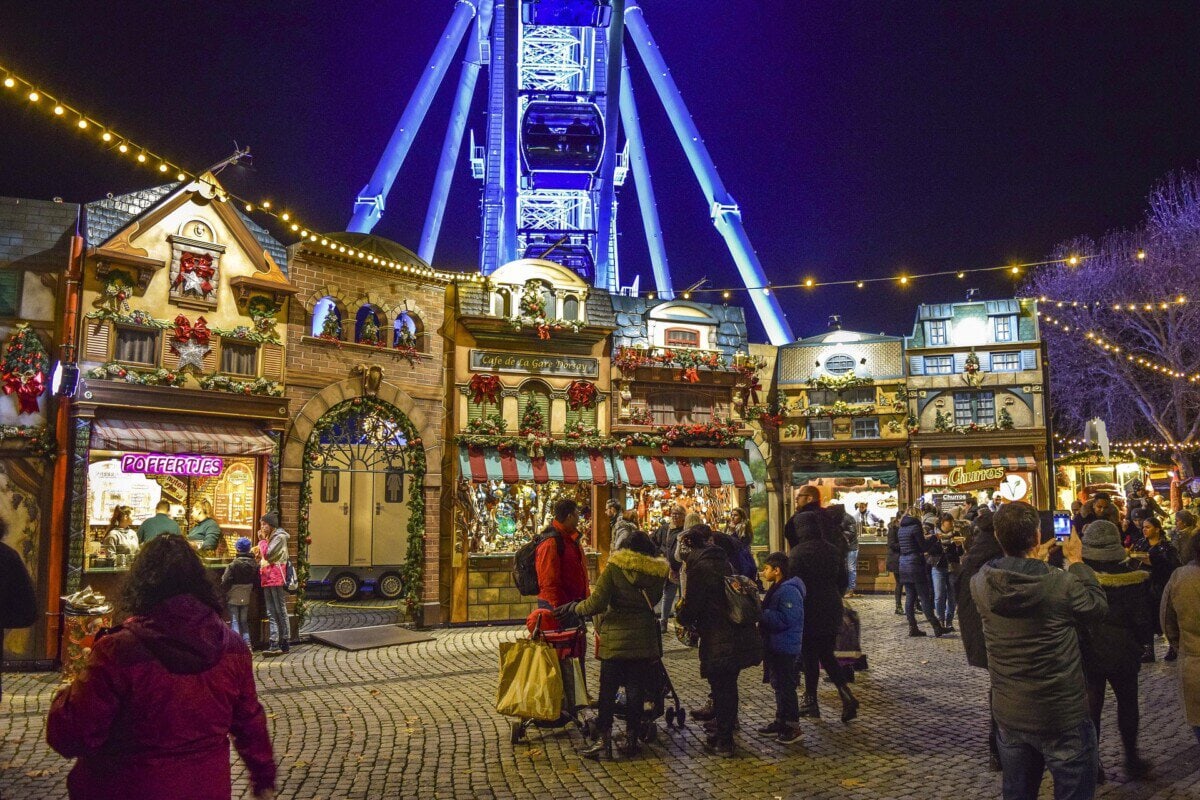
At Burgplatz, overlooking the Rhine, the Wheel of Vision Ferris wheel rises 55 metres over the city, one of the tallest seasonal wheels in Germany, with 42 gondolas each holding up to eight people. A standard ride costs around €9 (£7.70/$10) for adults and €6 (£5.20/$6.70) for children under 1.40 metres tall, with under-threes riding free, and an exclusive breakfast-gondola experience is bookable for anyone wanting a longer, more private ride over the river.
For genuine craft rather than just shopping, the Handwerker-Markt at the Marktplatz remains the strongest single stop, with glassblowers, wood carvers and pewterers demonstrating their trade live throughout the market’s run. Watching a piece actually being made, rather than simply buying a finished one, is a big part of what distinguishes this market from the seven’s more shopping-focused sites.
Between the rink, the wheel and the Handwerker-Markt’s live demonstrations, a single day can realistically combine all three without much backtracking, since Corneliusplatz, the Kö and the Marktplatz all sit within a comfortable walk of each other. Booking Kö on Ice sessions ahead is worth doing on weekend evenings, when slots fill quickly.
What’s on the Stalls: Killepitsch, Radschläger Figurines and Designer Gifts
What’s actually for sale varies sharply between Düsseldorf’s markets, and that variation is worth knowing before deciding where to shop. At the Old Town markets, the standout local buy is Killepitsch, a dark herbal liqueur made from a secret blend of some 98 herbs and fruits, produced in Düsseldorf since the 1950s and not found in the same concentration anywhere else in Germany. Bottled Altbier, the city’s own top-fermented beer, and jars of Düsseldorfer Senf mustard make equally genuine, portable souvenirs.
Craft stalls across the Altstadt-Markt and Handwerker-Markt sell handcrafted glass baubles and wood-carved ornaments, alongside Radschläger figurines, small models of the cartwheeling boy that appears throughout the city’s iconography. These sit at the more traditional, handmade end of what’s on offer, priced similarly to craft stalls at other German markets.
At the other end of the scale, the Winter Village on the Kö stocks noticeably more upmarket gifts, from designer-label small goods to fashion accessories sold alongside the mulled wine and champagne, a genuinely different retail experience from anywhere else in the city’s Christmas market scene. It’s worth browsing even for visitors with no intention of buying, simply to see how differently a Christmas market can be styled.
Prices reflect that same split. A bottle of Killepitsch typically costs around €15 to €18 (£13 to £15.50 / $17 to $20) depending on size, while a glass bauble or a small wood-carved ornament from the Altstadt runs closer to €6 to €10 (£5.20 to £8.60 / $6.70 to $11). Gifts at the Winter Village start at a similar level but climb well beyond it depending on the brand.
Food and Drink: From Himmel und Ääd to Feuerzangenbowle
Food at Düsseldorf’s markets leans firmly into regional Rhineland cooking rather than the generic bratwurst-and-pretzel spread found at many German markets. Himmel und Ääd, blood sausage served with mashed potato and stewed apple sauce, is the dish locals actually order, alongside Reibekuchen, crisp potato pancakes served with more of the same applesauce. Düsseldorfer Senfrostbraten, roast beef marinated in the city’s own mustard, and Flammlachs, grilled salmon fillets cooked over an open flame, round out the more substantial options.
On the drinks side, the city’s own white mulled wine, Weisser Glühwein, has its own dedicated following, and the Schwarzwaldhütte stall at the Handwerker-Markt is reliably where the longest queue forms for it. Altbier, Düsseldorf’s dark, top-fermented local beer, is available bottled or on draught across most of the markets, a genuinely different beer culture from the pilsner served at markets further south.
Feuerzangenbowle, the rum-soaked sugarloaf set alight over hot spiced wine, is the signature theatrical drink of the Kö-Bogen Markt specifically, though variations turn up at several of the seven sites. Killepitsch is served warm as a shot at several stalls too, a proper local specialty rather than something imported for the season.
For something lighter, Gagliardi-Mandeln, roasted almonds sold hot in paper cones, and Flammkuchen, a thin Alsatian flatbread with cream, onion and bacon, are widely available across most of the seven markets. A cup of Glühwein typically runs €4 to €6 (£3.50 to £5.20 / $4.50 to $6.70) including the keepsake mug, broadly in line with prices across Germany’s Christmas markets.
Compare routes and fares for your journey to Dusseldorf.
Compare flightsBrowse Airalo eSIM options for convenient travel data.
Check eSIMsCheck private pickup options and plan your onward journey before arrival.
View transfersThe Lichterdom and Christmas Lights Across the City
Düsseldorf’s best-known Christmas lighting isn’t tied to a single market at all. The Lichterdom, a domed light structure spanning the Königsallee, has illuminated the Kö every winter since 2016, built from around 3,500 individual lights and rising to roughly 15 metres over the boulevard’s central walkway. It takes a team of around 50 workers several weeks to install, and it comes on ahead of the market season itself, typically from the start of November.
Research for this guide found no evidence of a single, citywide lights switch-on ceremony in Düsseldorf, unlike some UK cities that build a whole evening event around one moment. Instead, the Lichterdom comes on gradually as installation finishes, and each of the seven markets’ own lighting follows its individual opening date across mid-to-late November, the same decentralised pattern found at Cologne’s markets an hour down the Rhine.
That means there’s no single date worth planning a trip around specifically for a switch-on, but it also means the Kö is reliably lit from early November onward, well before the markets themselves open on 19 November 2026. Anyone visiting Düsseldorf in late October or the first half of November will likely catch the Lichterdom already running, even without a market in sight.
Beyond the Kö, strings of lights run along Schadowstraße and through the Altstadt’s own narrow streets, giving the whole city centre a consistent festive backdrop rather than concentrating all the lighting budget in one spot. Evening walks between the markets double as a genuine light display in their own right, particularly along the stretch between the Kö and the river.
Beyond the Markets: Other Christmas Things to Do in Düsseldorf
Away from the seven markets, Düsseldorf runs its own dedicated festive concert season. The Tonhalle Düsseldorf, the city’s landmark concert hall built inside a former planetarium, puts together its own December programme each year, mixing seasonal orchestral concerts with its regular symphonic season. The Bach-Verein Düsseldorf choir also performs through Advent, a genuine local choral tradition rather than a one-off event laid on for tourists.
For something on the water, several operators run festive Rhine cruises past the Altstadt and the Kö-Bogen during December, giving a different vantage point on the city’s lights than walking between markets on foot. It’s a comfortable option for anyone visiting with limited mobility, or simply wanting an hour off from standing at stalls.
Düsseldorf’s museums and galleries, including the Kunstpalast and K21, keep their regular winter exhibitions running through December, and they’re a sensible way to fill daylight hours before the markets open for the evening. The city’s compact centre means switching between a museum visit and a market stop rarely takes more than a short tram ride.
None of this rivals the scale of a citywide festive programme like Vienna’s, and Düsseldorf doesn’t pretend otherwise. What it offers instead is a genuinely walkable city where a concert, a museum and three or four Christmas markets can realistically fit into a single day without much planning.
Shop, Transport and Attraction Hours Over Christmas and New Year
German shops keep fairly standard hours through most of December, and North Rhine-Westphalia places no fixed legal closing time on an ordinary weekday, so most city-centre stores stay open from around 9am or 10am to 8pm Monday to Saturday. Sundays are different: shops are normally closed altogether, and Düsseldorf only opens them on a handful of specially authorised verkaufsoffene Sonntage each year, several of which are timed to coincide with the Christmas market season, so it’s worth checking the city’s own published list before assuming a Sunday shopping trip will work.
Christmas Eve (24 December) is a half day, with most shops closing by early afternoon, in line with the markets’ own reduced 11am to 3pm hours that day. Christmas Day and Boxing Day (25 and 26 December) are both public holidays in Germany, so shops, banks and most attractions close completely, and New Year’s Day (1 January) follows the same pattern.
Rheinbahn, Düsseldorf’s public transport operator, keeps running throughout the holiday period on adjusted timetables. Most lines follow a Saturday schedule until 7pm on Christmas Eve, switching to a night-service pattern afterward, then run a standard Sunday timetable on both Christmas Day and Boxing Day. For New Year’s Eve, Rheinbahn reinforces several lines from 9pm through 5am, including extending U-Bahn services further out to Krefeld and Duisburg for anyone heading home late.
Major attractions generally follow the same public holiday pattern as shops, closing on 25 December and 1 January, with many reopening on Boxing Day. Checking a specific museum or landmark’s own site before a Christmas Day visit is worth doing, since a handful open on reduced hours rather than closing entirely.
New Year’s Eve in Düsseldorf: Fireworks Banned in the Old Town Itself
Düsseldorf’s New Year’s Eve is genuinely worth being specific about, because the honest picture is more nuanced than either a full ban or a free-for-all. Fireworks remain legal across most of the city, in line with the national rule allowing category F2 rockets, firecrackers and batteries to be set off between 6pm on 31 December and 7am on 1 January, and crowds do gather along the Rhine promenade to watch informal displays light up the sky at midnight, much as they do in Cologne.
What’s changed, and what most generic guides to the city miss, is that the Altstadt itself, the exact district most visitors associate with Düsseldorf’s Christmas markets and pub culture, has been placed under a specific fireworks ban for 2025/26. The restricted zone runs roughly from Ratinger Straße in the north down to Flinger Straße and Apolloplatz in the south, bordered by Heinrich-Heine-Allee to the east and the Rhine to the west, covering the same streets that host the Altstadt-Markt and Handwerker-Markt.
Within that zone, carrying or setting off category F2 fireworks, rockets, firecrackers and battery fireworks, is banned outright from 8pm on 31 December to 6am on 1 January, though harmless sparklers and ground spinners aimed at children remain permitted. The city’s fire department introduced the ban after 147 fire incidents and four firework-related injuries during the 2024/25 New Year period, arguing that the danger of fireworks in a dense, historic pub district is routinely underestimated.
For anyone visiting Düsseldorf specifically for New Year’s Eve, the practical takeaway is straightforward: the Old Town’s own streets will be genuinely quieter on fireworks than the riverside promenade just beyond the zone’s western edge, which remains a legal and popular vantage point. Anyone wanting to watch fireworks over the Rhine is better placed on the open promenade than inside the Altstadt’s narrow pub streets this year.
Düsseldorf’s December Weather and What to Pack
Düsseldorf’s position in the Rhine valley gives it a fairly mild, damp December rather than a harsh continental one. Daytime highs sit around 7°C (45°F) at the start of the month, easing to about 6°C (43°F) by the end of December, with overnight lows dropping from roughly 3°C (37°F) to just above freezing at 1°C (34°F).
Rain is the dominant weather factor rather than snow, with the chance of a wet day running from around 31% to 36% across the month. Snow is genuinely rare, with days that bring only snow sitting at roughly a constant 1% chance throughout December, so a settled white Christmas market scene is a real long shot rather than something to plan around.
Daylight shortens noticeably too, bottoming out at around 7 hours 53 minutes on 21 December, the shortest day of the year. That still leaves a reasonable amount of daylight compared with Scandinavian cities further north, but evenings close in early enough that the markets’ lighting is doing real work by mid-afternoon rather than purely for atmosphere.
Practically, that combination of cold, damp and frequent cloud cover, averaging around 71% through the month, means a proper waterproof coat matters more than a heavy winter one alone, paired with sturdy, waterproof footwear for the Old Town’s cobbled streets. An umbrella and warm layers underneath, rather than one single thick coat, is the more practical approach for a multi-day visit that will likely include at least one genuinely wet evening.
Getting to Düsseldorf and Where to Stay
Düsseldorf Airport (DUS) is one of Germany’s best-connected, sitting around 8 kilometres north of the city centre and linked by a driverless SkyTrain shuttle to Düsseldorf Airport train station, from where regional and S-Bahn services reach the main Hauptbahnhof in around 15 minutes. Our Düsseldorf Airport Transfers guide covers every route in, including taxi pricing for anyone travelling with luggage or arriving late in the evening.
Once in the city, Düsseldorf’s compact centre means the Altstadt, the Kö and the Rhine promenade all sit within a genuinely walkable core, with the U-Bahn and Rheinbahn trams covering anywhere slightly further out, including Burgplatz and Corneliusplatz. A Düsseldorf Card can be worth it for anyone combining several days of transport with museum visits, and our own Düsseldorf Card Guide breaks down whether it pays off for a typical festive trip.
Accommodation near the Altstadt or Hauptbahnhof puts you within easy reach of most of the seven markets, while staying closer to the Kö suits anyone prioritising the Winter Village and a more polished, design-led few days. Central double rooms in December typically run from around €90 to €160 (£77 to £138 / $101 to $179) a night, rising on weekends and around the markets’ opening weekend in particular.
A single day is enough to take in three or four of the seven markets, but visitors wanting to properly cover the Kö, the Altstadt and Roncalli’s riverside promenade, plus a concert or museum visit, are better served staying two or three nights. Cologne is close enough to make more than a half-day trip worthwhile too. Direct trains cover the roughly 35 kilometres between the two cities in as little as 20 minutes on the fastest ICE services, or around 30 minutes on a regional RE train, which makes a full weekend split between Düsseldorf and Cologne a realistic way to compare the two cities’ very different takes on the same tradition rather than squeezing it into a rushed afternoon.

Rupert’s Handy Travel Tips
Seven markets and two very different personalities sounds like a lot to plan around, so here’s how I’d approach a Düsseldorf trip.
- Pick a market to match your evening, not a single “best one”: the Kö’s Winter Village suits a smart, well-dressed evening, while the Altstadt’s markets pair naturally with a proper Altbier pub crawl afterward.
- Book Kö on Ice sessions ahead for weekends: Corneliusplatz gets busy once the after-work crowd arrives, and slots do sell out.
- Head to Roncalli’s promenade on a wet evening: the glass orangeries along the Rhine shelter you from the weather while keeping the river view.
- Don’t expect fireworks inside the Altstadt on New Year’s Eve: the district itself is under a specific ban this year, so head to the open Rhine promenade instead.
- Try the Weisser Glühwein at the Handwerker-Markt’s Schwarzwaldhütte stall: it’s a genuine local specialty, not something dreamed up for tourists.
- Pack for rain rather than snow: Düsseldorf’s December is properly wet more years than it’s white.
Want to meet the reindeer behind our travel tips? Find out more in our page Who is Rupert?.



Compare hostels and lower-cost places to stay in Dusseldorf.
Search hostelsGet help with compensation, eligible lounge access and disruption support.
Explore AirHelp+Use convenient luggage storage around Dusseldorf between arrival, check-in and departure.
Check storageFrequently Asked Questions About Düsseldorf Christmas Markets
How many Christmas markets does Düsseldorf have?
Seven distinct markets run across the city each season: the Altstadt-Markt, Handwerker-Markt, Engelchen-Markt, Schadow-Markt, Märchen-Markt, Kö-Bogen Markt, the Winter Village on the Königsallee, and Roncalli’s Weihnachtspromenade on the Rhine.
What’s the difference between Düsseldorf and Cologne’s Christmas markets?
Cologne’s seven markets share a broadly similar cathedral-city character built around one central landmark. Düsseldorf’s markets pull in genuinely different directions instead, from the designer Winter Village on the Kö to the raucous Altstadt pub district and a circus-themed market on the riverside.
When do Düsseldorf’s Christmas markets open in 2026?
Based on the confirmed 2026 season, the markets run from 19 November to 30 December 2026, closed for Totensonntag on 22 November and for Christmas Day itself.
Is there an ice rink at Düsseldorf’s Christmas markets?
Yes. Kö on Ice at Corneliusplatz, just off the Königsallee, is the city’s main skating rink, with a curling area and a two-storey dining venue alongside it.
Are there fireworks on New Year’s Eve in Düsseldorf?
Yes across most of the city, in line with the national rules on category F2 fireworks. The Altstadt itself is the exception: a specific fireworks ban covers the Old Town’s streets for 2025/26, so the open Rhine promenade is the better spot to watch a display.
What’s the weather like at Düsseldorf’s Christmas markets?
Expect daytime highs of around 7°C (45°F) easing to 6°C (43°F) by late December, with overnight lows close to freezing. Rain is far more likely than snow, so a waterproof coat matters more than a heavy winter one.
Is Düsseldorf’s Christmas market expensive?
Prices at the Old Town markets are broadly in line with the rest of Germany, with mulled wine typically €4 to €6 (£3.50 to £5.20/$4.50 to $6.70). The Winter Village on the Kö runs noticeably higher, in keeping with its designer setting.
Further Reading & Related Guides
Düsseldorf’s markets sit within a much broader European Christmas market scene, and anyone comparing the city against its bigger neighbours should read our European Christmas Markets Guide, which covers dates, atmosphere and what makes each city’s approach distinctive.
For more on the Kö’s dome of lights itself, Visit Düsseldorf’s own Lichterdom page covers how it’s built each year.
Düsseldorf’s closest comparison is an hour down the Rhine in Cologne, whose seven markets share the same regional food culture but a very different, cathedral-centred character. Cologne’s Christmas markets are worth reading about alongside this one for anyone deciding between the two cities, or planning to combine both on a single Rhineland trip. Beyond the markets, our Düsseldorf Travel Guide covers the wider city, including where to eat, what to see and how to get around with ease.
For a proper look at the city itself beyond the markets, our Self-Guided Düsseldorf Walking Tour takes in the historic core on foot, while our Düsseldorf Rhine River Cruise guide covers seeing the city, including the Altstadt and MedienHafen, from the water.
Visitors with more time can also use Düsseldorf as a base for the wider region. Our Best Day Trips from Düsseldorf guide covers nearby destinations reachable within an hour by train, a useful add-on for anyone staying more than a couple of nights over the festive period.