
Reviewed by our editorial team Updated
Discover Düsseldorf: Germany’s Elegant River City of Culture, Creativity, and Altbier
Welcome to our Düsseldorf travel guide, your essential companion to exploring one of Germany’s most elegant, stylish, and surprisingly dynamic cities. Set on the banks of the River Rhine, Düsseldorf combines old-world character with modern design, giving visitors a city break that can shift effortlessly from historic breweries and cobbled old streets to fashion flagships, Japanese ramen bars, and bold contemporary architecture.
What makes Düsseldorf so rewarding is the way it constantly changes character as you move through it. In the Altstadt, you can wander through narrow lanes lined with traditional pubs and breweries, an area often described as the “longest bar in the world” because of its extraordinary concentration of drinking spots.
A short distance away, Königsallee, known locally as the Kö, offers a completely different mood, with its elegant canal, mature trees, luxury boutiques, and polished shopping atmosphere. Then, within easy reach again, the MedienHafen reveals another side of the city altogether, where Frank Gehry’s striking buildings and waterside restaurants show off Düsseldorf’s confident, forward-looking identity.
The city’s cultural depth is equally impressive. Düsseldorf has long been associated with important names in modern art, including Joseph Beuys and Gerhard Richter, and that legacy still shapes the city’s museum scene today. At the same time, the city is known for one of Europe’s strongest Japanese communities, centred around Immermannstraße, where travellers will find outstanding ramen shops, sushi restaurants, Japanese bakeries, and specialist supermarkets. Each year, that connection is celebrated with Japan Day, one of the city’s major annual events, bringing together food, performances, cosplay, and a huge fireworks display over the Rhine.
For travellers, Düsseldorf is also extremely practical. It is compact, safe, and well connected, which makes it easy to enjoy whether you are staying for a long weekend or using it as a base for a wider trip through North Rhine-Westphalia. The city’s public transport system is efficient and straightforward, with trams, buses, U-Bahn, and S-Bahn services linking the centre, surrounding districts, and the airport.
The Rheinbahn App is especially useful for local journeys, while DB Navigator is the key tool for regional and long-distance rail travel. If you prefer on-demand transport, Free Now and Uber are both useful options, and Citymapper makes multi-modal route planning much easier. With the right apps on your phone, exploring Düsseldorf becomes smoother, quicker, and significantly less stressful.
From world-class art collections and riverside promenades to Altbier taverns, vegan cafés, flea markets, and design-led neighbourhoods, Düsseldorf has a range that surprises many first-time visitors. This is a city that feels polished without being cold, creative without being overwhelming, and international without losing its local character. If you want a German city break that feels easy to navigate yet full of distinct experiences, Düsseldorf deserves serious attention.
Düsseldorf’s Bold Artistic Identity
Beyond its breweries, boutiques, and river views, Düsseldorf is a city shaped by ideas, design, and artistic confidence. It has one of Europe’s most respected contemporary art reputations, supported by institutions such as Kunstsammlung NRW and the renowned Academy of Fine Arts, where influential artists including Joseph Beuys and Gerhard Richter studied and worked. This creative tradition is not tucked away behind gallery walls. It is visible in the city’s architecture, its public spaces, and in the way older districts and modern developments sit side by side.
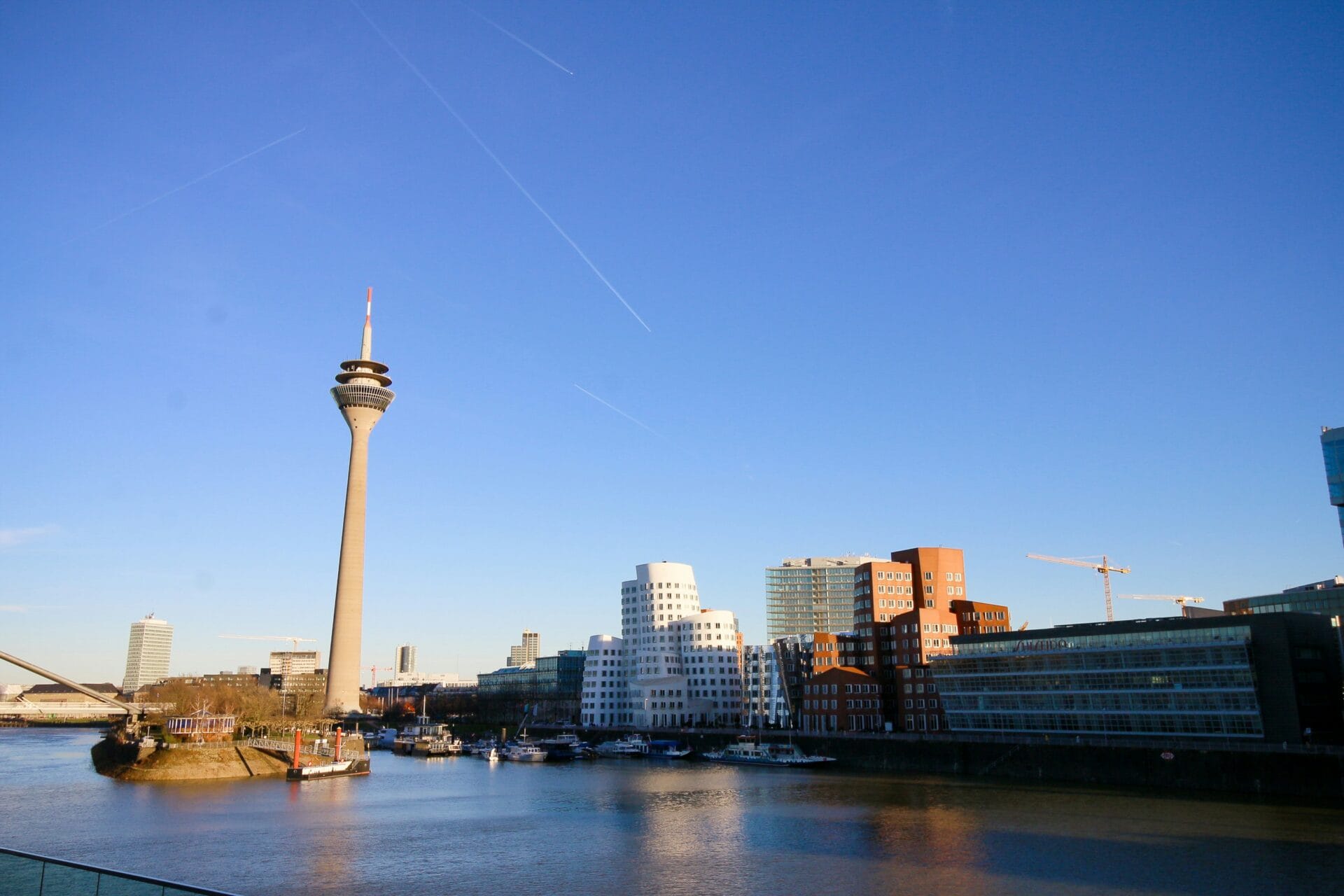
Nowhere is that more obvious than in the MedienHafen, where former harbourland has been transformed into one of the city’s most visually distinctive areas. Here, the skyline shifts from industrial edges to dramatic contemporary design, with the most famous landmarks being the sculptural, seemingly off-balance buildings designed by Frank Gehry. Reflected in the harbour water, these buildings symbolise a city that is comfortable reinventing itself while still holding onto its past.
Another defining part of Düsseldorf’s identity is its strong Japanese connection. The city is home to one of Europe’s largest Japanese communities, centred on Immermannstraße, often referred to as Little Tokyo. This part of the city is not a tourist gimmick, but a genuine cultural district, filled with authentic ramen shops, sushi counters, Japanese bookshops, bakeries, and Asian supermarkets that give the area real daily life and depth.
Every May, this relationship takes centre stage during Japan Day, when Düsseldorf hosts a huge celebration of Japanese culture featuring music, performances, food, and an unforgettable fireworks show on the Rhine.
For visitors, all of this is made even better by how easy the city is to use as a base. Düsseldorf Airport is only around 10 minutes from the city centre by rail, and the wider transport network is fast, clean, and easy to understand. Trams, buses, U-Bahn, and S-Bahn services run across the city and out into the wider region, making it simple to reach major sights, outer neighbourhoods, and nearby cities. Public transport information is widely available in a user-friendly format, and the city’s compact layout means you never feel as though you are battling against distance.
That combination of cultural depth, international flavour, and transport convenience is a big part of what makes Düsseldorf stand out. Whether you are visiting for a trade fair at Messe Düsseldorf, an art weekend, a Christmas market break, or just a few days of walking, eating, and riverside sightseeing, the city offers a polished but approachable experience. It feels both traditional and modern, and with the right planning tools in your pocket, it is very easy to experience it with confidence.
| Category | Details |
|---|---|
| City | Düsseldorf |
| Country | Germany |
| Region | North Rhine-Westphalia (NRW) |
| Population | Around 650,000 |
| Language | German, with English widely spoken in tourist areas, hotels, restaurants, and transport hubs |
| Currency | Euro (€) |
| Best Time to Visit | May to September for mild weather and outdoor sightseeing, or December for the Christmas markets |
| Time Zone | Central European Time (CET) and Central European Summer Time (CEST) |
| International Airport | Düsseldorf Airport (DUS), around 10 minutes from the city centre by train |
| Known For | Altbier breweries, Königsallee shopping, the Japanese Quarter, Media Harbour architecture, and a strong art scene |
| Nearby Cities | Cologne in around 25 minutes, with Essen and Bonn also easy to reach, while Amsterdam is around 2.5 hours away by train |
Compare hotels and other places to stay in Dusseldorf.
Check availabilityBrowse apartments, holiday homes and self-catering stays in Dusseldorf.
View rentalsSee hotel prices from multiple booking sites in one search.
Compare ratesBrief History & Background
The story of Düsseldorf is one of resilience, reinvention, and creative ambition. The city began as a settlement on the banks of the Düssel, a small river that flows into the Rhine, and its strategic position quickly helped it grow in importance. It was granted city rights in 1288 after the Battle of Worringen, a turning point that allowed it to develop into a prosperous trading centre. Its riverside location gave it commercial advantages that would shape its future for centuries.
By the 17th and 18th centuries, Düsseldorf had grown into the residence of the Counts and Electors Palatine, bringing prestige, court life, and significant architectural development. This era left behind important landmarks, including Schloss Benrath, one of the finest examples of baroque architecture in the region. During this period, the city also developed an early reputation as a place that supported the arts, laying the foundations for the cultural strength that still defines it today.
The 19th century brought industrialisation, and Düsseldorf expanded rapidly into a serious economic centre focused on steel, chemicals, and machinery. Its importance only increased in the early 20th century, although like many German cities, it suffered heavy destruction during the Second World War. Large parts of the city had to be rebuilt, but post-war reconstruction was energetic and purposeful. Rather than simply restoring what had been lost, Düsseldorf used the period to reshape itself as both an economic powerhouse and a modern city with international ambitions.
From the 1950s onwards, the city became increasingly associated with art, design, and cultural influence. Kunstakademie Düsseldorf emerged as one of Germany’s most important art schools, producing globally significant artists such as Joseph Beuys, Gerhard Richter, and Andreas Gursky. At the same time, Düsseldorf strengthened its status as a city of trade fairs, business, and international exchange, attracting global companies and developing one of Europe’s largest Japanese communities.
Today, Düsseldorf balances this history impressively well. You can still see the older city in the Altstadt, in its churches, squares, and long-standing brewing traditions, but you are never far from contemporary galleries, glass-fronted business districts, and modern architecture. It is a city where the past is present, but never static.
For travellers who want to dig deeper into that history while moving around the city, tools such as izi.TRAVEL and PocketGuide Audio Tours can add useful context, while Komoot is helpful for planning your own routes through historic districts and along the river. Düsseldorf’s story is layered, and modern travel apps make it easier than ever to uncover those layers properly.
Key Neighbourhoods, Areas & Regions
Düsseldorf may be a relatively compact city, but its neighbourhoods feel genuinely different from one another, and understanding those differences helps you make the most of your time. This is not a city where everything blends into one generic centre. Each district has its own rhythm, atmosphere, and purpose, and that variety is one of the reasons Düsseldorf works so well for a city break.
The Altstadt, or Old Town, is the city’s historic core and still one of its liveliest areas. It is best known for its dense concentration of pubs, breweries, and bars, with more than 260 drinking venues packed into a relatively small area. That is why it is often called the “longest bar in the world”.
Yet it is not only about nightlife. The Altstadt is also where you will find some of the city’s most important historic landmarks, atmospheric lanes, and easy access to the riverside promenade. Traditional Altbier taverns such as Uerige and Füchschen are among the best-known stops here, and the district remains one of the most rewarding places to experience the city’s older character.
The MedienHafen presents a completely different face of Düsseldorf. This regenerated harbour district is sleek, modern, and architecturally striking, with some of the city’s most recognisable contemporary buildings standing along the water. The area is especially associated with Frank Gehry’s sculptural, deconstructed designs, which have helped turn the harbour into one of the city’s visual signatures. It is also a strong dining area, with stylish restaurants and bars overlooking the water. For visitors who enjoy contemporary architecture, waterside walking routes, and a more polished evening atmosphere, the MedienHafen is one of the city’s standout districts.
Stadtmitte and Königsallee form the commercial and retail heart of the city. Königsallee, usually shortened to the Kö, is one of Germany’s most elegant shopping streets, with luxury boutiques, designer labels, and a tree-lined canal giving the whole area a refined, polished feel. Stadtmitte expands that experience with department stores, chain shops, cafés, and excellent transport connections. This is one of the most practical parts of the city to stay in, especially if you want to be near Düsseldorf Hauptbahnhof, shopping areas, and tram or U-Bahn links in multiple directions.
Then there is Immermannstraße, often called Little Tokyo, which reflects the strength and visibility of Düsseldorf’s Japanese community. This is one of the city’s most distinctive areas and one of the best places in Europe to enjoy authentic Japanese food, from ramen and sushi to bakeries, supermarkets, and specialist shops. It feels international in a very natural way, and it is a major part of what gives Düsseldorf its global identity. For travellers interested in food, this is not an optional extra. It is one of the city’s defining experiences.
Neighbourhoods such as Flingern and Unterbilk reveal a more local, creative side of the city. These districts are popular for their independent cafés, art spaces, vintage shops, and less polished but more individual atmosphere. They are ideal if you want to move beyond the classic tourist circuit and see a slightly more everyday, contemporary version of Düsseldorf. They also work particularly well for longer stays, slower afternoons, or anyone who prefers neighbourhood wandering to formal sightseeing.
One of the strengths of the city is that all of these districts are easy to reach. They are well linked by tram, U-Bahn, and bus, and most journeys between central areas are short. The Rheinbahn App is particularly useful for planning local trips, while Citymapper can help you compare routes across different forms of transport. Together, these neighbourhoods show why Düsseldorf feels so varied. It combines history, fashion, international food culture, creative energy, and modern design within a city that still feels manageable on foot and by public transport.

App availability note: If a download link looks broken on this page, it’s usually not an error on our side. Some apps are geo-locked in the Apple App Store or Google Play Store and only appear if your account region or SIM matches the country. This is common where apps rely on local payment systems, regulations, or developer resources. Once you’re in the right region, the app will normally work as expected.
Airport Overview & Transfers
Düsseldorf Airport, usually referred to as DUS, is one of Germany’s most important and convenient airports. Located around 7 kilometres north of the city centre, it serves more than 25 million passengers a year and offers direct connections across Europe, Asia, and North America.
For visitors, one of its biggest strengths is how easy it is to use. The airport is comparatively straightforward, with three terminals, clear bilingual signage, and a layout that is far less stressful than many larger European hubs. Free Wi-Fi is available throughout the airport, which is useful if you need to confirm hotel details, rail times, or onward transport after landing.
The airport is a major base for Eurowings, Lufthansa’s low-cost subsidiary, which makes it a strong hub for affordable short and medium-haul travel. From Düsseldorf, there are frequent services to major European cities including London, Paris, and Vienna, while carriers such as Lufthansa, Emirates, KLM, British Airways, and Qatar Airways maintain a strong presence as well. That gives the airport a useful balance between low-cost connectivity and premium long-haul options.
Transfers into the city are particularly good, and this is one of the reasons Düsseldorf works so well as a short-break destination. The airport is served by two separate railway stations, and understanding the difference matters. Düsseldorf Flughafen is the long-distance and regional rail station. This is where you connect to regional trains and long-distance services heading deeper into Germany and beyond. It is linked to the terminals by the SkyTrain, the airport’s suspended shuttle system, which runs frequently and makes the connection straightforward.
The second station, Flughafen Terminal, is the more important one for most visitors heading directly into the city. This station is used by the S11 S-Bahn, which runs straight to Düsseldorf Hauptbahnhof. The journey into the main station takes around 12 minutes, making it one of the fastest and easiest airport-to-centre transfers in Germany. Services are frequent throughout the day, and for many travellers this will be the best-value option by far.
Buses also operate from the airport and can be useful for reaching districts not directly on the rail line, while taxis and ride-hailing services are available outside the arrivals area. If you are heading to Messe Düsseldorf, the journey is especially simple, with the exhibition centre only around 10 minutes away by road under normal traffic conditions. This is a major advantage for business travellers and trade fair visitors.
For those arriving by car or planning to rent one, the airport connects directly to the A44 motorway, and both short-stay and long-stay parking are available. Car rental desks are located in the central arrivals hall, making pick-up easy after landing. If you are using apps, DB Navigator is the best tool for S-Bahn, regional, and long-distance rail services, while the Rheinbahn App is useful for local buses and onward urban connections. For road-based travel, Free Now and Uber both operate from the airport and provide a cashless, straightforward alternative to traditional taxi queues.

Private Airport Pickups for Düsseldorf
If you would rather skip arranging transport when you land in Düsseldorf, a Welcome Pickups transfer can be reserved before your trip.
Your driver can meet you at the airport and take you towards your accommodation, giving you a simple door-to-door start to your visit.
Compare your Düsseldorf airport transfer choices. You can also check another transfer provider before booking.
Trains
Düsseldorf is one of the best-connected rail cities in Germany, making it an excellent base for both city exploration and wider European travel. The main hub, Düsseldorf Hauptbahnhof, handles more than 250,000 passengers daily and connects the city to key destinations across the country and beyond.
High-speed ICE trains make long-distance travel fast and efficient. You can reach Frankfurt in around 90 minutes, Berlin in under five hours, and Amsterdam in approximately two and a half hours, depending on the service. These frequent connections mean you can realistically use Düsseldorf as a base for multi-city trips without needing to fly. The station itself is modern, well organised, and easy to navigate, with clear signage, food outlets, shops, and luggage storage facilities, making transfers straightforward even with bags.
For regional travel, the S-Bahn network plays a key role. It links central Düsseldorf with nearby cities such as Cologne, Duisburg, and Essen, with trains running regularly throughout the day. One of the most useful lines for visitors is the S11, which connects Düsseldorf Airport directly to Düsseldorf Hauptbahnhof in around 12 minutes, making airport transfers quick and reliable.
The wider VRR transport network integrates regional trains, trams, and buses under a shared system, meaning you can travel across much of North Rhine-Westphalia without needing separate tickets for each leg. This is particularly useful for day trips to places like Bonn, Dortmund, or the industrial heritage sites of the Ruhr region, where connections are frequent and easy to manage.
If you are planning to explore beyond Düsseldorf, it is worth considering a rail pass. The Interrail Germany Pass can offer excellent value if you intend to visit multiple cities over a short period, allowing flexible travel on regional and long-distance trains without needing to book each journey individually. It is especially useful for routes such as Düsseldorf to Berlin, Munich, or cross-border journeys into neighbouring countries. If you are building a wider itinerary, you can learn more in our Interrail Germany Pass Guide, where we break down pricing, routes, and whether it is worth it for your trip.
For travellers staying longer or making frequent regional journeys, the Deutschland-Ticket, priced at €49 per month, provides unlimited travel on regional trains, trams, and buses across Germany. While it does not cover high-speed ICE services, it is one of the most cost-effective options for slow travel and day trips within the region.
Overnight connections are also available, with ÖBB Nightjet trains linking Düsseldorf to destinations such as Vienna, Zurich, and Innsbruck, offering a comfortable alternative to flying.
For planning and booking, the DB Navigator app is essential. It provides real-time departures, platform information, delay updates, and ticket purchasing for both long-distance and regional services. The Rheinbahn App is better suited for local connections once you arrive in the city, while Omio is useful for comparing rail with coach options across Europe.
Rail travel is one of Düsseldorf’s strongest advantages, and with the right tickets or passes, it becomes one of the easiest ways to experience both the city and the wider region efficiently.


App availability and prices vary by country. Some of these may not appear in your local App Store or Google Play.
Buses & Coaches
Although trams and trains carry most of Düsseldorf’s passengers, buses play a vital role in filling the gaps between rail corridors. Within the city, they provide links to residential neighbourhoods, business parks, and districts not directly served by the U-Bahn or tram. Routes are frequent, clearly marked at stops, and typically run from early morning until late evening, with limited night services covering the busiest lines.
Bus hubs such as Heinrich-Heine-Allee and the Hauptbahnhof make transfers easy, ensuring smooth movement across the city. Vehicles are modern, low-floor for accessibility, and equipped with digital displays showing the next stops. For visitors staying outside the centre, buses provide a reliable way to reach accommodation or local attractions.
For longer distances, Düsseldorf has a well-developed long-distance coach network. Services run from the ZOB (central bus station) next to the Hauptbahnhof, with operators like FlixBus and BlaBlaBus connecting Düsseldorf to Cologne, Brussels, Paris, Amsterdam, and Berlin. Fares are usually cheaper than trains, and amenities such as Wi-Fi, power sockets, and spacious seating make coaches a solid budget option.
If you’re travelling during peak seasons like Carnival or the Christmas markets, it’s advisable to book coach tickets in advance to secure the lowest fares.
Apps to use: For local services, the Rheinbahn App offers live timetables and ticketing. For longer trips, the FlixBus app provides easy booking, boarding passes, and price alerts, while Omio allows comparison across coach and rail options.


App availability and prices vary by country. Some of these may not appear in your local App Store or Google Play.
Local Public Transport
Düsseldorf’s public transport system is one of the most efficient and user-friendly in Germany, making it easy to move around the city and into the wider Rhine-Ruhr region. Operated by Rheinbahn within the VRR network, the system combines trams, U-Bahn, and buses under a single, integrated ticketing structure.
The U-Bahn and tram network form the backbone of transport in the city. Services run frequently throughout the day, with most lines operating every 5 to 10 minutes in central areas. Key interchange stations such as Heinrich-Heine-Allee connect multiple lines, meaning most major sights including the Altstadt, Königsallee, and MedienHafen are only a short ride apart. Stations are clean, clearly signed, and increasingly step-free.
Tickets are zone-based, with most visitors staying within Zone A3, covering central Düsseldorf. A standard single ticket costs just over €3, while day tickets and group passes offer better value if you are making multiple journeys. The Happy Hour Ticket, valid from 6pm to 6am, is a popular low-cost option for evening travel, especially if you are heading into the Altstadt.
Transport generally runs from early morning until around 1am, with additional night services on weekends. For visitors staying several days, the DüsseldorfCard is often worth considering, combining unlimited travel with discounts on attractions.
For ease of use, the Rheinbahn App allows you to buy tickets and check live departures in one place. Citymapper is excellent for simple route planning, especially if you are unfamiliar with the system, while eezyNRW offers a tap-in, tap-out style payment option across the region.
Search routes and flight options for your trip to Dusseldorf.
Search flightsBrowse Airalo eSIM options for convenient travel data.
Check eSIMsHave a private airport pickup arranged before you travel.
Book a transferTicket Types & Pricing
Understanding ticket options in Düsseldorf can save both time and money, especially if you plan to use public transport regularly during your stay.
A standard Single Ticket (EinzelTicket) within central Düsseldorf is valid for around 90 minutes and costs approximately €3.00 to €3.60, depending on the exact zone. For very short journeys, the Short-Distance Ticket (Kurzstrecke) covers a limited number of stops and costs around €1.70, making it useful for quick hops across the centre.
If you expect to travel multiple times in a day, multi-ride options provide better value. The 4-trip ticket (4erTicket) reduces the cost per journey, while larger bundles such as the 10-trip ticket offer further savings. For evening travel, the Happy Hour Ticket allows unlimited journeys within the city between 6pm and 6am for a low fixed price.
For visitors, 24-hour day tickets are often the simplest option. These typically cost around €9 and allow unlimited travel across all local transport modes. Group day tickets are also available and can significantly reduce costs for two or more travellers.
The most comprehensive option is the DüsseldorfCard, which combines unlimited transport with discounts on museums, tours, and attractions. Prices vary depending on duration, starting from 24 hours up to 96 hours, and can offer strong value if you plan to explore extensively.
Tickets can be purchased at machines in stations, via the Rheinbahn App, or through contactless digital options. Always ensure your ticket is valid before boarding, as inspections are frequent and fines are set at €60.


App availability and prices vary by country. Some of these may not appear in your local App Store or Google Play.

Taxis & Ride Shares
Taxis and ride-hailing services in Düsseldorf are reliable, easy to use, and widely available across the city. While public transport is usually the most efficient way to get around, taxis are useful for late-night journeys, airport transfers, or when travelling with luggage.
Official taxis are easily recognisable as cream-coloured vehicles, typically high-quality models such as Mercedes, and operate under regulated pricing. You can pick one up from designated taxi ranks, flag one down in busy areas, or book in advance. A typical journey from Düsseldorf Hauptbahnhof to the Altstadt usually costs around €10 to €15, depending on traffic.
Ride-hailing apps add flexibility and often provide clearer pricing upfront. Uber operates across most of the city, offering standard and larger vehicle options. Free Now is particularly popular in Germany, as it combines licensed taxis with private hire vehicles in a single app, allowing you to compare options easily.
These services are especially useful during busy periods such as Karneval, major trade fairs, or late evenings when public transport becomes less frequent. They are also convenient for reaching Messe Düsseldorf, which is around 10 minutes by car from the centre.
Most vehicles accept card and contactless payments, although carrying some cash is still advisable. Overall, taxis are not essential for day-to-day sightseeing, but they are a dependable backup when convenience matters most.
Scooter & Bike Rentals
Düsseldorf has fully embraced shared mobility, and scooters and bikes are now a common and practical way to move between districts. For short journeys, they offer a fast and flexible alternative to waiting for trams or buses.
E-scooters are widely available throughout central areas such as the Altstadt, MedienHafen, and along the Rhine promenade. They are limited to 20 km/h, must be used on cycle paths or roads, and are not permitted on pavements. Designated parking zones are clearly marked, and you will find high availability near transport hubs and popular attractions.
Cycling is equally straightforward. The city is flat, well laid out, and increasingly equipped with dedicated cycle lanes, making it one of the easier German cities to explore on two wheels. The Rheinuferpromenade is a standout route, offering uninterrupted riverside paths that connect key parts of the city without traffic.
Bike-sharing services allow you to pick up and drop off bikes across the city without needing a fixed docking station. This makes it easy to combine cycling with public transport, especially for slightly longer journeys.
Apps such as Tier, Voi, and Bolt cover most scooter options, while Nextbike and Lime provide strong bike coverage. For planning scenic routes, Komoot is particularly useful, especially if you want to explore beyond the city centre.
Driving, Parking & Car Access
Driving in Düsseldorf is entirely possible, but for most visitors it is not the most efficient way to move around the city. Traffic can build quickly around the Altstadt, Königsallee, and major junctions, particularly during weekends, rush hours, and large events such as trade fairs at Messe Düsseldorf. The city is well designed for public transport, so driving is usually best reserved for specific situations such as day trips or hotel access.
One key thing to understand is that central Düsseldorf lies within an Umweltzone, or low-emission zone. Vehicles entering this area must display a valid green emissions sticker. Most rental cars registered in Germany already have this, but if you are driving in from abroad, it is important to check in advance. Fines can apply if you enter without the correct sticker.
Parking in the city centre is available but can be limited on the street. Most visitors will find it easier to use multi-storey car parks, particularly around Hauptbahnhof, Königsallee, and the Altstadt. These are well signposted, and many display real-time availability at the entrance. Prices typically range from €2 to €3 per hour, with full-day parking often costing between €20 and €25, depending on location.
For a more cost-effective option, especially during busy periods, park and ride facilities on the edge of the city allow you to leave your car outside the centre and continue by tram or train. This can save both time and stress, particularly during Christmas markets or major exhibitions when central parking fills quickly.
Apps such as EasyPark and Parkopedia are useful for finding available spaces, comparing prices, and in some cases paying digitally. Overall, driving works best when used selectively, while the city’s public transport network handles most day-to-day movement far more efficiently.


App availability and prices vary by country. Some of these may not appear in your local App Store or Google Play.
Car Rental
For travellers who want flexibility beyond the city, car rental in Düsseldorf is straightforward and widely available. The city’s location in the heart of North Rhine-Westphalia makes it an excellent starting point for exploring nearby regions, including the Mosel Valley, the Eifel National Park, and cross-border destinations in the Netherlands or Belgium.
The main rental hub is Düsseldorf Airport (DUS), where international providers such as Sixt, Europcar, Hertz, Avis, and Enterprise all operate from the central arrivals area. Vehicles can also be collected from Düsseldorf Hauptbahnhof, which is convenient if you arrive by train and plan to continue your journey by road. During major events such as MEDICA or Boot Düsseldorf, demand increases significantly, so booking in advance is strongly recommended.
Driving outside the city is generally straightforward, thanks to Germany’s well-maintained autobahn network. From Düsseldorf, you can reach Cologne in around 30 minutes, Dortmund in under an hour, and the Dutch border in a similar timeframe. Some sections of the autobahn have no fixed speed limit, while others are strictly controlled, so it is important to pay attention to signage.
Fuel stations are widely available and usually accept card and contactless payments, although having some cash can still be useful. Within the city, remember that the Umweltzone rules apply, and only vehicles with the correct emissions sticker are permitted in central areas.
For managing bookings and reservations, the official apps for providers such as Sixt, Europcar, and Hertz are reliable and easy to use. Car rental is not essential for a typical city visit, but it becomes valuable if you are planning a wider regional itinerary.
Search Car Hire Options in Düsseldorf
When public transport does not fit your plans in Düsseldorf, hiring a car can give you more control over your route and travel times.
Search both Discover Cars and EconomyBookings to compare rental prices, vehicle categories and supplier conditions.
Walking
One of Düsseldorf’s greatest strengths is how easy it is to explore on foot. The central districts are compact, flat, and well connected, making walking one of the most enjoyable ways to experience the city.
The Altstadt is best explored slowly, with its narrow streets, historic buildings, and lively atmosphere revealing themselves as you move between squares, churches, and traditional breweries. From here, it is only a short walk to the Rheinuferpromenade, a wide riverside walkway that stretches along the River Rhine. This route connects the old town with the MedienHafen, offering uninterrupted views, plenty of seating, and a relaxed pace that contrasts with the busier streets behind it.
Walking also makes it easy to link different parts of the city. You can move from the Altstadt to Königsallee in minutes, then continue into quieter neighbourhoods such as Flingern or Unterbilk, where you will find independent cafés, local shops, and a more residential feel. These areas are often overlooked by visitors who rely only on transport, but they are some of the most rewarding parts of the city to explore.
The city is generally safe to walk at night, particularly in central areas, although the Altstadt can become crowded during weekends and events. Comfortable footwear is recommended, as some streets are cobbled and can be uneven, especially in wet or winter conditions.
For route planning, Komoot is useful for scenic walks, while izi.TRAVEL offers self-guided audio tours that add historical context as you move through the city. Walking in Düsseldorf is not just practical. It is one of the best ways to understand how the city fits together.


App availability and prices vary by country. Some of these may not appear in your local App Store or Google Play.
Compare hostels and lower-cost places to stay in Dusseldorf.
Search hostelsGet help with compensation, eligible lounge access and disruption support.
Explore AirHelp+Use convenient luggage storage around Dusseldorf between arrival, check-in and departure.
Check storageFerries & Cruises
The River Rhine is central to Düsseldorf’s identity, and one of the most enjoyable ways to experience the city is from the water. River cruises and ferries operate along the Rhine, offering a different perspective on the skyline, architecture, and riverside districts.
The most established operator is the KD (Köln-Düsseldorfer) Line, which runs regular sightseeing cruises from spring through autumn. Standard trips typically last around one hour and include commentary, giving context to landmarks such as the Rheinturm, the MedienHafen, and the historic buildings of the Altstadt. These cruises are a simple way to see a large part of the city without needing to plan routes or navigate transport.
Evening cruises are particularly popular, as the city lights reflect across the river and create a more atmospheric experience. Some services include dining options, live music, or themed events, making them a good choice for a relaxed evening activity.
Beyond short sightseeing trips, longer river journeys connect Düsseldorf with other Rhine destinations. You can travel south towards Cologne or north towards Duisburg, turning the journey itself into part of the experience. These routes are slower than trains but offer a more scenic and leisurely alternative.
During major events such as Japan Day or the Largest Fair on the Rhine, additional boats are often scheduled, giving visitors the chance to watch fireworks and celebrations directly from the water, which is one of the most memorable ways to experience the city.
Tickets can be booked directly with operators or through platforms such as GetYourGuide and Tiqets, which often combine cruises with other attractions. While not essential for getting around, river travel adds a different dimension to visiting Düsseldorf and is well worth considering if you have the time.

Unique & Scenic Ways to Travel
Getting around Düsseldorf does not have to be purely functional. The city offers several ways to turn simple movement into part of the experience, especially if you want to explore at a slower pace or from a different perspective.
One of the best examples is the Rheinuferpromenade, which runs along the River Rhine and connects the Altstadt with the MedienHafen. Whether you choose to walk, cycle, or use a scooter, this route provides uninterrupted views of the river and skyline, with plenty of places to stop for a drink or take photos. It is particularly enjoyable in the early evening, when the light softens and the riverside becomes more atmospheric.
Cycling is another strong option. The city’s flat terrain and growing network of cycle lanes make it easy to move between districts without relying on public transport. You can combine cycling with rail travel by taking bikes on S-Bahn and U-Bahn services outside peak hours, which opens up longer routes beyond the centre.
For a more structured overview, the Hop-On Hop-Off sightseeing bus remains a practical option. It links major attractions including the Altstadt, Königsallee, MedienHafen, and Schloss Benrath, and allows you to cover more ground without planning individual routes. The open-top design is especially appealing in warmer months.
If you are willing to travel slightly further, one of the most unusual transport experiences in the region is the Schwebebahn in Wuppertal, around 40 minutes by train from Düsseldorf. This suspended monorail runs above the river and streets below, offering a unique journey that feels very different from standard rail travel.
Seasonal events also bring temporary travel experiences, including themed river cruises, cycling festivals, and large-scale outdoor events. These add variety and give you new ways to experience both the city and its surroundings.
Mini Trains, Trams & Tourist Shuttles
Trams are a major part of getting around Düsseldorf, and for many visitors they are one of the easiest and most pleasant ways to travel across the city. Along with the U-Bahn, the tram network forms the core of everyday local transport, linking central shopping streets, residential districts, cultural sights, and riverside areas with frequent, reliable services. In practical terms, if you are moving between places such as the Hauptbahnhof, Königsallee, Altstadt, and outer neighbourhoods, there is a good chance a tram will be part of the journey.
Services are generally frequent throughout the day, with many central routes running every 5 to 10 minutes, and stops are clearly marked with digital boards showing live departure times. Trams are modern, clean, and easy to use, with low-floor access on many services making boarding simpler for travellers with luggage, pushchairs, or mobility needs. Because the tram system is fully integrated into the wider Rheinbahn and VRR network, the same tickets can usually be used across trams, buses, and U-Bahn services without needing to buy separate fares.
Although Düsseldorf does not have a permanent tourist mini train in the style seen in some historic European cities, it does have a few transport experiences that add extra character. The most notable are the historic Rheinbahn trams, which sometimes run during festivals, special transport events, or heritage days. These beautifully restored vintage vehicles, often with polished wooden interiors and a more traditional feel, offer a nostalgic look at how the city once moved. They are not part of the daily transport system, but if your visit coincides with one of these special runs, they are worth seeking out.
For visitors who want a more sightseeing-focused option, the Hop-On Hop-Off bus acts as the city’s main tourist shuttle. It connects major points including the Altstadt, Königsallee, MedienHafen, and Schloss Benrath, allowing you to cover more ground without having to piece together your own route. In summer, the open-top format makes it particularly appealing, especially along the riverside sections.
During the Christmas market season, Düsseldorf sometimes adds seasonal shuttle-style services and special event transport to help move people between the busiest central areas. These are particularly useful in December, when visitor numbers rise and the city centre becomes much busier. Families visiting areas such as Nordpark or seasonal events may also occasionally come across small amusement-style rides or local transport attractions, although these are more temporary and event-based than fixed city features.
For everyday travel, the Rheinbahn App remains the best tool for checking tram times, routes, and live disruptions. If you are interested in heritage services or special tram events, the official Rheinbahn website and local event listings are the places to check in advance. In day-to-day use, though, Düsseldorf’s trams are not just a charming extra. They are one of the most practical parts of the city’s transport system and one of the easiest ways for visitors to move around efficiently.

Visiting: Top Attractions
Düsseldorf may not be as large as Berlin or Munich, but it offers a strong mix of historic landmarks, modern architecture, and cultural attractions within a compact area.
The Altstadt is the starting point for most visitors. This historic district combines cobbled streets, traditional breweries, and key landmarks such as St. Lambertus Church, known for its distinctive twisted spire. Just steps away, the Rhine promenade opens up into wide riverside views, making it one of the most pleasant walking areas in the city.
One of the most recognisable landmarks is the Rheinturm, or Rhine Tower, which rises above the skyline and offers panoramic views across the city and beyond. On clear days, visibility stretches far along the Rhine, giving a sense of how the city fits into the wider region.
The MedienHafen provides a striking contrast to the old town, with its modern buildings and waterfront setting. The area is best known for the work of Frank Gehry, whose bold architectural designs have become one of Düsseldorf’s defining visual features.
For art lovers, the city delivers consistently high-quality options. The Kunstsammlung NRW, split between K20 and K21, houses major works from modern and contemporary artists, while the Kunstpalast offers a broader mix of classical and modern collections. Families and science enthusiasts will enjoy the Aquazoo Löbbecke Museum, which combines natural history exhibits with an aquarium in a single venue.
Shopping is also part of the attraction mix. Königsallee is one of Europe’s most elegant shopping streets, while Schloss Benrath, located slightly outside the centre, offers a more peaceful experience with its baroque architecture and landscaped gardens.
Together, these attractions show the range of Düsseldorf, from historic and cultural to modern and architectural, all within easy reach of one another.
Historical Highlights & Landmarks
The history of Düsseldorf is visible throughout the city, particularly in its architecture and public spaces. While much was rebuilt after the Second World War, key landmarks still reflect the city’s earlier development and cultural importance.
In the Altstadt, the St. Lambertus Basilica is one of the most recognisable buildings, known for its unusual twisted tower that has become a symbol of the city. Nearby, Burgplatz is one of the most important historic squares, home to the Schlossturm, the last remaining part of Düsseldorf’s former Renaissance palace. Today, the tower houses the Maritime Museum, which explores the city’s long relationship with the Rhine.
The Rathaus, or City Hall, sits on Marktplatz and dates back to the 16th century. Its façade and central location make it one of the most prominent buildings in the historic centre. In front of it stands the equestrian statue of Jan Wellem, one of the city’s most influential rulers.
Further from the centre, Schloss Benrath offers a different view of the city’s past. Built in the 18th century, this baroque palace is surrounded by formal gardens, water features, and woodland, providing a clear contrast to the dense urban core.
More recent history is also present. The Tonhalle, now a concert hall, was originally constructed as a planetarium in the 1920s, while parts of the city still reflect post-war reconstruction. These layers of history give Düsseldorf a character that blends older traditions with modern redevelopment.
Hidden Gems & Local Secrets
While Düsseldorf’s main attractions are easy to find, some of the city’s most interesting experiences are slightly off the main tourist route.
In Bilk, the Bilker Bunker is a standout example of the city’s ability to reinvent itself. Originally built as a Second World War air raid shelter, it has been transformed into a creative space with exhibitions and a rooftop bar, offering both historical context and a modern social setting.
The district of Unterbilk is another area worth exploring. It is quieter than the centre but filled with independent cafés, bakeries, and small shops that give a more local feel. Places like Nordpark and its Japanese Garden provide a peaceful escape, with carefully designed landscapes, water features, and traditional elements that reflect the city’s strong Japanese connection.
For something more unusual, the Radschlägermarkt, one of the largest flea markets in the region, offers antiques, vintage items, and local curiosities several times a year. It is popular with both residents and visitors looking for something different from standard retail.
In the evening, venues such as Salon des Amateurs and Stahlwerk highlight a more experimental side of the city’s nightlife, combining music, art, and industrial spaces.
These lesser-known spots show a different side of Düsseldorf, one that rewards curiosity and a willingness to explore beyond the main streets.


Indoor Attractions & Rainy-Day Ideas
Rain is never a problem in Düsseldorf, as the city has a strong range of indoor attractions that cover art, history, science, and relaxation.
For art lovers, the Kunstsammlung NRW is one of the highlights, split between two main sites. K20 focuses on modern masters such as Picasso, Klee, and Warhol, while K21, housed in a former parliament building, showcases contemporary installations in a dramatic, glass-covered space. The Kunstpalast adds further depth, with collections that range from classical works to modern exhibitions.
Families and science-focused visitors should head to the Aquazoo Löbbecke Museum, which combines an aquarium, natural history exhibits, and interactive displays. It is well laid out, educational without feeling heavy, and suitable for a wide range of ages.
For something more unusual, the Classic Remise offers a unique indoor experience. Set in a restored industrial building, it combines vintage car exhibitions, workshops, and showrooms in a single space. The Film Museum provides a different angle, exploring over a century of cinema, while the Hetjens Museum focuses on ceramics from around the world.
Shopping centres such as Schadow Arkaden and Kö-Bogen II also double as practical rainy-day options, combining retail, cafés, and shelter in central locations.
If you prefer something slower, the Vabali Spa, located just outside the centre, offers a full wellness experience with saunas, pools, and relaxation areas. It is a good option if you want to step away from sightseeing for a few hours.
Shopping & Markets
Düsseldorf is widely regarded as one of Germany’s leading shopping cities, offering everything from luxury boutiques to local markets and independent stores.
At the top end, Königsallee, known as the Kö, is one of the most famous shopping streets in Europe. Designer brands, flagship stores, and elegant cafés line both sides of a canal, creating a setting that is as much about atmosphere as it is about retail. It is a key part of the city’s identity and worth visiting even if you are not planning to shop.
For more accessible options, Schadowstraße is one of the busiest shopping streets in Germany, filled with department stores and well-known brands. Nearby, developments such as Kö-Bogen II and Schadow Arkaden combine modern architecture with a mix of shops and dining options.
For a more local experience, Carlsplatz Market is a standout. This long-established market offers fresh produce, flowers, cheeses, and prepared food, making it a popular spot for lunch. It is a good place to sample local flavours without committing to a full restaurant meal.
Neighbourhoods such as Flingern offer a different style of shopping, with independent boutiques, vintage stores, and smaller creative businesses. These areas are ideal if you prefer browsing to structured retail.
Seasonal markets also play an important role. The Christmas markets transform the city centre into a festive environment, while events like the Radschlägermarkt flea market provide opportunities to find antiques and unusual items.
Suggested Itinerary
Düsseldorf is compact enough to explore in a short visit, but varied enough to keep you engaged over several days. A three-day itinerary offers a good balance between sightseeing, culture, and relaxed exploration.
On your first day, start with a walk along the Rheinuferpromenade, taking in views of the Rhine before heading into the Altstadt. Visit St. Lambertus Basilica and Burgplatz, then stop for lunch at Carlsplatz Market. In the afternoon, explore Königsallee, and finish the day in a traditional brewery, sampling Altbier with a local meal.
On the second day, begin in the MedienHafen, where modern architecture defines the skyline. Visit the Rheinturm for panoramic views, then head to Immermannstraße for a lunch focused on Japanese cuisine. Spend the afternoon in one of the city’s museums, such as K21 or Kunstpalast, and finish the evening in Unterbilk, where the atmosphere is more local and relaxed.
For your third day, travel slightly further out to Schloss Benrath, where the palace and gardens offer a quieter experience. Return to the city for either the Aquazoo Löbbecke Museum or a Rhine river cruise, depending on your interests. End your visit with dinner in a less tourist-focused district such as Pempelfort.
This structure allows you to experience the historic centre, modern districts, cultural attractions, and local neighbourhoods without rushing.

Events, Festivals, Seasonal Highlights & Annual Events
Düsseldorf’s event calendar is one of the most active in Germany, with major festivals taking place throughout the year.
The most famous is Karneval, held in February, when the city transforms with parades, costumes, and street celebrations. It is one of the largest carnival events in the country and creates a completely different atmosphere across the city.
In May, Japan Day highlights the city’s strong Japanese connection, attracting large crowds for cultural performances, food stalls, and a major fireworks display over the Rhine. This is one of Düsseldorf’s most distinctive events.
The summer peak comes with the Largest Fair on the Rhine, a ten-day event in July that combines rides, beer tents, and fireworks, drawing millions of visitors. The scale of the event makes it one of the biggest festivals in the region.
Autumn brings a more cultural focus, with events such as the Düsseldorf Festival and d’art digital festival, which showcase theatre, music, and contemporary art. At the same time, large trade fairs such as MEDICA bring international visitors to the city.
In winter, the Christmas markets take over the Altstadt, Schadowplatz, and surrounding areas, creating one of the most atmospheric times to visit. Wooden stalls, festive lighting, and seasonal food transform the centre into a different environment entirely.
Across the year, events are frequent enough that there is almost always something taking place, adding another layer to visiting Düsseldorf beyond its permanent attractions.
City Passes, Discount Cards & Tourism Bundles
If you plan to explore several attractions and use public transport regularly, Düsseldorf’s city passes can offer strong value and simplify your trip.
The most useful option for most visitors is the DüsseldorfCard. It is available for 24, 48, 72, or 96 hours and includes unlimited travel on trams, buses, U-Bahn, and S-Bahn within the city zones. In addition, it provides discounted or free entry to more than 50 attractions, including museums, galleries, guided tours, and river cruises. Discounts typically range from 10 percent to full entry, depending on the attraction. If you are planning to visit places such as the Aquazoo, Kunstsammlung NRW, or take a Rhine cruise, the savings can quickly add up.
For travel beyond the city, the SchönerTagTicket NRW is a strong option. It allows unlimited regional travel for one day across North Rhine-Westphalia, covering cities such as Cologne, Bonn, Essen, and Dortmund. It is particularly good value for small groups, as group tickets reduce the cost per person significantly.
For longer stays, the Deutschland-Ticket, priced at €49 per month, offers unlimited travel on local and regional transport across Germany. It does not include high-speed ICE trains, but it is ideal for slower travel and multiple day trips without needing to buy separate tickets each time.
Most passes can be purchased online, at ticket machines, or via apps such as DB Navigator and the Rheinbahn App. In general, they are best suited to travellers who plan to move around frequently and visit multiple attractions rather than those staying mostly within one area.
Parks, Gardens & Green Spaces
Despite its urban feel, Düsseldorf has a strong selection of parks and green spaces, offering easy escapes from the busier streets.
The most central is the Hofgarten, considered Germany’s oldest public park. Located close to the city centre, it provides shaded paths, open lawns, and quiet corners that are ideal for a break between sightseeing stops. It is especially attractive in autumn, when the trees change colour and the park becomes more atmospheric.
Further north, Nordpark is one of the city’s best-designed green areas. It features structured gardens, fountains, and the Japanese Garden, a peaceful space created in collaboration with Düsseldorf’s Japanese community. This area is particularly calm and offers a clear contrast to the busier central districts. The nearby Aquazoo Löbbecke Museum makes it easy to combine nature with an indoor visit.
To the south, Südpark covers a much larger area and includes themed gardens, lakes, and open spaces suitable for walking, jogging, or picnics. It is also used for local events and seasonal markets, adding to its appeal.
One of the most popular outdoor routes in the city is the Rheinuferpromenade, which combines green space with a riverside walkway. It connects the Altstadt with the MedienHafen, offering views of the Rhine while functioning as a shared space for walkers, cyclists, and skaters.
For something more formal, Schloss Benrath provides landscaped gardens surrounding its baroque palace, giving a more structured and historic park experience.

Where & What to Eat
Düsseldorf’s food scene reflects both its Rhineland traditions and its international character, making it one of the more interesting places to eat in Germany.
A key part of the local experience is Altbier, a dark, top-fermented beer traditionally served in small glasses in the Altstadt. Breweries such as Uerige, Füchschen, and Schumacher are among the most well-known places to try it. These venues often serve classic regional dishes, including Schweinshaxe, a roasted pork knuckle, and Senfrostbraten, pork with a mustard-based crust. A simpler option is the Halve Hahn, a rye bread roll with cheese and mustard, which is a local staple.
One of Düsseldorf’s standout features is its Japanese food scene, centred on Immermannstraße. This area offers some of the most authentic ramen, sushi, and izakaya-style dining in Europe. Restaurants such as Takumi and Naniwa are particularly popular, often with queues during peak times.
For a more casual experience, Carlsplatz Market is an excellent place to eat during the day. It combines fresh produce with ready-to-eat food stalls, making it a convenient stop for lunch. Meanwhile, districts such as Flingern and Unterbilk offer more modern options, including vegan cafés, bakeries, and independent restaurants.
At the higher end, Düsseldorf also has a strong fine dining scene, with restaurants such as Berens am Kai and Nagaya offering more refined experiences.
Overall, the city’s food culture balances traditional German cuisine, Japanese influence, and modern European trends, giving visitors a wide range of options.


App availability and prices vary by country. Some of these may not appear in your local App Store or Google Play.
Nightlife
Düsseldorf’s nightlife is varied, accessible, and centred around a few key areas, with something available for most preferences.
The Altstadt is the main focal point and is often referred to as the “longest bar in the world” due to its concentration of venues. Within a small area, you will find traditional breweries, casual bars, and more modern cocktail spots. It is the easiest place to start an evening and requires very little planning, as you can move between venues on foot.
For live music, venues such as Pitcher, Zakk, and Ratinger Hof host a range of performances, from rock and indie to electronic music. For a more alternative atmosphere, Salon des Amateurs combines art and club culture, while Stahlwerk, set in a converted industrial building, offers larger-scale events and concerts.
The MedienHafen provides a more polished nightlife experience, with rooftop bars and riverside venues that attract a slightly older or more business-focused crowd. This area is ideal if you are looking for a quieter or more refined evening.
Neighbourhoods such as Flingern and Pempelfort offer a more local feel, with smaller bars, wine spots, and late-night cafés that are less crowded than the Altstadt.
Public transport runs late, especially on weekends, and taxis and ride-hailing services are readily available, making it easy to get back to your accommodation. The city is generally safe at night, although busy areas can become crowded during peak times.

Day Trips
One of the biggest advantages of visiting Düsseldorf is its location within the Rhine-Ruhr region, one of the most densely connected areas in Europe. This makes day trips quick, frequent, and easy to organise, often without needing to plan far in advance.
The most popular destination is Cologne, just 25 minutes away by train. Services run every few minutes throughout the day, making it one of the easiest city-to-city trips in Germany. Cologne offers a different atmosphere, with its Gothic cathedral, riverside setting, and more informal feel compared to Düsseldorf.
To the north and east, cities such as Essen and Duisburg highlight the region’s industrial heritage. The Zollverein Coal Mine Complex in Essen, a UNESCO World Heritage Site, has been transformed into a cultural and museum space and is one of the most interesting historical sites in the region. Duisburg’s Inner Harbour combines modern redevelopment with its shipping past.
For a quieter experience, Bonn is around 45 to 60 minutes away by train. As the former capital of West Germany, it offers museums such as the Haus der Geschichte and the Beethoven House, making it particularly appealing for history and culture.
If you want to travel further, Amsterdam can be reached in around 2.5 hours by train, making it a realistic international day trip. Alternatively, natural landscapes such as the Eifel National Park provide a contrast to the city, with hiking trails, lakes, and small villages accessible by regional rail.
Train services across the region are frequent, reliable, and well integrated. Using tools such as DB Navigator or the Rheinbahn App, you can plan most trips in minutes, often without needing advance booking unless you are travelling at peak times.
Cultural Norms & Etiquette
Düsseldorf combines Rhineland friendliness with a more structured, organised approach typical of German cities. Visitors will generally find locals approachable and helpful, particularly in hospitality settings, but there are a few cultural expectations worth understanding.
In social situations, a handshake is the standard greeting, especially in more formal contexts, although casual greetings are common among younger people. Punctuality is taken seriously, so arriving on time for bookings, tours, or meetings is expected.
Tipping is straightforward. In restaurants and cafés, rounding up the bill or leaving around 5 to 10 percent is considered polite. It is usually done directly when paying rather than leaving money on the table.
Public behaviour tends to be more reserved. On public transport, keeping noise levels low is expected, and phone calls are generally kept brief. Rules are followed closely, including waiting for pedestrian signals before crossing roads and using designated cycling lanes.
In the Altstadt breweries, there is one local custom that often surprises visitors. When drinking Altbier, servers will automatically replace your empty glass with a new one. To signal that you are finished, place your beer mat on top of the glass.
During events such as Karneval, the atmosphere becomes much more relaxed and informal, with costumes, street celebrations, and a break from usual routines. Outside these periods, however, order and structure remain important parts of daily life.
Where to Stay
Düsseldorf offers a wide range of accommodation, and choosing the right area can shape your overall experience of the city.
The Altstadt is the best option for first-time visitors who want to be close to nightlife, historic sights, and the river. It is lively and convenient, although it can be noisy, especially on weekends.
The MedienHafen offers a more modern and upscale experience. With its contemporary architecture and riverside setting, it is particularly popular with business travellers and couples looking for a more polished stay. Hotels such as the Hyatt Regency Düsseldorf are located here.
For convenience, Stadtmitte and Friedrichstadt are excellent choices. These areas are close to Düsseldorf Hauptbahnhof and Königsallee, providing easy access to transport, shopping, and central attractions. They offer a wide range of mid-range hotels and are practical for short stays.
Neighbourhoods such as Pempelfort and Derendorf provide a quieter, more local feel, with cafés, residential streets, and good transport links. These are well suited to longer stays or travellers who prefer a less tourist-focused environment.
During major events such as MEDICA or Boot Düsseldorf, accommodation demand increases sharply and prices can rise significantly. Booking well in advance is essential if your visit coincides with these dates.
Compare hotel prices in Dusseldorf with Vio
Vio compares prices across major booking sites, including Booking.com, Expedia, Agoda and Hotels.com, so you can check whether the same stay is cheaper elsewhere before you book.
Other booking options
Click the map to open a larger interactive view and explore more accommodation options.
Accommodation Grid – Düsseldorf
| Hotel Name | Style / Category | Best For | Notes |
|---|---|---|---|
| Hyatt Regency Düsseldorf | Luxury, riverside | Business travellers, couples | Located in MedienHafen with Rhine views |
| Breidenbacher Hof | 5-star classic | Luxury stays, central location | On Königsallee, historic grand hotel |
| me and all hotel | Boutique, trendy | Young travellers, digital nomads | Stylish design, popular rooftop bar |
| Motel One Düsseldorf | Budget design hotel | Short stays, affordability | Multiple locations incl. Hauptbahnhof & Kö |
| Backpackers Düsseldorf | Hostel | Budget travellers, solo backpackers | Friendly atmosphere, near Friedrichstadt |
| Living Hotel De Medici | Boutique heritage | Culture lovers, art enthusiasts | Converted monastery with onsite art collection |
Major International Hotel Chains in Düsseldorf
| Hotel Chain | Presence in Düsseldorf? | Number of Hotels |
|---|---|---|
| Accor (Novotel, Mercure, ibis, Tribe, etc.) | Yes | 7+ |
| Hilton | Yes | 3 |
| Marriott (Courtyard, Moxy, Residence Inn) | Yes | 3 |
| IHG (Holiday Inn, Crowne Plaza, Indigo, Express) | Yes | 4+ |
| Radisson Hotel Group | Yes | 3 |
| Hyatt | Yes | 1 |
| Wyndham | Yes | 1 |
| Best Western | Yes | 3+ |
| Choice Hotels (Comfort, Quality, Clarion) | No | 0 |
Toilets & Accessibility
Düsseldorf is generally well equipped in terms of accessibility, with modern infrastructure and good facilities across transport, attractions, and public spaces.
Most U-Bahn and tram stations have lifts or step-free access, particularly at major hubs such as Heinrich-Heine-Allee and Hauptbahnhof. Buses are typically low-floor and designed for easy boarding, with priority seating clearly marked.
Public toilets are available at train stations, shopping centres, and near major public areas such as Marktplatz. These are usually clean and well maintained, although a small fee of around €0.50 to €1.00 is common. Many cafés and restaurants also allow access, sometimes with a small charge.
Museums and major attractions, including the Kunstpalast, Aquazoo, and Schloss Benrath, generally provide accessible entrances, lifts, and adapted facilities. Hotels often offer accessible rooms, but it is advisable to confirm details before booking.
For visitors with additional needs, tools such as Wheelmap and AccessNow provide user-generated information about accessibility across the city. Apps such as Flush or similar services can help locate nearby public toilets quickly.
Overall, Düsseldorf is a practical and accessible city for most travellers, with consistent standards across transport and public facilities.
Weather & Best Time to Visit
Düsseldorf is a year-round destination, but the experience changes noticeably with the seasons, so timing your visit can make a difference depending on what you want to do.
Spring, from March to May, brings gradually warming temperatures, typically between 10°C and 18°C, along with blooming parks and the return of outdoor cafés. It is a good time for walking and sightseeing without the peak summer crowds. Events such as the Düsseldorf Marathon also take place during this period.
Summer, from June to August, is the busiest and most vibrant time to visit. Temperatures usually range from 20°C to 28°C, with long daylight hours that suit river walks, beer gardens, and outdoor events. This is also when major festivals take place, including the Largest Fair on the Rhine, which attracts millions of visitors.
Autumn, from September to November, offers cooler weather and fewer tourists. Temperatures drop gradually, and parks such as the Hofgarten and Nordpark become particularly attractive as the leaves change colour. Cultural events tend to dominate the calendar during this time, making it a good period for museums and performances.
Winter, from December to February, is colder, with temperatures typically between 0°C and 8°C, but it is also one of the most atmospheric times to visit. The Christmas markets transform the city centre with lights, stalls, and seasonal food, while Karneval in February brings a completely different, high-energy atmosphere.
Overall, May and September are often the best-balanced months, offering good weather with manageable crowds. July is ideal if you want a lively, event-filled visit, while December is perfect for festive travel.
eSIMs & Connectivity
Staying connected in Düsseldorf is simple, with strong mobile coverage and multiple options for both short and longer stays.
Germany’s main providers, Telekom, Vodafone, and O2, all offer reliable 4G and 5G coverage across the city. Prepaid SIM cards are available at Düsseldorf Airport, major train stations, and electronics stores such as Saturn and MediaMarkt. You will usually need to show a passport to activate a SIM.
For convenience, many travellers now use eSIMs, which can be set up before arrival. Providers such as Airalo, Holafly, and Nomad offer packages covering Germany or the wider EU, with activation handled through an app. This avoids the need to visit a shop or swap physical SIM cards.
Wi-Fi is widely available in hotels, cafés, and public venues, with additional hotspots in areas such as the Altstadt, Königsallee, and Hauptbahnhof. Speeds can vary, so relying on mobile data is often more consistent.
For longer stays or remote work, coworking spaces are available in districts such as Unterbilk and Pempelfort, offering stable connections and work-friendly environments.
Apps such as WiFi Map help locate public hotspots, while Google Translate can assist with any setup instructions that appear in German.
Religious Customs & Behaviour in Sacred Spaces
Although Düsseldorf is a modern and largely secular city, its churches and religious spaces remain important cultural and historical landmarks.
The most recognisable is the St. Lambertus Basilica in the Altstadt, known for its distinctive twisted tower and Gothic interior. Visitors are welcome, but it is expected that you dress modestly, with shoulders covered and hats removed when inside. Photography is usually permitted, but flash should be avoided, especially during services.
Other notable sites include the Johanneskirche, a prominent Protestant church that also hosts concerts and events, and smaller chapels and memorial spaces across the city. Düsseldorf is also home to mosques and synagogues, reflecting its international population, although access to some sites may be restricted outside organised visits or guided tours.
If you attend a service or enter a place of worship, maintaining quiet and respectful behaviour is important. Mobile phones should be silenced, and movement should be kept to a minimum while services are taking place.
These spaces are not only places of worship but also part of the city’s cultural fabric, and visiting them with respect helps preserve access for future travellers.
Laws, Safety & Warnings
Düsseldorf is considered one of the safest large cities in Germany, with low levels of serious crime and a well-maintained public environment. For most visitors, safety concerns are minimal, but there are a few practical points to keep in mind.
In busy areas such as the Altstadt, particularly during weekends, festivals, or large events, pickpocketing can occur. Keeping valuables secure and avoiding crowded situations where possible is sensible.
Public transport is safe and widely used, but ticket inspections are frequent, and fines for travelling without a valid ticket are currently €60. Always ensure your ticket is purchased and valid before boarding.
If you are cycling, it is important to follow local rules. Use designated bike lanes, obey traffic signals, and avoid cycling on pavements where it is not permitted. These rules are enforced more strictly than in some other countries.
Alcohol is widely available and part of the local culture, but excessive behaviour outside festival periods is discouraged. Smoking is banned in indoor public spaces, including restaurants and bars, although designated areas are usually provided.
Drivers should be aware of the Umweltzone, which requires vehicles to display a valid emissions sticker to enter central areas. This is particularly important if you are driving a car from outside Germany.
Emergency services can be reached by calling 112, which covers police, fire, and medical assistance. Apps such as Free Now or Uber are useful for safe late-night travel, while tools like what3words can help share precise locations if needed.
Overall, Düsseldorf is a well-organised and secure city, where following basic local rules is usually all that is required for a smooth visit.

Rupert’s Handy Travel Tips
Exploring Düsseldorf? Rupert has wandered the Rhine, sampled more Altbier than he will admit, and picked up a few smart tips along the way:
- Use the S-Bahn from the airport: The S11 gets you from Düsseldorf Airport to the Hauptbahnhof in around 12 minutes and is often quicker than a taxi.
- Understand the Altbier rule: In traditional breweries, your glass will be replaced automatically. Place your beer mat on top when you are finished.
- Buy tickets before boarding: Ticket inspections are frequent across trams and trains, and fines are €60 if you are caught without a valid ticket.
- Walk the Rhine at sunset: The Rheinuferpromenade offers some of the best views in the city, especially looking back towards the Rheinturm.
- Check trade fair dates: Events like MEDICA and Boot Düsseldorf can push hotel prices up significantly, so booking early is essential.
Want to meet the reindeer behind our travel tips? Find out more in our page Who is Rupert?.


Frequently Asked Questions
Is Düsseldorf safe for tourists?
Yes. Düsseldorf is one of Germany’s safest large cities. The Altstadt and central districts are well lit and regularly patrolled, especially in the evenings. Like most European cities, the main risk is pickpocketing in crowded areas, particularly during large events such as Karneval or the Christmas markets, so keep valuables secure.
What’s the best way to get around Düsseldorf?
The easiest way to travel around the city is using the integrated Rheinbahn network, which includes trams, buses, U-Bahn, and S-Bahn trains. The DüsseldorfCard can be a good value option as it includes unlimited local transport and discounts at attractions. For journey planning, the Rheinbahn app or Citymapper are very useful.
When is the best time to visit Düsseldorf?
May and September are often considered the best months to visit, with mild weather and fewer crowds. July is very lively due to the Largest Fair on the Rhine, while December is popular for the city’s famous Christmas markets.
Do people speak English in Düsseldorf?
Yes. English is widely spoken in hotels, restaurants, shops, and tourist areas. However, learning a few basic German phrases is appreciated, and translation apps can be helpful in smaller local businesses.
What local food should I try in Düsseldorf?
You should try Altbier, the city’s traditional dark beer, usually served in historic breweries in the Altstadt. Popular local dishes include Schweinshaxe (pork knuckle) and Halve Hahn. Düsseldorf is also famous for Little Tokyo, one of Europe’s best areas for authentic Japanese food, including ramen and sushi.
Can I use contactless payment in Düsseldorf?
Yes, most hotels, restaurants, and larger shops accept contactless cards and mobile payments. However, some smaller cafés, kiosks, and traditional pubs may prefer cash, so it is still useful to carry some euros.
Is Düsseldorf worth visiting compared to Berlin or Munich?
Absolutely. Düsseldorf is smaller and less touristy than Berlin or Munich but offers a unique mix of art, fashion, Japanese culture, modern architecture, and riverside walking areas, making it a great city for a short break.
Further Reading & Related Guides
If you are planning a wider trip, our Germany Travel Guide is a useful starting point for country-wide planning. You can also explore nearby cities such as Cologne with our dedicated guide, or plan efficient regional travel using our Local Transport Apps Guide, which explains how to navigate German cities with ease.
For staying connected, our eSIM Apps Guide breaks down the best options for reliable data across Germany and Europe. If food is a key part of your trip, the Restaurant Table Booking Apps Guide helps you secure reservations in busy areas like the Altstadt or MedienHafen.
To make the most of sightseeing, our Attraction Ticket Apps Guide shows you how to skip queues and pre-book experiences, while the Travel Insurance Apps Guide helps ensure you are covered for unexpected issues.
If you want to explore the city on foot, our Düsseldorf Walking Tour gives a structured route through the main highlights. For saving money, the Düsseldorf Card Guide explains whether the city pass is worth it based on your travel plans. You can also expand your trip with our Best Day Trips from Düsseldorf guide, covering destinations such as Bonn, Essen, and the Rhine Valley.











