Reviewed by our editorial team Published
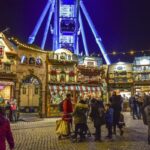
Florence is not the first city that comes to mind for a Christmas market trip, but tucked into Piazza Santa Croce, right in front of one of the city’s grandest Renaissance basilicas, sits one of Italy’s longest-running and most surprising festive markets: a genuine German-style Weihnachtsmarkt, imported wholesale from Heidelberg and now in its 24th year. Wooden chalets selling Glühwein and Lebkuchen stand shoulder to shoulder with a skyline of domes and campaniles that owe nothing to Northern Europe.
That contrast is exactly what makes Florence worth a dedicated Christmas market guide rather than a footnote on a wider Tuscany page. Around 50 wooden huts fill Piazza Santa Croce with pretzels, wurstel and mulled wine sitting alongside proper Tuscan specialities such as panforte, ricciarelli and vin brulé, a genuinely unusual pairing of Northern European market tradition and Italian food culture in one square. The market sits within a much bigger citywide festive programme too, including a separate ice rink at the Fortezza da Basso and a monument-wide light and videomapping festival called Florence Lights Up.
This guide covers where the market actually is and who really runs it, what’s genuinely on the stalls, the entertainment and other festive things happening across the city, the Christmas lights, shop and museum hours over the holiday period, the honest truth about New Year’s Eve in a city that has actually banned fireworks outright, the weather, and how to get there and where to stay. Prices throughout are shown in euros first, since that is the currency the market actually trades in, with pound and dollar conversions alongside.
Florence’s Festive Draws at a Glance
| Event | Location | What It Is |
|---|---|---|
| Weihnachtsmarkt (German Christmas Market) | Piazza Santa Croce | Around 50 stalls, German and Tuscan food, gifts and crafts |
| Florence On Ice | Fortezza da Basso, Piazzale Oriana Fallaci | 320-metre outdoor ice rink |
| Florence Lights Up | Citywide, all five quarters | Videomapping and light installations on major monuments |
All three sit within a comfortably walkable central Florence, so a single trip can realistically take in the market, the rink and at least the historic centre’s share of the lights without needing transport between them. The sections below cover each in turn, along with everything else worth building into a Florence Christmas trip.
Piazza Santa Croce: Where the Market Actually Is
The market fills Piazza Santa Croce, the wide square in front of the Basilica di Santa Croce, one of Florence’s most important churches and the burial place of Michelangelo, Galileo and Machiavelli. Wooden chalets line the piazza’s perimeter, leaving the basilica’s striped marble facade visible above the stalls, a genuinely striking backdrop that no purpose-built German market can match.
For 2026, the market is expected to run from Saturday 14 November to Monday 21 December, based on the confirmed 2026 pattern published by organisers, with the site closing well before Christmas itself. Typical opening hours run 10am to 10pm Monday to Thursday and 10am to 11pm Friday to Sunday, giving genuinely long evening hours for anyone visiting after a day of sightseeing.
Entry is completely free, with no gates or timed slots, and the piazza sits a comfortable 10 to 15 minute walk from the Duomo, well within Florence’s compact and largely pedestrianised historic centre. There is no dedicated market parking, and driving into the UNESCO-listed centre is heavily restricted for non-residents in any case, so arriving on foot or by public transport is the realistic option.
Because Santa Croce is already a major sightseeing stop in its own right, the market naturally folds into a normal day of Florence sightseeing rather than requiring a special separate trip. Visiting in the late afternoon, once the basilica’s queues have thinned and the piazza’s own lights are on, gives the best combination of atmosphere and manageable crowds.
Browse hotels and accommodation for your visit to Florence.
View staysExplore holiday homes and apartments around Florence.
See holiday homesCompare prices for Florence hotels across multiple booking sites.
Check dealsThe Heidelberg Connection: A Genuine German Import
What makes Florence’s market a genuine point of difference from every other Italian Christmas market is that it is not a home-grown Italian invention dressed up as German. The organisers behind Heidelberg’s own famous Weihnachtsmarkt brought the concept to Florence in 2003, and the Piazza Santa Croce market has run every year since, making 2026 its 24th edition.
That German lineage shows in the market’s genuine authenticity rather than a superficial theme. Traders come not only from Germany but from across Europe, including France and the Netherlands, bringing real imported German beer, sausage and Christmas ornaments rather than locally-made approximations, alongside the wider spread of European craft and food stalls.
Unlike Birmingham’s own Frankfurt-linked market, which has grown into one of the largest German markets outside Germany, Florence’s Heidelberg market has stayed deliberately smaller and more intimate, at around 50 chalets rather than a hundred or more. That scale suits the piazza itself, and keeps the market feeling like a genuine curated import rather than a sprawling commercial event competing with Santa Croce’s own architecture for attention.
For anyone deciding between a purely Italian Christmas city break and a Northern European market trip, Florence’s Santa Croce market is a genuinely useful middle ground: real German market culture, transplanted wholesale, inside one of Italy’s most important Renaissance cities. That combination, verified directly against the market’s own 2003 Heidelberg origins rather than assumed, is the page’s real point of difference against generic “Christmas in Florence” content.
What’s on the Stalls: German Imports Meet Tuscan Tradition
The food side of the market splits genuinely evenly between its German roots and its Tuscan setting. Wurstel and pretzels sit alongside proper Tuscan panforte, a dense spiced fruit cake, and ricciarelli, soft almond biscuits dusted in icing sugar, giving visitors a real choice between the market’s imported and local specialities rather than one dominating the other.
On the drinks side, German Glühwein sits directly alongside Italian vin brulé, essentially the same mulled wine tradition under two different names, usually costing around €5 to €7 (£4 to £6 / $5 to $8) including a keepsake mug. German Stollen, the dense, fruit-studded festive cake, and Lebkuchen gingerbread biscuits round out the sweeter German imports.
Craft stalls lean into both traditions too, selling German-style ceramics, handmade ornaments and woollen goods alongside genuinely Tuscan items including leather goods, olive oil, wine and marbled paper, a Florentine speciality dating back centuries. A sausage in a roll typically runs around €6 to €8 (£5 to £7 / $7 to $9), broadly comparable to prices at Germany’s own markets despite the Italian setting.
For anyone wanting a purely Italian festive treat instead, panettone is widely available across the stalls too, Italy’s own traditional Christmas sweet bread, giving the market a genuinely rounded food offering rather than forcing a choice between German and Italian traditions. It is this deliberate blending, rather than one culture simply hosting the other, that gives Florence’s market its real character.
Entertainment and Activities for Families
A Santa’s House sets up directly in front of the basilica for the market’s run, giving children the chance to write letters to Santa and take part in organised festive games throughout the season. It is a genuinely charming, low-key family attraction rather than a heavily ticketed experience, in keeping with the market’s smaller, more intimate scale.
Unlike some larger European Christmas markets, Piazza Santa Croce itself does not run rides, a big wheel or an on-site ice rink, since the piazza’s historic setting and the basilica’s own significance limit how much fairground infrastructure could realistically be added. Anyone specifically wanting rides or a rink needs to look to the city’s other festive events instead, covered in the next section.
Live music is a fairly constant presence around the piazza’s edges during the market’s busiest evenings, generally informal street performance rather than a scheduled programme, and buskers are common along the approach from the Duomo too. The market’s own atmosphere, rather than a fixed entertainment schedule, is really the main draw for an evening visit.
For families wanting a bit more structured entertainment, the Collegio on Ice winter wonderland event elsewhere in the city runs weekend artisan markets alongside live jazz and gospel performances, a genuinely different, more curated festive event to pair with a Santa Croce visit on a longer Florence trip.
Florence On Ice: The City’s Real Ice Rink
For genuine ice skating, Florence On Ice at Piazzale Oriana Fallaci, beside the Fortezza da Basso fortress a short walk from Santa Maria Novella station, is the city’s real answer to the German markets that pair skating with their stalls. Its most recently confirmed season ran from 28 November to 31 January, giving it a notably longer run than the Santa Croce market itself.
The rink covers a genuinely large 320 metres of real ice, among the bigger seasonal rinks in Italy, set against the fortress’s Renaissance-era walls rather than a purpose-built winter village. It is a proper standalone attraction rather than an add-on to the Christmas market, worth budgeting as its own separate outing.
Because the rink sits near Santa Maria Novella station rather than beside Piazza Santa Croce, combining both in one day means factoring in a genuine cross-city walk or a short tram or bus hop, roughly 20 to 25 minutes on foot. Visitors staying more than a single day in Florence are better placed to enjoy both without rushing.
Pricing for seasonal Italian ice rinks typically runs from around €8 to €12 (£7 to £10 / $9 to $13) for a standard adult skating session including hire, though checking the rink’s own current pricing directly before visiting is worth doing since seasonal rink prices can shift year to year.
Florence Lights Up: The City’s Christmas Lights
Florence’s real answer to a single “lights switch-on” event is Florence Lights Up, a citywide light and videomapping festival run directly by the Comune di Firenze rather than a single evening ceremony. Its most recently confirmed run spanned 6 December to 6 January, meaning it comfortably outlasts the Santa Croce market on both ends of the season.
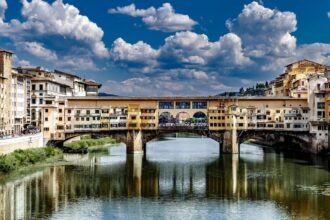
Rather than one switch-on moment, the festival projects videomapping displays directly onto major monuments including Ponte Vecchio, Palazzo Vecchio and the church of San Paolino, alongside lighting installations at Santa Maria Novella square, San Lorenzo square and the courtyard of Palazzo Medici Riccardi. Because these run nightly throughout the festival’s dates rather than as a one-off event, visitors arriving any evening during the run see the full display, not just those who time a trip around a single switch-on date.
Beyond the historic centre, all five of Florence’s city quarters receive their own illuminations, with over 200 Christmas trees and more than 60 kilometres of LED lights strung across the city as a whole. Via de’ Tornabuoni, Florence’s luxury shopping street, runs its own particularly elegant lighting display each year, worth a dedicated evening walk even without buying anything from its boutiques.
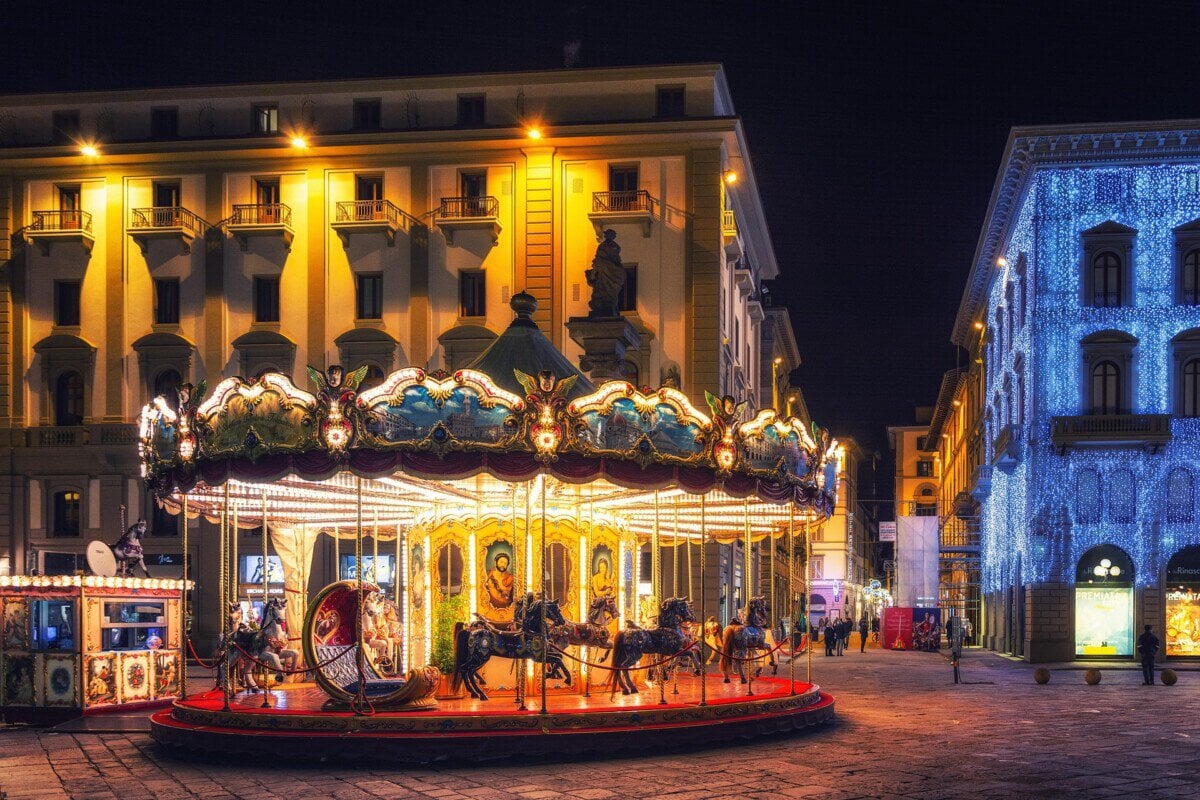
The department store La Rinascente on Piazza della Repubblica also puts on its own festive light display each December, a smaller but genuinely photogenic addition to the wider citywide programme. Taken together, Florence’s lights are less about one big switch-on evening and more about a full month of illuminated monuments worth seeing across several different visits.
Beyond the Market: Other Christmas Things to Do
Florence’s international community runs several smaller festive markets worth knowing about beyond the main Santa Croce stalls. The British Institute Christmas Fair and the AILO Christmas Bazaar, run by the American International League of Florence, both take place in early December most years, generally focused on gifts, crafts and charity fundraising rather than food and drink.
A smaller Nordic Christmas market, known as Joulutori, has also run in recent years at The Social Hub near Piazza della Libertà, giving Florence a genuinely third distinct festive market culture alongside its German and Italian traditions. These smaller markets tend to run for a single weekend rather than the full season, so checking specific dates before planning a visit around one is worth doing.
For music, the Orchestra della Toscana runs a well-regarded Christmas concert at Teatro Verdi, with tickets typically running from around €5 to €24 (£4 to £21 / $5 to $26), a genuinely accessible way to add a proper concert to a Florence festive trip. Several of the city’s churches, including Santa Maria Novella, also hold seasonal services and concerts through December.
Visitors with more time can also day-trip to nearby Tuscan towns running their own festive programmes, including Arezzo’s Città del Natale in Piazza Grande and Empoli’s own Città del Natale, both roughly an hour from Florence by train and running well into January, giving a genuinely different, smaller-town Tuscan Christmas atmosphere to contrast with Florence’s own market.
Search flights and useful route combinations for your trip.
View flightsChoose an Airalo eSIM and arrange mobile data before you arrive.
Browse eSIMsHave a private airport pickup arranged before you travel.
Book a transferShop, Museum and Transport Hours Over Christmas and New Year
Florence’s shops, including those in the historic centre and the outlying districts, generally stay open daily right through to Christmas Eve, unlike some UK and Irish cities where hours pull back noticeably in the final week. On Christmas Day itself, almost all shops close entirely, reopening for normal trading from 26 December onward.
Museums generally close only on 25 December and 1 January rather than across the wider holiday period, a genuinely more generous pattern than several other European cities. A handful of exceptions, including Palazzo Vecchio, the Basilica di Santa Maria Novella and the Museo degli Innocenti, have historically opened even on Christmas Day itself, though checking a specific venue’s own site before visiting is always worth doing.
Autolinee Toscane, which operates Florence’s buses, and regional Trenitalia services both typically run a reduced, Sunday-style holiday timetable on 25 December and 1 January, with a broadly normal service resuming on Boxing Day. Florence’s historic centre is compact enough that many visitors simply walk between the market, museums and their accommodation regardless, reducing how much the reduced transport schedule actually affects a typical trip.
Because Florence’s shops stay open later into December than several Northern European cities, and its museums close on fewer days overall, the city is a genuinely easier place to spend Christmas week itself as a tourist than some of its market-hosting counterparts further north, worth factoring in when choosing between destinations for a late-December trip specifically.
New Year’s Eve in Florence: The Honest Answer
Florence is genuinely worth being direct about on this point, and in an unusual direction: rather than simply lacking an official fireworks display, the Comune di Firenze has actively banned fireworks and firecrackers across the whole city for New Year’s Eve, with an ordinance prohibiting anyone from possessing or setting off pyrotechnics in public spaces from 7pm on 31 December to 7am on 1 January. The ban covers licensed fireworks and commercially available firecrackers alike, and is explicitly framed around public health, noise and animal welfare.
Some travel content online still points visitors toward Piazzale Michelangelo or the banks of the Arno for “spectacular fireworks,” language that reflects informal, privately set-off displays that the city’s own ordinance is specifically trying to reduce rather than an organised civic show. Anyone visiting Florence for New Year’s Eve should plan around the genuinely confirmed official programme instead, not an assumption of fireworks the city is actively discouraging.
That official programme, run by the MUS.E Foundation with the city, centres on free concerts across three piazzas: pop and DJ sets at Piazza Santa Croce, gospel music at Piazza Santissima Annunziata, and jazz at Piazza del Carmine, alongside a light show and midnight countdown at Piazza della Signoria. Within the UNESCO-listed historic centre, additional restrictions on carrying or serving drinks in glass containers apply on the night itself, so a genuine drink in hand needs to come from a proper glass or paper cup rather than a takeaway bottle.
Public transport runs later than usual to support the evening, with extended tram and bus services through the early hours. For a genuinely reliable organised fireworks spectacular as part of a European New Year trip, cities that actually run one, rather than actively banning private displays, remain the more dependable choice; Florence’s own strength on the night is its free, piazza-based concerts and light show instead.
Florence’s December Weather and What to Pack
Florence’s inland Tuscan setting, ringed by hills rather than open to the coast, gives it a genuinely milder December than Northern Europe’s own market cities, though still a proper winter by Italian standards. Daytime highs typically run around 12°C (54°F) at the start of the month, easing to closer to 10°C (50°F) by the end of December, with overnight lows generally between 2°C and 4°C (36°F to 39°F).
Rain is a genuine but not overwhelming factor, with the chance of a wet day running from around 27% early in the month down to roughly 22% by its end, meaning clear, cold evenings are genuinely common for enjoying the market and the lights. A warm coat matters more than a heavy waterproof for most of the month, though packing something water-resistant for the occasional wet evening is still sensible.
Snow is rare in Florence itself, and when it does fall it is usually light and short-lived rather than settling for days, since the city’s position in the Arno valley keeps it noticeably milder than the Apennine hills visible from the city on a clear day. Visitors hoping for a snowy market scene should treat that as a genuine rarity rather than a realistic expectation for a December trip.
Practically, that means layering under a proper coat works better than the heaviest possible winter gear, with comfortable, sturdy footwear given how much of a Florence visit involves walking on the city’s cobbled streets. Evenings at the market and around Florence Lights Up’s illuminated monuments turn noticeably colder than the daytime high once the sun sets, so a scarf and gloves are worth having even on an otherwise mild day.
Getting to Florence and Where to Stay
Florence Airport (Amerigo Vespucci, also known as Peretola) connects directly to the city centre via the T2 tram line, a journey of around 20 minutes to the Alamanni-Strozzi stop beside Santa Maria Novella station, making it one of the more straightforward European airport transfers for a Christmas market trip. Many travellers also fly into the larger Pisa Airport, roughly an hour from Florence by direct train, which can offer more route options and lower fares depending on where a trip originates.
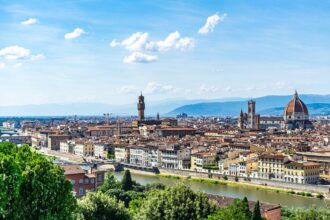
Once in the city, Florence’s compact, largely pedestrianised historic centre means the market, the Duomo and most major sights sit within a genuinely easy walk of each other, and a car is actively unhelpful given the UNESCO centre’s traffic restrictions. Buses and the tram network cover anywhere slightly further out, including the Fortezza da Basso ice rink, without needing to drive.
Accommodation in central Florence typically runs from around €90 to €180 (£78 to £156 / $97 to $195) a night for a well-located double room in December, rising on weekends and around the market’s opening weeks. Staying near Santa Maria Novella station or the Duomo keeps the market, the ice rink and the historic centre’s lights all within easy walking distance of each other.
A single day is enough to take in the Santa Croce market alongside Florence’s major sights, but visitors wanting to add Florence On Ice, a proper evening exploring Florence Lights Up’s full monument circuit, or a day trip to Arezzo or Empoli’s own Christmas towns are better served by staying two or three nights, giving genuine breathing room beyond a single rushed day.

Rupert’s Handy Travel Tips
Rupert has sipped vin brulé under Santa Croce’s marble facade more than once, and reckons Florence rewards a bit of planning at Christmas.
- Visit the market after the basilica’s queues thin out: late afternoon and early evening give the best balance of atmosphere and manageable crowds.
- Don’t expect the market and the ice rink to be next to each other: Florence On Ice sits near Santa Maria Novella station, a genuine walk from Piazza Santa Croce.
- Skip any fireworks plans: Florence actively bans private fireworks on New Year’s Eve, so head to one of the free piazza concerts instead.
- Try vin brulé alongside the Glühwein: it’s the same mulled wine tradition under an Italian name, and a genuine local comparison worth making.
- Walk Via de’ Tornabuoni after dark: the luxury shopping street’s own Christmas lighting is worth seeing even without buying anything.
- Pack a proper coat over a heavy waterproof: Florence’s December is milder and drier than Northern Europe’s own market cities.
Want to meet the reindeer behind our travel tips? Find out more in our page Who is Rupert?.




Frequently Asked Questions About Florence Christmas Markets
When does Florence’s Christmas market open in 2026?
The Piazza Santa Croce Weihnachtsmarkt is expected to run from Saturday 14 November to Monday 21 December 2026, based on the confirmed 2026 pattern published by organisers, in what would be its 24th year.
Is Florence’s Christmas market really German?
Yes, genuinely so. It was brought to Piazza Santa Croce in 2003 by the same organisers behind Heidelberg’s own Weihnachtsmarkt, and many traders and products are imported directly from Germany rather than locally themed.
Is there an ice rink at Florence’s Christmas market?
Not at Piazza Santa Croce itself. Florence On Ice, a separate 320-metre rink at the Fortezza da Basso near Santa Maria Novella station, is the city’s real ice skating option through the season.
Does Florence have fireworks on New Year’s Eve?
No official display, and in fact the city has banned private fireworks and firecrackers entirely for New Year’s Eve. The official programme instead centres on free concerts in three piazzas and a light show and countdown at Piazza della Signoria.
Is Florence’s Christmas market open on Christmas Day?
No, the market closes on 21 December and does not reopen, though unlike the market, many of Florence’s shops stay open right up until Christmas Eve itself.
What is Florence Lights Up?
A citywide light and videomapping festival run by the Comune di Firenze, projecting displays onto monuments including Ponte Vecchio and Palazzo Vecchio, typically running from early December into early January across all five of the city’s quarters.
Will it snow in Florence at Christmas?
Rarely. Florence’s inland but relatively mild Tuscan setting means any snow that does fall is usually light and short-lived, so a proper coat is a safer bet to pack than snow boots.
Further Reading & Related Guides
Florence’s market sits within a much wider European Christmas market scene, and travellers comparing it against Germany and Austria’s own traditional markets should read our European Christmas Markets Guide, which covers dates, atmosphere and what makes each city’s market distinctive.
For the market’s own confirmed opening dates and hours, the City of Florence’s official market listing on Feel Florence is worth checking before a trip.
If Florence is your final destination beyond the market itself, our Things to Do in Florence guide covers the Duomo, the Uffizi, the Oltrarno and the wider city’s attractions for anyone staying beyond a single market visit.
Anyone wanting to see more of Tuscany beyond the city should read our Best Day Trips from Florence guide, covering Pisa, Siena and the Chianti wine region, all realistic additions to a longer festive stay.
Anyone flying in should also read our Florence Airport to City Centre guide, covering the T2 tram, taxis and every other route from Amerigo Vespucci Airport into town.
Florence’s Heidelberg-linked market also makes an interesting comparison against Britain’s own imported German markets. Our coverage of Birmingham’s Frankfurt Christmas Market, brought over from its own German sister city, is worth reading alongside this guide for anyone curious how differently the same idea plays out in an English city centre versus a Renaissance piazza.
For a longer Italian Christmas trip, Florence pairs naturally with nearby Tuscan towns running their own festive programmes, including Arezzo and Empoli’s own Città del Natale events, both under an hour away by train. Travellers building a wider European festive itinerary may also want to look at our coverage of Salzburg and Vienna’s own Christmas markets, both genuinely different in character from Florence’s smaller, more intimate German import.