Reviewed by our editorial team Updated
Why Florence Should Be on Your Italy Itinerary
Florence does not need much of an introduction, and yet it still manages to surprise almost every visitor who arrives expecting a pleasant but predictable stop on the Italian trail. This is genuinely the city where the Renaissance itself was born, and the sheer concentration of world changing art, architecture and history packed into such a compact historic centre remains genuinely difficult to comprehend until you’re standing in the middle of it.
As the capital of Tuscany and the ancestral seat of the Medici family, Florence spent centuries as one of Europe’s wealthiest and most culturally ambitious cities, and that legacy is written into practically every building, church and piazza you’ll pass while exploring on foot. Michelangelo, Botticelli, Brunelleschi and Leonardo da Vinci all left their mark here, and much of their finest work remains on display exactly where it was created or first exhibited.
Unlike some of Italy’s larger cities, Florence’s historic centre is genuinely walkable, small enough that most of its headline sights sit within a twenty minute stroll of one another, yet dense enough with genuine masterpieces that even a week barely scratches the surface for art enthusiasts. This makes it an unusually forgiving city to visit, whether you have a single rushed day or a leisurely week to explore.
This guide covers the essential things to do in Florence, from climbing the Duomo’s famous dome and standing before Michelangelo’s David through to sampling Tuscan cuisine, wandering the Oltrarno district after dark, and deciding whether an attraction pass genuinely makes sense for your specific trip.
Top Attractions at a Glance
Before working through each attraction in detail, it genuinely helps to see how Florence’s biggest draws compare on cost, time needed and who each one actually suits. Some, like the Uffizi Gallery, genuinely reward setting aside half a day or more, while others, such as a stroll across Ponte Vecchio or an evening at Piazzale Michelangelo, cost nothing at all and slot easily into almost any itinerary.
Florence genuinely rewards a mix of paid museums and free sights rather than leaning entirely on ticketed attractions the way some cities do. The table below groups the essentials by rough cost and time commitment, giving you a realistic starting point for building a day by day plan rather than trying to squeeze everything into a single overwhelming day.
Prices at Florence’s major museums do shift periodically, particularly around seasonal changes and peak versus off peak entry windows, so it is always genuinely worth checking official websites close to your travel dates. That said, the figures below reflect current typical pricing and should give you a genuinely reliable starting point for budgeting your visit.
Note that several of the city’s biggest sights, including the Uffizi, Accademia and Palazzo Pitti, sit within reach of combined tickets or city passes that can meaningfully reduce the total cost if you’re planning to visit more than two or three paid attractions, a topic covered in detail later in this guide.
| Attraction | Cost | Time Needed | Best For |
|---|---|---|---|
| Florence Cathedral (Duomo) | Free church, €30 (£26 / $35) Brunelleschi Pass for dome | 1.5 to 2 hours | Iconic dome and cathedral complex |
| Accademia Gallery | €16, about €20 with the booking fee | 1 to 1.5 hours | Michelangelo’s David |
| Uffizi Gallery | €16-25 (£14-22 / $19-29) | 2 to 3 hours | World class Renaissance art |
| Ponte Vecchio | Free | 20 to 30 minutes | Iconic bridge and photos |
| Piazza della Signoria | Free | 30 to 45 minutes | Open air sculpture and history |
| Boboli Gardens | €10 on the day, €13 in advance, or €22 with Pitti | 1 to 2 hours | Renaissance gardens and views |
| Palazzo Pitti | €16 alone, €22 combined with Boboli | 1.5 to 2 hours | Medici palace and paintings |
| Santa Croce Basilica | €8 (£7 / $9) | 45 minutes to 1 hour | Tombs of Michelangelo and Galileo |
| Mercato Centrale | Free to browse | 1 hour | Local food culture |
| Piazzale Michelangelo | Free | 30 to 60 minutes | Sunset views over the city |
Compare hotels and other places to stay in Florence.
Check availabilityExplore holiday homes and apartments around Florence.
See holiday homesCompare prices for Florence hotels across multiple booking sites.
Check dealsClimb to the Top of Florence Cathedral
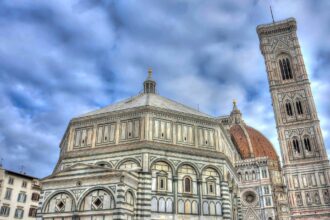
Climbing to the top of Brunelleschi’s Dome is genuinely one of the defining experiences of a visit to Florence, rewarding the effort of over four hundred narrow, winding steps with a panoramic view across the entire historic centre and out towards the surrounding Tuscan hills. The dome itself, crowning the Florence Cathedral, known locally as the Duomo or Santa Maria del Fiore, remains a genuine feat of Renaissance engineering that architects still study today.
Completed in the fifteenth century without the wooden supporting frame typically used for domes of its scale, Brunelleschi’s design used an ingenious double shell construction that allowed the structure to support its own weight during construction. Climbing between the two shells lets you appreciate this engineering up close, along with genuinely close views of The Last Judgment, the vast fresco covering the interior of the dome itself.
Entry to the cathedral’s ground floor is free, but climbing the dome requires a ticket, generally bundled into a wider Brunelleschi Pass costing €30 (£26 / $35), which also covers the Baptistery, Giotto’s Bell Tower, and the Opera del Duomo Museum across a seventy two hour validity window. This flexibility lets you spread your Duomo complex visits across several days rather than trying to fit everything into a single exhausting morning.
Given how popular the dome climb genuinely is, booking a timed slot well in advance is essential, particularly during peak season when passes can sell out weeks ahead. If you’re visiting the Bell Tower instead, it offers a genuinely comparable view of the dome itself from the outside, arguably a better photograph, without requiring quite the same physical effort as the narrower dome staircase.
Climb Giotto’s Bell Tower
Standing beside Florence Cathedral, Giotto’s Bell Tower is one of the city’s most recognisable landmarks and offers one of the finest views in Florence. While many visitors head straight for Brunelleschi’s famous dome, the bell tower provides an equally rewarding experience and is often the better choice if your main goal is to photograph the city’s skyline.
Designed by the renowned artist and architect Giotto di Bondone, construction of the tower began in 1334, although it was completed after his death by Andrea Pisano and Francesco Talenti. Rising to almost 85 metres, the elegant Gothic tower is decorated with white, green and pink marble that perfectly complements Florence Cathedral and the nearby Baptistery, making it one of the most beautiful bell towers in Italy.
Climbing the tower involves tackling 414 steps, but unlike the Duomo climb there are no particularly narrow passageways or enclosed spaces, making it a more comfortable option for many visitors. The reward at the top is a spectacular panoramic view across Florence, with the enormous red-tiled dome of Santa Maria del Fiore dominating the skyline. It is one of the few places where you can fully appreciate Brunelleschi’s masterpiece from close range while also enjoying views across the surrounding Tuscan hills.
Entry to Giotto’s Bell Tower is included with the Brunelleschi Pass, which also covers the Cathedral complex, Baptistery and Opera del Duomo Museum over a 72-hour period. While the dome remains Florence’s most famous climb, many visitors actually prefer the Bell Tower because the views include the cathedral itself, creating one of the city’s most iconic photo opportunities.
Admire Michelangelo’s David
Standing in front of Michelangelo’s David is genuinely one of those rare travel moments that lives up to the hype, even for visitors who’ve seen the statue reproduced in photographs their whole lives. Housed in the Accademia Gallery, the original marble sculpture stands considerably taller in person than most people expect, and the specially built rotunda surrounding it, designed specifically to showcase the statue with natural light, adds genuine theatrical weight to the encounter.
Carved from a single, famously flawed block of marble that other sculptors had already rejected, Michelangelo completed the statue in the early sixteenth century as a young artist still building his reputation. The finished work became an instant civic symbol for Florence, representing the city’s own sense of defiant strength against considerably larger rivals, and it remains one of the most recognisable sculptures anywhere in the world today.
Tickets to the Accademia are €16 (£14 / $19) for standard entry, rising to about €20 (£17 / $23) once the gallery’s €4 (£3.50 / $5) booking fee is added for a reserved time slot, and given that the gallery receives close to two million visitors a year, booking a timed entry slot well ahead of your visit is genuinely essential rather than optional, particularly during the busy summer months.
Beyond David itself, the Accademia holds several other genuinely worthwhile Michelangelo works, including his unfinished Prisoners sculptures, along with a broader collection of Renaissance paintings that most visitors rush past on their way to the main attraction. For a considerably more detailed look at the Accademia alongside Florence’s other major museums, our dedicated Best Museums in Florence guide covers ticketing, timing and what else is genuinely worth seeing inside.
Relax in the Rose Garden
Just below Piazzale Michelangelo, the Giardino delle Rose, or Rose Garden, is one of Florence’s most peaceful attractions and remains surprisingly overlooked by many visitors. Covering around one hectare on the hillside overlooking the city, the garden offers spectacular panoramic views without the large crowds that often gather at the famous viewpoint above.
The garden contains hundreds of varieties of roses, alongside ornamental plants, terraces and shaded pathways that make it an ideal place to escape the busy streets of the historic centre. The best time to visit is between May and June, when the roses are in full bloom, although the garden remains an attractive place to relax throughout much of the year thanks to its beautiful setting.
As well as its flowers, the Rose Garden features a collection of whimsical bronze sculptures by Belgian artist Jean-Michel Folon, whose colourful works are dotted throughout the grounds. These unusual sculptures add an extra dimension to the visit and make the gardens feel more like an open-air gallery than a traditional public park.
One of the biggest attractions is the uninterrupted view across Florence. From here you can admire Florence Cathedral, Palazzo Vecchio, the River Arno and the city’s terracotta rooftops, all framed by the surrounding Tuscan hills. The atmosphere is generally much quieter than Piazzale Michelangelo, making it a perfect place to enjoy a picnic, take photographs or simply relax after a busy morning of sightseeing.
Perhaps best of all, entry to the Rose Garden is completely free. It combines beautifully with a visit to Piazzale Michelangelo or the nearby Basilica of San Miniato al Monte, creating one of the most enjoyable walks in Florence while introducing visitors to one of the city’s best-kept secrets.
Explore the Uffizi Gallery
The Uffizi Gallery is genuinely the single most important art museum in Florence, and arguably one of the finest anywhere in the world, housing an extraordinary collection of Renaissance masterpieces assembled over centuries by the ruling Medici family before being bequeathed to the city itself. For many visitors, the Uffizi alone justifies an entire trip to Florence.
The collection’s undisputed highlight is Botticelli’s The Birth of Venus, displayed alongside his equally celebrated Primavera in a room that draws crowds throughout the day. Beyond Botticelli, the galleries hold significant works by Leonardo da Vinci, including his early Annunciation, alongside pieces by Raphael, Titian, Caravaggio and countless other artists whose work fundamentally shaped the course of Western art history.
Standard tickets cost €25 (£22 / $29) bought on the day, dropping to €16 (£14 / $19) for afternoon entry from four o’clock onwards, as the Uffizi Galleries’ official ticket page sets out, a genuinely useful budget option for visitors happy to explore later in the day rather than first thing in the morning. Given the sheer scale of the collection, allowing at least two to three hours for your visit is genuinely worthwhile, and serious art enthusiasts can easily spend the better part of a day working through every wing.
Booking a timed entry slot well in advance is essential given the Uffizi’s enormous popularity, particularly during the busy spring and summer months when walk up queues can stretch for hours outside the entrance. For a considerably deeper look at the Uffizi’s individual rooms, must see paintings and how it compares with Florence’s other major galleries, our Best Museums in Florence guide covers everything in far more detail than we can fit here.
Cross the Famous Ponte Vecchio
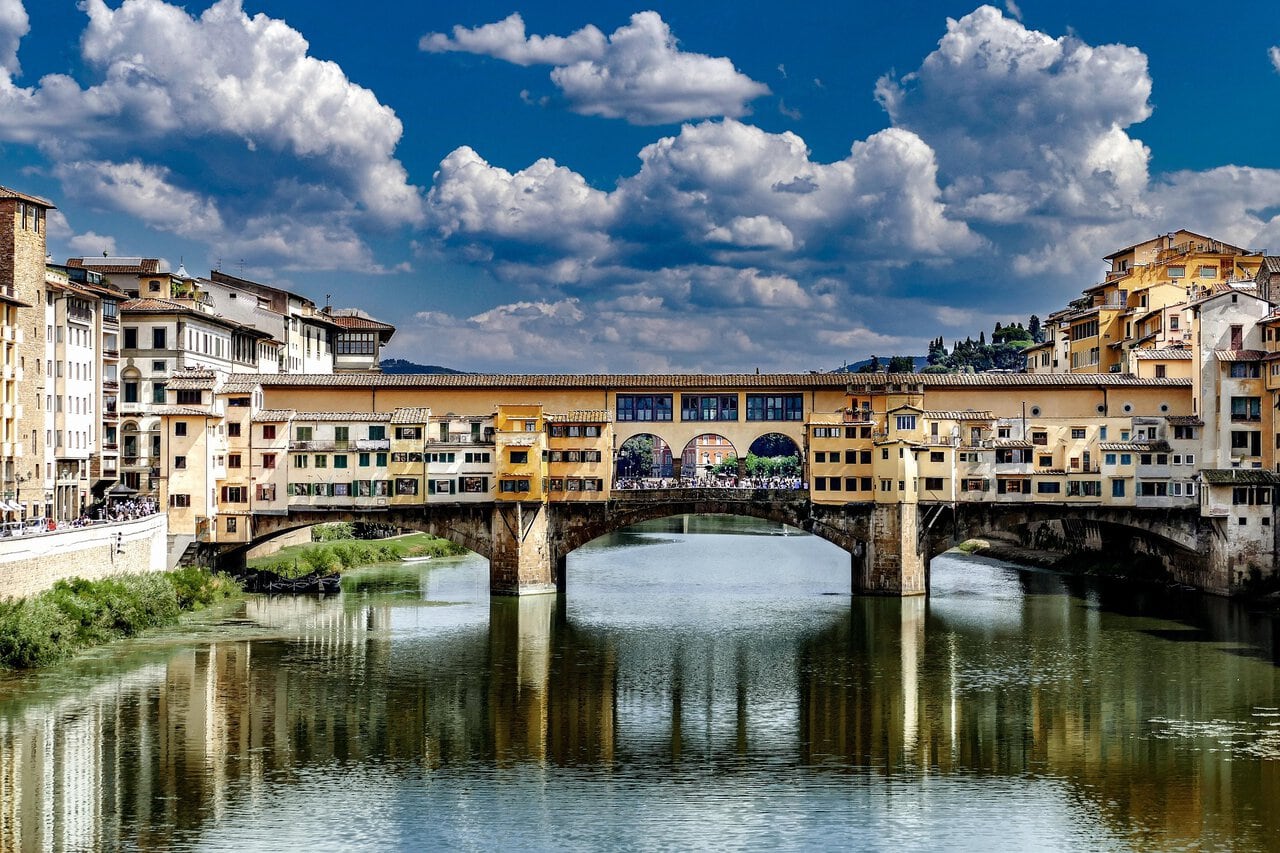
Crossing the Ponte Vecchio is one of the most photographed moments of any Florence visit, and genuinely one of the few remaining medieval bridges anywhere in Europe still lined with shops rather than simply pedestrian traffic. The bridge has spanned the Arno River in more or less its current form since the fourteenth century, surviving centuries of flooding and, remarkably, deliberate destruction during the Second World War.
The shops lining both sides of the bridge today deal almost exclusively in gold jewellery, a tradition dating back to the sixteenth century when the ruling Medici family, reportedly offended by the smell of the butchers and tanners who previously occupied the bridge, ordered them replaced with goldsmiths instead. Many of these jewellery workshops remain family run businesses today, some tracing their history back several generations.
Above the shops runs the Vasari Corridor, an elevated passageway built to allow the Medici family to move between the Palazzo Vecchio and Palazzo Pitti without needing to walk through the crowded streets below. Reopened to visitors and bookable on a combined Uffizi and Vasari Corridor ticket, it adds another genuinely fascinating layer to the bridge’s already rich history for anyone who looks up while crossing.
Crossing the Ponte Vecchio costs nothing and takes only a few minutes, but the surrounding views, particularly from the neighbouring Ponte Santa Trinita looking back towards the bridge itself, are genuinely worth pausing for. Early morning or early evening tends to offer the best light and considerably thinner crowds than the middle of the day, when the bridge becomes one of Florence’s busiest pedestrian bottlenecks, particularly during the peak summer tourist season.
Search routes and flight options for your trip to Florence.
Search flightsChoose an Airalo eSIM and arrange mobile data before you arrive.
Browse eSIMsHave a private airport pickup arranged before you travel.
Book a transferWander Through Piazza della Signoria
Piazza della Signoria has functioned as the civic and political heart of Florence since the medieval era, and it remains genuinely one of the best places to get a first feel for the city’s layered history in a single visit. Dominated by the imposing Palazzo Vecchio, Florence’s fortress like town hall, the square has witnessed everything from public executions to Renaissance triumphs across its long history.
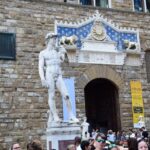
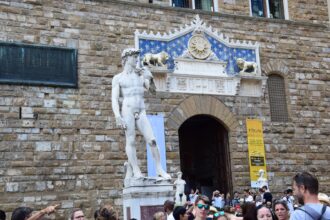
The piazza doubles as a genuinely impressive open air sculpture gallery, with the Loggia dei Lanzi along one edge sheltering a collection of significant Renaissance and classical statues that visitors can view completely free of charge. A replica of Michelangelo’s David stands at the palace entrance, marking the original statue’s location before it was moved indoors to the Accademia for its own protection.
The Fountain of Neptune, an ambitious sixteenth century sculpture that locals nicknamed rather unkindly for its perceived shortcomings, sits at the square’s centre and remains a popular meeting point and photograph spot throughout the day. Surrounding cafés and restaurants offer a genuinely pleasant vantage point for people watching, though prices here tend to run higher than elsewhere in the city given the prime location.
Piazza della Signoria costs nothing to visit and works well at almost any time of day, though evenings bring a noticeably different atmosphere as the square fills with both locals and visitors enjoying an aperitivo against the illuminated backdrop of Palazzo Vecchio. Given its central position, the piazza also makes a genuinely natural starting point for exploring the Uffizi, Ponte Vecchio and much of the surrounding historic centre on foot, without needing to consult a map too closely along the way.
Relax in the Boboli Gardens
The Boboli Gardens offer a genuinely welcome change of pace from Florence’s dense, art heavy historic centre, providing acres of formally landscaped Renaissance parkland right behind Palazzo Pitti in the Oltrarno district. Laid out from the sixteenth century onward as the private gardens of the ruling Medici family, they now rank among the finest historic gardens found anywhere in Italy.
Wandering the grounds takes you past elaborate fountains, classical statues, grottoes and carefully sculpted hedges, all arranged across a hillside that offers genuinely rewarding views back across the city towards the Duomo’s dome. The Amphitheatre, built into a natural depression in the hillside, was originally used for Medici family entertainments and remains one of the garden’s most striking architectural features today.
Standard admission to the Boboli Gardens is €10 (£9 / $12) bought on the day, or €13 (£11 / $15) booked in advance, though a combined ticket covering both the gardens and neighbouring Palazzo Pitti costs €22 (£19 / $26) on the day and €25 (£22 / $29) in advance, genuinely worth considering if you’re planning to visit both attractions on the same day. Given the size of the grounds, allowing at least an hour or two for a proper wander is genuinely worthwhile, longer if you want to explore every corner and grotto.
The gardens work particularly well as a mid afternoon break between more intensive museum visits, offering fresh air and considerably more breathing room than the crowded streets of the historic centre nearby. Spring and early autumn tend to bring the most pleasant weather for exploring, though the gardens remain genuinely worth a visit throughout the year given how much of the appeal lies in the architecture and views rather than seasonal planting alone, unlike some purely botanical gardens elsewhere.
Tour Palazzo Pitti
Palazzo Pitti is genuinely one of Florence’s most underrated major sights, a vast Renaissance palace across the river from the historic centre that once served as the primary residence of the ruling Medici family before later becoming home to Italy’s royal House of Savoy. Its sheer scale and relatively lower visitor numbers compared with the Uffizi make it a genuinely rewarding stop for anyone wanting a quieter, more spacious museum experience.
Inside, the Palatine Gallery houses an extraordinary collection of paintings displayed in the lavish, over the top style of a genuine royal residence, with works stacked salon style across ornately frescoed ceilings rather than arranged with the clinical precision of a modern gallery. Raphael, Titian and Rubens all feature prominently among the collection’s highlights, alongside room after room of gilded Medici and Savoy era furnishings.
Beyond the Palatine Gallery, Palazzo Pitti also houses several smaller specialist museums covering costume history, silver and precious objects, and modern art, giving visitors with a full afternoon to spare considerably more to explore than the headline paintings alone. The palace connects directly to the Boboli Gardens covered in the previous section, making the two attractions a natural pairing for a single visit.
Entry is €16 (£14 / $19) on the day for the palace alone, or €22 (£19 / $26) when combined with Boboli Gardens access, and given the palace’s genuine scale, allowing at least ninety minutes to two hours is worthwhile if you want to see more than just the headline rooms. For a considerably more detailed breakdown of what’s inside Palazzo Pitti and how it compares with Florence’s other major museums, our Best Museums in Florence guide covers it in far greater depth.
Discover Santa Croce Basilica
Santa Croce Basilica is genuinely one of Florence’s most significant churches, often nicknamed the “Temple of the Italian Glories” thanks to the extraordinary roll call of historical figures buried or memorialised within its walls. Standing inside, it becomes quickly apparent why the church holds such an outsized place in Italian national identity beyond its purely religious significance, a resting place for the country’s own cultural memory.
Among the tombs housed here are those of Michelangelo, Galileo Galilei, Machiavelli and the composer Rossini, alongside a cenotaph honouring Dante, whose actual remains rest in Ravenna rather than his native Florence. Walking between these monuments genuinely feels like tracing the intellectual history of Italy itself, condensed into a single, remarkably atmospheric Gothic interior.
Beyond the tombs, Santa Croce holds significant artistic treasures of its own, including Giotto’s frescoes in the Bardi and Peruzzi chapels, considered among the most important surviving works of early Renaissance painting anywhere in Florence. The adjoining Pazzi Chapel, designed by Brunelleschi, offers a genuine masterclass in restrained, harmonious Renaissance architecture that contrasts nicely with the basilica’s more ornate main interior.
Entry costs around eight euros, considerably less than Florence’s headline museums, and the basilica tends to be noticeably quieter than the Duomo or Uffizi, particularly during Sunday afternoon slots when many first time visitors overlook it entirely. Allow around forty five minutes to an hour for a proper visit, and consider combining it with a wander through the surrounding Santa Croce neighbourhood, genuinely one of the more authentic, less touristy corners of central Florence, filled with leather workshops and unhurried local trattorias.
Discover More of Florence’s Outstanding Museums
While the Uffizi Gallery, Accademia Gallery and Palazzo Pitti understandably attract most of the attention, Florence is packed with smaller museums that reward visitors willing to venture beyond the obvious highlights. If you have more than a couple of days in the city, or you’ve already visited the major attractions, these collections offer a deeper understanding of Florence’s Renaissance history, science, archaeology and artistic heritage.
One of the finest is the Bargello Museum, housed inside a medieval palace that once served as Florence’s prison and law court. Today it contains one of Italy’s greatest collections of Renaissance sculpture, including masterpieces by Donatello, Michelangelo, Verrocchio and Cellini. It is often quieter than the Uffizi and Accademia, allowing you to admire works at a much more relaxed pace.
Art lovers should also consider the Museo dell’Opera del Duomo, which displays many of the original sculptures, carvings and treasures removed from Florence Cathedral to protect them from the elements. Among its highlights are Ghiberti’s original Gates of Paradise, Michelangelo’s unfinished Pietà Bandini, and Brunelleschi’s architectural models, making it one of the best places to appreciate the extraordinary craftsmanship behind the Duomo complex.
Science enthusiasts will enjoy the Galileo Museum, located close to the River Arno. Its fascinating collection includes original scientific instruments used by Galileo Galilei, astronomical devices, globes and early measuring equipment that demonstrate how Florence became one of Europe’s leading centres of scientific discovery during the Renaissance.
History lovers should not overlook the National Archaeological Museum, home to one of Italy’s finest collections of Etruscan artefacts, alongside Greek and Roman sculptures, ancient Egyptian antiquities and beautifully preserved ceramics. It provides valuable context for understanding the civilisations that shaped Tuscany long before the Renaissance transformed Florence into one of Europe’s greatest cultural capitals.
If you’re fascinated by Michelangelo, the Museo Casa Buonarroti, the artist’s former family home, contains early sculptures, sketches and personal memorabilia that provide a more intimate perspective than simply seeing David at the Accademia. Together, these smaller museums demonstrate that Florence’s cultural riches extend far beyond its headline attractions.
Many of these museums are included in the Firenze Card or other Florence attraction passes, making them excellent value if you’re planning several museum visits during your stay. If you’d like a full comparison of every major collection, including ticket prices, opening times, highlights and which museums are genuinely worth prioritising, our dedicated Best Museums in Florence Guide explores each one in much greater detail.
Visit the Mercato Centrale
The Mercato Centrale is genuinely one of the best places in Florence to experience the city’s food culture up close, a two storey covered market that has served locals since the nineteenth century and now doubles as a lively food hall for visitors. Located near San Lorenzo, just a short walk from the Duomo, it makes a genuinely easy addition to a morning spent exploring the historic centre on foot.
The ground floor houses traditional stalls selling fresh Tuscan produce, cured meats, cheeses, olive oil and pasta, essentially a working food market where locals still do their weekly shopping alongside curious visitors. Wandering between stalls offers a genuinely different perspective on Florence than the museums and monuments covered elsewhere in this guide, showing the city’s everyday rhythms rather than its historical monuments.
Upstairs, the more recently renovated food hall brings together numerous individual vendors serving everything from fresh pasta and pizza to steak, gelato and craft beer, all arranged around shared communal seating. This makes it a genuinely good option for lunch, particularly if your group can’t agree on a single cuisine, since everyone can choose something different and still eat together at the same table.
Entry to browse the market is entirely free, and there’s genuinely no obligation to buy anything beyond whatever catches your eye as you wander between the stalls. Weekday mornings tend to be considerably quieter than weekends, when both the ground floor market and upstairs food hall fill with a genuinely lively mix of locals and tourists alike, particularly around the lunchtime rush and again in the early evening.
Compare hostels and budget-friendly accommodation around Florence.
Browse hostelsGet help with compensation, eligible lounge access and disruption support.
Explore AirHelp+Use convenient luggage storage around Florence between arrival, check-in and departure.
Check storageBrowse the San Lorenzo Market
If you’re looking for souvenirs, local produce or simply a lively atmosphere, San Lorenzo Market is one of the best places to visit in Florence. Stretching around the Basilica of San Lorenzo and the Mercato Centrale, it combines one of the city’s busiest outdoor markets with Florence’s famous indoor food market, making it easy to spend several enjoyable hours exploring the area.
The outdoor market is best known for its wide selection of Italian leather goods, with stalls selling handbags, wallets, belts, jackets and luggage alongside clothing, scarves, gifts and souvenirs. While browsing is part of the fun, it’s worth taking your time and comparing quality between different stalls, as products range from inexpensive souvenirs to genuine handmade leather items produced by local artisans.
Just behind the market sits the Mercato Centrale, where the ground floor continues to operate as a traditional food market selling fresh fruit, vegetables, cheeses, cured meats, olive oils and other Tuscan specialities. Upstairs, the modern food hall brings together a wide range of independent vendors serving fresh pasta, pizza, steak, seafood, gelato and regional wines, making it one of Florence’s most popular lunch destinations.
The market’s central location also makes it easy to combine with visits to San Lorenzo Basilica, the Medici Chapels and Florence Cathedral, all of which are within a short walk. Whether you’re shopping for gifts, sampling Tuscan food or simply soaking up the atmosphere, San Lorenzo Market offers a different side of Florence that complements the city’s world-famous museums and historic landmarks.
Ride the Florence Hop-On Hop-Off Bus
Florence’s Hop-On Hop-Off sightseeing bus offers a genuinely useful option for visitors who want an overview of the city without committing to walking everywhere on foot, particularly given how compact the historic centre already is compared with the attractions sitting slightly further out. Open top double decker buses run along fixed routes, letting you hop off at any stop and rejoin a later bus once you’ve finished exploring.
The routes typically connect Florence’s headline sights, including the Duomo, Ponte Vecchio and Piazza della Signoria, with destinations that are genuinely more awkward to reach on foot, particularly Piazzale Michelangelo, covered later in this guide, whose uphill walk puts many visitors off despite the spectacular view waiting at the top. The bus removes that barrier entirely, delivering you directly to the viewpoint without the climb.
Tickets are typically sold in twenty four or forty eight hour blocks, running to somewhere around twenty five to thirty euros depending on the exact provider and duration chosen, with multilingual audio commentary included throughout the journey explaining the history behind each landmark you pass. Given Florence’s genuinely compact centre, many first time visitors initially assume they won’t need the bus at all, only to find it useful once their feet start tiring by the second or third day.
The bus works particularly well combined with one of the Florence attraction passes covered later in this guide, several of which include hop on hop off access as an optional add on rather than a standalone purchase. For visitors staying purely within the immediate historic centre and skipping Piazzale Michelangelo entirely, walking alone will likely suffice without needing the bus at all.
Discover the Legacy of the Medici Family
It is impossible to understand Florence without understanding the Medici family. Although they never officially ruled the city as kings, the Medici became one of Europe’s most powerful banking dynasties during the Renaissance, using their immense wealth to transform Florence into a centre of art, architecture and learning. Their influence can still be seen throughout the city, making a little knowledge of their story one of the best ways to appreciate everything you will see during your visit.
Beginning in the fifteenth century, the Medici family financed some of history’s greatest artists and architects, including Michelangelo, Leonardo da Vinci, Botticelli and Brunelleschi. Their patronage helped create many of Florence’s most famous masterpieces, while their political influence shaped the city for almost three centuries. Rather than simply collecting art, the Medici commissioned works that would define the Renaissance and leave a lasting legacy across Europe.
Many of Florence’s biggest attractions are closely linked to the Medici family. The Uffizi Gallery began life as government offices commissioned by Cosimo I de’ Medici before becoming home to the family’s extraordinary art collection. Palazzo Pitti became the Medici residence after it was purchased by Eleanor of Toledo, while the magnificent Boboli Gardens were developed as the family’s private gardens. The Medici Chapels at the Basilica of San Lorenzo contain the family’s elaborate tombs, including Michelangelo’s remarkable sculptures.
As you explore Florence, you’ll quickly notice that the Medici name appears everywhere. Their wealth funded churches, libraries, palaces and scientific discoveries, helping Florence become one of the richest and most culturally important cities in Europe. Even attractions such as the Galileo Museum owe part of their existence to Medici patronage, with Galileo himself working under the protection of the family.
Learning about the Medici adds another dimension to your visit. Instead of seeing Florence as a collection of beautiful buildings and museums, you begin to understand how one remarkable family helped shape the city into the birthplace of the Renaissance.

Visit the Basilica of San Lorenzo and the Medici Chapels
Although the Duomo attracts most first-time visitors, the Basilica of San Lorenzo is one of Florence’s most historically important churches. Located just a short walk from the Central Market, it was the parish church of the Medici family for generations and became their chosen burial place, making it one of the city’s most significant Renaissance landmarks.
The church itself was redesigned by Filippo Brunelleschi, whose clean, elegant architectural style marked a turning point in Renaissance design. Inside, the spacious interior contrasts with the richly decorated churches found elsewhere in Italy, creating a peaceful atmosphere that encourages visitors to slow down and appreciate the building’s remarkable proportions and craftsmanship.
For many visitors, however, the true highlight lies next door in the Medici Chapels. Here you’ll find the lavish mausoleum built for the Medici family, including Michelangelo’s famous sculptures representing Day, Night, Dawn and Dusk. These dramatic marble figures rank among the artist’s greatest achievements and offer a completely different experience from seeing David at the Accademia Gallery.
The church is also closely linked with Florence’s famous San Lorenzo Market, making it easy to combine history, shopping and local food in a single visit. Spend time exploring the leather market outside before heading into the Mercato Centrale for lunch or an afternoon coffee.
Whether you’re interested in Renaissance architecture, Michelangelo’s sculptures or the fascinating story of the Medici family, San Lorenzo deserves a place on every Florence itinerary. It may receive fewer visitors than the Duomo, but many travellers leave saying it was one of the most rewarding attractions they experienced.
Explore the Artisan Quarter of Oltrarno
Crossing the Ponte Vecchio into Oltrarno feels like stepping into a different side of Florence. While the streets around the Duomo are often crowded with visitors, Oltrarno has managed to preserve much of its traditional character, with artisan workshops, quiet squares and family-run cafés giving the neighbourhood a more authentic atmosphere.
For centuries, this district has been home to skilled craftsmen producing everything from handmade leather goods and jewellery to furniture, ceramics and intricate paper products. Many workshops still welcome visitors, allowing you to watch artisans at work and purchase unique souvenirs directly from the people who create them.
The heart of the district is Piazza Santo Spirito, one of Florence’s liveliest neighbourhood squares. During the day, locals gather in cafés while visitors browse independent boutiques and small galleries tucked away in the surrounding streets. The atmosphere is noticeably more relaxed than the busy streets north of the River Arno, making it an ideal place to slow down and enjoy everyday Florentine life.
Oltrarno is also home to several important attractions, including Palazzo Pitti, the Boboli Gardens and the Brancacci Chapel, allowing you to combine sightseeing with wandering through one of Florence’s most attractive neighbourhoods. Many of the city’s best traditional restaurants and wine bars are also located here, making it a wonderful area to linger over lunch before continuing your exploration.
If you’ve already visited Florence’s headline attractions, spending a few hours exploring Oltrarno offers a completely different perspective on the city. It’s a neighbourhood where getting lost is part of the experience, with quiet lanes, hidden courtyards and artisan workshops waiting around almost every corner.
Join a Tuscan Cooking Class
Joining a Tuscan cooking class is genuinely one of the more memorable ways to spend an afternoon or evening in Florence, moving beyond simply eating the region’s famous cuisine to actually understanding how it’s made. Most classes run for around three to four hours, typically including a market visit or ingredient briefing before hands on cooking and a genuinely satisfying shared meal at the end of the session.
Classic dishes taught in most Florentine cooking classes include fresh pasta made entirely by hand, traditional ragù, and regional specialities such as ribollita, the hearty Tuscan bread and vegetable soup that showcases the region’s tradition of using every last scrap of good ingredients rather than wasting anything. Some classes also cover Florentine specific dishes, including the famous bistecca alla fiorentina, the region’s celebrated T-bone steak.
Classes typically cost somewhere between seventy and one hundred and twenty euros per person, varying considerably depending on group size, whether the class includes wine pairings, and whether it’s held in a professional cooking school or a more intimate private home setting. Smaller groups and private classes naturally cost more but offer a genuinely more personal, hands on experience than larger group sessions, with more direct time alongside the instructor.
Beyond the practical cooking skills, these classes offer a genuinely valuable window into Tuscan food culture and the philosophy behind it, something that simply eating in restaurants doesn’t always convey as clearly. For families or groups looking for a shared activity beyond museum visits, a cooking class also provides a genuinely memorable, tangible souvenir in the form of recipes you can recreate long after your trip to Florence has ended.

Sample Authentic Florentine Cuisine
Beyond a dedicated cooking class, simply eating your way through Florentine cuisine is genuinely one of the highlights of any visit to the city, with a food culture built on rustic, ingredient led simplicity rather than elaborate presentation. Tuscan cooking generally favours a handful of excellent ingredients treated with genuine respect over complicated technique, and Florence’s restaurants reflect that philosophy throughout.
The signature dish to try is bistecca alla fiorentina, an enormous T-bone steak from the region’s native Chianina cattle, traditionally grilled rare over an open flame and served simply with lemon and olive oil rather than heavy sauces. Given its size, the dish is typically ordered to share between two or more people, and genuinely good versions can be found across a wide range of price points throughout the historic centre.
Beyond steak, look out for ribollita, a hearty bread and vegetable soup that exemplifies Tuscan cucina povera, the region’s tradition of transforming humble, inexpensive ingredients into genuinely satisfying meals. Pappa al pomodoro, a similarly rustic tomato and bread soup, and panzanella, a bread based summer salad, both reflect the same resourceful culinary tradition that runs throughout Tuscan cooking more broadly.
For something sweeter, Florence’s gelato culture rivals anywhere in Italy, and seeking out artisan gelaterias using natural colours and seasonal ingredients rather than the artificially bright displays found at more tourist focused shops is genuinely worth the small extra effort. Wine lovers should also sample Chianti, produced in the rolling hills surrounding the city and available by the glass at practically every restaurant and wine bar throughout Florence’s historic centre, often at genuinely reasonable prices.
Enjoy Sunset at Piazzale Michelangelo
Watching the sunset from Piazzale Michelangelo is genuinely one of the most rewarding, free experiences Florence has to offer, delivering a sweeping panoramic view across the entire historic centre from a hillside terrace on the opposite side of the Arno. As the light fades and the Duomo’s dome catches the last of the sun, it’s easy to understand why this remains one of the most photographed viewpoints in the city.
The square takes its name from another bronze replica of Michelangelo’s David, standing at its centre alongside replicas of his other Florentine sculptures, though most visitors barely glance at the statue given the view stretching out behind it. From here, practically every major landmark covered elsewhere in this guide becomes visible at once, from the Duomo and Palazzo Vecchio through to Santa Croce and the winding path of the Arno itself.
Reaching the piazzale involves a genuinely steep uphill walk from the riverside, taking around twenty to thirty minutes on foot depending on your pace and fitness, though the Hop-On Hop-Off bus covered earlier in this guide also stops here directly, removing the climb entirely for visitors who would rather save their energy. Regular city buses serve the area too, offering a considerably cheaper alternative to the sightseeing bus for a single one way trip.
Entry to the piazzale itself is entirely free, and arriving thirty minutes or so before sunset genuinely gives you time to find a good spot before the crowds build, since this is one of Florence’s most popular gathering points as the day winds down. Bringing a bottle of wine and simply sitting on the steps to watch the sky change colour over the city is a genuinely popular, low cost way to spend an evening here.
Discover Florence’s Lively Evening Food and Wine Scene
While Florence may be best known for its Renaissance art and architecture, the city takes on a completely different character once the museums close and the crowds begin to thin. Evenings in Florence are less about rushing between attractions and more about embracing the relaxed Tuscan lifestyle, with locals and visitors gathering in piazzas, wine bars and traditional trattorias long after the day’s sightseeing has finished.
One of the city’s most enjoyable traditions is aperitivo, usually served between early evening and dinner. Order a glass of local Chianti, an Aperol Spritz or a classic Negroni, which was invented in Florence, and many bars will serve complimentary snacks ranging from olives and bruschetta to small plates of pasta or cured meats. It’s a wonderful way to slow down after a busy day and experience one of Italy’s favourite social traditions.
As the evening progresses, Florence’s restaurants come alive. This is the perfect time to sample regional dishes such as bistecca alla Fiorentina, handmade pasta, ribollita or pappa al pomodoro, accompanied by wines produced in the surrounding Tuscan countryside. While restaurants close to the Duomo are always busy, venturing a few streets away or crossing into the Oltrarno district often rewards visitors with a more authentic atmosphere and excellent local cooking.
If you’re looking for entertainment after dinner, Florence offers everything from intimate jazz bars and rooftop terraces to classical concerts held in historic churches and palaces. During the summer months, many piazzas also host outdoor performances, creating a lively yet relaxed atmosphere that continues well into the evening.
Although Florence isn’t known as a late-night party destination like Rome or Barcelona, its combination of excellent food, local wines and beautiful illuminated streets makes spending an evening in the city one of the highlights of any visit. A leisurely stroll back across the Ponte Vecchio or along the River Arno provides the perfect end to a day exploring one of Italy’s most beautiful cities.

Take a Walk Along the River Arno
While Florence’s museums and churches deservedly receive most of the attention, one of the simplest and most rewarding things to do is take a leisurely walk along the banks of the River Arno. Flowing through the heart of the city, the river has shaped Florence’s history for centuries and provides some of its most beautiful views, particularly around the famous bridges that connect the historic centre with the Oltrarno district.
Most visitors naturally find themselves crossing the Ponte Vecchio, but it’s worth exploring beyond the city’s most famous bridge. Walking west towards Ponte Santa Trinita offers one of the finest views back towards the Ponte Vecchio, with its distinctive row of medieval shops appearing to float above the water. This is one of Florence’s classic photography locations, particularly during the early morning or as the late afternoon light reflects off the colourful buildings lining the riverbanks.
Heading east from the Ponte Vecchio provides a quieter experience, passing elegant riverside buildings, small cafés and peaceful stretches where locals pause to enjoy the view. The riverside promenades offer a welcome break from the busier streets around the Duomo and Piazza della Signoria, making them an ideal place to slow down between sightseeing stops.
The Arno is also closely linked to Florence’s history. For centuries it served as the city’s commercial lifeline, transporting goods through Tuscany while powering mills and supporting the industries that helped make Florence wealthy. Today it remains at the heart of city life, with riverside walks, bridges and open spaces providing some of the best places to appreciate Florence’s remarkable skyline.
If you have time, continue your walk towards Piazzale Michelangelo, where the road gradually climbs above the river to reveal one of the most spectacular panoramic views in Italy. Alternatively, simply find a bench along the riverbank, enjoy a gelato or coffee, and watch the city pass by. Sometimes the most memorable moments in Florence come not from rushing between attractions, but from taking the time to appreciate the beauty of the River Arno and the Renaissance city that grew beside it.
Should You Buy a Florence Attraction Pass?
Given how many of Florence’s biggest attractions come with their own individual admission fees, it’s genuinely worth pausing to consider whether one of the city’s available attraction passes could save you both money and planning time before buying tickets separately. Whether a pass genuinely makes sense depends entirely on how many paid museums and attractions you’re actually planning to visit during your stay.
Florence currently offers a small handful of pass options, ranging from the official Firenze Card, which covers roughly sixty museums over a seventy two hour period and suits visitors focused heavily on art and history, through to broader sightseeing packages that combine headline museums like the Uffizi and Accademia with guided tours, bike hire and the Hop-On Hop-Off bus covered earlier in this guide. A more flexible option lets you simply pick a set number of attractions from a wider list, better suited to shorter stays or returning visitors.
As a rough guide, if your itinerary only includes one or two paid attractions, buying individual tickets will usually work out genuinely cheaper than any pass. Once you start adding several museums, guided experiences or transport together, though, the maths genuinely starts favouring a pass, particularly for families where children under certain ages often travel free alongside a paying adult on some products.
Rather than trying to summarise every detail here, our dedicated Florence Attraction Pass Comparison guide breaks down exactly what each option includes, who it genuinely suits, and which pass offers the best value depending on how long you’re staying and how museum focused your itinerary actually is.
Christmas Markets in Florence
Florence’s Christmas market is a genuine surprise for a Renaissance city. A proper German-style Weihnachtsmarkt fills Piazza Santa Croce, right in front of the basilica, in what is now its 24th year, with around 50 wooden chalets imported wholesale from Heidelberg back in 2003.
The food side blends both traditions genuinely evenly. German wurstel and pretzels sit alongside Tuscan panforte and ricciarelli, while German Glühwein shares stall space with Italian vin brulé, essentially the same mulled wine tradition sold under two different regional names.
Beyond the market itself, Florence On Ice runs a 320-metre rink near Santa Maria Novella station, and the separate Florence Lights Up festival projects citywide videomapping onto monuments including Ponte Vecchio, running for weeks beyond the market’s own closing date.
Read our full Florence Christmas Markets guide for exact 2026 dates, what’s genuinely on the stalls, and the honest story behind the city’s outright New Year’s Eve fireworks ban.

Rupert’s Handy Travel Tips
Florence rewards a bit of planning, so here’s what I’d want to know before exploring the city.
- Book the Uffizi and Accademia well in advance: both are extremely popular and timed entry slots can sell out weeks ahead during peak season.
- Try afternoon entry to the Uffizi for a discount: tickets drop to €16 (£14 / $19) for entry from 4pm onwards.
- Compare a pass before buying tickets separately: if you’re visiting several museums, the Firenze Card or a Florence City Pass could genuinely save you money.
- Arrive early at Piazzale Michelangelo for sunset: it’s one of Florence’s most popular gathering spots as the day winds down, so give yourself thirty minutes to find a good spot.
- Explore the Oltrarno in the evening: it has a genuinely more local atmosphere than the busy streets around the Duomo and Uffizi.
Want to meet the reindeer behind our travel tips? Find out more in our page Who is Rupert?.




Frequently Asked Questions
How many days do you need in Florence?
Two to three days covers the main attractions comfortably, including the Duomo, Uffizi, Accademia and a walk around the historic centre. A longer stay allows time for Palazzo Pitti, day trips or a cooking class.
What is Florence best known for?
Florence is known as the birthplace of the Renaissance, home to Michelangelo’s David, the Uffizi Gallery, Brunelleschi’s Dome, and its rich Medici history and Tuscan cuisine.
Is the Uffizi Gallery worth visiting?
Yes. It houses one of the world’s finest collections of Renaissance art, including Botticelli’s The Birth of Venus, and is widely considered one of Italy’s best museums.
Do I need to book tickets for Michelangelo’s David?
Yes. The Accademia Gallery receives close to two million visitors a year, so booking a timed entry slot well in advance is genuinely essential, particularly in summer.
Is Florence walkable?
Yes, the historic centre is genuinely compact, with most major sights within a twenty minute walk of one another, though Piazzale Michelangelo involves a steeper uphill climb.
What is the best time to watch the sunset in Florence?
Piazzale Michelangelo is the classic spot, offering panoramic views across the city. Arrive around thirty minutes before sunset to find a good spot before the crowds build.
Is Florence good for food lovers?
Yes. From bistecca alla fiorentina and ribollita to the Mercato Centrale food hall and hands on cooking classes, Florence offers one of Italy’s richest regional food cultures.
Further Reading
Arriving by air, our Florence Airport to City Centre guide covers the T2 tram, taxis, private transfers and every other transport option into the city.
For a deeper dive into the city’s museums, our Best Museums in Florence guide covers the Uffizi, Accademia, Palazzo Pitti and other major collections in far more detail, and our Florence Attraction Pass Comparison guide explains whether the Firenze Card, Florence City Pass or Flex Pass genuinely suits your trip.
If you have extra time to explore Tuscany, our Best Day Trips from Florence guide rounds up Pisa, Siena, San Gimignano and other unforgettable destinations, and our Pisa Day Trip from Florence guide covers that specific route in detail.
If you’re travelling around Italy more widely, our Best eSIM Apps Guide and Train Booking Apps Guide will help you stay connected and book rail journeys with confidence.