Reviewed by our editorial team Updated
Discover the Best Things to Do in Ghent
Ghent combines a medieval skyline with a much more lived-in feel than many historic cities. The centre is full of towers, canals, guild houses and churches, but it is also a university city with street art, nightlife, modern museums and a strong local food scene.
The major attractions are close enough together to explore on foot, which makes Ghent easy for a day trip, but there is enough depth for a weekend. If you are arriving by train, our Belgium Train Tickets Explained guide covers the current SNCB fare system, while our Day Trips from Brussels guide shows how Ghent compares with Bruges and other Belgian cities.
Ghent Attractions at a Glance
| Attraction | Time to Allow | Best For |
|---|---|---|
| Gravensteen | 1.5–2 hr | Medieval history |
| St Bavo’s Cathedral and Ghent Altarpiece | 1–1.5 hr | Art and architecture |
| Ghent Belfry | 45–60 min | City views |
| Graslei and Korenlei | 30–60 min | Architecture and canals |
| Canal cruise | 40–50 min | Seeing the city from the water |
| Patershol | 45–90 min | Historic streets and food |
| STAM | 1.5–2 hr | Ghent history |
| Museum of Fine Arts | 1.5–2 hr | Art |
| Museum of Industry | 1.5–2 hr | Industrial history |
| Graffiti Street | 20–30 min | Street art |
Browse hotels and accommodation for your journey.
View staysBrowse apartments, holiday homes and self-catering stays.
View rentalsCompare hotel deals from multiple booking sites in one search.
Compare pricesExplore Gravensteen, Ghent’s Castle of the Counts
Gravensteen is the most dramatic historic attraction in Ghent, and unlike many European castles it rises directly from the old city rather than sitting on a distant hill or suburban edge. The heavy stone walls, towers and battlements give the centre a genuine medieval focal point, and the castle is close enough to Patershol, the riverfront and the main shopping streets to fit naturally into almost any itinerary.
Allow around 90 minutes to two hours for a proper visit. The interior explains the castle’s military, political and judicial history, while the upper levels provide some of the best rooftop views in central Ghent. The visit involves stairs, narrow passages and historic surfaces, so it is worth checking current accessibility information if mobility is a concern.
Gravensteen works best early in the day if you want to avoid spending the busiest part of your visit inside a queue. From the castle, walk into Patershol for lunch or continue towards Graslei and Korenlei. That creates an efficient route through the western side of the historic centre without repeatedly doubling back.
If you only have one day in Ghent, this is one of the paid attractions most worth keeping. The castle gives you history, architecture and a viewpoint in one stop, which is more useful than trying to fit several smaller museums into an already busy day.
Walk the Graslei and Korenlei Waterfront
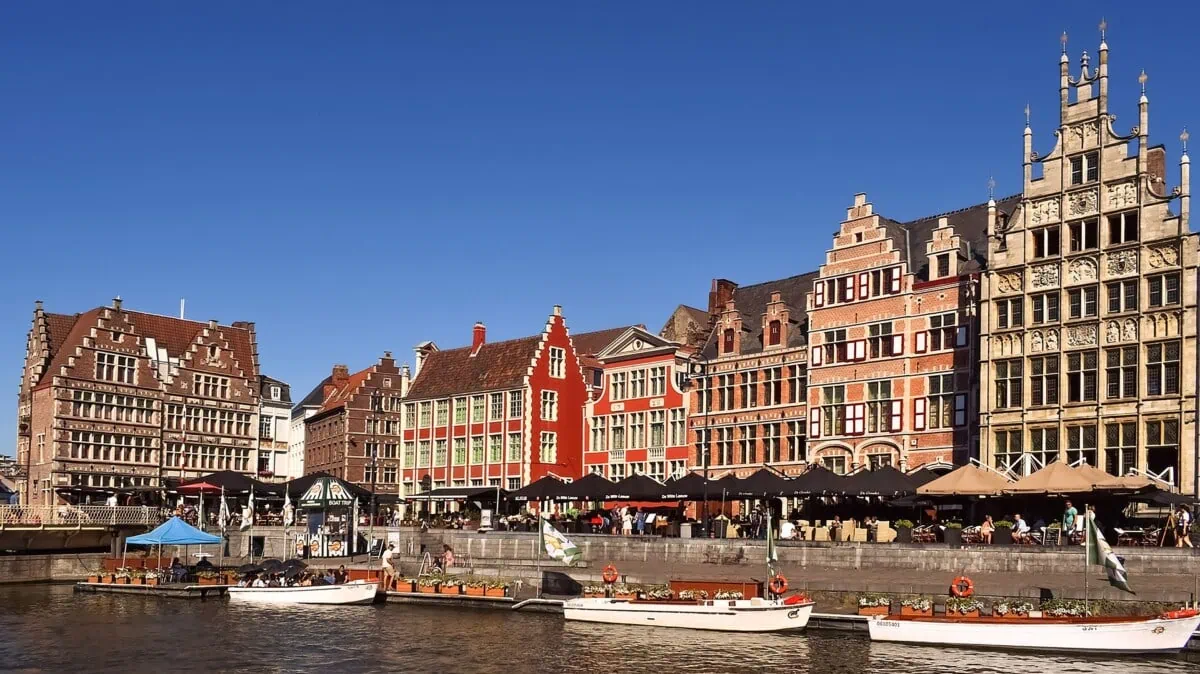
The paired quays of Graslei and Korenlei form one of Ghent’s defining views. Historic guild houses line both sides of the River Lys, while St Michael’s Bridge gives you one of the best elevated viewpoints across the water and towards the city’s towers.
This is one of the best free things to do in Ghent and it is not a place you need to rush through. Sit beside the water, cross between the two quays and look back at the different façades rather than treating the riverfront as a single photo stop. In warmer weather the terraces and steps become one of the busiest social spaces in the centre.
The waterfront is also a useful orientation point for a first visit. Gravensteen lies a short walk to the north, St Nicholas’ Church and the Belfry are close to the east, and several boat tours depart nearby. That makes Graslei and Korenlei an easy place to build into the middle of the day between major attractions.
If you are staying overnight, return after dark. Ghent’s evening lighting transforms the canals and façades, and the reflections create a very different atmosphere from the busier daytime scene. Even on a day trip, staying into early evening can be worthwhile before taking the train back to Brussels.
See the Ghent Altarpiece Inside St Bavo’s Cathedral
St Bavo’s Cathedral is one of the most important historic buildings in Ghent and the main reason many visitors enter is the Ghent Altarpiece, also known as the Adoration of the Mystic Lamb. The work by the Van Eyck brothers was completed in 1432 and remains one of Belgium’s most significant artworks.
The cathedral itself is free to enter, but the Altarpiece visitor experience is separately ticketed. If seeing it is essential, book a time in advance because popular slots can sell out at weekends and during busy holiday periods. The visitor centre adds context rather than simply placing you in front of the work with no explanation.
Allow around an hour to 90 minutes if you want to see both the cathedral and the Altarpiece properly. Rushing through in twenty minutes misses much of the point, especially because the cathedral itself contains other important works and architectural details beyond the famous panels.
Restoration is still part of the story in 2026. The upper register of the inner panels is being restored at the Museum of Fine Arts, where visitors can see restorers at work from Tuesday to Friday. On weekends and holidays, the panels are displayed for public viewing. If the Altarpiece is central to your trip, pairing St Bavo’s with MSK gives you the fullest experience.
The cathedral and visitor centre are wheelchair accessible, which makes this one of the easier major historic attractions to plan around if step-free access is important. It also sits beside the Belfry and close to St Nicholas’ Church, so you can combine all three towers without extra transport.

See Ghent from the Water on a Canal Cruise
A canal cruise is one of the easiest ways to understand Ghent’s layout because the historic centre grew around the Lys and Scheldt. From the water, the relationship between Gravensteen, Graslei, Korenlei, old bridges and tightly packed waterside buildings becomes much clearer than it does from street level.
Most standard sightseeing cruises take under an hour, which makes them easy to fit into a day trip without sacrificing half the afternoon. Several operators depart from the historic centre, and the exact route can vary depending on water levels, works and operator, so compare the live description rather than assuming every cruise follows exactly the same circuit.
A cruise is particularly useful if you are travelling with children, want a break from walking or would like commentary that connects the buildings you have already seen. On a one-day visit, it often adds more variety than another small museum. If the weather is poor, however, check whether the boat is sufficiently covered before booking.
Booking in advance can make sense on busy weekends and during peak summer dates, but spontaneous departures are often possible outside the busiest periods. If you want more flexibility than a single fixed cruise, the hop-on hop-off water tram is the stronger option. It lets you combine boat travel with walking and sightseeing across the day rather than treating the water journey as one isolated attraction.
Climb the Ghent Belfry for City Views
The Ghent Belfry is one of the city’s three defining medieval towers, standing between St Bavo’s Cathedral and St Nicholas’ Church. From street level the three towers create Ghent’s best-known skyline, but going up the Belfry gives you the clearest sense of how tightly packed the historic centre really is.
The viewpoint is the main reason to visit. From above, the canals, church towers, castle and dense roofscape are much easier to place in relation to one another. If you are only choosing one elevated viewpoint during a short stay, the Belfry is usually the strongest option because of its central position.
The Belfry is part of the UNESCO-listed group of Belgian and French belfries. Allow around 45 to 60 minutes for the visit, more if queues are building. Historic towers inevitably involve tighter spaces and steps, so check current access arrangements before travelling if you need step-free access.
For the best skyline view from the ground, walk afterwards towards St Michael’s Bridge. From there, the Belfry, St Nicholas’ Church and St Bavo’s line up across the centre, creating one of the most useful orientation points in Ghent.
Wander Through Patershol’s Historic Streets
Patershol is one of the most atmospheric neighbourhoods in central Ghent. Its narrow lanes and old houses sit immediately behind Gravensteen, so you can move from the castle into a much quieter part of the historic centre in only a few minutes.
The area is especially useful around lunchtime or early evening because it has a strong concentration of restaurants without feeling as exposed to the main sightseeing flow as Graslei and Korenlei. If you want a sit-down meal during a day trip, Patershol is one of the easiest places to build it into the route without losing time to extra transport.
Do not expect one single headline attraction here. The appeal is the streets themselves, the change of pace and the contrast with Ghent’s monumental centre. Walk slowly, explore the smaller lanes and then continue towards Vrijdagmarkt or back towards the river.
Patershol becomes even more appealing later in the day when the castle crowds begin to thin and the neighbourhood shifts towards dinner and evening atmosphere. If you are staying overnight, this is one of the areas worth revisiting after dark rather than trying to tick off another museum.
Search flights and useful route combinations in one place.
View flightsBrowse Airalo eSIM options for convenient travel data.
Check eSIMsArrange a private pickup before travel instead of sorting transport after landing.
Book a transferSee Ghent’s Ever-Changing Graffiti Street
Ghent’s Graffiti Street, officially Werregarenstraat, is one of the easiest ways to see the city’s more contemporary side without leaving the historic centre. The walls are deliberately repainted, layered and changed over time, so the street is less a fixed attraction than an evolving outdoor canvas.
It is free and only takes around 20 to 30 minutes, making it particularly useful between larger attractions. The street sits close enough to the central shopping area and main historic sights that there is no need to make a special transport journey to reach it.
The contrast with the castle, churches and guild houses is part of the appeal. Ghent is not simply a preserved medieval destination, and its university population and creative scene give the centre a much more contemporary energy than you might expect from the skyline alone.
If street art interests you, use Graffiti Street as a starting point rather than the whole experience. Ghent has wider street-art routes and murals scattered around the city, so you can easily turn this short stop into a bigger theme for the afternoon.
Understand the City at STAM, Ghent’s City Museum
STAM is the best place to understand how Ghent became the city you are walking through. Rather than concentrating on one artist or period, the museum connects medieval growth, industry, transport, neighbourhoods and modern urban development through maps, objects and large-scale displays.
This is particularly useful after you have already seen the historic centre because it gives context to the canals, former industrial areas and changing city boundaries. Allow around 90 minutes to two hours if you want enough time to follow the story rather than simply pick out a few exhibits.
STAM sits outside the tightest cluster of medieval attractions, so it is better treated as a deliberate museum stop than something you casually squeeze in between the Belfry and Gravensteen. If you are in Ghent for only one day, choose it when urban history genuinely interests you; on a two-day stay it becomes much easier to justify.
The museum is also a strong wet-weather option. It gives you substantial indoor time without duplicating the art collections elsewhere in the city, and it pairs well with a tram journey from the centre or with other attractions south of the historic core.
Visit the Museum of Fine Arts and See the Ghent Altarpiece Restoration
The Museum of Fine Arts, usually shortened to MSK, is one of Ghent’s strongest conventional art museums and a useful counterpoint to the medieval centre. Its collection extends well beyond the Van Eycks, making it worthwhile even if the Ghent Altarpiece is not the main reason for your visit.
In 2026, however, the museum has an unusual extra draw because visitors can follow the ongoing restoration of parts of the Ghent Altarpiece. From Tuesday to Friday, restorers can be seen at work, while on weekends and holidays the panels are positioned for public viewing. Restoration is currently scheduled to continue through the end of 2026.
If the Altarpiece is one of the main reasons for your trip, combine MSK with St Bavo’s Cathedral. Seeing the work in the cathedral and then the conservation process at the museum gives far more context than visiting either site in isolation.
MSK is outside the tight historic-centre cluster, so allow extra time for the journey and do not try to squeeze it into the final hour of a day trip. It works best on a two-day visit, or on a museum-focused day when you are already planning to spend time south of the centre.
Discover Ghent’s Industrial Story at the Museum of Industry
The Museum of Industry tells a side of Ghent that is easy to miss if you stay only around the castle and medieval churches. The city became a major industrial centre, especially for textiles, and the museum uses machinery, printing equipment, photographs and social history to show how that transformation affected everyday life.
This is one of the best choices if you want something very different from Ghent’s medieval attractions. It is substantial enough to justify around 90 minutes to two hours, and the industrial building itself helps the story feel grounded in the city rather than detached from it.
The higher parts of the building also give elevated views across nearby neighbourhoods. They are not a replacement for the Belfry, but they provide a different perspective over a less touristy part of Ghent and help connect the museum’s industrial story with the city outside.
On a short visit, choose the Museum of Industry if you are genuinely interested in technology, social history or manufacturing. On a longer stay, it is an excellent way to prevent the itinerary becoming a sequence of castles, churches and art museums.
Plan for the Reopening of Design Museum Gent
Design Museum Gent is scheduled to reopen on 3 October 2026 after a major transformation, so the timing of your visit matters. Anyone travelling before the reopening should not build a day around the museum, while autumn and winter visitors can treat it as one of the city’s major returning cultural attractions.
Once open, the museum adds a strong modern design-focused stop in the historic centre. That is important because Ghent’s most obvious attractions lean heavily towards medieval history, churches and art. Design Museum Gent gives you a different theme without requiring a long journey away from the old town.
If design is a major interest, allow enough time for a proper visit rather than treating it as a filler attraction between the castle and riverfront. The reopening also means exhibitions and visitor arrangements may evolve during the first months, so check the official museum information for your exact date before travelling.
For a one-day Ghent itinerary, it will compete with attractions such as Gravensteen and the Ghent Altarpiece for your limited indoor time. On a two-day stay, however, it should fit much more comfortably alongside the city’s historic sights and museums.
See St Nicholas’ Church and Ghent’s Famous Three Towers
St Nicholas’ Church completes Ghent’s famous line of three medieval towers alongside the Belfry and St Bavo’s Cathedral. The church stands directly beside Korenmarkt, so it is almost impossible to miss if you are walking between the historic core, the riverfront and the cathedral quarter.
The exterior is the first reason to stop, but the interior is also worth a look if it is open during your visit. Unlike a destination museum, this is easy to add without reorganising the day, and it works especially well as part of a walking route between St Michael’s Bridge, Korenmarkt, the Belfry and St Bavo’s Cathedral.
St Michael’s Bridge gives the best ground-level view of the three-tower skyline. From the bridge you can look back towards St Nicholas’ Church, the Belfry and St Bavo’s in sequence, with the old centre and canal architecture around them. It is one of the strongest free viewpoints in Ghent.
If your time is limited, treat this whole area as one connected experience rather than three separate stops. The buildings sit close together, so you can see the skyline, enter one or two interiors and continue towards Graslei without wasting time on transport.
Compare hostels and budget-friendly places to stay.
Browse hostelsGet fast compensation payouts, eligible lounge benefits and expert help when flights go wrong.
See AirHelp+ benefitsLeave your luggage somewhere convenient and explore hands-free.
View storageExplore Ghent with the Hop-On Hop-Off Water Tram
Ghent’s hop-on hop-off water tram is a much more flexible sightseeing option than a standard one-way canal cruise. A full-day ticket lets you move around the city by boat, get off at different stops, explore on foot and then rejoin a later service. That makes it especially useful if you want to combine the waterways with several of Ghent’s main attractions rather than simply sit through one fixed cruise.
The current route uses six stops, including the Korenlei, Music Center De Bijloke, Sint-Pietersabdij, Saint Bavo Cathedral and the Veldstraat shopping district. The product also includes a map linking the stops with six suggested walking routes, so it works as both transport and a loose sightseeing framework for the day.
The timetable shown for the water tram is built around six stops in a fixed sequence: Gravensteen, Korenlei + Graslei, Museumsite, Sint-Pietersabdij, Kathedraal and Shopping Veldstraat. The published timetable shown by the operator gives five circuits across the day.
| Stop | 1st circuit | 2nd circuit | 3rd circuit | 4th circuit | 5th circuit |
|---|---|---|---|---|---|
| Gravensteen | 10:30 | 12:00 | 14:00 | 15:30 | 17:00 |
| Korenlei + Graslei | 10:40 | 12:10 | 14:10 | 15:40 | 17:10 |
| Museumsite | 10:55 | 12:25 | 14:25 | 15:55 | 17:25 |
| Sint-Pietersabdij | 11:20 | 12:50 | 14:50 | 16:20 | 17:50 |
| Kathedraal | 11:35 | 13:05 | 15:05 | 16:35 | 18:05 |
| Shopping Veldstraat | 11:50 | 13:20 | 15:20 | 16:50 | 18:20 |
That spacing matters when planning a hop-off stop. For example, if you leave the boat at Gravensteen at 10:30, the next listed service from the same stop is at 12:00. At Korenlei + Graslei the corresponding departures are 10:40, 12:10, 14:10, 15:40 and 17:10. Treat these times as the operator’s published planning timetable rather than a guarantee, and check the live schedule on the day in case it changes.
You can start at any of the six stops and use the ticket throughout the day. The service is designed around getting on and off rather than completing the whole route in one sitting, which makes it easy to use the boat for longer hops and then walk between nearby sights. The current timetable has several departures spread across the day, but treat it as a planning guide rather than a guarantee because operating times and routes can change.
An audio guide is included in Dutch, English, French and German, and the route connects many of the places most first-time visitors want to see, including the Graslei and Korenlei, Gravensteen, St Bavo’s Cathedral, the Belfry and St Nicholas’ Church. It can therefore replace some local walking without turning the day into a conventional bus-style sightseeing tour.
The water tram is particularly useful if you want to mix sightseeing with rest periods. Ghent is highly walkable, but a full day on cobbled streets can become tiring. Using the boat between sections of the centre gives you a seated break while still showing you the city from a different angle.
There are two practical limitations worth knowing. The operator states that the current service is not suitable for wheelchair users, and pets are not allowed except assistance dogs. The tour runs in rain as well as dry weather, so check the forecast and boat-cover arrangements if poor weather is expected.
For a first visit, this is one of the better ways to join up Ghent’s scattered sights without buying a separate city pass. It works best when you already know which attractions you want to enter and use the water tram to move between them at your own pace.
Decide Whether CityCard Gent Is Worth It
Ghent’s official city pass, the CityCard Gent, gives one-time entry to more than a dozen museums and attractions plus a day’s travel on the hop-on hop-off water tram, a bike rental and unlimited local trams and buses. In 2026, the 48-hour card costs €49 (£42/$57), while the 72-hour version costs €55 (£47/$64). Both are sold directly through Visit Gent and at tourist information points in the city.
The card covers Gravensteen, the Belfry, MSK, STAM, S.M.A.K., the Museum of Industry, the House of Alijn, the Dr Guislain Museum and several smaller historic houses, along with every temporary exhibition running in Ghent’s museums during the card’s validity. It also knocks €10 off a separately booked Ghent Altarpiece ticket rather than including that experience outright.
The comparison against paying separately is where the card earns its keep. Standalone adult admission to just three of its sites, Gravensteen (€15/£13/$17), the Belfry (€13/£11/$15) and MSK (€15/£13/$17), already totals €43 (£37/$50), close to the 48-hour price on its own. Add STAM (€14/£12/$16) and the same four attractions come to €57 (£49/$66), more than either card tier before the free transport and exhibitions are even counted.
The card suits a genuinely museum-heavy two or three-day stay more than a fast single-day trip. Children and teenagers already get free entry to most Ghent museums, so a family buying the card only for the adults is usually the better combination rather than assuming every traveller needs one. If your day is built mostly around Gravensteen, the Belfry and free outdoor sights like Graslei and Korenlei, paying separately is likely to work out cheaper.
Best Free Things to Do in Ghent
Ghent is very easy to enjoy without building the day around paid attractions. Graslei and Korenlei, St Michael’s Bridge, Graffiti Street, the historic lanes around Patershol and the exterior of Gravensteen all give you substantial sightseeing without an admission fee.
St Bavo’s Cathedral itself is also free to enter, although the Ghent Altarpiece visitor experience is separately ticketed. That distinction matters if you are planning a low-cost day and do not want to assume that every famous interior sight is included for free.
A strong budget itinerary starts at St Michael’s Bridge, follows Graslei and Korenlei towards Gravensteen, explores Patershol and Graffiti Street, then loops back towards the cathedral and three towers. You can then add just one paid experience, such as the castle, Altarpiece or a boat cruise.
That approach works particularly well on a day trip because you still see the parts of Ghent that create its atmosphere while keeping costs under control. If the weather is good, you may find the canals, neighbourhoods and viewpoints occupy more of the day than expected.

How Many Days Do You Need in Ghent?
One day is enough for a strong first visit if you stay focused on the historic centre. Gravensteen, Graslei and Korenlei, St Bavo’s Cathedral, the Belfry and one extra experience such as a canal cruise can all fit without turning the day into a sprint.
If you are coming from Brussels, the direct train makes a day trip realistic, but remember that Gent-Sint-Pieters is outside the historic centre. Build the tram or local connection into the day rather than treating the rail journey time as the complete transfer.
Two days is the sweet spot for most visitors. It gives you time for the castle and Altarpiece without sacrificing museums, Patershol, a boat trip or an evening around the illuminated canals. You can also use the hop-on hop-off water tram more effectively, spreading the route across the day rather than forcing several paid attractions into one tightly packed itinerary.
A third day makes sense for travellers who want to explore museums in depth, follow street-art routes, spend more time outside the medieval centre or use Ghent as part of a slower Belgian itinerary. If you are choosing between adding another Ghent day and visiting Bruges, our Day Trips from Brussels guide compares the two cities directly.
Accessibility and Visiting Ghent with Children
Ghent’s historic centre is compact, but it is not uniformly smooth or step-free. Cobbles, older paving, bridges and historic buildings can make some routes slower with a wheelchair, walker or pushchair. The good news is that many of the main sights are close together, so you can often shorten the route without losing the core of the visit.
St Bavo’s Cathedral and the Ghent Altarpiece visitor centre are wheelchair accessible, while access at older attractions such as towers and historic houses can be more limited. Check the current accessibility page for any attraction where lifts, stairs or narrow passages could affect the visit rather than assuming a medieval building will be fully step-free.
Families usually get the best balance from Gravensteen, a canal cruise, Graffiti Street and shorter museum visits rather than trying to cover every church and gallery. The castle gives children something visually dramatic, while a boat trip provides a useful seated break after several hours on foot.
If you are travelling with younger children, keep lunch and rest stops flexible and avoid booking several timed attractions back-to-back. Ghent’s compact layout means it is easy to drop one museum, spend longer by the river or head into Patershol for food without wrecking the rest of the day.

Rupert’s Handy Travel Tips
Ghent is compact enough to be flexible, but a little planning makes a big difference. These are the things I would sort out before setting off.
- Book the Ghent Altarpiece first: If seeing the Altarpiece is essential, reserve a time before building the rest of the day around it. Popular slots can sell out.
- Use Gravensteen as your morning anchor: The castle gets busier as the day goes on and sits perfectly for continuing into Patershol and the riverfront afterwards.
- Do not underestimate the station transfer: Gent-Sint-Pieters is outside the historic centre, so allow time for the tram or local connection in both directions.
- Stay into early evening if you can: Graslei and Korenlei feel very different once some day-trippers have left, and the illuminated canals are one of Ghent’s best free experiences.
Want to meet the reindeer behind our travel tips? Find out more in our page Who is Rupert?.




Frequently Asked Questions
What is the best thing to do in Ghent?
For most first-time visitors, Gravensteen, St Bavo’s Cathedral and the historic Graslei and Korenlei waterfront are the strongest starting points.
Is Ghent worth visiting for one day?
Yes. The main attractions are concentrated in a compact centre, so one day is enough for the major sights. Two days gives you more time for museums and neighbourhoods.
Do you need to book the Ghent Altarpiece?
Advance booking is recommended because the visitor centre has limited capacity and popular time slots can sell out, especially at weekends and during holidays.
Is the Ghent hop-on hop-off water tram worth it?
It is a good choice if you want to combine sightseeing by boat with walking and use the service throughout the day rather than taking one fixed canal cruise. It is less useful if you only want a short scenic boat trip.
Can you walk around Ghent easily?
Yes. Most central attractions are within walking distance, although trams can be useful for reaching Gent-Sint-Pieters station and museums outside the historic core.
Further Reading
If Ghent is part of a wider Belgian rail trip, start with our Belgium Train Tickets Explained guide. It covers SNCB fares, Train+ discounts and the current domestic ticket system, while our Interrail Benelux Pass Guide is more useful if Belgium is only one part of a longer journey through the Netherlands and Luxembourg.
Brussels makes an excellent base for visiting Ghent because the direct train is fast enough for a comfortable day trip. Our Day Trips from Brussels guide compares Ghent with Bruges, Antwerp, Leuven, Waterloo, Namur, Liège and Dinant, while Things to Do in Brussels is useful if you are splitting your time between the two cities.
If you are deciding between Ghent and Bruges, our Things to Do in Bruges guide gives you the same practical detail on the Belfry, canals, museums, churches and brewery visits. The two cities work very differently: Bruges is more compact and postcard-like, while Ghent feels larger, livelier and easier to mix with museums, street art and evening sightseeing.
Ghent also works well in a cross-border itinerary rather than only as a Brussels side trip. If you are travelling from northern France, our Day Trips from Lille guide explains the practical rail options for combining Lille with Ghent, Bruges and Brussels without needing a car.