Reviewed by our editorial team Published
Münster rarely appears on a first time visitor’s shortlist of German cities, and that is largely because its two biggest claims to fame sound almost contradictory. This is the city where the Thirty Years’ War officially ended in 1648, a place soaked in centuries of ecclesiastical history as the seat of a prince-bishopric, and it is also, by a wide and genuinely earned margin, Germany’s bicycle capital, a city where more bikes cross the centre each morning than cars. Both identities sit comfortably side by side in a compact, walkable old town that was almost entirely destroyed in the Second World War and rebuilt with real care for its original character.
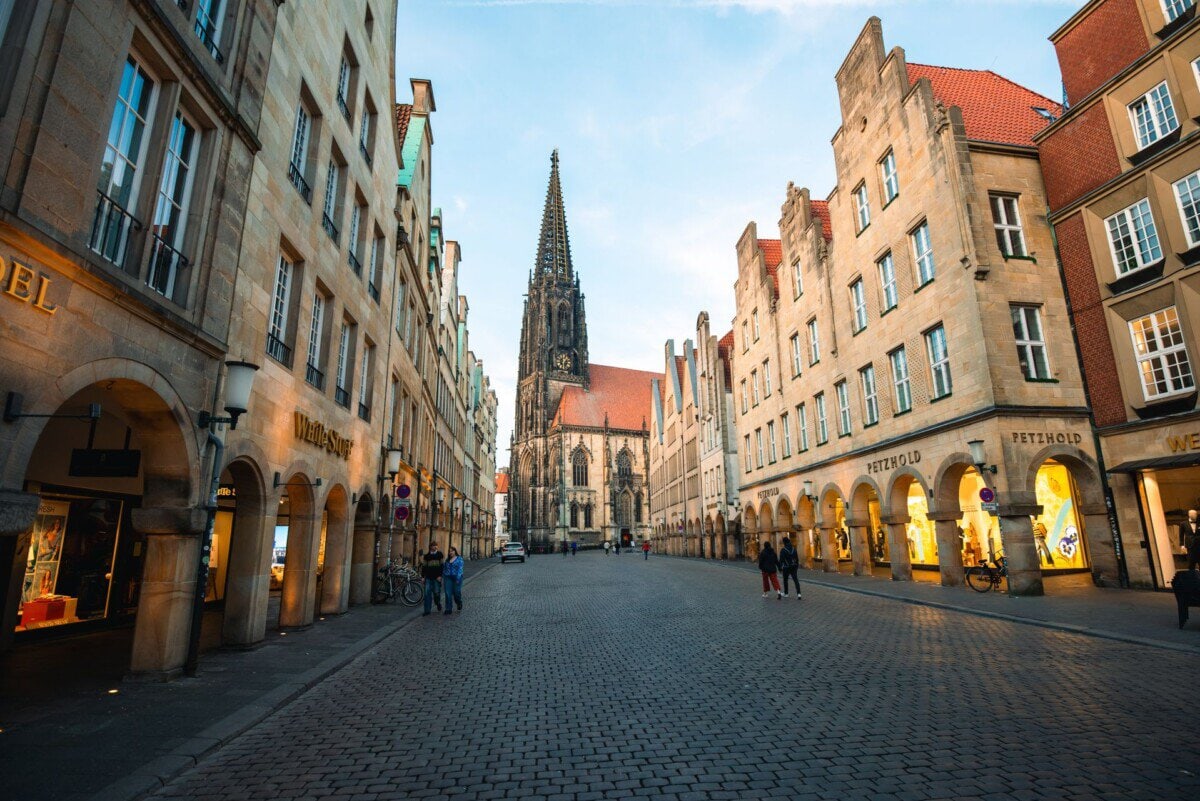
The obvious starting point is the Prinzipalmarkt, an arcaded row of gabled merchant houses leading to the Historic Rathaus, where the Peace of Westphalia was signed in the wood panelled Friedenssaal. A short walk away, the twin towered St. Paulus Dom anchors the cathedral quarter, while the Aasee lake and the surrounding parkland give the city a genuinely large green lung within easy reach of the centre on foot or, far more likely, by bike.
Münster is also a proper university city. The Westfälische Wilhelms-Universität is one of Germany’s largest, and its student population gives the old town a genuinely lively, youthful energy that a purely historical city centre can sometimes lack. Add a Baroque prince-bishop’s castle, a strong regional museum in the LWL Museum für Kunst und Kultur, and a local food and beer culture built around dishes and breweries that rarely travel far outside the Münsterland, and a pattern emerges: this is a city that rewards a properly unhurried day or two rather than a rushed stop between trains.
This guide works through the sights that make up a proper visit to Münster, along with the food, shopping, family options and rainy day backups that round out a trip. For step by step help getting from Münster Osnabrück Airport into the centre, a separate guide on this site covers every transfer option in detail.
| Section | What you’ll find |
| St. Paulus Dom | Münster’s cathedral, its working 1540 astronomical clock and the tomb of Cardinal von Galen |
| Prinzipalmarkt and the Historic Rathaus | The arcaded merchant street and the Friedenssaal where the Peace of Westphalia was signed in 1648 |
| The Aasee | The artificial lake’s 5.7km path, pedal boats, and the zoo, museum and open-air village on its shore |
| Germany’s Bicycle Capital | The traffic-free Promenade ring, cycle infrastructure and daily bike hire behind Münster’s cycling reputation |
| LWL Museum für Kunst und Kultur | Westphalia’s leading art museum, from medieval sculpture to major temporary exhibitions |
| Münster Castle and the University | The Baroque prince-bishop’s palace that now serves as the university’s main administrative building |
| The Botanical Garden | Free outdoor collections and tropical greenhouses beside the castle grounds |
| The Kiepenkerl Statue and Altstadt Side Streets | The bronze peddler landmark and the lively Kiepenkerlviertel of bars and restaurants around it |
| Food and Drink | Münsterländer Töttchen stew and Pinkus Müller’s historic organic brewery |
| Shopping | The Prinzipalmarkt, Ludgeristraße and Salzstraße retail core plus independent boutiques nearby |
| Family-Friendly Münster and Rainy Day Options | The Allwetterzoo, natural history museum and other indoor backups for wet weather |
St. Paulus Dom: Münster’s Romanesque and Gothic Cathedral
Rising over the eastern edge of the old town, St. Paulus Dom is Münster’s cathedral and the visual anchor of the wider Domplatz quarter. Construction began in 1225 on the site of an earlier church, and the building that gradually took shape over the following decades blends late Romanesque massing with early Gothic detailing, a transitional style that gives the cathedral its distinctive, slightly severe character compared with the purely Gothic cathedrals found elsewhere in Germany. Twin west towers and a third crossing tower dominate the skyline of the surrounding streets.
The cathedral’s best known feature inside is its astronomical clock, a genuinely remarkable Renaissance mechanism dating to 1540 that still functions today, tracking the time, the phases of the moon and the position of the sun against the zodiac, along with a calendar of movable religious feast days calculated decades in advance. A small crowd typically gathers at noon to watch its figures move, and it remains one of relatively few such clocks in Europe still in working order after nearly five centuries.
The cathedral also holds real weight in more recent history. It serves as the resting place of Cardinal Clemens August Graf von Galen, the wartime Bishop of Münster known for his outspoken sermons against Nazi policy, later canonised for his stand, and his tomb draws a steady stream of visitors alongside those there purely for the architecture and the clock.
Entry to St. Paulus Dom is free, and the cathedral is generally open to visitors daily from 7am to 7pm, though tourists cannot walk around during services, and it is worth checking the current schedule if a specific visit time matters. Donations towards the ongoing upkeep of the building are welcomed but not expected, and allowing thirty to forty five minutes is generally enough to take in the nave, the clock and the surrounding cloister without rushing.
Prinzipalmarkt and the Historic Rathaus: Where the Peace of Westphalia Was Signed
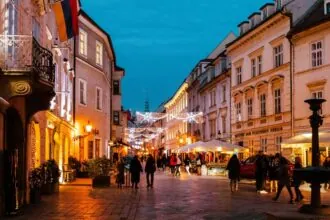
The Prinzipalmarkt is Münster’s central showpiece, a broad, arcaded street lined with tall gabled merchant houses that has served as the city’s main marketplace and processional route for centuries. Almost everything visible today is a careful postwar reconstruction, since the old town was reduced to rubble by Allied bombing in 1943 and 1945, but the rebuilding followed the original plot lines and gable shapes closely enough that the street still reads as a genuinely historic Westphalian streetscape rather than a modern pastiche. Cafes and shops now fill the arcades at street level, making it a natural place to pause between sights.
At the street’s midpoint stands the Historic Rathaus, a Gothic step gabled town hall whose ground floor hall, the Friedenssaal or Peace Hall, is where the single most consequential event in Münster’s history took place. On 15 May 1648, after roughly five years of parallel negotiations conducted partly here and partly in nearby Osnabrück, representatives of the Holy Roman Empire and Spain signed the treaty that ended the Thirty Years’ War here, with the wider Peace of Westphalia settlement following shortly after. The wood panelled hall, hung with portraits of the diplomats and sovereigns who took part, survived because its furnishings had been removed for safekeeping before the wartime bombing destroyed much of the building around it, allowing a faithful postwar restoration.
The Friedenssaal is open to visitors Tuesday to Friday from 10am to 5pm and Saturday to Sunday from 10am to 4pm, closed on Mondays, with adult admission costing €3.00 (£2.58/$3.51) and a reduced rate of €2.00 (£1.72/$2.34), while children enter free. In April 2015, the European Commission awarded the town halls of Münster and Osnabrück the European Heritage Label jointly in recognition of their shared role in the peace settlement. Full visitor details are published by Münster’s official tourism office.
At the northern end of the Prinzipalmarkt, St. Lamberti Church carries its own dark footnote to the city’s history: three iron cages still hang from its tower, originally used to display the bodies of the executed leaders of the radical Münster Rebellion of 1534 to 1535 as a public warning. It is a striking, slightly macabre detail worth pointing out to anyone walking the length of the street.
Best for two or three nights. The widest choice of rooms, with filters for free cancellation and included breakfast.
View staysBest for families, or any stay past about four nights. A kitchen and a washing machine start paying for themselves.
Browse rentalsBest for double-checking. Runs the same search across several booking sites so you are not leaving money behind.
Compare pricesThe Aasee: Münster’s Lakeside Green Space
A short walk or a very short bike ride south west of the old town, the Aasee is Münster’s answer to a lack of a river running through its centre. The idea for an artificial lake dates back to 1888, when a local zoology professor proposed damming the small Aa river partly to control the recurring flooding that had plagued the city since a siege in 1660, and construction finally began in 1914 before being interrupted by the First World War. The lake was not completed until 1934, and a later expansion between 1972 and 1976 nearly doubled its size to its current area of roughly 40 hectares, stretching about 2.3 kilometres end to end.
A flat, well maintained path of around 5.7 kilometres circles the entire lake, popular with joggers, cyclists and families pushing prams, and in 2009 the surrounding Aasee Park was named the most beautiful park in Europe after already winning the equivalent German award the year before. Rental pedal boats, several shaped like swans, are a genuinely popular way to get out onto the water on a warm afternoon, and sailing clubs operate from the southern shore.
The lake’s western shore is also where several of Münster’s other big attractions cluster together. The Allwetterzoo (literally the “all weather zoo”) sits directly on the water, the LWL Museum of Natural History with its own planetarium is a short walk away, and the open air Mühlenhof Museum recreates a historic Westphalian farming village with original relocated buildings. That density of attractions makes the Aasee shore an easy half day loop on its own, longer with children keen on the zoo or the museum.
Access to the Aasee promenade itself is free and unrestricted at any time, and it sits close enough to the Altstadt that combining a lakeside walk with a morning at the cathedral or the Prinzipalmarkt requires very little extra planning.
Germany’s Bicycle Capital: Cycling Culture in Münster
No description of things to do in Münster is complete without addressing the city’s defining identity: it is widely regarded, and genuinely lives up to the reputation, as Germany’s bicycle capital. Locals here own bikes in numbers that rival, and by some counts exceed, the city’s own population, and cycling is not a niche leisure activity but the default way most residents get to work, university and the shops.
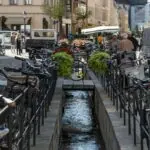
The physical backbone of that culture is the Promenade, a roughly 4.5 kilometre tree lined ring encircling the entire old town, laid out where the city’s fortifications once stood after they were dismantled in the 18th century. Rather than becoming a road, the Promenade was landscaped as a green corridor and is now reserved for cyclists and pedestrians, giving Münster an almost complete traffic free loop around its historic core, something few German cities of comparable size can match.
That infrastructure shows up everywhere else too. Dedicated cycle lanes run along most major streets, junctions are genuinely designed around bike priority rather than treating cycling as an afterthought to car traffic, and the covered bicycle parking station at the Hauptbahnhof is regularly cited as among the largest of its kind anywhere in the world, holding thousands of bikes across multiple levels.
For visitors, several operators around the station and the old town offer daily bike hire, and given how flat the city and the surrounding Münsterland countryside both are, renting a bike for even a single day is genuinely one of the best ways to see Münster the way locals do. The Aasee’s ring path and the Promenade both make for an easy, low stress introduction to cycling here before venturing further into the wider region on two wheels.
LWL Museum für Kunst und Kultur: Westphalia’s Leading Art Collection
A short walk from the cathedral, the LWL Museum für Kunst und Kultur, the Westphalian State Museum of Art and Cultural History, is the region’s leading art museum and a genuinely worthwhile stop even for visitors who do not normally seek out regional galleries. The collection spans a remarkable range, from medieval sculpture and panel painting produced across Westphalia through to a strong holding of 19th and 20th century German painting, alongside a rotating programme of major temporary exhibitions that regularly draws visitors from across the wider region.
The building itself, redeveloped with a striking modern extension, gives the older religious and courtly works room to sit alongside more contemporary pieces without either era feeling squeezed out, and the museum’s location directly opposite the cathedral makes it an easy pairing with a visit to St. Paulus Dom on the same morning.
The museum is open Tuesday to Sunday from 10am to 6pm, closed on Mondays, with extended hours running until midnight on the second Friday of each month for anyone wanting an evening visit. Adult admission to the permanent collection costs €10.00 (£8.60/$11.70), dropping to €5.00 (£4.30/$5.85) at the reduced rate, and admission is free for children and teenagers up to the age of seventeen. Temporary exhibitions, such as the museum’s periodic major shows, sometimes carry a separate, higher ticket price, so it is worth checking what is currently showing before a visit.
Allow at least ninety minutes for a proper walk through the permanent collection, considerably longer if a major temporary exhibition happens to coincide with the visit. Group rates are available for parties of sixteen or more, worth knowing for anyone travelling as part of an organised tour.
Münster Castle and the Westfälische Wilhelms-Universität
On the northern edge of the old town, the pink sandstone Münster Castle, or Schloss Münster, is the city’s grandest single building, a Baroque prince-bishop’s residence built between 1767 and 1787 to designs by the celebrated Westphalian architect Johann Conrad Schlaun. It was the final major project of its kind before secularisation swept away the prince-bishopric’s temporal power at the start of the 19th century, and its symmetrical facade and formal grounds still give a strong sense of the wealth and ambition of Münster’s ecclesiastical rulers at their peak.
Badly damaged during the Second World War, the castle was carefully restored and today serves an entirely different purpose: it is the main administrative building of the Westfälische Wilhelms-Universität, generally known simply as the University of Münster. Founded in 1780 and reorganised into its modern form in 1902, it now ranks among Germany’s largest universities, with a student population running well into the tens of thousands across faculties spread throughout the city, and that student presence is a large part of why Münster feels far livelier after dark than a city built primarily around history and religion might otherwise suggest.
The castle’s formal Schlossgarten grounds, laid out as an English style landscape park, are open to the public and lead directly into the Botanical Garden covered in the next section, making the whole area a natural extension of a walk through the university quarter rather than a separate excursion.
Visitors cannot generally tour the castle’s interior, since it remains a working university administration building, but the exterior and grounds are freely accessible at any time, and the building’s scale alone makes it worth the short walk from the Altstadt even for a quick look.
The Botanical Garden Beside the Castle
Directly beside the castle grounds, Münster’s Botanical Garden is run by the university and makes an easy, unhurried addition to a visit to the Schlossgarten. The garden’s collection spreads across outdoor beds organised by plant family and geography alongside a set of greenhouses holding tropical, subtropical and arid collections, including cacti and succulents that give visitors a reason to duck inside even on a cooler day.
The garden is genuinely well suited to a relaxed hour or two rather than a rushed walk-through, with quiet paths that see far fewer visitors than the more famous sights closer to the cathedral, making it a good option for anyone wanting a break from the busier parts of the old town without leaving the city centre area.
Admission to the Botanical Garden is completely free, and it opens daily, including weekends and public holidays. Summer hours, running from 15 March to 14 October, are 8am to 7pm, while winter hours from 15 October to 14 March run 9am to 4pm, with a bell signal announcing closing time each day.
Because the garden sits directly between the castle and the wider university quarter, it slots naturally into the same visit as Münster Castle, and the two together make for a pleasant, low cost hour that balances out a morning spent on the busier Prinzipalmarkt or inside the cathedral.
The Kiepenkerl Statue and the Altstadt Side Streets
Tucked into a small square just off the Spiekerhof, the bronze Kiepenkerl statue is one of Münster’s most recognisable small landmarks, depicting a traveling peddler carrying goods to market in a large wicker basket, or Kiepe, strapped to his back. The figure represents a real historical trade: tenant farmers from the Münsterland countryside who walked into the city to sell eggs, vegetables and small livestock door to door, a way of life that had largely disappeared by the early 20th century but became a genuinely beloved symbol of the wider region.
The original sandstone statue, created by sculptor August Schmiemann, was unveiled in 1896, but it was destroyed during the Second World War. A bronze replacement by Albert Mazzotti Jr. was inaugurated on 20 September 1953 by Federal President Theodor Heuss, and that is the statue visitors see standing in Kiepenkerl Square today, a rare piece of the old town that survived the war era intact in spirit even if not in original material.
The surrounding Kiepenkerlviertel has grown into one of the liveliest pockets of the Altstadt, packed with small restaurants, wine bars and traditional Gaststätten that fill their outdoor tables through the warmer months. It sits within a few minutes’ walk of both the Prinzipalmarkt and the cathedral, which makes it an easy, natural stop to fold into a walking loop of the old town rather than a planned separate excursion.
Visiting the statue and the surrounding square costs nothing and requires no set opening hours, and it is arguably at its best in the early evening, when the neighbouring bars and restaurants begin to fill and the square takes on a genuinely local, unhurried atmosphere.
Best for long or awkward journeys. Builds one itinerary out of separate flights.
View flightsBest for short trips. Install the eSIM at home and arrive with working data, no shop queue.
Browse eSIMsBest after a long flight or a late landing. Price agreed before you travel, and no taxi queue.
Check transfersFood and Drink: Töttchen and Pinkus Müller’s Organic Beer
Münster’s food culture is rooted firmly in the surrounding Münsterland countryside rather than chasing culinary trends, and the genuinely local dish worth actively seeking out is Münsterländer Töttchen, a slow cooked veal stew traditionally seasoned with capers, bay leaf and a touch of lemon, served with bread dumplings or dark rye bread. It rarely appears far outside the region, and traditional restaurants around the Altstadt and the Kiepenkerlviertel remain the most reliable places to try it properly.
On the drinks side, Pinkus Müller is the city’s great surviving brewing institution. Founded in 1816 by Johannes Müller and his wife Friederika Cramer, it began as a combined bakery and brewery and has operated continuously ever since, making it the last of roughly 150 historic breweries that once operated in Münster. The brewery is also notable for brewing genuinely organic, Demeter certified beers, a rarity among Germany’s traditional regional brewers, alongside its signature top fermented Alt style.
The brewery’s own traditional Gaststätte in the Altstadt serves its beer fresh alongside a menu of regional dishes, including Töttchen, and it remains one of the most atmospheric places in the city to sit down for an evening meal surrounded by genuine brewing history rather than a themed reproduction of one.
Beyond Töttchen and Pinkus Müller’s own beers, the Kiepenkerlviertel and the streets immediately around the Prinzipalmarkt hold a wide spread of cafes, wine bars and international restaurants that cater heavily to the city’s large student population, giving Münster’s dining scene a noticeably more youthful, casual feel than some of Germany’s more formal historic city centres.
Shopping Along the Prinzipalmarkt and Ludgeristraße
Münster’s main shopping district runs along the arcaded Prinzipalmarkt itself and continues into the pedestrianised Ludgeristraße and Salzstraße, together forming a compact, entirely walkable retail core that rarely requires much backtracking. High street fashion chains and larger department stores dominate the main thoroughfares, sheltered from the weather by the Prinzipalmarkt’s historic arcades, a genuinely practical hangover from the street’s centuries as a working marketplace.
For something more independent, the side streets branching off towards the Kuhviertel and around Alter Steinweg hold smaller boutiques, bookshops and design stores that get overshadowed by the bigger names on the main streets, and this is generally where visitors find gifts and local crafts with more character than a standard souvenir shop offers.
Given the density of students living in and around the centre, Münster’s shopping streets also carry a noticeably younger, more casual retail mix than some equivalent German city centres, with independent record shops, secondhand clothing stores and student focused cafes woven in among the more conventional chains.
Saturday remains the busiest shopping day, in keeping with most German cities, and many shops close entirely on Sundays, so visitors planning a dedicated shopping morning are best building it into a weekday or Saturday itinerary rather than assuming Sunday options will be available.
Family-Friendly Münster and Rainy Day Options
Münster handles a family visit well, largely because several of its biggest attractions already double as genuine family days out. The Allwetterzoo on the Aasee shore is the obvious anchor, and its name, literally “all weather zoo,” is not a marketing accident: it was built with extensive indoor pavilions specifically so a visit still works on a wet or cold day rather than becoming a washout. The neighbouring LWL Museum of Natural History and Planetarium gives children an additional indoor option within the same short walk.
The Mühlenhof open-air museum beside the Aasee works well for younger children too, with its collection of relocated historic farm buildings, working windmill and small animals giving them something to physically explore rather than simply look at from behind glass. Combined with the Aasee’s flat, buggy friendly promenade and its pedal boats, the lakeside area alone can comfortably fill a full family day.
For a wet afternoon in the old town itself, the LWL Museum für Kunst und Kultur and St. Paulus Dom both work as unhurried indoor visits regardless of the weather, and the arcaded Prinzipalmarkt offers a genuinely practical covered walking route between shops and cafes without getting properly soaked. The Kiepenkerlviertel’s cafes and restaurants make an easy, warm backup once museum hours have been exhausted.
Between the zoo, the museums clustered around the Aasee, and the covered arcades of the old town, a family trip or a rainy day in Münster rarely needs to be a wasted one, and much of what makes the city appealing, its flat streets and short distances between sights, works just as well pushing a pram as it does on a bike.

Rupert’s Handy Travel Tips
Planning a visit to Münster? Rupert has a few tips worth knowing before you go:
- Rent a bike on day one: the Promenade ring and the flat Aasee path make Münster genuinely easy to explore by bike, and it is how most locals get around anyway.
- Skip Monday for the Friedenssaal and the LWL Museum: both close on Mondays, so build them into a Tuesday to Sunday day instead.
- Time a visit to the astronomical clock for around noon: the cathedral’s 1540 mechanism draws a small crowd when its figures move, and it is easy to miss if you arrive at the wrong moment.
- Pair the castle with the Botanical Garden: the two sit right beside each other, making an easy half hour add-on that avoids doubling back later.
- Book a table at Pinkus Müller for Töttchen: the city’s genuinely local stew and its own organic beer are best tried together at the brewery’s own Gaststätte.
- Keep the Allwetterzoo in your back pocket for rain: its indoor pavilions were built specifically for bad weather, unlike some of the city’s purely outdoor sights.
Want to meet the reindeer behind our travel tips? Find out more in our page Who is Rupert?.



Frequently Asked Questions About Things to Do in Münster
What is Münster best known for?
Münster is best known as Germany’s bicycle capital, with cycling built into the fabric of daily life, and as the historic site where the Peace of Westphalia was signed in 1648, ending the Thirty Years’ War.
Is St. Paulus Dom free to visit?
Yes. The cathedral is free to enter and generally open daily from 7am to 7pm, though visitors cannot walk around during religious services.
How much does it cost to visit the Friedenssaal?
Adult admission to the Peace Hall in the Historic Rathaus costs €3.00 (£2.58/$3.51), with a reduced rate of €2.00 (£1.72/$2.34) and free entry for children.
Is the Botanical Garden in Münster free?
Yes. Entry is completely free, with summer hours of 8am to 7pm from mid-March to mid-October and winter hours of 9am to 4pm the rest of the year.
What food should I try in Münster?
Münsterländer Töttchen, a caper seasoned veal stew, is the genuinely local dish, best paired with an organic Alt beer from the historic Pinkus Müller brewery.
Can visitors hire bikes in Münster?
Yes. Several operators around the Hauptbahnhof and old town offer daily bike hire, and the flat terrain and dedicated cycle paths make it one of the easiest German cities to explore this way.
How many days do you need in Münster?
A full day covers the cathedral, Prinzipalmarkt and Rathaus comfortably, with a second day useful for the Aasee, the castle and Botanical Garden, and the LWL Museum.
Is Münster good for a family trip or a rainy day?
Yes. The Allwetterzoo‘s indoor pavilions, the LWL Museum für Kunst und Kultur, and the arcaded Prinzipalmarkt all work well regardless of the weather.
Further Reading & Related Guides
For getting into the city in the first place, our Münster Airport Transfers guide covers the S50 and R51 buses, taxis and every other option from FMO, including why many visitors arrive via Dortmund or Düsseldorf instead. Anyone building a wider North Rhine-Westphalia itinerary will find our Things to Do in Dortmund and Things to Do in Bremen guides useful companions elsewhere in the country’s growing content on this site.
If onward rail travel around the region is part of the plan, our German Rail Tickets Explained guide breaks down the Deutschland-Ticket and regional fares that cover journeys between Münster, Dortmund and Osnabrück, while our Interrail Germany Pass Guide explains when a country-specific pass beats buying tickets individually for a longer trip through the wider Münsterland.