Reviewed by our editorial team Published
Getting Around Hamburg
Hamburg is a port city built around water, and its public transport network reflects that in a way no other major German city can match. Alongside a familiar U-Bahn and S-Bahn network, Hamburg also runs genuine commuter ferries across the Elbe as part of the same ticket system.
All of it sits under one umbrella, the HVV, which sets shared tickets and fare rings across every operator, so a single ticket carries you from a U-Bahn platform onto a harbour ferry without buying anything extra.
It is worth being clear early on that these HVV ferries are not the same thing as Hamburg’s paid sightseeing harbour cruises. One is everyday public transport, priced and ticketed like a bus, while the other is a separate tourist product covered in its own guide.
This guide covers how Hamburg’s network fits together, the city’s ring-based fare system, current ticket prices, and exactly how the HVV harbour ferries work and where they differ from a paid sightseeing tour.
Hamburg is Germany’s second-largest city, and its transport network stretches well beyond the postcard harbour view, reaching into Schleswig-Holstein and Lower Saxony via regional rail and cross-border bus routes.
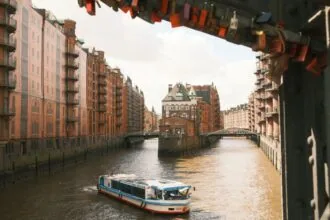
Visitors staying centrally around the Speicherstadt or Altstadt will find most sights within a short U-Bahn or S-Bahn hop, with the harbour ferries adding a genuinely scenic alternative for crossing the Elbe rather than backtracking through a station.
Hamburg Public Transport at a Glance
| Transport | Main operator | Best for | Visitor tip |
|---|---|---|---|
| U-Bahn | Hochbahn | Fast journeys across the city | Four lines, very frequent on weekdays |
| S-Bahn | S-Bahn Hamburg (DB) | Airport and longer suburban hops | The S1 runs directly to Hamburg Airport |
| Buses | Hochbahn / VHH | Filling in the gaps | MetroBus routes run every few minutes |
| Harbour ferries | HADAG | Crossing the Elbe like a local | Line 62 is covered by a normal HVV ticket |
Best if you want daily housekeeping and a front desk. Filter by area first, then by price.
Check availabilityBest for longer stays. Whole apartments and houses, so you are not eating out three times a day.
View rentalsBest as a last check before booking. Compares hotel rates across several sites in one search.
Compare ratesWho Runs Public Transport in Hamburg?
Hochbahn is Hamburg’s best known operator, running the U-Bahn network and a large share of the city’s buses. It is the closest equivalent to Berlin’s BVG or Munich’s MVG, and its trains carry the network’s most familiar branding.
The S-Bahn is run separately by S-Bahn Hamburg, a Deutsche Bahn subsidiary, while HADAG operates the harbour ferries and a company called VHH runs a further slice of the bus network.
What matters for a visitor is that the HVV, the Hamburg Transport Association, ties all four operators together under one fare structure, so tickets bought for the U-Bahn are equally valid on an S-Bahn train, a bus or a HADAG ferry.
This is unusually convenient by German standards: most cities do not fold a ferry service into the standard transit fare, and Hamburg’s willingness to do so is one of its more distinctive features.
The HVV umbrella also extends to regional buses run by smaller operators further out into Schleswig-Holstein and Lower Saxony, so a standard HVV ticket often still applies on the first leg of a day trip beyond the city.
Unlike Berlin or Munich, Hamburg never developed a citywide tram network, so Hochbahn’s buses and U-Bahn effectively share the load that a tram system would otherwise carry in a comparable German city.
How the Hamburg U-Bahn Works
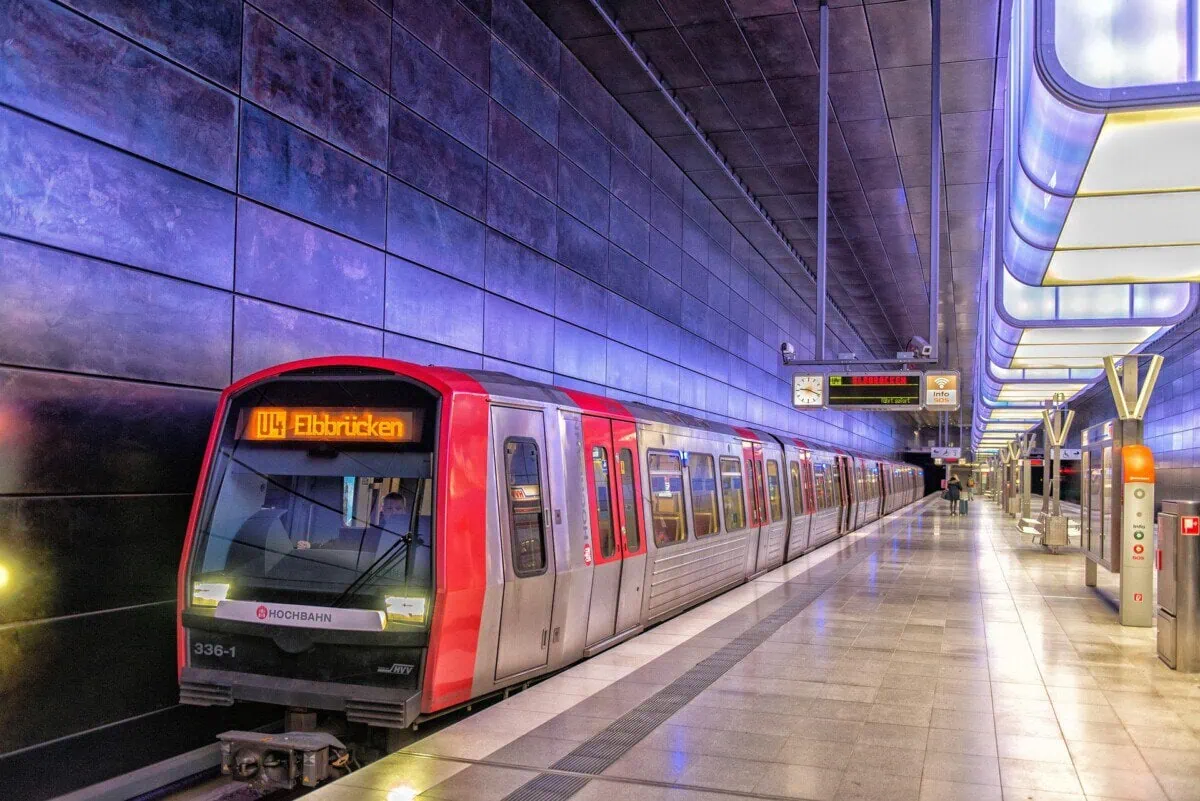
Hamburg’s U-Bahn runs four lines, U1 through U4, covering around 106 kilometres of track and 91 stations across the city and its suburbs. Jungfernstieg and Hauptbahnhof are the busiest interchange stations, and most cross-city journeys pass through one of them.
The U1 is the network’s longest line, running from Norderstedt Mitte in the north through Jungfernstieg and Hauptbahnhof Süd before splitting toward Ohlstedt and Großhansdorf in the eastern suburbs. The U2 crosses the city largely underground, linking Niendorf Nord with Mümmelmannsberg via Hagenbecks Tierpark, Schlump and Berliner Tor.
The U3 is Hamburg’s oldest line and its de facto ring route, looping from Barmbek through Sternschanze, St. Pauli and Landungsbrücken before finishing at Wandsbek-Gartenstadt, with an elevated stretch above the harbour that gives genuinely good views for the price of a normal ticket. The U4 is the newest line, opened in 2012 and extended since, running from Billstedt to Elbbrücken through Jungfernstieg and HafenCity Universität, right past the Elbphilharmonie.
Trains run every few minutes on weekdays, and several lines continue through the night on weekends, which suits Hamburg’s famously late-running nightlife around the Reeperbahn. Platform displays show the next arrivals and their final stop, which is useful since some lines split toward different outer branches near the edges of the network.
A handful of stations, including Jungfernstieg, connect directly to S-Bahn platforms under one roof, so changing between the two networks rarely means stepping back out onto the street. Trains are generally modern and air-conditioned, and digital screens inside the carriages confirm the next stop, which helps when you are unfamiliar with station names.
The Hamburg S-Bahn
Hamburg’s S-Bahn runs five lines, S1, S2, S3, S5 and S7, reaching further out than the U-Bahn and forming the fastest way to and from the airport. The S1 splits south of Ohlsdorf, with some trains continuing to Hamburg Airport in around twenty five minutes from the main station and others heading on to Poppenbüttel, while its western end runs out to Wedel via Blankenese.
The S2 links Altona to Bergedorf through Hauptbahnhof, extending further to Aumühle on evenings and weekends, and the S3 runs from Pinneberg through the underground City-S-Bahn tunnel to Neugraben, continuing on to Stade for anyone heading toward the Altes Land orchards. The S5 connects Elbgaustraße to Stade on a slightly different route through the centre, and the S7 covers Altona to Aumühle on the eastern side of the network, a line created by relabelling an existing service rather than laying new track.
A sixth line, the S4, is under construction to link Hasselbrook with Ahrensburg and Bad Oldesloe east of the city, but it is not yet running and current timelines put a first service several years away, so it can safely be ignored when planning a trip today. As a Deutsche Bahn subsidiary rather than part of Hochbahn, S-Bahn Hamburg trains are branded differently, but every HVV ticket and fare ring rule applies to them exactly as it does to the U-Bahn.
Trains can be less frequent than the U-Bahn outside peak hours, so checking a live departure board is worth doing before committing to an S-Bahn route. The S-Bahn also serves Hamburg’s major stadium and exhibition venues, making it the practical choice on match days or during trade fairs when city-centre traffic and parking become genuinely difficult.
Carriages are wider than the U-Bahn’s, with dedicated luggage space near the doors, useful if you are heading to or from the airport with suitcases. Announcements are typically given in German and English on the airport line specifically, and platform screens display the next two or three arrivals to help when a line splits further out.
The S-Bahn shares one fare system with the rest of the network, so any ticket valid for the U-Bahn is valid here too, covering the full range of buying channels set out in how to buy a ticket further down this page. The DB Navigator app is also worth having installed for S-Bahn-specific disruption alerts, though it is not needed to buy a valid ticket in the first place.
Hamburg Buses
Hamburg runs 22 MetroBus lines, numbered 1 to 14 for routes running into the centre and 20 to 27 for routes that cross the outer districts without touching it, covering the streets Hamburg’s rail network does not reach. Hamburg has no tram network today, so buses do more of the heavy lifting here than in Berlin or Munich.
MetroBus routes run at least every ten minutes between roughly 6am and 9pm on weekdays, genuinely rivalling a tram or light rail line elsewhere in Germany. The busiest, MetroBus 5, runs between Burgwedel and Hauptbahnhof via Niendorf and Hoheluftbrücke, and is regularly cited as one of the busiest bus routes anywhere in Europe.
Alongside MetroBus sits a smaller network of XpressBus routes, marked with an X prefix, which run longer distances with fewer stops for a faster cross-city hop where the U-Bahn or S-Bahn does not reach directly. Night buses take over once the U-Bahn and S-Bahn slow down in the small hours, particularly useful for reaching areas around the harbour late at night.
Buses are the one part of the HVV network where you can still buy a ticket from a person, with drivers selling single and day tickets on board for cash or card. See how to buy a ticket further down this page for the full range of channels, and how to validate a ticket for how the honour-system spot checks work across every mode.
Buses are low-floor and wheelchair accessible across virtually the entire fleet, and drivers will lower the boarding ramp on request for anyone travelling with a pushchair or mobility aid. A number of routes double as genuinely useful sightseeing options, including services that pass close to the Elbphilharmonie and the Fischmarkt, without the cost of a dedicated tour bus.
Real-time countdown displays at busier stops, alongside live data in the hvv app, make it easy to time your arrival rather than waiting blind. This matters most on a MetroBus or XpressBus route running every few minutes, where turning up without checking can mean missing one bus only to watch the next arrive moments later anyway.
The HVV Ferries: Hamburg’s Commuter Hafenfähren
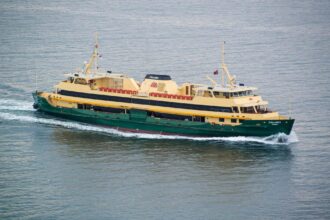
Hamburg’s harbour ferries, the Hafenfähren, are genuine scheduled public transport, run by HADAG and fully covered by a normal HVV ticket. There are seven numbered lines in total, 61, 62, 64, 68, 72, 73 and 75, and line 62 is the most useful for visitors, linking Landungsbrücken to Altona, Neumühlen, Övelgönne and Finkenwerder across the Elbe.
Commuters use these boats to get to work every day, and any standard HVV ticket, Deutschlandticket or Hamburg CARD covers them exactly as it would a bus, with the full range of buying channels covered in how to buy a ticket further down this page. The smaller Bubendey-Ufer and Blankenese piers have no ticket machine at all, so buying ahead through the app or online shop matters specifically at those two stops.
This is a genuinely important distinction to make clear: the Hafenfähren are not the same product as Hamburg’s paid sightseeing harbour cruises, which run longer scenic routes, cost considerably more and are booked separately as a tourist activity rather than a transit ticket.
If you simply want an inexpensive way to see the harbour from the water while actually going somewhere, hop on line 62 with your normal HVV ticket; if you want a longer, guided tour of the port with commentary, that is a different, paid product covered further down this page.
Bicycles travel free on the Hafenfähren whenever there is room, though that space is not guaranteed at busy times, so a cyclist heading to Finkenwerder at rush hour should have a backup plan. The ferry piers themselves are step-free and generally well suited to pushchairs, wheelchairs and heavy luggage, making line 62 a genuinely practical option rather than just a novelty for photographs.
How to Buy a Ticket in Hamburg
Every fare channel across Hamburg’s network feeds into the same HVV ticket, covering the U-Bahn, S-Bahn, buses and HADAG harbour ferries alike. There is no separate ferry or bus fare to track down, which makes choosing the right ticket the only real decision a visitor needs to make.
Platform ticket machines stand at every U-Bahn and S-Bahn station and at most ferry piers, taking both cash and card for a single, day or group day ticket. These machines print a ticket that is valid from the moment of purchase, so nothing else needs activating.
The hvv app and its more comprehensive sibling hvv switch cover the same tickets from a phone, including the Deutschlandticket subscription covered further down this page. Buying through either app is usually fastest, and a ticket bought this way is fully valid on a HADAG ferry exactly as it is on a bus or train.
Buses are the one HVV mode where you can still buy a ticket directly from a person, with drivers selling single and day tickets on board for cash or card. That makes a bus the easiest fallback if you land somewhere without a working machine nearby.
Most ferry piers also carry a ticket machine, but the smaller Bubendey-Ufer and Blankenese stops have none at all, so buying through the app or online shop before you arrive matters there specifically. Turning up without a ticket already in hand still counts as boarding without one, which the honour system below treats as a genuine problem.
Whichever channel you use, the ticket types stay the same: a single fare, a day ticket, the ring-based fares set out in our fare system section, and the Deutschlandticket covered further down this page. A standard single, day ticket, Deutschlandticket or Hamburg CARD is equally valid on the HADAG ferries, so riding one changes nothing about which ticket to buy.
| Channel | Payment | Covers |
|---|---|---|
| Platform machine | Cash, card | U-Bahn, S-Bahn, most ferry piers |
| hvv app / hvv switch | Card, mobile wallet | Every mode, plus the Deutschlandticket |
| Bus driver | Cash, card | Buses only |
| Online shop | Card | Best backup for Bubendey-Ufer and Blankenese |
Best if you can move a day either way. Shows how the fare changes across the month.
Compare flightsBest for short trips. Install the eSIM at home and arrive with working data, no shop queue.
Browse eSIMsBest if you would rather not work out the transport on arrival. Book it now and forget it.
View transfersHow to Validate a Ticket in Hamburg
Hamburg runs its entire network on an honour system: there are no ticket barriers or gates anywhere, on the U-Bahn, S-Bahn, buses or HADAG ferries. Nothing physically stops you boarding without a valid ticket, but that does not make travelling without one any less of an offence.
A ticket bought from a platform machine, the hvv app or hvv switch app is already time-stamped and valid the instant you buy it, with nothing further to stamp before travelling. The same applies to a ticket bought from a bus driver, valid for boarding as soon as it is handed over.
The one exception is an older-style paper ticket that still carries a validator symbol; where that applies, yellow or orange validator boxes on board are where it needs stamping before the journey starts. Visitors buying a standard single, day or group ticket from a modern machine rarely meet this, since those tickets are already valid on issue.
hvv app tickets need no separate stamping at all: the ticket becomes valid roughly ninety seconds after purchase, shown on screen with a countdown, and that screen is what an inspector checks rather than a physical stamp. Keep your phone charged and the app open before boarding, since a dead battery at a check is not treated as an excuse.
Spot checks happen across every mode, carried out by plain-clothed or uniformed HVV inspectors who can board a U-Bahn carriage, a bus or a ferry at any point in the journey. Travelling without a valid, validated ticket carries an increased fare of €60 (around £52/$65), reduced to roughly €7 (around £6/$8) only with later proof of a valid season ticket at the time.
This applies identically on the Hafenfähren, so a ticket that is not ready to show when a ferry inspector asks for it is treated exactly the same as one missing on a U-Bahn platform. Keeping a ticket, whether paper or digital, on you for the whole journey is the only real rule worth remembering.
The Best Stations for Changing Lines in Hamburg
Three stations do most of the work when it comes to changing lines, arriving by long-distance train or reaching the harbour in Hamburg. Each one specialises in a different part of a trip, so it helps to know which applies before you set off.
Hauptbahnhof is Hamburg’s biggest interchange and its long-distance rail gateway, bringing together U-Bahn lines U1, U2, U3 and U4 with S-Bahn lines S1, S2, S3 and S5. ICE and IC services run from here to Berlin, Copenhagen and onward across northern Europe, and it also carries the S1 line out to Hamburg Airport in around twenty five minutes.
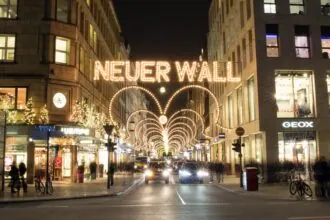
Jungfernstieg, on the edge of the Binnenalster lake, links U-Bahn lines U1, U2 and U4 with S-Bahn lines S1 and S3, and sits right in the middle of the shopping streets around Neuer Wall and Mönckebergstraße. It is the natural base for anyone staying centrally who wants a short walk to the water and the main retail core, without needing to change onto the S-Bahn for most trips.
Landungsbrücken is different again: it carries the U3 U-Bahn line and S1 and S3 S-Bahn services, but its real significance is as Hamburg’s main ferry pier, where HADAG’s commuter Hafenfähren, including line 62, depart across the Elbe. Anyone planning to ride a ferry as part of their trip, rather than just admire the harbour from land, should treat this as their reference point rather than Hauptbahnhof or Jungfernstieg.
Between the three, Hauptbahnhof is the one to plan long-distance and airport journeys around, Jungfernstieg suits a central shopping-and-sightseeing base, and Landungsbrücken is where the harbour and the ferries actually begin.
| Station | Key Lines | Best For |
|---|---|---|
| Hauptbahnhof | U1, U2, U3, U4; S1, S2, S3, S5; ICE/IC | Long-distance trains; S1 to the airport |
| Jungfernstieg | U1, U2, U4; S1, S3 | Central shopping and sightseeing base |
| Landungsbrücken | U3; S1, S3; HADAG ferries | Harbour ferries, including line 62 |
Hamburg’s Fare Ring System: A to H Explained
Hamburg divides its service area into eight concentric rings, lettered A through H, radiating outward from the city centre. Ring A covers the inner city, and Ring B covers the rest of Hamburg’s own municipal area, and together they form what HVV calls Großbereich Hamburg AB.
For almost all visitor journeys, including the harbour, Speicherstadt and city centre, a Hamburg AB ticket is all you need, since it already covers virtually everything inside the municipal boundary.
Rings C through E stretch into surrounding towns such as Pinneberg and Buxtehude, while Rings F, G and H reach further still toward Lüneburg and Neumünster, mainly relevant for day trips rather than city sightseeing.
This ring model is a genuinely different shape from Berlin’s three lettered zones or Munich’s numbered rings from a central zone, so it is worth treating Hamburg’s system on its own terms rather than assuming it matches either.
Ring boundaries are shown clearly on every official HVV map, including the ones posted at stations and inside the app, so double-checking before a longer day trip only takes a moment.
A ticket bought for the wrong ring is not automatically upgraded on board, so it is worth confirming your route covers the right rings before a trip that strays beyond the Hamburg AB zone.

Hamburg Public Transport Ticket Prices
Prices below cover the Hamburg AB zone, which is all most visitors will ever need. Every ticket type listed is valid across the U-Bahn, S-Bahn, buses and the HADAG harbour ferries without any extra charge.
Children under six travel free on all HVV services, and children aged six to fourteen pay a reduced Kinder fare, worth factoring in when budgeting for a family trip.
| Ticket | Rings | Price | Validity |
|---|---|---|---|
| Kurzstrecke (short trip) | AB | €2.10 | Up to three stops, no transfers |
| Einzelfahrschein (single) | AB | €4.10 | One direction, transfers allowed |
| Tageskarte (day ticket) | AB | €8.20 | Until 6am the following day |
| Gruppentageskarte (group day) | AB | €16.40 | Up to five people, any age, one day |
A 9-Uhr-Tageskarte, valid only from 9am, is sold at a discount over the standard day ticket and suits visitors who are not planning an early start.
All of these fares can be bought from platform ticket machines, Hochbahn customer centres, or the hvv app, and machine-bought tickets accept both cash and card at most stations.
The Gruppentageskarte above is genuinely good value for a family or small group sightseeing together, since it costs only about twice a single day ticket while covering up to five people.
The Deutschlandticket in Hamburg
The national Deutschlandticket costs €63 a month and covers unlimited travel across the whole HVV network, including the harbour ferries, right out to Ring H if you ever need it.
It also works on regional trains across Germany, which makes it a sensible option for anyone combining a Hamburg stay with day trips to Lübeck or further along the coast.
For a short city break, single and day tickets are usually cheaper, but anyone staying beyond about a week should work out the Deutschlandticket cost before defaulting to individual fares.
The ticket is non-transferable and tied to one named person, so a couple or family cannot share a single subscription between them the way an older group day ticket worked.
It is sold as a rolling monthly subscription rather than a one-off purchase, and most providers let you cancel before the next billing cycle if your trip ends earlier than planned.
Because it activates from the first day of the calendar month rather than the purchase date, arriving mid-month means paying the full price for partial use, so weigh that against single and day tickets first.
The ticket can be bought directly through the hvv or hvv switch app, or via the Deutschlandticket’s own national website, and it is valid from the moment of purchase rather than needing separate activation.
Apps for Getting Around Hamburg
The official hvv app covers journey planning, live departures and mobile ticket purchase across every operator in the network, including the harbour ferries alongside the U-Bahn, S-Bahn and buses, all in one route planner.
Alongside it sits hvv switch, a more comprehensive mobility app from the same operator that bundles the Deutschlandticket, StadtRAD bike hire, e-scooters, car-sharing services including SIXT share and MILES, and the MOIA ride-pooling service into a single login and wallet.
Hamburg’s Hochbahn and Berlin’s BVG are jointly developing a new combined mobility app, reported under the working name Max, intended to eventually merge features from both cities’ apps into one. The project has faced delays and public disagreement between the transport bodies involved, so the existing hvv and hvv switch apps remain the reliable choice for now.
Both hvv apps are available in English as well as German, which makes switching between journey planning and ticket purchase straightforward even on a first visit.
The DB Navigator app is worth keeping alongside these for S-Bahn disruption alerts or booking onward regional and long-distance trains from Hauptbahnhof.
A ticket bought in any of these apps is fully valid on a HADAG ferry as well as on land, so there is no need to buy anything separately at the ferry pier.
Best if you would rather spend the money on the trip than on the room. Compare hostels by location and rating.
Search hostelsBest arranged before you fly rather than after. Covers claim handling, plus lounge access on eligible delays.
Explore AirHelp+Best for a day with a suitcase and nowhere to put it. Find a storage point near where you already are.
View storageGetting To and From Hamburg Airport
Hamburg Airport sits just nine kilometres from the city centre, and the S1 S-Bahn line runs directly there in around twenty five minutes. Buses also connect the airport to nearby districts for anyone not headed straight into the centre.
The S1 runs roughly every ten minutes through most of the day, making it one of the most frequent airport rail links in Germany, and there is no need to book ahead or reserve a seat.
Buses connecting the airport to nearby districts, including the Ohlsdorf U-Bahn interchange, are a useful alternative if your accommodation sits closer to the northern suburbs than the city centre.
A standard taxi from the airport to the centre takes a similar amount of time to the S1 during quiet traffic, but costs considerably more, so the train remains the better value option for most visitors.
Because this involves comparing the S-Bahn against buses, taxis and private transfers, we cover it fully in a dedicated guide rather than repeating every option here.
See our Hamburg Airport Transfers guide for a full comparison of every route between HAM and the city, with current prices and timings.
Common Hamburg Public Transport Mistakes
The most common mistake is assuming the harbour ferries need a separate ticket or booking, the way a sightseeing cruise would. A normal HVV ticket covers line 62 and the other Hafenfähren routes exactly as it covers a bus, with nothing extra to buy at the pier.
The reverse mistake also happens: visitors sometimes board a paid sightseeing harbour cruise expecting their HVV ticket to work, when those tours are a completely separate commercial product with their own pricing.
Finally, remember that Hamburg has no barriers, so a valid, validated ticket is still required even though nothing physically stops you from boarding without one.
Some visitors also assume Hamburg’s ferries follow a tourist timetable rather than a genuine commuter one, and are surprised when line 62 gets noticeably busier during the morning and evening rush as locals use it to get to work.
A less obvious trap is booking the paid harbour cruise expecting it to stop at the same piers as the commuter ferry; sightseeing cruises typically depart from a separate section of Landungsbrücken with their own ticket booth.
Finally, it is easy to forget that night bus schedules and reduced weekend U-Bahn frequency run differently to weekday daytime services, so always check the app before relying on a very late or very early connection.

Rupert’s Handy Travel Tips
Hamburg is the one German city where I genuinely tell people to ride the ferry on purpose, so here is what I have learned crossing the Elbe.
- Ride HADAG line 62 with your normal HVV ticket for harbour views without paying for a separate sightseeing cruise.
- A Hamburg AB ticket covers almost everything you will need, including the ferries, so there is rarely a reason to buy anything wider.
- The S1 is your fastest link to the airport, no need to overthink the route.
- If you want commentary and a longer scenic loop, book the separate paid harbour cruise instead of the commuter ferry.
- Remember there are no barriers here either, so keep your validated ticket on you at all times.
Want to meet the reindeer behind our travel tips? Find out more in our page Who is Rupert?.




Frequently Asked Questions
Are the HVV ferries the same as Hamburg’s sightseeing cruises?
No. The Hafenfähren are everyday public transport covered by a normal HVV ticket, while sightseeing cruises are a separate paid tourist product with their own pricing and booking.
Do I need a special ticket for the harbour ferries?
No. Any valid HVV ticket, including a single, day ticket or Deutschlandticket, covers travel on HADAG’s scheduled ferry lines with nothing extra to buy.
What fare ring do I need as a visitor?
Hamburg AB covers the city centre, the harbour and Speicherstadt, which is enough for almost every visitor trip.
Does Hamburg have ticket barriers?
No. Like Berlin and Munich, Hamburg runs on a proof-of-payment honour system with spot checks rather than gates.
How do I get from the airport to the city centre?
The S1 S-Bahn runs directly from Hamburg Airport to the city centre in around twenty five minutes, using the same HVV ticket as the rest of the network.
Further Reading
Getting around is only one part of a Hamburg trip, so a few of our other Hamburg guides pair well with this one. Our Hamburg Airport Transfers guide covers every route between HAM and the city in full, while our Best Things to Do in Hamburg guide covers the Speicherstadt, Elbphilharmonie and Reeperbahn your HVV ticket can reach.
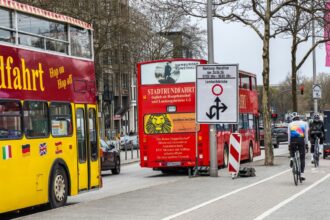
Want a longer, guided look at the port instead of a quick hop on the line 62 ferry? Our Hamburg Sightseeing Cruises guide compares the paid harbour tour options in detail, and our Hamburg Hop-On Hop-Off Bus Tours guide does the same for the sightseeing buses.
Ready to head further out, our Hamburg Day Trips guide covers Hanseatic old towns and the North Sea coast, several of which are reachable on the same HVV or Deutschlandticket fare.
Landing over the festive season, our Hamburg Christmas Markets guide covers the Rathausmarkt, Jungfernstieg and the harbour’s own take on the season, most a short U- or S-Bahn ride from each other.