Reviewed by our editorial team Published
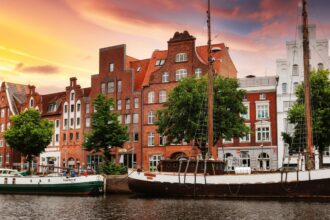
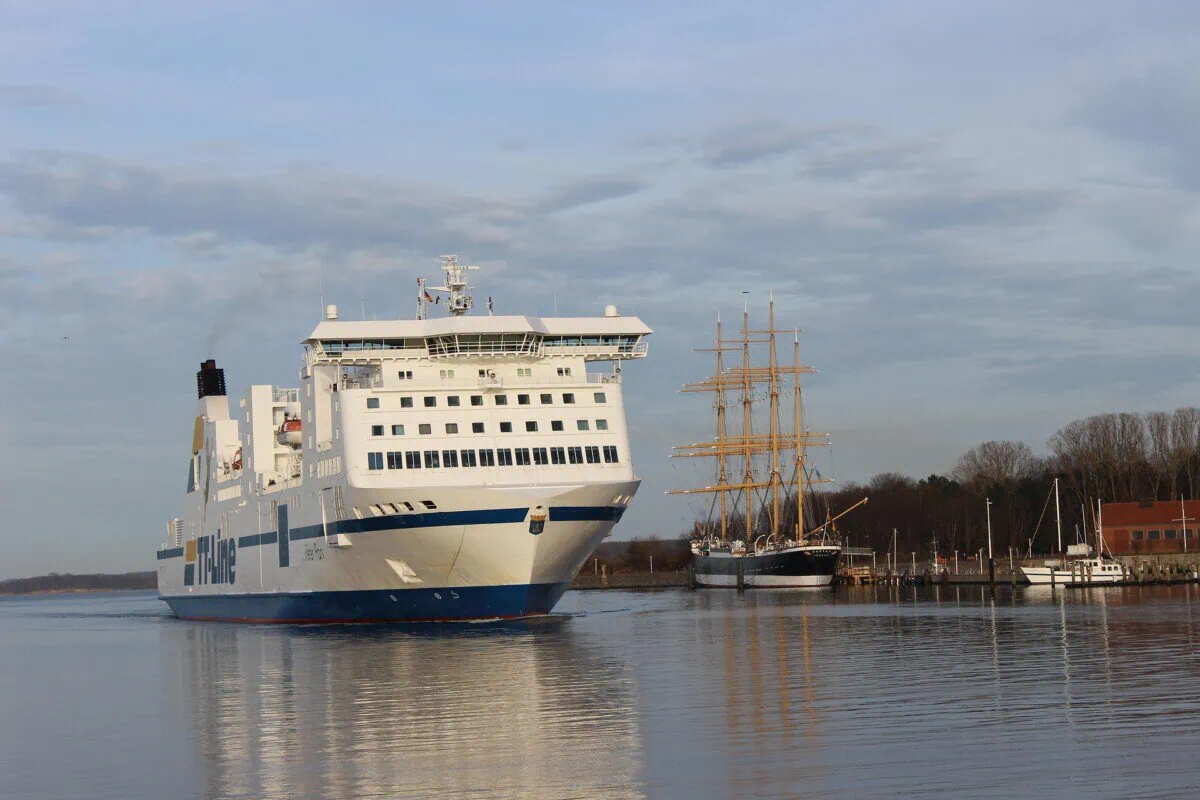
Travemünde is the point where the historic Hanseatic city of Lübeck meets the open Baltic, and it manages to be two genuinely different places at once. Walk along the Vorderreihe promenade on a summer afternoon and it feels like any well kept German seaside resort, with roofed wicker beach chairs, ice cream stands and a working lighthouse at one end of the strip. Turn to look across the river mouth, though, and the view fills with something else entirely: the vast Skandinavienkai ferry terminal, where huge ropax ships load for Sweden and Finland several times a day, making this stretch of coastline one of the busiest international ferry crossings anywhere in Germany.
That dual identity is not a marketing exaggeration. Skandinavienkai is genuinely Germany’s largest ferry port on the Baltic Sea, and two established operators, TT-Line and Finnlines, run scheduled passenger and freight sailings from it every day of the year. A separate quay closer to the town centre, Ostpreussenkai, takes occasional ocean going cruise ships too, giving Travemünde a smaller but genuine cruise dimension alongside its ferry traffic, entirely distinct from the ropax terminal across the water.
This guide works through both sides of Travemünde in proper depth: the TT-Line crossing to Trelleborg, the Finnlines routes to Helsinki and Malmö, the separate cruise quay at Ostpreussenkai, the short train ride out from Lübeck, and the resort side of town that gives so many visitors a reason to come here even without a ferry ticket booked, from the Priwall peninsula and the old lighthouse to the promenade and the former casino building.
Travemünde’s Ferry, Cruise and Rail Links at a Glance
The table below summarises the essentials before the detailed sections that follow cover each one in full. All routes and terminals were checked against current sources before this guide was written, rather than relying on older assumptions about what still runs.
| Route / Facility | Operator | Detail |
|---|---|---|
| Travemünde – Trelleborg | TT-Line | Approx. 7 to 9 hours (avg. 8), multiple daily departures, Skandinavienkai |
| Travemünde – Helsinki | Finnlines | Long haul overnight Baltic crossing, Skandinavienkai |
| Travemünde – Malmö | Finnlines | Multiple nightly departures, Skandinavienkai |
| Cruise ship quay | Port of Lübeck | Ostpreussenkai, separate from the ferry terminal, occasional ocean cruise calls |
| From Lübeck Hauptbahnhof | Regional train | Short hop on the Lübeck–Travemünde line, frequent departures |
Skandinavienkai: Germany’s Largest Ferry Terminal on the Baltic
Almost everything Travemünde is known for on the ferry side happens at a single sprawling terminal: Skandinavienkai, sitting on the western bank of the Trave estuary close to the Priwall peninsula. This is genuinely Germany’s largest ferry port on the Baltic Sea by throughput, built around nine separate berths handling roll on roll off traffic for cars, trucks, trailers and rail wagons alongside the passengers travelling on the same ships. It is a working industrial port first and a passenger gateway second, and the scale of it, container stacks, freight yards and enormous vessels queuing to load, makes the terminal feel closer to Rotterdam in miniature than to a typical seaside ferry dock.
Two operators share the terminal on a genuinely permanent, year round basis. TT-Line has run its flagship service from here to Trelleborg in southern Sweden since the company’s founding in 1962, making it one of the longest continuously operating ferry routes anywhere on the Baltic. Finnlines runs alongside it with two further scheduled routes, one reaching all the way to Helsinki and a second, far more frequent service to Malmö, meaning a single stretch of quay at Skandinavienkai connects Travemünde directly to both Sweden and Finland without needing to change terminals.
Because Skandinavienkai is built primarily around freight, passenger facilities are functional rather than glamorous: check in halls, a passenger terminal building and dedicated lanes for foot passengers and cyclists sit alongside the vehicle marshalling areas rather than a shopping mall style development. For anyone arriving without a car, a dedicated bus service connects the terminal with Travemünde and onward to Lübeck, since the terminal itself sits a genuine distance from the town centre and is not realistically walkable with luggage.
Best for two or three nights. The widest choice of rooms, with filters for free cancellation and included breakfast.
View staysBest for groups who want one address and separate bedrooms rather than three hotel rooms.
See holiday homesBest for double-checking. Runs the same search across several booking sites so you are not leaving money behind.
Compare pricesTT-Line to Trelleborg: The Daily Backbone Route to Sweden
The Travemünde to Trelleborg crossing is TT-Line’s founding route and remains the backbone of the company’s entire network more than six decades later. Current timetables published directly by TT-Line show multiple departures a day in both directions, with the crossing itself taking somewhere between 7 and 9 hours depending on the specific sailing, averaging out at around 8 hours for planning purposes. That is short enough to run as both a daytime and an overnight service, and TT-Line schedules a genuine mix of the two across a typical week rather than treating this purely as a sleeper crossing.
Several ships rotate through the route as part of TT-Line’s wider Baltic fleet, and two names come up repeatedly on the Travemünde to Trelleborg service: Nils Holgersson, a modern vessel fitted with electric vehicle charging points on its car decks, and Peter Pan, regularly scheduled on Saturday night departures. Both are proper ropax ships, carrying passengers, cars and substantial freight capacity side by side, which is exactly why the route can sustain multiple sailings a day rather than the single daily departure typical of longer overnight crossings elsewhere in the Baltic.
Trelleborg itself sits on Sweden’s southern coast with good onward rail connections toward Malmö and across the Öresund Bridge into Denmark, which makes this route a genuinely practical gateway for travellers continuing into Scandinavia by train rather than simply a there and back crossing. Current timetables, fares and ship assignments are published directly on the official TT-Line website, and given how much both frequency and pricing shift by season, it is worth checking a specific sailing date there before booking rather than relying on a general guide.
Travemünde to Trelleborg Ferry Times & Departures
Use Ferryhopper to check live sailings between Travemünde and Trelleborg in both directions. Select your travel date to compare scheduled ferry departures, sailing times and available tickets.
Select the date you want to travel. The times shown on the right-hand side are the scheduled departure and arrival times for each ferry.
Availability can change quickly, particularly during weekends and the summer season. Some sailings may stop accepting bookings a few hours before departure. If a timetable is blank, there may be no available sailings for today. Try moving to a later date to check future services.
This is the timetable for the outward direction. Use it to check sailings from Travemünde to Trelleborg for the date you plan to travel.
This is a separate timetable for the opposite direction. It does not select a return ticket for the journey above. Use it to check sailings from Trelleborg to Travemünde.
Want to compare different routes and other ferry options?
Compare routes, operators, sailing times and prices with Ferryhopper or Direct Ferries.
Finnlines to Helsinki and Malmö: Two Routes From One Quay
Alongside TT-Line, Finnlines operates two genuinely separate scheduled routes from the same Skandinavienkai terminal, and the difference between them is worth understanding before booking either one. The Travemünde to Helsinki service is the long haul option, a substantial overnight Baltic crossing that carries the route’s name through to Finland’s capital rather than stopping partway, and it forms part of Finnlines’ wider Baltic freight and passenger network connecting Germany directly with Finland without needing a connection through Sweden.
The Travemünde to Malmö route runs on a considerably tighter schedule, with multiple departures most nights rather than a single daily sailing, reflecting how much freight and passenger demand exists on this shorter hop to southern Sweden. Both routes accept foot passengers, cyclists and drivers with vehicles, and Finnlines publishes clear guidance that anyone travelling without a car needs to arrive by a fixed cut off, generally around 11pm, since the shuttle bus that carries foot passengers to the ship stops running at midnight regardless of a sailing’s exact departure time.
Check in windows vary by sailing and route, typically opening a couple of hours before departure and closing well ahead of boarding, and Finnlines’ own booking system is the most reliable source for a specific date’s exact times. As with the TT-Line service next door, these are working ropax ships built to carry substantial freight alongside passengers, so cabins are the norm rather than a seat only option on either crossing. Current schedules, fares and cabin availability are published directly on the official Finnlines website, which is worth checking closely given how much both routes’ timings can shift between weekdays and weekends.

Travemünde to Malmö Ferry Schedules & Tickets
Check the current Travemünde to Malmö ferry schedule with Ferryhopper. Change the date to compare available crossings, departure times and bookable tickets for both directions.
Select the date you want to travel. The times shown on the right-hand side are the scheduled departure and arrival times for each ferry.
Availability can change quickly, particularly during weekends and the summer season. Some sailings may stop accepting bookings a few hours before departure. If a timetable is blank, there may be no available sailings for today. Try moving to a later date to check future services.
This is the timetable for the outward direction. Use it to check sailings from Travemünde to Malmö for the date you plan to travel.
This is a separate timetable for the opposite direction. It does not select a return ticket for the journey above. Use it to check sailings from Malmö to Travemünde.
Want to compare alternative ferry routes and more sailing options?
Compare routes, operators, sailing times and prices with Ferryhopper or Direct Ferries.
Travemünde to Helsinki Ferry Crossings & Times
Compare ferry crossings between Travemünde and Helsinki with Ferryhopper. The live timetable shows scheduled departure and arrival times so you can choose a suitable sailing in either direction.
Select the date you want to travel. The times shown on the right-hand side are the scheduled departure and arrival times for each ferry.
Availability can change quickly, particularly during weekends and the summer season. Some sailings may stop accepting bookings a few hours before departure. If a timetable is blank, there may be no available sailings for today. Try moving to a later date to check future services.
This is the timetable for the outward direction. Use it to check sailings from Travemünde to Helsinki for the date you plan to travel.
This is a separate timetable for the opposite direction. It does not select a return ticket for the journey above. Use it to check sailings from Helsinki to Travemünde.
Looking for different ferry routes or other ferry options?
Compare routes, operators, sailing times and prices with Ferryhopper or Direct Ferries.
Ostpreussenkai: Travemünde’s Separate Cruise Ship Quay
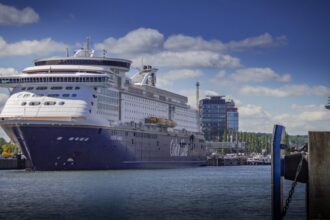
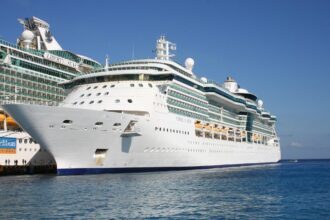
Travemünde’s cruise story is a genuinely different one from its ferry story, and it happens at a different address entirely. Rather than sharing space with the TT-Line and Finnlines ships at Skandinavienkai, ocean going cruise vessels calling at Travemünde use Ostpreussenkai, a quay sitting much closer to the town centre, near the Vorderreihe promenade rather than out among the freight yards on the Priwall side of the river. That location means a cruise call here drops passengers within genuine walking distance of Travemünde’s beach, shops and lighthouse rather than requiring a transfer bus first.
This is a smaller and more occasional cruise operation than the purpose built cruise terminals at nearby Kiel or at Hamburg, and it should be understood that way rather than oversold. Travemünde does not run anything close to Kiel’s scale of scheduled turnaround sailings, and there is no dedicated year round cruise programme published in the way Ostseekai’s is. What does happen, genuinely and verifiably, is that cruise ships dock at Ostpreussenkai from time to time, close enough to the promenade that a docked vessel becomes part of the view for anyone walking the seafront that day.
Anyone specifically planning a cruise stop in Travemünde rather than simply hoping to see a ship in port should confirm the exact terminal, call date and any transfer arrangements directly through their cruise line’s booking confirmation rather than assuming Ostpreussenkai automatically means the same facilities as a dedicated cruise port. For travellers wanting a genuinely major, purpose built German Baltic cruise terminal with a full published season of calls, our separate Kiel Cruise Port Guide covers exactly that kind of operation in full.
Best if you can move a day either way. Shows how the fare changes across the month.
Compare flightsBest for short trips. Install the eSIM at home and arrive with working data, no shop queue.
Browse eSIMsBest after a long flight or a late landing. Price agreed before you travel, and no taxi queue.
Check transfersFacilities at the Terminal
TT-Line and Finnlines share a single crescent shaped terminal building at Skandinavienkai known locally as the Hafenhaus, with each operator’s check-in desks positioned on opposite sides of the same hall rather than in separate buildings. Foot passengers and anyone without a booked vehicle check in here, collect boarding passes, and then wait in a downstairs departure lounge before a shuttle bus carries them out to the ship itself, while drivers with booked vehicles bypass the building entirely and head straight for the marshalling lanes outside.
Inside the Hafenhaus, facilities run to a small bistro serving lunch and snacks, though it tends to close by mid afternoon rather than staying open for late departures, alongside a drinks and confectionery shop stocking Nordic beers, wine and sweets at fairly ordinary travel shop prices. Vending machines, plentiful seating and an outdoor terrace looking out over the harbour cover the gaps between meals, and toilets are available throughout the building. Published sources do not confirm free public WiFi inside the terminal, so anyone needing to stay connected before boarding should plan on mobile data rather than assume a network will be there.
Facilities are noticeably more basic than at a major cruise terminal, and that is a fair reflection of what Skandinavienkai actually is: a working freight and ropax port with passenger amenities added on rather than built around from the start. Ostpreussenkai, the separate cruise quay closer to town, does not have a comparable passenger terminal building of its own, since it exists mainly as a mooring point rather than a full cruise facility; anyone arriving there is within easy walking distance of the Vorderreihe’s own cafes and shops instead, which do the job a dedicated terminal building would elsewhere.
Getting to Travemünde by Train
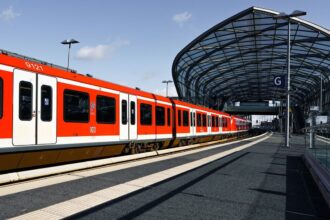
Travemünde is not a separate city requiring a long journey to reach. It is technically a district of Lübeck itself, sitting at the mouth of the Trave a short distance downstream from the UNESCO listed old town, and regional trains connect the two on a genuinely frequent, straightforward schedule throughout the day. Services run directly from Lübeck Hauptbahnhof, calling at stations including Lübeck-Travemünde Skandinavienkai, close to the ferry terminal, and Lübeck-Travemünde Strand, closer to the beach and town centre, so choosing the right stop for a specific plan matters more than the journey time itself.
The ride itself is short, comfortably under half an hour on the regional trains that run the route roughly every thirty minutes for most of the day, making Travemünde a genuinely easy half day or full day trip from Lübeck rather than something requiring careful timetable planning. Anyone already holding, or planning to buy, a Deutschland-Ticket for a wider German trip will find it covers this journey too, since the ticket applies to regional services nationwide rather than being restricted to long distance intercity trains.
For travellers arriving with a ferry or cruise booking already confirmed, it is worth double checking which of Travemünde’s two main stations sits closest to the relevant terminal before setting off, since Skandinavienkai and Ostpreussenkai are genuinely different distances from each stop. Our separate Things to Do in Lübeck guide covers the old town itself in full for anyone building a longer stop either side of the coastal leg.
Getting to Travemünde by Bus
A direct bus service runs between central Lübeck and Travemünde alongside the train, operated by Stadtwerke Lübeck as part of the local NAH.SH network. Bus lines 30 and 40 both connect Lübeck’s ZOB and Hauptbahnhof with Travemünde, and line 30 in particular calls at a stop named simply Skandinavienkai Terminal, which sits right at the ferry terminal itself rather than a short walk away, making it a genuinely useful option for foot passengers heading straight to check-in.
The trade off is journey time: because the bus threads through several intermediate stops on the way out from central Lübeck, including the Kücknitz district, the ride to Skandinavienkai takes around 30 minutes, longer than the direct regional train covering the same distance. Services run roughly every 20 to 30 minutes through the day on weekdays, thinning out somewhat on Sundays and public holidays, and current timetables are published directly by Stadtwerke Lübeck rather than fixed here, since routes and stops around the terminal have shifted in recent years as the port has been redeveloped.
For most travellers the train remains the faster choice between Lübeck Hauptbahnhof and either Travemünde station, but the bus is a genuinely useful backup, particularly for anyone whose Deutschland-Ticket or local transport pass already covers it, or for reaching the terminal building directly without needing to change at a station platform first.

Getting to Travemünde by Car and Parking
Driving from Hamburg or further south, the route to Travemünde runs up the A1 motorway toward Lübeck, then peels off onto the short A226 spur signposted Lübeck-Travemünde at the Lübeck interchange near Bad Schwartau. From there, an exit signposted Skandinavienkai leads directly into the ferry terminal’s check-in and marshalling area, and a car’s navigation system will get there reliably enough simply by entering “Skandinavienkai” or the terminal’s street address, Zum Hafenplatz 1, as the destination. Heavy vehicles over 3.8 metres in height need to check in at the port office rather than using the standard vehicle lanes.
Drivers arriving for a TT-Line or Finnlines sailing have dedicated vehicle marshalling and waiting areas built directly into the Skandinavienkai terminal itself, since the port is designed primarily around roll on roll off traffic rather than treating cars as an afterthought. Both operators run their own paid, unattended car parks alongside the terminal, at roughly €6 (£5.16 / $7.02) a day with TT-Line and €9 (£7.74 / $10.53) a day with Finnlines, with payment typically made by entering a vehicle’s licence plate at a machine near the entrance rather than through a barrier ticket. Current check in windows and any specific parking guidance for a booked sailing are best confirmed directly through the relevant operator’s own booking confirmation, since procedures and prices can differ slightly between the two.
For visitors driving to Travemünde purely for the beach and promenade rather than a ferry crossing, public car parks are available close to the Vorderreihe and the main seafront, including the Leuchtenfeld, Godewind, Backbord and Kowitzberg lots right along the beach and a further option by the Hafenbahnhof nearer the town centre. Space can genuinely fill on the busiest summer weekends when the resort is at its most popular with day trippers from Lübeck and Hamburg alike, and arriving earlier in the day meaningfully improves the odds of finding a space close to the beach rather than a longer walk in from further back.
Anyone planning to combine a beach visit with a ferry departure on the same day should treat the two as separate parking questions entirely, since the terminal’s own vehicle lanes are not a substitute for a standard public space near the promenade, and the two areas sit a genuine distance apart on opposite sides of the harbour mouth. Building in extra time to move between them, rather than assuming a single parking spot covers both purposes, avoids an unnecessary rush on an already busy day.
The Priwall Peninsula: Beach, Airfield History and the Foot Ferry
Across the narrow mouth of the Trave from Travemünde’s main promenade sits the Priwall, a genuinely quieter peninsula that most day trippers never bother crossing to, which is exactly why it rewards the effort. A small passenger and vehicle ferry, the Priwallfähre, shuttles constantly back and forth across the river mouth, taking only a couple of minutes to cross and running frequently enough throughout the day that it rarely involves much of a wait, a genuinely pleasant short boat trip in its own right rather than a chore to endure before reaching the other side.
The Priwall’s own beach runs for a considerable stretch along the open Baltic, generally far less crowded than Travemünde’s main town beach even at the height of summer, and it draws a noticeably more local crowd than the promenade side of the river. The peninsula also carries a genuinely distinctive history: it was long used as a military and glider flying airfield, and during the Cold War it sat directly on the sensitive inner German border, with the frontier running close enough to the beach that the area was heavily restricted for decades before reunification opened it back up to ordinary visitors.
Today that history sits quietly in the background rather than dominating a visit, and the Priwall functions mainly as a spot for a longer beach walk, cycling along the old airfield tracks, or simply escaping the busier promenade for an hour. It makes a genuinely worthwhile add-on to a Travemünde day trip for anyone with a couple of spare hours either side of a ferry departure or a walk along the main seafront, and the short ferry crossing itself is reason enough to make the detour.
The Promenade and Vorderreihe: Travemünde’s Town Beach
The heart of Travemünde’s resort side is the Vorderreihe, a shopping street running parallel to the harbour that marks the start of the town’s main promenade, with the beach itself beginning only a short walk further on. Rows of covered, wicker Strandkörbe, the distinctive roofed beach chairs found right along the German Baltic and North Sea coasts, line the sand in neat ranks through the season, and renting one for a day is a genuinely standard part of a Travemünde beach visit rather than an optional extra tourists alone go in for.
The promenade itself mixes restaurants, ice cream stands and small shops with genuinely good views out across the water, and on a clear day it is possible to watch TT-Line and Finnlines ships heading out toward the open Baltic from Skandinavienkai while standing on the same stretch of sand families have used for generations. A landscaped Kurpark sits just back from the seafront, adding a quieter green space for anyone wanting a break from the busier beach and shopping strip during a longer stay.
Because Travemünde functions as a genuine working resort rather than purely a ferry stopover, the promenade gets noticeably busy during the German summer school holidays, and both accommodation and the more popular restaurants along the Vorderreihe are worth booking ahead during that period. Outside peak summer, the same stretch is considerably quieter and arguably more pleasant for a relaxed walk, even if the beach itself is obviously less suited to swimming in the cooler months.
Best if you would rather spend the money on the trip than on the room. Compare hostels by location and rating.
Search hostelsBest for anyone flying more than once or twice a year. Handles the compensation claim so you are not chasing the airline.
See AirHelp+Best for a day with a suitcase and nowhere to put it. Find a storage point near where you already are.
View storageThe Old Lighthouse and the Kurhaus Casino
Standing at the point where the promenade meets the harbour mouth, Travemünde’s lighthouse is a genuine historical landmark rather than a modern replica built for photographs. It dates from 1539, making it the oldest lighthouse on the entire German Baltic coast, and its squat, solid brick tower has watched over shipping traffic into the Trave for close to five centuries, long before either the ferry terminal or the modern resort existed in anything like their current form. The tower remains one of the most photographed spots in town, and its position right where the river meets open water makes it a natural first orientation point for anyone arriving by train for the first time.
A short distance along the seafront, the elegant Kurhaus, designed by the architect Joseph Christian Lillie, anchors the more genteel end of Travemünde’s history as a resort town, the kind of grand seaside building that 19th century Baltic spa towns built to signal their arrival as fashionable destinations. Travemünde’s original casino building sits nearby, though it no longer functions as a casino today: the building has since become the Columbia Hotel, its striking historic exterior preserved even as its interior use has changed considerably from its original purpose.
Together the lighthouse and the old spa architecture give Travemünde a genuinely different character from a purely functional ferry port, and it is worth building at least an hour into any visit, ferry bound or otherwise, to walk this stretch of seafront properly rather than heading straight for the terminal. Anyone with a longer stopover between sailings will find this the most rewarding way to spend it.

Rupert’s Handy Travel Tips
Planning a trip to Travemünde? Rupert has a few tips worth knowing before you go:
- Know which quay you need: TT-Line and Finnlines both use Skandinavienkai, while cruise ships use the separate Ostpreussenkai closer to the town centre.
- Pick the right train station: Lübeck-Travemünde Skandinavienkai suits ferry passengers, while Lübeck-Travemünde Strand sits closer to the beach and promenade.
- Book a cabin for either ferry route: these are genuine multi hour Baltic crossings, so treat a berth as standard rather than a seat only option.
- Cross to the Priwall if you have time: the short passenger ferry across the river mouth reaches a genuinely quieter beach in only a couple of minutes.
- Separate your ferry and beach parking plans: the terminal’s vehicle lanes and the public car parks near the promenade sit on opposite sides of the harbour.
- Visit outside the school holidays for a quieter promenade: Travemünde’s Vorderreihe gets genuinely busy during the German summer break, so a shoulder season visit is noticeably more relaxed.
Want to meet the reindeer behind our travel tips? Find out more in our page Who is Rupert?.




Frequently Asked Questions About Travemünde’s Ferry and Cruise Port
What ferry routes leave from Travemünde?
Travemünde runs three scheduled international routes from Skandinavienkai: TT-Line’s crossing to Trelleborg in Sweden, and Finnlines’ separate routes to Helsinki and to Malmö.
How long is the ferry from Travemünde to Trelleborg?
The TT-Line crossing takes approximately 7 to 9 hours, averaging around 8 hours, with multiple daily departures in both directions.
Does Travemünde have a cruise ship terminal?
Yes, but a separate and smaller one from its ferry operation. Ocean going cruise ships call occasionally at Ostpreussenkai, close to the town centre, rather than at the Skandinavienkai ferry terminal.
Is Travemünde part of Lübeck?
Yes. Travemünde is a district of Lübeck sitting at the mouth of the Trave, connected to Lübeck Hauptbahnhof by frequent regional trains taking under half an hour.
Which train station do I need for the ferry terminal?
Lübeck-Travemünde Skandinavienkai sits closest to the TT-Line and Finnlines terminal, while Lübeck-Travemünde Strand is the better stop for the beach and promenade.
Can I take a car on the Travemünde ferries?
Yes, both TT-Line and Finnlines carry vehicles alongside foot passengers, with dedicated marshalling lanes built into the Skandinavienkai terminal.
What is the Priwall and how do I get there?
The Priwall is a peninsula across the harbour mouth from Travemünde’s main promenade, reached by a short, frequent passenger and vehicle ferry, with its own quieter beach and airfield history.
Is Travemünde worth visiting without taking a ferry?
Yes. The promenade, the 1539 lighthouse, the Kurhaus and Priwall beach make it a worthwhile day trip from Lübeck in its own right, entirely separate from its role as a ferry and cruise port.
Further Reading & Related Guides
Anyone visiting Travemünde as part of a wider stop in Lübeck should read our Things to Do in Lübeck guide, which covers the UNESCO listed old town, the Holstentor and the city’s Hanseatic history in full. Comparing Germany’s other major Baltic ferry ports is worth doing before booking, and our Ferry Routes from Kiel guide covers the Oslo and Gothenburg crossings from Schleswig-Holstein’s other big port city.
For the cruise side specifically, our Kiel Cruise Port Guide covers a considerably larger, purpose built German Baltic cruise terminal in full detail, useful context for understanding how Travemünde’s smaller Ostpreussenkai operation compares. For onward rail travel around the region, our German Rail Tickets Explained guide breaks down the Deutschland-Ticket and regional fares, while our Interrail Germany Pass Guide explains when a country-specific pass beats buying tickets individually for a longer trip.