Reviewed by our editorial team Published
Genoa sits at the centre of the Italian Riviera, and that position makes it one of the best possible bases for exploring the Ligurian coast without ever needing a car. A single rail line hugs the coastline in both directions, linking Genoa to a run of harbour towns that between them cover everything from designer glamour to genuinely quiet fishing villages.
The trick with this stretch of coast is that the most famous name, Portofino, is not actually the easiest or cheapest place to reach directly. Most of the towns covered in this guide connect to each other as much as they connect to Genoa, so a single day can often take in two or three stops rather than just one.
Seasonal ferries add a second, more scenic way to move along this coast between roughly late March and late October, calling at Camogli, San Fruttuoso and Portofino from Genoa’s own Porto Antico. Outside that window, or for anyone who would rather not rely on the weather, the regional train covers the same towns reliably all year round.
This guide brings together the genuine range of realistic day trips from Genoa, comparing how to get to each one, what to expect on arrival, and how much time it is actually worth setting aside. The Cinque Terre already has its own full, dedicated coverage on this site, so it is included here only briefly, with a pointer through to that deeper guide.
Genoa Day Trips at a Glance
| Destination | How to Get There | Journey Time | Suggested Time Needed |
|---|---|---|---|
| Portofino | Train to Santa Margherita Ligure, then bus or ferry, or direct seasonal ferry from Genoa | About 1 hour to 1 hour 30 minutes | Half day |
| Camogli | Direct regional train from Genoa Piazza Principe or Brignole | About 25-35 minutes | Half day |
| Santa Margherita Ligure | Direct regional train from Genoa Piazza Principe or Brignole | About 30-40 minutes | Half day to full day |
| San Fruttuoso | Seasonal ferry from Genoa, Camogli or Portofino, or a coastal hike from Camogli | About 30-75 minutes depending on start point | Half day |
| Rapallo | Direct regional train from Genoa Piazza Principe or Brignole | About 30-40 minutes | Half day |
| Sestri Levante | Direct regional train from Genoa Piazza Principe or Brignole | About 45-55 minutes | Half day to full day |
| Cinque Terre | Regional train to La Spezia or Monterosso, changing where needed | About 1 hour 15 minutes to 1 hour 45 minutes | Full day, better as an overnight |
Portofino: The Riviera’s Glamorous Harbour Village
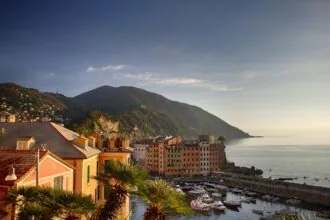
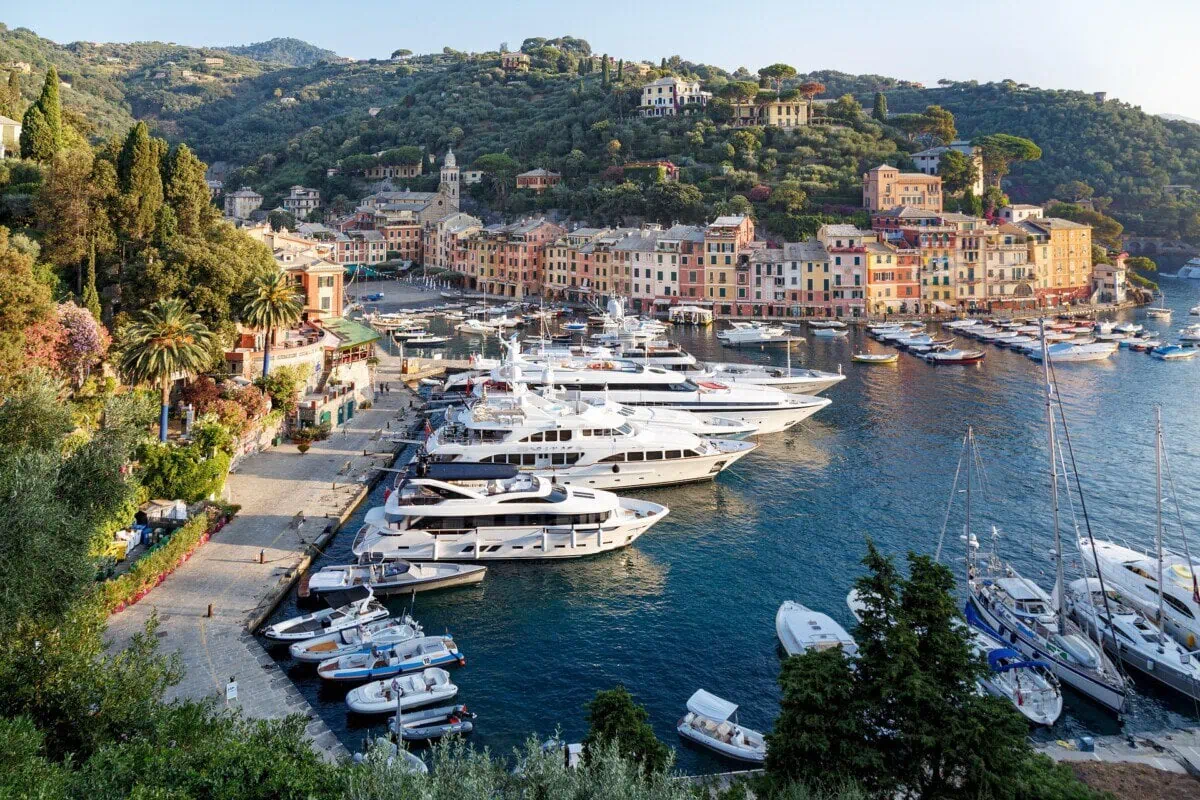
Portofino is the name most people associate with the Italian Riviera, a tiny fishing harbour turned playground for the wealthy that somehow still keeps a genuinely photogenic charm despite the crowds and price tags. Pastel houses ring a small marina lined with yachts, restaurants and designer boutiques rather than fishing boats these days.
There is no direct train to Portofino itself, since the village has no railway station of its own. The usual route is a regional train from Genoa to Santa Margherita Ligure in around 30 to 40 minutes, followed by either a local bus or, far more scenically, a short ferry along the coast to Portofino’s harbour.
Between late March and late October, a seasonal direct ferry also runs from Genoa’s own Porto Antico, calling at Camogli and San Fruttuoso en route, which turns the journey itself into part of the day out rather than a means to an end. Outside that window, the train-plus-bus route via Santa Margherita is the reliable year-round option.
Travellers combining Portofino with other Riviera stops might look at the Italia in Tour Pass, priced from around €35 (£30/$38) for three days of unlimited regional travel. It covers the train as far as Santa Margherita Ligure, though not the onward bus or ferry into Portofino itself.
Once there, the real pleasure is simply wandering the small harbour, climbing to the Castello Brown above the village for a view back over the bay, and continuing on to the lighthouse at Punta del Faro along a coastal path. Portofino is compact enough that a couple of hours covers the essentials, though its reputation for expensive everything is well earned.
A half day is enough for most visitors, and pairing Portofino with a stop in Santa Margherita Ligure on the way back makes for a fuller, more varied day without much extra effort.
Best for two or three nights. The widest choice of rooms, with filters for free cancellation and included breakfast.
View staysBest for families, or any stay past about four nights. A kitchen and a washing machine start paying for themselves.
Browse rentalsBest as a last check before booking. Compares hotel rates across several sites in one search.
Compare ratesCamogli: A Genuine Fishing Village on the Riviera
Camogli is what Portofino might look like without the yachts and the price tags, a working fishing harbour with tall, narrow, colourfully painted houses stacked above a pebble beach. It is a strong pick for anyone who wants the Riviera’s classic look without the crowds that build up around its more famous neighbour.
Direct regional trains run from Genoa’s Piazza Principe and Brignole stations in around 25 to 35 minutes, with frequent departures throughout the day. A standard second-class regional fare costs around €4 (£3/$5) each way, making Camogli one of the cheapest day trips on this list.
That regional fare also falls within the Italia in Tour Pass, which gives unlimited travel on Trenitalia’s regional network for three or five consecutive days from around €35 (£30/$38). Anyone combining Camogli with two or three other towns on this list is the most likely to see it beat single fares.
The town’s own basilica, Santa Maria Assunta, sits right on the harbourfront, and the ruined Castel Dragone beside it can be climbed for a proper view over the bay. Camogli’s beach and seafront promenade are genuinely pleasant for simply sitting and watching the boats come and go.
Camogli also works as the most popular starting point for the coastal walk to San Fruttuoso, a well-marked hike of a couple of hours through pine woods and along cliff edges, for anyone who would rather walk than take the ferry. The town’s annual Sagra del Pesce fish festival in May is worth timing a visit around if the dates line up.
A half day covers the town itself comfortably, and it pairs naturally with either San Fruttuoso or Portofino for a fuller day along this stretch of coast.
Santa Margherita Ligure: An Elegant Base for the Coast
Santa Margherita Ligure sits just around the headland from Portofino and works both as a destination in its own right and as the most practical gateway to it. The town has a noticeably more relaxed, less overrun feel than its famous neighbour, with genuine palm-lined seafront promenades and a working harbour of its own.
Direct regional trains from Genoa take around 30 to 40 minutes, with a standard second-class fare costing roughly €4.50 (£4/$5). The station sits a short, flat walk from the seafront, making arrival straightforward compared with some of the steeper towns further along the coast.
This regional service is also covered by the Italia in Tour Pass, priced from roughly €59 (£50/$64) for five days of unlimited regional travel. It is worth considering for a longer itinerary that uses Santa Margherita as a base for onward ferries and trains rather than a single return trip.
The town’s own sights include the baroque Basilica di Santa Margherita, the waterfront Villa Durazzo and its terraced gardens, and a genuinely pleasant public beach right in the centre. Ferries to Portofino and San Fruttuoso both depart from the harbour here, making it a useful hub for a day covering more than one stop.
Restaurant prices here sit somewhere between Camogli’s genuine affordability and Portofino’s premium, making it a sensible lunch stop on a day that also takes in the more expensive village further round the headland.
A full day works well if Santa Margherita is the sole destination, or treat it as a half-day base for onward ferries to Portofino and San Fruttuoso on a busier itinerary.
San Fruttuoso: An Abbey Reachable Only by Boat or Trail
San Fruttuoso is one of the more unusual day trips anywhere on the Italian Riviera, a tiny cove with a medieval abbey that has no road access at all. The only ways in are by boat or on foot, which keeps it from ever feeling as crowded as the more accessible towns nearby.
Seasonal ferries reach San Fruttuoso from Genoa, Camogli, Santa Margherita Ligure and Portofino between roughly late March and late October, with the crossing from Camogli the shortest at around 20 to 30 minutes. Outside the ferry season, the only way in is the coastal hiking trail from Camogli, a genuinely scenic but properly strenuous couple of hours each way.
The Abbey of San Fruttuoso itself, founded around the tenth century, sits directly on the tiny beach and is open to visitors for a modest admission fee. Just offshore, the famous bronze statue Christ of the Abyss sits eight metres underwater, and while diving to see it needs specialist arrangements, its story is well explained inside the abbey. Current opening days and ticket prices are listed on the abbey’s official FAI page, since the site only opens on a seasonal schedule.
Facilities here are deliberately limited given the lack of road access, with a couple of small restaurants covering the beach rather than a full village of shops. This is part of the appeal for anyone wanting a genuinely quiet stretch of the Riviera rather than a busier resort town.
A half day is enough given the limited facilities, and it is well worth checking the return ferry schedule carefully before setting off, since missing the last boat back means a long walk in the dark.
Rapallo: A Cable Car and a Genuine Castle
Rapallo is a larger, more year-round resort town than its immediate neighbours, with a genuine mix of local life and tourism that gives it a slightly different feel from the postcard villages further along the coast. Its most recognisable landmark, a small castle standing on rocks in the bay, dates back to the sixteenth century.
Direct regional trains from Genoa take around 30 to 40 minutes, with fares from roughly €4.50 (£4/$5) each way. The station sits close to the seafront, and the town’s promenade runs the full length of the bay past the castle.
Rapallo’s regional train is also covered by the Italia in Tour Pass, worth considering at around €59 (£50/$64) for five days if the plan includes several stops rather than just this one town.
Rapallo’s standout attraction is its cable car up to the Sanctuary of Montallegro, a pilgrimage church perched high above the town with sweeping views back down over the bay and coastline. The ride takes around eight minutes and costs roughly €8 (£7/$9) return.
The town also makes a practical base for reaching Portofino by ferry rather than train and bus, since boats to Portofino, Santa Margherita and San Fruttuoso all call at Rapallo’s own harbour during the operating season. This flexibility makes it worth considering as a base rather than a quick stop.
A half day covers the town and cable car comfortably, and Rapallo pairs easily with a ferry onward to one of its more famous neighbours for a fuller day.
Sestri Levante: Two Bays and a Quieter Pace
Sestri Levante sits a little further along the coast than the other towns in this guide, and that extra distance keeps it noticeably quieter while still delivering the same dramatic Riviera scenery. The town occupies a small peninsula with a distinctly different beach on either side.
Direct regional trains from Genoa take around 45 to 55 minutes, with fares from roughly €6 (£5/$7) each way. This makes it a genuine full-day trip rather than a quick half-day hop, though it is still comfortably manageable without an overnight stay.
The same Italia in Tour Pass covers this route too, and because Sestri Levante sits at the far end of this list, a 5-day pass from around €59 (£50/$64) can work out cheaper than paying for several single return fares.
The town’s two bays have their own distinct character and names: the sheltered Baia del Silenzio, or Bay of Silence, is calm and picture-postcard pretty, while the larger Baia delle Favole, or Bay of Fables, named for Hans Christian Andersen’s stay here, has more space and a livelier promenade.
The peninsula between the two bays, known locally as l’Isola, is a pleasant short walk with views out to sea on both sides, and the old town’s narrow streets are worth a wander in their own right beyond the beaches themselves.
Given the longer journey, this is best treated as a full day rather than combined with another stop, and it particularly suits anyone who wants proper beach time alongside the sightseeing.
Cinque Terre: Worth the Longer Trip, Better as an Overnight
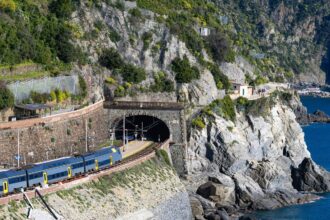
The Cinque Terre sits just beyond the towns covered above, and it is genuinely popular enough as a day trip from Genoa that it deserves a mention here, even though it already has its own full, dedicated coverage elsewhere on this site. Regional trains run from Genoa to La Spezia or directly into the five villages in around 1 hour 15 minutes to 1 hour 45 minutes, depending on the exact service and destination village.
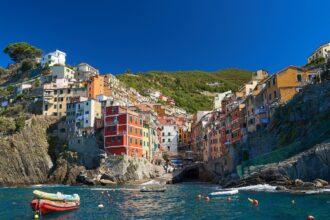
The appeal lies in the five cliffside villages themselves, Monterosso, Vernazza, Corniglia, Manarola and Riomaggiore, each stacked above its own tiny cove and linked by coastal trails and terraced vineyards. Vernazza and Manarola are usually rated the most photogenic of the five.
The Italia in Tour Pass covers the regional train from Genoa as far as La Spezia, though not the short Levanto-La Spezia stretch through the villages themselves, which needs the separate Cinque Terre Card instead.
Because the villages themselves are best explored slowly, on foot, along the coastal trails between them, a single rushed day from Genoa tends to leave visitors wishing they had built in an overnight rather than a return journey the same evening. For anyone set on a day trip regardless, an early start genuinely pays off here more than almost anywhere else on this list.
For the full breakdown of trains, the Cinque Terre Card, hiking trails between villages, and which village suits which kind of visit, our dedicated Cinque Terre guide and How to Get to Cinque Terre guide cover everything needed to plan a proper visit, whether that ends up being a long day or a short overnight stay.
Best if you can move a day either way. Shows how the fare changes across the month.
Compare flightsBest for short trips. Install the eSIM at home and arrive with working data, no shop queue.
Browse eSIMsBest if you would rather not work out the transport on arrival. Book it now and forget it.
View transfersWhich Day Trip Should You Choose?
For a first visit to this stretch of the Riviera, pair Santa Margherita Ligure with Portofino, using the train out and a scenic ferry back, or the reverse. Between them they cover the classic postcard version of this coast without needing a full day dedicated to either alone.
Travellers who want the Riviera’s charm without the crowds or the price tags should head to Camogli instead, and consider adding the coastal walk or ferry on to San Fruttuoso for one of the more memorable half days anywhere on this list.
Anyone short on time but wanting a proper taste of the coast should pick Rapallo, since its cable car and central position make it an efficient single stop with genuine variety built in. Sestri Levante suits travellers who want a full day with real beach time rather than a packed sightseeing itinerary.
Save the Cinque Terre for a day when an early start is genuinely possible, or better still, build in an overnight so the villages can be enjoyed properly rather than rushed between train departures.
Whichever combination fits the trip, buying tickets on the day at any Trenitalia station or through the Trenitalia app works perfectly well for this whole stretch of coast, and advance booking is rarely necessary outside the busiest summer weekends.
Day Trips by Train Versus Seasonal Boat
Most of the destinations in this guide are reachable by direct regional train from Genoa’s Piazza Principe or Brignole stations, running reliably all year regardless of the season or the weather. Camogli, Santa Margherita Ligure, Rapallo, Sestri Levante and the Cinque Terre, via La Spezia, all fall into this year-round, train-only bracket, and none of them genuinely need a boat to be reached at all.
Portofino and San Fruttuoso sit in a different category, since a genuine seasonal ferry links them to Genoa’s own Porto Antico, plus Camogli, Santa Margherita and each other, roughly between late March and late October. Outside that window, Portofino still has its train-plus-bus route via Santa Margherita Ligure, but San Fruttuoso’s only fallback is the coastal hiking trail from Camogli covered earlier in this guide.
This seasonal gap catches out a fair number of visitors planning a winter or early-spring trip, since a quick search does not always make clear that the boats simply stop running outside the warmer months. Anyone travelling between November and March should treat San Fruttuoso as walk-only and build any Portofino visit around the train and bus route rather than assuming a ferry will be waiting at Porto Antico.
For a first visit in season, mixing the two modes works well: take the train out to Santa Margherita Ligure or Camogli, then return by the scenic ferry rather than doubling back the way you came. Checking the current ferry timetable before setting off is worth doing regardless of season, since services thin out noticeably at either end of the summer schedule.

Rupert’s Handy Travel Tips
The Italian Riviera rewards a bit of planning, so here are a few things worth knowing before you set off from Genoa:
- Take the ferry at least once if the season allows it: the seasonal boats between Genoa, Camogli, San Fruttuoso and Portofino are genuinely one of the best ways to see this coastline.
- Check the last ferry back before visiting San Fruttuoso: there is no road out, so missing the final boat means a long hike in the dark.
- Go to Camogli or Santa Margherita instead of Portofino for lunch: prices in Portofino itself run noticeably higher than in either neighbouring town.
- Buy regional train tickets on the day: advance booking is rarely necessary for this stretch of coast outside the busiest summer weekends.
- Wear proper footwear for San Fruttuoso’s trail: the coastal path from Camogli is scenic but genuinely steep and uneven in places.
- Build in an overnight for the Cinque Terre if you can: a single rushed day from Genoa leaves little time to enjoy the villages properly.
Want to meet the reindeer behind our travel tips? Find out more in our page Who is Rupert?.




Frequently Asked Questions About Day Trips from Genoa
What is the best day trip from Genoa?
Santa Margherita Ligure paired with Portofino is the classic choice, though Camogli is a strong pick for travellers who want the Riviera’s charm without the crowds.
How do I get from Genoa to Portofino?
There is no direct train, so the usual route is a regional train to Santa Margherita Ligure followed by a local bus or ferry, or a direct seasonal ferry from Genoa itself.
Is the Cinque Terre a realistic day trip from Genoa?
It is possible, with trains taking around 1 hour 15 minutes to 1 hour 45 minutes each way, but the villages are better enjoyed with an overnight stay rather than a rushed single day.
How do I get to San Fruttuoso?
Between late March and late October, seasonal ferries run from Genoa, Camogli, Santa Margherita and Portofino. Outside that season, the only access is a coastal hiking trail from Camogli.
Is Camogli or Portofino better to visit?
Camogli is more affordable and feels like a genuine working fishing village, while Portofino has more polish and prestige but noticeably higher prices for very similar scenery.
Do I need a car for any of these day trips?
No, every destination in this guide is reachable by direct regional train, seasonal ferry, or a short bus connection from Genoa, and a car adds little beyond flexibility.
When do the Genoa to Portofino ferries run?
The seasonal ferry service typically operates from late March to late October, with reduced or no service outside those months.
Further Reading
Landing in Genoa before any of these trips? Our Genoa Airport Transfers guide covers every realistic way of reaching the city centre from Cristoforo Colombo, and our Things to Do in Genoa guide rounds up the sights worth prioritising in the city itself before you head out on any of the trips above.
Continuing further along the coast? Our Cinque Terre guide, Cinque Terre by Train guide and Cinque Terre Boat and Ferry guide cover the stretch of coast just beyond Genoa’s own in full depth.
For the wider picture on Italian rail travel, our Interrail Italy Pass guide explains when a multi-country rail pass beats buying individual point-to-point tickets for a longer trip along this coast.