Reviewed by our editorial team Updated
Getting to the Cinque Terre
The Cinque Terre has no airport of its own, and genuinely no direct high-speed rail line reaches the villages themselves, which understandably leaves first time visitors wondering exactly how to plan their journey here. The good news is that once you understand the basic shape of the region’s transport network, actually getting to the Cinque Terre is considerably more straightforward than it first appears.
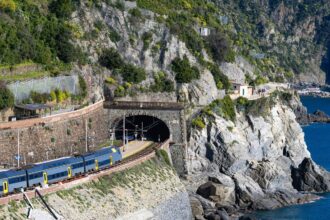
Every route into the region ultimately funnels through one of two gateway towns, La Spezia to the south or Levanto to the north, both sitting on Italy’s main coastal railway line with frequent connections to Florence, Pisa, Genoa, Milan and beyond. From either gateway, the short, scenic Cinque Terre Express regional train covers the remaining distance into the villages themselves in a matter of minutes.
For international visitors arriving by air, the nearest useful airports are genuinely Pisa and Genoa, both offering reasonably direct rail connections south or north into the National Park. Florence and Milan airports sit further away but remain entirely workable given Italy’s excellent rail network, particularly if you’re already planning to visit either city as part of a wider Italian itinerary.
This guide covers every practical route into the Cinque Terre, from the two main airport gateways through to travelling by train from Florence, Pisa, Milan and Genoa, along with an honest look at why driving here is genuinely more hassle than it’s worth. For getting around once you’ve arrived, our Complete Guide to Visiting Cinque Terre and dedicated Cinque Terre by Train guide cover the region’s internal transport network in full.
Travel Times at a Glance
Before working through each route in detail, it genuinely helps to see how travel times compare from Italy’s major cities, since the fastest option isn’t always the most obvious one. Direct high-speed services can sometimes beat a seemingly shorter regional route, particularly on the Florence and Milan connections covered below.
All journey times in the table are given to La Spezia Centrale, the busier and better connected of the two gateway towns, since most visitors arriving from the south or from major Italian cities will pass through here regardless of their final village destination. Add a further ten to twenty minutes for the connecting Cinque Terre Express onward into the National Park itself.
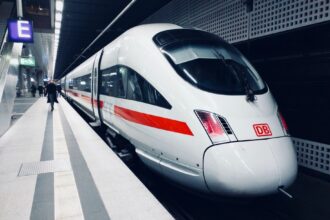
Journey times below reflect the fastest direct or near direct services typically available, though actual travel time varies depending on the exact train, time of day and whether engineering works are affecting the line. Booking your longer distance tickets in advance through Trenitalia or Italo, particularly for high-speed Frecciarossa, Frecciargento and Frecciabianca services, is genuinely worth doing for both better prices and guaranteed seating.
Whichever city you’re travelling from, the underlying principle remains the same: get yourself to La Spezia or Levanto by whatever combination of high-speed or regional train works best, then let the short, frequent Cinque Terre Express handle the final stretch into whichever village you’re staying in.
| From | Fastest Option | Typical Time to La Spezia |
|---|---|---|
| Florence | Direct Frecciargento | ~1.5 hours |
| Pisa | Direct regional train | ~1 to 1.5 hours |
| Milan | Direct Frecciabianca | ~3.5 hours |
| Genoa | Direct regional train | ~1 to 1.5 hours |
| Rome | Frecciarossa with a change | ~4 hours |
Compare hotels and other places to stay for your trip.
Check availabilityBrowse apartments, homes and self-catering accommodation.
Browse rentalsCompare hotel prices across multiple booking sites.
Compare ratesFlying In: Which Airport Should You Use?
Choosing the right airport genuinely depends on where else your Italian itinerary takes you, since no single airport sits conveniently close to the Cinque Terre itself. Understanding the trade offs between the main options upfront will save considerable confusion once you land and start hunting for the right platform.
Pisa International Airport (PSA) is genuinely the most practical choice for visitors heading straight to the Cinque Terre, given its direct rail connection through Pisa Centrale onward to La Spezia. The full journey, including the connection, typically takes around an hour and a half, making Pisa a genuinely sensible arrival point even if you’re not otherwise planning to visit the city.
Genoa Airport (GOA) offers the shortest overall distance to the region, sitting roughly one hundred kilometres north of the Cinque Terre along the same Ligurian coastline. Reaching the rail network requires a shuttle bus into central Genoa first, typically to Genova Brignole station, followed by a direct regional train to La Spezia taking around an hour to ninety minutes.
Florence Airport (FLR) and Milan’s airports sit considerably further away, but remain genuinely workable options given Italy’s fast, frequent rail network, particularly for visitors already building a wider Tuscany or northern Italy itinerary around either city. Rome’s Fiumicino Airport, while further still, also connects reasonably well given Italy’s excellent high-speed rail spine running the length of the country, with journeys typically requiring one change along the way.
Travelling from Florence
Travelling from Florence to the Cinque Terre offers a genuine choice between speed and cost, both starting from Firenze Santa Maria Novella, the city’s main railway station. The fastest option, a direct Frecciargento high-speed service, covers the journey to La Spezia in around ninety minutes, though tickets cost noticeably more than the slower alternative.
Budget conscious travellers, or anyone holding a regional rail pass such as the Italia in Tour Pass, will instead typically travel via a change at Pisa Centrale, with the full journey taking somewhere between two and two and a half hours depending on connection timings. This route works particularly well if you’re already planning to stop in Pisa along the way, since it requires no additional detour to break your journey there.
If you’re flying into Florence Airport rather than starting from a hotel in the city centre, note that there is no direct rail connection from the airport itself. You’ll need to take the T2 tram into Santa Maria Novella station first, a journey of around twenty minutes, before continuing onward towards the Cinque Terre from there.
Given the choice between speed and cost, most visitors travelling from Florence find the regional route via Pisa offers the better overall value, particularly since booking the direct Frecciargento well in advance rarely closes the price gap by much. Either way, allow a full morning for the journey if you’re hoping to reach the villages with a genuine afternoon of exploring still ahead of you, rather than arriving already worn out from a rushed connection.
Transfering from Pisa
Travelling from Pisa is genuinely one of the most straightforward routes into the Cinque Terre, given the frequent direct regional trains connecting Pisa Centrale to La Spezia Centrale throughout the day. The journey typically takes around an hour to ninety minutes depending on the specific service, with no change required along the way.
For visitors flying into Pisa International Airport rather than starting from the city itself, the airport’s own PisaMover automated people mover connects directly to Pisa Centrale station in only a few minutes, making the full journey from touchdown to La Spezia genuinely achievable in around an hour and a half to two hours including your connection. This makes Pisa Airport arguably the single most convenient international arrival point for visitors heading straight to the Cinque Terre without any other Italian stops planned.
Given how close Pisa sits to the Cinque Terre, many visitors also choose to combine both destinations into a single itinerary, spending a morning admiring the Leaning Tower before continuing onward to the coast in the afternoon, or reversing the order depending on which direction their wider trip is heading.
Regional trains between Pisa and La Spezia run frequently throughout the day, generally every hour or so, and tickets are inexpensive compared with the high-speed alternatives available from cities further afield. Booking is rarely necessary in advance for this particular route, though buying your ticket before boarding, either at the station or via the Trenitalia app, remains essential to avoid an on board penalty fare from the conductor.

Starting In Milan
Travelling from Milan to the Cinque Terre takes considerably longer than the Tuscan or Ligurian routes, but remains a genuinely comfortable journey given Italy’s excellent long-distance rail connections. Direct Frecciabianca services run from Milano Centrale straight through to La Spezia and, on certain services, all the way to Monterosso itself, with a typical journey time of around three and a half hours.
Choosing the direct Frecciabianca over a route requiring a change genuinely simplifies the journey, since it removes the need to navigate a connection at Genoa or Pisa with luggage in tow. Given the distance involved, booking your ticket in advance through Trenitalia is genuinely worth doing, both for better pricing and to secure a reserved seat on what can be a fairly full service during peak season.
For visitors flying into Milan Malpensa, the Malpensa Express train connects directly to Milano Centrale in under an hour, making the full combined journey from touchdown to La Spezia achievable within a single day, albeit a fairly long one given the total distance covered. Milan Linate, being considerably closer to the city centre, offers a quicker initial connection into town via bus or taxi, though it serves fewer long-haul international routes than Malpensa.
Given the length of this particular journey, many visitors travelling from Milan choose to break it up with an overnight stop somewhere along the way, whether in Genoa to explore its historic centre, or further south in Pisa or Florence, rather than attempting the full route in a single exhausting day.
Heading Down from Genoa
Travelling from Genoa is genuinely the shortest and most straightforward route into the Cinque Terre, given the city’s position roughly one hundred kilometres north along the same stretch of Ligurian coastline. Direct regional trains run frequently between Genova Brignole or Genova Piazza Principe stations and La Spezia Centrale, typically taking between one and one and a half hours.
For visitors flying into Genoa Airport (GOA), also known as Cristoforo Colombo Airport, reaching the rail network requires an initial shuttle bus connection, typically the Volabus service, into central Genoa, usually to Genova Brignole station, taking around thirty minutes. From there, the regional train onward to La Spezia adds a further hour or so, bringing the full journey from touchdown to around ninety minutes to two hours in total.
Given Genoa’s genuinely handsome historic centre, one of the largest in Europe, and its position as a major Ligurian port city, many visitors choose to spend a day or two exploring Genoa itself before continuing south to the Cinque Terre, treating the city as a genuinely worthwhile destination in its own right rather than simply a transit point along the way.
The regional line connecting Genoa to La Spezia also passes through several other attractive Ligurian coastal towns, including Camogli, Santa Margherita Ligure and Sestri Levante, any of which could make an interesting stop if your itinerary allows for a slower, more scenic journey south towards the Cinque Terre itself, rather than travelling the route in a single sitting.
Arriving via La Spezia
La Spezia functions as the busier and better connected of the Cinque Terre’s two gateway towns, with its main station, La Spezia Centrale, sitting on the principal rail line connecting Genoa, Milan, Florence, Pisa and Rome. For most visitors arriving from major Italian cities, La Spezia will genuinely be your final change before boarding the Cinque Terre Express itself, so it’s worth becoming familiar with the layout of the station in advance.
Beyond its role as a transport hub, La Spezia offers a genuinely practical base for exploring the Cinque Terre, with a considerably wider range of hotels and restaurants than the villages themselves, along with the added benefit of not needing to book accommodation months in advance the way village stays often require. The onward journey to Riomaggiore, the closest village, takes only around ten minutes by regional train.
La Spezia also serves as a departure point for boat services along the coast during the warmer months, offering an alternative to the train for reachingMonterosso, Vernazza, Manarola and Riomaggiore, along with excursions further afield to Portovenere and the nearby Palmaria Island. Our dedicated Cinque Terre Boat and Ferry Guide covers these seasonal services in full.
Given its practicality and considerably lower accommodation costs compared with staying inside the National Park itself, La Spezia genuinely suits visitors prioritising convenience and choice over the atmosphere of falling asleep within one of the five villages, particularly for longer stays, larger groups, or families struggling to find suitable village accommodation at short notice.
Compare routes and fares for your next trip.
Compare flightsUse an eSIM to get online without hunting for a local SIM after arrival.
See eSIM optionsCheck private airport pickup options and plan the first part of your journey in advance.
View transfersArriving via Levanto
Levanto, sitting just north of Monterosso al Mare at the opposite end of the Cinque Terre Express line, offers a genuinely quieter and increasingly popular alternative gateway to La Spezia, particularly for visitors arriving from Milan, Genoa or the wider Ligurian Riviera to the north.
Levanto is itself a genuinely attractive seaside town in its own right, with a considerably longer sandy beach than any of the five villages themselves, making it a popular choice for visitors who want beach time alongside their Cinque Terre sightseeing without needing to base themselves in Monterosso. The town’s own historic centre, though smaller than La Spezia’s, holds a pleasant medieval loggia and covered market worth a wander before or after your train connection.
Reaching Levanto by train works well from Genoa, with direct regional services taking around an hour, though visitors arriving from Florence, Pisa or further south will generally find La Spezia the more convenient gateway given the direction of most rail connections into the region from those cities.
Choosing Levanto over La Spezia genuinely comes down to which direction you’re approaching the Cinque Terre from and whether beach access matters to your stay. Given its position at the northern end of the line, Levanto also makes a genuinely sensible base for visitors planning to spend most of their time in Monterosso, the closest and most beach-friendly of the five villages, with the added bonus of a wider hotel selection than the village itself.
Should You Drive?
Driving to the Cinque Terre is technically possible, given the A12 motorway running along the Ligurian coast, but honestly represents more hassle than it’s worth once you understand how the villages themselves are set up. None of the five settlements offer meaningful parking within their historic centres, and several restrict vehicle access to residents only.
Visitors driving in typically need to park at one of the paid car parks located above Riomaggiore, Manarola or Monterosso, or alternatively leave their car in La Spezia or Levanto and continue by train, which most visitors ultimately find is simpler than attempting to drive between villages directly. Parking within the National Park itself is both limited and considerably more expensive than in either gateway town.
The steep, narrow roads connecting the villages by car also offer none of the scenic drama that the train or coastal hiking trails provide, since much of the route runs through tunnels bored directly through the cliffs rather than along the coastline itself. Given this, a car genuinely adds cost and complication without providing any meaningful benefit over the train for actually experiencing the Cinque Terre.
For visitors who do arrive by car, whether as part of a wider Italian road trip or simply because it suited an earlier leg of the journey, the sensible approach is genuinely to park in La Spezia or Levanto for the duration of your Cinque Terre stay and rely entirely on the train and your own feet to explore the villages themselves, rather than fighting for a scarce parking spot each day.
Which Gateway Should You Choose?
Deciding between La Spezia and Levanto as your entry point into the Cinque Terre genuinely comes down to two main factors: the direction you’re travelling from, and how much you value beach access and a wider choice of accommodation over the practicality of a major rail hub.
Visitors arriving from Florence, Pisa, Rome or anywhere south along Italy’s rail network will generally find La Spezia the more natural gateway, given its position on the main line and considerably better connections in that direction. La Spezia also offers the wider range of hotels and, being the larger town, a genuinely broader choice of restaurants for evenings when you’d rather not fight the crowds in the villages themselves.
Visitors arriving from Genoa, Milan or the wider Ligurian Riviera to the north will often find Levanto the more convenient option, particularly if beach time forms part of your plans given the town’s own long sandy shoreline. Levanto’s smaller scale also makes it a genuinely pleasant, quieter base compared with the busier atmosphere of La Spezia.
Ultimately, both gateways connect to the same Cinque Terre Express line, so neither choice locks you out of any particular village or forces a compromise on your wider itinerary. Whichever gateway suits your itinerary better, the key takeaway remains the same throughout this guide: get yourself to either La Spezia or Levanto by whatever combination of trains works from your starting point, then let the short regional train handle the rest.

Rupert’s Handy Travel Tips
Getting to the Cinque Terre is easier than it looks, so here’s what I’d want to know before setting off.
- Fly into Pisa if you can: it offers the most direct, hassle-free route straight to La Spezia of any international airport.
- Don’t rely on Florence Airport for a direct connection: you’ll need the T2 tram into the city centre first before continuing by train.
- Book Frecciarossa and Frecciabianca tickets ahead: both for better pricing and to guarantee a seat during peak season.
- Leave the car in La Spezia or Levanto: village parking is limited, expensive, and genuinely not worth the hassle.
- Choose your gateway by direction of travel: La Spezia suits visitors from the south, Levanto suits those from Genoa or Milan.
Want to meet the reindeer behind our travel tips? Find out more in our page Who is Rupert?.



Frequently Asked Questions
What is the nearest airport to the Cinque Terre?
Pisa International Airport is generally the most convenient, offering a direct rail connection through Pisa Centrale to La Spezia in around ninety minutes total.
How do I get to the Cinque Terre from Florence?
Take a direct Frecciargento to La Spezia in around ninety minutes, or a cheaper regional service via Pisa taking two to two and a half hours.
Can I drive to the Cinque Terre?
Yes, but it’s not recommended. Village parking is limited and expensive, and most visitors find parking in La Spezia or Levanto and taking the train considerably easier.
Should I arrive via La Spezia or Levanto?
La Spezia suits visitors arriving from Florence, Pisa or Rome, while Levanto suits those coming from Genoa, Milan or the northern Ligurian coast.
How long does it take to get to the Cinque Terre from Milan?
Around three and a half hours on a direct Frecciabianca service from Milano Centrale to La Spezia or Monterosso.
Is there a train from Florence Airport to the Cinque Terre?
No direct connection exists. You’ll need to take the T2 tram into Florence Santa Maria Novella station first, then continue by train from there.
Further Reading
For an overview of the whole region, including each village and the Cinque Terre Card, our Complete Guide to Visiting Cinque Terre is the best place to start. Once you’ve arrived, our dedicated Cinque Terre by Train guide and Cinque Terre Boat and Ferry Guide cover every way to move between the villages themselves.
If your time is limited, our Cinque Terre Day Trip Guide explains how to make the most of a single day visit from Florence, Pisa or elsewhere in Italy.
Exploring more of Italy by rail? Our Trenitalia Pass Italy guide, Italia in Tour Pass guide and Interrail Italy Pass guide explain the wider rail pass landscape, including the important exclusions that apply to the Cinque Terre National Park.
If you’re travelling around Italy more widely, our Best eSIM Apps Guide and Train Booking Apps Guide will help you stay connected and book rail journeys with confidence.