Reviewed by our editorial team Published
A road trip is the only way to see all of Mallorca properly, and this circular route takes in almost every corner of it. Starting and finishing in Palma, the loop runs along the dramatic Tramuntana coast road, crosses to the northern tip at Cap de Formentor, drops down the quieter east coast, and returns through the island’s inland heartland.
The whole circuit covers roughly 400 kilometres and works comfortably as a four to five day trip, with an overnight stop in the mountains, another near Alcúdia in the north, and a third on the east coast before heading back. A car is genuinely necessary for large stretches of this route, since the bus network thins out fast once you leave Palma and the coastal villages of the Tramuntana, and it barely touches the quieter east coast at all.
This guide covers everything needed to plan the loop yourself: picking up a hire car at the airport, a full day-by-day itinerary with real driving distances and times, an honest description of the notoriously narrow Ma-10 mountain road, and a handful of worthwhile detours for anyone with a spare afternoon. It also flags the apps worth having installed before setting off, since mobile signal drops out completely in parts of the mountains.
Spring and autumn are the easiest times to drive this route, when the roads are quieter and the heat is more forgiving, while midsummer brings tour coaches, cyclists, and traffic queues to the busiest stretches of the Tramuntana. Anyone short on time or nervous about mountain driving can still see most of these places without a car; see our guide to getting around Mallorca without a car for the bus and train alternatives.
Car Hire at the Airport
Every hire company on the island operates out of Palma de Mallorca Airport (PMI), either from a desk in the terminal or a short shuttle-bus ride to an off-site depot, so this is genuinely where the road trip begins. Anyone who would rather not drive straight from the terminal can arrange a taxi or private transfer into Palma first and pick the car up the following morning; our Palma Airport transfers guide covers those options in full.
Drivers generally need to be at least 21 (often 23-25 for the smallest economy cars) and to have held a full licence for at least a year, and anyone travelling on a non-EU licence should carry an international driving permit alongside it. There are no toll roads anywhere on Mallorca, which keeps budgeting simple, though every rental agreement still asks for a credit card to hold a security deposit, typically somewhere between £130-430 (€150-500 / $175-585) depending on the car.
Headline rates on comparison sites can look strikingly cheap, but those figures rarely include the excess insurance waiver or a second driver, so budget on a more realistic £30-40 (€35-45 / $40-53) a day for a small car in low season once those extras are added, rising well beyond that in July and August. Fuel is sold by the litre rather than the gallon, with pump prices in autumn 2026 running at roughly £1.50-1.60 (€1.75-1.85 / $2.00-2.15) per litre for diesel, a straightforward local top-up rather than anything to plan around.
Book an automatic gearbox well in advance if it matters, since most rental fleets on the island default to manual and automatics sell out fastest in peak season. It’s also worth photographing every panel of the car at pick-up, since the narrow lanes and stone walls of the Tramuntana villages are where most rental scrapes actually happen.

Plan Your Mallorca Car Hire
If a road trip or several day trips are part of your visit to Mallorca, arranging car hire before arrival can make planning much simpler.
Use Discover Cars and EconomyBookings to compare available vehicles, suppliers and booking conditions for your travel dates.
The Itinerary at a Glance
The table below sets out the whole loop stop by stop, with the driving distance and approximate time from the previous stop and a suggested place to spend each night. Treat the overnight bases as sensible defaults rather than fixed rules; anyone with more time can easily split a day in two.
| Day | Stop | Distance from Previous Stop | Approx. Drive Time | Suggested Overnight Base |
|---|---|---|---|---|
| 1 | Palma (collect hire car) | – | – | – |
| 1 | Andratx | 28 km (17 mi) | 25 min | – |
| 1 | Estellencs | 17 km (11 mi) | 20 min | – |
| 1 | Banyalbufar | 7.5 km (4.5 mi) | 10 min | – |
| 1 | Valldemossa | 16 km (10 mi) | 20 min | – |
| 1 | Deià | 10 km (6 mi) | 15 min | Deià or Sóller |
| 2 | Sóller / Port de Sóller | 11 km (7 mi) | 15 min | – |
| 2 | Pollença | 58 km (36 mi) | 50 min | Pollença or Port de Pollença |
| 3 | Cap de Formentor (return trip) | 55 km (34 mi) round trip | 1 hr 40 min | – |
| 3 | Alcúdia | 12 km (7 mi) | 20 min | Alcúdia or Port d’Alcúdia |
| 4 | Artà | 33 km (21 mi) | 35 min | – |
| 4 | Capdepera | 8 km (5 mi) | 10 min | – |
| 4 | Porto Cristo | 25 km (16 mi) | 25 min | – |
| 4 | Cala Millor | 10 km (6 mi) | 10 min | Cala Millor |
| 5 | Manacor | 19 km (12 mi) | 20 min | – |
| 5 | Algaida | 29 km (18 mi) | 25 min | – |
| 5 | Palma | 25 km (16 mi) | 25 min | – |
Compare hotels and other places to stay for your trip.
Check availabilityBrowse apartments, homes and self-catering accommodation.
Browse rentalsCompare hotel prices across multiple booking sites.
Compare ratesPalma to the Tramuntana Coast Road: Day 1
Leaving Palma on the Ma-1 and then the Ma-10, the road hugs the coast almost immediately after Andratx, and the scenery changes from suburban roundabouts to sheer cliffs within about half an hour. The 28-kilometre run to Andratx itself takes around 25 minutes and is mostly dual carriageway, so treat it as the calm before the real driving starts.
From Andratx, the next stretch to Estellencs is where the Ma-10 earns its reputation, climbing steeply through a series of tight bends with the sea dropping away on one side. It’s only 17 kilometres and takes about 20 minutes, but this is not a road to rush; both Estellencs and the next village, Banyalbufar, are barely 10 minutes apart and worth a short stop each for their terraced hillside vineyards and stone watchtowers.
Banyalbufar to Valldemossa is another 16 kilometres and roughly 20 minutes, arriving at the best-known village on this stretch, where the Real Cartuja monastery once hosted the composer Chopin and the writer George Sand for a winter in 1838. The final short hop to Deià, just 10 kilometres and about 15 minutes further on, is one of the prettiest villages on the whole island and a sensible place to stop for the night.
Deià earns its reputation as more than a pretty backdrop: its pink sandstone houses climb a steep hillside below Puig des Teix, and the writer Robert Graves settled here in 1929, drawn by a light and quiet that still pulls in painters and musicians today. A steep path below the village leads down to the small pebble cove of Cala Deià, worth the walk if the legs are still willing.
For full coverage of what to actually see and do in Valldemossa, Deià, Sóller, and the rest of the Tramuntana, our things to do in the Serra de Tramuntana guide goes into far more depth than a driving itinerary has room for. This first day covers just under 80 kilometres in total, but with a stop at each village it realistically fills a full day.
Sóller and the Road North to Pollença: Day 2
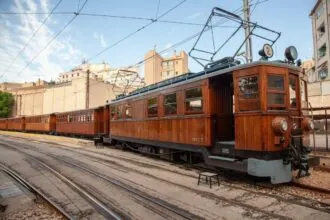
A short 11-kilometre, 15-minute drive down from Deià brings you into Sóller, a handsome market town in a citrus-growing valley, and on to Port de Sóller on the coast itself. Anyone who fancies a break from driving can leave the car in Sóller and ride the vintage narrow-gauge Sóller train to Palma and back instead, one of the island’s genuine icons rather than just a transport link.
Sóller’s charm goes well beyond the train ride: the town grew wealthy on its orange and lemon groves in the nineteenth century, and that money paid for the ornate Modernista façades still standing around the main square, including a church front finished by a disciple of Gaudí. A coffee at one of the square’s cafés is enough to feel the valley’s slower pace.
From Sóller, the fastest way north is through the Sóller tunnel, which cuts straight through the mountain and avoids a long stretch of the old pass road. It picks up faster roads on the far side, and the full 58-kilometre run to Pollença takes about 50 minutes, a welcome contrast to the previous day’s pace.
Pollença itself is a quiet, handsome inland town built around a pine-covered hill, the Calvari, with 365 steps leading up to a chapel at the top. It makes a sensible overnight base for the next day’s detour north, and Port de Pollença on the bay gives a beach-side alternative for anyone who would rather stay by the water.
Climbing the Calvari’s 365 steps earns a view over Pollença’s terracotta rooftops to the bay beyond, especially good in the last hour before sunset when the stone turns orange. The old town at the bottom is a working town rather than a resort, with a Sunday market that has filled the same streets for generations.
Drivers who would rather skip the winding Tramuntana roads entirely but still see the mountains can base themselves in Sóller and use local buses or the train for day trips; see our guide to getting around Mallorca without a car for how that works in practice. Most road-trippers, though, will find the drive itself is exactly the point of this stretch.
Cap de Formentor and Alcúdia: Day 3
The detour to Cap de Formentor is a there-and-back trip from Pollença rather than a through-route, and it’s worth setting aside the best part of a morning for it. The round trip covers roughly 55 kilometres and takes around 1 hour 40 minutes of driving alone, before any stops at the viewpoints along the way.
The road out to the lighthouse is narrower than the Ma-10 in places, clinging to a limestone ridge with the Mirador Es Colomer viewpoint about a third of the way along, arguably the single best view on the island. Parking at the most popular stops fills early in high season, so an early start pays off here more than almost anywhere else on this route.
What makes the narrow road worth the nerve is the scale of it: umbrella pines cling to cliffs that drop hundreds of metres to a turquoise sea, and wild goats are a common sight picking their way across the rock. On a clear day the lighthouse at the tip looks out towards Menorca, a fitting finish to the most dramatic stretch of coastline on the whole route.
One seasonal quirk worth knowing before setting off: the final stretch of road beyond Mirador Es Colomer towards the lighthouse is closed to private cars for most of the day during the busiest months, roughly 10am to 10pm from mid-May to mid-October, with a shuttle bus covering that last section instead. The exact dates shift slightly year to year, so the practical fix on this itinerary is either an early start well before 10am or leaving the car near Es Colomer and covering the last stretch to the lighthouse by bus; see the traffic rules section further down this guide for more detail.
Back in Pollença, the final leg to Alcúdia is a short and easy 12 kilometres, taking about 20 minutes on a proper road rather than a mountain pass. Alcúdia’s walled old town and the long sandy bay at Port d’Alcúdia make a comfortable place to spend the third night.
Alcúdia’s walls are the real thing rather than a rebuild for tourists, raised in the fourteenth century against pirate raids and still ringing almost the entire old town. Just outside them, the excavated Roman city of Pollentia is a reminder that people were fortifying this same stretch of coast two thousand years before the current walls went up.
Alcúdia, Pollença, and the beaches around the bay have enough going on to fill several days on their own, and our dedicated guide to Alcúdia and the north of Mallorca covers all of it in depth. This itinerary only has room to pass through, but it’s easily the part of the route worth slowing down for if the schedule allows.

Down the East Coast: Day 4
Leaving Alcúdia, the road to Artà covers 33 kilometres in about 35 minutes, swapping the resort bustle of the north bay for a quieter, more agricultural stretch of the island. Artà’s hilltop sanctuary, the Santuari de Sant Salvador, is visible from the road long before you reach the town itself.
The climb up to the sanctuary is worth it for the view alone, looking back over Artà’s rooftops to the flat plain beyond. Just outside town, the Bronze Age settlement of Ses Païsses adds a couple of thousand years of history to the stop, its massive stone walls still standing among the olive trees.
Artà to Capdepera is a brisk 8-kilometre, 10-minute hop to the island’s easternmost town, best known for its imposing hilltop castle and the resort of Cala Ratjada just below it. From there, the road runs 25 kilometres and about 25 minutes down to Porto Cristo, home to the show caves at the Coves del Drac, one of the most visited attractions on this side of the island.
Capdepera’s castle earns the climb for the view alone, a near-complete ring of medieval walls looking out over the bay towards Menorca on a clear day. Down at Porto Cristo, the Coves del Drac hide an underground lake first explored in 1896, and the tour still ends with a short classical concert performed from rowing boats on the water.
The final stretch to Cala Millor is only 10 kilometres and 10 minutes further south, a straightforward coastal drive into one of Mallorca’s larger east-coast resort towns. Anyone with more time can continue further south towards Cala d’Or instead, adding roughly another 45 minutes to the day but reaching a quieter, more upmarket stretch of coastline.
Artà, Capdepera, Porto Cristo, and the beaches around them are covered in far more depth in our guide to Mallorca’s east coast, including the show caves, coves, and smaller villages this itinerary only has time to drive past. This is the quietest day of driving on the whole loop, and a good one to build in some genuine beach time.
Back to Palma via the Inland Route: Day 5
The final day turns away from the coast entirely and cuts back across the island’s flat, agricultural centre, starting with the 19-kilometre, 20-minute drive from Cala Millor to Manacor. Manacor is Mallorca’s second-largest town and the traditional home of the island’s artificial pearl and furniture-making industries, worth a brief stop if either interests you.
Manacor’s workshops still export their imitation pearls worldwide under the name Majorica, a trade that has kept the town’s economy humming since the nineteenth century. It’s also the hometown of tennis player Rafael Nadal, whose academy on the edge of town has become a minor pilgrimage stop in its own right.
From Manacor, the road runs 29 kilometres and about 25 minutes to Algaida, passing through the kind of small farming towns that most visitors to the coast never see. Algaida is known locally for its siurell figurines, whistling clay ornaments unique to Mallorca, sold from workshops right on the main road through town.
Algaida’s other claim to fame sits on the same main road: the Gordiola glassworks, founded in 1719 and still family-run, blows glass in full view of visitors inside a building shaped like a small castle. It’s a genuinely interesting five-minute stop even for anyone with no plans to buy anything.
The final 25 kilometres back into Palma takes about 25 minutes on the Ma-15 motorway, closing the loop where the trip began. Dropping the car off at the airport rather than in the city centre avoids a second cross-town drive, and most rental desks will accept a return a few hours either side of the scheduled time without extra charge.
Anyone with energy left for one more stop before the airport should consider an hour in Palma’s old town itself, which this itinerary otherwise bypasses entirely in favour of the wider island. Our guide to things to do in Palma de Mallorca covers the cathedral, the old town, and the port in full.
Choose Your Itinerary Length
The five-day loop above is the version that shows the most of Mallorca without feeling rushed, but it isn’t the only sensible way to drive this route. Anyone with a long weekend rather than a working week can trim it down to three days, while drivers happy to slow right down and add a rest day or two can stretch the same roads into a full week instead. The stops and roads themselves don’t change between versions, only how much time gets spent at each one and how many of them make the final cut.
Search flights and useful route combinations in one place.
View flightsUse an eSIM to get online without hunting for a local SIM after arrival.
See eSIM optionsArrange a private pickup before travel instead of sorting transport after landing.
Book a transferThe 3-Day Mallorca Road Trip
This tighter loop keeps the two best days of driving on the island, the Tramuntana coast road and the run north to Formentor, and drops the east coast and the inland return entirely. It suits anyone flying in for a long weekend or bolting a short road trip onto a beach-based stay elsewhere on the island, and it still needs a genuine overnight stop rather than trying to squeeze everything into day trips from Palma.
Day one follows the Ma-10 coast road exactly as in the five-day version above, running from Palma through Andratx, Estellencs, and Banyalbufar before reaching Valldemossa and Deià. It’s the same roughly 80-kilometre first day described earlier in this guide, and Deià or Sóller remain the sensible place to spend the first night.
Day two drops down into Sóller and then crosses through the Sóller tunnel to Pollença, the same 58-kilometre, 50-minute run north described in the five-day itinerary, with Pollença or Port de Pollença as the overnight base. Anyone tempted by the Sa Calobra detour should know this compressed version has no spare time for it, since the third day already has a full morning built in.
The final day heads out to Cap de Formentor first thing, the same 55-kilometre round trip and roughly 1 hour 40 minutes of driving as the longer itineraries, with time for a quick look at Alcúdia’s old town on the way back through if the morning has gone smoothly. From there, the return to Palma runs directly rather than continuing on to the east coast, a further 55 kilometres (34 miles) and about 50 minutes, closing the loop in a single afternoon.
The 7-Day Mallorca Road Trip
A full week gives the same route room to breathe, particularly in the Tramuntana, where the five-day version already asks a lot of a single day. This version splits the mountain crossing into two easier days, adds a genuine rest day by the beach near Alcúdia, and pushes the east coast leg further south to Cala d’Or before turning back inland, all without introducing a single stop that isn’t already part of the core loop.
Day one now stops in Valldemossa rather than pushing on to Deià, covering the same Andratx, Estellencs, and Banyalbufar stretch at a noticeably gentler pace with time to properly explore each village. It’s a shorter driving day of around 1 hour 15 minutes in total, leaving the afternoon free for the monastery and the village itself rather than treating it as a drive-through stop.
Day two covers the short remaining hop to Deià and on to Sóller, and this is the natural day to add the detour down to Sa Calobra and the Torrent de Pareis mentioned elsewhere in this guide, since a shorter itinerary rarely has the spare hour each way it needs. The core drive that day is only around 30 minutes, so the extra couple of hours for Sa Calobra fits comfortably, with Sóller as the overnight base.
Day three follows the same route as the five-day version, crossing through the Sóller tunnel to Pollença, a 58-kilometre, 50-minute drive, with Pollença or Port de Pollença as the overnight stop.
Day four is the Formentor detour and the short run on to Alcúdia, identical to Day 3 of the five-day itinerary and around 2 hours of driving in total between the round trip to the lighthouse and the final hop into town.
Day five is a deliberate rest day with no long drive at all, spent on the beaches around Port d’Alcúdia or exploring the walled old town and the Roman ruins at Pollentia at an unhurried pace. It’s the one day on this extended itinerary built entirely around not getting back in the car.
Day six picks the east coast leg back up, running through Artà, Capdepera, and Porto Cristo exactly as in the five-day version, but continues past Cala Millor to Cala d’Or for the night, the same optional extension mentioned in the Optional Extras section of this guide. It adds roughly 2 hours 5 minutes of driving for the day rather than the five-day version’s quieter finish at Cala Millor, but reaches a noticeably quieter stretch of coastline.
The final day mirrors the five-day version’s inland return, just starting a little further south, running back through Manacor and Algaida to Palma in about 1 hour 55 minutes. Dropping the car at the airport rather than in the city closes the loop in exactly the same way as the shorter itineraries.
The table below sets out this seven-day version day by day, with the overnight base, the approximate driving time for that day’s leg, and the key stops along the way. Both shorter itineraries reuse the same bases and roads, just fewer of them: the three-day trip above corresponds to a compressed version of Days 1, 3, and 4 here, while the five-day version already has its own stop-by-stop table earlier in this guide.
| Day | Overnight Base | Approx. Driving Time | Key Stops |
|---|---|---|---|
| 1 | Valldemossa | About 1 hr 15 min | Andratx, Estellencs, Banyalbufar |
| 2 | Sóller | About 30 min (plus roughly 2 hrs round trip for the optional Sa Calobra detour) | Deià, Sa Calobra and Torrent de Pareis (optional), Port de Sóller |
| 3 | Pollença or Port de Pollença | About 50 min | Sóller town, the Sóller tunnel |
| 4 | Alcúdia or Port d’Alcúdia | About 2 hrs | Cap de Formentor, Mirador Es Colomer, Alcúdia old town |
| 5 | Alcúdia or Port d’Alcúdia | Minimal, a rest day | Port d’Alcúdia beaches, the Roman ruins at Pollentia |
| 6 | Cala d’Or (or Cala Millor) | About 2 hrs 5 min | Artà, Capdepera Castle, Coves del Drac at Porto Cristo, Cala Millor |
| 7 | Palma (trip ends) | About 1 hr 55 min | Manacor, Algaida, the Gordiola glassworks |
Driving the Ma-10: What to Actually Expect
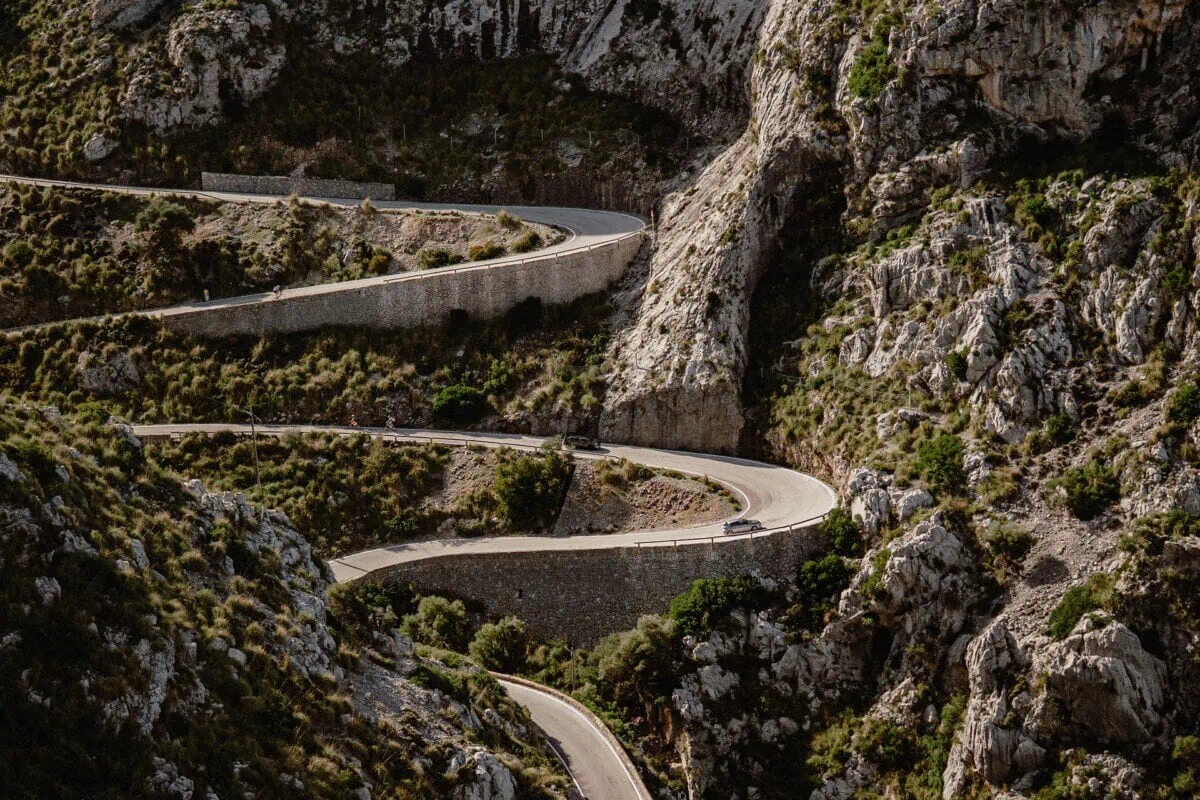
The Ma-10 is not a difficult road in the sense of poor surfaces or missing signage; it’s fully paved, well maintained, and clearly marked along its full 110-kilometre length from Andratx to Pollença. What makes it demanding is its width and its bends, since long stretches are barely wide enough for two cars to pass and the road folds back on itself constantly as it climbs and descends the Tramuntana.
The most famous single feature is the Nus de sa Corbata near Sa Calobra, a 270-degree loop where the road passes beneath itself, but the whole route between Andratx and Sóller is a near-constant sequence of hairpins rather than one dramatic exception. Speed limits drop to 60 km/h or lower on the tightest sections, and drivers who treat those limits as a suggestion rather than a rule are the ones who end up in the local news.
Tour coaches use this road constantly in high season, along with a steady stream of road cyclists drawn by the same scenery that makes it famous, so patience matters more than pace. Leaving before 9am, particularly through Valldemossa and Deià, avoids the worst of both the coach traffic and the crowded, undersized car parks in each village.
None of this should put off a competent, unhurried driver, and a huge number of rental cars complete this road every year without incident. Anyone genuinely nervous about narrow mountain roads, though, might prefer to see this stretch by bus, taxi, or the Sóller train instead and save the driving for the easier east coast and inland legs of the loop.

Traffic Rules a Non-Spanish Driver Might Not Know
Spain drives on the right, which catches out most UK and Irish arrivals at the first roundabout rather than the first straight road. Overtaking and roundabout priority both run the opposite way to the UK, so a few quiet minutes in the rental car park before pulling out into traffic are well spent.
Speed limits vary more by road type than most visitors expect: 120 km/h on motorways, 90 km/h on the open conventional roads that make up most of this route including long stretches of the Ma-10, and 50 km/h on two-lane urban roads. Since a 2021 reform, many single-lane town streets, including parts of Andratx and Manacor, now default to just 30 km/h, well below what the road’s width might suggest.
Spain’s drink-drive limit is stricter than large parts of the UK: 0.5g/l of blood for ordinary drivers, tightening to 0.3g/l for anyone who has held a licence less than two years. That’s roughly the same as Scotland’s limit but noticeably lower than the 0.8g/l allowed in England and Wales, so a lunchtime drink that feels fine driving at home can tip over the line here.
Every car registered in Spain, hire cars included, must now carry a V16 connected warning beacon rather than the old red triangles, a rule that took effect from January 2026; rental companies fit one as standard, usually kept in the glove box. A reflective vest is still a separate legal requirement, and it must go on before anyone opens the door and steps out onto the road, whatever the reason for stopping.
Holding a phone while driving carries a fine of around €200 and up to six points, even at a red light or in traffic, so a proper dashboard mount is worth having rather than relying on a lap or a seat. Dipped headlights aren’t generally compulsory for cars in daylight outside tunnels and poor visibility, but they’re a sensible habit on the blind bends of the Ma-10 regardless of what the law strictly requires.
One more local quirk worth flagging before Day 3: the final stretch of the Formentor road beyond Mirador Es Colomer towards the lighthouse is closed to private cars for most of the day during the busiest months, with a shuttle bus covering that last section instead. See the Day 3 section above for the current dates and hours and how it affects this itinerary.
Parking in Mallorca: Blue Zones, Free Spaces, and Trailheads
Palma and several larger towns use a metered ORA blue zone system, where street parking within a marked zone is free for local permit holders but chargeable by the hour for everyone else. Bays are usually free in the evenings and on Sundays, but expect a ticket machine or an app such as EasyPark checking meters closely during weekday shopping hours.
Free parking is realistic on the outskirts of most towns rather than in the historic centre itself, and a short walk in from a residential side street is usually the best trade-off between cost and convenience. The Tramuntana villages are the exception: Valldemossa and Deià both charge for their main visitor car parks, and both fill within an hour of opening in peak season regardless of price.
Trailhead and beach car parks follow the same pattern of filling early rather than charging heavily; the small gravel lots at Sa Calobra and along the Formentor road are the two worst on this route, both routinely full by mid-morning between June and September. Arriving before 9am, or building in the slack the Rupert box below suggests for Formentor, solves most of this without any extra cost.
A handful of east-coast beach car parks, including some near Porto Cristo, charge a flat daily fee in high season instead of running a meter, typically a few euros for the whole day regardless of length of stay. Sóller’s town centre has its own tight, largely resident-only parking, which is one more reason to leave the car and take the train in from Palma rather than drive there directly.
Roadside parking in the narrow lanes of the mountain villages themselves is best avoided altogether, since a car left on a bend can block the single lane completely for anyone coming the other way. Using a proper car park, even a paid one, and finishing the last stretch into a village on foot is almost always the less stressful option on this route.
Fuel and Petrol: What to Expect at the Pump
Fuel stations in Spain use their own local names rather than the UK’s “petrol” and “diesel”: gasolina, usually sold as Sin Plomo 95 or 98, is the equivalent of unleaded petrol, while diésel covers what UK drivers simply call diesel. Most hire cars on the island run on diesel, so it’s worth checking the fuel flap or the rental paperwork rather than assuming either way.
Prices move around through the year, but autumn 2026 pump prices on Mallorca sit at roughly £1.50-1.65 (€1.75-1.90 / $2.00-2.20) a litre for both diesel and Sin Plomo 95, with diesel usually the slightly cheaper of the two. That’s a straightforward local top-up cost rather than a major line item against flights, accommodation, or the hire car itself.
Larger stations on the main roads and around Palma are staffed and take payment inside as well as at the pump, while many smaller rural stations are unstaffed and card-only, particularly outside normal daytime hours. Carrying a card with a PIN that works reliably abroad avoids any awkwardness at an empty pump on a quiet Sunday evening.
A handful of stations, mostly on the ring roads around Palma and the larger resort towns, stay open 24 hours, but villages in the Tramuntana and along quieter stretches of the east coast often have none at all, or one that closes by early evening. Fuel stations thin out fast once you leave Andratx heading into the mountains, exactly as the Rupert box below flags, so treat a full tank as the starting point for any day that includes the Ma-10 or the Formentor detour.
It’s worth filling up again before the final inland run back to Palma on Day 5, since Algaida and the small farming towns along that stretch have fewer stations than the coast. A near-empty tank and a closed pump are a bad combination on a route with this many rural gaps, so treat the half-tank mark as the point to start looking rather than waiting for the warning light.
Browse hostels and budget-friendly stays.
See hostelsGet fast compensation payouts, eligible lounge benefits and expert help when flights go wrong.
See AirHelp+ benefitsUse convenient luggage storage between arrival, check-in and departure.
Check storageWhat to Do If Your Hire Car Breaks Down
The rental company’s own 24-hour assistance number, printed on the rental agreement, is the first call to make for almost any breakdown, since recovery and a replacement car are usually included in the contract rather than something to arrange separately. It’s worth saving that number in a phone before setting off, since the mountain sections of this route are exactly where signal drops out and a screenshot is more reliable than a search.
If the rental company can’t be reached, or the situation is a genuine emergency such as a collision or a blocked road, Spain’s general emergency number 112 covers the rest and is answered in English as well as Spanish. It connects to police, ambulance, or the Guardia Civil’s traffic division depending on what’s needed, so it’s a sensible backup rather than a first resort for a simple flat tyre or warning light.
Since January 2026, hire cars in Spain carry a V16 connected warning beacon instead of the old red triangles, supplied by the rental company and usually kept in the glove box. If the car breaks down, the beacon can be switched on and placed on the roof through a lowered window without getting out of the car at all, and it broadcasts the car’s location automatically to the emergency services.
Anyone who does need to get out of the car, for a flat tyre or to wait somewhere safer, must put on a reflective vest before opening the door, a legal requirement that carries its own fine if ignored. Rental cars are required to carry one, but it’s worth confirming it’s actually in the car at pick-up rather than assuming, since it should sit in the glove box or door pocket rather than the boot.
Once the beacon is out and everyone is somewhere safe, off the carriageway if at all possible, the process is largely a matter of waiting; a recovery truck or replacement car typically follows within an hour or two depending on how remote the breakdown is. Keep the rental agreement, passport, and driving licence together in the car for this reason, since whoever arrives to help will usually ask for all three before towing the car away.
Optional Extras and Things You Shouldn’t Miss
The detour down to Sa Calobra and the Torrent de Pareis is the single biggest optional add-on to this route, branching off the Ma-10 partway between Deià and Sóller down to a dramatic gorge and cove at sea level. It adds around an hour of extra driving each way on one of the twistiest side roads on the island, so it only really works if Day 1 or Day 2 is kept deliberately light on other stops.
Hikers with a spare day should look at the GR221, the long-distance trail that threads through the same mountains this route drives around; our guide to the Serra de Tramuntana covers the best walking routes, including much of the GR221. It’s a genuinely different way to experience the same landscape and works well as a rest day from driving.
Cyclists will already recognise several of this route’s climbs from professional training camps, since Mallorca is one of Europe’s most popular road-cycling destinations; our guide to cycling in Mallorca explains why, and where to hire a bike if the idea appeals. Beach-focused travellers with a spare afternoon, meanwhile, should detour towards Es Trenc on the south coast, generally rated the island’s best beach and covered along with the rest in our guide to Mallorca’s best beaches.
Inland, the market town of Sineu holds a genuine working livestock and produce market every Wednesday morning and makes an easy substitute stop on Day 5 for anyone travelling on that day of the week. None of these extras are essential to the core loop, but each one is a reasonable way to use a spare half-day if the itinerary above runs faster than expected.
Useful Apps for Driving in Mallorca
Download offline maps before setting off, since mobile signal drops out completely in parts of the Tramuntana valleys and along stretches of the Ma-10. Google Maps lets you save an offline area for exactly this reason, and it’s worth doing for the whole island rather than just the mountain sections, since coverage gaps also crop up around some of the smaller inland villages.
For parking in Palma itself, the city’s metered ORA blue zone spaces and several multi-storey car parks can be started and paid for through apps such as EasyPark or mobiAPParc rather than hunting for coins at a machine. Both work in English and save the hassle of finding change in a country that increasingly runs on card and app payments anyway.
Spain’s national traffic authority publishes live road conditions, closures, and average-speed camera zones through its own DGT app, which is genuinely useful on a route with this many mountain passes and rural roads. Google Translate, with its camera mode for reading menus and signs, covers the language gap in smaller inland towns where English is far less common than on the coast.
For breakdowns, the rental company’s own 24-hour assistance number on the rental agreement is the first call to make rather than a general roadside app, since most contracts include recovery as standard. Spain’s general emergency number, 112, covers everything else and is answered in English as well as Spanish.

Rupert’s Handy Travel Tips
I’ve trotted this whole loop myself, and a few small habits make the week noticeably easier.
- Fill up before the mountains: fuel stations thin out fast once you leave Andratx, so top up the tank before starting the Ma-10 rather than hoping to find one in Estellencs or Banyalbufar.
- Start early through the villages: leave before 9am for Valldemossa and Deià, since their car parks fill within an hour of opening and the coach traffic gets heavier as the morning goes on.
- Carry some cash: cafes and honesty-box fruit stalls in the smaller mountain villages often don’t take cards, so keep a little on hand for the Tramuntana stretch.
- Download offline maps first: save an offline map of the whole island before you leave Palma, since signal disappears completely in some of the mountain valleys.
- Build in slack for Formentor: there’s no way to reserve a parking space at the viewpoints, so leave a loose morning rather than a fixed arrival time.
Want to meet the reindeer behind our travel tips? Find out more in our page Who is Rupert?.




Frequently Asked Questions
Do I need a 4×4 to drive the Tramuntana roads?
No. The Ma-10 and every road on this route is fully paved and manageable in a standard hire car; the challenge is the road’s width and bends, not its surface.
How many days should I set aside for this route?
Four to five days covers the loop comfortably with one overnight stop in the mountains, one near Alcúdia, and one on the east coast. It can be driven faster with fewer stops, but that defeats much of the point.
Is the Ma-10 safe for a nervous driver?
It’s manageable at a slow, patient pace, but the width and constant hairpins genuinely unsettle some drivers. Anyone who would rather avoid it can see the same villages by bus, taxi, or the Sóller train instead.
Can I do this trip without a car at all?
Not the full loop. Public transport thins out badly once you leave Palma and the main Tramuntana villages, and it barely reaches the east coast; see our guide to getting around Mallorca without a car for what is realistically possible without driving.
Are there tolls anywhere on this route?
No. Mallorca has no toll roads at all, so a standard hire car with a full tank is all the budgeting this route needs.
What’s the best time of year to drive this loop?
Spring (April-May) and autumn (September-October) offer the quietest roads and the most comfortable temperatures. July and August bring heavy coach and cyclist traffic to the Tramuntana, plus midday heat that makes long stretches in the car less pleasant.
Further Reading
For the wider picture before setting off, our Mallorca travel guide covers the best time to visit, the various ways onto the island, and how the regions covered on this drive fit together. Anyone arriving with their own vehicle by sea rather than flying into Palma should also check our guide to Mallorca’s ferry routes from the Spanish mainland.
If a full week feels too long for a road trip alone, our day trips from Palma guide covers shorter, out-and-back versions of some of the same destinations for anyone based in the capital for their whole stay. And for the beaches this itinerary only passes near rather than properly visits, our guide to Mallorca’s best beaches rounds up the island’s best sand and coves in one place.
For an official reference on road rules, speed limits, and live traffic conditions, Spain’s Dirección General de Tráfico publishes both directly.