Reviewed by our editorial team Updated
Palma de Mallorca is such a convenient base that many visitors never travel beyond the promenade and the old town, yet some of the island’s most memorable places sit only thirty to fifty minutes inland by car. This page covers five of them: the wild south coast around Es Trenc and the Ses Salines salt flats, the hilltop sanctuary above Randa, the medieval market town of Sineu, the Franciscan missionary’s home town of Petra, and the underground chambers at Coves de Campanet.
These five day trips share a common thread: they show a side of Mallorca that has little to do with beach resorts or nightlife. Central and southern Mallorca is still a landscape of almond groves, windmills and stone farmhouses, and a single day away from Palma is often enough to feel like a genuinely different island.
Getting around matters more here than it does in Palma itself. Some of these destinations, like Sineu, sit directly on Mallorca’s surviving train line and are genuinely easy without a car, while others, like the summit of Puig de Randa, are really only practical with your own transport or a booked tour. Read our guide to Getting Around Mallorca Without a Car for the island’s wider public transport picture, or our Mallorca Road Trip guide if you are hiring a car for the week.
This page does not cover the Tramuntana villages of Valldemossa, Deià and Sóller, the historic Sóller Train, or the beaches and towns around Alcúdia and the east coast; those each have their own dedicated guide, linked throughout this page and in Further Reading below. A little planning goes a long way on these routes, and a decent policy is worth having before you set off; see our guide to the best Travel Insurance Apps for cover you can buy and manage from your phone.
Mallorca Day Trips at a Glance
| Destination | Distance/Time from Palma | Best For | How to Get There |
|---|---|---|---|
| Es Trenc & Ses Salines | ~50 km, about 45-50 minutes by car | Beaches, salt flats and birdwatching | Car or organised tour recommended; TIB buses run but involve a change and take well over two hours |
| Randa & Puig de Randa | ~30 km, about 30-35 minutes by car | Hilltop views, a working monastery, quiet walking | Car, taxi or tour; the summit road is not served by any public bus |
| Sineu | ~30 km, about 35-40 minutes by car or train | The Wednesday market, historic town centre | Train (SFM line T3) is genuinely the easiest option, roughly hourly |
| Petra | ~46 km, about 45 minutes by car | Wine tasting, Junípero Serra heritage | Car recommended; public transport is infrequent and slow |
| Coves de Campanet | ~45 km, about 45 minutes by car | Show caves, a family-friendly outing | Car easiest; bus 333 connects from Inca, reachable by train from Palma |
Treat the table as a starting point rather than a strict ranking. Sineu and its Wednesday market pair naturally with a morning train ride, while Es Trenc, Randa and Petra combine well into one long day if you have a car for the day.
A Full-Day Escorted Tour: Boat, Train, Tram and the Lluc Monastery
Not every visitor wants to plan train times, a tram connection and a boat crossing separately, and this full-day escorted tour bundles all three into one guided excursion out of Palma. Departing around 9:30am and running roughly eight and a half hours, it covers ground this page doesn’t otherwise reach: the mountain monastery at Lluc and the dramatic cove at Sa Calobra.
The route runs by coach up into the Tramuntana to the Santuari de Lluc for free time around the monastery, then on along the famously winding Ma-10 mountain road down to Sa Calobra beach for over an hour to swim or explore the Torrent de Pareis gorge. A short ferry crossing then carries the group along the coast to Port de Sóller.
From Port de Sóller, a vintage tram trundles through orange groves into Sóller town for a spell of free time, before the historic wooden train completes the loop back to Palma. Train, tram and boat tickets are all included in the price, along with a multilingual guide and air-conditioned coach transport for the road sections.
Prices start from around £92 (€108/$117) per person, with free cancellation typically available up to 24 hours beforehand and no commercial shopping stops built into the itinerary. It suits travellers without a hire car who still want to experience the Sóller Train, the tram and the Tramuntana mountains in a single organised day.
Best for a short trip. Compare rooms by neighbourhood, price and guest rating before you book.
Compare hotelsBest for groups who want one address and separate bedrooms rather than three hotel rooms.
See holiday homesBest for double-checking. Runs the same search across several booking sites so you are not leaving money behind.
Compare pricesEs Trenc Beach: White Sand and Turquoise Water
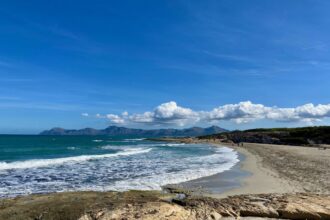
Es Trenc is the long stretch of white sand and shallow turquoise water that regularly gets compared to the Caribbean, backed by low dunes and umbrella pines rather than hotels. It has been a protected natural area since the 1980s, which is why there is still no beachfront development along most of its length.
The permanent beach bars that once stood on the sand were demolished in 2017 under the park’s protection rules, and only removable kiosks selling drinks, ice cream and snacks operate here in summer now. There is no entry fee for the beach itself, though parking nearby is limited and paid.
Two access points work well for a day trip: from Ses Covetes, a small village at the beach’s western end, or via a track off the MA-6040 near Ses Salines that leads to a dusty paid car park roughly a seven-minute walk from the sand. Both fill early in July and August, so arriving before mid-morning matters.
Public transport technically reaches this coast on TIB line 501 towards Campos plus a connecting local line, but the journey runs to well over two hours each way with a change of bus. A hired car or a booked excursion from Palma is realistically the only sensible option for a beach day.
Bring your own shade, water and lunch, since facilities are deliberately minimal. The lack of concrete beach clubs is what keeps Es Trenc feeling wild compared with the busier bays covered in our guide to Mallorca’s Best Beaches.
Ses Salines Salt Flats and Nature Reserve
Ses Salines takes its name from the salt flats worked here since Roman times; local sources credit troops under Quintus Caecilius Metellus with exploiting the S’Avall saltpans from 123 BC. The flats later became royal property before being granted to the Dezcallar family in the 1300s, who still own part of the operation today.
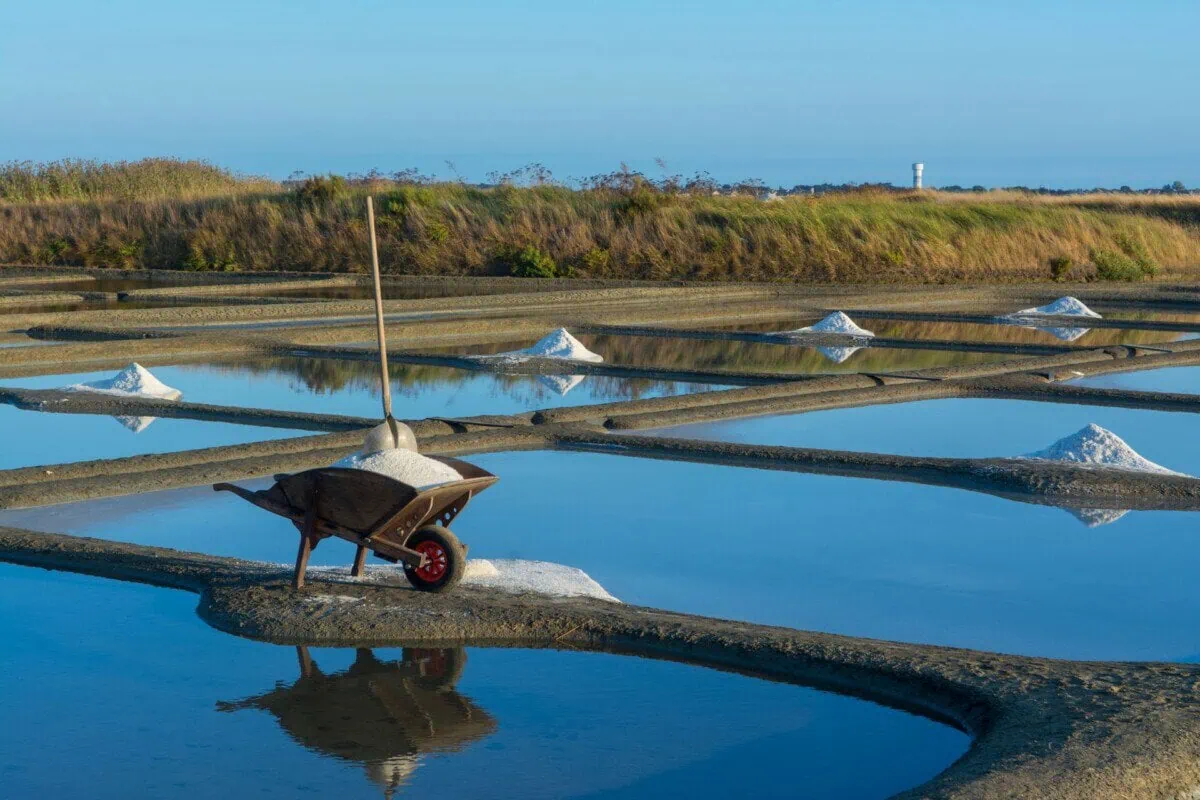
Salt is still harvested here in August using largely traditional methods, and the resulting flavoured sea salts are sold as a genuine local product rather than a tourist souvenir. The flats themselves are a striking sight, a patchwork of shallow, pink-tinged pools and white salt mounds running along the coast road toward Colonia de Sant Jordi.
Beyond the salt, the wetland is an important stop for migratory birds moving between Africa and their European breeding grounds each spring and autumn, and flamingos, herons and various waders are regularly spotted from the roadside. Cap de Ses Salines, Mallorca’s southernmost point, is a short drive further on and makes a good add-on stop for a working lighthouse and open sea views.
There is no public transport to the salt flats themselves, so this is very much a car-based stop, easily combined with Es Trenc on the same short drive. The small fishing port of Colonia de Sant Jordi nearby is worth a look too, with a working harbour, seafront restaurants and boat trips out to Cabrera island.
Randa Village: A Quiet Hilltop Base
Randa itself is tiny, a scatter of stone houses and a single main street at the base of the hill, roughly thirty minutes’ drive from Palma via the Ma-15 and Ma-19. There is little in the way of shops or restaurants, and that quiet is really the point; most visitors pass through on their way up the mountain rather than staying long in the village itself.
The village gives its name to the hill above it and is the usual starting point for the winding summit road, so it is worth a short stop even if you are driving straight up. A handful of small restaurants serve traditional Mallorcan food, and it is a peaceful spot to break a longer drive to the east coast.
There is no useful public transport into Randa itself; the nearest TIB service, line 403 between Palma and Campos, passes through neighbouring Algaida but does not run into the village or up the mountain. A car, taxi or organised tour is realistically required to visit Randa and Puig de Randa together in one trip.

Puig de Randa and the Santuari de Cura
The hill rises to 543 metres and carries three separate hermitages along its winding summit road, each built at a different stage of its religious history. The lowest, the Oratori de Nostra Senyora de Gràcia, sits on a ledge with a sheer 200-metre drop below it, followed by the mid-level Santuari de Sant Honorat, with the Santuari de Cura crowning the summit.
Cura is the reason most people make the drive. The Majorcan philosopher and missionary Ramon Llull founded Mallorca’s first hermitage here in 1275, after a spiritual crisis that led him to withdraw from public life, and the site has functioned as a place of retreat and pilgrimage ever since.
The summit buildings today include a working chapel, simple pilgrim accommodation and a small museum room, the Sala Gramàtica, holding some of Llull’s original manuscripts. A café and restaurant operate on the terrace year-round, and the view is the real payoff: a sweeping panorama across the plain to Palma Bay and, on a clear day, the island of Cabrera.
The summit road is narrow and winds through several hairpin bends, so it rewards a careful driver rather than a rushed one, and there is free parking near the top. Entry to the sanctuary itself is free, though a small donation is customary if you use the café or the pilgrim rooms, and there is no public bus service anywhere near the summit, so this stop only really works by car, taxi, or as part of a guided day tour out of Palma.
Sineu: Mallorca’s Former Royal Seat and Wednesday Market
Sineu is the one destination on this page you can reach easily by train, and it happens to be one of the most rewarding: a compact hilltop town that was once significant enough to house the island’s own kings. King Sanç of Mallorca made Sineu his residence in the early 1300s, and the royal palace he built, the Palau dels Reis de Mallorca, still stands in the centre of town, today home to a community of Concepcionist nuns rather than royalty.
The Gothic parish church, the Església de Santa Maria, dominates the skyline from well outside town and holds an elaborate baroque altarpiece inside; climbing up to the church square gives one of the better views over the surrounding plain. Sineu’s real claim to fame, though, is its Wednesday market, widely regarded as the oldest surviving weekly market on the island and one that still trades livestock alongside the usual stalls of cheese, sobrassada, fruit and crafts.
The market fills the streets around the church from early morning, and arriving before mid-morning avoids both the coach parties and the midday heat in summer. Even outside market day, Sineu’s old town is pleasant to wander, with narrow lanes, a handful of traditional cafés and none of the tourist-shop clutter found in the coastal resorts.
The train is genuinely the easiest way here: the SFM line T3 (Palma-Manacor) calls at Sineu roughly every hour throughout the day from Palma’s Estació Intermodal, a journey of around 35-40 minutes, with single fares typically running from about €2 to €4 (£2/$2-5). The trains are simple, air-conditioned regional units with space for luggage or bikes rather than a scenic tourist railway, but the line itself crosses genuinely pretty open farmland, and Sineu’s own station, a short walk from the main square, makes this one of the few destinations on this page that needs no car at all.
Petra: Birthplace of Fray Junípero Serra
Petra is a small farming town in Mallorca’s flat interior, roughly forty-five minutes’ drive from Palma, best known as the birthplace of the Franciscan missionary Fray Junípero Serra. Serra left Mallorca in 1749 and went on to found several of California’s original Spanish missions, including those that grew into San Diego and San Francisco, which makes this modest town an unlikely but genuine link between rural Mallorca and California’s early history.
The Casa Museu de Fra Juníper Serra, his restored birth house and adjoining museum, is the town’s main sight, walking visitors through his early life and missionary work with period rooms and exhibits for a modest entrance fee. A short “Juniperian route” marked around town also takes in streets, squares and monuments connected to his memory, worth an hour’s wander on its own.
Petra is also genuinely known within Mallorca for its local wineries, including Bodegues Miquel Oliver, a family winery dating back to 1912 that still produces wines from native Mallorcan grape varieties, and the smaller Vins Ca’n Coleto. Both are worth building a stop around if you are driving, particularly if you want to bring home a bottle of something distinctly local rather than the mass-market wine found everywhere else.
Public transport to Petra is limited; there is no train station in the town itself, and TIB bus connections from Palma are infrequent and best checked directly at tib.org before relying on them. A hired car is the practical way to combine Petra with a winery visit, and it pairs naturally with Randa or Sineu on the same inland loop if you are already out this way.
Best for long or awkward journeys. Builds one itinerary out of separate flights.
View flightsBest for short trips. Install the eSIM at home and arrive with working data, no shop queue.
Browse eSIMsBest after a long flight or a late landing. Price agreed before you travel, and no taxi queue.
Check transfersCoves de Campanet: Mallorca’s Quietest Show Caves
The Coves de Campanet sit at the northern foot of the Serra de Tramuntana, near Campanet village, about forty-five minutes’ drive from Palma on the Palma-Inca-Sa Pobla highway. Discovered in 1945, they are smaller and less visited than Mallorca’s better-known show caves on the east coast, which keeps them noticeably calmer even in high season.
Inside, a roughly 45-minute guided route winds past dense stalactite and stalagmite formations and underground pools, all at a constant year-round temperature of around 20 degrees. It makes a genuinely welcome break from the summer heat outside, and the lighting is understated enough that the formations still feel like a discovery rather than a stage set.
Entry runs around €17 (£15/$20) for adults and €9 (£8/$11) for children aged four to twelve, with under-fours free, and opening hours generally run 10am to 5pm in summer and 10am to 4pm from November to March. These are worth double-checking directly with the caves before travelling, since hours can shift seasonally, and free parking is available on site.
A car is by far the easiest way here, though TIB bus line 333 does connect from Inca, which is itself reachable by train from Palma, making a car-free visit possible with some patience. Coves de Campanet pairs naturally with a stop in Sineu, or with the northern Tramuntana towns covered in our Things to Do in the Serra de Tramuntana guide, if you are spending a full day inland.
Which Day Trip Should You Pick?
With only one day spare, the choice really comes down to what kind of Mallorca you want to see. If a proper beach day is non-negotiable, Es Trenc and Ses Salines together are hard to beat, and they justify hiring a car for the day on their own.
If you would rather leave the car behind, Sineu is the standout choice on this page, easily reached by train and rewarding enough on a Wednesday to fill a full day around the market alone. For a quieter, more reflective day, the climb to Puig de Randa offers some of the best views on this list without needing to drive far at all.
Travellers curious about Mallorca’s history beyond its beaches should head to Petra, particularly if wine tasting appeals, while Coves de Campanet is the natural pick for families or a day when the weather turns. Several destinations sit close enough to combine, most naturally Randa with Petra, or Sineu with Campanet.
Time of year affects the choice too, since high summer makes Es Trenc’s car parks fill by mid-morning and turns the Puig de Randa road distinctly hotter than the plain below. Cooler months suit Randa’s hilltop walk and Petra’s wine tasting particularly well, while Sineu’s Wednesday market runs year-round regardless of season, making it the safest pick whenever you happen to be on the island.
The Hidden Gem Most Visitors Skip: Puig de Randa
Es Trenc gets the crowds and Sineu gets the Wednesday coach parties, but Puig de Randa barely features on most itineraries out of Palma at all. With no public bus or train reaching the summit, it simply falls off the radar for travellers relying on public transport, which is exactly what keeps it peaceful.
Even in August, the hairpin summit road rarely sees more than a handful of other cars, and the three hermitages along the way feel more like a quiet walk than a tourist stop. Weekday mornings are the quietest window of all, well before the terrace café fills with lunch traffic.
Allow around two to three hours for the return trip from Palma, including time to wander between the lower hermitages and the summit sanctuary itself. The reward is a genuinely uncrowded panorama across the plain to Palma Bay, something increasingly hard to find on an island this popular.
Petra sits close enough to combine with Randa on the same inland loop if you already have a car for the day, turning one quiet stop into two. Parking and entry costs are minimal here too, since the summit car park is free and there is no entrance fee for the sanctuary itself.
For travellers who found Es Trenc or Sineu busier than expected, Randa is the easiest way to salvage a sense of discovery from the same trip. A slower pace rather than a longer drive is really all it takes to feel like you have found somewhere the coach tours missed.

Best Day Trips for Families and Kids
Coves de Campanet is the easiest of the five for families with young children, since the underground route is short, well-lit and blessedly cool even when it is uncomfortably hot for a toddler outside. Pushchairs manage the paved path without much trouble, and the constant temperature underground means no meltdowns over the heat halfway through.
Es Trenc works well for slightly older children who are happy to swim, since the water stays shallow for a long way out and there is enough space on the sand that nobody feels cramped. Pack your own shade and snacks though, since the beach’s deliberately minimal facilities mean no kiosk selling sun cream or spare buckets.
Sineu’s Wednesday market is the most low-effort family outing of the three, mostly flat, mostly outdoors, and short on the kind of walking that tires small legs out before lunch. Livestock pens and market stalls tend to hold children’s attention longer than a church interior would, which makes it an easy sell if the family vote is split.
Randa and Petra are realistically the two to skip with very young children, since the summit road’s hairpin bends and Petra’s museum-heavy sightseeing suit older kids and adults better. A single car-based day combining Campanet with a stop in Sineu, already set out in the destination table above, is the easiest family itinerary this page can offer.
Day Trips You Can Do Without a Car
Sineu is the one truly easy option on this page without a car, since the SFM line T3 calls there roughly every hour from Palma’s Estació Intermodal for a fare of around €2 to €4 (£2/$2-5) each way. No connections or transfers are needed, which makes it the simplest of these five day trips for anyone without a hire car.
Coves de Campanet takes a little more patience, since it means catching a train to Inca and then TIB bus line 333 onward, but it is genuinely doable in a single day if you check timetables in advance. Building in a buffer of thirty minutes either side of the bus connection avoids the kind of missed link that ruins an afternoon.
Es Trenc, Randa and Petra are the three where public transport realistically fails visitors; TIB buses either take well over two hours with a change, as with Es Trenc, or barely run at all near the destination, as with the Puig de Randa summit road. A taxi or a booked tour from Palma is the honest workaround for any of these three if hiring a car for the whole trip does not appeal.
Anyone planning a whole week around public transport rather than a hire car should read our full guide to Getting Around Mallorca Without a Car, which covers the TIB bus network and the island’s two train lines in more depth than fits here. Sineu and Campanet together, reachable this way in a single day, are the strongest car-free itinerary this page can put together.
The Best Rainy Day Option: Coves de Campanet
A wet forecast rules out Es Trenc and most of Randa’s appeal in one stroke, but it does not have to cancel the day, since two of these five destinations work just as well under cloud as under sun. Coves de Campanet is the obvious first choice, since the caves keep a constant year-round temperature regardless of what is happening outside.
Petra is the other rainy-day option worth considering, since the Casa Museu de Fra Junípero Serra and its exhibits are entirely indoors, and a wet afternoon is a good excuse to linger over the Juniperian route’s history rather than rushing it. A short dash between the museum and a covered winery tasting room keeps most of the day under a roof.
Sineu splits the difference: the Wednesday market itself is outdoors and considerably less pleasant in the rain, but the Gothic interior of the Església de Santa Maria and the town’s handful of small cafés give you somewhere to wait it out if a shower passes through. A flexible plan beats a rigid one here, since Mallorcan rain tends to arrive in short bursts rather than settling in for the whole day.
If the forecast looks genuinely bad for the whole day, Coves de Campanet remains the safest single choice on this page, and it also happens to be one of the more child-friendly options if the whole family is stuck deciding where to go. Checking the forecast the night before rather than the morning of saves a wasted drive to a coastline that is no fun to visit under grey skies.

Rupert’s Handy Travel Tips
Rupert has done this exact loop through central Mallorca more than once, and it is easy to get the logistics wrong if you assume public transport will work for all five stops.
- Pick one transport method per day: Sineu works brilliantly by train, but trying to reach Es Trenc or Randa without a car will eat your whole afternoon.
- Visit Sineu on a Wednesday if you can: the market is what makes the town special, and it is a much quieter, ordinary town the rest of the week.
- Drive up to Puig de Randa in daylight: the hairpin bends on the summit road are narrow, and the views are the whole point of going.
- Check Coves de Campanet’s hours before you set off: the caves are small enough that visitor numbers are managed closely at busy times.
- Carry some cash for Petra’s wineries and Sineu’s market stalls: smaller producers and market traders don’t always take cards.
Want to meet the reindeer behind our travel tips? Find out more in our page Who is Rupert?.




Best if you would rather spend the money on the trip than on the room. Compare hostels by location and rating.
Search hostelsBest arranged before you fly rather than after. Covers claim handling, plus lounge access on eligible delays.
Explore AirHelp+Best for a day with a suitcase and nowhere to put it. Find a storage point near where you already are.
View storageFrequently Asked Questions About Day Trips from Palma
Do I need a car to see all five of these day trips?
Not for Sineu, which is easily reached by train, but a car, taxi or organised tour is genuinely necessary for Es Trenc, Randa, Petra and Coves de Campanet, since public bus connections to these inland and southern spots are slow or non-existent.
How far is Es Trenc from Palma?
About 50 km, roughly 45-50 minutes by car via Campos or Ses Salines; the equivalent public transport journey involves a bus change and takes well over two hours.
Is the Wednesday market in Sineu worth planning a trip around?
Yes, it is widely considered the oldest surviving weekly market on the island and genuinely changes the feel of the town, so it is worth timing a Sineu day trip for a Wednesday if your schedule allows it.
Can I combine more than one of these day trips in a single day?
With a car, yes: Randa and Petra sit close together in the island’s interior, and Sineu and Coves de Campanet can also be combined on the same inland loop, though Es Trenc is far enough south that it is best kept as its own day.
What should I wear to visit Puig de Randa?
Comfortable shoes for uneven ground around the hermitages, plus a light layer for the summit, which is noticeably breezier and cooler than the plain below even in summer.
Are these day trips suitable for families with young children?
Coves de Campanet and Es Trenc are the easiest with children, thanks to the caves’ gentle walking route and the beach’s shallow water, while the Sineu market is also a good family outing with plenty to see without much walking.
Further Reading
For the wider practicalities of exploring Mallorca beyond Palma, our guide to Getting Around Mallorca Without a Car covers the island’s TIB bus and train network in full, while Mallorca Road Trip lays out a longer circular driving route taking in the Tramuntana coast, Alcúdia and the east coast beyond what fits into a single day trip.
If Palma itself is still on your list, Things to Do in Palma covers the cathedral, old town and waterfront in depth, and our Mallorca Travel Guide hub page ties together the whole island cluster, from arrival to regional highlights.
The villages of the Tramuntana mountains, including Valldemossa, Deià and Sóller, get their own dedicated coverage in Things to Do in the Serra de Tramuntana, and the vintage Sóller Train that runs between Palma and Sóller has a full guide of its own if you want to add a scenic rail trip to your itinerary.
For more of Mallorca’s coastline beyond Es Trenc, our roundup of Mallorca’s Best Beaches covers the island’s other standout coves, and it’s worth sorting Travel Insurance Apps before you go, particularly if car hire or hiking is part of your plans.