Reviewed by our editorial team Updated
Palma de Mallorca rewards visitors who give it more than an afternoon between flights and beach days. The city’s compact old town, seafront promenade and contemporary art scene all sit within easy walking or bus distance of each other, which makes Palma one of the more manageable capital cities in the Mediterranean to explore properly.
At the heart of it all stands La Seu, the vast Gothic cathedral that dominates the skyline from almost every angle, with the royal Almudaina Palace next door. A short walk inland leads into the tangle of the Casc Antic, Palma’s old town, where an Arab-era bathhouse and a Gothic basilica sit tucked behind unassuming doorways.
Beyond the old town, Bellver Castle rises above a pine forest on a hill overlooking the bay, while the waterfront Es Baluard museum houses modern art inside a 16th-century fortress bastion. Further along the coast, the Santa Catalina neighbourhood has become Palma’s most talked-about food destination, built around a working municipal market.
This guide covers Palma’s own city-centre sights in depth, from the cathedral and palace through to the castle, museum, waterfront and Santa Catalina, with a practical note on how to reach each one by public transport. For the rest of the island, our day trips from Palma guide covers Es Trenc, Randa and the inland villages, and our guide to Mallorca’s best beaches covers the island’s coastline beyond Palma’s own city beach.
Whether you have a single day off a cruise ship or a full week based in the capital, Palma’s main sights cluster tightly enough to see mostly on foot, topped up with the odd short bus ride. The sections below go through each one in turn, with approximate opening hours, entry prices in euros, pounds and dollars, and honest notes on what actually earns your time.
One Day or Two: Suggested Palma Itineraries
With only a single day in Palma, the old town earns almost all of it. Begin early at La Seu, since the cathedral is quietest in the first hour after opening, then cross the small square to the Almudaina Palace next door before the crowds build. From there, a short walk through the Casc Antic takes in the Arab Baths and the Basílica de Sant Francesc’s Gothic cloister, both easy stops of fifteen to twenty minutes each. Break for lunch either in the old town itself or a fifteen-minute walk along the seafront to Santa Catalina, where the covered market’s in-house bars serve a genuinely good plate for the price. Spend what’s left of the afternoon on the Passeig Marítim, walking or cycling the flat promenade toward Es Baluard for the golden-hour view of the cathedral rising out of the sea wall, which is the single image most people take home from a first visit.
Two days allows the same old town morning without rushing it, then adds the sights that sit further out. Keep day one to La Seu, the palace, the Arab Baths, the basilica and an aimless hour in the backstreets around Plaça Major, finishing with dinner in Santa Catalina or the quieter lanes near La Llotja. Give day two to Bellver Castle first, ideally on the hop-on-hop-off bus or an EMT service to the Joan Miró stop, since the hill is genuinely too far to walk comfortably in the heat; the battlement views over the bay are worth the early start. Come back down toward the coast for Es Baluard’s contemporary galleries and rooftop terrace, then finish along the waterfront, ending the two days where the first began: looking back at La Seu from the water.
Exploring Palma’s Old Town
Palma’s Casc Antic is small enough to cover on foot in a day, but dense enough with history that most visitors end up returning to it more than once. The five stops below sit within about fifteen minutes’ walk of one another, roughly bounded by the cathedral, the Passeig des Born and the old city walls.
Two of the busiest anchors sit at either end of this stretch: the cathedral itself, and the Passeig des Born, the boulevard where the old town gives way to Palma’s main shopping streets. Later sections of this guide cover the city’s markets, shopping streets and nightlife in their own right, but it’s worth knowing from the outset that all of it sits within a similarly short walk of wherever the day starts.
Best if you want daily housekeeping and a front desk. Filter by area first, then by price.
Check availabilityBest for groups who want one address and separate bedrooms rather than three hotel rooms.
See holiday homesBest as a last check before booking. Compares hotel rates across several sites in one search.
Compare ratesLa Seu Cathedral (Palma Cathedral)
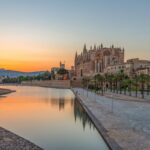
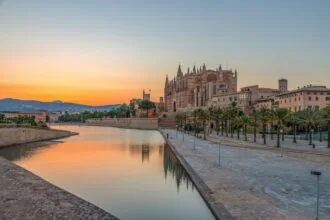
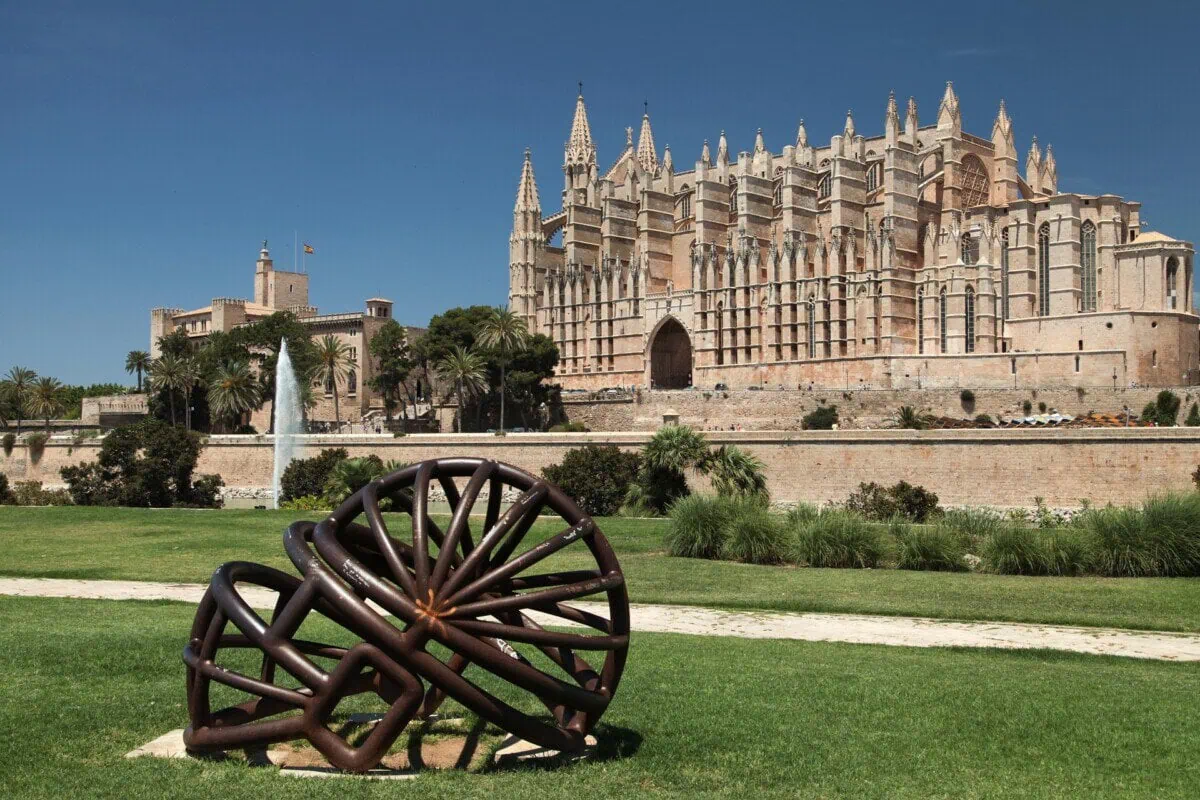
La Seu is the single image most people picture when they think of Palma, a limestone Gothic cathedral rising directly above the sea wall with the bay behind it. Work began under King James I in 1229 and continued for nearly four centuries, which is why the building blends early Gothic bones with later additions.
Inside, the main draw is the rose window above the main altar, one of the largest genuine Gothic rose windows anywhere, known locally as the “Gothic Eye” for the way it throws a shifting pattern of light across the nave. Antoni Gaudí reworked parts of the interior in the early 1900s, and Mallorcan artist Miquel Barceló added a striking ceramic mural to the Chapel of the Blessed Sacrament in 2007, so the cathedral reads as a living building rather than a museum piece.
Standard opening hours run Monday to Friday 10am to 5:15pm and Saturday 10am to 2:15pm, with the cathedral closed to visiting tourists on Sundays (it remains open for worship). A combined ticket covering the cathedral and its Museum of Sacred Art costs from €11 (£9/$13) online, and children under ten go free with a paying adult; a separate, seasonal rooftop terraces tour runs at limited times and is best checked and booked directly through the cathedral’s official website in advance.
The cathedral sits right in the centre of the old town, so it is walkable from almost anywhere in central Palma, including a five-minute stroll from Plaça de la Reina or the Passeig des Born. Anyone arriving from further out can take an EMT Palma city bus into the historic centre and finish the last stretch on foot, since no route runs directly up to the cathedral doors.
Outside standard visiting hours, La Seu occasionally hosts organ recitals and classical concerts inside the nave, usually ticketed separately from daytime admission. Checking the cathedral’s own listings before a trip is worth it for anyone who wants to hear the building’s acoustics rather than just see them.
Almudaina Palace
The Royal Palace of La Almudaina sits immediately next to the cathedral, and the two buildings are usually visited back to back. It began life as a Muslim alcázar before King James II converted it into a Gothic royal residence in the 14th century, and it remains one of the official residences of the Spanish royal family today.
The self-guided route takes in the Throne Room, the chapel and a series of state apartments hung with Flemish tapestries, and the building is still occasionally used for official events during royal visits to Mallorca. Managed by Patrimonio Nacional, it opens Tuesday to Sunday, 10am to 6pm in winter and 10am to 7pm in summer, closed Mondays.
Standard entry costs €8 (£7/$9), with a reduced rate of €5 (£4/$6) for ages five to sixteen, over-65s and students up to 25; under-fives go free. EU citizens can enter free on Wednesday and Sunday afternoons between 3pm and 7pm, and a one-hour guided tour adds an €8 (£7/$9) supplement to the entry price.
Like the cathedral, the palace is fully walkable from anywhere in the old town, sitting right on Plaça de l’Almudaina, and needs no bus connection for anyone already exploring central Palma on foot.
Because the palace and cathedral share the same small square, they’re easy to combine into a single, unhurried morning rather than two separate outings. The palace also tends to draw noticeably shorter queues than the cathedral itself, which makes it a useful stop for anyone trying to avoid the busiest pinch points of the old town.
The Arab Baths (Banys Àrabs)
Tucked behind a private garden on Carrer de Can Serra, the Banys Àrabs are one of the only physical survivors of Medina Mayurqa, the Islamic-era city that occupied this site before the Catalan conquest of 1229. A small domed chamber, its horseshoe arches resting on a mismatched set of recycled Roman columns, is genuinely all that remains, but it is an atmospheric few minutes among orange trees and quiet stone.
It opens daily from 9:30am to 8pm between April and November, and 9:30am to 7pm from December to March, and a visit rarely takes more than fifteen or twenty minutes. Entry costs a modest €2 (£2/$2), making it one of the cheapest stops in the old town.
The baths sit a short, flat walk from both the cathedral and the Basílica de Sant Francesc, within the same pocket of narrow lanes, so no bus is needed to reach them from anywhere else in the Casc Antic.
The baths originally functioned as a hammam, a communal bathing house central to daily life in Islamic-era Palma, and the surviving chamber is thought to have been part of a larger complex that once stood on the site. Little else of Medina Mayurqa survived the Catalan conquest, which makes this modest, quiet space one of the few places in the city where that earlier chapter of Palma’s history is still physically visible rather than just described on a plaque.

Escaping the Old Town for Caves and Snorkelling
Not every worthwhile stop near Palma involves a monument or a market stall. A short drive from the harbour, a speedboat trip along the coast southeast of the city swaps cathedral stonework for sea caves, low cliffs and clear water for a few hours.
The three-hour route calls at two coves, Cala Vella and Cala Blava, with roughly half an hour in the water at each and a look into the area’s Green Cave along the way. Snorkelling gear and paddleboards are provided, so nobody needs their own kit to get in the water.
Boats run three times a day, with a morning, an early-afternoon and a late-afternoon departure, and food and drinks are included on board rather than sold separately. It suits anyone after a genuine break from walking between sights, with the Mallorcan coastline itself as the destination rather than a museum or a church.
This sits a step beyond Palma’s own city limits, closer in spirit to the island’s day trips than its old town sights, but the boat leaves directly from the city’s harbour, so no separate transfer or hire car is needed to reach the meeting point. It’s a straightforward way to add a half-day of sea and snorkelling onto a city-based stay without changing hotels.
Basílica de Sant Francesc
A few minutes’ walk from the Arab Baths, the Basílica de Sant Francesc is a 13th-century Gothic church fronted by a Baroque facade and a statue of Junípero Serra, the Mallorcan friar who went on to found the mission chain that became coastal California. Its real highlight is the Gothic cloister, a peaceful two-storey arcade planted with orange and lemon trees around a central well.
Inside the church, a side chapel holds the tomb of Ramon Llull, the medieval philosopher and theologian regarded as one of the most original thinkers of his age. The basilica opens Monday to Saturday 9:30am to 12:30pm and 3:10pm to 6pm, and Sundays and holidays 9am to 12:30pm, with entry costing €3 (£3/$4).
It sits deep inside the old town’s pedestrian streets, so it is reached entirely on foot from the cathedral, the palace or the Arab Baths, all a few minutes apart.
The cloister is also where the basilica quietly connects Palma to California mission history, since Junípero Serra trained here as a young friar before travelling to the Americas, and a small exhibition near the entrance touches on that story. Even visitors who skip every other detail tend to linger in the cloister itself, since the two-tier arcade and citrus trees make it one of the most peaceful corners in the old town.
The Old Town’s Backstreets and Hidden Corners
Beyond the named monuments, the real pleasure of the old town is simply getting lost in it for an hour or two. Streets like Carrer del Sol and the lanes around Plaça Major open onto hidden courtyards, ochre-stone mansions and the occasional glimpse of an interior patio through a half-open gate.
Near the seafront edge of the old town, La Llotja, the former merchants’ exchange, is a striking example of civil Gothic architecture and is now used mainly for temporary exhibitions rather than kept as a standing museum. None of this costs anything beyond the time it takes to wander, and there is no admission fee for the streets themselves.
The entire old town is flat and pedestrian-friendly in its core, and every stop covered above sits within it, so a comfortable pair of shoes is the only transport most visitors will need for a morning here.
Several of these lanes still trace the tangled layout of Medina Mayurqa, the medieval Islamic city that lay beneath today’s old town, rather than the grid pattern common in more formally planned European quarters. It shows in the way streets suddenly narrow, double back or open onto small squares with no obvious logic, which is part of what makes an aimless hour here rewarding rather than confusing.
Best if you can move a day either way. Shows how the fare changes across the month.
Compare flightsBest for short trips. Install the eSIM at home and arrive with working data, no shop queue.
Browse eSIMsBest when public transport has stopped, or when you are travelling with children and bags.
Book a transferCovering More Ground on an Open-Top Bus
Anyone who would rather sit than walk, or who is short on time, has an easy alternative to covering Palma entirely on foot. A hop-on-hop-off bus, run by City Sightseeing, loops around nineteen stops across the city and its outskirts, with an open top deck and multilingual commentary.
The route links the cathedral and old town with the Passeig del Born, the seafront Passeig Marítim, the Poble Espanyol open-air museum and Bellver Castle, so it’s possible to stay aboard for the sights already covered above and step off for the ones that need a longer look. Buses run at regular intervals through the day, roughly between 10am and 5:30pm.
A ticket covers unlimited rides for 24 hours, so it’s easy to ride the full loop once for an overview, then hop off wherever the day calls for a proper stop rather than a drive-by. It’s a particularly useful option for reaching Bellver Castle itself, which sits too far uphill from the centre for most people to walk comfortably.
It won’t replace walking the old town’s lanes, since a bus can’t reach the narrowest pedestrian streets, but it fills the gap between the cathedral and the sights further out, including the castle, the museum and the waterfront. For a first visit to Palma, it’s a reasonable way to get oriented before committing to a full day on foot.
Bellver Castle
Bellver Castle is unusual among European castles for being genuinely, deliberately circular, a design more common in Byzantine fortifications than in Gothic Europe. King James II had it built in the early 14th century as a royal summer residence on a pine-covered hill above the bay, and its ring-shaped courtyard and four projecting towers still feel distinctive today.
The castle’s history has not always been so genteel. Over the centuries it served as a military prison, holding political prisoners as recently as the early 20th century, before being handed over to the city and converted into the Museum of the History of Palma, which now displays archaeological finds and city artefacts inside the old cells and courtyard.
The real draw, though, is the view from the battlements, a genuine panorama over Palma’s rooftops, the cathedral and the bay beyond, best enjoyed on a clear morning before the midday heat sets in. Opening hours run Tuesday to Saturday 10am to 7pm and Sunday/holidays 10am to 3pm from April to September, shortening slightly to 10am-6pm on weekdays over winter, and the castle is closed on Mondays.
General admission costs €4 (£3/$5), with a reduced rate of €2 (£2/$2) for students, pensioners and ages 14 to 18, and Palma residents pay €2.50 (£2/$3). Entry is free on all Sundays and for children under 14, which makes Sunday morning a genuinely good time to visit if the crowds elsewhere in the old town are off-putting.
Bellver sits about two and a half kilometres from the centre on a hill, so it is too far for most people to walk comfortably in the heat, though it can be done in around 30 to 40 minutes uphill. The easiest options are EMT city bus lines 4 or 20 to the Joan Miró stop, followed by a signposted uphill walk of around 20 minutes, or bus 46 to Plaça Gomila for a similar walk through the Bellver road; the hop-on-hop-off tourist bus also has a stop directly outside the castle gates, which is the most convenient choice for visitors without a car. Our guide to getting around Mallorca without a car covers EMT routes and tickets in more detail.
The wooded grounds around the castle are free to wander even for visitors who skip the paid museum inside, and they make a shaded, quiet spot for a picnic away from the old town’s heat on a hot afternoon.
Es Baluard Museum of Modern and Contemporary Art
Es Baluard occupies one of the most unusual museum buildings in Spain, a 16th-century Renaissance bastion that once formed part of Palma’s defensive sea wall. Rather than hiding the fortress, the 2004 conversion built the museum around and into it, so visitors move between white contemporary galleries and raw stone ramparts within the same walk.
The permanent collection leans heavily on Spanish and Mallorcan modern art, with works by Joan Miró, Pablo Picasso and the Mallorcan painter Miquel Barceló among its highlights, alongside a rotating programme of temporary exhibitions. The rooftop terrace, dotted with sculpture and framed by sea views toward the marina, is worth the visit on its own.
The museum opens Tuesday to Saturday 10am to 8pm and Sunday 10am to 3pm, closed Mondays and on 1 January and 25 December. General admission is €8 (£7/$9), reduced to €5.50 (£5/$6) for students, over-65s and groups, and on Fridays the museum runs a pay-what-you-wish policy from as little as €0.10, with free entry on a handful of cultural dates each year including Three Kings Day in January.
Es Baluard sits at the edge of the old town on Plaça Porta de Santa Catalina, an easy 15-minute walk from the cathedral along the top of the old sea walls, or a five-minute walk from the Santa Catalina market. It is also on the seafront Passeig Marítim, which the A1 airport express bus and several other EMT city routes run along, so anyone already on a bus along the harbour can simply get off nearby.
The museum’s shop and café both sit inside the fortress walls, making it an easy spot to break for a coffee without leaving the building, and the surrounding ramparts stay open to walk even outside the gallery’s own ticketed hours.

The Palma Waterfront and Marina
Palma’s Passeig Marítim curves for several kilometres along the harbour, giving one of the best low-effort views of the cathedral rising directly out of the sea wall, especially in the last hour of daylight when La Seu turns gold. It is a genuinely pleasant stretch to walk, cycle or simply sit beside with a coffee, and it strings together most of the city’s other waterfront sights.
The harbour itself is split between the working fishing port, the ferry terminals further west, and a string of marinas that berth some of the largest private yachts in the Mediterranean during summer, a genuine spectacle for anyone who enjoys looking at boats. Near the Es Baluard end of the promenade, the old sea wall itself has been turned into a public walkway, giving elevated views back over the port.
Palma also has its own small city beach, Can Pere Antoni, a short stretch of sand just east of the marina that is popular with locals for a quick swim without leaving town. It is a convenient option for a couple of hours, though it is modest compared with the island’s better beaches, which our guide to Mallorca’s best beaches covers in full.
The whole promenade is flat and walkable end to end, and the A1 airport express bus runs directly along it between the airport and Plaça d’Espanya, making it easy to hop on for a few stops rather than walking the full length in the heat. Ferry travellers heading onward to the mainland or the Balearics can find full route detail in our Mallorca ferry routes guide.
Bike hire kiosks dot the promenade for anyone who would rather cycle than walk its full length, and the flat, traffic-separated surface makes it one of the easiest stretches on the island for a first-time cyclist.
Santa Catalina: Palma’s Market and Tapas Neighbourhood
Santa Catalina was once Palma’s windmill-topped fishermen’s quarter, and it has spent the last two decades quietly becoming the city’s most talked-about neighbourhood for food. Its narrow streets are now lined with tapas bars, wine bars and small independent restaurants, many run by young Mallorcan chefs, while a handful of the old windmills still stand as a reminder of what the district used to be.
At its centre sits the Mercat de Santa Catalina, a covered municipal market that has operated on the same site for well over a century. Stalls sell fresh fish, local produce, cheese and cured meats from around 7am to 3pm Monday to Saturday, while the food-service counters and bars inside the market itself typically stay open into the afternoon, and the fishmongers close on Mondays.
Visiting mid-morning gives the fullest sense of the market as a working space rather than a tourist stop, and grabbing a plate of something fresh at one of the in-market bars is a genuinely good, inexpensive lunch. In the evenings the surrounding streets fill with locals as much as visitors, particularly on weekends, which is a fair sign the neighbourhood’s reputation is deserved rather than manufactured.
Santa Catalina sits just west of the old town, a flat 15 to 20-minute walk along the seafront from the cathedral or Es Baluard, or a short EMT city bus ride from Plaça d’Espanya for anyone who would rather not walk. It is close enough to combine with a morning in the old town or an afternoon at Es Baluard without needing to plan a separate trip.
Once the market stalls close for the day, the same streets shift into one of the liveliest spots for an evening drink, covered in more depth in the nightlife section later in this guide, so a lazy lunch here can easily turn into a night out without moving far.
Attractions You Shouldn’t Miss
Beyond the headline sights above, a few smaller details make a real difference to a visit and rarely make it into a first-time itinerary. None of them need a ticket or a booking, just knowing they are there.
The Passeig del Born, Palma’s grand tree-lined boulevard running from Plaça Rei Joan Carles I down toward the sea, began life as a watercourse and later hosted horse races and jousting tournaments before becoming the elegant shopping promenade it is today. Sitting at one of its pavement cafés with a coffee, watching the city go by under the plane trees, is one of the simplest and most enjoyable things to do in Palma.
For the best view of the cathedral without paying for the rooftop terraces, the Passeig Dalt Murada, a walkway built along the top of the old city walls between the cathedral and Parc de la Mar, gives a genuinely elevated, largely free vantage point over both La Seu and the bay. It is a favourite spot with locals at sunset and is easy to combine with a visit to the cathedral itself.
Away from Santa Catalina, the Mercat de l’Olivar near Plaça d’Espanya is the more local of Palma’s two big covered markets, busiest early on weekday mornings when restaurant buyers and residents do their shopping rather than visitors. It is a good place to see the produce side of Mallorcan food culture up close, with none of the queues that build up at the more famous market across town.
For a fuller rundown of Palma’s shopping streets and its two main food markets side by side, along with the city’s flea market option, the dedicated section further down this guide goes into all three in more depth.
Best for short city stops where being central matters more than the room. Dorms and private rooms both listed.
See hostelsBest arranged before you fly rather than after. Covers claim handling, plus lounge access on eligible delays.
Explore AirHelp+Best for a day with a suitcase and nowhere to put it. Find a storage point near where you already are.
View storageShopping and Markets in Palma
Palma’s smartest shopping runs along the Passeig del Born and Avinguda Jaume III, the boulevard and street that continue on from each other just north of the old town. International names sit alongside long-established Mallorcan jewellers and leather shops, and the wide, tree-lined pavements make it a comfortable stretch to browse even in the height of summer.
Away from the big names, the old town’s narrow lanes, particularly around Carrer de Sant Miquel and Carrer de la Missió, hold a denser cluster of independent shops selling hand-blown glass, ceramics and leather goods, several run by the same families for generations. Many close for a couple of hours over lunch, so a late-morning or early-evening visit works better than the middle of the afternoon.
Mercat de l’Olivar, covered earlier in this guide as one of Palma’s two big food markets, is also worth knowing as a general shopping stop. It runs roughly 7am to 2:30pm Monday to Thursday, 7am to 3pm on Saturdays and later into the evening on Fridays, with the whole building closed on Sundays.
For something smaller and more handmade, the Plaça Major craft market sets up stalls of jewellery, ceramics, candles and soap on most weekday mornings and Saturdays between roughly 10am and 2pm, right in the heart of the old town. It runs a reduced schedule in early spring, so it’s worth checking locally if visiting outside the main season.
Palma’s other major food market, the Mercat de Santa Catalina, gets a full section of its own earlier in this guide. Between the two food markets, the craft market and the old town’s boutiques, a single day covers most of what the city has to offer a shopper.
The one genuine flea market within easy reach is the Consell antiques and vintage market, held every Sunday from 8am to 2pm in the industrial area between Consell and Santa Maria, roughly 20 minutes’ drive north of the city. It’s a proper rummage through furniture, vinyl, books and bric-a-brac rather than a tourist stall, but it needs a car or an organised trip to reach, since no direct EMT bus route runs there from central Palma.
Palma’s Nightlife
Palma’s own nightlife runs on a calmer, more grown-up register than the party resorts elsewhere on the island, built around cocktail bars, wine lounges and a handful of proper late-night clubs rather than foam parties. Three areas do most of the work: Santa Catalina, the old town around La Llotja, and the clubs strung along the marina.
Santa Catalina, already covered above for its market and tapas, doubles as Palma’s trendiest bar neighbourhood after dark, with natural wine bars, cocktail spots and a scattering of rooftop terraces catching the sunset over the harbour. The crowd here leans young and stylish, but the atmosphere stays relaxed rather than rowdy.
The La Llotja district and old town take a quieter, more intimate approach, with candlelit wine bars tucked behind unmarked doors and elegant terraces set under centuries-old stone. It suits an older or more low-key crowd better than a big night out, and it pairs naturally with a late dinner in the same streets.
For genuine late-night clubbing, the Paseo Marítimo, the seafront strip also known as Avenida Gabriel Roca, is where it happens, home to established venues including Tito’s and Pacha Mallorca. Most of these clubs don’t get going until close to midnight and run through to around 6am, so a late dinner elsewhere first is the usual local approach.
It’s worth being clear that this is a different scene entirely from Magaluf or Playa de Palma (El Arenal), the resort strips further along the bay known for mega-clubs, foam parties and a younger, louder package-holiday crowd. Palma city itself rarely feels like that, and anyone drawn specifically to that atmosphere is better off basing themselves out that way instead.
Getting between the three areas is easy, since Santa Catalina, the old town and the marina all sit within a short taxi ride or a walk of each other along the flat seafront, and EMT city buses run late along the Passeig Marítim on weekend nights.
Things to Do in Palma When It Rains
Palma rarely gets prolonged rain even in the wetter autumn and winter months, but when it does, the city has enough genuinely indoor attractions to fill a full day without needing an umbrella for long. Most of them are sights already covered elsewhere in this guide.
La Seu Cathedral and the neighbouring Almudaina Palace, both covered in detail above, are almost entirely indoor visits and sit close enough together to fill a couple of hours between them. Both stay open through all but the worst weather closures, and the cathedral’s vast interior feels just as atmospheric under grey light through the rose window.
Es Baluard museum is fully indoors once inside the fortress, making its contemporary art galleries a reliable wet-weather stop, though the rooftop terrace loses its appeal in a downpour. The Arab Baths are smaller and partly open to a courtyard garden, so they suit a quick dash between showers rather than a full hour sheltering from one.
Bellver Castle’s Museum of the History of Palma, inside the old cells and lower rooms of the castle, gives an indoor option even on a wet day, although reaching the site and its open courtyard means a spell outdoors either side of the visit. It’s a reasonable trade-off for the view alone on a day when the rain eases.
Both of Palma’s covered food markets, the Mercat de Santa Catalina and Mercat de l’Olivar, sit entirely under a solid roof and make an easy lunch stop that doubles as shelter, with plenty of in-market bars to sit out a heavier shower over a coffee or a plate of tapas.
For families, Palma Aquarium, a short bus or taxi ride out near Playa de Palma, is a fully indoor option with large shark tanks and hands-on exhibits built for a full wet afternoon. Closer to the centre, the Porto Pi shopping centre near the port and the department stores on Avinguda Jaume III both offer a straightforward, weatherproof couple of hours if the rain simply refuses to let up.
High Season and Low Season in Palma
Palma does have a genuine high and low season, and the difference is real enough to plan around rather than a marketing distinction. Broadly, July and August count as high season, May, June, September and October form a shoulder season, and November to April is low season.
In July and August, expect daytime temperatures around 30°C and sea temperatures near 26°C, with the old town, cathedral and city beach all busy and cruise-ship crowds adding to the queues at the main sights. Accommodation and flight prices peak in these two months, and booking cathedral tickets and restaurant tables ahead becomes genuinely necessary rather than optional.
May, June, September and October tend to offer the best balance for a city visit, with warm but manageable weather, noticeably thinner crowds at the cathedral and Bellver Castle, and prices that sit well below the August peak. Sea temperatures are usually still warm enough to swim from Can Pere Antoni or the wider island’s beaches through most of this window.
Low season, roughly November to April, brings milder temperatures of around 12 to 17°C, which suits walking between the old town’s sights far better than the summer heat, and February’s almond blossom season is a genuine highlight for anyone visiting the wider island. Palma’s own museums, the cathedral and both covered markets all stay open through winter, though some resort-area hotels and restaurants outside the city close for the season.
For a visitor, the clearest differences are crowd levels and prices rather than whether the city itself is open, since Palma’s own sights, unlike the beach resorts further along the coast, run on a near year-round schedule. Anyone chasing swimming weather should aim for June to September, while anyone chasing quieter streets and lower prices does better outside July and August.

Rupert’s Handy Travel Tips
Rupert reckons the biggest mistake in Palma is rushing through the old town on the way to the beach without giving the city itself a proper morning.
- Visit La Seu early: the cathedral is far quieter in the first hour after opening, before the cruise-ship crowds and tour groups arrive.
- Go up to Bellver on a Sunday: entry is free every Sunday, and the bay views are just as good as any other day of the week.
- Skip a taxi for the seafront: the flat Passeig Marítim promenade is an easy, scenic walk between the old town, Es Baluard and Santa Catalina.
- Eat at the market, not just around it: the in-market bars at Santa Catalina and Mercat de l’Olivar are usually cheaper and fresher than the restaurants outside.
- Keep cash for small entry fees: a few of Palma’s smaller sights, including the Arab Baths, are cheap enough that card machines aren’t always set up.
Want to meet the reindeer behind our travel tips? Find out more in our page Who is Rupert?.




Frequently Asked Questions About Things to Do in Palma
How many days do you need for Palma’s main sights?
A full day covers the old town’s highlights, including the cathedral, palace and Arab Baths, at a comfortable pace. Two days lets you add Bellver Castle, Es Baluard and a proper afternoon in Santa Catalina without rushing.
Is Palma’s old town walkable, or do I need public transport?
The old town itself is flat, compact and entirely walkable, so no bus is needed once you’re inside it. A bus or short taxi ride is only really useful for reaching Bellver Castle, which sits on a hill outside the centre.
Do I need to book Palma Cathedral tickets in advance?
Booking online ahead is strongly advised between May and October, when queues build quickly, and essential in August. Outside peak season it’s usually fine to buy on the day, though arriving early still helps avoid the busiest tour-group windows.
Is Bellver Castle worth the trip out from the centre?
Yes, particularly for the panoramic view over the bay and the unusual circular design, which is rare among European castles. The Museum of the History of Palma inside adds context, and Sunday entry is free.
Where is the best neighbourhood in Palma for tapas?
Santa Catalina is generally considered Palma’s strongest food neighbourhood, built around its own covered market and a dense cluster of small tapas bars and restaurants. The old town also has good options, but Santa Catalina is where locals tend to eat.
Is Palma worth visiting outside the summer months?
Very much so, since the old town’s main sights, museums and markets all operate year-round, and cooler weather actually makes walking between them more comfortable. Spring and autumn tend to combine good weather with noticeably smaller crowds at the cathedral and Bellver Castle.
Further Reading
This page focuses purely on Palma city itself, but it sits within a much wider Mallorca travel guide covering the rest of the island in detail. If you’re only just landing, our Palma Airport transfers guide walks through every realistic way of getting from the terminal into the city centre.
Once you’ve explored the city, our day trips from Palma guide covers Es Trenc, Randa and Sineu, and our guide to Mallorca’s best beaches goes well beyond the city’s own modest stretch of sand. Anyone planning to explore the wider island without hiring a car should also read our guide to getting around Mallorca without a car, which covers buses, trains and the ferry network in full.
Finally, it’s always worth sorting the practical basics before you travel. Our roundup of travel insurance apps is a useful place to start, and pairing it with a good eSIM app keeps you connected the moment you land without hunting for a local SIM card in the airport.